The Relationship between Market Orientation,
Learning Orientation and Organizational
Performance in the Development of New Products
Uiliam Hahn Biegelmeyer University of Caxias do Sul, Brazil
Maria Emilia Camargo University of Caxias do Sul, Brazil
Tânia Craco
University of Caxias do Sul, Brazil
Ademar Galelli
University of Caxias do Sul, Brazil
Alice Munz Fernandes
University Federal of Rio Grande do Sul, Brazil
Silvana Cargnino Biegelmeyer
Multidisciplinary research group in administration, CNPq, Brazil
Abstract
This theoretic essay has the objective to revise the relationship and explore literary reflections between the orientation of learning and organizational development for the market in light of new products. This orientation is for learning and development of organizational fulfillment or performance in light of the development of new products. Undoubtedly this is an analysis of the relationship between these three favorable pillars, resulting in the creation of propositions that will either benefit or cause difficulties in the development of new products (DNP). To put into practice the proposed objective, suggested propositions were elaborated in studies of each fundamental pillar in relationship with the DNP to take note the manner in which the same were tackled in the past until now and how they are treated in literature today. Market orientation is the capacity of the business to generate and dissimulate information concerning the very market obtaining the answers to the questions. Learning attained promotes the development of skills and encourages competition thus giving incentive, instigating curiosity to improve performance furthermore forming critical reflections on the organizational presumptions. The organizational performance is relational to the application of the available resources to obtain the objectives. In some way, these foundational pillars are connected and directly or indirectly influence the development of new products (DNP). The pillars are approached in constructed proposition with literary base where their relationships are discussed. In tackling these propositions in light of literary investigations, positive and negative affirmatives were concluded.
Keywords: Learning orientation, market orientation, and organizational performance.
1.INTRODUCTION
In the past, the market orientation studies and business learning studies, together with the organizational performance was the scholastic objective with academic incentives.
In the literary sense, diverse works produced definitions and specifications applied to latter international works such as: Cantalone, Cavusgil, Zhao (2002); Wang (2008), and Rhee, Park, Lee (2009).
In the national field these concepts were utilized by Perin, Sampaio, Faleiro (2004) and Leopoldino, Loiola (2010).
In lieu of such analysis of these pillars, the existent relationship between them was considered positive, though this was not new information, it is characterized as emergent, moved by demand for additional studies.
In a recent study by Mores (2013), it became evident that a consistent contribution was represented by the association amidsta market orientation, learning orientation, and organizational development. The author believes that it is noteworthy that the market orientation has positive repercussions in organizational performance generating a competitive advantage.
Slater and Narver (1995), suggest that learning intensifies the performance of organization, resaving that both should be synchronized in a direct relationship. In lieu of this logic, Cilloet al., (2002), emphasizes that the process of learning and information affect the outcome. In the same way, Senge (1999) presumes that learning indirectly conducts a better performance that facilitates a change in behavior.
In organizations that have positions in lieu of the market, rapid alterations are possible generating immediate lucrative results. On the other hand, companies with a learning orientation need a longer time period to execute this orientation which is dependent upon on-going processes implemented with acquired and developed behavior.
In this scenario, evidence ratified, including empirical studies which refer to the positive relations, Day (1994), and Slater and Narver (1995), defend an association necessary to maximize the abilities and a proper structure of processes plus incentives for operations.
In this sense, the essay departs with the presupposition that the pillars can influence and mutually be influenced depending on the ambient where they are found. We can indirectly verify the relationship between the organizational performance and the market orientation only by means of a moderator.
Furthermore, the objective of this theoretic essay is to discuss connection, tentatively presenting theoretic reflections concerning the relationship between learning orientation, market orientation, and organizational performance in the development of new products.
Finally, the theme described, the theoretic essay is structured in four sessions following this introduction. In the second session, a literary revision is made concerning the market orientation, learning orientation, and organizational performance. In the third session, the propositions and discussions are listed. In the fourth session, the final considerations will be presented.
2. THEORETIC REFERENCES 2.1. Market Orientation
Nowadays, not only on-goings monitoring of the clients must be considered, but also, their needs and the market conditions; making the enterprise adapt to development, which must result in the deliverance of better visualized and valued products by the buyer (Day, 1994).
This type of behavior is denoted as market orientation. Although authors like Hamel and Prahalad (1994), allege that this practice can put an organization into a vulnerable situation because of the possible strategic mistakes made by the manager utilizing the point of view of the clients; it can be considered a prerequisite for a good performance of an organization (Atuahene, 1995).
Market orientation can be understood like the promotion, divulgation, and capacity of the intelligent answer to the market; furthermore, serving the needs of the client (Kohli; Jaworski, 1990).
It is also considered an important antecedent of innovative behavior in products, activities, and performance (Atuahene-Gima, 1996).
Kohl and Jaworski (1990) suggest that the market orientation give a focus on the unification of efforts and projects of individuals in the departments yielding a superior performance.
Defending the same point of view, Day (1994) reinforces that for this practice to be efficient, it is necessary that there is verifiable synergy inside and out of the organization.
With the end result of market self-sufficiency and at the same time increase satisfaction for the client; it is necessary that the organization be oriented for the market detecting the shortcomings and expectations of the consumer together elaborating strategies with flexible possibilities with variations of this market (Antoni, 2004).
Kholi and Jaworski (1990) understand that this exercise consists of the capacity of the business to generate and dissimulate information about the market beyond obtaining answers to their questions.
In this context, a responsive conduct preconizes that the market information obtained by the present clients should concentrate on their needs; a proactive orientation should dedicate itself to the satisfaction of the hidden necessities, all in light of discovering new opportunities in the market and the future needs thereof (Jaworski, et al.,2000).
According to the classification adopted by Narveret, al., (2004) market orientation is divided into sensitive and proactive categories; being that the first is the declared needs by the consumers and the second attend to the hidden necessities of the client. According to the understanding of these authors, the isolated use of the sensitive market orientation is not sufficient, seeing that the proactive orientation determinates the success of the new product.
Narvaret al., (2000) asserts that many firms have a partial understanding in the market orientation in their tendency to ignore the satisfaction of the future needs of their clients.
They still argue that this business practice is natural, for a market oriented business is capable to anticipate the emerging and unfulfilled needs of their consumers.
innovative product performance in a creative manner that aims in understanding the needs of the clientele (Narver; Slater, 1990). Whence, we take to the exploration of opportunities of innovation that are associated with the current dominion of the business world and present learning experiences (Slater; Narver, 1995).
Studies reveal that businesses with high levels of market orientation are more likely to develop a new incremental product instead of a radical one (Christensen; Bower, 1996). According to these studies that are focused on customer service and articulated to the needs of the shopper there is a probability of losing opportunities in the development of new products, if they are unable to account for the possibilities to supply the customers necessities (Christensen; Bower, 1996).
Hamell and Prahalad (1995) advocate that the emerging innovations need to be developed to satisfy the necessities of clients in a disjointed manner to supply the personal needs of the client.
In this way, the businesses that give powerful market orientation prioritize in investigating their patrons to discover the possible influential factors that may affect their capability to influence and satisfy their consumer’s needs. (Backer, Sinkula, 2005). In this sense, Christensen and Bower (1996) contend that market orientation gives incentive and supports the refinement and adaptations of innovations which comply not only with the present necessities of the client but also for the development of new products guided by the emergent customer needs. Supporting this ideology, the authors sustain that the enterprise attentively listen to their clients allocating resources in favor of incremental innovations to comply with the existent market and end up abandoning products with a vies radical innovator.
Backer and Sinkula (2005) identify categories of resources that should support market orientation, which are the following: organization, information, planning, supervision, and finally human resources. These conditions verified, the company with a compelling market orientation is willing to identify and takes advantage of the opportunities of new services and products and thus tends to dominate the market and broadcast its brands while the establishments with weak market orientation having difficulty in identifying new opportunities (Day, 1994;Gatignon;Xuereb, 1997). In this way, businesses oriented towards the market using processing, flux of information and knowledge, are capable to identify and rapidly respond to the client’s necessities (Jaworski; Kholi, 1990). Considering the risk pointed out by Olleros (1986) when market orientation is based on technology usage by some products the result has a heightened risk of failure on the market where it is inserted.
From this same perspective, Hoffman (2000) identified a relationship between resources and capabilities that can be combined in the orientation creating a sustainable competitive advantage resulting in an implementation of a strategy of creating value.This strategy sustains itself when business competition is incapable of copying the product, it has rare attributes or value, cannot be imitated or substituted (Barney, 1991).
Levintal (1990) believes that consumers are rigorous with the limits of business strategies, creating a short-sightedness to emerging technologies. Likewise, Martin (1995) ratifies Levintal’s thoughts defending that companies should not have market orientation, principally in product innovation, for many times this gets them off track.
Slater and Narver (1995) write that market orientation mirrors itself in adaptive learning identifying environmental changes and responding by means of presuppositions from the clients and competitors.
Foxall (1984) highlights that this exercise instigates a reactive answer to the necessities of the present clientele and that it draws out action from the competitors. In research that utilizes an adaptable structure it is suggested that enterprises have different adjustable orientations that base their choices of standards according to strategy and organization. Consequently, they adopt different procedures and operational activities (Conant et al., 1990).Following this reasoning it is possible to claim that market orientation is an adaptation of capacity on the part of the firm’s reaction or answer to the conditions of the market’s environment (Hunt; Morgan, 1995).
According to the theory adapted by Hamel and Prahalad (1994), it is necessary to have an heightened degree of attention in the market orientation referring to the stimulation and the development of new products. Furthermore, these products can result in pioneer technology, acting with resolution even with the uncertainties of the market. Finally, the technicians are associated with the development and commercialization of these innovations. Therefore the business that combines high levels of market orientation together with entrepreneurship should have better performance in product innovations than other combinations of orientation (Barney, 1991).
Hunt and Morgan (1995) note that market orientation is quite intangible, a resource that permits a firm to gather and utilize information to produce products adaptable to the necessities of the market. It is discussed further that the knowledge acquired concerning external environment and market orientation consequentially will amplify knowledge within the business.
2.2. Learning Orientation
organizational presuppositions (Baker; Sinkula, 1999). They also predicate that learning orientation involves a questioning of values and will probably have a synergy with market orientation.
A definition of learning orientation can be understood as a conjunction of abilities that suggest an intensity with which an institution believes is answered by theories accepted that can line up with market ideas (Prahalad, 1995).The organizations that possess an effective learning orientation, visibly post the employee questions and adopted guidelines, information and market conduct (Sinkula; Baker; Noordewier, 1997).In this way, the learning orientation can be defined as a set of values adopted by the organization that have the power to influence the selfsame organization to create and use the knowledge it has attained (Perin, et al 2004).
Organizations with learning orientation are primarily focused on the fact that they construct an organizational culture centered on learning the elements that are responsible forestablishing of an effectual flow of information; consequently, they reflect on creating new knowledge (Senge, 1999).
Thereby, from the moment the learning orientation conceives in a simple manner, it will not be apt to generate an organization to a more complex level of learning, unless it is combined with a powerful learning orientation (Senge, 1990; Narver, Slater, 1995).
Organizations that dedicate themselves to learning and not only exploring opportunities as time passes create new opportunities (Belohlav, 1996).It is ratified by Mahoney (1995) that organizational learning is manifest in knowledge, experience, and information. According to this author, this practice helps an organization to not only accompany the competition, but also keeps the business ahead of it. In this manner, the enterprise needs to be prepared to listen more attentively to consumer questions and identify business areas that require attention (Slocum et. al, 1993).
The process of innovation involves an acquisition and dissemination of new knowledge. With this consensus, learning orientation and innovation within companies is highly correlated (Hurley; Hult, 1998). Also mentioned is that an organization that commits to learning orientation takes on a greater capacity of product innovation and processes. Learning orientation is composed of four following factors: commitment to learning, shared vision, an open mind, and the implementation of organizational knowledge (Hurley; Hult, 1998).
Learning orientation is intimately connected with innovational organization, in that, if organization is compromised with learning, it can maximize the capacity to innovate and supersede its competitors (Damapour, 1991).Furthermore, this practice refers to the organizational activity at the level of creating and utilizing the knowledge to increase the competitive advantage. This includes the obtaining and dividing of information about the needs of the client, changes in the market, actions of the competitors, plus the development of new technologies to create new products that are superior to the competitors (Moorman; Miner 1998).
The point of view defended by Lukaset al., (1996) considers that learning orientation results in an individual’s accumulation of learning transcending to the sharing of knowledge within the organization which is necessary to inhibit the loss of already existent information.
According to the foundational thought of Sinkula (1997), it can be inferred that an organization with a detailed learning orientation is a possessor of knowledge. The feedback from patrons, the channels, and competitors can be used to evolve this competition.
Stressing Sinkula (1994), the effect of learning orientation is influenced by the age of the organization, explained by the efficient supply of information concerning the market and organizations from years past. In Slater and Nerver (1995), the authors confirm that the learning orientation must be combined with market orientation to better perform as an organization.
2.3. Organizational Performance
Organizational performance has a concept connected to a sequence of results according toSonnentag, Frese (2002) and brings a suggestion to search objectives based on efficiency and effectiveness (Abbad, 1999).This performance dictates the results that an organization reaches in a particular time period with a metering done by indicators.
For Calantoneet al., (2002), the rate of increase in the intensity of the level of learning orientation, will proportionally better the organizational performance, in function of its own existent interaction.As already addressed by Calantoneet al., (2010), the development of new products is a direct consequence of performance and that in turn is directly connected to innovation. Innovation is an instrument that will directly influence the performance of the organization and in turn be the success in the development of the new product.
If the enterprise possesses a powerful market orientation it will have a better advantage with its product. The more advantageous the product, the more performance it will display and consequently organizational performance will have been evident (Langerak et al., 2003).
A superior organizational performance can be reached by way of a simple or radical product never before attained for the benefit of the clientele and a significant reduction in costs with the possibilities of new organizations created (Slater, Mohr, Sengupta, 2014).
approach a relationship between the pillars of organizational performance, market orientation, and learning orientation. He concludes evolving the presupposition that market orientation gives the opportunity to improve organizational learning.
In a posterior work of Baker and Sinkula (1999), the relationship was made between the pillar of learning orientation and the pillar of organizational performance in combination with subjects pertaining to the market in a third pillar:market orientation. In this way it was concluded that learning orientation represents an influence indirectly on organizational performance. Baker and Sinkula (2005), reveal that the majority of studies that analyze market orientation related with the development of a new products, denote a positive and significant relationship between them. In this same study it is demonstrated that market orientation and the success of the development of the new product is mediated by the organizational learning.
Therefore, within all the theoretic references presented, the elaborated propositions were based on the pillars previously mentioned. With this in mind, the following affiliations have an objective of DNP.
3. PROPOSITIONS AND DISCUSSIONS
The diversified information attained by means of a boosted research has brought on the discovery of new connections between different ideas and perspectives. Combining old and new knowledge, mainly far from the present business dominion, new variations are susceptible to be added to the ensemble of knowledge (Katila; Ahuha 2002).These new variations provide for a richer body of solutions to deal with emerging questions. In literary texts, the creating powers of knowledge highlight that the combination of diverse information and new knowledge favors to greater development. When diverse information is incorporated to obtain new knowledge, creative ideas their involved are effectively transformed into new products (Smith et,al, 2005).The exploration of new markets and new dominions of technology inspire businesses to build skills of the second order permitting them to absorb a new client and technological skills (Danneels, 2008).Since the organizational performance is connected to the performance of a new product, consequently, it is associated with the very important factors, strategies adopted, the resources used, and the process of development of the product.
From these statements, it is possible to procure that learning orientation allows a change in the behavior and culture consequently improving the organizational performance (Senge, 1999). According to the reflections addressed in this essay the following proposition becomes evident:
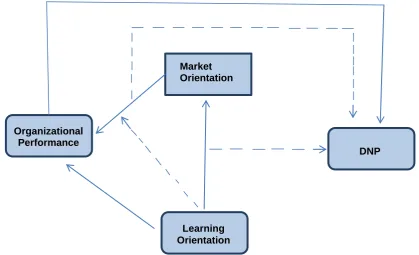
P1: The more powerful the learning orientation is, the greater the organizational performance will be which will then encourage the development of new products.
On the basis of the writings of Slater and Narver (1995), the lining up of market orientation with the other orientations will develop complex and tacit skills that will trigger a potential and creative human who will generate new ideas in the creation of new products and services. This alignment of organizational orientations is also illustrated by Powell, 1992.
One must fittingly stress that an intense learning orientation can positively influence moderating market orientation (Slater; Narver, 1995). In a pioneer work written by Sinkula (1994), he addresses how market orientation produces beneficial results for the organization in the aspect of organizational learning orientation. Interpreting Sinkula (1994), it is possible to allege that these cited benefits are obtained as a influence on the role exercised by the pillar of learning orientation.
According to Webster (1994), the culture of organizational learning is very important for market orientation. With the concept of organizational learning implanted, a business can learn more about its customers and calmly adapt to the necessary changes to be made.
A relationship between learning orientation and market orientation positively interferes in the creation of new products and finally yields to superior organizational performance. It is possible to accomplish an increased level of market orientation and organizational learning simply by diffusing the information about the market together with a learning pact finalizing with more efficiency these learning pillars (Mores, 2013).
Baker and Sinkula (1999) created another reaffirming model that the success of a new product is mediated by market orientation in connection with organizational performance.
Based on statements made in literary research the following proposition can be elaborated:
P2: The relationship betwixt learning orientation and market orientation influence the development of new products.
Amidst the reflections about theories presented, Voss and Voss (2000) corroborate that if an enterprise is oriented for the market, it will possess greater synergy with the clients, therefore generating consumer satisfaction and consequently the betterment of the company’s performance.
From another approach Homburg and Pflesser (2000) find strong bonds amid organizational performance and market orientation. They considered that organizational performance be defined as an efficiency of marketing that utilizes as an indicator the satisfaction and retention of costumers all the while obtaining participation in the market.
performance. Various practical studies were published which were conducted in various different circumstances having the objective to confirm this relationship by way of experimentation.
Normally studies that connect market orientation and organizational development indicate that the association is not directly related; but via a moderator, that can accentuate or diminish the intensity of the educational pillar, it is expressed in the business as a function of its own characteristics in all its departments. The link between the market orientation and organizational performance pillars is contrary to risks. In affirmation to Mores (2013), comments by other authors declare that market orientation has the possibility to sensitively increase the performance of a company although learning orientation acts in a negative way at the level of innovation in these firms but in a positive and largely significant manner in market orientation. This logic then conducts a consideration for the following proposition:
P3: The relation between market orientation and organizational performance is moderated by the learning orientation in the development of new products.
The diagram below synthesizes the proposals previously described:
Figure 1 - Scheme of Propositions
4. FINAL CONSIDERATIONS
Henceforth, with these theoretic discoveries, it is observed that there is not a plain relational connection between the pillars of learning orientation, market orientation and organizational performance. This can be caused by the diversity of approaches found in the bibliography or maybe even by the lack of aids that strengthen definite conclusions.
During the research, ideas were found that go against the ideas described in this very essay. Adverse assertions were given. It is important to stress that pertinent approaches by respected authors from the academy like Sinkula (1994) along with Slater and Narver (1995), validate the initial considerations presented. According to observational results, Baker and Sinkula (1999) defend the point of view that learning orientation weakens the positive impact of market orientation; consequently influencing the success of the new product. Slater and Narver (1995) corroborate a critical evaluation that involves learning, guaranteeing an opportune orientation and qualified information stimulated by proactive behavior. Market orientation without effective learning orientation can result in inefficient experimentation for the making of new products.
According to Baker and Sinkula (2005), learning orientation weakens the positive impact of market orientation and in the end, negatively reflects on the result of the new product. With this logic, it is concluded that a company turns either to the client or the market, abandoning the creation of new products and directs its efforts solely attempting to meet the desires of the consumer.
It is important to mention that after much study even in an experimental way, a conclusion was drawn that market orientation is not sufficient to obtain optimal organizational performance defended Sinkula (1994); but also Slater and Narver (1995) further denoted that market orientation only improved performance if it is
DNP Organizational
Performance
Learning Orientation
combined with learning orientation. However, recognizing that differences betwixt writers exist, theoretical research was verified and diverse arguments confirm the propositions elaborated.
Referring to the analysis of this essay, it is adequate to propose that further empirical research must be done. Investigations must be performed where the hypotheses can be put to the test within the company; therefore aiding in the validation and confirmation of the ideology thus elaborated and furthermore contributing to the justifying importance of the investigative fulfilment in this field of study.
REFERENCES
ABBAD,G. Um Modelo Integrado de Avaliação do Impacto do Treinamento no Trabalho. IMPACT, Tese de Doutorado, instituto de Psicologia, UNB, 1999.
ABBADE, E,B. O Efeito da Orientação para a Aprendizagem no desempenho Organizacional das Empresas da Região Central do Rio Grande do Sul, REGE , v.19, N.2, p.241-262, 2012.
ANTONI,V,L. A Relação entre a Orientação para o Mercado e Performance Organizacional: um estudo nos Cursos de Bacharelado em Administração na Região Sul do Brasil- Tese de Doutorado. UFSC.2004.
ATUAHENE, G.; KWAKU. An Exploratory Analysis of the Impact of Market Orientation on New Product Performance: A Contingency Approach. Journal of Product Innovation Mannagement. 12275-293, 1995.
ATUAHENE, G, KWAKU Market Orientation and Innovation. Journal of Business Research, 35 2 – 93-103, 1996.
BAKER, W.E.; SINKULA,J. M. Learning Orientation, Market Orientation, and Innovation: Integrating and Extending Models of Organizational Performance. Journal of Market Focused Management 4:295-308, 1999.
BAKER, W.E.; SINKULA,J. M. Market Orientation and New Product Paradox. Journal of Product and Innovation Management 22- 483-502, 2005.
BARNEY, J. B. Is the Resource-Based View a Useful Perspective for Strategic Management Research? Yes. Academy of Management Review 26: 41-56, 1991.
BELOHLAV,J. A. The Evolving Competitive Paradigm. Business Horizons. March-April:11-19, 1996.
BETTIS,R. A; PRAHALAD, C.K. The Dominant Logic: Retrospective and Extension. Strategic Management Journal, v.16, n1, p. 5-14, 1995.
CALANTONE, R.J.;CAVUSGIL S.T.;ZHAO Y. Learning Orinetation, Firm Innovation Capability, and Firm Performance.Industrial Marketing Management.v31, n6, p515-524, 2002.
CALANTONE,R. J.; HARMANCIOGLU,N.; DROGE, C. Inconclusive Innovation Returns. A Meta Analysis of Research on Innovation in New Product Development.Product Development & Management Association. J Prod Manag, 27:1065-108, 2010.
CHRISTENSEN,C. M.;BOWER, J. L. Customer Power, Strategic Investiment and the Failure of leading Firms.Strategic Management Journal.17:197-218, 1996.
CILLO,P.;MAZURSKY,D.;TROILO, G. Retrospective and Forward-looking Market Orientation Among Innovative Companies: Some Empirical Evidence from the Fashion Industry. In 31st EMAC Conference, Braga, Proceendings,Braga:EMAC,2002.
CONANT,J. S. M. P.; MOKWA, P. R. Varadarajan.Strategic Types Distintive Marketing Competencies and Organizational Performance: A Multiple Measures Based Study. Strategic Management J.11.365-383, 1990.
DAMANPOUR,F. Organizational Innovation: a Meta Analysis off the Effects of Determinats and Moderators. Acad Manage. Rev. J 34: 555-90,1991.
DANNEELS, E. Organizational Antecedents os Second-order Competences.Strategic Management Journal. 29:519-43, 2008.
DAY, G. S. The Capabilities of Market- Driven Organizations.Journalof Marketing.58: 37-52, 1994.
FERNANDES, B,H;FLEURY,M,T;MILLS,J. Construindo o Diálogo entre Competências, Recursos e Desempenho Organizacional. ERA;SP. V.46; n.4;p.48-65;2006.
FOXALL,G. R. Corporate Innovation: Marketing and Strategy. Croom Helm, Beckenham,Kent UK, 1984. GARVIN, D. A. Building a Learning Organization. Harvard Business Review, v.71n.4 p.78-91-1993.
GATIGNON, H.; XUEREB, J. M. Strategic Orientation of the Firm and New Productperformance. Journal of Marketing Research. 34: 77-90, 1997.
HAMEL, G. PRAHALAD, C. K. Competing for the Future. Boston:HBS, 1994.
HAMEL, G. PRAHALAD, C. K. Competing for the Future. Cambridge,Massachusetts: Harvard Business Scholl Press, 1995.
HOFFMAN,N. P. An Examination of the Sustainable Competitive Advantage Concept: Past, Present and Future. Academy of Marketing Science Review.1-16. 2000.
HOMBURG,C.;PFLESSER, C. A Multiple Layer Model of Market OrientedOrganizational Culture: Measurement Issues and Performance Outcomes.Journal of Marketing Research.37, 449-462, 2000.
examination. J Mark, 62: 42-54, 1998.
JAWORSKI,B. J. KHOLI,A. K. SAHAY, A. Market Orientation and Consequences.Journal of Marketing. 57:53-70, 1993. JAWORSKI,B. J.; KHOLI,A. K.; SAHAY, A. Market Driven versus Driven Markets.Journal of the Academy of Marketing
Science.28: 45-54, 2000.
KATILA,R.; ARUJA,G. Something Old Something New: A Longitudinal Study of Search Behavior and New Product Introduction. Academy of Management Journal. 45 (6): 1183-194, 2002.
KOHLI,A. K.; JAWORSKI, B. J. Market Orientation: The Construct, Research Propositions and Managerial Implications.
Journal of Marketing. 54:1-18, 1990.
LANGERAK,F. An Apparisal of the Predictive Power of Market Orientation.European Management Journal. v.21.P477-464, 2003.
LEOPOLDINO, C,B; LOIOLA,E. Desempenho Organizacional e aprendizagem Organizacional: O que podemos Aprender sobre esta Relação? ENAMPAD, 34, Rio de Janeiro, 2010.
LUKAS,B. A.;HULT,G. T. M.; FERREL, O. C.A Theoretical Perspective of the Antecedents and Consequences of Organizational Learning in Marketing Channels.J Bus Res.36, 233-44,1996.
MARTIN,J. Ignore your Costomers.Fortune. v. 1, 87-90,1995.
LEVINTAL,D. A.;MARCH,J.G.The Myopia of Learning.Strategic Management Journal. 14: 95-112, 1993.
MAHONEY,J.T. The Management of Resources and the Resource of Management.Journal of Business Research. 33:91-101, 1995.
MOORMAN,C.; MINER,A. S.; Organizational Improvisation and Organizational Memory.AcadManageRev;23 (4):698-723,1998.
MORES,G,V;ABBADE,E,B;ANTONI,V,L.Orientações Estratégicas e desempenho: Evidências do Setor Varejista de Ópticas. Revista de Administração e Inovação. v.10, n.3 p.65-88,2013.
NARVER, J.C.; SLATER,S. F. The Effect of a Market Orientation on Business Performance, Journal ofMarketing. 54: 20-35, 1990.
NARVER, J.C.; SLATER, S. F.;MACLACHLAN, D. Total Market Orientation, Business Performance and Innovation.Marketing Science Institute Working Paper Series, 00 -116, 2000.
NARVER, J.C.; SLATER,S. F.;MACLACHLAN, D. Responsive and Proactive Market Orientation and New Product Success.Journal of Product and Innovation Management. 21:5 : 334- 37, 2004.
OLLEROS,F. J. Emerging Industries and Burnout Pioneers. J. Product Innovation Management. 12. 531-544, 1986.
PERIN, M, G; SAMPAIO,C,H;FALEIRO, S, N. O Impacto da orientação para o Mercado e da orientação para a Aprendizagem sobre a Inovação de Produto:uma Comparação entre a Indústria Eletroeletrônica e o Setor de Ensino Universitário de Administração. RAC, v.8, n.1, p.70-103, 2004.
POWEL,T. Organizational Aligment as Competitive Advantage.Strategic Management.J, 7.485-501, 1992.
RHEE,J. PARK, T. LEE, D, Hyung. Drivers of Innovativeness and Performance for Innovative SMEs in South Korea: Mediation of Learning Orientation. Technovation, v. 30, n.1, p. 65-75, 2009.
SENGE,P. A Quinta Disciplina, 4ª ed, São Paulo, Best Seller,1999.
SINKULA,J.M. Market Formation Processing and Organizational Learning. Journal of Marketing.v 58,n1, p. 35-45,1994. SINKULA,J. M.; BAKER,W. E.; NOORDEWIER,T. A. Framework for Market-based Organizational Learning: Linking Values,
Knowledge and Behavior .J Acad Mark Sci. 25: 305-18, 1997.
SLATER , S. F.; NARVER, J. C. Market Orientation and the Learning Organization. Journal of Marketing. 59: 63-74, 1995. SALTER,S,F;MOHR,J,J;SENGUPTA,S. Radical Product Innovation Capability: Literature Review, Synthesis, and Illustrative
Research Propositions. 31(3):552-566, 2014.
SLOCUM,J. W.; MCGILL,M.; TEI,D. T. The New Learning Strategy: Anytime, Anything, Anywhere. Organizational Dynamics. 22:33-47, 1993.
SMITH,K. G.;COLLINS, C. J.; CLARK.K. Existing Knowledge, Knowledge Creation Capability, and the Rate of New Product Introduction in High-tecnology Firms. Academy of Management Journal. 48 (2):346-57, 2005.
SONNENTAG,S;FRESE,M. Performance Concepts and Performance Theory. Psycological Management of Individual Performance.Chichester; UK John Wiley e Sens, p 03-25,2002.
TONDOLO, V. A. G.; BITENCOURT, C. C. Compreendendo as capacidades dinâmicas a partir de seus antecedentes, processos e resultados. Brazilian Business Review, v. 11, n. 5, p. 124-147, 2014.
VOSS,G.; VOSS,Z. Strategic Orientation and Firm Performance in Artistic Enviroment.Journal of Marketing. New York, v64, n1,p. 67-83, 2000.