Original Research Article
A study on assessment of depression and factors associated with it
among medical students of Raichur Institute of
Medical Sciences, Raichur
Rahul C. Kirte, M. A. Fahim*
INTRODUCTION
Depression is a state of low mood and aversion to activity that can affect a person's thoughts, behavior, feelings and sense of well-being.1 Depression is highly common and according to WHO by 2020, it would be the second-most prevalent condition worldwide.2 In 2017 WHO selected
theme ofWorld Health Day as “Depression, Let’s Talk”.
Training in Medical Colleges is intended to prepare
graduates for a personally rewarding, career promoting and socially meaningful health care provider. During medical training students are subjected to different kinds of stressors such as burden of vast academic pressure with an obligation to succeed, an uncertain future, difficulties of integrating into the system along with emotional, social, physical and family problems. These stressors often exert an inadvertent negative effect with catastrophic consequences on students’ academic
ABSTRACT
Background: Depression among medical students represents a neglected public health problem in India. Early onset
depression among medical students interferes with psychological, social, and academic functioning. Clearly, depression in medical students is of paramount importance and warrants serious study to detect early symptoms of depression.This study was conducted to find out the prevalence and the risk factors associated with depression among medical students of RIMS, Raichur.
Methods: Cross-sectional study conducted among medical students from 1st year to final year of RIMS, Raichur who
gave consent. Socio-demographic and risk factors details were collected using pre-tested, semi-structured questionnaire and beck depression inventory scale was used to assess the depression level. Data was analyzed using Epi-Info 7 software and appropriate statistical tests were applied. Level of significance was set at a p<0.05.
Results: Of the 421 medical students participated in the study, 214 (50.83%) were males and 207 (49.17%) were females. The overall prevalence of depression was found to be 22.09%. Statistically significant association of depression was found with family history (χ2
=4.23, p<0.05), family problems (χ2=61.98, p<0.001), relation with parents (χ2
=51.82, p<0.001), high expectations from parents (χ2=22.76, p<0.001), those who regret joining MBBS (χ2
=30.44, p<0.001), relationship status (χ2=4.63, p<0.05).
Conclusions: Our findings emphasize the importance of screening for depression of medical students on a regular basis for early detection and appropriate intervention like group counseling, stress management training, support services etc. to protect this valuable future human resource.
Keywords: Depression, Medical students, MBBS, RIMS, Raichur, Medical college
Department ofCommunity Medicine, Raichur Institute of Medical Sciences, Raichur, Karnataka, India
Received: 08 February 2018
Accepted: 06 March 2018
*Correspondence:
Dr. M. A. Fahim,
E-mail: [email protected]
Copyright: © the author(s), publisher and licensee Medip Academy. This is an open-access article distributed under
the terms of the Creative Commons Attribution Non-Commercial License, which permits unrestricted non-commercial use, distribution, and reproduction in any medium, provided the original work is properly cited.
performances, physical health and psychological well being with a high frequency of depression, anxiety, stress and even attrition from medical course. Psychological distress among students’ also reduces their self-esteem, quality of life and the quality of care they provide to patients with decreased empathy. They may engage in potentially harmful methods of coping strategy from stress such as tobacco, alcohol and other substance abuse. Medical students have a higher risk of suicidal ideation and suicide than age matched peers and general population.3-10 Studies have shown that gender, age, year of study, residence, birth order, parents education and occupation, socio-economic status, family history of depression, type of family, Broken family, problems in the family, relation with parents and friends, relationship status, lack of entertainment in the institution, physical exercise, place of staying during training and presence of any chronic disease have role in development of depression among Medical students.5,8,11-18 India has one of the largest numbers of medical colleges and medical students, it is very important to detect early symptoms of depression with appropriate intervention so that ill effects of depression could not hamper one’s education and career, thereby protecting valuable future human resource.
Few studies have been conducted at a global level to assess the prevalence of depression among medical students. All these studies have been conducted in western countries as well as in other parts of the world. In India, epidemiological studies on depression among medical students are scanty. Hence this study was conducted to find out the prevalence and the risk factors associated with depression among medical students of Raichur Institute of Medical Sciences, Raichur.
METHODS
Study design:Cross-sectional study
Study period:December 2017 to January 2018
Study setting: Raichur Institute of Medical Sciences, Raichur.
Study sample
All medical students (MBBS) students from 1st year to final year of Raichur Institute of Medical Sciences, Raichur.
Inclusion criteria
Inclusion criteria were medical students of Raichur Institute of Medical Sciences, Raichur.
Exclusion criteria
Exclusion criteria were students who didn’t give consent for the study.
Method of collection of data
Socio-demographic details were collected and beck depression inventory scale[19] was used to assess the depression level after taking verbal consent from students. Data was collected using online survey form after explaining them about the study and each question. Privacy of the participants was maintained throughout the study and we have taken care that participant’s identity is not disclosed at any point during the study.
Statistical analysis
Data was entered using Microsoft Excel 2007 and was analyzed using Epi-Info 7 software and appropriate statistical tests were applied. Level of significance was kept at a p<0.05.
RESULTS
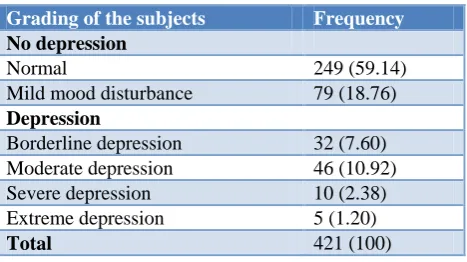
Of the 421 medical students participated in the study, 214 (50.8%) were males and 207 (49.2%) were females. Mean age of students was 20.3±4.2 years. The overall prevalence of depression was found to be 22.1%. Among those with depression, a majority (18.3%) had mild and moderate degree of depression. The prevalence of severe and extreme depression was 2.37% and 1.18%, respectively (Table 1).
Table 1: Grading of depression among study subjects.
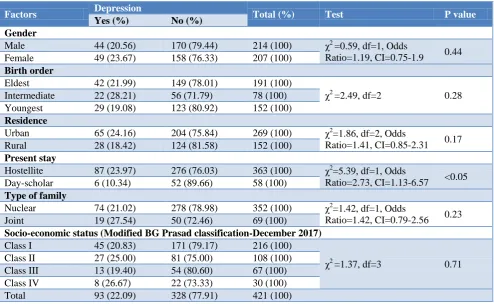
The present study showed that prevalence of depression was 23.67% among females and 20.56% among males; but the depression between depression and sex was not statistically significant (χ2
=0.59, df=1, p=0.32).
Prevalence of depression was 2.73 times more among students staying in hostel as compared to day-scholars and it was statistically significant (χ2
=5.39, df=1, CI=1.13-6.57). There was no statistically significant association between other socio-demographic factors like birth order, residence, type of family and socio-economic status (Table 2).
The prevalence of depression was found 2.16 times more in students with family history of depression and it was found to be statistically significant (χ2
=4.23, df=1, Odds, p<0.05). Problems in families had highly significant association with prevalence of depression (χ2
=61.98,
Grading of the subjects Frequency
No depression
Normal 249 (59.14)
Mild mood disturbance 79 (18.76)
Depression
Borderline depression 32 (7.60)
Moderate depression 46 (10.92)
Severe depression 10 (2.38)
Extreme depression 5 (1.20)
df=1, p<0.001, Odds Ratio=6.82, CI=4.08-11.39), similarly with relationship with parents (χ2
=51.82, df=, p<0.001). We also found highly significant association
with the other factors like students relationship status (having girlfriend/boyfriend), regretting joining MBBS and high expectations from parents (Table 3).
Table 2: Relationship of depression with socio-demographic factors.
Factors Depression Total (%) Test P value
Yes (%) No (%)
Gender
Male 44 (20.56) 170 (79.44) 214 (100) χ2 =0.59, df=1, Odds
Ratio=1.19, CI=0.75-1.9 0.44
Female 49 (23.67) 158 (76.33) 207 (100)
Birth order
Eldest 42 (21.99) 149 (78.01) 191 (100)
χ2
=2.49, df=2 0.28
Intermediate 22 (28.21) 56 (71.79) 78 (100)
Youngest 29 (19.08) 123 (80.92) 152 (100)
Residence
Urban 65 (24.16) 204 (75.84) 269 (100) χ2
=1.86, df=2, Odds
Ratio=1.41, CI=0.85-2.31 0.17
Rural 28 (18.42) 124 (81.58) 152 (100)
Present stay
Hostellite 87 (23.97) 276 (76.03) 363 (100) χ2
=5.39, df=1, Odds
Ratio=2.73, CI=1.13-6.57 <0.05
Day-scholar 6 (10.34) 52 (89.66) 58 (100)
Type of family
Nuclear 74 (21.02) 278 (78.98) 352 (100) χ2=1.42, df=1, Odds
Ratio=1.42, CI=0.79-2.56 0.23
Joint 19 (27.54) 50 (72.46) 69 (100)
Socio-economic status (Modified BG Prasad classification-December 2017)
Class I 45 (20.83) 171 (79.17) 216 (100)
χ2
=1.37, df=3 0.71
Class II 27 (25.00) 81 (75.00) 108 (100)
Class III 13 (19.40) 54 (80.60) 67 (100)
Class IV 8 (26.67) 22 (73.33) 30 (100)
Total 93 (22.09) 328 (77.91) 421 (100)
Table 3: Relationship of depression with other factors.
Factors Depression Total (%) Test P value
Yes (%) No (%)
Family history
Yes 12 (36.36) 21 (63.64) 33 (100) χ2 =4.23, df=1, Odds
Ratio=2.16, CI=1.12-4.58 <0.05
No 81 (20.88) 307 (79.12) 388 (100)
Relationship with parents
Friendly 33 (15.07) 186 (84.93) 219 (100)
χ2
=51.82, df=2 <0.001
Neutral 39 (22.41 135 (77.59) 174 (100)
Fear 21 (75.00) 7 (25.00) 28 (100)
Problems in family
Yes 49 (51.58) 46 (48.42) 95 (100) χ2 =61.98, df=1, Odds
Ratio=6.82, CI=4.08-11.39
<0.001
No 44 (13.50) 282 (86.50) 326 (100)
In relationship (having girlfriend/boyfriend)
Yes 20 (32.79) 41 (67.21) 61 (100) χ2 =4.63, df=1, Odds
Ratio=1.92, CI=1.25-3.44 <0.05
No 73 (20.39) 285 (79.61) 358 (100)
Phase of study
1st 32 (23.36) 105 (76.64) 137 (100)
χ2
=4.21, df=3 0.238
2nd 31 (24.60) 95 (75.40) 126 (100)
3rd 21 (23.86) 67 (76.14) 88 (100)
Final 9 (12.86) 61 (87.14) 70 (100)
Type of batch
Regular 85 (21.41) 312 (78.59) 397 (100) χ2 =1.86, df=1, Odds
Ratio=1.83, CI=0.75-4.43 0.17
Repeater 8 (33.33) 16 (66.67) 24 (100)
Factors Depression Total (%) Test P value
Yes (%) No (%)
Regret joining MBBS
Yes 29 (50.00) 29 (50.00) 58 (100) χ2
=30.44, df=1, Odds
Ratio=4.67, CI=2.61-8.35 <0.001
No 64 (17.63) 299 (82.37) 363 (100)
High expectations from parents
Yes 85 (28.15) 217 (71.85) 302 (100) χ2 =22.76, df=1, Odds
Ratio=5.43, CI=2.54-11.62
<0.001
No 8 (6.72) 111 (93.28) 119 (100)
Total 93 (22.09) 328 (77.91) 421 (100)
DISCUSSION
Consistent with the economic changes in the country, medical student population is increasing every year. In this competitive era, this has enhanced the risk of developing various mental disorders like depression. This study presents the report of 421 undergraduate medical students of a Medical College in Raichur, Karnataka, India where this type of study was never done in the past. We have used the reliable and valid depression screening tool, BDI scale. The overall depression reported by our respondents was 22.1%, of which a majority (18.3%) had mild and moderate degree of depression. The prevalence of severe and extreme depression was 2.37% and 1.18%, respectively Using same BDI scale, findings of the study done by Singh et al (49.1%) in a Medical College in Northern India and another study in India by Kumar et al (71.25%) in Mangalore, Karnataka found higher proportion of depressive symptoms among medical undergraduates.8,11 Other studies in different parts of the world also showed wide range of variation of depression among medical trainees, from 2.2% upto 85% of the students.20-28 Reasons are different geographical regions, different sample sizes with varied demographic characteristics, scales used to assess depression and cutoffs used were also different and different medical curricula in these countries.In our study we found that prevalence of depression was more (75%) among respondents who don’t have cordial relations with their parents and fear them and also it was 5.43 times more among students whose parents have high expectations from their son/daughter. This emphasizes that during medical training, medical educators should also pay attention to develop some strategies for reduction of stress of their students and parents should also be careful that they do not pressurize their sons and daughters for their high expectations. These results are in consistent with study done by Sarkar et al in Kolkata.29 We found statistically significant association between prevalence of depression and family history of depression which is similar to result of a study in a medical college of Mangalore, Karnataka by Kumar et al.11 Prevalence of depression was 6.82 times higher among participants with family problems and this association was found to be highly significant, which is similar to results from Kumar et al.11
CONCLUSION
This study gives an idea of magnitude of depression among medical students and some of its associated factors, which can be evaluated by further studies in depth by qualitative and quantitative methods. Since it is a cross-sectional study, it is hard to assess direction of influence and it precludes us from making causal inferences from our study findings. However, the sufficient sample size and using a valid scale to classify depressive symptoms of the students increases the validity of the study. Depression is highly prevalent among medical students and our findings point to the importance of screening of this vulnerable population and taking appropriate interventional measures to prevent the complications of depression. An effective system for the prediction of the development of depression in medical students needs to be developed and interventions aimed at reducing the incidence of depression needs further research. Proper counseling, effective treatment and management should be carried out. By providing a healthy environment and encouraging extracurricular activities we can prevent serious consequences to the future providers of health. A proper assessment before medical school admission can help set up a treatment and counseling plan be for the future doctors. This can also in turn not only affect the young students but also their potential future patients and population in general.
ACKNOWLEDGEMENTS
We are thankful to all the medical students who participated in the study without them this study was not possible.
Funding: No funding sources Conflict of interest: None declared
Ethical approval: The study was approved by the Institutional Ethics Committee of Raichur Institute of Medical Sciences, Raichur
REFERENCES
1. Diagnostic and Statistical Manual of Mental
Available at: nimh.nih.gov. Accessed on 22 December 2017.
2. World Health Organization. Mental and
neurological disorders. Fact sheet No. 265; 2001
3. Dyrbye, Liselotte N, Thomas, Matthew R.,
Shanafelt, Tait D. Systematic Review of
Depression, Anxiety and other Indicators of Psychological Distress Among U.S. and Canadian Medical Students. Acad Med. 2006;81(4):354-73.
4. Sreeramareddy CT, Shankar PR, Binu VS,
Mukhopadhyay C, Ray B, Menezes RG.
Psychological morbidity, sources of stress and coping strategies among undergraduate medical students of Nepal. BMC Med Educ. 2007;7-26.
5. Goebert D, Thompson D, Takeshita J, Bech C,
Bryson P. Kimberly Ephgrave et al. Depressive Symptoms in Medical Students and Residents: A Multischool study. Acad Med. 2009;84(2):236-41.
6. Marjani A, Gharavi AM, Jahanshahi M, Vahidirad
A, Alizadeh F. Stress among medical students of Gorgan (South East of Caspian Sea), Iran. Kathmandu Univ Med J (KUMJ). 2008;6(23):421-5. 7. Jafari N, Loghmani A, Montazeri A. Mental health of Medical Students in Different Levels of Training. Int J Prev Med. 2012;3(Suppl1): S107–12.
8. Singh A, lal A, Shekhar. Prevalence of depression Among Medical Students of a Pvt Medical College: India. Online J Health Allied Sci. 2010;9(4):1-3.
9. Schwenk TL, Davis L, Leslie A. Satt W.
Depression,Stigma and Suicidal Ideation in Medical Students. JAMA. 2010;304(11):1181-90.
10. Quince TA, Wood DF, Parker RA, Benson J.
Prevalence and persistence of depression among undergraduate medical students: a longitudinal study at one U.K Medical School. BMJ Open. 2012;00:e001519.
11. Kumar GS, Jain A, Hegde S. Prevalence of
depression and its associated factors using Beck Depression Inventory among students of a medical college in Karnataka. Indian J Psychiatry. 2012;54(3):223-6.
12. Yadav A, Gupta ID, Gaur KL, Mathur K, Jangid N.
A Point Prevalence assessment of depression by back depression inventory (BDI) scale and its relation with Psycho-wellness as per Modified MINI Scale (MMS). Int Multispecialty J Health. 2015;1(4):12-6.
13. Inam SNB, Saqib A, Alam E. Prevalence of Anxiety
and Depression among Medical Students of Private University, Karachi, Pakistan. J Pak Med Assoc. 2003;53(2).
14. Shabbir MH, Bashir U. Depression Among Medical
Students. J Psychol Clin Psychiatr. 2016;6(5):371.
15. Sreeramareddy CT, Shankar PR, Binu VS,
Mukhopadhyay C, Ray B, Menezes RG.
Psychological morbidity, sources of stress and coping strategies among undergraduate medical students of Nepal. BMC Med Educ. 2007;7:26.
16. Abdulghani HM. stress and depression among
medical students: a cross sectional study at a medical college in saudi Arabia. Pak J Med Sci. 2008;24(1):12-7.
17. Ngasa SN, Sama CB, Dzekem BS, Nforchu KN,
Tindong M, Aroke D, et al. Prevalence and factors associated with depression among medical students in Cameroon: a cross-sectional study. BMC Psychiatr. 2017;17:1382-3.
18. Gore F M, Bloem P J, Patton G C, Forquson J, Joseph V, Coffey C, et al. Global burden of disease in young people aged 10-24 yrs.: a systematic analyses. Lancet. 2011;377(9783):2093-102.
19. http://www.med.navy.mil/sites/NMCP2/PatientServ
ices/SleepClinicLab/Documents/Beck_Depression_I nventory.pdf. Accessed on 22nd September 2017
20. Clark DC, Zedlow PB. Vicissitude of depressed
mood during four years of medical school. J Am Med Assoc. 1988;260:2521–8.
21. Levine RE, Litwins SD, Frye AW. An Evaluation of
Depressed Mood in Two Classes of Medical Students. Acad Psychiatr. 2006;30:235–7.
22. Chan DW. Depressive symptoms and depressed
mood among Chinese medical students in Hong Kong. Compr Psychiatr. 1991;32:170–80.
23. Zoccolillo M, Murphy GE, Wetzel RD. Depression
among medical students. J Affect Disord.
1986;11:91–6.
24. Birmaher B, Ryan ND, Williamson DE, Brent DA.
Childhood and adolescent depression: A review of the past 10 years, Part I. J Am Acad Child Adolesc Psychiatry. 1996;35:1427–39.
25. Inam SNB, Saqib A, Alam E. Prevalence of anxiety
and depression among medical students of private university. J Pak Med Assoc. 2003;53:44–7.
26. Vaidya PM, Mulgaonker KP. Prevalence of
depression, anxiety and stress in undergraduate medical students and its correlation with their academic performance. Indian J Occup Ther. 2007;39:1–10.
27. Aniebue PN, Onyema GO. Prevalence of depressive
symptoms among Nigerian medical undergraduates. Trop Doct. 2008;38:157–8.
28. Marie D, Joneborg N, Runeson B. Stress and
depression among medical students: A cross sectional study. Med Educ. 2005;39:594–604.
29. Sarkar J, SenGupta P, Manna N, Saren AB,
Chattopadhyay S, Mundle M. Depressive symptoms among undergraduate Medical students: Study from a Medical college in Kolkata, India. IOSR J Dental Med Sci. 2013;4(3):13-8.
Cite this article as: Kirte RC, Fahim MA.A study