ERICON
Authors:
This report is mainly based on the deliberations of the ERICON AURORA BOREALIS Scientific Advisory Panel and Science Support Unit. Special thanks to the participants of the two workshops in Strasbourg (November 2010) and Vienna (April 2011) for their constructive contributions to this document.
Coordinating Lead Author:
• Veronica Willmott, Alfred Wegener Institute for Polar and Marine Research, Germany
Lead Authors:
• Roberto Azzolini, Consiglio Nazionale delle Ricerche, Italy • Angelika Brandt, University
of Hamburg, Germany
• Henk Brinkhuis, Royal NIOZ and Utrecht University, The Netherlands • Angelo Camerlenghi, University
of Barcelona, Spain • Bernard Coakley, University
of Alaska, USA
• Laura De Santis, Istituto nazionale di Oceanografia e Geofisica Sperimentale, Italy
• Yngve Kristoffersen, University of Bergen, Norway
• Lester Lembke-Jene, Alfred Wegener Institute for Polar and Marine Research, Germany • Michele Rebesco, Istituto nazionale
di Oceanografia e Geofisica Sperimentale, Italy
• Jörn Thiede, St. Petersburg State University, Russia
Contributing Authors:
• Ulrich Bathmann, Leibniz Institute for Baltic Sea Research Warnemünde, Germany
• Andrea Bergamasco, Istituto di Scienze Marine, Italy
• Georgy Cherkashov, VNIIOkeangeologia, Russia • Eugene Domack, Hamilton College,
USA
• Olav Eldholm, University of Bergen, Norway
• Carlota Escutia, University of Granada, Spain
• Jan Inge Faleide, University of Oslo, Norway
• Carl Fredrik Forsberg, Norwegian Geotechnical Institute, Norway
• Carmen Gaina, University of Oslo, Norway
• Christian Haas, University of Alberta, Canada
• Susanne Hanson, Danish Meteorological Institute, Denmark • Karen Heywood, University East
Anglia, UK
• Raina Hristova, Institute of Oceanology, Bulgaria
• Michael Ivanov, Moscow State University, Russia †
• Martin Jakobsson, University of Stockholm, Sweden • Johnny Johannessen, Nansen
Environmental and Remote Sensing Center, Norway
• Alexander Klepikov, Arctic and Antarctic Research Institute, Russia • Gert Koenig-Langlo, Alfred Wegener
Institute for Polar and Marine Research, Germany
• Catherine Mével, Centre National de la Recherche Scientifique, France • Naja Mikkelsen, Geological Survey
of Denmark and Greenland, Denmark
• Nicolae Panin, National Research and Development Institute for Marine Geology and Geoecology, Romania
• Stephen Pekar, Queens College, NY, USA
• Matti Perttilä, Finnish Meteorological Institute, Finland
• Daniel Prieur, University of Brest, France
• Søren Rysgaard, Greenland Institute of Natural Resources, Greenland • Rüdiger Stein, Alfred Wegener
Institute for Polar and Marine Research, Germany
• Marino Vacchi, Istituto Centrale per la Ricerca Scientifica e Tecnologica Applicata al Mare, Italy
• Anne de Vernal, University of Québec, Canada
Contributing Authors to the
Technical Requirements (Chapter 6):
• Matti Arpiainen, Aker Arctic Technology Inc., Finland • Peter Blum, Ocean Drilling
Program – U.S. Implementing Organization, USA
• Albrecht Delius, Schiffko GmbH/ Wartsila Ship Design, Germany • Willy Doelling, Schiffko GmbH/ Wartsila Ship Design, Germany • David Haupt, Integrated Ocean
Drilling Program – U.S. Implementing Organization, USA
• Wilfried Jokat, Alfred Wegener Institute for Polar and Marine Research, Germany
• Sönke Neben, BGR - Federal Institute for Geosciences and Natural Resources, Germany † • Mikko Niini, Aker Arctic Technology
Inc., Finland
• Berend Pruin, Technolog GmbH, Germany
• Eberhard Wagner, Alfred Wegener Institute for Polar and Marine Research, Germany
ERICON-AB Project Coordinator:
• Bonnie Wolff-Boenisch, European Science Foundation, France
Acknowledgements:
Sincere thanks to the European Science Foundation (France) and to the Alfred Wegener Institute for Polar and Marine Research (Germany).
Special Acknowledgements to:
• Nicole Biebow, Alfred Wegener Institute for Polar and Marine Research, Germany
• Paul Egerton, European Science Foundation, France
• Rüdiger Gerdes, Alfred Wegener Institute for Polar and Marine Research, Germany
• Anastasiya Kozubovskaya-Pellé, European Science Foundation, France
• Elena Tschertkowa-Paulenz, Alfred Wegener Institute for Polar and Marine Research, Germany • Barbara Weber, European Science
Foundation, France
Building up a new community-driven Science Perspective is always a major endeavour. This is especially so given the ambition to embrace the research and technologi-cal needs of many different research communities for the understanding of climate change processes in the polar regions. It means “taking a bet” on the future by foreseeing multilevel developments spanning diverse research fi elds in a specifi c world region.
Reaching the polar oceans is a major priority for sci-entists, but harsh weather conditions, remoteness, and logistical costs, as well as a lack of adequate tools and technological development, are constraining factors.
This Science Perspective with its key questions is structured around fi ve main research topics in the polar realm (Chapters 1 to 5), and demonstrates the huge scientifi c interest and potential of a joint collaboration and international network around an internationally oper-ated research icebreaker. A vessel such as the AURORA BOREALIS would offer new scientifi c potential exceeding the capabilities of individual nations. The time frame for the Science Perspective from the years 2015 to 2030 was chosen to allow for the planning and construction time of a novel research icebreaker, and the latest devel-opments in polar research. On the international scene neither a technically comparable nor any joint interna-tionally operated vessel is in sight in the medium-term. Meanwhile, the key questions identifi ed by this Science Perspective will start to be addressed by existing less ambitious projects.
The ERICON AB Science Perspective is literally an expression of interest by the respective science com-munities, based on a foresight planning process that describes the high demand for such a novel platform and for research in both polar regions: the Arctic, high on the political agenda, and the Antarctic, which is an equally urgent research priority.
I would like to express my gratitude to all committed scientists from all nations who conveyed their strong interest in pursuing technological developments for the advancement of knowledge in the polar regions, making this Science Perspective not only a strategic plan for the future, but also a white paper to be read by decision makers in research and policy.
My very special thanks to Veronica Willmott for her dedication, persistence and humour, basic requisites for the successful fi nalization of this Science Perspective.
With best regards,
Bonnie Wolff-Boenisch,
2 | Scientific Research in Polar Seas – ERICON, Science Perspective 2015-2030 Polar oceans and connected land areas have a high impact on the global environment, and they can be considered drivers of global climate change. This is par-ticularly true for Europe and the Arctic Ocean because the interplay between the North Atlantic Ocean and the Arctic Ocean results in large anomalies in the cli-matic zones of the Northern Hemisphere. Henceforth, European nations have an eminent interest in under-standing the Arctic region, its properties and natural variability, as well as its interaction with the adjacent temperate ocean basins. Many European nations there-fore support polar research not only in the Arctic but in the Antarctica as well, and indeed many European polar research programs have a bipolar perspective.
The urgent need to form opinions and make deci-sions about the future of the global environment has resulted in large polar research efforts in many nations. At the present time the perspectives of polar research for the coming decades in the Northern and Southern Hemisphere high-latitude regions are being evaluated, defined, and strengthened in many ways.
This Science Perspective under the umbrella of the EU-funded European Research Icebreaker Consortium AURORA BOREALIS (ERICON AB) project (in short, AURORA) is one of these attempts. Advances in sci-ence are often preceded and enabled by advances in technology. In many cases, fundamentally new tools and techniques are needed to enable new missions. The AURORA project is built around the concept of con-structing a research platform that can operate during all seasons of the year in the permanently sea-ice covered areas, and which is equipped with the latest technology, including the equipment to carry out deep-sea drilling in ice-infested waters with dynamic positioning technol-ogy. The project is aiming at a wide range of scientific communities that need a tool like the AURORA to con-duct their research: namely the classical polar marine research disciplines requiring a research platform to conduct their research, and which are in dire need of data from the unfavourable seasons of the year; and the communities using deep-sea drilling techniques to study the properties, composition and history of the deep-sea floors in polar oceans.
The Science Perspective of the ERICON project presents a holistic strategy to provide the basis for an international integrated and interdisciplinary program to develop a more comprehensive understanding of the present and past evolution of the polar regions. The philosophy of this plan is to explicitly acknowledge the importance of carrying out research in the Central Arctic Ocean and Antarctic ice-infested waters
throughout the entire year. Understanding the past
and future changes of the polar regions is essential, as our present knowledge about these changes and
their impacts on humans and natural resources is far smaller than in any other regions of the world. The Science Perspective is not intended to cover in detail all the research that can be carried out in polar regions, but to identify the outstanding scientific questions most relevant for understanding the processes underlying changes currently taking place. Many of these ques-tions can only be identified and addressed through novel technology.
The AURORA concept aims to provide a unique research platform meeting the demands of several mul-tidisciplinary scientific programmes in polar regions. The concept provides a pathway for the development of international cooperation in polar scientific research and operational capabilities. The implementation of a research platform with the AURORA concept will open up long-term perspectives for international programmes, and provide adequate knowledge for sound policy advice to governments on the status of changes to the global environment.
The development of the current Science Perspective started in 2010 with the establishment of the ERICON AB Scientific Advisory Panel (ESAP). The ESAP comprises twenty-nine top-level polar scientists set up by mem-bers of the ERICON AB Stakeholder Council and the European Polar Board in late 2009, distributed into the five main core-themes that form the Science Perspective. A series of plenary meetings brought together the top-level scientists to discuss and select the key questions to be addressed in this volume. The Science Perspective was circulated among the ERICON members up until March 2012 for contributions and comments prior to its completion.
1st ESAP Meeting, 18-19th November 2010, ESF, Strasbourg, France
Authors
Foreword 1
The ERICON Science Perspective Premises
2
Development of this Science Perspective
3
Contents 5
List of Figures
8
List of Acronyms
10
Executive Summary
11
The Role of AURORA in Future Polar Research
15
Chapter 1: The Changing Polar Oceans, Ice and Atmosphere
17
Introduction ...17
KEY QUESTION 1) How does polar climate change affect global climate? How does climate change affect the long-term trends and seasonal variability of sea ice and polar oceanic and atmospheric circulation patterns? ...19
KEY QUESTION 2) Which are the polar oceans sources and sinks of CO2 and other gases? ...22
KEY QUESTION 3) How stable are ice shelves, glaciers and ice caps and what is their influence on sea level rise? How do changes in polar ice reflect real-time climate change? ...23
KEY QUESTION 4) What are the real-time changes in water masses and where do they occur? ...24
BOX 1.1. Polar Amplification of Current Global Climate Change ...26
BOX 1.2. The Meridional Overturning Circulation...27
BOX 1.3. New Minima in Arctic Sea Ice ...28
BOX 1.4. Improving Weather and Sea Ice Forecasts ...29
Research Needs ...29
References ...30
Chapter 2: The Polar Marine Biosphere
33
Introduction ...33KEY QUESTION 1) How did polar marine organisms adapt to past change and what does this tell us about their capacity to adapt to future change? ...36
KEY QUESTION 2) What are the threats to biodiversity and what are the wider implications of biodiversity changes in polar regions? ...37
KEY QUESTION 3) How will changes in the biological systems of the polar regions influence global biogeochemical cycles? ...38
6 | Scientific Research in Polar Seas – ERICON, Science Perspective 2015-2030
BOX 2.2: The Deep-Biosphere: Secrets of a Recently Discovered World ...43
BOX 2.3: Alteration of Ocean Living Resources Distribution ...43
Research Needs ...44
References ...44
Chapter 3: The Polar Ocean’s Geological History
47
Introduction ...47KEY QUESTION 1) How and when were the Arctic Ocean basins formed? ...49
KEY QUESTION 2) How and when did the supercontinent Gondwana break up? ...50
KEY QUESTION 3) What is the history of the polar gateways leading to the current oceanographic boundary conditions? ...52
KEY QUESTION 4) How is the spatial and temporal history of polar region glaciation reflected in the stratigraphic framework of its shelves, slopes and basins? ...54
BOX 3.1. Requirements for Polar Ocean Drilling ...54
BOX 3.2. Ultra-Slow Spreading Ridges and the Deep Biosphere ...56
Research Needs ...57
References ...57
Chapter 4: Polar Palaeoclimate and Marine Palaeo-Environments
61
Introduction ...61KEY QUESTION 1) What is the timing of the inception, variability (growth and collapse) of polar ice sheets and sea ice systems and what are the underlying forcing mechanisms? ...62
KEY QUESTION 2) How did varying palaeo-atmospheric CO2 affect polar regions (on different time scales)? ...64
KEY QUESTION 3) What was the role of the polar oceanic ecosystems, including the deep biosphere, in global carbon cycling, budgets and turnover rates? ...66
KEY QUESTION 4) What was the impact of past polar shallow and deep oceanographic changes for global oceanic circulation? ...66
BOX 4.1. Key Areas for Future Arctic Ocean Drilling ...68
BOX 4.2. Key Areas for Future Antarctic Ocean Drilling ...69
BOX 4.3. Understanding Past Polar Variability as a Basis for modelling Future Global Changes ... 70
Research Needs ...70
References: ...71
Chapter 5: Arctic and Antarctic Sea-Floor Processes and Natural Hazards
73
Introduction ...73KEY QUESTION 1) What is the real extent of subsea permafrost on Arctic continental shelves? ...75
KEY QUESTION 2) How to quantify the role of gas hydrate systems in marine Arctic sediments? ...77
KEY QUESTION 3) Which is the glacial sedimentary model that describes the polar depositional environments, the sedimentary processes involved, and the recurring pattern of sedimentation? ...78
KEY QUESTION 4) Which are the sedimentary systems, within glacial depositional systems, that favour the accretion of unstable continental slopes? ...79
BOX 5.2: Extending the Global Climate Observing System Into Polar Oceans ...82
Research Needs ...83
References ...84
Chapter 6: Scientific-Technical Mission Requirements
for an International Research Icebreaker
87
Introduction ...87Assessment Method ...87
Purpose of Ship ...87
Design Requirements and Operational Envelope ...87
1. Icebreaking ...88
2. Open Water Performance ...88
3. Propulsion and Main Engines ...88
4. Station-Keeping and Dynamic Positioning System ...89
5. Vessel Noise and Acoustic Performance ...89
6. Environmental Requirements and Standards ...89
7. Moon Pool ...90
8. Winches and Crane Capacities for Scientific Use ...90
9. Helicopter and Air Operations ...92
10. Drilling and Geosciences Coring Equipment ...92
11. Ice and Weather Observation Capabilities ...94
12. Permanently Installed Scientific Systems ...95
13. Seismic Survey Capacity ...95
14. Science Mast and Observation Deck Capacity ...96
15. Laboratories and Research Areas ...96
16. Scientific Berthing, Capacity and Endurance ...99
17. Lifetime Cycle ...99
References ...100
Appendix 1: Proposal of Noise Level Requirements
103
Appendix 2: Rules, Regulations, Codes
104
2.1. Applicable Rules & Regulations, National Codes and Regulations ... 1042.2. Classification Society ... 104
2.3. Listing of Other Applicable Rules and Regulations ... 104
Appendix 3: Exemplary Crane Arrangement for Research Support
106
8 | Scientific Research in Polar Seas – ERICON, Science Perspective 2015-2030
Figure 1.1. 18
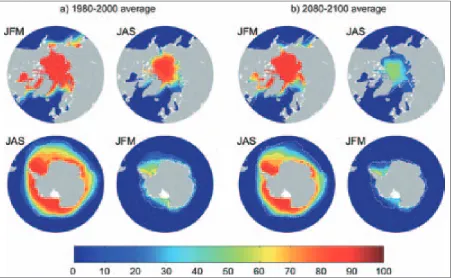
Multi-model mean sea ice concentration (%) for January to March (JFM) and June to
September (JAS), in the Arctic (top) and Antarctic (bottom) for the periods (a) 1980 to 2000 and b) 2080 to 2100 for the SRES A1B scenario.
Figure 1.2. 20
CryoSat’s sea ice thickness map from the Arctic Ocean. Data from January and February 2011, approaching the annual maximum.
Figure 1.3. 20
Oceanic circulation of the North Atlantic and Arctic oceans. The North Atlantic and Arctic Oceans are critical components of the ocean-climate system.
Figure 1.4. 20
Circumpolar map of mean annual sea ice thickness (including ridges).
Figure 1.5. 21
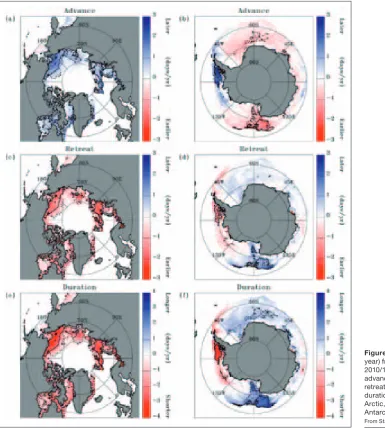
Trends (days/year) from 1979/80 to 2010/11 in (a, b) sea ice advance, (c, d) sea ice retreat, (e, f) ice season duration, for (left) the Arctic, and (right) the Antarctic.
Figure 1.6. 24
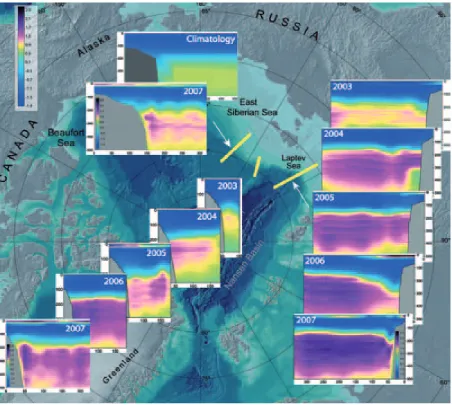
Vertical cross sections of water temperature (°C) from the Laptev Sea slope.
Figure 1.7. 25
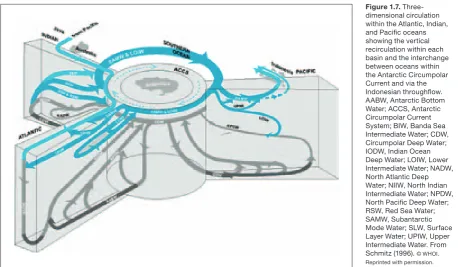
Three-dimensional circulation within the Atlantic, Indian, and Pacific oceans showing the vertical recirculation within each basin and the interchange between oceans within the Antarctic Circumpolar Current and via the Indonesian throughflow.
Figure BOX 1.1. 26
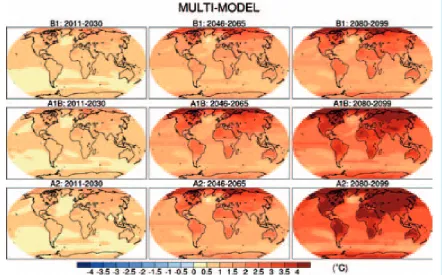
Multi-model mean of annual mean surface warming (surface air temperature change, °C) for the scenarios B1 (top), A1B (middle) and A2 (bottom), and three time periods, 2011 to 2030 (left), 2046 to 2065 (middle) and 2080 to 2099 (right).
Figure BOX 1.2. 27
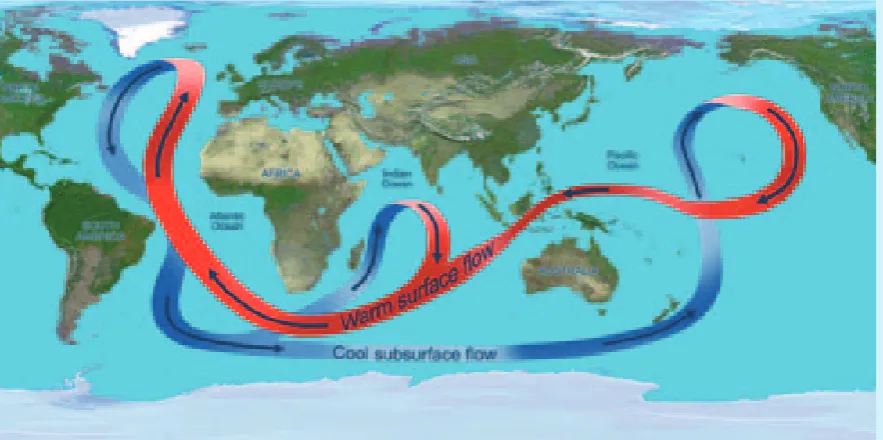
Simplified map of the world’s MOC.
Figure BOX 1.3. 28
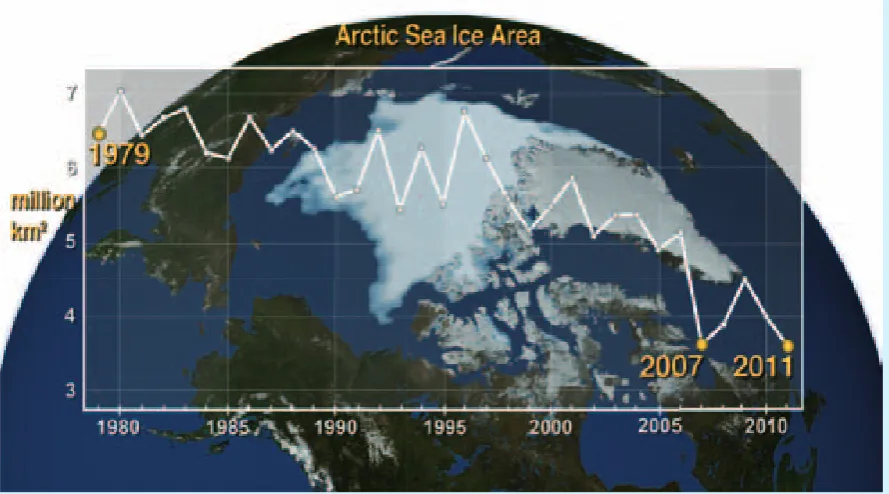
Image of the Arctic sea ice minimum from 2011 overlaid by a graph with the annual Arctic sea ice minimum (in millions of square kilometres) from 1979 to 2011.
Figure 2.1. 34
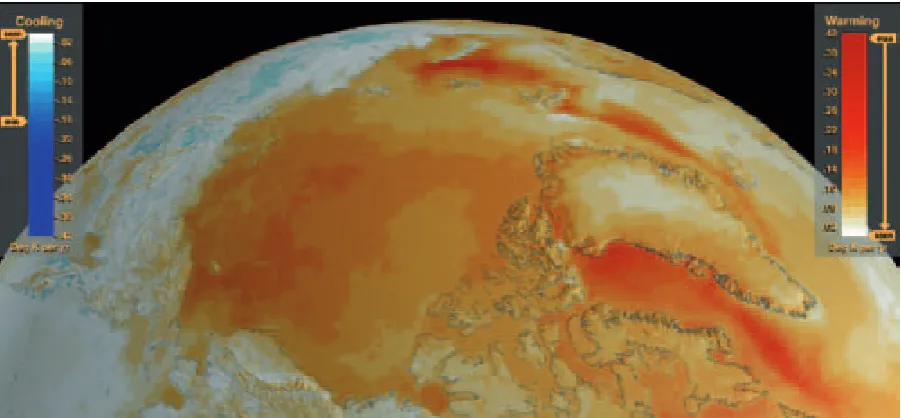
Image depicting the 28-year surface temperature trend over the Arctic region determined from data collected between August 1981 and July 2009.
Figure 2.2. 35
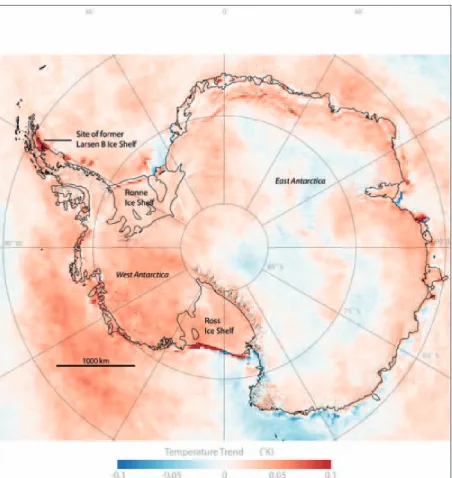
Image illustrating long-term changes in yearly surface temperature in and around Antarctica between 1981 and 2007.
Figure 2.3. 38
Ascidians found at the sea floor of the Larsen A region (East Antarctic Peninsula).
Figure 2.4. 39
Schematic figure representing the high and low latitude CO2 pump.
Figure 2.5. 40
Trends in annual sea ice persistence (left) and total annual net primary production (right) across the Arctic Ocean and its adjacent shelf seas from 1998-2009.
Figure BOX 2.1. 42
Antarctic ice fish.
Figure 3.1. 48
Major structural features of the modern Arctic Ocean.
Figure 3.2. 51
Age of the ocean floor surrounding Antarctica.
Figure BOX 3.1. 55
Tracks of existing seismic reflection data in the Arctic Ocean (from Yngve Kristoffersen, UiB, Norway). White tracks represents ice stations, red lines indicate multi-channel data collected by RV Polarstern, Oden, Healy and Russian vessels.
Figure BOX 3.2. 56
Multichannel reflection seismic reflection data collected by all countries and archived into the Antarctic Seismic Data Library System.
Figure 4.1. 64
a. Synthesis of the ACEX coring results.
b. The age model from 5 to 0 Ma ago.
Figure 4.2. 65
Evolution of atmospheric CO2 levels and global climate over the past 65 Ma and timing of the hyperthermals.
Figure 4.3. 67
Historical trends in carbon dioxide concentrations and temperature, on a geological and recent time scale.
Figure BOX 4.1. 68
Key areas for future drilling in the Arctic Ocean
Figure BOX 4.2. 69
Figure 5.1. 74 A. Major issues of gas hydrates.
B. Potential scenario whereby dissociation of gas hydrates may give rise to subsea slope failure and massive methane gas release.
Figure 5.2. 76
Distribution of permafrost in the Northern Hemisphere.
Figure 5.3. 78
Polar sedimentary processes and controlling factors.
Figure BOX 5.1. 81
Mixing ratio of methane in the air above the water surface measured along a ship’s route in September 2005.
Figure BOX 5.2. 82
Schematic figure of the stack of observations from satellites to seabed that would be necessary to study the present state and future fate of the polar regions.
Figure 6.1. 90
Proposal for exemplary underwater radiated noise requirements for the AURORA research icebreaker (Borealis version) in comparison to other ships.
Figure 6.2. 92
Left, scientist releasing a weather balloon. Right, example of scientific helicopter deployment.
Figure 6.3. 93
Deployment of long CALYPSO-type piston corer from the French R/V Marion Dufresne.
Figure 6.4. 93
Deployment of the remotely operated seafloor drilling rig MEBO.
Figure 6.5. 94
Drilling technology with mobile rigs.
Figure 6.6. 96
Example of twin stern ramps for geophysics deployment.
Figure 6.7. 96
10 | Scientific Research in Polar Seas – ERICON, Science Perspective 2015-2030
AABW,Antarctic Bottom Water;
AARI, Arctic and Antarctic Research Institute, St. Petersburg, Russia
ACC,Antarctic Circumpolar Current
ACCS, Antarctic Circumpolar Current System
ACEX, Arctic Coring EXpedition
ACIA, Arctic Climate Impact Association
AMAP, Arctic Monitoring and Assessment Programme
AMV, Atlantic Multi-decadal Variability
ANDRILL, ANtarctic geological DRILLing project
AO, Arctic Oscillation
ArcOD, Arctic Ocean Diversity project
ARGO, Array for Real-Time Geostrophic Oceanography
ASPeCt, Antarctic Sea-Ice Processes and Climate
program
AUV, Autonomous Underwater Vehicle
AVO, Amplitude Versus Offset
BIW, Banda (Sea) Intermediate Water
BSR, Bottom Simulating Reflector
CAML, Census of Antarctic Marine Life project
CCGS, Canadian Coast Guard Ship
CDW, Circumpolar Deep Water
CoML, Census of Marine Life
CPOM, Centre for Polar Observation and Modelling
(National Centre for Earth Observation; UK)
CPTU, cone penetrometer test
CRP, Cape Roberts Project
DP, Dynamic Positioning
DSDP, Deep-Sea Drilling Project
ERICON AB, European Research Icebreaker
Consortium AURORA BOREALIS
ESA, European Space Agency
ESAP, ERICON AB Scientific Advisory Panel
ESO, European Science Operator
GAW, Global Atmosphere Watch
GCM(s), General Circulation Model(s)
GCOS, Global Climate Observing System
ICDP, International Continental Drilling Program
IODP, Integrated Ocean Drilling Program
IODW, Indian Ocean Deep Water
IOS, International Organization for Standardization
IPCC, Intergovernmental Panel on Climate Change
LIP(s), Large Igneous Province(s)
LLSVP(s), Large Low Shear Wave Velocity province(s)
LOIW, Lower Intermediate Water
Ma, unit of one million years.”M” denotes mega- (106), and “a” denotes years (from the Latin annum)
MOC, Meridional Overturning Circulation
NADW, North Atlantic Deep Water
NAO, North Atlantic Oscillation
NASA, National Aeronautics and Space Administration
NERSC, Nansen Environmental Remote Sensing
Centre, Norway
NIIW, North Indian Intermediate Water
NOAA, National Oceanic and Atmospheric
Administration
NPDW, North Pacific Deep Water
NSIDC, National Snow and Ice Data Center
ODP, Ocean Drilling Program
ROV, Remotely Operated Vehicles
RSW, Red Sea Water
RV, Research Vessel
SAMW, Subantarctic Mode Water
SCAR, Scientific Committee on Antarctic Research
SDLS, Seismic Data Library System
SLW, Surface Layer Water
SST, Sea Surface Temperature
UCL, University College London
UPIW, Upper Intermediate Water
UPS, Uninterruptible Power Supply
Polar sciences are a modern branch of the natural sciences involving large groups of researchers, and sophisticated instrumentation contributing indispensable data for a better understanding of the polar regions and their impact on the global environment. The fact that a lot of the necessary data can only be collected by dedicated research vessels, from permanently manned stations, or during expeditions involving many different disciplines and substantial logistic efforts, has resulted in complex and expensive interdisciplinary experiments. These can only be effectively coordinated within the framework of close international cooperation.
The ERICON Science Perspective addresses the entire polar marine scientific community that requires a research vessel for carrying out their field and sea work throughout all seasons of the year. It also addresses the community that needs a deep-sea drilling facility, which would use the research platform, mainly during the sum-mer months, to study the structure and properties of the oceanic crust and the history of the oceanic depositional environments in polar regions. Deep-sea drilling has only been done once in the ice-infested waters of the cen-tral Arctic during the Integrated Ocean Drilling Program (IODP) 302, aka, ACEX Coring Expedition. Around Antarctica substantial progress has been achieved by using the drilling platforms of the Deep-Sea Drilling Project (DSDP), the Ocean Drilling Program (ODP), and the IODP, during the ice-free seasons, and by using a drill rig from the land fast sea ice very close to shore on the Cape Roberts Project (CRP), and from the ice shelf in the ANtarctic geological DRILLing project (ANDRILL). However, in Antarctica, neither the CRP-tools nor the conventional drilling vessels, which cannot enter ice-infested waters, are able to cover all desirable drilling locations. So far, mainly due to the lack of a suitable ice-capable drilling platform, it has not been possible to investigate many of these locations. These scientific targets will now receive renewed attention in this report (cf. Chapters 3 and 4).
The ERICON scientific program focuses on the research disciplines and activities that require a platform with the unique capability of year-round operations in the central Arctic and Antarctic ice infested waters. This document is organized in six chapters. Chapters 1 to 5
are dedicated to five major Scientific Core Topics, each encompassing a number of high-priority key questions embracing the most important scientific challenges that should be targeted in the next fifteen years. Chapter 6
focuses on the technological requirements needed to successfully answer these scientific questions.
The managerial, financial, and organizational
struc-elaborated on within the EU FP7 funded EUROPEAN ICEBREAKER CONSORTIUM “AURORA BOREALIS” (ERICON-AB) project, of which this Science Perspective is a component.
The five research topics, around which this Science Perspective is structured, provide an umbrella under which technological and scientific research needs and strategies can be identified. The key questions pro-posed in each of the chapters have been intentionally kept general and of a nature that will require a strong effort to fulfil, while allowing shorter-term studies to be undertaken on more specific issues. The research topics targeted in this Science Perspective are:
• The Changing Polar Oceans, Ice and Atmosphere • The Polar Marine Biosphere
• The Polar Ocean’s Geological History
• Polar Paleoclimate and Marine Paleoenvironments • Seafloor Processes and Natural Hazards
A dedicated platform for polar research with drilling capacities will allow scientists of all polar disciplines to address the five research topics by establishing inter-disciplinary campaigns with common goals.
Chapter 1:
The Changing Polar Oceans, Ice
and Atmosphere
Proposes key questions on the interaction of sea ice, ocean and atmosphere in times of climate change: • How does polar climate change affect global climate? How does climate change affect the long-term trends and seasonal variability of sea ice and polar oceanic and atmospheric circulation patterns?
• Which are the polar oceans sources and sinks of CO2 and other gases?
• How stable are shelves, glaciers and ice-caps and what is their influence on sea level rise?
• What are the real-time changes in water masses and where do they occur?
12 | Scientific Research in Polar Seas – ERICON, Science Perspective 2015-2030
system of surface and deep ocean currents encom-passing all basins, which is an important component in poleward energy transfer and climate control. The geological history at the same time provides the basis to evaluate the resource potential of the polar areas and the risk of geological hazards.
Chapter 4:
Polar Paleoclimate and Marine
Paleoenvironments
Approaches the paleoclimatic history of the polar regions through the following questions:
• What is the timing of the inception, variability (growth and collapse) of polar ice sheets and sea ice systems and what are the underlying forcing mechanisms?
• How did varying paleo-atmospheric CO2 affect
polar regions (on different time scales)? • What was the role of the polar
oceanic-ecosystems, including the deep biosphere, in terms of global carbon cycling, budgets and turnover rates?
• What was the impact of past polar shallow- and deep oceanographic changes for global oceanic circulation?
Understanding the dynamics and stability of the polar caps is of special relevance because a temperature rise of 2.9°C to 5.3°C (relative to the 1961-1990 baseline) is expected by the end of this century1. Paleoclimate records play a key role in our understanding of the Earth’s past and on the forecast of future climate changes, by placing the instrumental record in a longer context, espe-cially in times where the atmospheric CO2 concentrations were higher than today.
Chapter 5:
Seafloor Processes and Natural Hazards
Seeks to understand the potentially hazardous geologi-cal and geomorphologigeologi-cal activity of the polar regions’ seafloor when dynamically responding to changes in the cryosphere.• What is the real extent of subsea permafrost on Arctic continental shelves?
• How to quantify the role of gas hydrate systems in marine Arctic sediments?
• Which is the glacial sedimentary model that best describes the polar depositional
1. IPCC, 2007, Fourth Assessment Report (AR4). International Panel on Climate Change, Cambridge, Cambridge University Press.
of their climatic shift, requires an integrated approach, which includes all year round observations, laboratory and field studies, sample recovery and numerical mod-elling.
Chapter 2:
The Polar Marine Biosphere
Addresses key questions on the threats and capac-ity of polar organisms to survive and adapt in times of changes.
• How did polar marine organisms adapt to past change and what does this tell us about the capacity to adapt to future change?
• What are the threats to biodiversity and what are the wider implications of biodiversity changes in polar regions?
• How changes in the biological systems of the polar regions will influence global biogeochemical cycles?
• To what extent, in what direction, and on what time scales will polar organisms and ecosystems change?
Polar marine ecosystems are intimately tied to sea ice extent and seawater temperatures, which together influence food sources, organism growth and repro-duction, and biogeochemical cycles. Climate change will alter marine ecosystems; however, the complexity of the food webs, combined with chronic undersampling, constrains efforts to predict their future and to optimally manage and protect marine resources.
Chapter 3:
The Polar Ocean’s Geological History
Focuses on the geological history of the polar regions, formation of its basins, and opening of gateways. • How and when were the Arctic Ocean Basins
formed?
• How and when did the supercontinent Gondwana break up?
• What is the history of the polar gateways leading to the current oceanographic boundary conditions?
• How is the spatial and temporal history of glaciation of the polar regions reflected in the stratigraphic framework of its shelves, slopes and basins?
environments, the sedimentary processes involved and the recurring pattern of sedimentation?
• Which are the sedimentary systems, within glacial depositional systems, that favour the accretion of unstable continental slopes?
When the lithosphere adapts to new environmental con-ditions driving load-pressure changes (e.g., ice melt, rapid sea-level rise), it adjusts by modulating or triggering a broad range of surface and crustal phenomena, which include volcanic and seismic activity, submarine and subaerial landslides, tsunamis and landslide ‘splash’ waves, glacial outburst and rock-dam failure floods, debris flows and gas-hydrate destabilization.
Chapter 6:
Scientific-Technical Mission Requirements
for an International Research Icebreaker
The key scientific questions outlined in the ERICON Science Perspective calls for a set of technical require-ments that a European Research Icebreaker must fulfil. • Naval Architecture – Design Requirements -Lifetime cycles
• Operational Capacity and Endurance • Research Capabilities
Since the polar regions react more rapidly and intensively to global changes than other regions of the earth, they are currently a subject of intense scientific debate and investigations. News about shrinking of the Arctic sea ice cover, potentially leading to an opening of sea passages to the north of North America and Eurasia, leading to a “blue” Arctic Ocean, as well as about the calving of giant table icebergs from the ice shelves of Antarctica, are examples of these modern dynamics.
Global climate models demonstrate the sensitivity of the polar areas to changes in forcing of the ocean/ climate system. The presence or absence of snow and ice influences global heat distribution through its effect on the albedo, and the polar oceans are the source of dense, cold bottom waters, which influence the Meridional Overturning Circulation. However, most of the processes occurring, today and in the past, in the deep-water source areas are still almost unknown, due to the fact that they lie in areas covered by thick sea ice, or infested by icebergs, and are as a result difficult to reach.
Modern research vessels capable of penetrating into the central Arctic are few. A new state-of-the-art research icebreaker is therefore urgently required to meet the needs of polar research and to document multi-national presence in the Arctic. This new icebreaker would be conceived as an optimized science platform from the keel up, and will allow long, international and interdisciplinary expeditions into the central Arctic Ocean during all seasons of the year.
In spite of the critical role of the central Arctic Ocean in climate evolution, it has been sampled only once, dur-ing the ACEX expedition, in a difficult operation which involved the coordination of three ice-breakers. Its long-term environmental history and tectonic structure is hence poorly known. This lack of data represents one of the largest gaps of information in modern Earth Science, also relevant for the field of hydrocarbon exploration. Therefore, a new research icebreaker such as AURORA should be equipped with technical facilities to acquire long sedimentary sections to fulfil the needs of the IODP for an “Alternate Platform” to drill in deep, permanently ice-covered ocean basins. The drilling equipment will only be used during the summer months and could be removable, potentially to be used and adapted to International Continental Scientific Drilling Program (ICDP) projects. The icebreaker must also be powerful enough to keep station against the drifting sea ice cover and will have to be equipped with dynamic positioning. In the long run, AURORA could also have a major impact on research in the Southern Ocean, which is – in comparison with the central Arctic Ocean – better
inves-must be available during all seasons of the year, and be able to endure particularly bad weather during the Southern Hemisphere fall, winter and spring seasons. Such vessels are presently not available.
Whereas great progress has been achieved over the past years in unraveling the plate tectonic history of the ocean crust under the Southern Ocean, there are major gaps in understanding the paleoceanographic history of the world´s biggest ocean current system, of the seasonal modes and patterns of sea ice formation, of the functionality of Southern Ocean benthic and pelagic ecosystems, and of their biodiversity.
The appearance of an innovative research icebreaker on the Southern Hemisphere scene would mean a revolution in the exploration of a region of the planet Earth, which is indispensable for understanding the mechanisms and causes of modern and future global environmental change. The qualities and research capacities would also result in major steps forward to establish internationally well-coordinated research pro-grams directed towards virtually all aspects of marine polar research in the Southern Ocean.
An efficient use of a new research platform of this kind requires the formation of a consortium of several countries and their polar research institutions to ensure a high quality of science, and efficient employment of the research platform during all seasons of the year. Extensive and well-developed Arctic research programs exist in several countries, particularly in the Scandinavian countries, Russia and Germany. In each individual coun-try, there exist different organizations or working groups, with rather diverse structures and impacts in their home countries. Other European countries, like Spain, Italy and France, have had quite extensive Antarctic programs for several decades. The construction of AURORA as a joint research icebreaker would result in a considerable commitment of the participating nations to co-ordinate and expand their polar research programs, in order to operate this research platform continuously and with the necessary efficiency.
16 | Scientific Research in Polar Seas – ERICON, Science Perspective 2015-2030
Scientists drawing the electromagnetic sensor EM-Bird for ice thickness measurements in a canoe on the sea ice during the 26th Arctic
Introduction
The climate of the polar regions is rapidly shifting, as documented by the unprecedented warming of their atmosphere, oceans and land. Such changes have been paralleled by environmental modifications affecting the marine and terrestrial ecosystems, hydrosphere and cryosphere systems (ACIA, 2005; IPCC, 2007).
Despite the importance of high latitude changes for global climate, there is still a lack of understanding of how the system functions and what are the drivers of such changes (Bekryaev et al., 2010). In particular, there is a limited understanding of, and even controversy about the role of polar amplification in long-term surface air temperature variations and modern Arctic warming.
The instrumental data record shows that observed polar climate change is not symmetric. Except along the Antarctic Peninsula (Vaughan et al., 2003), most of the evidence of significant warming is from the Arctic. In addition, total sea ice extent in the Southern Ocean has shown no significant trend since satellites began record-ing data in 1979. Newer climate models generally also show little or no polar amplification over the Southern Ocean and Antarctica during the past century (IPCC, 2007). Climate models’ projections indicate that Arctic
Numerical simulations forecast continued warming and accelerated decline in sea ice cover. However, there is a wide range in the exact projections of the future of the Arctic’s climate, which in turn introduces significant uncertainties about how the Arctic may potentially shape climate around the globe (Budikova, 2009). Current cli-mate models are limited by their ability to represent processes at scales smaller than the model grid reso-lution (now of the order of 100 km). Parameterizations of subgrid-scale processes should represent not only the present climate state, but also very different climates which may be expected in the future. Thus climate mod-els must be validated through observations from both present and past climatic conditions.
18 | Scientific Research in Polar Seas – ERICON, Science Perspective 2015-2030
Understanding the interactions between the polar oceans, ice and atmosphere, and the consequences of their climatic shift, requires an integrated approach, which includes year-round observations, laboratory and field studies, sample recovery and numerical modelling. The results of this field of research are key compo-nents of the other topics addressed by this Science Perspective, since they provide the basis for under-standing the dynamics of ice, water and atmospheric masses and their synergies with the climatic system and surrounding organisms. The four focus areas targeted in this chapter interlink with the other chapters through a paradigm of forcing, response and variability changes (Table 1.1.).
This core theme targets four focus areas, each of which addresses one or more key questions:
Variability Trends
• How does polar climate change affect global climate? How does climate change affect the long-term trends and seasonal variability of sea ice and polar oceanic and atmospheric circulation patterns?
CO2 Sources and Sinks
• What are the polar oceans sources and sinks of CO2 and other gases?
Stability of Ice Sheets
• How stable are ice shelves, glaciers and ice caps and what is their influence on sea level rise?
Changes in Water Masses
• What are the real-time changes in water masses and where do they occur?
Chapter 1: The Changing Polar Oceans, Ice and Atmosphere
The natural climatic variability of the Arctic and North Atlantic climate system displays large amplitude multi-decadal variability, controlled by the interaction of several oscillatory modes: the Arctic Oscillation (AO), the North Atlantic Oscillation (NAO), and the Atlantic Multidecadal Variability (AMV). Because the AMV has considerable strength and a timescale in the same range as that projected for the anthropogenic signal, the AMV may partially mask the latter. In order to differentiate natural from human-induced climate variability, it is important to understand the genesis and predictability of those variability modes (Ou, 2012). The evidence supports the notion that ocean-ice-air interactions play a key role in shaping Arctic and North Atlantic variability (Polyakov et al., 2005).
Around Antarctica, sea ice has increased by about 1% per decade since the start of the satellite record (Cavalieri and Parkinson, 2008). However, it is still unknown whether this small increase in sea ice extent is a sign of significant change, because ice extents in the Southern Hemisphere vary considerably from year to year and from place to place around the continent. If we consider different Antarctic regions individually, only the Ross Sea sector had a significant positive trend in sea ice extent, whereas in the Bellingshausen and Amundsen seas sector sea ice extent has actu-ally decreased (Cavalieri and Parkinson, 2008). These large scale variations make it difficult to detect a trend
KEY QUESTION 1
How does polar climate change
affect global climate? How does
climate change affect the
long-term trends and seasonal variability
of sea ice and polar oceanic and
atmospheric circulation patterns?
What are the ocean-atmosphere-ice
interactions?
The capacity of Arctic sea ice to influence global cli-mate through atmosphere and oceanic circulation is broadly recognized. But the recent loss of summer sea ice in the Arctic is directly linked to changes in northern wind patterns in the following autumn, producing altera-tions of the heat balance at the cold end of the climate machinery (Liu et al., 2012). With a continued decrease in summer sea ice over the coming decades, scien-tists anticipate, among other impacts, further changes in the atmospheric circulation patterns (Overland and Wang, 2010). The sensitivity of Arctic sea ice to climate warming depends strongly on the thickness of the ice (Wadhams, 2012), but observations of sea ice thick-ness variations are far less robust than those of its areal extent. Nevertheless, the available information shows
Table 1.1. Links and interrelationships between the focus areas of Chapter 1 and the other scientific chapters of this Science Perspective. l Forcing l Response l Variability
Chapter 1: Sea Ice, Ocean, Atmosphere
Chapter 2: Polar Marine Biosphere
Chapter 3:
Polar Palaeoclimate and Marine Palaeo-Environments
Chapter 4: Geological History
Chapter 5: Natural Hazards
Variability Trends l l l l l l l
CO2 Sources and Sinks l l l l l l l
Stability of Ice-Sheets l l l l l l l
Changes in Water Masses l l l l l l For example, changes in variability trends of sea ice, ocean and atmosphere:
– will force changes and produce variability of the polar marine biosphere;
– have responded to changes in palaeoclimate, and at the same time forced changes in palaeoenvironments; – are conditioned by geological history;
20 | Scientific Research in Polar Seas – ERICON, Science Perspective 2015-2030
Figure 1.2. CryoSat’s sea ice thickness map from the Arctic Ocean. Data from January and February 2011, approaching the annual maximum. The European Space Agency (ESA) recently launched the CryoSat-2, a satellite equipped with a sophisticated radar altimeter to acquire accurate measurements of the thickness of floating sea ice. © CPOM/UCL/ESA.
Figure 1.4. Circumpolar map of mean annual sea ice thickness (including ridges). The data set comprises 23,373 observations collected over more than two decades of activity and has been compiled as part of the Scientific Committee on Antarctic Research (SCAR) Antarctic Sea ice Processes and Climate (ASPeCt) programme. From Worby et al. (2008).
The timing of annual sea ice retreat and advance in both polar regions has also changed since the start of the satellite record. In the Arctic region, Antarctic Peninsula and Bellinghausen Sea region sea ice retreat is now consistently more than one month earlier and advance is more than one month later, making the summer ice-free season almost three months longer. In contrast, in the western Ross Sea (Antarctica) sea ice retreat now occurs one month later and advance one month earlier, making the summer ice-free season two months shorter
face enormous complexities: processes at micro scale (like sea-ice formation) have far reaching implications at regional and global scale. Accordingly it is vital to examine the main processes and feedbacks at every scale from an integrated perspective.
Figure 1.5. Trends (days/ year) from 1979/80 to 2010/11 in (a, b) sea ice advance, (c, d) sea ice retreat, (e, f) ice season duration, for (left) the Arctic, and (right) the Antarctic.
22 | Scientific Research in Polar Seas – ERICON, Science Perspective 2015-2030
KEY QUESTION 2
Which are the polar oceans
sources and sinks of CO
2and other gases?
Understanding the processes of carbon dioxide (CO2) exchange between atmosphere, ocean and land is especially important since global marine and terrestrial systems currently absorb about half of the CO2 emitted by fossil-fuel combustion (Sabine et al., 2004). But, even though the monitoring of seasonal and geographical CO2 exchange rates has been increasing in recent years, the ice-covered polar oceans have been largely ignored, not only because of the difficulty of access, but also because a continuous sea ice cover is believed to block the outgassing of CO2 rich waters to the atmosphere very efficiently, and global models do not include CO2 exchange over sea ice (Rysgaard et al., 2011). The relative importance of high and low latitudes for the transport of CO2 by physical processes is not well known, and may be poorly represented in most ocean carbon models (IPCC, 2007).
The ocean carbon cycle is mainly controlled by three pumps: the physical, the biological and the alkalinity or anion pump (Sundquist and Broecker, 1985). The physi-cal pump is driven by physiphysi-cal and chemiphysi-cal processes, which affect the solubility of CO2 and the transport of water from the surface mixed layer to depth. The biologi-cal pump is driven by primary production, consuming dissolved CO2 through photosynthesis, and produc-ing particulate and dissolved organic carbon (POC and DOC). The alkalinity pump concerns the removal of car-bon by calcification in the upper waters, and the release of carbon when calcium carbonate is dissolved at depth (Sundquist and Broecker, 1985). Since the solubility of CO2 increases with decreasing temperature, high latitude oceans are potentially large sinks of atmospheric CO2.
In polar oceans, the formation and melting of sea ice is an important CO2 flux mechanism. As sea ice forms, the brine rejection into the water column causes formation of high saline dense water in the polar and subpolar seas, strengthening and ventilating the deep thermohaline circulation in the world ocean. Besides the physical impact of sea ice on ocean circulation, brine rejection also influences the release of dissolved gases and solutes into the water column (Rysgaard et al., 2011). In the Arctic Ocean, the large decrease in summer sea ice extent has been shown to significantly alter the fluxes of carbon through its impact on the primary productiv-ity of the region (Wang et al., 2005) and the air-CO2 flux (Bates, 2006). At present, even though seasonal sea ice cover reduces the gas exchange between the atmosphere and the ocean, the Arctic Ocean takes up
CO2 in the order of 66 to 199 Tg C year−1, contributing 5–14% to the global balance of CO2 sinks and sources (Bates and Mathis, 2009). Biological amplification of ocean acidification, due to the remineralisation of organic matter transported downwards, will probably reduce the ability of many species to produce CaCO3 shells or tests, which would have profound implications for the Arctic marine ecosystem. However, whether sea ice facilitates the uptake or release of CO2 by the ocean, and the season-dependent processes by which sea ice controls air–sea CO2 exchange, are areas of active research with no definite answer (Bates and Mathis, 2009; Rysgaard et al., 2011).
In the Southern Ocean, recent observations have shown that between 1981 and 2004 the CO2 sink weak-ened by 0.08 Pg C year −1 relative to the trend expected given the large increase in atmospheric CO2 (Le Quéré et al., 2007). As a consequence, the efficiency of the Antarctic CO2 pump is expected to decrease in the com-ing decades.
In order to understand and evaluate the processes and effects of CO2 exchange between sea, ice and atmosphere, it is necessary to produce measurements of air-sea gas exchange processes in polar regions all year round (specially in winter). In addition, in situ atmospheric and marine chemistry measurements are necessary to evaluate the importance of seasonal cycles in sea ice biology and biogeochemistry.
KEY QUESTION 3
How stable are ice shelves, glaciers
and ice caps and what is their
influence on sea level rise? How do
changes in polar ice reflect
real-time climate change?
The Antarctic and Greenland ice sheets carry about 33 million km3 of ice, which is enough water to raise the global sea level by about 70 m (IPCC, 2007). The average annual snowfall on the ice sheets is equiva-lent to 6.5 mm of sea level, and therefore only a small imbalance between snow precipitation and meltwater discharge into the ocean could be a major contributor to present-day sea-level rise, at present ~3 mm/year (Nerem et al., 2006). During times of rapid deglaciation over the past million years, changes in the volume of the ice sheets have resulted in rates of sea-level rise at least one order of magnitude larger than at present. Recent evidence from observational and modelling studies of both Antarctica and Greenland suggests that profound changes in flow and mass balance are possible over time scales of a few years to decades (Bamber et al., 2007). Since the present condition of the ice sheets depends not only on this long-term trend, determined by past climate and dynamic history, but also on more recent changes in climate and ice-sheet dynamics, a detailed knowledge and understanding of the evolution of polar ice sheets is of considerable societal importance (Rignot and Thomas, 2002).
The balance between net accumulation and melting of ice is not the same on the two ice sheets, due to differ-ences in their climatic regimes (for a review see Rignot and Thomas, 2002).
Greenland’s climate is strongly influenced by nearby land masses and the North Atlantic, with the warm Gulf Stream to the south. The average accumulation rate is currently ~30 cm/year, which is twice that for Antarctica. Ice melting occurs during summer over half of the ice-sheet surface, with much of the water flowing into the sea. Ice is lost primarily by surface runoff and iceberg calving, except in the north where basal melting from small ice shelves is important (Rignot and Thomas, 2002).
Antarctica exhibits cold conditions even during the summer, so there is little surface melting, even near the coast, and this exerts a climatic influence not only on the continent but also the surrounding ocean. Massive floating ice shelves exist around much of the continental
Peninsula have been in constant retreat over the past few decades (Skvarca et al., 1999), culminating in the total collapse of the Larsen B ice shelf in March 2002 (Scambos et al., 2003). Estimating the extent to which sea level may rise as a result of changes in the Greenland Ice Sheet and in Antarctica during the current century and beyond is a major source of uncertainty in projec-tions of future sea level rise (IPCC, 2007). While most of the current models suggest that ice loss from Greenland will contribute about 5-10 cm to the rise in global sea level by 2100, recent projections for global sea level rise that include the contributions from thermal expansion of the oceans and the rest of the world’s ice masses are as high as 1m (with an error of ± 0.5m) (AMSA, 2009).
Moving the time horizon much further into the future is very difficult and entails enormous uncertainties. However, the complete melting of the Greenland ice sheet would raise global sea levels by 7 m (IPCC, 2007), which is a devastating prospect for coastal populations around the world. But while most climate change models suggest that complete melting would take some thou-sand years, a threshold for destabilizing change will be approached on a much shorter time frame (AMAP, 2009).
24 | Scientific Research in Polar Seas – ERICON, Science Perspective 2015-2030
KEY QUESTION 4
What are the real-time changes
in water masses and where do they
occur?
What are the changes in dense water
formation and what are their climatic
consequences?
One of the important new findings in oceanography is that the ocean, including its abyss, is warming at a rate
of 0.5°C or more per century (Levitus et al., 2000). The major contributor of heat advection towards the Arctic arises from the northward-flowing Atlantic Water, the intermediate depth (150-200 m) temperature of which has increased in recent decades. The Atlantic Water warming, associated with the Eurasian basin water masses stratification, facilitates an upward spread of Atlantic Water heat through the Arctic which strongly affects the sea ice distribution in extent and thickness (Polyakov et al., 2010). Records of its natural variability have shown that those recent warm water masses enter-ing the Arctic Ocean are unprecedented for the past 2000 years (Spielhagen et al., 2011).
While many factors contribute to the historical obser-vations and palaeoclimatic variability, a number of model studies identify the North Atlantic and its associated deepwater formation as a focal point of decadal and cen-tennial time scale variability (e.g.,Manabe and Stouffer, 1993). These model studies, combined with observa-tions, provide evidence that changes in freshwater influx into the Northern Atlantic Ocean can substantially modify the deep ocean circulation, and in turn, dramatically influ-ence the climate state and drive rapid climate change. The freshwater surplus in the Arctic Ocean due to ice melt, and its influx into the global ocean, needs to be quantified with the aim of evaluating its possible con-sequences (Wadhams, 2012).
The role of the southern source of deepwater, the Antarctic Bottom Water (AABW), in modulating vari-ability, has received very little attention, and this has limited the development of a complete understanding of multi-decadal to millennial time scale climate change. Whether the North Atlantic Deep Water (NADW) is the ultimate driver of the Meridional Overturning Circulation (MOC), and whether substantial additional variability is generated by freshwater impacts in the Southern Ocean, remain unresolved issues (Seidov et al., 2001).
Ice core data from both Greenland and Antarctica
occurred repeatedly in the past (Weaver, 1995; Knorr and Lohmann, 2007). For example, mathematical model-ling suggests that a continuous freshwater source as a result of ice melting could prevent deep-water formation in the North Atlantic and slow down or even totally shut down the MOC (Manabe and Stouffer, 1997). Switching off the ocean’s main global circulation system would have profound effects on global marine life and fisher-ies. Moreover, shutting down deep-water formation in the North Atlantic would eliminate important sinks for greenhouse gases, increasing their level in the atmos-phere and speeding up the rate of climate change. Even though the total shutdown of the MOC is considered a high impact, low probability event (Wood et al., 2006), the increasing perception of the vulnerability of MOC to climate change has stimulated a large amount of scien-tific research over the past few decades.
26 | Scientific Research in Polar Seas – ERICON, Science Perspective 2015-2030
Figure BOX 1.1. Multi-model mean of annual mean surface warming (surface air temperature change, °C) for the scenarios B1 (top), A1B (middle) and A2 (bottom), and three time periods, 2011 to 2030 (left), 2046 to 2065 (middle) and 2080 to 2099 (right). Anomalies are relative to the average of the period 1980 to 1999. © IPCC (2007).
An analysis of observational records shows that global surface air temperatures have increased by 0.6 °C since 1861, with a greater rate of warming in the 20th century (Jones et al., 1999). During that period, the 1990s was the warmest decade in the Northern Hemisphere. The global warming has been associ-ated with an increase in the land-surface precipitation rate, a decrease in snow cover and sea ice extent, sea level rises and changes in atmospheric and oce-anic circulation patterns (IPCC, 2007).
The term “polar amplification” describes the ampli-fied rate of surface warming at the poles compared to the rest of the globe. Near-surface warming in the Arctic has been almost twice as large as the global average over recent decades (Johannessen et al., 2004; ACIA, 2005), a phenomenon that is known as “Arctic amplification”. Although the underlying causes of this temperature amplification are still
un-certain, it is broadly accepted that changes in the surface albedo associated with melting snow and ice enhance warming in the Arctic (e.g., Serreze and Francis, 2006). Other processes such as changes in cloud cover and atmospheric water vapour content, the increase in the atmospheric poleward transport of heat and moisture and changes in Arctic storm behaviour (Graversen et al., 2008) also contribute to enhanced Arctic warming. However, intrinsic Arctic variability obscures long-term changes and limits our ability to identify complex feedbacks in the Arctic climate system (Polyakov et al., 2002). Nevertheless, model projections show that we are probably close to the point where absorption of solar radiation dur-ing summer limits ice growth in the followdur-ing autumn and winter, which will initiate a feedback leading to a substantial increase in Arctic Ocean temperatures (Serreze and Francis, 2006).
Figure BOX 1.2. Simplified map of the world’s MOC. This current system transports vast amounts of heat and salt around the planet via warmer surface currents (red) and colder deep currents (blue). It plays a central role in determining Earth’s climate. © NASA/JPL. It is at the polar regions where the process of
con-vection takes place, as cold and salty water sinks to great depths and is replaced by warmer waters from the upper ocean layers, in a process which moves millions of cubic meters of ocean water. This is the en-gine of the Meridional Overturning Circulation (MOC). The MOC is a global-scale overturning in the ocean that transports significant amounts of heat towards the poles through warm and highly saline water, and at depth returns cold, less saline waters towards the equator (Wüst, 1935). The MOC is sustained by two major deepwater sources, the North Atlantic and the Southern Ocean surrounding Antarctica (primarily the Weddell and Ross seas and the Adelie Land-George V margin). In the North Atlantic, it is between the Greenland-Norwegian and the Labrador seas, where the warm salty water from the North Atlantic is cooled by Arctic waters and by intense heat loss to the at-mosphere, becoming denser and sinking to deeper layers of the ocean. The salt which is rejected as sea ice forms further increases the density, thus contrib-uting to the process. Although this process of sinking water is slow, it takes place over a wide area and each winter several million km3 of water are brought down and begin moving slowly south along the bottom of
the Atlantic Ocean. The dense, cooled water thus formed, called North Atlantic Deep Water (NADW), becomes part of the MOC, eventually returning to the surface in the Southern, Indian and Pacific oceans, coming back to the Atlantic and moving polewards as the Gulf Stream and North Atlantic Drift, which warms north-western Europe substantially (Fanning and Weaver, 1997; Clark et al., 2002). The MOC also has a strong impact on nutrient circulation, and hence on biogeochemical cycles. Since the MOC is driven by both temperature and salinity differences, criti-cal salinity values of the polar regions’ thermohaline structure, as a consequence of ice melt, could have a strong impact both on the deep-water formation and on the global circulation.
Although most of the future scenarios of the MOC in warmer climatic conditions with extensive melt-ing of sea ice forecast a weakened current, there are some models that do not show a significant reduction of its strength under such conditions (Schmittner et al., 2005), indicating either a large uncertainty in the response to forcing or the models’ inability to accu-rately simulate the current climate of the high-latitude North Atlantic, mainly because of the lack of field data, particularly during winter.
28 | Scientifi c Research in Polar Seas – ERICON, Science Perspective 2015-2030
Figure BOX 1.3. Image of the Arctic sea ice minimum from 2011 overlaid by a graph with the annual Arctic sea ice minimum (in millions of square kilometres) from 1979 to 2011. The ‘1979’, ‘2007’, and ‘2011’ data points are highlighted on the graph.
© NASA/Goddard Space Flight Center Scientifi c Visualization Studio. Data from Rob Gerston (GSFC). Sea ice is one of the critical components of the polar
ocean’s marine system that has suffered a substantial change over the past decades. Sea ice is an integral player in the global climate system because it me-diates the exchange of radiation and sensible heat between the atmosphere and the ocean, impacting the climate through the ice-albedo feedback mecha-nism* (Curry et al., 1994). In addition, sea ice plays an important role in the processes of deep water for-mation in polar areas, which is the motor driving the MOC.
The maximum seasonal sea ice extent in high-latitude seas corresponds to about 7% of the Earth’s surface area. Around Antarctica the seasonal sea-ice cover changes by about 80%, whereas the seasonal changes in the Arctic Ocean are less pronounced because a signifi cantly higher fraction of sea ice is multiyear ice (Gloersen and Campbell, 1991), i.e., more than 1 year old.
Since the late 1970s, Arctic sea ice extent has consistently declined, and since the early 1990s the retreat has been accelerating, with only 50% of the sea ice present in 1972 still remaining (1972 was when satellite observations started). A new minima in sea ice extent was reached on 8 of September 2011, with 27,000 million km2, exceeding the previous minima of 2007 by 0.6%, most probably the smallest extent since the last climate optimum about 8,000 years ago (Heygster, 2011).
* Areas of reduced sea ice produce a change in surface albedo that promotes the absorption of more solar energy. When coupled with anthropogenic influences the conditions may be providing persistence to a new regime of reduced sea ice.