Original Research Article
A study on the effectiveness of educational intervention regarding first
aid management of selected medical emergencies among adolescents
at a school in Kolkata
Kuroram Das, Arkaprovo Pal*, Aparajita Dasgupta, Lina Bandyopadhay, Bobby Paul,
Shamita Mandal, Debayan Podder, Moumita Mandal
INTRODUCTION
The concept of first-aid is to provide temporary and prompt assistance to an individual suffering from sudden illness or injury, till professional medical help is available. The primary aim of first-aid is described with 3P’s; preserve life, prevent further harm, and Promote early recovery.
According to the World Health report, the burden of the disease due to injuries has increased from about 12% in 1990 to 15% in 2000, which is further expected to increase to about 20% by 2020.1 Injuries are the leading cause of death among children in the school-going age all over the world.2 Early and appropriate management of such injuries can help to reduce morbidity and mortality rates.3 First-aid training prepares students to react in such
ABSTRACT
Background: Preventable medical emergencies and accidents accounts for a major share of mortality worldwide. First-aid is the provision of initial, on spot management for an illness or injury, meted out by a trained person, who is not an expert, till professional medical assistance is available. School children have often been projected as a potentially promising agent for radically revolutionizing the health scenario of our society, if properly mentored. The aim of study was to assess the changes in knowledge and attitude of adolescent school children towards first-aid management, after appropriate educational intervention.
Methods: It was a school based quasi-experimental study conducted among 201 adolescent children. Baseline knowledge and attitude about first-aid management of selected medical emergencies were assessed using pre-designed, pre-tested questionnaire. Then, educational intervention was administered in the form of lectures and demonstrations. Post-interventional evaluation was done using the same questionnaire, after two weeks of intervention. Data was analyzed by SPSS version 16.0.
Results: Health professionals (29.2%) and teachers (26.1%) were the primary source of knowledge. Wilcoxon Signed-Rank test was carried out to determine effect of intervention on knowledge and attitude scores of the students. There was a statistically significant increase in knowledge (Z=-10.982, p<0.001) with large effect size (r=0.54) and an increase in attitude, though not statistically significant (Z=-1.949, p=0.05) with small effect size (r=0.09).
Conclusions: There is a need for a uniform, interactive module including hands on activities and periodic mock drills to be incorporated as a separate entity to encourage participation.
Keywords: Educational intervention, First-aid, School children
Department of Preventive and Social Medicine, All India Institute of Hygiene and Public Health, Kolkata, West Bengal, India
Received: 18 November 2019 Accepted: 12 December 2019
*Correspondence: Dr. Arkaprovo Pal,
E-mail: [email protected]
Copyright: © the author(s), publisher and licensee Medip Academy. This is an open-access article distributed under the terms of the Creative Commons Attribution Non-Commercial License, which permits unrestricted non-commercial use, distribution, and reproduction in any medium, provided the original work is properly cited.
situations and provide immediate, efficient management for a wide variety of incidents such as choking, breathing, and circulation emergencies. Imparting knowledge and training on appropriate management of common injuries and illnesses to students, improves their knowledge regarding health, which will equip them to react intelligently to emergency situations.4
Immediate medical help in the form of first-aid makes a huge difference.5 In certain self-limiting medical conditions correct first-aid measures are sufficient by itself, and does not warrant any further medical consultation.6 Glendon et al, suggested that the teaching first-aid to students is perhaps cost-effective in terms of saving life.7 Thus, preparing the students to provide emergency assistance while being mindful of their own safety at school, would be a step towards a better and safer society.8
With this background, the study was conducted among adolescent school children at a school in Kolkata, to evaluate the change in their knowledge and attitude, after providing them appropriate education regarding some selected medical emergencies and their management.
METHODS
This school based, quasi-experimental study was conducted at a school located in south Kolkata, among students studying in classes VIII to XI, during the period of November to December 2018. 248 students attended school on the day of educational intervention. Among them 229 gave assent for participation. 28 questionnaires were incomplete and hence discarded. Thus, only 201 completed questionnaires were included in final analysis.
Inclusion criteria
All the students studying in the selected school, from classes VIII to XI, who were present on the day of pre-interventional data collection, were included in the study.
Exclusion criteria
The students from whom assent for participation and their parents from whom informed written consent could not be obtained were excluded from the study.
Sampling technique: Complete enumeration method was used for sampling.
Study technique: Pre-interventional assessment of baseline knowledge and attitude was done at the initial stage, followed by module based educational intervention, and subsequently post-interventional assessment was done.
After obtaining permission from the Institute Ethics Committee of All India Institute of Hygiene and Public
Health, Kolkata, and formal approval from the school authority, a brief introduction regarding the nature of the study was given to the participants.
The pre-interventional assessment of the knowledge regarding management of selected medical emergencies was done using a self-administered questionnaire. It consisted of four sections; namely socio-demographic profile of the students, knowledge regarding first-aid and first-aid box, knowledge regarding first-aid for common injuries or accidents (15 items), and attitude of the students regarding first-aid application (6 items). The participants were then given thirty minutes to complete the questionnaire on their own. Efforts were made to prevent any kind of data contamination from discussion among students, and clarifying all doubts individually to retain the chastity of the data.
The students were divided into four groups of around fifty to ensure proper implementation. The intervention was done by the primary researcher himself, among all the groups, to ensure uniformity.
An intervention was administered in the form of an hour long, module-based tutorial using audio-visual aids, followed by practical demonstrations for management of selected common injuries and accidents by the researchers.
The first part of the teaching module comprised of didactic lecture sessions, consisting of general introduction about first-aid, importance of first-aid in daily life, and importance of the knowledge of first-aid among school students. The second part of the module comprised of live demonstrations of four common situations warranting first-aid intervention; namely burn, foreign body in the eye, electric shock and dog bite.
After two weeks the post interventional assessment was done using the same self-administered questionnaire used for pre-interventional assessment, to evaluate the effectiveness of the educational intervention. The presence of all 201 students, who were subjected to the intervention, was ensured on the day of post-interventional evaluation.
Statistical analysis
Table 1: Correct responses to the questions regarding selected medical emergencies.
Question Correct response
Sharp cut injury Application of ice directly over the wound
Burn injury Placing affected area immediately under running water for 15 to 20 minutes Sprain Application of ice pack over the sprained area
Accidental ingestion of
poisonous substances Induction of vomiting and then giving milk/water to consume Foreign-body in the eye Rinsing the eye with clean water
Snake bite Immobilization of the bitten part
Nasal bleed (epistaxis) Lowering the head and pinching the nose just below the bridge Heat exhaustion/heat stroke Using a fan to cool victim’s body temperature
Bee bite Scraping the area with finger nail to remove the stinger
Electric shock Removing the victim from the source with non-conductive material Drowning Clearing mouth and removing any foreign body
Convulsion Making the patient lie on the ground and turning the victim on one side laterally Fainting (loss of consciousness) Making the victim lie down and elevating the leg of the victim
Dog or cat bite Washing the bite area thoroughly in running water with soap Fracture Cold compress and immobilization of the part with splint
The accepted correct responses to all the items eliciting Knowledge regarding some selected common first-aids are shown in Table 1.
The number of correct responses among the participants before and after the intervention was compared for statistical significance using McNemar's Chi Square Test. The scores were not normally distributed hence Wilcoxon signed rank test was conducted, to test the significance of the change in level of knowledge and attitude prior to and after the intervention.
RESULTS
Out of 201 students, 75.1% of the students were males. The mean age of participants was 16.67 year, ranging from 14 to 19 years. 54.2% of the students were from class X.
All the participants had heard about the term first-aid. 174 (86.6%) participants had previously seen a first-aid box. Health professionals (29.2%) and teachers (26.1%) were the primary source of knowledge. 159 (81.5%) participants revealed that first-aid was taught in school curriculum.
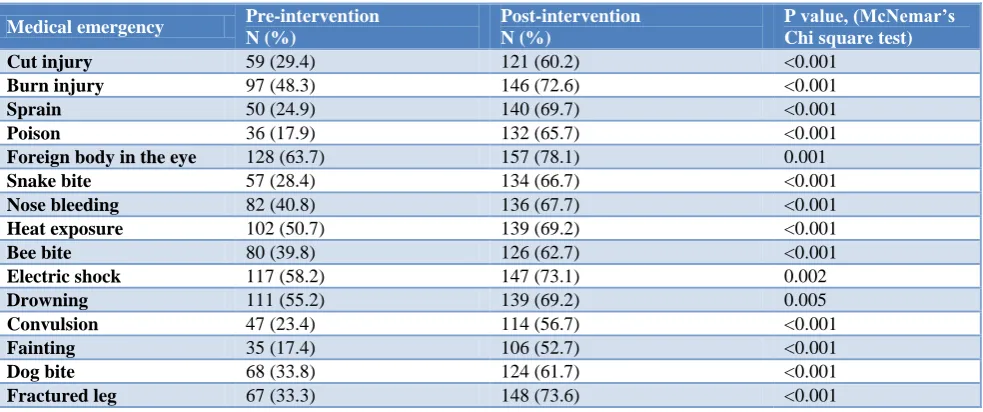
Prior to intervention, knowledge regarding fainting (17.4%), poisoning (17.9%) and convulsion (23.4%) were the least among all, which increased significantly to 52.7 %, 65.75%, and 56.7% respectively. More than half the study population had knowledge regarding foreign body in the eye (63.7%), electric shock (58.2%), drowning (55.2%) and heat exposure (50.7%); which increased to 78.1%, 73.1%, 69.2%, and 69.2% respectively post-intervention.
Table 2: Comparison of correct responses related to knowledge of first aid management of selected medical emergencies before and after educational intervention (n=201).
Medical emergency Pre-intervention
N (%)
Post-intervention N (%)
P value, (McNemar’s Chi square test)
Cut injury 59 (29.4) 121 (60.2) <0.001 Burn injury 97 (48.3) 146 (72.6) <0.001 Sprain 50 (24.9) 140 (69.7) <0.001 Poison 36 (17.9) 132 (65.7) <0.001 Foreign body in the eye 128 (63.7) 157 (78.1) 0.001 Snake bite 57 (28.4) 134 (66.7) <0.001 Nose bleeding 82 (40.8) 136 (67.7) <0.001 Heat exposure 102 (50.7) 139 (69.2) <0.001 Bee bite 80 (39.8) 126 (62.7) <0.001 Electric shock 117 (58.2) 147 (73.1) 0.002
Drowning 111 (55.2) 139 (69.2) 0.005
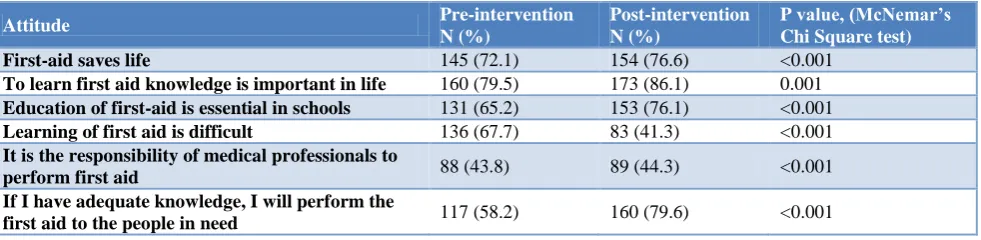
Table 3: Comparison of favourable responses related to attitude before and after educational intervention (n = 201).
Attitude Pre-intervention
N (%)
Post-intervention N (%)
P value, (McNemar’s Chi Square test)
First-aid saves life 145 (72.1) 154 (76.6) <0.001 To learn first aid knowledge is important in life 160 (79.5) 173 (86.1) 0.001 Education of first-aid is essential in schools 131 (65.2) 153 (76.1) <0.001 Learning of first aid is difficult 136 (67.7) 83 (41.3) <0.001 It is the responsibility of medical professionals to
perform first aid 88 (43.8) 89 (44.3) <0.001 If I have adequate knowledge, I will perform the
first aid to the people in need 117 (58.2) 160 (79.6) <0.001
Table 4: Comparison of knowledge and attitude scores of school students before and after intervention (n=201).
Score Median Interquartile range Wilcoxon (Z) test P value Correlation coefficient
[Effect size(r)]
Knowledge score
Pre-intervention 6.00 4.0-7.0
-10.982 <0.001 0.54 Post-intervention 10.00 8.0-10.0
Attitude score
Pre-intervention 2.00 1.0-4.0
-1.949 0.05 0.09 Post-intervention 3.00 2.0-4.0
Table 3 shows the attitude levels of the study participants prior to and after the intervention. The percentage of study participants who had a favorable attitude towards the role of first-aid in saving life, the importance of having the knowledge about first-aid, and essentiality of including first-aid in academic curriculum prior to test was 72.1%, 79.5% and 65.2% respectively, which after the intervention increased significantly (p<0.001) to 76.6%, 86.1%, and 76.1 % respectively. The averseness to learn about first-aid was reflected as majority (67.7%) felt learning first-aid techniques were difficult, the percentage of which decreased significantly (p<0.001) to 58.7%, after the intervention.
Table 4 shows change in the level of knowledge and attitude, prior to and after the intervention. Wilcoxon Signed-Rank test revealed a statistically significant increase in knowledge following the intervention, Z=-10.982, p<0.001, with a large effect size (r=0.54). The median knowledge score increased from 6 to 10, after intervention.
In case of attitude, Wilcoxon Signed-Ranks test indicates an increase in attitude scores following intervention, though the change was not statistically significant, Z=-1.949, p=0.05. However, there was an increase in the median score of attitude from 2 before intervention, to 3 with a small effect size (r=0.09).
DISCUSSION
This study found all the participants were aware about the term first-aid, which was similar to the findings of the studies by Bandyopadhyay et al from West Bengal, and Priyangika and Hettiarachhi from Sri Lanka.9,10 This was
probably because the study in Sri Lanka had prior training in first-aid, and the study participants in this study had some exposure to the topics through the school curriculum, which was not the case with the study conducted by Bandyopadhyay et al.
Knowledge regarding fainting, convulsion, and animal bites were still around 50%, even after intervention in this study, as was observed in studies by Dasgupta et al and Shinde et al in their study among high school students, in rural West Bengal and Pune respectively.11,12 This was probably due to the logistical inability on the part of the researchers to demonstrate management of such emergencies in a way which would have been more conducive to learning for the audience.
Health professionals (28.4%) and teachers (25.4%) were the chief source of information about first-aid, in contrast to the study by Badyopadhyay et al in West Bengal, and Mobarak et.al in Saudi Arabia, which reported the televised materials as well as the parents as the main source.9,13
The perceived notion about the difficulty in learning first-aid was deep seated among the study participants, which barely improved even after the intervention. This was not the case in the study by Badyopadhyay et al, where the perception altered considerably after the intervention.9 This can be explained by the fact that a change in attitude can only be brought about by repeated reinforcements over a period of time.
eagerness among the participants to help the needy after acquiring adequate knowledge was high throughout.
Limitations of this study were this was a school-based study involving complete enumeration of the study participants; hence it lacks external generalizability.
CONCLUSION
The present study highlights the effectiveness of a pre-planned, well designed interventional programme in significantly raising the awareness and preparedness about first-aid among school children. Being more receptive and eager to learn and implement new things than adults, we advocate repeated, interactive, hands-on mode of teaching first-aid to school going children of adolescent age group, to armour them with the knowledge of protecting the people in their surroundings. Percolation of information from one child to other children and adults in their immediate surroundings, could be used as a useful medium to disseminate such essential information among the community as a whole. Though certain medical emergencies are included in the school curriculum, they are spread over different subjects in various years of schooling. Hence, there is a need for a uniform, interactive module to be incorporated as a separate entity to encourage participation. Mock drills at periodic intervals may be useful in preparing the students for unforeseen events.
ACKNOWLEDGEMENTS
Authors would like to thank the cooperation and enthusiasm of the headmaster of the school.
Funding: No funding sources Conflict of interest: None declared
Ethical approval: The study was approved by the Institutional Ethics Committee and All India Institute of Hygiene and Public Health, Kolkata, West Bengal, India
REFERENCES
1. Kapoor R, Vyas S, Mashru P, Mehta A, Mehta A, Mehta S, et al. Impact of training on knowledge and attitude regarding first aid among students of schools of Ahmedabad. Natl J Community Med. 2017;8(7):380-4.
2. Thein MM, Lee BW, Bun PY. Knowledge attitudes and practices of childhood injuries and their prevention by primary care givers in Singapore. Singapore Med J. 2005;46(3):122.
3. Singer AJ, Gulla J, Thode HC, Cronin KA. Pediatric first aid knowledge among parents, pediatric emergency care. 2004;20:808-11.
4. Goel S, Singh A. Comparative impact of two training packages on awareness and practices of first
aid for injuries and common illnesses among high school students in India. Int Electro J Health Edu. 2008;11:69-80.
5. Kendrick D, Mulvaney CA, Ye L, Stevens T, Mytton JA, Stewart-Brown S. Parenting interventions for the prevention of unintentional injuries in childhood. Cochrane Database Syst Rev. 2013;28:3.
6. Hecht BK. First aid: from witchdoctors and religious knights to modern doctors. Available at: http://www.medicinenet.com/script/main/art. Accessed on 25th October 2019.
7. AI Glendon, SP McKenna, SS Blaylock, K Hunt. Evaluating mass training in cardiopulmonary resuscitation. Br Med J. 1987;294(6581):1182-3. 8. Goniewicz M, Chemperek E, Mikula A. Attitude of
students of high schools in Lublin towards the problem of first aid. Wiadomosci Lekarskie. 2002;55:679-85.
9. Bandyopadhyay L, Manjula M, Paul B, Dasgupta A. Effectiveness of first-aid training on school students in Singur Block of Hooghly District, West Bengal. J Family Med Prim Care. 2017;6:39-42.
10. Priyangika KG, Hettiarachhi M. Knowledge, attitudes and practices on first aid measures among senior school prefects in Galle Education Division, Sri Lanka. Proceedings of 8th International Research Conference, Kotelawala Defence University; 2015. 11. Dasgupta A, Bandyopadhyay L, Das M.
Effectiveness of health education in terms of knowledge acquisition on first-aid measures among school students of a rural area of West Bengal. Med Res Chron. 2014;1:84-91.
12. Shinde VS, Shinde DS, Shinde SR. Knowledge of high school students in Pune about first aid and the effect of training on them. Indian J Basic Appl Med Res. 2015;5:556-9.
13. Mobarak AS, Afifi MR, Qulali A. First aid knowledge and attitude of secondary school students in Saudi Arabia. Health. 2015;7(1):366-78.
14. Muneeswari B. A study to assess the effectiveness of planned health teaching programme using child to child approach on knowledge of selected first aid measures among school children in selected schools at Dharapuram in Tamil Nadu, India. Glob J Med Public Health .2014;3(1):18.
Cite this article as: Das K, Pal A, Dasgupta A, Bandyopadhay L, Paul B, Mandal S, et al.A study on the effectiveness of educational intervention