* To whom all correspondence should be addressed.
Bioresistant Building Composites on the Basis of Glass Wastes
Vladimir Trofimovich Erofeev1, Andrey Dmitriyevich Bogatov1,
Vasily Filippovich Smirnov2, Svetlana Nikolaevna Bogatova1,
Vladimir Ivanovich Rimshin3 and Vladimir Leonidovich Kurbatov4
1Mordovia N.P. Ogarev State University,
2Nizhegorodskiy N.I. Lobachevskiy State University Bolshevistskaya str. 68, Saransk, 430005. 3Moscow State University of Civil Engineering 129337, Yaroslavl highway, 26 4North Caucasian branch of the federal government’s budget educational institution of higher professional education “Belgorod State Technological University. VG Shukhov
Zheleznovodskaya Street 24, Mineralnye Vody, Stavropol Territory, 357202 , Russia
DOI: http://dx.doi.org/10.13005/bbra/1710
(Received: 03 February 2015; accepted: 20 March 2015)
The article presents the production technology of binding and building composite materials on the basis of glass wastes. Compositions of mortar mixes, heavy and light concretes are developed and optimized. It is proved that given materials are bioresistant in conditions, influenced by microscopic organisms. Extensive researches of bioresistant bindings and specific structure of microorganisms occupying them are presented.
Key words: Glass wastes, binding mortars, concretes, bioresistance, bindings, Microorganisms, aging, hostile environment, potential biodestructors
Broken glass makes a considerable part of all the techogenic wastes that are thrown as useless dumps. In Russia taken alone, the volume of glass wastes amounts to 4 million tons per year. A greater part of such wastes, while accumulating, contaminates the environmental medium. Meanwhile, broken glass is productive secondary resource that can be used in building industry for producing binding materials, mortars, concretes, and constructions on their basis.
At present, the existing processes of making building materials with the application of broken glass are based on technologies that envisage the sintering of raw materials at high temperatures or relevant treatment in autoclaves (Merkin, A. P. and Zeifman, M.I.,1979, Toturbiev, B. D., 1988). If high energy consumption and cost
of such processes are into account, then the most perspective way to solve the problem of broken glass utilization is, in our opinion, the production of binding materials, composites and other products that can solidify and harden at temperatures lower 90° C or in normal humid-temperature conditions.
Methodology
this process takes place at high temperatures and pressures. The economic efficacy of using such materials may be attained if the technology of their production is simplified. We have experimentally proved that the formation of the above-mentioned compounds can take place with no autoclave treatment. This is attainable if certain corrective additives are introduced. Clay and carbonate rocs, as well as industrial wastes of building industry producing ceramic materials are fount to be effective as such additives.
Researches on durability dependence on the quantitative content in the composition of water solution of caustic natron and mineral additive, and also of a latter type were conducted. It is established that the best properties have those mixtures that use fine powders of chalk and haydite as a mineral component.
On the basis of developed binding, the compositions of mortars and concrete with optimum ratio are obtained and their physical and technical properties are studied. Main characteristics of materials are presented in Table 1.
The developed binding compositions of mortars and concrete meet the physical, mechanical, thermotechnical, technological requirements demanded of walling and they can be used for constructing superstructure of low buildings. One of distinguishing features of new materials is the use of sand with clay impurity as filling materials. When mortars and concrete harden on such sands in the conditions of high alkalinity of a liquid phase there is a hydration of clay minerals, resulting in alkaline hydroaluminosilicate promoting their structures consolidation (Kurbatov, V. L and Danilyan, E.A.,2014, Ivanov F. M., et al., 1984). So, on the basis of experimental researches it is established that when using mixture of sand with a 7 % of clay to prepare mortar its durability after thermo humidity processing proved to be 18 % higher, than a similar mixture with pure quartz sand as a filler.
Thus, the application of binding on the basis of broken glass makes it possible to use sand with high clay impurity to produce concretes, but for cement concrete it is not recommended. It is necessary to note that sand resources of that kind
Table 1. Physical and technical properties building materials on the basis of glass alkaline binding
Index Mortar High-density Low Cellular Concrete with concrete density concrete aggregates from concrete microspheres
Pressure strength, MPa 18 25 16 0,5-0,9 20
Average density, kg/m 3 2000 2400 1400 500 650
Thermal conductivity, W/m ºC - - 0,43 0,13 0,19
Coefficient of elasticity, MPa 6000 9750 4600 400 6500 Coefficient of temperature equilibrium 0,897×10 -2 1,558E10 -5 0,427×10 -5 -
-Linear shrinkage, % 0,13 0,12 0,24 - -*
Water absorption during 24 h, % by mass 0,3-0,6 0,2-0,3 1,5-4,5 30-50 0,2
Table 2. The research results of fungi resistance of binding ingredients
Name of material Degree of fungi fouling in numbers Estimation of according to GOST 9.049-91 fungi resistance
Method 1 Method 3
Limestone 2 5 fungi resistance
Brick dust 4 5 not fungi resistance
Glass powder 2 5 fungi resistance
Haydite powder 2 5 fungi resistance
Clay 3 5 not fungi resistance
Slag 2 5 fungi resistance
in Russia are great enough in Russia, whereas in many regions expensive operations on enrichment of local sand are performed.
Recently the increasing attention is given to research on operational reliability of building materials and in particular their stability in the conditions of biologically active environments influence. Bacteria, fungi, actinomycete belong to those environments (Hansen, D. J., et al., 1981, Varmylen, M.,1985).
Biological corrosion
Materials biological corrosion takes place at the enterprises of the food, chemical, medical, microbiological industry, and also in agricultural, transport, hydraulic engineering buildings and constructions. Public and residential constructions are exposed to microorganisms affection, since the smallest particles of organic substance of soil, plants, animals serve as a nutritious substratum for fungi and are practically always presented in
the air, accumulating on construction surfaces. The most active destroyers among microorganisms are mycelium fungi that cause degradation by direct consumption of a material or its separate components as a foodstuff, and also due to chemical influence on a material of their vital activity products to which first of all belong organic acids, enzymes, amino acids. It is counted up that damages caused to buildings and constructions as a result of biodamages, makes many ten milliard of dollars annually (Perfettini, I. V., et al., 1990, Pirt, S. J., 1980, Popescu, A. and Ionescu-Homoriceanu, S., 1991, Solodky, N.F., et al., 2009, Zaitseva, E. I., 2003). Besides, microorganisms can cause serious diseases because some kinds are pathogenic in relation to human beings and animals.
A Research of biological resistance of bindings on the basis of glass breakage was carried out according to GOST 9.049-91.
Table 3. Research results of fungi resistance of bindings on the basis of broken glass
Name of material Degree of fungi fouling in numbers Estimation of according to GOST 9.049-91 fungi resistance
Method 1 Method 3
Glass alkali binding
1) with ground brick 0 0 fungicidal
2) with ground clay 0 3 fungi resistant 3) with ground c haydite
without additive 0 0 fungicidal
with additive
a) six water chloride aluminium 0 3 fungi resistant
) sodium aluminate 0 0 fungicidal
b) acetone 0 0 fungicidal
Table 4. Research results of bioresistance
Name of material Degree of fungi fouling in numbers Estimation of according to GOST 9.049-91 fungi resistance
Method 1 Method 3
Portland cement rock 0 3 fungi resistant
gypsum rock 0 3 fungi resistant
hardened epoxy resin 0 3 fungi resistant engineering sulfur 0 3 fungi resistant hardened binding on the basis
of glass 0 0 fungicidal (R=45 mm).
cellular concrete on the basis
of glass alkali binding 0 0 fungicidal (R=24 mm).
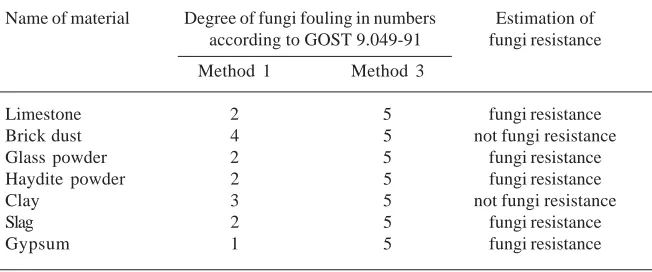
The research results of fungi fouling of the components forming bindings and hardened compositions themselves are given in Tables 2 and 3.
As the research results show binding components do not possess fungicidal properties, however limestone, ground glass, ground haydite, semi water plaster are fungi resistant. As compositions tempering is done by an alkaline solution so the hydrogen indicator of the environment increases to values adverse for growth and reproduction of microorganisms and that raises their biological resistance considerably. As it shown in Table 2 the majority of examined structures possess fungicidal properties (Antonova, E. A., 2014, Kozlov, Y. A.,1998,Rusina, V. V., 2007).
Test results of samples bioresistance on the developed bindings and the traditional ones on the basis of Portland cement, building plaster, technical sulphur and epoxide resin are presented in Table 4.
As it can be seen from the table developed glass alkaline bindings and materials on its basis in contrast to widely used cement, plaster, polymeric and sulfuric bindings possess fungicidal
properties and that proves the practicability of their use when manufacturing goods maintained in the conditions influenced by biologically active environments.
Metabolic characteristics of fungi. Statistics show that filamentous fungi have one of the most damaging impact on the industrial and construction materials among the various kinds of microorganisms ( Bozhenov, P. I., 1978, Solomatov, V. I. et al., 2001). Their high destructive activity is due to the ability of adapting to materials of different chemical nature, mainly caused by the presence of well-developed, powerful and mobile enzyme complex. Metabolic feature of fungi, caused damage, is that they have the systems of highly oxidative, glycolytic and other more or less specific enzymes carrying out a variety of chemical transformations of complex substrates. Cleavage of such substrates may occur by oxidation, hydroxylation, rupturing of ring and cyclic olefinic bonds , transformation of molecules and compounds, biochemical syntheses, and in other ways.
We have studied the resistance of composites based on various types of bindings in the presence of filamentous fungi attack. Material
Table 5. Research results of bindings bioresistance.
Name of material Method1 Method 3 Results
After grade strength having been reached
Glass alkali binding 0 0 (R* = 45 <<) fungicidal
Portland cement rock 0 3 fungi resistant
Gypsum rock 4 5 fungi nonresistant
Hardened epoxy resin 2 5 fungi resistant After three-month dry curing
Glass alkali binding 0 0 (R=15 <<) fungicidal Portland cement rock 0 3 fungi resistant
Gypsum rock 4 5 fungi nonresistant
Hardened epoxy resin 2 5 fungi resistant After twelve-month dry curing
Glass alkali binding 0 2 fungi resistant Portland cement rock 0 4 fungi resistant
Gypsum rock 4 5 fungi nonresistant
Hardened epoxy resin 4 5 fungi nonresistant
After three-month storage in Czapek-Dox medium
Glass alkali binding – 1 fungicidal Portland cement rock – 5 non- fungicidal
Gypsum rock – 5 non- fungicidal
Hardened epoxy resin – 5 non- fungicidal
testing was carried out in accordance with GOST 9.049 - 91 by applying two methods: 1 (no extra mediums) and 3 (with the use of Czapek-Dox solid medium).
Table 1 shows the kinetics of changes in biological stability of composites based on various types of bindings afterthree- and twelve-month dry curing ,as well as quantitative indicators of their biological stability after a long storage in the presence of a constant affect of nutritive medium. The results in Table 1 show that after grade strength having been reached only samples of glass alkali binding have fungicidal properties. High biostability of binding based on glass breakage is due to higher level of the system basicity. Materials aging reduces their biostability, for example, microbistatic area radius is less for samples of glass alkali binding , and hardened
epoxy resin becomes non-fungicidal. Materials storage under the action of biological media in the presence of a nutrient medium for filamentous fungi promotes biofouling.
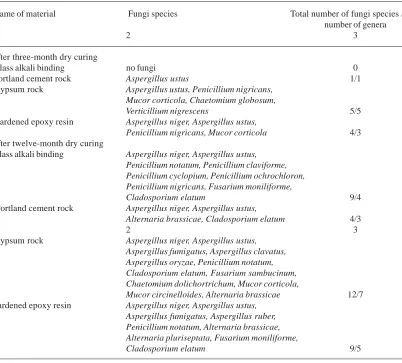
In order to identify potential biodestructors of bindings after storage in air-dry conditions, studies have been conducted to determine the species composition of microorganisms inhabiting them. The objective of this research was to establish the number of genera of fungi present in the air of the room that can use binders as a source of nutrition, as well as identification of specific species - the representatives of this genus. The species composition of fungi is shown in Table 2.
The results of the experiments
After three- month storage samples of Portland cement rock have 1 fungi genus
-Table 6. Species composition of fungi colonies in bindings
Name of material Fungi species Total number of fungi species / number of genera
1 2 3
after three-month dry curing
Glass alkali binding no fungi 0
Portland cement rock Aspergillus ustus 1/1
gypsum rock Aspergillus ustus, Penicillium nigricans, Mucor corticola, Chaetomium globosum,
Verticillium nigrescens 5/5
hardened epoxy resin Aspergillus niger, Aspergillus ustus,
Penicillium nigricans, Mucor corticola 4/3
after twelve-month dry curing
glass alkali binding Aspergillus niger, Aspergillus ustus, Penicillium notatum, Penicillium claviforme, Penicillium cyclopium, Penicillium ochrochloron, Penicillium nigricans, Fusarium moniliforme,
Cladosporium elatum 9/4
Portland cement rock Aspergillus niger, Aspergillus ustus,
Alternaria brassicae, Cladosporium elatum 4/3
1 2 3
gypsum rock Aspergillus niger, Aspergillus ustus, Aspergillus fumigatus, Aspergillus clavatus, Aspergillus oryzae, Penicillium notatum, Cladosporium elatum, Fusarium sambucinum, Chaetomium dolichortrichum, Mucor corticola,
Mucor circinelloides, Alternaria brassicae 12/7
hardened epoxy resin Aspergillus niger, Aspergillus ustus, Aspergillus fumigatus, Aspergillus ruber, Penicillium notatum, Alternaria brassicae, Alternaria pluriseptata, Fusarium moniliforme,
Table 7. Species composition of fungi colonies in bindings
Name of Fungi species Total number of
material fungi species /
number of genera
1 2 3
Pig-breeding farm building
Glass alkali Aspergillus ustus, Aspergillus versicolor, Aspergillus rubber,
binding Penicillium nigricans, Penicillium tardum, Penicillium cyclopium, Alternaria dianthi, Alternaria alternate, Mucor hiemalis, Fusarium heterosporum, Fusarium sambucinum,
Chaetomium globosum, Paecilomyces variotii 13/7
Portland cement Aspergillus niger, Aspergillus ustus, Aspergillus fumigatus,
rock Aspergillus clavatus, Aspergillus terreus, Aspergillus oryzae,
Aspergillus penicilloides, Penicillium godlewskii,
Penicillium cyclopium, Penicillium urticae, Alternaria alternate, Alternaria dianthi, Mucor corticola, Mucor circinelloides,
Mucor hiemalis, Cladosporium elatum, Cladosporium macrocarpum,
Fusarium avenaceum, Rhizopus cohnii, Chaetomium dolichortrichum 20/8
hardened epoxy Aspergillus niger, Aspergillus oryzae, Aspergillus nidulans,
resin Aspergillus ustus, Aspergillus sydowi, Mucor corticola,
Mucor hiemalis, Mucor circinelloides, Cladosporium macrocarpum, Penicillium godlewskii, Penicillium cyclopium, Penicillium claviforme, Penicillium notatum, Penicillium corylophilum,
Chaetomium dolichortrichum 15/5
gypsum rock Aspergillus niger, Aspergillus ustus, Aspergillus sydowi, Aspergillus oryzae, Aspergillus nidulans Aspergillus terreus, Penicillium claviforme, Penicillium godlewskii, Penicillium cyclopium, Penicillium lanosum, Penicillium notatum, Penicillium expansum, Penicillium meleagrinum, Mucor corticola, Mucor circinelloides, Fusarium avenaceum, Fusarium sambucinum, Alternaria alternate, Alternaria pluriseptata, Alternaria brassicae,
Chaetomium dolichortrichum, Chaetomium bostrychodes, Trichoderma koningii, Cladosporium macrocarpum,
Cladosporium elatum 25/8
Poultry building
glass alkali binding Aspergillus ustus, Aspergillus versicolor, Penicillium nigricans, Penicillium cyclopium, Penicillium claviforme,
Penicillium godlewskii, Mucor hiemalis,Mucor corticola, Cladosporium macrocarpum, Cladosporium elatum, Alternaria brassicae, Alternaria pluriseptata,
Chaetomium globosum 13/6
1 2 3
Portland cement Aspergillus niger, Aspergillus ustus, Aspergillus oryzae,
rock Aspergillus sydowi, Penicillium godlewskii,
Penicillium cyclopium, Penicillium expansum, Penicillium nigricans, Penicillium corylophilum, Penicillium notatum, Penicillium chrysogenum,
Penicillium claviforme, Mucor corticola, Mucor hiemalis, Alternaria alternate, Alternaria pluriseptata,
Alternaria brassicae, Cladosporium macrocarpum, Cladosporium herbarum, Chaetomium dolichortrichum,
Fusarium sambucinum 21/7
hardened epoxy Aspergillus niger, Aspergillus ustus, Aspergillus sydowi,
resin Aspergillus clavatus, Aspergillus fumigatus, Penicillium godlewskii, Penicillium notatum, Penicillium cyclopium, Penicillium chrysogenum, Penicillium corylophilum, Alternaria alternate, Alternaria dianthi, Cladosporium elatum, Cladosporium herbarum,
Mucor corticola, Trichoderma koningii 18/6 gypsum rock Aspergillus ustus, Aspergillus niger, Aspergillus rubber,
Aspergillus clavatus, Aspergillus penicilloides, Penicillium godlewskii, Penicillium nigricans, Penicillium lanosum, Penicillium cyclopium, Mucor corticola, Mucor circinelloides, Alternaria alternate, Alternaria brassicae, Cladosporium macrocarpum, Cladosporium elatum, Chaetomium dolichortrichum,
Chaetomium bostrychodes, Trichoderma viride, Paecilomyces variotii 19/8
Potato storage space
Glass alkali binding Aspergillus penicilloides, Aspergillus sydowi, Aspergillus nidulans, Aspergillus versicolor, Aspergillus clavatus, Aspergillus oryzae, Aspergillus ustus, Aspergillus fumigatus, Penicillium canescens, Penicillium godlewskii, Penicillium lanosum, Penicillium nigricans, Penicillium cyclopium, Penicillium claviforme, Penicillium urticae, Fusarium heterosporum, Fusarium moniliforme,
Fusarium sambucinum, Alternaria brassicae, Mucor circinelloides,
Verticillium album, Cladosporium elatum, Cladosporium macrocarpum 23/7
Portland cement Aspergillus niger, Aspergillus ustus, Aspergillus sydowi,
rock Penicillium corylophilum, Penicillium clavigerim, Penicillium urticae,
Penicillium claviforme, Penicillium canescens, Penicillium godlewskii, Penicillium cyclopium, Mucor corticola, Mucor circinelloides, Cladosporium macrocarpum, Cladosporium elatum,
Fusarium sambucinum, Trichoderma koningii, Trichoderma viride 17/6
1 2 3
hardened epoxy Aspergillus ustus, Aspergillus penicilloides, Aspergillus fumigatus,
resin Penicillium oxalicum, Penicillium nigricans, Penicillium godlewskii, Penicillium lanosum, Penicillium cyclopium, Penicillium corylophilum, Penicillium expansum, Penicillium claviforme, Penicillium meleagrinum, Alternaria brassicae, Fusarium moniliforme, Fusarium sambucinum, Fusarium avenaceum, Cladosporium macrocarpum, Cladosporium elatum,
Trichoderma viride, Verticillium tenerum, Mucor corticola, Mucor hiemalis 22/8
gypsum rock Aspergillus ustus, Aspergillus penicilloides, Aspergillus niger, Aspergillus clavatus, Aspergillus sydowi, Aspergillus fumigatus, Aspergillus nigricans, Penicillium lanosum, Penicillium oxalicum, Penicillium puberulum, Penicillium corylophilum, Penicillium canescens, Penicillium claviforme, Penicillium cyclopium, Alternaria alternate, Alternaria brassicae, Alternaria dianthi, Cladosporium macrocarpum, Cladosporium elatum, Paecilomyces variotii, Fusarium sambucinum, Fusarium avenaceum, Verticillium tenerum, Rhizopus cohnii,
Trichoderma viride, Mucor corticola, Mucor hiemalis, Botrytis cinerea 28/11
Malt house of brewery works of OJSC «Sun InBev» ( Saransk branch)
glass alkali binding Aspergillus ustus, Penicillium meleagrinum, Fusarium moniliforme, Alternaria alternat0, Alternaria pluriseptata, Alternaria dianthi,
Cladosporium sphaerospermum, Mucor corticola 8/6
Portland cement Aspergillus niger, Aspergillus ustus, Penicillium meleagrinum,
rock Alternaria pluriseptata, Alternaria dianthi, Alternaria brassicae,
Fusarium avenaceum, Chaetomium dolichortrichum,
Cladosporium sphaerospermum, Cladosporium cladosporioides,
Mucor corticola 11/7
hardened epoxy Aspergillus niger, Aspergillus ustus, Aspergillus oryzae,
resin Aspergillus clavatus, Penicillium notatum, Penicillium tardum, Penicillium claviforme, Alternaria alternat0, Alternaria pluriseptata, Alternaria dianthi, Alternaria brassicae, Fusarium avenaceum, Fusarium moniliforme, Chaetomium dolichortrichum,
Cladosporium cladosporioides, Cladosporium sphaerospermum 16/6
gypsum rock Aspergillus terreus, Aspergillus fumigatus, Fusarium moniliforme, Cladosporium cladosporioides, Cladosporium sphaerospermum, Cladosporium herbarum, Verticillium album, Mucor hiemalis,
Aspergillus ustus, gypsum rock - 5 genera of fungi (Aspergillus, Penicillium, Mucor, Chaetomium, Verticillium), hardened epoxy resin - 3 genera of fungi (Aspergillus, Penicillium, Mucor ).Increasing of storage period led to the expansion of the species composition of fungi. Table 2 shows that the number of fungi that are found on the surface of the composites after twelve-month dry curing , has increased dramatically. Glass alkali binding has no fungi after three-month standard curing , and although fungal colonies are detected in the samples after twelve months, they develop slowly and are in a depressed state.
In this regard, the use of glass alkali composites in buildings with biologically active media is the most preferred, since, in this case, along with the increased durability of structures and products, the environmental situation in buildings and structures improves. Settling on materials surface of building structures microorganisms can cause mouldy smell in rooms and release toxic products, allergens (Ershova, O. V. et. al., 2012, Fomin, R. V., 2003). Developing on the materials, fungi secrete a lot of sporules and various pro-life activity products that can cause a number of serious human diseases.
DISCUSSION
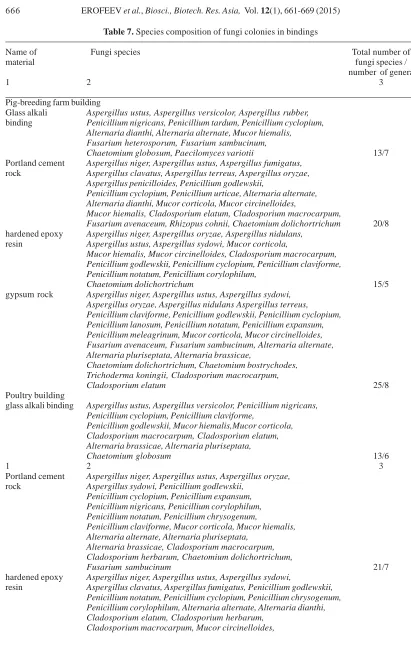
Identification of species composition of microorganisms. To identify potential biodestructors of bindings using in construction of pig-breeding complex and poultry buildings, potato storage space and malt house of brewery works, studies have been conducted to determine the species composition of microorganisms inhabiting the bindings. The experiment was conducted in natural conditions within 6 months. The research results are listed in Table 3.
In the end we can say. Fungi genera found on the investigated materials at their operation in all the above conditions are: Aspergillus, Penicillium and Mucor, with Aspergillus and Penicillium largely predominated. Long-term studies in the field of composite building materials bioresistance indicate that fungi species of Aspergillus niger and Penicillium chrysogenum bring the greatest harm to industrial and construction materials, products and designs in comparison with all the varieties of microscopic
organisms (Child P., 1987, Komarova , N. D. and Kurbatov, V. L., 2015). The obtained results show that these types of filamentous fungi were not only detected on glass alkali binding samples in any of the cases. During operation in pig and poultry buildings and in potato storage space only Aspergillus niger is found on the surface of gypsum rock. Two harmful fungi species are found on the surfaces of Portland cement rock and hardened epoxy resin when used in the poultry house and for storing in a malt house of brewery works only Aspergillus niger is found.
CONCLUSION
The experimental study of the behavior of composite building materials (CSM) under the action of microscopic organisms showed a decrease in strength characteristics and changes of masses of composites with cement, glass alkali and polymer bindings (Solomatov, V. I. et al., 1998, Kanevskaya, I. G., 1988).Masses changes results show that the interaction of materials with microorganisms and their metabolites occurs by different mechanisms. For example, composites with cement and gypsum bindings are characterized by mass decreasing and materials with polymer bindings have increase in mass . These data confirm that under biodegradation the rate of corrosive destruction depends on degradation caused by chemically aggressive media and is determined by the rate of chemical reactions on the surface of the material, internal diffusion of the microorganisms and their metabolic products in the structure of the material and undergoing of chemical reactions. Only in this case it is also necessary to consider the nature of the interaction of microorganisms with the components of the material.
that there is a necessity to be selective when choosing building materials and protective coatings, depending on the specific operating conditions and taking measures to prevent or minimize potential settling of microscopic organisms on the surfaces of the materials.
Further research will focus on the development of measures to minimize the maximum exposure to biological corrosion on various construction materials and not only.
REFERENCES
1. Antonova, E. A., Liquid composites for special purposes. Young scientist 2014; 12: 67-69. 2. Bozhenov P.I., Technology of autoclaved
materials. Leningrad, L. : Stroiizdat., 1978; 367. 3. Child P., Glass-recycling can be good business.
Amer. Glass. Rev 1987; 98(3): 6-9.
4. Ershova, O. V., Colyada, L. G., Krapivko, U. S., Study the properties of composite materials on the basis of technogenic mineral and polymer waste. Actual problems of modern science, technology and education: proceedings of the 70th interregional scientific-technical conference. Magnitogorsk: Publishing house of Magnitogorsk state technical. University G.I. Nosov 2012; 1: 195-199.
5. Fomin, R. V., Construction composites based on liquid glass with modifying additive polymer of acrylamide. Saratov state technical University, Saratov, Russia, 2003.
6. Glukhovskiy, V. D., Slag-alkaline concretes on fine-grain aggregates. Kiev: High school, 1981; 223.
7. Hansen, D. J., Tighe-Ford, D. J., George, G.C., Role the mycelium in the corrosive activity of Cladosporium resinae in dioso/water system.
Int. Biodeterior. Bull 1981; 17(4): 103-112. 8. Ivanov F. M., Gorshin S. N., White. D. et al.,
Biodegradation in the construction M .: Stroyizdat, 1984; 320 .
9. Kanevskaya, I. G., Biological damage of industrial materials. Leningrad, L.: Nauka. 1988; 230.
10. Kirilishin, V. P., Cremeconcrete. Kiev.: Budevilnik, 1975; 110
11. Komarova , N. D., Kurbatov, V. L., Analytical Modification of Seismic Effect on the Building.
Modern Applied Science 2015; 9(3): 10-16. DOI:
10.5539/mas.v9n3p10
12. Kozlov, Y. A., Severe composites based on liquid glass for protection against radiation. Penza state architectural - building Academy, Penza, Russia, 1998.
13. Kurbatov, V. L., Danilyan, E.A., Properties of composite materials depending on physic mechanical indicators of phases, granulometriya and concentration of fillers. Science Time magazine: Materials of the International scientific and practical conferences of Society of Science and creativity. Kazan, 2014; 35-41. 14. Merkin, A. P., Zeifman, M.I., Concretes and
products on the basis of acid volcanic glasses. Slag-alkaline cements, concretes and constructions: Thesis of reports at all-union scientific conference 1979; 15-16. Kiev. 15. Perfettini, I. V., Revertegat, E., Hangomazino,
N., Evaluation of the cement degradation induced by the metabolic products of two fungal strains. Mater. et Techn 1990; 78: 59-64.
16. Pirt, S. J., Microbial degradation of sinthetic polimers. Chem. Technol. and Biotechnol 1980;
30(4): 176-179.
17. Popescu, A., Ionescu-Homoriceanu, S., Biodeterioration aspects at a brick structure and bioprotection possibilities. Ind. Ceram 1991;
11(3): 128-130.
18. Rusina, V.V., Mineral binding substances on the basis of megaton-capacity of industrial waste. Handbook, Bratsk: GOU VPO “Brest state University”, 2007; 224 .
19. Solodky, N.F., Surikov, A.S., Pogrebenko, V.M., Mineral-raw material base of the Urals for ceramic, refractory and glass industry. Handbook. Tomsk: TPU 2009; 332.
20. Solomatov V. I., Cherkasov V. D., Erofeev V. T., Building biotechnology and biocomposites / Engineering. M., 1998; 165.
21. Solomatov V. I., Erofeev V. T., Smirnov V. F. et al., Biological resistance of materials. - Saransk: Mordovian University Press, 2001; 196. 22. Toturbiev, B. D., Building materials on the basis
of silico-sodium cjmpositions urbiev. Moscow, M. : Stroiizdat, 1988; 155.
23. Varmylen, M., Glass-recycling in Europe. Glass Technol 1985; 20(3): 58-63.
24. Zaitseva, E. I., Construction unburned composites based battle technical glasses.
Russian Chemical Journal. Chemistry of modern