http://www.ijcmph.com pISSN 2394-6032 | eISSN 2394-6040
Original Research Article
Exclusive breast feeding reduces diarrhoeal episodes among children:
results from a cross-sectional study among the mothers
of under-five children in Kolkata
Nibedita Banerjee
1, Arup Chakraborty
2, Arista Lahiri
2, Kalidas Biswas
3*
INTRODUCTION
Six months of exclusive breastfeeding, has a significant effect in the reduction of mortality from the two biggest contributors to infant deaths: diarrhoea and pneumonia.1 Optimal infant and young children feeding (IYCF) is essential for child growth. The 2008 Lancet Nutrition
Series reinforced the significance of IYCF on child
survival.2 Optimal IYCF, especially exclusive
breastfeeding, was estimated to prevent potentially 1.4 million deaths every year among children under five; out of approximately 10 million annual deaths. A 2006 study in rural Ghana showed that early initiation of breast feeding within the first hours of birth could prevent 22%
ABSTRACT
Background: Breast feeding is of utmost importance for optimal child growth. This study aims to determine the knowledge on breast feeding among the mothers of under five children and to find out the association between the proportion of exclusive breast feeding and the incidence of diarrhoeal disease.
Methods: An institution based cross sectional descriptive study was conducted among ninety (90) mothers of under five children who attended the immunization clinic of a tertiary care hospital with the help of a designed, pre-tested, semi-structured schedule. Mothers were selected by systematic random sampling and interview done after obtaining written consent.
Results: The mean age of the respondent mothers were 25.78 years. Among them 77.8% were staying in the nuclear family with the mean education up to 8th standard, 94.4% of home maker. The mean education of fathers was 9th standard with majority (77.8%) occupied either in service or in other occupation. Average no of children per family was 1.3. Majority of mothers‟ younger children (66.7%) were male. Majority (66.7%) mothers had heard the term colostrum and 88.3% knew that colostrum has anti-infective property and nutritionally superior. Sixty (66.67%) mothers had exclusively breast fed their children. Out of not exclusively breastfed children 36.67% experienced diarrhoea.
Conclusions: Though majority mothers knew about breastfeeding, yet the proportion not having proper knowledge was high. The statistical analysis showed exclusive breast feeding to be highly protective against developing diarrhoeal episodes. In order to generate better breastfeeding practices, addressing the knowledge gap is needed.
Keywords: Breast feeding, Diarrhoea, Knowledge, Under-five children
1
Department of Blood Bank, Institute of Child Health, Kolkata, India
2Department of Community Medicine, 3Department of Medical Gastroenterology, Medical College and Hospital,
Kolkata, India
Received: 22 November 2018
Revised: 03 January 2019
Accepted: 07 January 2019
*Correspondence:
Dr. Kalidas Biswas,
E-mail: [email protected]
Copyright: © the author(s), publisher and licensee Medip Academy. This is an open-access article distributed under the terms of the Creative Commons Attribution Non-Commercial License, which permits unrestricted non-commercial use, distribution, and reproduction in any medium, provided the original work is properly cited.
of neonatal deaths, and initiation within the first day, 16% of deaths, while a similar study in Nepal found that approximately 19.1% and 7.7% of all neo-natal deaths could be avoided with universal initiation of breastfeeding within the first hour and first day of life respectively.3,4 Thus awareness regarding breast feeding among the mothers of under five children is very important aspect, indirectly associated with the nutritional status and childhood morbidity. This study aims to determine the knowledge on breast feeding among the mothers of under five children and to find out the association between the proportion of exclusive breast feeding and the incidence of diarrhoeal disease.
METHODS
A institution based cross sectional descriptive study was conducted among the mothers of the under five children who attended the immunization clinic under Department of Community Medicine of Medical College & Hospital, Kolkata, West Bengal. In that clinic all the regular vaccines were available as per Govt. of India (GOI) national immunization guideline. Apart from vaccination the important functions of that clinic were-growth monitoring of under five children and nutritional counselling and health education to postnatal mothers on breast feeding and different family planning practices. Mothers who gave birth in that hospital as well as from surrounding localities of Kolkata are the primary health care seeker in that clinic. The children who developed diarrhoea were asked to come for treatment in medical gastroenterology department of that institute.
Ninety (90) mothers who came in that immunization clinic with their children in first and second weeks of December 2014 were taken as study subjects as per the calculation of sample size of cross sectional study.5 Study subjects were chosen by systematic random sampling technique. Mothers, who were not willing to give consent or participate in the study, were excluded. A pre designed, pre tested, semi structured schedule was used to get the responses from the mothers as exit interview mode. Consent was obtained from each mother prior to participation. Data entry and analysis was done in Microsoft excel (2007) and epi info 7 software.
RESULTS
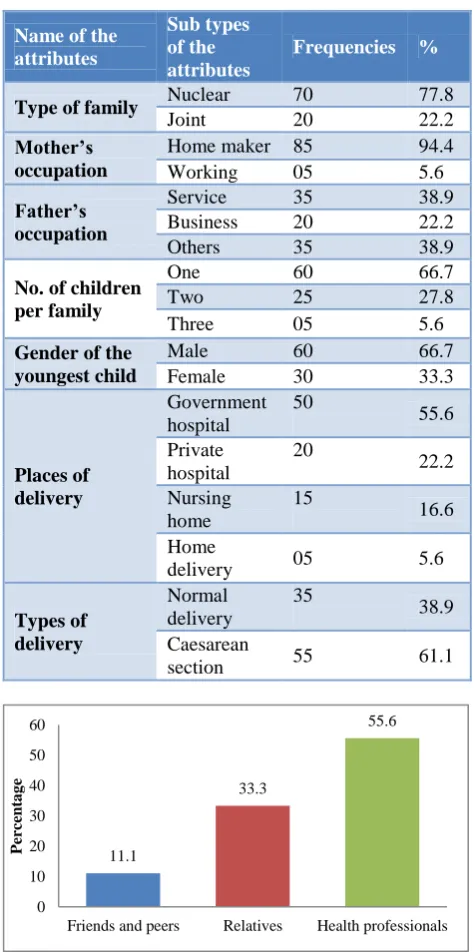
Table 1 shows different socio-demographic factors of the study mothers. The mean age of the respondent mothers were 25.78 years. The minimum age was 15 years and maximum age was 32 years. Among them 77.8% were staying in the nuclear family where as 22.2% belonged to joint family. The mean education of mothers was 8th standard (range from illiterate to post graduation). 94.4% of mothers were home maker and rest 5.6% of them were employed. The mean education of fathers was 9th standard (range from illiterate to post graduation). Majority (77.8%) of the fathers were occupied either in service or in other occupation where as 22.2% father had
business. Average no of children per family was 1.3 (range from one to three). 66.7% of mother‟s younger children were male. The average age of the youngest children was around two years (23.11 months).
Table 1: Socio demographic profiles of study mothers (n=90).
Name of the attributes
Sub types of the attributes
Frequencies %
Type of family Nuclear 70 77.8
Joint 20 22.2
Mother’s occupation
Home maker 85 94.4
Working 05 5.6
Father’s occupation
Service 35 38.9
Business 20 22.2
Others 35 38.9
No. of children per family
One 60 66.7
Two 25 27.8
Three 05 5.6
Gender of the youngest child
Male 60 66.7
Female 30 33.3
Places of delivery
Government hospital
50
55.6
Private hospital
20
22.2
Nursing home
15
16.6
Home
delivery 05 5.6
Types of delivery
Normal delivery
35
38.9
Caesarean
section 55 61.1
Figure 1: Simple bar diagram showing distribution of mothers as per different sources of information
regarding breast feeding (n=90).
Figure 1 describes different sources of information of the knowledge among the study mothers. Though 66.7% study mothers had heard the term colostrum i.e. “first yellow sticky milk” but 88.3% of them either knew that colostrum having anti-infective property and it is nutritionally superior.
11.1
33.3
55.6
0 10 20 30 40 50 60
Friends and peers Relatives Health professionals
Pe
rc
en
ta
g
Table 2: Responses of different Knowledge based questions (n=90).
Knowledge related
variables Responses Frequency
Percentage (%)
Necessity of breast-feeding for the baby (n=90)
Contains all nutritional elements required for baby 45 50
Protects baby from diseases 5 5.6
Helps the baby to become more intelligent 10 11.1
Always available 5 5.6
All of the above 25 27.7
Initiation of breast feeding
As early as possible 35 38.9
Within one hour 10 11.1
After one hour but before two hours 10 11.1
Do not know 15 16.7
After 4 hrs 10 11.1
Other specify (after 2 days) 10 11.1
Timing of breast feeding
Fixed timing only (every two/three hourly) 30 33.3
On demand (at the time of cry) 40 44.4
Semi demand (fixed as well as at the time of cry) 20 22.3
Meaning of exclusive breast feeding (EBF)
Only breast milk 55 61.1
Breast milk and water 25 27.7
Breast milk and other liquid 5 5.6
Do not know 5 5.6
Duration of EBF
Three months 15 16.7
Six months 75 83.3
One year 0 0
Do not know 0 0
other specify 0 0
Duration of breast feeding with other foods
One year 25 27.7
Two years 55 61.1
Three years 5 5.6
Do not know 5 5.6
Adequacy of breast milk
Stoppage of cry of baby 15 16.7
Adequate sleep 5 5.6
Adequate passage of urine or stool 20 22.2
All of the above 50 55.5
Table 3: Association between and exclusive breast feeding and incidence of diarrhoea among study children.
Suffered from diarrhoea Did not suffer from
diarrhoea Total
N (%) N (%) N (%)
Exclusively breast feeding done 4 (6.67) 56 (93.33) 60 (100.00)
Exclusively breast feeding not done 11 (36.67) 19 (63.33) 30 (100.00)
Total 15 (16.87) 75 (83.23) 90 (100.00)
The other different knowledge based questions and their responses are given in Table 2. It was good to know that almost all the study mothers has received some amount of knowledge regarding breast feeding from different sources.
Sixty (66.67%) mothers had exclusively breast fed their children while rest did not. Out of the mother who exclusively breast fed, among them 6.67% ever suffered from at least one episode of diarrhoea whereas who did not exclusively breast feed 36.67% experienced
diarrhoea. The difference is statistically significant. The Pearson chi square value 12.96, p<0.001. The Odds ratio is 0.12 (0.03-0.4) which is highly protective for developing diarrhoeal episodes in exclusive breast fed children (Table 3).
DISCUSSION
illnesses, malnutrition and mortality in infants.7 Knowledge of attitudes and practices associated with infant feeding forms an essential first step for any „need-felt‟ intervention program designed to bring about positive behavioral change in infant health. The knowledge of the mothers regarding the time of initiation of breast feeding and complementary feeding, types and frequency of feeding was very poor. Discontinuing complementary feeding during child illness (92.3%) and breast feeding in maternal illness was a common practice.7 On the contrary in our study, 83.3% of mother correctly new that exclusive breast feeding should be continued up to the age of six months. 66.7% mothers have heard the name of “colostrum” and 50% of them knew that it was important for its anti infective property and 33.3% knew it was nutritionally superior.
In Kisangunj, Bihar similar kind of KAP study reported that, 100%nourishing mothers knew that mother‟s milk is the best food for the baby.8 71.3% of the mothers were having knowledge that breast feeding should be initiated within half an hour of birth. 73.6% of the mothers believed that colostrum increases the immunity which was higher than the present study. Those who were not offering colostrum to their baby were mainly due to their belief that either it is harmful for the baby or baby cannot digest it easily. In our present study the reason was mainly due to lack of milk secretion. 86.8% of the mothers were having knowledge that exclusive breast feeding (EBF) should be given up to 6 months which was almost comparable to our study i.e. 83.3%. Most of the mothers believed that breast feeding should be continued for up to 2 yrs. of age but in the present study 61.1% agreed that breast feeding could be continued up to two years.
Other Indian study by Setthy et al found that 82% of the respondent believed that they should give colostrums to the newborn.9 58.7% of the subjects knew that breastfeeding should be initiated within 1 hour of the child birth, but only 48% of the mothers who had delivered initiated breastfeeding within 1 hour. 71.6% of the mothers knew that exclusive breastfeeding should be practised for 6 months. The study finding was comparable to the present study.
In a study among female school teachers in Saudi Arab, 89.3% of the participants reported that colostrum was good for the baby, while 1.3% considered it either not good or possibly detrimental to the child‟s health and 9.4% didn't know the answer. The duration of which the child should receive only breast milk without supplements was chosen by 28% to be 6 months. Study among the mothers in Erbil found that 41.6% of mothers received information concerning breast feeding or complementary feeding from physician, 41.9% of mothers received information from physician in the private clinic, 17.2% of mothers received information concerning breast feeding or complementary feeding from nurse, 54.7% of mothers received information from
nurse in the primary health centres and 36.1% of mothers receive information from their mothers or mothers in law.12 In the present study 55.6% mother received the knowledge by health professional during ante natal visits. 33.3% of them got it from relatives and 11.1% from friends and peers. Strikingly nobody has told that they have received the information from any types of media.
The result of a retrospective cohort study found exclusive breast feeding in early infancy reduces the risk of severe illness like diarrhea and suspected pneumonia. In rural Vietnam, Public health programs to reduce the burden of inpatient admission from diarrheal and respiratory illness.13
A protective effect of breastfeeding against cholera has been demonstrated in areas endemic of cholera in Guinea-Bissau.14
To describe breastfeeding practices and investigate the influence of exclusive breastfeeding in early infancy on the risk of infant deaths, a study conducted in the slum areas of Dhaka, Bangladesh. From the study it was observed that, partial or no breastfeeding was associated with a 2.23-fold higher risk of infant deaths resulting from all causes and 2.40- and 3.94-fold higher risk of deaths attributable to ARI and diarrhoea, respectively.15
In present study also 66.67% mothers had exclusively breast fed their children while rest did not. Out of the mother who exclusively breast fed, among them 6.67% ever suffered from at least one episode of diarrhoea whereas who did not exclusively breast feed 36.67% experienced diarrhoea. The Odds ratio is 0.12 (.03-.4) which is highly protective for developing diarrhoeal episodes in exclusive breast fed children The fact supports that exclusive breast feeding reduces the incidence of diarrhoea
The importance of breastfeeding as preventive
ACKNOWLEDGEMENTS
The authors would like to acknowledge the mothers of the under-five children who participated in the study, without them the study would not have been possible. The authors would also like to thank the staffs of the immunization clinic for their help.
Funding: No funding sources Conflict of interest: None declared
Ethical approval: The study was approved by the Institutional Ethics Committee
REFERENCES
1. UNICEF. Infant and young child feeding, nutrition section program, New York, 2012.
2. UNICEF. Division of Communication. Tracking
progress on child and maternal nutrition: a survival and development priority. Unicef; 2009.
3. Edmond KM, Zandoh C, Quigley MA,
Amenga-Etego S, Owusu-Agyei S, Kirkwood BR. Delayed breastfeeding initiation increases risk of neonatal mortality. Pediatrics. 2006;117(3):e380-6.
4. Mullany LC, Katz J, Li YM, Khatry SK, LeClerq SC, Darmstadt GL, Tielsch JM. Breast-feeding patterns, time to initiation, and mortality risk among
newborns in southern Nepal. J Nutr.
2008;138(3):599-603.
5. Charan J, Biswas T. How to calculate sample size for different study designs in medical research? Indian J Psychological Med. 2013;35(2):121.
6. Ministry of Human Resource Development,
Department of Women and Child Development (Food and Nutrition Board), Government of Indian. National Guidelines on Infant and Young Child
Feeding. Wcd.nic.in. 2004. Available at:
http://www.wcd.nic.in/sites/default/files/nationalgui delines.pdf. Accessed on 19 November 2018. 7. Sethi V, Kashyap S, Seth V. Infant feeding practices
in a relocated slum--a pilot study. Indian Pediatrics. 2003;40(6):579.
8. Kumar L, Shahnawaz K, Varma G, Choudhary SK,
Gupta A, Singh JB. Knowledge, attitude and practices of nourishing mothers about breast
feeding, attending urban health centre: A cross-sectional study from Kishanganj, Bihar. J Evol Med Dent Sci. 2014;3(7):1681-90.
9. Shetty SB, Shetty K. KAP study of factors promoting breastfeeding in nursing mothers and pregnant women. Nitte University J Health Sci. 2013;3(3):34-7.
10. Shaili V, Parul S, Kandpal SD, Jayanti S, Anurag S, Vipul N. A community based study on breastfeeding practices in a rural area of Uttarakhand. Natl J Community Med. 2012;3(2):283-6.
11. Al-Binali AM. Breastfeeding knowledge, attitude and practice among school teachers in Abha female educational district, southwestern Saudi Arabia. Int Breastfeeding J. 2012;7(1):10.
12. AL-Azzawi SI, Hussein KA, Shaker NZ.
Knowledge, attitude and practices (KAP) of mothers toward infant and young child feeding in primary health care (PHC) centers, Erbil city. Kufa J Nurs Sci. 2012;2(2):118-26.
13. Hanieh S, Ha TT, Simpson JA, Thuy TT, Khuong NC, Thoang DD, et al. Exclusive breast feeding in early infancy reduces the risk of inpatient admission for diarrhea and suspected pneumonia in rural Vietnam: a prospective cohort study. BMC Public Health. 2015;15(1):1166.
14. Qureshi K, Mølbak K, Sandström A, Kofoed PE, Rodrigues A, Dias F, et al. Breast milk reduces the risk of illness in children of mothers with cholera: observations from an epidemic of cholera in
Guinea-Bissau. Pediatric Infect Dis J.
2006;25(12):1163-6.
15. Arifeen S, Black RE, Antelman G, Baqui A, Caulfield L, Becker S. Exclusive breastfeeding reduces acute respiratory infection and diarrhea deaths among infants in Dhaka slums. Pediatrics. 2001;108(4):67.