249
Antimicrobial activity of extracts obtained from Anacardium excelsum
againts some pathogenic microorganisms
C. Celis∗, A. García, G. Sequeda, G. Mendez and R. Torrenegra
Phytochemistry Laboratory, Chemistry Department, Pontificia Universidad Javeriana, Cra 7 N 43-82 Bogotá, Colombia
Abstract: In this study,we evaluated the antimicrobial activity of secondary metabolites presents in extracts and fractions of Anacardium excelsum (Anacardeaceae), using agar well diffusion assay and bioautography. As a general result was determined that Anacardium excelsum has good antimicrobial activity against gram positive microorganisms. Regarding the fractions in study, these were tested against Bacillus subtilis where the integument, seed and seed coat showed the best antimicrobial activity. Analysis by gas chromatography (GC) with mass selective detector (MSD) established the presence of some phenolic compounds like 2-(1,1-dimethylethyl)-4-(1,1,3,3-tetramethylbutyl)phenol, which is responsible of the activity found.
Key words: Anacaurdium excelsum, microbial activity, phenolic compounds
ﻤﻟا
تادﺎﻀﻣ
طﺎﺸﻧ
ﻴ
ﺺﻠﺨﺘﺴﻤﻟ
تﺎﺑوﺮﻜ
تﺎﺒﻧ
Anacardium excelsum
ا
ﺾﻌﺑ
ﺪﺿ
تﺎﻨﺋﺎﻜﻟ
ﺔﻘﻴﻗﺪﻟا
ﺔﻴﺤﻟا
ﺮﻤﻟا
ﺿ
ﺔ
اﺮﻘﻴﻨﻴﻨﻳرﻮﺗ .رﺁوزﺪﻨﻴﻣ .ﻲﺟ ,اﺪﻳﻮﻜﻴﺳ .ﻲﺟ،ﺎﻴﺳرﺎﻗ .ﺁ،*ﺲﻴﻠﺳ .ﻲﺳ
ﺮﺒﺘﺨﻣ اﺮآ،ﺎﻧﺎﻨﻳرﺎﻴﻓﺎﺟﺎﻴﺴﻴﻔﻴﺘﻧﻮﺑﺔﻌﻣﺎﺟ،ءﺎﻴﻤﻴﻜﻟاﻢﺴﻗ , ﺔﻴﺗﺎﺒﻨﻟاءﺎﻴﻤﻴﻜﻟا 7N 43-82
ﺎﻴﺒﻤﻟﻮآ ,ﺎﺗﻮﻗﻮﺑ
ﺺﺨﻠﻤﻟا تﺎﺒﻧ ﻊﻃﺎﻘﻣو تﺎﺼﻠﺨﺘﺴﻣ ﻲﻓ ةدﻮﺟﻮﻤﻟا ﺔﻳﻮﻧﺎﺜﻟا تﺎﺒآﺮﻤﻟا ﻰﻓ تﺎﺑوﺮﻜﻴﻤﻟا تادﺎﻀﻣ طﺎﺸﻧ ﻢﻴﻴﻘﺗ ﻢﺗ ﺔﺳارﺪﻟا ﻩﺬه ﻲﻓ :
Anacardium excelsum (Anacardeaceae) ،
ﺔﻘﻳﺮﻃماﺪﺨﺘﺳﺎﺑ
رﺎﺟﻻاةدﺎﻣﻲﻓﺺﺤﻓ
bioautography
تدﺪﺤﺗﺔﻣﺎﻋﺔﺠﻴﺘﻨآ .
تﺎﺒﻧنا Anacardium excelsum ﺎﻤﻴﻓو .ماﺮﺟﺔﻐﺒﺼﻟﺔﺒﺟﻮﻤﻟاﺔﻘﻴﻗﺪﻟاﺔﻴﺤﻟاتﺎﻨﺋﺎﻜﻟاﺪﺿﺔﺒﺟﻮﻤﻟاتﺎﺑوﺮﻜﻴﻤﻟاﺪﺿﺪﻴﺟطﺎﺸﻧﻚﻠﺘﻤﻳ
بوﺮﻜﻴﻣ ﺪﺿﺎهرﺎﺒﺘﺧاﻢﺗ ﺪﻘﻓﻊﻃﺎﻘﻤﻟﺎﺑﻖﻠﻌﺘﻳ Bacillus subtilis
ءاداﻞﻀﻓاتﺮﻬﻇاﺚﻴﺣ ﻲﻓتﺎﺑوﺮﻜﻴﻤﻠﻟدﺎﻀﻣطﺎﺸﻧو
تﺎﺼﻠﺨﺘﺴﻣ
ﺔﻄﺳاﻮﺑﻞﻴﻠﺤﺘﻟﺎﺑو .روﺬﺒﻠﻟﻲﺟرﺎﺨﻟاءﺎﻄﻐﻟاوروﺬﺒﻟا
gas chromatography
زﺎﻬﺟﻊﻣو
mass selective detector (MSD)
ﻢﺗ
ﻞﺜﻣﺔﻴﻟﻮﻨﻴﻔﻟاتﺎﺒآﺮﻤﻟاﺾﻌﺑﻰﻠﻋرﻮﺜﻌﻟا
2-(1,1-dimethylethyl)-4-(1,1,3,3-tetramethylbutyl)
اﺬهﻦﻋﺔﻟوﺆﺴﻤﻟاﻲهو
.طﺎﺸﻨﻟا
.
∗Corresponding Author,
250 Introduction
The wild cashew (Anacardium excelsum; Anacardium rhinocarpus, Rhinocarpus excelsa), Ber. et Balb (Bartholomaus, 1995) is a tree in the flowering plant Anacardiacea. The tree is common in the Pacific and Atlantic watersheds, growing from the sea level to 1000 m, found as far north as Guatemala and extending south into Ecuador. It received different names like cajuhy or cashu (Brasil), espavel (Costa Rica), nariz (Cuba), caschou (Guyana), caracoli (Panamá, Ecuador, Colombia), merey (Venezuela) (Cáceres, 1980), (Programa Colombia forestal, 2005). In Colombia is found in the lower valley of Atrato river, in the foothills of Andes mountains and in the Colombian Amazon region (Cáceres, Meneses and Quintero, 1980).
It is a large evergreen tree growing to 45 m tall, with a straight, rose-hued trunk reaching 3m in diameter, brown colorwith medium size lenticels equi-dimentionals, and few inconspicuous (Maderas Colombianas, 1970). The leaves are simple, alternate, oval-shaped, 15–30 cm long and 5–12cm broad (Cáceres, Meneses and Quintero, 1980). The flowers are produced in a pinnacle up to 35cm long, each flower small, pale green to white (Smith et al., 2004, Espinal, 1963). The true fruit is a 2–3cm long drupe shaped like a kidney supported by a green stalk (Cáceres, 1980). The nuts of wild cashew are a treat for monkeys but raw nuts contain oil poisonous for man. Roasted nuts are free from the poison and as tasty as their relatives, cashew nuts. In Valledupar region in Colombia is used cooked and ground to make a kind of edible bread called Caracoli bread (Araujo, 2008; Smithsonian, 2008).
Maturation occurs in from March to May (Nichols, 1991). Anacardium is one of the most studied genera, determining multiple chemical and biological activities; these are summarized in Table 1. The aims of this study were to determine the antimicrobial activity of total extracts and fractions of Anacardium excelsum against some microorganisms pathogens such as Staphylococcus aureus, Bacillus subtilis,
Escherichia coli and Salmonella, and
determinate the kind of chemical compounds related to such activity.
Material and Methods
Samples of plant material were collected during the flowering season in the metropolitan area of Bucaramanga, Santander-Colombia, under the following coordinates 7°06'32 .51''N and 73°06'15.19''W, at elevation of 986 m. Specimens of the plats were identified by the National Herbarium of Colombia as
Anacardium excelsum under classification
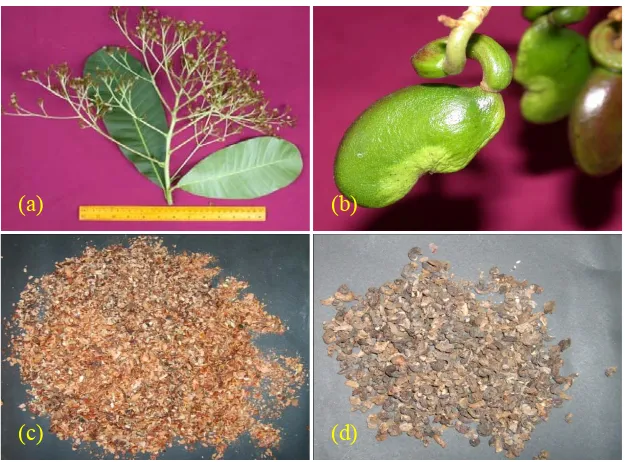
number 520397 (Figure 1). The material was thoroughly washed in water; leaves, fruits, flowers, bark, seed, seed coat and integument were separated and dried to the environment for 15 days until humidity between 7 and 15% (Figure 1). The dried material was powdered to size of 5 mm and stored in sterile conditions at 3°C until use. From 400 to 600g of dried material were brought under solid-liquid extraction by soxhlet technique for 15 days to obtain the total extract in ethanol. Partial liquid-liquid extraction was made in continuously using solvents in different polarities. Total extracts and fractions were concentrated using vacuum at 40°C (Santos et al., 2010). The antimicrobial activity was tested against Staphylococcus aureus and Bacillus subtilis (Gram positive) and Escherichia coli and
Salmonella (Gram negative) (Dobner et al.,
251
Table 1. Anacardium genus plants with chemical and biological activity
Plant Part Used Method / Assay / Determination Activity / Effect Metabolite Reference
Anacardium occidentale
Fruit: Anacardic acids extracted and HPLC purified.
RP-HPLC. Anion superoxide. Auto oxidation. Lipoxigenasa. DPPH. Uric Acid generate by Xantina Oxidized
Antioxidant. Anacardic acids: acid
6-pentadec(en) salicylic. Kubo et al., 2006 Fruit: Anacardic acids
extracted and HPLC purified.
HPLC. Nano-ESI-MS-MS, GC-MS and NMR. Cinamic acid. Anion superoxide. Uric acid. 2-deoxi guanosine.
Antioxidant.
Alkyl phenols: Anacardic acids, cardanols and cardols.
Trevisan et al., 2006
Extract from stem bark. Induced septic shock. Plasma leakage in
mouse skin. Inflammatory. No reported. Olajide et al., 2004
Extract from bark. Agar Diffusion. Antimicrobial. Tannins, alkaloids. Akimpelu, 2001
Fruit: Anacardic acids extracted and HPLC purified.
Macrodilution. Antibacterial. Acid 6-alqu(en)ilsalicylic. Kubo et al., 2003
Fruit Extracts. RP-HPLC. Agar Dilution. Antibacterial. Anacardic acids and
cardanols. Kubo et al., 1995
Fruit Extracts. RP-HPLC. UV-VIS. IR. RMN. Antimollusk.
Anacardic acids, cardanols, cardol and 2-methyl-cardol.
Kubo et al., 1986
Fruit Extracts. Mutagenicity.Promotion-initiation in mouse skin tumors. Cocarcinogenic. Mutagenic, carcinogenic, cocarcinogenic. No reported. George and Kuttan, 1997
Anacardium
excelsum All tree (in situ). Estimation of carbon in trees. Carbon Interchange. No reported. Losi et al., 2003 Anacardium
humile Total Extract.
Maceration. Qualitative assay of
functional groups. Anti ulcer. Bi flavonoids. Ferreira et al., 2004
Anacardium
giganteum Fruit Extracts.
HPLC. HRGC-MSD. RMN. Citotoxicity
of human cell lines. Antitumor.
Alkyl resorcinols and
acid 6-alkilsalic. Ramos et al., 2004
Anacardium semecarpus
Nuts Extracts. Necrosis tumor factor. Analysis hispatologic and radiologic.
Anti-arthritic
(rheumatoid arthritis). Metabolism of bones.
No reported. Ramprasath et al., 2006
Fruits Extracts in formulation ingredients.
Monitoring of lipids, enzymes of lipid
and lipoprotein metabolism. Anti-carcinogenic. No reported. Veena et al., 2006
No reported. Superoxide dismutase. Catalase and glutathione peroxidase. Lipid peroxides in tissues. Glutathione reductase.
Antioxidant. No reported. Ramprasath et al.,
252
Figure 1. (a) Anacardium exelsum plant with flowers; (b) fruit;
(c) powdered integument and (d) powdered fruit.
The antibacterial effect was classified based upon inhibition zone diameters, halo greater than 5mm present activity and halo iqual or lower than 5mm without activity (Jasir et al., 2004). Thin layer chromatography (TLC) and bioautography was realized to fractions with microbial activity using Silica gel G60 F254 alumina backed plates (3cm × 8cm). Two TLC plate were run, in the first, the sample was applied directly and the chromatograph was run. The layers were developed with Vanillin to determine the region with active compounds. The second chromatographic plate was run and placed in direct contact in the petri dishes with
Bacillus subtilis culture for 17h at 4°C.
Subsequently, plates were removed from each of the petri dishes and incubated at 35°C for 24h (Schmourlo et al., 2005). The active compounds were established in the region
where was generated growth inhibition of pathogenic microorganism. To identify the kind of compounds with antimicrobial activity was made a column chromatography according to the results of TLC and bioautography and the fractions obtained were analyzed by GC-MSD.
Results and Discussions
The results of extractions performed with different solvents polarities are shown in Table 2. The efficiency for ethanol extractions in dry material reached the higher yield for seed coat, fruit and seed with 44.6, 36.0 and 29.4% respectively, while the higher extraction efficiencies for partial fractions were: low polarity in fruits (61.7%), medium polarity in leaves (71.7%) and high polarity in bark (63.2%).
(a) (b)
253
Table 2. Weights of total extracts and partial extracts in differents solvents obtained from Anacardium excelsum.
Petrol DCM BuOH
Integument 53,4 23,8 23,8 5,1 2,4 12,6
Seed 614,8 140,1 98,1 6,4 4,1 42,6
Fruit 39,2 14,1 14,1 8,7 0,8 1,8
Flower 263,1 53,3 22,2 7,2 5,4 2,7
Seed Coad 476,7 61,3 34,8 10,6 11,1
---Bark 273,3 73,1 30,1 2,2 2,0 19,0
Leave 325,7 73,2 14,6 3,9 10,4
---Part Plant Dry Sample Weight [g] Total Extract in EtOH [g] Initial Weight [g]
Partial Extracts [g], in:
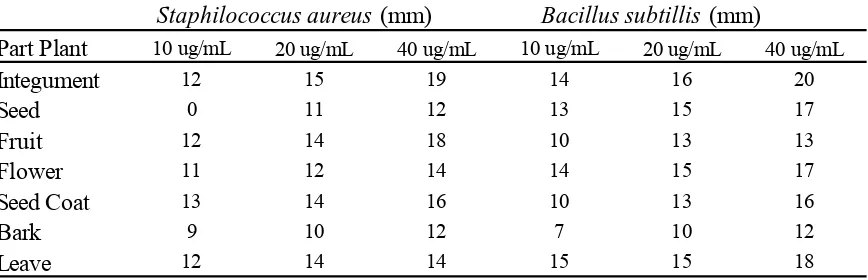
The results of antimicrobial activity (Figure 2) with total ethanolic extract not showed inhibition against Escherichia coli and
Salmonella, possibly these gram negative
microorganisms did not generate sensitivity to the total extracts, because of the complexity of its cell wall. Gram negative bacteria contain a very thick layer of peptideglycan composed of polysaccharides which develop links among themselves and also with amino acids preventing the entry of some kind of chemical compounds. In the other hand, Gran positive bacteria, Staphylococcus aureus and Bacillus
subtillis, were inhibited. The table 3 summaries the results of this inhibition.
The ethanolic extracts were fractioned with petroleum ether (petrol), dichloromethane (DCM) and butanol (BuOH) and used them in the microbial assay inhibition with Bacillus
subtillis. As result we found that only the
fraction of integument, seed and seed coat presented microbial inhibition (Table 4). The concentration used in this assay was 40 mg/ml and dissolved in DMSO. The positive control was gentamicin and negative control DMSO.
Table 3. Antimicrobial activity of total extracts from Anacardium excelsum in differents
concentration against Staphylococus aureus and Bacillus subtillis. The microbial activity
was measured according to the inhibition grown in milimeters (mm).
Staphilococcus aureus (mm) Bacillus subtillis (mm)
Part Plant 10 ug/mL 20 ug/mL 40 ug/mL 10 ug/mL 20 ug/mL 40 ug/mL
Integument 12 15 19 14 16 20
Seed 0 11 12 13 15 17
Fruit 12 14 18 10 13 13
Flower 11 12 14 14 15 17
Seed Coat 13 14 16 10 13 16
Bark 9 10 12 7 10 12
254
Table 4. Antimicrobial activity of partial extracts from Integument, seed and seed coad against Bacillus subtillis. The microbial activity was measured according to the inhibition grown in mm.
Partial Fraction (mm)
Part Plant Petrol DCM BuOH
Integumento 15 16 19
Seed 13 13 16
Seed Coad 17 11 13
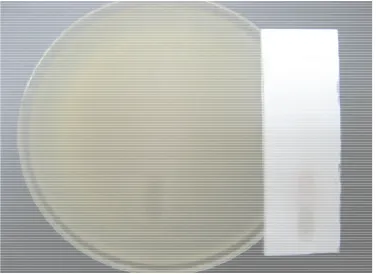
The bioautography assay was carried out only for the extracts that showed antimicrobial activity against Bacillus subtillis, using a silica gel TLC plates. Them were revealed with long-wave U.V. light and fluorescence was detected in the spots where are presents the
antimicrobial compounds. Clear inhibition zones in the Petri dishes incubated with TLC were observed to integument fraction. These bands are in different polarities but only the high polarity zone showed inhibition against Bacillus subtillis (Figure 3).
Figure 2. (a) Antimicrobial activity of total seed extract A. excelsum against Bacillus subtilis, A: 20 mg /
ml, B: 10 mg / ml, C: 40 mg / ml; (b) Antimicrobial activity of fractions obtained from ethanolic extracts of integument; A: petrol, B: Dichloromethane; C: Positive control (gentamicin); D: Ethanol.
Figure 3. Bioatography in TLC using DCM:MeOH (1:1) as movil phase to the fraction methanol/butanol obtained from integument of Anacardium excelsum.
255 To determine the type of compound microbiologically active was made a percolation column with different solvents using the polar fraction of integument. These fractions were analyzed in a gas chromatograph
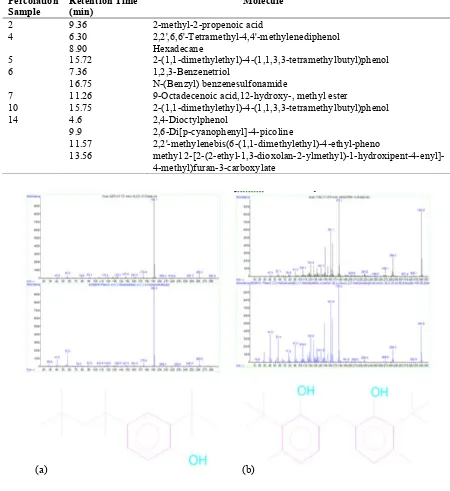
coupled a mass selective detector. Sixteen fraction from the percolation process were obtained and their analyses by GC/MSD are summarized in the table 5 and figure 4.
Table 5. Compounds identified by GC/MS, according to mass spectra library Wiley.
Percolation Sample
Retention Time (min)
Molecule
2 9.36 2-methyl-2-propenoic acid
4 6.30 8.90
2,2',6,6'-Tetramethyl-4,4'-methylenediphenol Hexadecane
5 15.72 2-(1,1-dimethylethyl)-4-(1,1,3,3-tetramethylbutyl)phenol 6 7.36
16.75
1,2,3-Benzenetriol
N-(Benzyl) benzenesulfonamide
7 11.26 9-Octadecenoic acid,12-hydroxy-, methyl ester 10
14
15.75 4.6 9.9 11.57 13.56
2-(1,1-dimethylethyl)-4-(1,1,3,3-tetramethylbutyl)phenol 2,4-Dioctylphenol
2,6-Di[p-cyanophenyl]-4-picoline
2,2'-methylenebis(6-(1,1-dimethylethyl)-4-ethyl-pheno
methyl 2-[2-(2-ethyl-1,3-dioxolan-2-ylmethyl)-1-hydroxipent-4-enyl]-4-methyl)furan-3-carboxylate
Figure 4. (a) 2-(1,1-dimethylethyl)-4-(1,1,3,3-tetramethylbutyl) phenol identified by GC/MS; (b) 2,2'-methylenebis(6-(1,1-dimethylethyl)-4-ethyl-phenol identified by GC/MS.
256 According to the results obtained by GC/MSD, it was achieved data only from the percolate samples number 2,4,5,6,7,10 and 14 which evidenced the presence of certain chemical groups derived from terpene, benzene and phenols. These results suggest that the possible compound with antimicrobial activity are the 2-(1,1-dimethylethyl)-4-(1,1,3,3-tetramethylbutyl)phenol present in the fraction 5 and 10 with retention time of 15.7 minutes and the 2,2'-methylenebis(6-(1,1-dimethylethyl)-4-ethyl-phenol found in the fraction 14 with retention time of 11.57 minutes. This kind of compounds has powerful antimicrobial and antiseptic properties resulting in an active germicidal action, due to its toxic potential (Routh, 1990). It is also possible to correlate the presence of this type of phenols with the results of the autobiography analysis where the band of very high polarity, was the one that showed higher antimicrobial activity against bacillus subtillis.
Conclusions
The data collected during chemical analysis and bioactivity test of Anacardium excelsum allows to draw following conclusions.
The extracts from leaves, fruits, coat, seed coat, seed, flower and bark of Anacardium excelsum have antimicrobial activity against gram positive bacteria Staphylococcus aureus and Bacillus subtilis and they are no active against gram negative bacteria Escherichia coli and Salmonella.
The ethanol fraction of seed coat and integument, and petrol fraction from seed coat have the higher antimicrobial activity against Bacillus subtilis, the activity was evidenced through autobiographical analysis.
It was evidenced by GC/MS the presence of phenolic compounds characteristic of Anacardiacea family which are associated with the high antimicrobial activity determined in the study.
Some of these phenolic compounds are toxic to the man but those present in the fruit of Anacardium excelsum specie are easily broken by temperature when cooked and used as food.
Acknowledgements
This research was financially supported by Vicerrectotia Academica-Pontificia Universidad Javeriana, project 000027.
References
Araujo, N. C. 2008. Árboles Nativos. En: Lexicón del Valle de Úpar. http://www. lablaa.org.
Bartholomaus, A., A. De La Rosa, J. Santos, L. Acero and W. Moosbrugger. 1995. El manto de la tierra, flora de los andes. Corporación autónoma regional de las cuencas de los ríos de Bogotá, Ubate y Suarez, CAR. Eschborn: Sociedad alemana de cooperación técnica, GTZ. Santa fe de Bogotá, Colombia. p. 17
Cáceres, H. 1980. Extracción y evaluación de los taninos presentes en la corteza del
Anacardium Excelsum (Caracolí).
Universidad industrial de Santander Facultad de ciencias, centro de investigaciones en celulosa, pulpa y papel. Bucaramanga. pp 1-8.
Dobner, M., S. Schwaiger, I. Jenewein and H. Stuppner 2003. Antibacterial activity of
Leontopodium alpinum (Edelweiss). J.
Ethnopharmacol. 8:301-303.
Espinal, L. 1963. Algunos arboles y arbustos que se encuentran en Colombia. Instituto geográfico Agustín Codazzi. Bogotá. p. 12. Ferreira, A. L., A. M. Vinagre, V.
Basrbastefano, M. Cola, C. A. Hiruma, C. B. Serra, W. Vilegas and A. R. Souza. 2004. Estudio de la actividad antiulcerogénica del extracto bruto metanólico de Anacardium humile St. Hil. (Anacardiaceae). Rev. Cubana Plant. Med. 9:69.
George, J. and R. Kuttan 1997. Mutagenic, Carcinogenic and cocarcinogenic activity of cashewnut shell liquid. Cancer Lett. 112:11-16.
Gram-257 positive pathogensndian. J. Med. Res. 74-76.
Kubo, I., S. Komatsu and M. Ochi. 1986. Molluscicides from the cashew
Anacardium occidentale and their
large-scale isolation. J. Agric. Food Chem. 34:970-973.
Kubo, I., H. Muroi and A. Kubo. 1995. Structural funtions of antimicrobial long-chain alcohols and phenols. Bioorg. Med. Chem. 3:873-880.
Kubo, I., K. I. Nihei and K. Tsujimoto. 2003. Antibacterial action of anacardic acids against methicillin resistant Staphylococcus
aureus (MRSA). J. Agric. Food Chem.
51:7624-7628.
Kubo, I., N. Masuoka, T. J. Ha and K. Tsujimoto. 2006. Antioxidant activity of anacardic acids. Food Chem. 99:555-562. Losi, C. J., T. G. Siccama, R. Condit and J. E.
Morales. 2003. Analysis of alternative methods for estimating carbon stock in young tropical plantations. Forest Ecol. Manag. 184:355-368.
Nichols, D. and E. González. 1991. Especies nativas y exóticas para la reforestación en la zona sur de Costa Rica. OET-DGF-UNED. Costa Rica.
Olajide, O. A., M. A. Aderogba, A. D. A. Adedapo and J. M. Makinde. 2004. Effects
of Anacardium occidentale stem bark
extract on in vivo inflammatory models. J. Ethnopharmacol. 95:139-142.
Programa Colombia Forestal. 2005. Recopilación y actualización autorizada de la base de datos de especies Industriales Menos Utilizadas de OIMT. realizada por el USAID/Chemonics Intl. Yokohama. Ramos, F. A., C. Osorio, C. Duque, C.
Cordero, L. Aristizába, F. C. Garzón and Y. Fujimoto. 2004. Estudio químico de la nuez del marañón gigante (Anacardium
giganteum). Rev. Acad. Colomb. Cienc.
28:565-576.
Ramprasatha, V. N., P. Shanthib and P. Sachdanandam. 2005. Evaluation of antioxidant effect of Semecarpus
anacardium Linn. nut extract on the
components of immune system in adjuvant arthritis. Vascular Pharmacol. 42:179-186. Ramprasatha, V. N., P. Shanthib and P.
Sachdanandam. 2006. Curative effect of
Semecarpus anacardium Linn. nut milk
extract against adjuvant arthritis - with special reference to bone metabolism. Chemico-Biol. Interact. 160:183-192.
Santos, D., P. Veggi and A. Meireles. 2010. Extraction of antioxidant compounds from Jabuticaba (Myrciaria cauliflora) skins: Yield, composition and economical evaluation. J. Food Eng.101:23-31.
Schmourlo, G., R. Mendoca-Filho, A. Celuta and S. Costa. 2005. Screening of antifungal agents using ethanol precipitation and bioautography of medicinal and food plants. J. Ethnopharmacol. 96:563-568. Smith, N., S. Mori, A. Henderson, D.
Stevenson and S. Heald. 2004. Flowering plants of the Neotropics. The New York botanical garden. Published by Princeton university press. USA, New Jersey. pp.14-16
Smithsonian Tropical Research Institute. 2008. Center for Tropical Forest Science. En: http://ctfs.si.edu/. Consultada el 20 de Mayo de 2008.
Trevisan, M. T. S., B. Pfundstein, R. Haubner, G. Würtele, B. Spieglehalder, B. Bartsch, and R.W. Owen. 2006. Characterization of alkyl phenols in cashew (Anacardium
occidentale) products and assay of their
antioxidant capacity. Food Chem. Toxicol. 44:188-197.
Veena, K., P. Shanthi and P. Sachdanandam. 2006. The Biochemical alterations following administration of kalpaamruthaa
and Semecarpus Anacardium in mammary