Original Research Article
A study on awareness of health effects of tobacco consumption among
medical students and impact of modular training
Sajjan Madappady
1, Hemant Kumar
1*, S. Jayaram
1, Krutarth Brahmbhatt
2, Manjula Anil
1,
Tamal Chakraborty
3, Shwethashree
4, Sindhushree H. R.
5INTRODUCTION
The tobacco epidemic is one of the biggest public health threats the world has ever faced, killing more than 7 million people a year, a figure that is predicted to grow to more than 8 million a year by 2030 without intensified action. More than 6 million of these deaths are the result of direct tobacco use while around 890,000 are the result of non-smokers being exposed to second-hand smoke. Nearly 80% of the more than 1 billion smokers
worldwide live in low- and middle-income countries, where the burden of tobacco-related illness and death is the heaviest.1 In some countries, children from poor households are frequently employed in tobacco farming to raise family income rendering them vulnerable to "green tobacco sickness", which is caused by the nicotine that is absorbed through the skin from the handling of wet tobacco leaves. Tobacco users, whether using cigarettes, bidis or other forms of smokeless tobacco, develop serious illness, die prematurely, deprive their families of
ABSTRACT
Background: Tobacco kills more than seven million people each year. In India tobacco kills nearly one million people each year and many of these deaths occur among people who are very young. Studies indicate that approximately 70% of all tobacco users would like to quit smoking and tobacco use.
Methods: A non-randomized, cross sectional study was conducted in a Medical College in Mangaluru (Karnataka) which included medical students from first year to third year. A module developed by “Quit Tobacco International” was used for the purpose of training and counselling the selected medical students, focusing on the specific effects of tobacco, depicting simulated case scenarios.
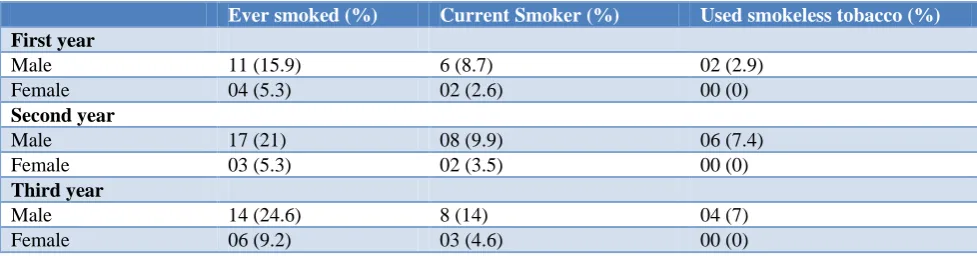
Results: A total of 404 medical students were included in the study. It was observed that 15.9% males and 5.3% females among first year students, 21.0% males and 5.3% females among second year students and 24.6% males and 9.2% females among third year students had smoked at some point in their life while the among current users, the prevalence of smoking was found to be much higher i.e. 8.7% and 2.6% among first year students, 9.9% and 3.5% among second year students; while it as highest among third year students i.e. 14% and 4.6%; among boys and girls respectively.
Conclusions: The study brings out the need for inclusion of structured teaching and training of our medical students on harmful effects of tobacco use and its cessation techniques.
Keywords: Smoking, Students, Doctors, Training, Nurses, Prevalence
Department of Community Medicine, 1AJIMS &RC Mangalore, Karnataka; 2GMERS Medical College, Gujarat;
3
Tripura Medical College, Tripura; 4JSS Medical College, Mysore, Karnataka, India
5
A J Hospital, Mangalore, Karnataka, India
Received: 14 June 2018
Revised: 25 July 2018
Accepted: 26 July 2018
*Correspondence:
Dr. Hemant Kumar,
E-mail: [email protected]
Copyright: © the author(s), publisher and licensee Medip Academy. This is an open-access article distributed under the terms of the Creative Commons Attribution Non-Commercial License, which permits unrestricted non-commercial use, distribution, and reproduction in any medium, provided the original work is properly cited.
income, raise the cost of health care and hinder economic development.2 Recent research estimates that the total economic cost of smoking globally amounts to 2 trillion dollars, when adjusted for 2016 purchasing power parity (PPP), is equivalent to almost 2% of the world‟s total economic output”.3
Tobacco is one of the major causes of death and disease in India, accounting for nearly one million deaths every year while India has 11.2% of the world‟s total smokers.4 China, India, and Indonesia are the three leading countries which account for 50.0% of the world‟s male smokers, while USA, China and India, account for 27.0% of the world's female smoker.5 According to a study, tobacco related diseases cost India, Rs. 1,04,500 crore (over $15 billion) in 2011. Out of these, the direct medical costs were Rs. 16,800 crores while indirect morbidity costs were Rs. 14,700 crores. The cost of premature mortality was estimated to be about Rs. 73,000 crores, indicating a substantial productive loss to the nation.6
Reducing tobacco-related morbidity and mortality is a global health priority that requires both tobacco prevention and cessation efforts. To date, far more attention has been focused on prevention rather than cessation, especially in low and middle income countries. Research has shown that approximately 70% of all tobacco users would like to quit, though, only less than 10% of them are successful in a given attempt. But a simple advice from a physician has been shown to increase abstinence rates nearly by 30%, as compared to those with "no advice". Likewise, nursing-led interventions for smoking cessation have also shown an increase of nearly 50%.7,8 These studies clearly indicate the challenge and need of raising knowledge and skills of medical college faculties,students and the paramedical staff about the harmful effects of tobacco use and its cessation; and culturally appropriate style of counselling the patients.
These challenges were taken up by "Project Quit Tobacco International (QTI) 2002–2007", a multidisciplinary team of tobacco researchers from the University of Arizona, Sree Chitra Tirunal Institute of Medical Science and Technology, Kerala, India, and Gajah Mada University, Indonesia. This research team has spent last ten years developing tobacco cessation curricula for medical colleges in India and Indonesia, adopting evidence-based cessation approaches to fit local cultures, and promoting community-based smoke free home campaigns as a means of reducing women and children‟s exposure to second-hand smoke. They also found that medical colleges dedicated little time to tobacco as a disease risk factor. Calling attention to the negative effects of tobacco on organ systems, disease processes, or medicine effectiveness was left to individual faculty members and was not a mandated part of the formal medical curriculum. It was further observed that "cessation skills" were not covered in medical college classes nor
demonstrated in the wards or during community medicine postings.9
These research findings led to a conclusion that it was necessary to develop a different type of tobacco curriculum for medical colleges and integrate tobacco education into all semesters of the medical curriculum as a means to tie illness and organ-specific information to tobacco cessation.10 Only in this way would young doctors be trained to establish the relevance of advice on "Quit Tobacco" during medical consultations with their patients.
In the backdrop of above, present study had been planned to assess the knowledge levels of medical students regarding harmful health effects of tobacco consumption and empower them with appropriate skills of counselling the patients to quit tobacco use.
Objective
To assess the awareness among medical students on harmful effects of tobacco use and impact of modular training on their knowledge and patient counseling skills.
METHODS
A cross sectional, non -randomized, institution based interventional study was carried out at A.J. Institute of Medical Science and Research Centre, Mangaluru (Karnataka) which included medical students from first year to third year, except those who were unwilling or were absent even after two visits. A module developed by “Quit Tobacco International” was used for the purpose of training and counselling of subject medical students, focusing on the specific harmful effects of tobacco use, depicting simulated case scenarios.
Ethical clearance as well as permission was obtained from the AJ Institute of Medical sciences &Research Centre, Mangaluru as well as from “Quit Tobacco India” developers (University of Arizona Tucson, Arizonan) to conduct the study. Further, the researchers were trained by the Quit Tobacco India team adequately, well before the research was started. Informed written consents were taken from each student. The period of study was one year i.e. from 01 July 2014 to 30 June 2015. Module used for training of medical students has been summarised in Table 1.
Five sessions were conducted for first year students, 10 for second year students & 20 for third year students. The duration of each session was one hour.
Table 1: Breakdown of topics used in the training module for medical students.
First year Second year Third year
1. Tobacco issues in basic medical practice and professionalism.
2. Tobacco and community medicine and public health. 3. Tobacco and adolescent
health.
First year topics and : 1. Effects of tobacco on the
cardiovascular system. 2. Effects of tobacco on the
respiratory system.
3. Tobacco and the
gastrointestinal system.
4. Tobacco and endocrine
problems.
First year and Second year topics and :
1. Tobacco and other metabolic
disorders.
2. Tobacco and mental health.
3. Tobacco and depression and anxiety.
4. Tobacco and musculoskeletal pain.
5. Tobacco and neoplasia.
6. Tobacco and the nervous system.
7. Tobacco and the reproductive system.
8. Tobacco and sensory organs.
9. Tobacco and uropoetics.
10. Tobacco and children‟s health.
Subsequent sessions were dedicated to teaching and training of the students with the help of module developed by “Quit Tobacco International' while last session was allocated for assessment of knowledge gained after training using the same questionnaire administered during the first session. Students who were absent for less than 2 classes, were given additional training sessions. Finally, Pre and Post -test evaluation was carried out.
Statistical analysis
The data was analyzed using SPSS version 16 and results were presented in narratives and tables. Descriptive
statistics such as frequency, percentage, mean, and standard deviation were used to interpret the data. Mc Nemar's test as used to assess the significance of the difference. A p<0.05 were considered significant.
RESULTS
A total of 404 medical students were included in the study with 207 males and 197 females. Out of these 145 students were studying in first year i.e. 69 (48%) males and 76 (52%) females, 138 students were in second year i.e. 57 (41%) females and 81 (59%) males, while 121 students were in third year i.e. 57 (47%) males and 64 (53%) females (Table 2).
Table 2: Gender distribution of the medical students of first year (n=145), second year (n=138) and third year (n=121) students (total n=404).
Gender First year (%) Second year (%) Third year (%) Total (%)
Male 69 (48) 81 (59) 57 (47) 207 (51)
Female 76 (52) 57 (41) 64 (53) 197 (49)
Total 145 (100) 138 (100) 121 (100) 404 (100)
Table 3: Smoking habit among medical students according to gender; (n=145), second year (n=138) and third year (n=121) students.
Ever smoked (%) Current Smoker (%) Used smokeless tobacco (%)
First year
Male 11 (15.9) 6 (8.7) 02 (2.9)
Female 04 (5.3) 02 (2.6) 00 (0)
Second year
Male 17 (21) 08 (9.9) 06 (7.4)
Female 03 (5.3) 02 (3.5) 00 (0)
Third year
Male 14 (24.6) 8 (14) 04 (7)
Female 06 (9.2) 03 (4.6) 00 (0)
Table 3 shows that 11 (15.9%) males and 4 (5,3%) females among first year students, 17 (21%) males and 3 (5.3%) females among second year students and 14 (24.6% ) males and 6 (9.2%) females among third year students had smoked at least one cigarette / bidi at some
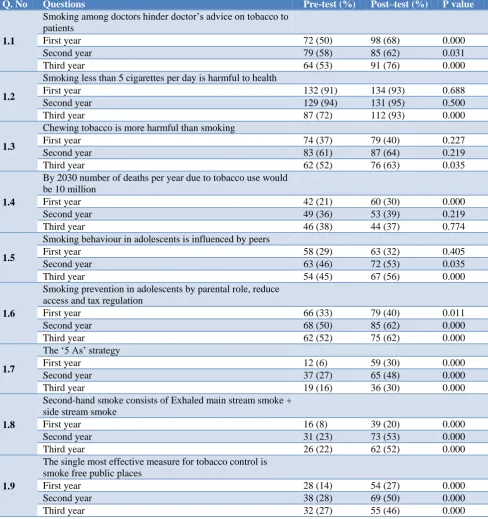
Table 4: Pre and post-test knowledge assessment of first year (n=145), second year (n=138) and third year (n=121) students.
Q. No Questions Pre-test (%) Post–test (%) P value
1.1
Smoking among doctors hinder doctor‟s advice on tobacco to patients
First year 72 (50) 98 (68) 0.000
Second year 79 (58) 85 (62) 0.031
Third year 64 (53) 91 (76) 0.000
1.2
Smoking less than 5 cigarettes per day is harmful to health
First year 132 (91) 134 (93) 0.688
Second year 129 (94) 131 (95) 0.500
Third year 87 (72) 112 (93) 0.000
1.3
Chewing tobacco is more harmful than smoking
First year 74 (37) 79 (40) 0.227
Second year 83 (61) 87 (64) 0.219
Third year 62 (52) 76 (63) 0.035
1.4
By 2030 number of deaths per year due to tobacco use would be 10 million
First year 42 (21) 60 (30) 0.000
Second year 49 (36) 53 (39) 0.219
Third year 46 (38) 44 (37) 0.774
1.5
Smoking behaviour in adolescents is influenced by peers
First year 58 (29) 63 (32) 0.405
Second year 63 (46) 72 (53) 0.035
Third year 54 (45) 67 (56) 0.000
1.6
Smoking prevention in adolescents by parental role, reduce access and tax regulation
First year 66 (33) 79 (40) 0.011
Second year 68 (50) 85 (62) 0.000
Third year 62 (52) 75 (62) 0.000
1.7
The „5 As‟ strategy
First year 12 (6) 59 (30) 0.000
Second year 37 (27) 65 (48) 0.000
Third year 19 (16) 36 (30) 0.000
1.8
Second-hand smoke consists of Exhaled main stream smoke + side stream smoke
First year 16 (8) 39 (20) 0.000
Second year 31 (23) 73 (53) 0.000
Third year 26 (22) 62 (52) 0.000
1.9
The single most effective measure for tobacco control is smoke free public places
First year 28 (14) 54 (27) 0.000
Second year 38 (28) 69 (50) 0.000
Third year 32 (27) 55 (46) 0.000
Table 4 shows pre and post-test knowledge assessment of first year (n=145), second year (n=138) and third year (n=121) subject students.
Figure 1 displays awareness levels for question 1.1 - "Smoking among doctors hinders doctor‟s advice on tobacco to patient‟s and it shows statistically significant increase in the knowledge after imparting modular training i.e. from 50% to 68% (p<0.000) among first year students, from 58% to 62% (p<0.031) among second year
students and from 53% to 76% (p<0.000) among third year students.
Figure 1: Smoking among doctors hinder doctor’s advice on tobacco to patients.
Figure 2: Smoking less than 5 cigarettes per day is harmful to health.
Figure 3: Chewing tobacco is more harmful than smoking.
Figure 3 displays awareness levels for question 1.3 - "Chewing tobacco is more harmful than smoking" and it shows an increase from 37% to 40% (p<0.227) among first year students, from 61% to 64% (p< 0.219) among second year students and from 52% to 63% (p<0.035) among third year students and it was also found to be statistically significant.
Figure 4 displays awareness levels for question 1.4 - "By 2030 number of deaths per year due to tobacco use would be 10 million" and it shows an increase from 21% to 30% (p<0.000) among first year students (which was found to be statistically significant), 36% to 39% (p<0.219) among
second year students and 38% to 37% (p< 0.774) among third year students.
Figure 4: By 2030 number of deaths per year due to tobacco use would be 10 million.
Figure 5: Smoking behaviour in adolescents is influenced by peers.
Figure 5 displays awareness levels for question 1.5 - "Smoking behaviour in adolescents is influenced by peers?" and it shows an increase from 29% to 32% (p<0.405) among first year students, from 46% to 53% (p< 0.035) among second year students (which was found to be statistically significant), and from 45% to 56% (p< 0.000) among third year students; while this too was found to be statistically significant.
Figure 6: Smoking prevention in adolescents by parental role, reduce access and tax regulation.
Figure 6 displays awareness levels for question 1.6 -"Smoking prevention in adolescents by parental role,
50
58
53 68
62
76
First year Second year Third year
PRE TEST POST TEST
91 94
72
93 95 93
First year Second year Third year
PRE TEST POST TEST
37
61
52
40
64 63
First year Second year Third year
PRE TEST POST TEST
21
36 38
30
39 37
First year Second year Third year
PRE TEST POST TEST
29
46 45
32
53 56
First year Second year Third year
PRE TEST POST TEST
33
50 52
40
62 62
First year Second year Third year
reduce access and tax regulation ", and it shows statistically significant increase in the knowledge levels among all students i.e. from 33% to 40% (p<0.011) among first year students, from 50% to 62% (p<0.000) among second year students and from 52% to 62% (p<0.000) among third year students.
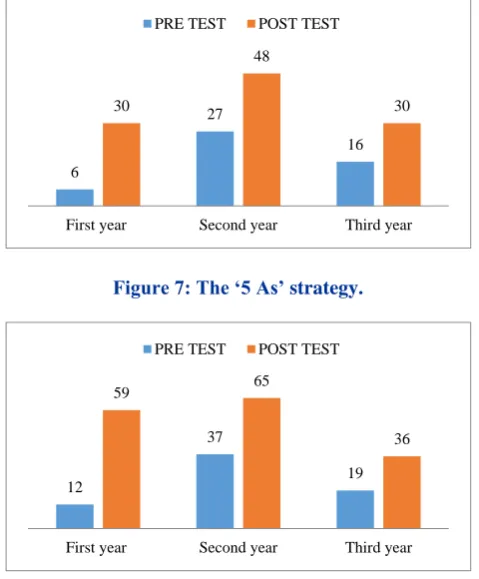
Figure 7 displays awareness levels for question 1.7 - "Is 5 As strategy really effective?", and it shows statistically significant increase in the knowledge level among all the subject students i.e. from 06% to 30% (p<0.000) among first year students, from 27% to 48% (p<0.000) among second year students and from 16% to 30% (p<0.000) among third year students.
Figure 7: The ‘5 As’ strategy.
Figure 8: Second-hand smoke consists of exhaled main stream smoke + side stream smoke.
Figure 8 display awareness levels for question 1.8- "Second-hand smoke consists of Exhaled main stream smoke + side stream smoke" and it shows statistically significant increase in the knowledge level of all the subject students i.e. from 12% to 59% (p<0.000) among first year students, from 37% to 65% (p<0.000) among second year students and from 19% to 36% (p<0.000) among third year students.
Figure 9 display awareness levels for question 1.9 - "The single most effective measure for tobacco control is smoke free public places" and it shows statistically significant increase in the knowledge level of all subject students i.e. from 14% to 27% (p<0.000) among first year students, from 28% to 50% (p<0.000) among second year students and from 27% to 46% (p<0.000) among third year students.
Figure 9: the single most effective measure for tobacco control is smoke free public places.
Table 5 brings out that 98% of first year, 98% of second year and 99% of third year students found tobacco module implementation was useful in understanding the ill effects as well as the importance of tobacco cessation. About 81% of first year, 81% of second year and 86% of third year students were confident of providing tobacco cessation counselling to patients. About 98% of first year, 98% of second year and 99% of third year students were willing to have more training on tobacco cessation.
Table 5: Opinions on usefulness of the quit tobacco international modules (n=145), second year (n=138) and third year (n=121) students.
S.no. Questions First year (%) Second year (%) Third year (%)
4.1 Has the tobacco module implementation helped you
in understanding the ill effects of Tobacco 127 (88) 120 (87) 108 (90)
4.2
Has the tobacco module implementation helped you in understanding the importance of tobacco
cessation
125 (87) 119 (87) 109 (91)
4.3
In future, are you confident of providing tobacco cessation to your patients or helping patients to quit tobacco use
116 (81) 111 (81) 103 (86)
4.4 Do you wish to have more training on tobacco
cessation 141 (98) 134 (98) 119 (99)
6
27
16 30
48
30
First year Second year Third year
PRE TEST POST TEST
12
37
19
59 65
36
First year Second year Third year
PRE TEST POST TEST
14
28 27
27
50
46
First year Second year Third year
DISCUSSION
It has been well established that for a downward shift in tobacco use to occur, healthcare providers must be at the forefront of tobacco cessation and control policies. To do so, they need both - quit using tobacco themselves and start advising patients to quit. Research has established beyond doubt that an advice from a doctor to a patient can significantly impact the rate as well as the desire to quit smoking.11-13
In a study conducted by the QTI in Kerala, India, it was observed that 35.3% of doctors, including medical college faculties, always enquired about tobacco use during routine medical practice from patients who presented with diseases such as lung cancer, tuberculosis, chronic obstructive lung disease, and other severe respiratory illnesses and advised them to quit the use of tobacco. However, most messages given to patients by doctors were general in nature and not illness-specific. Further, the doctors who had never smoked, were three times more likely to advise their patients to quit tobacco as compared to those who were current smokers. The results of QTI study suggested that a comprehensive tobacco control education programme was necessary in medical colleges linking illness-specific tobacco facts to cessation practice.14-16
Our study subjects comprised of 51% males and 49% females. Similar results were also reported by Sreeramareddy et al in their study in Malaysia, India, Pakistan, Nepal, and Bangladesh who found an overall proportion of male and female students in their study as 50.7% and 48.2% respectively. In all the countries the proportion of male to female students was nearly 50% except Pakistan (65% were females) and Nepal (67% were males).17
In the present study, the prevalence of smoking among male students was found to be 8.7%, 9.9% and 14% in first year, second year and third year respectively, whereas among female students it was 2.6%, 3.5% and 4.6% in first, second and third year respectively. The prevalence of smokeless tobacco was found to be 2.9% among first year male students, 7.4% among second year and 7% among third year students, while there were no smokeless tobacco users among female students.
Mony et al in their study at Bangalore and Coimbatore; among medical and nursing students observed that 14.5% of students had ever experimented with tobacco; 12.9% with smoking and 3.6% with chewing. Current tobacco use was reported to be 1.6% (1.5% were current smokers and 0.4% were current chewers). The prevalence of smoking among male medical, female medical and female nursing students was found to be 4%, 0.3% and 0%, respectively. The prevalence of smoking was found to be much higher among medical students in Coimbatore i.e. 4.6% as compared to Bangalore which was only 0.8%.18
Sreeramareddy et al in their study among medical students in Malaysia, India, Pakistan, Nepal, and Bangladesh found an overall prevalence of 'ever smokers' and 'current smokers' to be 31.7% and 13.1% respectively. Majority (80%) of students asked the patients about their smoking habits during clinical postings/clerkships, while only one third of them did counselling, and assessed the patients' willingness to quit. Majority of the students agreed about doctors' role in tobacco control as crucial, and felt that there was a need for training about tobacco cessation in medical schools. About 50% of them also agreed that albeit current curriculum teaches about tobacco smoking but not systematically and should be included as a separate module. Prevalence of „ever smokers‟ was found to be highest in Bangladesh (38.8%), followed by Malaysia (34.5%) while it was lowest in India (10.1%). Prevalence of smoking among males was higher than females in all the countries. Male students were more both, as „ever smokers‟ as well as „current smokers‟.17
Post test knowledge on "Smoking less than 5 cigarettes per day is harmful to health"showed an increase among all students but among third year students the difference in increase was also found to be statistically significant. However, in a study by Mony, et al, the results showed, that majority (65%) of the study subjects were of the opinion that tobacco had limited addictive potential and a sizeable proportion (48%) perceived the so-called „light‟ cigarette smoking to be less harmful.18
In our study, a large majority of students found tobacco module implementation were useful in understanding the ill effects of tobacco. Hayes et al in a multi-centric randomised control trial among medical students also observed that a tobacco treatment training intervention or curriculum that can effectively target physicians-in-training, their preceptors, and their broader medical school policies and educational practices, is needed given the important role of formative medical skill training and the clinical and public health impact of the physician on smokers.19
CONCLUSION
Limitation
Self-reported information was not validated by any objective measures. However, self-reports have been established to be reliable and are commonly used in epidemiological research. It has also been reported that non-response bias may be fewer in health professionals‟ surveys as compared to those of the general public.
ACKNOWLEDGEMENTS
We humbly acknowledge with gratitude the immense support and help provided during the conduct of this study by Dr. Unnikrishnan B and Dr. Rekha Thapar of KMC Mangalore, Dr. Mark Nichter and Dr. Mimi Nichter, from "Quit Tobacco India Developers” (University of Arizona Tucson, Arizonan); and Dr. P.V Kurulkar, Dr. Prasanna Mithra P, Dr. Maria Nelliyil, Dr.Pradeep Senapathi and Dr. Chethana K. Rao of AJIMS &RC Mangalore.
Funding: Present research was funded and supported by Quit Tobacco India Project-Building Capacity for Tobacco Cessation in India - Fogarty International Centre of National Institute of Health, USA, through the University of Arizoana, USA
Conflict of interest: None declared
Ethical approval: The study was approved by the Institutional Ethics Committee from the AJ Institute of Medical sciences &Research Centre, Mangaluru as well as from “Quit Tobacco India” developers (University of Arizona Tucson, Arizonan) before conduct of the the study
REFERENCES
1. WHO. Tobacco. Fact sheet. 2017. Available at: http://www.who.int/mediacentre/factsheets/fs339/en /. Accessed on 14 June 2018.
2. Chapanda JP. Assessing the impact of tobacco farming in poverty alleviation: the case of small holder centenary farmers. 2016. Available at: http://ir.msu.ac.zw:8080/jspui/bitstream/11408/2168 /1/julliet%20 dissertation%20final.pdf. Accessed 14 June 2018.
3. WNTD 2017– Global Costs of Smoking.
http://www.tobaccoatlas.org/news/wntd-2017-global-costs-of-smoking/. Accessed on 14 June 2018.
4. Mishra GA, Pimple SA, Shastri SS. An overview of
the tobacco problem in India. Indian J Med Paediatr Oncol. 2012;33(3):139-45.
5. Noise Break.India Among Highest Four Countries In Death By Smoking. http://noisebreak.com/india-among-highest-four-countries-death-smoking. Accessed 14 June 2018.
6. Economic burden of tobacco related diseases in
India. Available at: http://www.searo.who.
int/india/topics/tobacco/economic_burden_of_tobac
co_related_diseases_in_india_executive_summary.p df. Accessed 14 June 2018.
7. Fiore MC, Bailey WC, Cohen SJ, Dorfman SF,
Goldstein MG, Gritz FR. Treating tobacco use and dependence: Clinical practice guideline. Rockville, MD: US Department of Health and Human Services, Public Health Service; 2000. Accessed 14 June 2018.
8. Hughes JR, Gulliver SB, Fenwick JW, Valliere WA,
Cruser K, Pepper S, et al. Smoking cessation among self-quitters. Health Psychol. 1992;11:331–4. 9. Quit tobacco international Project Team, India.
Available at: https://quittobaccointernational.org/ team-india.html. Accessed 14 June 2018.
10. Yamini TR, Nichter M, Nichter M, Sairu P,
Aswathy S, Leelamoni K, et al. Developing a fully integrated tobacco curriculum in medical colleges in India. BMC Medical Education. 2015;15:90.
11. Lancaster T, Stead L, Silagy C, Sowden A.
Effectiveness of interventions to help people stop smoking: Findings from the Cochrane Library. BMJ. 2000;321:355–8.
12. Kottke TE, Battista RN, DeFriese GH, Brekke ML.
Attributes of successful smoking cessation
interventions in medical practice: A meta-analysis of 39 controlled trials. JAMA. 1988;259:2883–9.
13. Eckert T, Junker C. Motivation for smoking
cessation: What role do doctors play? Swiss Med Wkly. 2001;131:521–6.
14. Nichter M, Nichter M, Padmavathi S, Thresia CU. Anthropological contributions to the development of culturally appropriate tobacco cessation programs: A global health priority. In: Hahn RA, Inhorn MC (eds). Anthropology and public health: Bridging the differences in culture and society, 2nd ed. Oxford University Press, New York; 2009: 298–331.
15. Mohan S, Pradeepkumar AS, Thresia CU,
Thankappan KR, Poston WSC, HaddockCK, et al. Tobacco use among medical professionals in Kerala, India: The need for enhanced tobacco cessation and control efforts. Addict Behav. 2006;31:2313–8.
16. Thankappan KR, Pradeepkumar AS, Nichter M.
Doctors‟ behaviour and skills for tobacco cessation in Kerala. Indian J Med Res. 2009:129:249–55. 17. Sreeramareddy CT, Suri S, Menezes RG, Kumar
HN, Rahman M, Islam MR, et al. Self-reported tobacco smoking practices among medical students and their perceptions towards training about tobacco smoking in medical curricula: A cross-sectional, questionnaire survey in Malaysia, India, Pakistan, Nepal, and Bangladesh. Subst Abuse Treat Prev Policy. 2010;5:29.
18. Mony PK. Is tobacco use increasing among medical
students of Bengaluru city, India? Evidence from two cross-sectional studies. Natl Med J India. 2016;29(5):274-6.
during medical school: rationale and design of the Medical Students helping patients Quit tobacco (MSQuit) group randomized controlled trial. Contemporary Clin Trials. 2014;37:284–93.