http://www.ijcmph.com pISSN 2394-6032 | eISSN 2394-6040
Original Research Article
Perception of private practitioners towards diagnosis and treatment of
tuberculosis in Hubballi city, India
Sachin Kumar Patil*, Geeta V. Bathija
INTRODUCTION
Tuberculosis (TB) has existed for millennia and remains a major global health problem. It causes ill-health in millions of people each year and in 2015 was one of the top 10 causes of death worldwide, ranking above HIV/AIDS as one of the leading causes of death from an infectious disease.1India accounts for one fourth of the global TB burden. In 2015, an estimated 28 lakh cases occurred and 4.8 lakh people died due to TB. India reports highest burden of both TB and multi drug resistant (MDR). An estimated 1.3 lakh incident multi-drug resistant TB patients emerge annually in India.1
The Revised National Tuberculosis Control Programme (RNTCP) is being implemented in the country since 1997 with complete coverage by March 2006, with diagnostic and treatment services integrated throughout public sector.2 Since inception, the programme has treated more than 20 million TB patients. The programme aims to achieve „Universal Access‟ for quality diagnosis and treatment for all TB patients in the country.3 The incidence of TB has reduced from 289 per lakh per year in 2000 to 217 per lakh per year in 2015 and the mortality due to TB has reduced from 56 per lakh per year in 2000 to 36 per lakh per year in 2015. The RNTCP notified 17.5 lakh TB patients in 2016 including both from public and ABSTRACT
Background: Private sector accounts more than third of all out- patient visit in India. For Revised Nation Tuberculosis Control Programme (RNTCP) to broaden its reach and have maximum impact, the involvement of private practitioners (PPs) in the programme plays a prime role. Objectives of the study were to assess the knowledge, attitude and practice of PPs about diagnosis and management of tuberculosis patient and their involvement RNTCP.
Methods: A cross sectional study was conducted among 120 private medical practitioners of Hubballi Taluk, Dharwad district, Karnataka during June-July 2017. Using a pre-designed and semi-structured questionnaire data regarding their specialization, TB management practices, attitude towards DOTS (Directly Observed Treatment -short course), barriers in referring to RNTCP and notification from PPs at their clinic was collected.
Results: Cough with sputum not relieved with antibiotics lead to suspicion of tuberculosis according to 80.8% of practitioners and 75.8 % preferred both sputum examination and chest x-ray for diagnosis of tuberculosis. 79% of private practitioners were aware of notification regarding TB case. Need for notification according to 63.3% of practitioners was to help in tracing contacts and further prevention of TB, follow up of patients (40%). Only 23.3% had heard of Nikshay. 42.5% referred patient to RNTCP and major reason was availability of free drugs (76.6%).
Conclusions: The awareness and involvement of PPs regarding RNTCP & its initiatives were low. There is a need for measures to improve training and interactions with PPs by programme officers to insure their Maximum participation.
Keywords: Tuberculosis, Private practitioners, RNTCP, Notification, DOTS
Department of Community Medicine, Karnataka Institute of Medical Sciences, Hubballi, Karnataka, India
Received: 04 March 2018
Accepted: 29 March 2018
*Correspondence:
Dr. Sachin Kumar Patil,
E-mail: [email protected]
Copyright: © the author(s), publisher and licensee Medip Academy. This is an open-access article distributed under the terms of the Creative Commons Attribution Non-Commercial License, which permits unrestricted non-commercial use, distribution, and reproduction in any medium, provided the original work is properly cited.
private health sector and 33,820 drug resistant TB patients are notified additionally.3
In India, private practitioners (PPs) of medicine are widely distributed in rural and urban areas. The private sector accounts for 82% of all outpatient visits at all levels of health care, with no significant variation by income group. More than half of patients with TB in India prefer to seek their treatment at private sectors, which most of times serves as first point of care before referral to public sector. It‟s been reported that 50% of treatment cases notified under RNTCP are treated in other sectors before reaching RNTCP. There was a alarming tread of increasing incidence of Multi drug resistant (MDR-TB) TB reported from Mumbai which found a that significant number of MDR-TB patients reserved irrational prescription from PPs.4
Thus the diagnosis and treatment certainly depends on knowledge of PPs regarding national and international guidelines for TB treatment. Subsequent delay in diagnosis, incomplete treatment and lack of follow up of patients results in extended infection of TB, acquired drug resistance, default to treatment, treatment failure and high relapse rates, all of which can impair the efforts for TB control in India. However a large proportion of cases that are detected and treated in the private do not get notified in many settings.9 Lack of documentation and notification hampers is identifying the actual burden of TB in community.
With the aim of improving reporting of TB from PPs, Government of India declared TB as a notifiable disease in year 2012 and states mandatory reporting of all diagnosed TB cases to public sector.5 Also wed-based application called Nikshay was launched in May 2012 under RNTCP to facilitate Notification of TB cases. Since then RNTCP uses a standard recording and reporting system for TB patients. Collaboration between the RNTCP and PPs in India, has improved the case notification lately
Mandatory TB notification will help better patient management by enabling RNTCP to conduct contact screening, provide free drugs under DOTS and RNTCP and monitor the outcomes of treatment in the private sector for tuberculosis.5,8 Complete and accurate data obtained from mandatory TB notification through various means like emails, mobile phones, via health workers or by directly uploading in the form at NIKSHAY portal, will help RNTCP to estimate TB burden in India and periodically evaluate the efficiency of the TB control efforts.8 Thus Notification provides a opportunity to private sector in ensuring standard TB care and help patient with right diagnosis , right drugs , at right time and social support.
In spite of these efforts, studies have found the knowledge of private practitioners regarding TB treatment and management is low and lack awareness
regarding public resources available for TB control. Persuading PPs for notify cases to RNTCP seems challenging. Hence this study is mainly taken up to assess the prevalent diagnosis and management practices followed for Tuberculosis among the private practicing doctors and to assess their perception as well as participation about mandatory notification of tuberculosis through evaluation of their knowledge, attitude and practice.
METHODS
A cross- sectional study was conducted among private allopathic practitioners in Hubballi City of Dharwad district, Karnataka during June - July 2017. Permission for study was obtained from Indian Medical Association (IMA) Hubballi and the Institution. PPs who are qualified to practice western medicine are referred to allopathic practitioners here. Based on the previous studies, assuming 88% of private practitioners were aware of mandatory notification, with a confidence interval of 5%, confidence co efficient of 95% and considering non response 5%, 112 private practitioners formed the sample size. After obtaining list of doctors practicing in the city, complete enumeration of all doctors who were willing to participate in study was done. 120 private practitioners participated in the study.
Pre-designed and semi structured questioner was used and interview was carried depending on availability and feasibility of doctors. Questioner was designed to collect data regarding knowledge, attitude and practice of private practitioners regarding diagnosis and management of TB cases. Data was fed into Microsoft excel and analyzed using SPSS package.
RESULTS
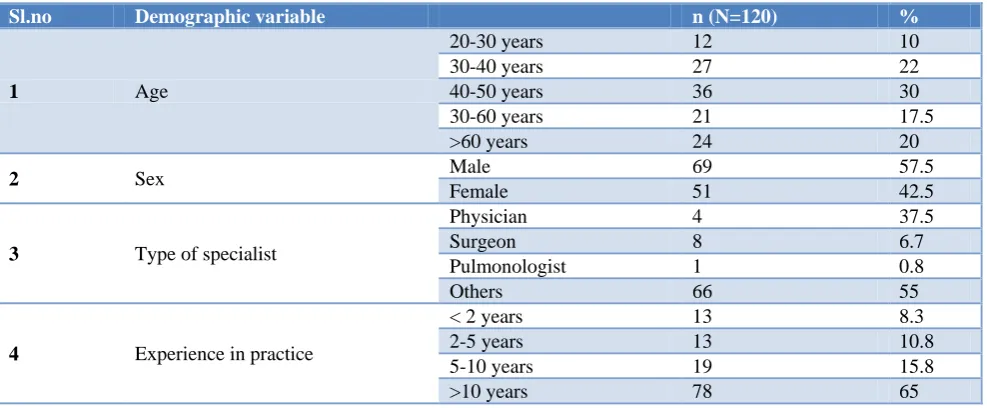
120 private practitioners were interviewed in the present study. 37.5% were physicians and 65% had experience more than 10 years (Table 1).
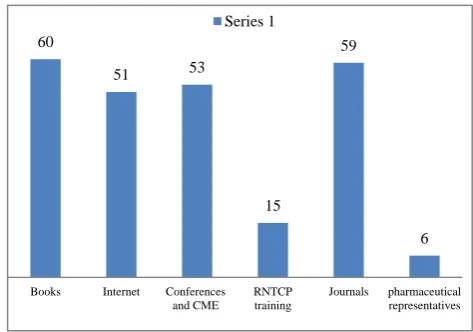
Figure 1: Source of information tuberculosis treatment updates.
60
51 53
15
59
6
Books Internet Conferences and CME
RNTCP training
Journals pharmaceutical representatives
Table 1: Characteristics of private practitioners who participated in study.
Sl.no Demographic variable n (N=120) %
1 Age
20-30 years 12 10
30-40 years 27 22
40-50 years 36 30
30-60 years 21 17.5
>60 years 24 20
2 Sex Male 69 57.5
Female 51 42.5
3 Type of specialist
Physician 4 37.5
Surgeon 8 6.7
Pulmonologist 1 0.8
Others 66 55
4 Experience in practice
< 2 years 13 8.3
2-5 years 13 10.8
5-10 years 19 15.8
>10 years 78 65
Table 2 Attitude of private practitioners regarding tuberculosis treatment.
Sl.no Attitude n (%)
Agree (%) Disagree (%)
1 Sputum examination most reliable for TB diagnosis 113 (94.1) 7 (5.9)
2. All TB cases should be notified 115 (95.8) 5 (4.2)
3. DOTS helps in treatment completion 117 (97.5) 3 (2.5)
4. Involvement of local community workers is helps in TB treatment 119 (99.2) 1(0.8)
Table 3: Practices of private practitioners in tuberculosis treatment.
Sl.no Practices n (N=120) %
1. No. of cases per month
At least 1 case 45 37.5
2-4 cases 32 26.7
>4 cases 9 7.5
2. Preferred diagnostic Method
Chest X-ray alone 4 3.3
Sputum microscopy 26 21.7
Chest X-ray & sputum microscopy 91 75.8
PCR & others 16 13.3
3. Method of treatment
Own prescription 50 41.7
Refer for DOTS in RNTCP 51 42.5
Only notify and treatment by own prescription. 19 15.8
4. Drug prescription formulation DOTS thrice weekly regimen 43 35.8
Non–DOTS daily regimen 77 64.2
5. Reasons for referral to
Government
Patient cannot afford private care 49 40.8
Availability of free drugs 92 76.6
Accessibility 14 11.6
On patient request 15 12.5
Cough with sputum not relieved with antibiotics lead to suspicion of tuberculosis according to 80.8% of practitioners and 75.8 % preferred both sputum examination and chest X-ray for diagnosis of tuberculosis. 42.5 % of practitioners referred to public sector and major reasons for referral includes availability of free drugs in public sector (76.6%) and lack of patients affordability for private care (40.8%) (Table 3).
Updates regarding tuberculosis treatment to most of practitioners were books (50%), journals (49%) and conferences (44%) (Figure 1).
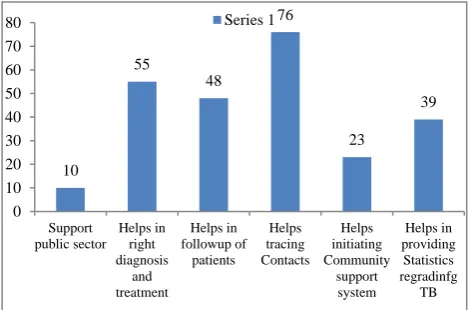
63.3% of practitioners was to help in tracing contacts and further prevention of TB, follow up of patients (40%), provide statistics regarding TB (32.5%) and support public sector (8.3%) (Figure 2). Only 23.3 % (28) were aware of Nikshay, majority was unaware and 14.7% had registered with Nikshay.
Figure 2: Need for notification of TB cases according to PPs.
DISCUSSION
PPs form first line of contact with patient in most cases especially in urban areas and their involvement becomes important in case detection and treatment. Suspicion of TB by majority PPs was made when patient treatment was not relived with treatment with antibiotics. Preferred diagnostic methods of more than one third of private practitioners were using both sputum examination and chest X-ray. Similar finding was reported by Uplekar et al in Maharastra.12 Datta et al found 68% preferred chest X-ray alone for diagnosis of TB.11 This leads to delay diagnosis and spread on infection in community .Knowledge regarding RNTCP guidelines for case detection is likely to help in early diagnosis and cost reduction in TB management.
The government had made TB notifiable disease since 2012, despite that only 79% of private practitioners were aware of notification. This is corroborated with findings of Studies by Phillip et al in Alappuzha and Thomas et al in Chennai.6,13 Only 12.5% private practitioners had attended modular training on RNTCP, similar was finding in study by Datta et al in West Bengal (22%).6 Study reported from Mysore city by Singh et al found higher awareness and major source of information was National TB Programme staff.15 Thus there is a need to create awareness regarding TB notification among the private practitioners.
DOTS is considered to be key objective in RNTCP to control TB and improve treatment compliance. Although the study found that majority i.e, 97.5% of PPs agreed that DOTS was helpful, only half practiced it. Similar attitude was documented by Salve et al study.14
Study by Neeta Singla et al7 conducted in New Delhi found that 76.5% of PPs preferred to treat their own and only 13% preferred to refer to public sector whereas as this study found 45.5% of PPs were referring to government hospitals and also found that 37.5% of private practitioners diagnosed at least one TB case every month. Most common reason for referral are free drugs in government (76.6%) and lack of patient‟s affordability for private care (40.6%). Study by Thomas et al in Chennai found 78% private Practitioners referred to government and reason for referral was same as present study.13 Similar reason was stated for referral by Hurtig et al in study conducted in Nepal.10 Lack of affordability can lead discontinuation of treatment and lack of system for supervision of follow up among PPs can lead increased treatment default rate and emergence of drug resistance. As per study reported by Udwadia et al median number of TB patient seen per month was 8 and one third was referred to government hospitals.4
Majority of practitioners said they gave first priority for regular and complete treatment and nearly all practitioners agreed local community health workers are important in TB management. Similar to this study, first priority in health education among PPs was for regular treatment (19.5%) followed by good diet (14%) in study done Neeta Singla et al.7 Nearly 80% of private practitioners said the reason for not participating in RNTCP as “nobody approached from government seeking their involvement”.
Thus measures are needed to be implemented to sensitize private practitioners regarding mandatory notification of TB cases. Programme officers should organise Specific training at district and sub district levels regarding Nikshay and Newer RNTCP guidelines to update PPs and to improve their involvement in RNTCP.
Limitations
Since the study involved only allopathic private practitioners, the attitude and practice of non allopathic practitioners towards TB diagnosis and treatment was not assessed. Recent studies in Andra Pradesh and Maharashtra has reported significant contribution of AYUSH (Ayurveda, Yoga & naturopathy, Unani, Sidda & Homeopathy) practitioner in notification and management of TB cases.2,5
CONCLUSION
so as to achieve wider and better implementation of programme.
ACKNOWLEDGEMENTS
The authors thank IMA, Hubli Zone for their support and all private practitioners for their co-operation and participation in Study.
Funding: No funding sources Conflict of interest: None declared Ethical approval: Not required
REFERENCES
1. World Health Organization: Global TB report 2016. Report: WHO/ HTM/TB (2016.07): Geneva: WHO 2016/ full.pdf. https://extranet.who.int/tme. Accessed on 19 December 2017.
2. Achanta S, Jaju J, Kumar AM, Nagaraja SB, Shamrao SR, Bandi SK, et al. Tuberculosis Management Practices by Private Practitioners in Andhra Pradesh, India. PLoS One. 2013;8(8):e71119.
3. TB India, 2016; RNTCP status report; Central TB Division, Directorate General of Health services, Ministry of Health and Family welfare, Government of India. www.tbcindia.org. Accessed 19 December 2017.
4. Udwadia ZF, Pinto LM, Uplekar MW. Tuberulosis Management by Private practitioners in Mumbai, India: Has anything changed in two decades? PLoS One. 2010;5(8):e12023.
5. Government of India. Notification of TB Cases. Ministry of Health and Family Welfare, New Delhi 2012.
6. Philip S, Isaakidis P, Sagili KD, Meharunnisa A, Mrithyunjayan S, Kumar AMV. “They know, They Agree, but They Don‟t Do” – The Paradox of Tuberculosis Case Notification by Private Practitioners in Alappuzha District, Kerala, India. PLoS One. 2015;10(4):e0123286..
7. Singla N, Sharma PP, Singla R, Jain RC. Survey of knowledge, attitudes and practices for tuberculosis
among general practitioners in Delhi, India. Int J Tuberc Lung Dis. 1998;2(5):384-9.
8. Yeole RD, Khillare K, Chadha VP, Lo T, Kumar AMV. Tuberculosis case notification by private practitioners in Pune, India: how well are we doing. Public Health Action. 2015;5(3):173–9.
9. Uplekar M, Atre S, Wells WA, Weil D, Lopez R, Migliori GB, et al. Mandatory tuberculosis case notification in high tuberculosis incidence countries: policy and practice. Eur Respir J. 2016;48(6):1571-81.
10. Hurtig AK, Pande SB, Porter JDH, Bam DS. Tuberculosis treatment and Private Practitioners, Kathmandu Valley. J Nep Med Assoc. 2000:39:163-8.
11. Datta K, Bhatnagar T, Murhekar M. Private Practitioners‟ Knowledge, Attitude and Practices about Tuberculosis, Hooghly District, India. Indian J Tuberculosis. 2010;57:199-206.
12. Uplekar M, Juvekar S, Morankar S, Rangan S, Nunn P. Tuberculosis patients and practitioners in private clinics in India; Int J Tuberc Lung Dis. 1998;2(4):324-9.
13. Thomas BE, Velayutham B, Thiruvengadam K, Nair D, Barman SB, Jayabal L, et al. Perceptions of private medical practitioners on tuberculosis notification: A study from Chennai, South India. PLoS One. 2016;11(1):e0147579.
14. Solomon Salve, Kabir Sheikh, John DH Porter. Private Practitioners‟ perceptives on their involvement with the tuberculosis control programme in a Southern Indian State. Int J Health Policy Manag. 2016;5(11):631-42.
15. Chadha SS, Nagaraja SB, Trivedi A, Satapathy S, Devendrappa NM, Sagili KD. Mandatory TB Notification in Mysore City, India: Have we heard the private practitioners‟ plea? BMC Health Services Res. 2017;17:1.