Original Research Article
Assessment of mother's knowledge towards pregnancy, childbirth,
postpartum and essential newborn care in district Solan, HP
Manisha Behal
1, Rajeev Vinayak
2*, Arjit Kumar
3INTRODUCTION
The postnatal period is a very critical phase in the lives of mothers and newborn babies. Most maternal and infant deaths occur during this time.1 Still then, this is the most neglected period for providing good health care services. Lack of appropriate knowledge and care during this period could result in significant mortality and morbidity. One-fifth of the total live births and more than 25% of the neonatal deaths in the world occur in our country. In
2015, among the 5.9 million under-5 deaths all over the world, 2.7 million occurred in the neonatal period.2 In India about 3/4th million neonates died in the year 2013. The current neonatal mortality rate is 28 per 1000 live births.3 It has declined from 44 per 1000 live births in 2000 to the current levels. But this rate of decline was less than the decline in infant mortality rate during the same period. The current perinatal mortality rate of India (2013) is 26 per 1000 births.3 India’s maternal mortality rate reduced from 556 deaths per 100,000 live births in 2007 to 174 deaths in 2015; however, adolescent and illiterate mothers and those living in hard to reach areas
ABSTRACT
Background: Even though the neonatal, maternal and perinatal mortality is declining in our country, still the morbidity and mortality rate is very high. Further improvement is possible by increasing awareness and appropriate practices of mothers towards pregnancy, childbirth, postpartum and essential newborn care. Objective of the study was to assess the knowledge of postnatal mothers regarding pregnancy, childbirth, postpartum and newborn care. These feeding practices were assessed in postnatal mothers, using a structured questionnaire.
Methods: Univariate analyses method [such as frequencies, percent distribution, means, and standard deviations (SD)] and Binary Logistic regression method was used for analysis of data with help of analyse-it and SPSS software.
Results: Knowledge regarding pregnancy, childbirth and postpartum care: Mean percentage obtained was 68.128% (SD of 18.15). 100% was obtained by only 7 mothers (2.3% of total). Knowledge regarding essential newborn care: Mean percentage obtained was 59.8% (SD of 19.6). 100% was obtained by only 15 mothers (5% of total). A total of 71 mothers failed, constituting 23.7% of total. Education status and parity status both were significantly associated with maternal knowledge regarding pregnancy and postpartum but they do not predict the outcome very well.
Conclusions: Postnatal mothers had inadequate knowledge on pregnancy, childbirth, postpartum and newborn care. Therefore educational intervention at multiple levels is required during the period of antenatal, and postnatal visits. Secondly socio-demographic factors- educational status and parity status of postnatal mothers were not associated with maternal knowledge.
Keywords: Knowledge, Pregnancy, Childbirth, Newborn care
1
Department of Obstetrics and Gynaecology, 2Department of Paediatrics, 3Department of Preventive and social medicine, Maharishi Markandeshwar Medical College and Hospital, Solan, Himachal Pradesh, India
Received: 12 March 2018
Revised: 04 April 2018
Accepted: 05 April 2018
*Correspondence:
Dr. Rajeev Vinayak,
E-mail: [email protected]
Copyright: © the author(s), publisher and licensee Medip Academy. This is an open-access article distributed under the terms of the Creative Commons Attribution Non-Commercial License, which permits unrestricted non-commercial use, distribution, and reproduction in any medium, provided the original work is properly cited.
still have a much greater chance of dying in childbirth.4 Evidence tells us that improving maternal education is very effective in improving neonatal and maternal survival, as it improves preventive lifestyle and increases the utilization of maternal and neonatal health services.5-7 Stabilization of population growth and low levels of infant and neonatal mortality in Kerela is partly because of its high female education levels.8 Upadhyay et al found that low educational status of parents, occupation and caste explains about 45.7% of neonatal deaths in Haryana.9 Nationwide United Nations Children Fund Coverage Evaluation Survey was done in India from November 2009 to January 2010. It assessed the coverage of key interventions in antenatal, natal and postnatal periods.10 About 25% of pregnant women had full antenatal check-up, at least one tetanus toxoid injection and adequate iron and folic acid tablets during the pregnancy. Approximately 33% neonates were breastfed within 1 hour of birth.10
In various studies done, the percentage of neonates who receive at least 3 antenatal visits within first 10 days of life is usually less than 50%.11-15 The parity status of the mother also plays a role in the knowledge of mother regarding pregnancy, delivery, postpartum and neonatal care.16-18
Although several initiatives have been taken by the Indian government regarding these shortcomings, their impact remains limited due to mismanagement, shortage of skilled health staff and lack of preparedness of health-care facilities.19,20 The quality of care (both health centre based and household-based) during pregnancy, delivery and post partum period has significant impact on newborn health. Essential newborn, pregnancy, childbirth and postpartum care are a set of comprehensive recommendations designed by World Health Organization (WHO) to improve health of the newborn through intervention before conception, during pregnancy, soon after birth and in postnatal period.1,21-23 Based on these numerous recommendations and guidelines we asked few questions from the postnatal mothers living around our hospital. Their answers provided us the health related knowledge status of these mothers and the efficacy and penetration of primary, secondary and tertiary level health care facility which cater to them. This can greatly help the policy makers and health providers in better implementation and making further improvements in the existing health care network. This was also an opportunity for the mothers enrolled in this study to correct and update their knowledge regarding maternal and child health.
Objectives
Primary objectives
To assess knowledge on essential newborn care among mothers in district Solan, Himachal Pradesh.
To assess knowledge on pregnancy, childbirth and postpartum care among mothers in district Solan, Himachal Pradesh.
Secondary objectives
To determine whether literacy status and parity of mothers are associated with maternal knowledge about pregnancy, childbirth, postpartum and essential newborn care care among mothers in district Solan, Himachal Pradesh.
METHODS
Study design
This hospital based descriptive cross sectional study was done till 300 cases were studied, w.e.f. date of clearance from Ethics committee of hospital (October 2017). The study was fully voluntary and strictly confidential. No financial compensation was given for participation. Participants were free to withdraw at any point during the study.
Inclusion criteria
All parous ladies (who gave consent) in the local community in district Solan served by Maharishi Markandeshwar Medical College who had delivered in the past one year preceding the study.
Exclusion criteria
This included abortion or stillborn cases, women who were critically ill and were admitted in Intensive care units, women with mental or psychiatric illnesses or whose baby/babies died after birth or were critically sick at time of questionnaire. The questionnaire made consists of both closed and open ended questions and the mothers were explained the questions in their local language and asked to answer the questions orally, which were filled in by the principal or co-investigators only. This questionnaire was based on the recommendations and guidelines issued by the WHO.1,21-23
Statistical method
have inadequate knowledge and labelled '0' and those who scored above were considered to have adequate knowledge were labelled '1' under the respective questionnaire. Before starting Binary Logistic regression by SPSS, Box- Tidwell test was used to show a linear relationship between continuous predictors and logit. Parity status and Education status were taken as independent variables and both being classified under categorical covariates. Parity 1 and education status as illiterate was considered as reference (or baseline) category for comparison.
RESULTS
Characteristics of the sample population
The sample population of the study constituted a total of 300 married women aged 18-48 years who delivered a living baby during the twelve month period preceding the conducting of the interviews.
Socio-demographic characteristics
Age: Figure shows that three-quarters (90%) of the sample women were in the prime childbearing age (20-35 yrs), 8% were older (≥35 years), while 2% were younger than the prime childbearing age (18-20 years). None were below 18 yrs age. The mean age of the respondents was 28.3 years [Standard deviation (SD) 4.1]. The age of the women ranged from 19-38 years. Maximum mothers were of 29 yrs age (15% of total).
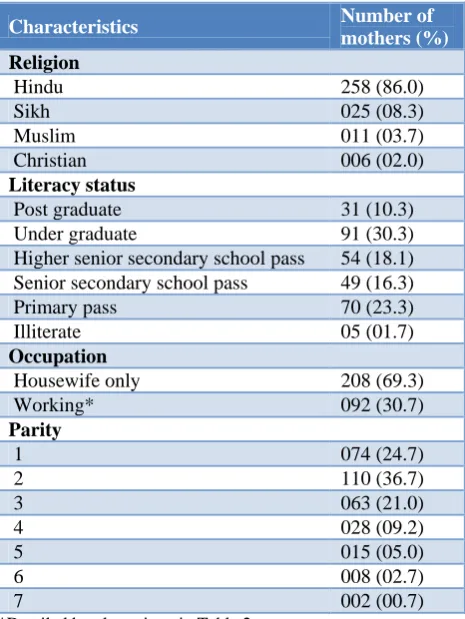
Rest of socio-demographic factors are detailed in Table 1 and 2.
Knowledge regarding pregnancy, childbirth and postpartum care
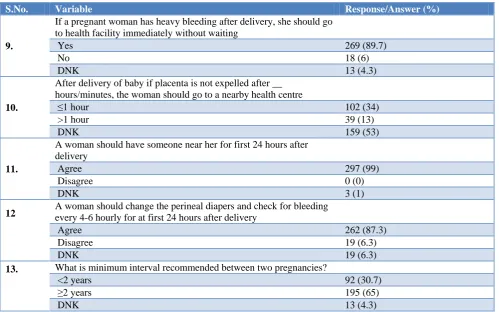
A total of 13 different questions were asked and the responses accordingly are given in Table 3(a) and 3(b). Mothers who gave 50% or more of correct answers were considered to be in pass category and the rest in fail category. Mean percentage obtained was 68.128% with SD of 18.15. Minimum percentage obtained was 23.07% and maximum was 100%. 100% was obtained by only 7 mothers (2.3% of total). A total of 59 mothers failed, constituting 19.6% of total. Most of mothers scored between 69-84% (145 out of total of 300 mothers). Percentage breakup is given in Figure 1.
Knowledge regarding essential newborn care
A total of 10 different questions were asked and the responses accordingly are given in Table 4a and 4b. Mothers who gave 50% or more of correct answers were considered to be in pass category and the rest in fail category. Mean percentage obtained was 59.8% with SD of 19.6 and median was 60%. Minimum percentage obtained was 10% and maximum was 100%. 100% was obtained by only 15 mothers (5% of total). A total of 71
mothers failed, 23.7% of total. Percentage breakup is given in Figure 2.
Table 1: Socio-demographic characteristics of mothers (n=300).
Characteristics Number of
mothers (%)
Religion
Hindu 258 (86.0)
Sikh 025 (08.3)
Muslim 011 (03.7)
Christian 006 (02.0)
Literacy status
Post graduate 31 (10.3) Under graduate 91 (30.3) Higher senior secondary school pass 54 (18.1) Senior secondary school pass 49 (16.3) Primary pass 70 (23.3)
Illiterate 05 (01.7)
Occupation
Housewife only 208 (69.3)
Working* 092 (30.7)
Parity
1 074 (24.7)
2 110 (36.7)
3 063 (21.0)
4 028 (09.2)
5 015 (05.0)
6 008 (02.7)
7 002 (00.7)
*Detailed breakup given in Table 2
Table 2: Detailed breakup of maternal occupation. (n=300).
Maternal occupation Number Percentage (%)
Housewife 208 69.3
Teacher 21 7.0
Clerk 14 4.7
Tailor 12 4.0
Class 4 9 3.0
Banker 7 2.3
Beautician 7 2.3
Staff nurse 5 1.7
Agriculture 4 1.3
Business 4 1.3
Labourer 2 0.7
Lawyer 2 0.7
Salesgirl 2 0.7
Saleswoman 2 0.7
Shopkeeper 1 0.3
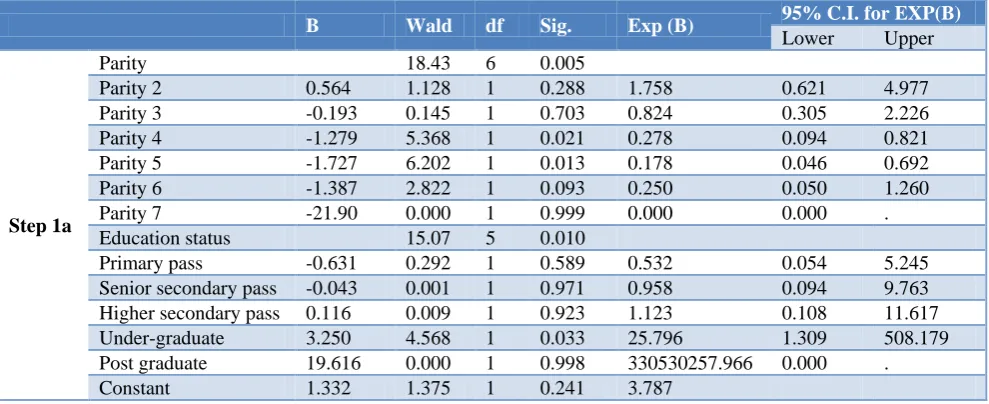
model is significantly better over empty/constant model (model with no predictors). Nagelkerke's R2 value was 0.430. Hosmer and Lemeshow test showed significance of 0.898 which tells us that our model is quite a good fit. Case wise list shows that only 5 cases do not fit the model well. -2 log likelihood value is 202.756 meaning that model poorly predicts decisions. Looking at the variables in equation results with education status of mothers as the variable, there is a highly significant overall effect with Wald value of 15.072, df=5 and p value of 0.01. Among all the education status categories only undergraduate’s category had statistically significant p value of 0.033. Odds ratio of 25.796 shows that
mothers from undergraduates category are 25.8 times more likely than illiterate mothers in having a good knowledge regarding antenatal, pregnancy and postpartum care. Looking at the variables in equation results with parity status of mothers as the variable, there is a highly significant overall effect with Wald value of 18.429, df=6 and p value of 0.005. Among all the categories only parity 4 and 5 categories had statistically significant p value of 0.021 and 0.013 respectively. Odds ratio of 0.278 and 0.178 shows that mothers from parity 4 and 5 category are very less likely than parity 1 mothers in having a good knowledge regarding antenatal, pregnancy and postpartum care.
Table 3a: Details of knowledge regarding pregnancy, childbirth and postpartum care.
S.No Variable Response/Answer (%)
1.
Minimum antenatal visits required
<4 121 (40.3)
=4 50 (16.7)
>4 109 (36.3)
Do not know (DNK) 20 (6.7)
2.
Is Tetanus toxoid necessary during pregnancy?
Yes 292 (97.3)
No 7 (2.3)
DNK 1 (0.3)
3.
Are IFA tablets required to be taken during pregnancy?
Yes 273 (91)
No 24 (8)
DNK 3 (1)
4.
Are IFA tablets required to be taken after pregnancy during postpartum period?
Yes 96 (32)
No 163 (54.3)
DNK 41 (13.7)
5. If delivery/labour pains do not start even if EDD is reached when will you go for advice to a nearby health care centre?
≤ 2 weeks 271 (90.3)
> 2 weeks 7 (2.3)
DNK 22 (7.3)
6. When amniotic bag of a pregnant woman rupture/water leaks she should wait for waters to stop before going to a health care facility?
Yes 124 (41.3)
No 118 (39.3)
DNK 58 (19.3)
7.
If a pregnant lady is not in labour pains even after ___ duration after rupture of bags, then she goes to a nearby health centre
≤6 hours 120 (40)
>6 hours 74 (24.7)
DNK 106 (35.3)
Table 3b: Details of knowledge regarding pregnancy, childbirth and postpartum care.
S.No. Variable Response/Answer (%)
8.
If labour pain continues for more than __ duration, a pregnant lady should go to nearby healthcare facility immediately
≤12 hours 211 (70.3)
>12 hours 59 (19.7)
DNK 30 (10)
S.No. Variable Response/Answer (%)
9.
If a pregnant woman has heavy bleeding after delivery, she should go to health facility immediately without waiting
Yes 269 (89.7)
No 18 (6)
DNK 13 (4.3)
10.
After delivery of baby if placenta is not expelled after __ hours/minutes, the woman should go to a nearby health centre
≤1 hour 102 (34)
>1 hour 39 (13)
DNK 159 (53)
11.
A woman should have someone near her for first 24 hours after delivery
Agree 297 (99)
Disagree 0 (0)
DNK 3 (1)
12 A woman should change the perineal diapers and check for bleeding every 4-6 hourly for at first 24 hours after delivery
Agree 262 (87.3)
Disagree 19 (6.3)
DNK 19 (6.3)
13. What is minimum interval recommended between two pregnancies?
<2 years 92 (30.7)
≥2 years 195 (65)
DNK 13 (4.3)
Table 4a: Details of knowledge regarding newborn care.
S.No. Variable Response/Answer (%)
1.
What is duration of exclusive breastfeeding?
<6 months 12 (4)
=6 months 90 (30)
>6 months 172 (57.3)
DNK 26 (8.7)
2.
How soon after delivery should the baby be breastfed?
≤1 hour 163 (54.3)
>1 hour 66 (22)
DNK 71 (23.7)
3.
First Bath of a newborn should be done after what age after birth?
<24 hours 43 (14.3)
≥24 hours 162 (54)
DNK 95 (31.7)
4.
Should the newborn baby be nursed separately from mother after delivery?
Yes 261 (87)
No 36 (12)
DNK 3 (1)
5. Number of clothes should be more in number than used by adults
Yes 292 (97.3)
No 2 (2)
DNK 6 (0.7)
6. How would you care for the umbilical stump of a newborn?
Covered 130 (43.3)
Uncovered 121 (40.3)
Table 4b: Details of knowledge regarding newborn care.
S.No. Variable Response/Answer (Percentage)
7.
Would you apply any substance to the umbilical cord? If yes what substance?
Antiseptic 128 (42.7)
Nothing 58 (19.3)
Oil/Ghee 39 (13)
DNK 75 (25)
8.
If the umbilical stump is soiled with baby’s urine or faeces, how would you clean it?
Clean with clean water 120 (40)
Clean with antiseptic 72 (24)
Will not clean it 5 (1.7)
DNK 103 (34.3)
9.
Enumerate the danger signs in newborn
≥50% signs answered correctly 228 (76) <50% signs answered correctly 72 (24)
10.
Does a newborn require any vaccination at birth?
Yes 292 (97.3)
No 0 (0)
DNK 8 (2.7)
Table 5: Association between maternal knowledge regarding pregnancy/childbirth/postpartum care and maternal parity/education status.
B Wald df Sig. Exp (B) 95% C.I. for EXP(B)
Lower Upper
Step 1a
Parity 18.43 6 0.005
Parity 2 0.564 1.128 1 0.288 1.758 0.621 4.977 Parity 3 -0.193 0.145 1 0.703 0.824 0.305 2.226 Parity 4 -1.279 5.368 1 0.021 0.278 0.094 0.821 Parity 5 -1.727 6.202 1 0.013 0.178 0.046 0.692 Parity 6 -1.387 2.822 1 0.093 0.250 0.050 1.260 Parity 7 -21.90 0.000 1 0.999 0.000 0.000 . Education status 15.07 5 0.010
Primary pass -0.631 0.292 1 0.589 0.532 0.054 5.245 Senior secondary pass -0.043 0.001 1 0.971 0.958 0.094 9.763 Higher secondary pass 0.116 0.009 1 0.923 1.123 0.108 11.617 Under-graduate 3.250 4.568 1 0.033 25.796 1.309 508.179 Post graduate 19.616 0.000 1 0.998 330530257.966 0.000 . Constant 1.332 1.375 1 0.241 3.787
a=Variable(s) entered on step 1: Parity, Education status.
Overall in compilation, though our model identifies that education status (undergraduates) and parity status (parity 4 and 5) both are significantly associated with maternal knowledge regarding pregnancy and postpartum, they do not predict the outcome very well. There is substantial individual variability that cannot be explained by parity and education status.
Relationship between maternal knowledge regarding newborn care and education status/parity status of mothers: Omnibus test of model coefficients showed a chi-square value of 37.79 with a p value of <0.05 which is highly significant. It means our model is significantly better over empty/constant model (model with no
predictors). Nagelkerke's R2 value was 0.178, which means the model explains roughly 18% of the variation in outcome. Hosmer and Lemeshow test showed significance of 0.687 which tells us that our model is quite a good fit. Case wise list shows that only 10 cases do not fit the model well. -2 log likelihood value is 290.53 meaning that model poorly predicts decisions. Looking at the variables in equation results with education status of mothers as the variable, none of the education status subcategories had statistically significant p value of <0.05. Looking at the variables in equation results with parity status of mothers as the variable, there is no significant overall effect with p value of 0.135.
Table 6: Association between Maternal knowledge regarding newborn care and maternal parity/education status.
B S.E. Wald df Sig. Exp (B) 95% C.I. for EXP(B)
Lower Upper
Step 1a
Parity 9.772 6 0.135
Parity 2 0.890 0.373 5.675 1 0.017 2.434 1.171 5.061 Parity 3 1.205 0.445 7.343 1 0.007 3.338 1.396 7.981 Parity 4 0.968 0.531 3.321 1 0.068 2.632 0.930 7.451 Parity 5 0.689 0.636 1.172 1 0.279 1.992 0.572 6.933 Parity 6 0.742 0.802 0.855 1 0.355 2.100 0.436 10.110 Parity 7 21.59 28420.72 0.000 1 0.999 2383848773.5 0.000 . Education status 21.334 5 0.001
Primary pass -0.408 0.988 0.171 1 0.679 0.665 0.096 4.609 Senior secondary
pass 0.211 1.002 0.044 1 0.833 1.235 0.173 8.804 Higher
secondary pass 0.343 1.005 0.117 1 0.733 1.409 0.197 10.101 Under-graduate 1.514 1.010 2.247 1 0.134 4.544 0.628 32.894 Post graduate 1.365 1.089 1.571 1 0.210 3.915 0.463 33.096 Constant 0.019 0.948 0.000 1 0.984 1.019
a=Variable(s) entered on step 1: Parity, Education status.
Figure 1: Breakup of percentages achieved by mothers regarding 'pregnancy, childbirth and postpartum care' questionnaire.
Overall in compilation, our model identifies that none of education status subcategories are significantly associated with maternal knowledge regarding essential newborn care. Also they do not predict the outcome very well.
DISCUSSION
In our study, majority of cases were of Hindu religion, housewives only, undergraduates and of parity 2. This is in consensus with the data given by District Level Household and Facility Survey-4 for Himachal.24 Questions in which >90% women answered correctly were - Tetanus toxoid, IFA during pregnancy, heavy bleeding post delivery, need for a helping person during 1st 24 hrs of delivery and labour pains not started even when EDD is crossed. Regarding newborn care questions in which >90% of women answered correctly were on number of clothing required and need of vaccination at birth. Regarding other questions mothers had poor knowledge (gave wrong answer or gave do not know response). Mean percentage obtained (of passing) was 68.128% and 59.8% in pregnancy care and newborn care questionnaire respectively.
Our study identifies that education status (only undergraduates) and parity status (parity 4 and 5) both are significantly associated with maternal knowledge regarding pregnancy and postpartum but they do not predict the outcome very well. There is substantial individual variability that cannot be explained by parity and education status and may be other multiple maternal factors are also contributing or responsible for maternal knowledge. Neither education status subcategories, nor parity status is significantly associated with maternal knowledge regarding essential newborn care. Our results are not the same as shown by a few Indian studies.8,9,16-18 May be selective and repetitive advice provided by the primary and tertiary health care providers and the number of antenatal and postnatal visits is more important than the educational status and parity status of mothers. Another reason may be that our questionnaire was very comprehensive and consisted of 23 questions in total covering pregnancy, postpartum and newborn care knowledge assessment. None of previous studies have covered these parameters in detail. Also there may be other multiple socio-demographic factors contributing to maternal knowledge.
This study indicates that awareness and attitude of postnatal mothers towards neonatal care has lots of lacunae. There is scope for improvement by providing better care and health education for antenatal mothers at primary care level itself. More observational and retrospective studies, on a larger scale are required to know the knowledge of postnatal mothers regarding pregnancy and newborn care and to know the association of these practices with various socio-demographic factors. These will finally help to design appropriate
interventional strategies to decrease maternal and neonatal mortality and morbidity.
Study limitations: Firstly, information has been collected from mothers who delivered 12 months preceding the survey date. Hence, there could be some recall bias. Secondly, the length of the questionnaire could have produced respondent fatigue. In addition, it is also likely that due to the long and sequential nature of the study questionnaire, the interviewers' might have unknowingly influenced a change in the study parameters.
CONCLUSION
Postnatal mothers had inadequate knowledge on pregnancy, childbirth, postpartum and newborn care. Therefore educational intervention at multiple levels is required during the period of antenatal, natal and postnatal visits.
Socio-demographic factors- educational status and parity status of postnatal mothers were not associated with maternal knowledge.
Funding: No funding sources Conflict of interest: None declared
Ethical approval: The study was approved by the Institutional Ethics Committee
REFERENCES
1. World Health Organization. WHO recommendations on postnatal care of the mother and newborn. World Health Organization; 2014. 2. Liu L, Oza S, Hogan D, Perin J, Rudan I, Lawn JE,
et al. Global, regional, and national causes of child mortality in 2000–13, with projections to inform post-2015 priorities: an updated systematic analysis. The Lancet. 2015;385(9966):430-40.
3. Registrar General of India. Sample registration system statistical report 2013. New Delhi, India: Government of India, 2013.
4. World Health Organization, Unicef. Trends in maternal mortality: 1990 to 2015: estimates by WHO, UNICEF, UNFPA, The World Bank and the United Nations Population Division.
5. Agha S, Carton TW. Determinants of institutional delivery in rural Jhang, Pakistan. International journal for equity in health. 2011;10(1):1-12. 6. Ogunlesi TA, Ogunlesi FB. Family
socio-demographic factors and maternal obstetric factors influencing appropriate health-care seeking behaviours for newborn jaundice in Sagamu, Nigeria. Maternal and child health journal. 2012;16(3):677-84.
8. Upadhyay RP, Chinnakali P, Odukoya O, Yadav K, Sinha S, Rizwan SA, et al. High neonatal mortality rates in rural India: what options to explore? ISRN paediatrics. 2012;2012:968921.
9. Upadhyay RP, Dwivedi PR, Rai SK, Misra P, Kalaivani M, Krishnan A. Determinants of neonatal mortality in rural Haryana: a retrospective population based study. Indian pediatrics. 2012;49(4):291-4.
10. UNICEF I. Coverage evaluation survey 2009. New Delhi: United Nations Children Fund. 2010.
11. Narang M, Kaushik JS, Sharma AK, Faridi MM. Predictors of mortality among the neonates transported to referral centre in Delhi, India. Indian journal of public health. 2013;57(2):100-4.
12. Pati S, Chauhan AS, Panda M, Swain S, Hussain MA. Neonatal care practices in a tribal community of Odisha, India: a cultural perspective. Journal of tropical pediatrics. 2014;60(3):238-44.
13. Joseph N, Unnikrishnan B, Naik VA, Mahantshetti NS, Mallapur MD, Kotian SM, Nelliyanil M. Infant rearing practices in South India: a longitudinal study. J family med primary care. 2013;2(1):37-43. 14. Patel A, Badhoniya N, Khadse S, Senarath U, Agho
KE, Dibley MJ, South Asia Infant Feeding Research Network (SAIFRN). Infant and young child feeding indicators and determinants of poor feeding practices in India: secondary data analysis of National Family Health Survey 2005–06. Food and Nutrition Bulletin. 2010;31(2):314-33.
15. Baqui AH, Ahmed S, El Arifeen S, Darmstadt GL, Rosecrans AM, Mannan I, et al. Effect of timing of first postnatal care home visit on neonatal mortality in Bangladesh: a observational cohort study. BMJ. 2009;339:b2826.
16. Dayaratne ND, de Silva G. Knowledge on newborn care among postnatal mothers of term babies with birth weights 2.5 kg or more at the De Soysa Hospital for Women, Colombo and associated factors. Sri Lanka J Child Health. 2016;45(4):271-5.
17. Uppadhaya SK, Bhansali S, Sivodia SK, Agrawal N, Garg K, Singh M. Utilization of Postnatal Care Services in Rural Area of Western Rajasthan, India. National J Comm Med. 2016;7(7):569-72.
18. Chaudhary J, Dhungana GP, Ghimire HC. Factors Affecting Newborn Care Practices Among Tharu Mothers in Selected Vilalge Development Committees of Chitwan Distract. J Chitwan Med College. 2013;3(1):42-5.
19. Malini S, Tripathi RM, Khattar P, Nair KS, Tekhre YL, Dhar N, Nandan D. A rapid appraisal on functioning of Janani Suraksha Yojana in South Orissa. Health Popul Perspect Issues. 2008;31:126-31.
20. Lim SS, Dandona L, Hoisington JA, James SL, Hogan MC, Gakidou E. India's Janani Suraksha Yojana, a conditional cash transfer programme to increase births in health facilities: an impact evaluation. The Lancet. 2010;375(9730):2009-23. 21. WHO. 2013. Recommendations on Maternal and
Perinatal Health. Geneva: WHO. Guidelines on maternal, newborn, child and adolescent health approved by the WHO guidelines review committee.
22. World Health Organization. 1998. Postpartum care of the mother and newborn: a practical guide: report of a technical working group.
23. World Health Organization. Integrated Management of Pregnancy and Childbirth: pregnancy, childbirth, postpartum and newborn care; a guide for essential practice. Geneva: World Health Organization. 2003. 24. International Institute for Population Sciences, 2014. District Level Household and Facility Survey, 2012-13: India. Himachal Pradesh: Mumbai: IIPS.