664 Emir. J. Food Agric ● Vol 29 ● Issue 9 ● 2017
Bread quality improvement by means of selected
pregelatinized waxy rice flour (PWRF)
Shihang Yang1, Peiyi Cheng1, Litang Wang2, Shenchung Lin3, Chiching Yang1*, Tzuching Wang4* 1Department of Food Science and Technology, National Pingtung University of Science and Technology, Pingtung, Taiwan, 2Department of Electrical Engineering, National Central University, Taoyuan, Taiwan, 3Department of Travel Management, Taipei University of Marine Technology, Danshui Town, New Taipei, Taiwan, 4Department of Hospitality Management, Meiho University, Pingtung, Taiwan
INTRODUCTION
Bread is a digestible and nutritious food and in some selected area it is adopted as staple food and is consider as appropriate food. During storage, like many foods made from starch, bread can be easily retrogradate and cause crystallization again. Del-Rosario and Pontiveros (1983) reported that from soft to hard of texture may curtail the storage life and lower product value. For all starchy foods, including bread,
retrogradation is a definite phenomenon (Kweon et al., 1994).
Thus, the bread quality can be extremely affected and therefore restrict its popularization and adoption (Huang et al., 1988). As the reason, to exploit new technologies to decline starch retrogradation is very important for bread industry.
Many techniques to improve starchy foods’ quality and delay retrogradation were found by researchers such as the addition of selected starch (Huang et al., 1988),
emulsifier (Rao et al., 1992) or enzyme (Kweon et al., 1994). For emulsifier, it can effectively prolong starch
colloid hardening and defer staling and retrogradation
rate (Keetels et al., 1996). Many emulsifiers are applied on
starchy foods until today. Rao et al. (1992) declared that excellent efficiency of using amylose-lipid and its high
capability to delay starch retrogradation. The ability of
monoglycerides, one of emulsifiers, can delay starch staling effectively (Hibi, 2001).
Besides, α-amylase can induce starch dehydration thus postpone staling and retrogradation was found (Kweon et al., 1994). Although α-amylase could be postpone bread staling, excessive dose of α-amylase may produce
numerous soluble dextrin and cause the organization easy
to form hollow and gummy (Hibi, 2001). Pregelatinized
starch can as well ameliorate bread texture and decrease the
bread volume and specific volume simultaneously though
it must be careful to dominate the amount when use (Hibi,
2001). In our previous pre-experiment, use only α-amylase
or monoglycerides just exhibit slight effect on inhibiting staling and improving product texture. Considering these
issues, we employed and slightly modified our previous study (Wang et al., 2011) which used PWRF to investigate
the PWRF whether can be used in bread manufacture and attempt to improve the bread quality.
The objective of the present study was attempted to develop a pregelatinized waxy rice flour (PWRF) retarding agent formulation by
merging with α-amylase and monoglycerides, as well as using pregelatinizing and lyophilizing technologies to improve bread characteristics
such as staling and retrogradation. The major methods, including texture profile analysis (TPA) and sensory evaluation were employed to assess bread qualities. Research results demonstrated the amylose complexing index (ACI) of the PWRF-adding bread samples were
higher than that of groups α-amylase-adding, monoglycerides-adding and control. PWRF-adding bread samples exhibited higher starch
digestibility and water activity (aw) and showed softer texture, lower hardness and soluble starch content than the groups α -amylase-adding, monoglycerides-adding and control after storage. The PWRF-D exhibited the best effect among all formulations. Further, either fresh or after storage PWRF-adding bread samples acquired the higher sensory score. The bread qualities were improved by PWRF and the staling and retrogradation were further retarded.
Keywords: Bread; Pregelatinized waxy rice flour (PWRF); Staling; Retrogradation; Sensory evaluation
http://www.ejfa.me/
R E G U L A R A R T I C L E
A B S T R A C T
*Corresponding author:
Tzuching Wang, Department of Hospitality Management, Meiho University, Pingtung, 91202, Taiwan. E-mail: [email protected] Chiching Yang, Department of Food Science and Technology, National Pingtung University of Science and Technology, Pingtung, Taiwan. Email: [email protected]
MATERIALS AND METHODS
Ingredients and reagents
High-gluten flour purchased from Uni-President Enterprises
Corporation (Tainan, Taiwan). Monoglycerides was obtained
from Yih-Yuan Food Additives Chemical Industrial Co., LTD. (Taipei, Taiwan). Waxy rice flour and indica rice flour were
taken from Ping-Tung Foods Corporation (Pingtung, Taiwan).
The approximate composition of waxy rice flour and indica rice flour were 80.8% and 77.4% for carbohydrate, 12.7% and 12.8% for moisture, 0.3% and 0.6% for crude protein, 5.6% and 8.2% for crude fat as well as 0.6% and 1.0% for ash, respectively. α-Amylase (activity: 46500-48830 RAU/g) and yeast were bought from DSM Bakery Ingredients (Delft,
Netherlands). All other food ingredients were food grade. Potassium sodium (+)-tartrate tetrahydrate, iodine, and acetic
acid were purchased from Nacalai tesque (Kyoto, Japan).
Potassium tartrate-water was acquired from Nakarai chemicals
(Tokyo, Japan). Amylose (A-0512), and 3,5-Dinitrosalicylic acid were received from Sigma-Aldrich Inc. (St Louis, MO, USA). Hydrochloric acid and potassium iodine were got from Nihon Shiyaku (Osaka, Japan). Methyl alcohol (methanol) was received from Tedia Company Inc. (Fairfield, Ohio, USA).
Termamyl 120L type LS was gained from Novozymes Co.,
(Copenhagen, Denmark). Sodium hydroxide sodium acetate
(anhydrous) was purchased from Union Chemical Works Ltd.,
(Hsinchu, Taiwan). All other regents were of analytical grade.
Preparations of PWRF and bread samples Bread formulation and baking
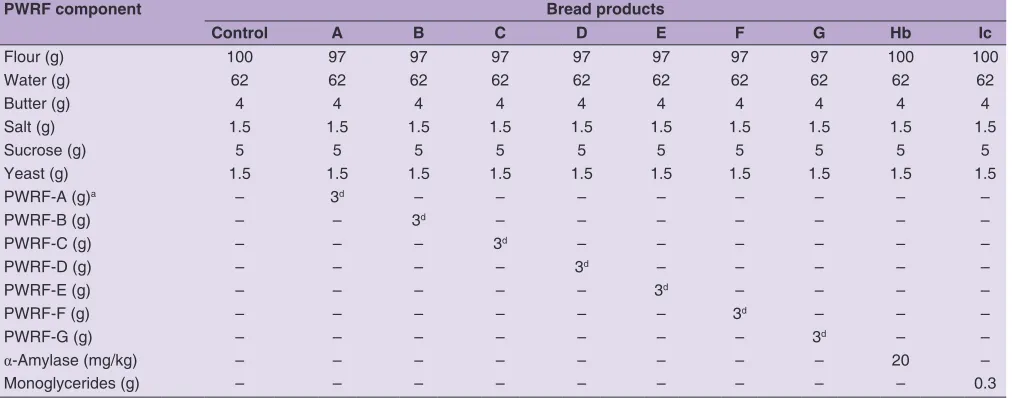
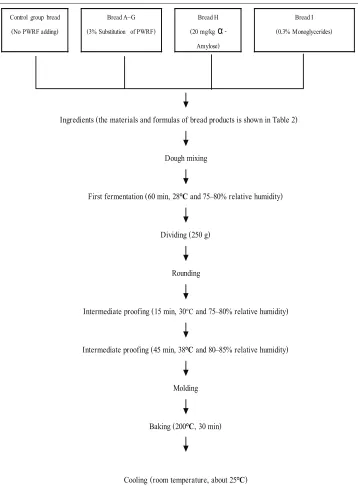
The materials and formulas of PWRF and bread samples are shown in Table 1 and 2, respectively. After mixing all
materials, double volume of water was added and heated
(temp.: 80°C/duration: 5 min). Then, it was allowed to cool at room temperature (about 25°C) and frozen (-40°C) for
three days and then lyophilized cake. Milled, crushed and
sieved (100-mesh) lyophilized cake to obtain PWRF. For bread preparing, the indica rice flour was substituted by PWRF-A~G (i.e. to produce bread A~G), added 20 mg/kg α-amylase -amylase (i.e. to produce bread H), and just added 0.3% monoglycerides (i.e. to produce bread I), respectively.
The detailed preparation of bread is shown in Fig. 1.
Bread weight, volume and specific volume
The weight was measured after the bread loaves were removed from oven for 1 h. The sesame seed displacement
Table 1: The materials and formulas of pregelatinized waxy rice flour
Formula Pregelatinized waxy rice flour (PWRF)
Waxy rice flour (g) Water (g) Monoglycerides (%)a α-Amylase (mg/kg)b
PWRF-A 100 200 1 40
PWRF-B 100 200 2 40
PWRF-C 100 200 4 40
PWRF-D 100 200 8 40
PWRF-E 100 200 4 10
PWRF-F 100 200 4 20
PWRF-G 100 200 4 60
aMonoglycerides was added at different levels (%, flour basis). bα-amylase was added at different levels (mg/kg, flour basis) Table 2: The materials and formulas of bread products
PWRF component Bread products
Control A B C D E F G Hb Ic
Flour (g) 100 97 97 97 97 97 97 97 100 100
Water (g) 62 62 62 62 62 62 62 62 62 62
Butter (g) 4 4 4 4 4 4 4 4 4 4
Salt (g) 1.5 1.5 1.5 1.5 1.5 1.5 1.5 1.5 1.5 1.5
Sucrose (g) 5 5 5 5 5 5 5 5 5 5
Yeast (g) 1.5 1.5 1.5 1.5 1.5 1.5 1.5 1.5 1.5 1.5
PWRF-A (g)a – 3d – – – – – – – –
PWRF-B (g) – – 3d – – – – – – –
PWRF-C (g) – – – 3d – – – – – –
PWRF-D (g) – – – – 3d – – – – –
PWRF-E (g) – – – – – 3d – – – –
PWRF-F (g) – – – – – – 3d – – –
PWRF-G (g) – – – – – – – 3d – –
α-Amylase (mg/kg) – – – – – – – – 20 –
Monoglycerides (g) – – – – – – – – – 0.3
a3% (w/w flour basis) flour was replaced by PWRF-A~G, respectively. bα-amylase was added at 20 mg/kg, flour basis. bH: Bread added α-amylase directly
666 Emir. J. Food Agric ● Vol 29 ● Issue 9 ● 2017 method (Sangnark and Noomhorm, 2003) was employed
to determine bread volume and the specific volume was
measured by dividing the volume by bread weight.
Properties analysis of PWRF and bread Amylose complexing index (ACI)
The ACI value was determined according to Riisom et al. (1984).
Soluble amylose content (SAC)
The SAC was determined according to the method
described by Shanthy et al. (1980).
Physical and chemical changes during storage
Bread samples were cooled for 3 h at room temperature and were packed in polyethylene and then sealed. These bread samples were symbolized respectively at selected days for analyzing various physical, chemical and sensory characteristics as described below.
Moisture content and water activity (aw)
During storage, the bread samples were examined for moisture content and aw on the selected day. For determination of moisture content, the procedure was
followed by the AOAC method (AOAC. 1990). For
detection of aw, bread samples was put in the sample case
of CX-2 Water Activity Meter (Decagon Devices Inc., U.S.A.) and aw was determined at 25°C.
Texture profile analysis (TPA)
TPA was executed by a universal materials testing machine
(model: 5564, Instron, Canton, Ma, U.S.A). In brief, a diameter of 9 mm cylinder with a rate of 120 mm/min to compress the tested samples (3 cm ×3 cm ×1.5 cm) to 75%
of their primeval altitude. The adaptor was repeated again
to finish the measuring. The TPA parameters including
hardness, cohesiveness, adhesiveness, springiness, gumminess and chewiness were estimated according to Fiszman et al.
(1998). The staling rate was determined as (firmness, aging sample – firmness, fresh sample) × 100 % (Maleki, 1981).
Starch digestibility
The starch digestibility was exercised according to Holm et al. (1985).
Soluble starch content
The soluble starch content was determined according to
the report by Kim and D’ Appolonia (1977) and with some modifications. In brief, weighed dry bread sample (2.5 g) in a volumetric flask and added distilled water (70 mL) into. Then, shaken (70 rpm, 30 min) the sample and centrifuged (10400 × g, 10 min, 25°C). The precipitate was leached and washed with distilled water (40 mL) twice. Clustered thrice filtrate and made up to 250 mL, drew 50 mL into the flask (weight A) and added 3-times methanol into,
covered with an aluminum lid and incubated in a water
bath (temp.: 100°C/duration: 20 min). Taken off the
supernatant liquid and allowed to overnight and heated in an oven until to constant weight (weight B). The percentage of soluble starch was determined as { [(Weight B –
Weight A) × 5]/2.5} × 100%, and the retrogradation rate
was determined as [1 – (soluble starch content, aging sample – soluble starch content, fresh sample)] × 100% (Del-Rosario
and Pontiveros 1983).
Sensory analysis
Acceptance testing was employed to assess sensory evaluation. Fifteen skilled sensory panelists were trained to depict their sensory experiences and to give a score from 1 to 9. Respectively, 1 means soft and 9 means
firm for moistureness,1 means strong and 9 means weak for firmness, 1 means good and 9 means poor for
springiness, and 1 means like and 9 dislike for overall acceptability.
Statistical analysis
All the measurements were performed at least in triplicate and the average values with SD were plotted. The experimental data collected were executed using Duncun’s test in SAS Version 8.1. The mean values and SD were
shown in the final results. The P < 0.05 was considered statistical significance.
RESULTS AND DISCUSSION
ACI and SAC
Bread staling could be decreased by addition of
anti-staling enzymes (Amigo et al., 2016) and their synergistic
interactions with retarding agents to prevent staling was
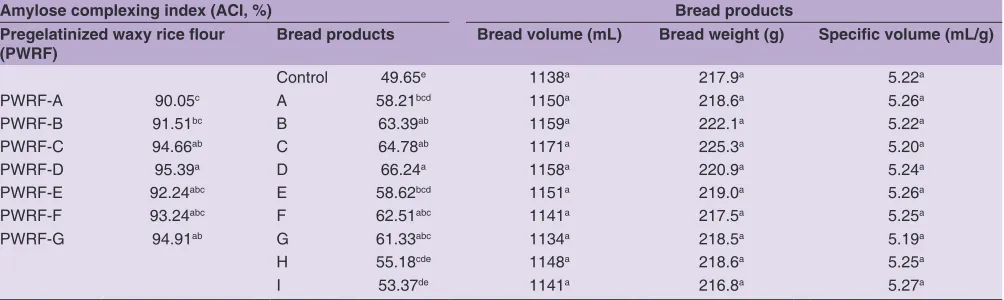
found (Giannone et al., 2016). The highest ACI (95.39%) was found when PWRF-D added and the lowest (90.05%)
was added PWRF-A (Table 3).This result was the same as
our previous report (Wang et al., 2011). Experimentally, the addition of α-amylase resulted in only a slight increase in the ACI of PWRF. Interestingly, PWRF-C, E, F, G exhibited no significant distinction upon the addition of α-amylase while both the PWRF-D and PWRF-A were the
two extremes in the experiment.
The ACI value of the bread is positively correlated with
the addition of PWRF. This is due to two different factors.
Firstly, the combination of emulsifier and α-amylase can
successfully decrease retrogradation by enhancing the
Table 3: The ACI of various PWRF and bread products as well as the effect of PWRF substituted ratios at 3% on volume, weight and specific volume of bread products
Amylose complexing index (ACI, %) Bread products
Pregelatinized waxy rice flour
(PWRF) Bread products Bread volume (mL) Bread weight (g) Specific volume (mL/g)
Control 49.65e 1138a 217.9a 5.22a
PWRF-A 90.05c A 58.21bcd 1150a 218.6a 5.26a
PWRF-B 91.51bc B 63.39ab 1159a 222.1a 5.22a
PWRF-C 94.66ab C 64.78ab 1171a 225.3a 5.20a
PWRF-D 95.39a D 66.24a 1158a 220.9a 5.24a
PWRF-E 92.24abc E 58.62bcd 1151a 219.0a 5.26a
PWRF-F 93.24abc F 62.51abc 1141a 217.5a 5.25a
PWRF-G 94.91ab G 61.33abc 1134a 218.5a 5.19a
H 55.18cde 1148a 218.6a 5.25a
668 Emir. J. Food Agric ● Vol 29 ● Issue 9 ● 2017 ACI. Secondly, the synthesis of amylose-lipid complex
could delay the rate of recrystallization. Caballero et al.
(2007) reported that the addition of α-amylase can serve a dual purpose - increase the ACI value and exhibit anti-staling effect for bread quality. The ACI value slightly increased with increased α-amylase content of PWRF-added bread samples though there were no significant
(P > 0.05) difference among bread sample groups A, B
and C or among bread sample groups B, C and D. Further,
the ACI value of those PWRF-added bread samples are significant (P < 0.05) higher than the control (49.65%) and among them the group D bread had the highest ACI value (66.24%). Groups B, C, F and G exhibited no significant
(P > 0.05) difference, but their ACI values were significant
(P < 0.05) higher than that of control and group A bread (58.21%). In addition, the ACI value of groups B, C and G were significant (P < 0.05) higher than groups H and I.
This is primarily due to the possible correlation between
ACI and PWRF. Matsukura et al. (1983) pointed out that the higher the formation of the complex, the higher the ACI, and hence, the more efficacious for postponing staling. Among seven PWRF groups, no significant (P > 0.05)
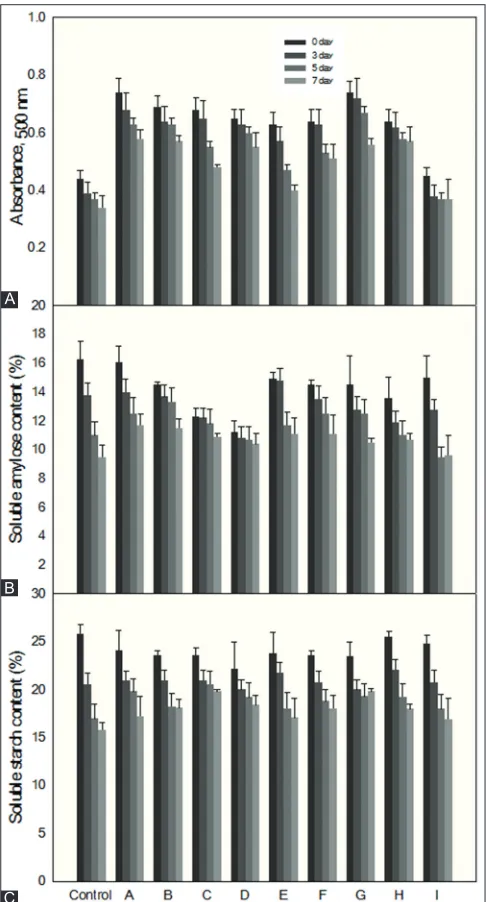
difference of SAC was found (Fig. 2A); however, the SAC of PWRF-added bread samples were significant (P < 0.05)
lower than that of control (Fig. 2B). The reason could result from that they possessed higher ACI values than that of
control. Besides, it is also be due to that complexes frame
an insoluble film on the starch appearance to avoid water
soaking in starch particle and prevent further swelling. This phenomenon will hence reduce SAC and amylose exudation
(Richardson et al., 2003).
Bread weight, volume and specific volume
Table 3 shows the weight, volume and specific volume of all breads. No significant (P > 0.05) difference with regard to weight, volume and specific volume among all bread
samples. This result is in accordance with the previous research (Shu et al., 1999).
Moisture content, aw, hardness, staling rate and retrogradation rate
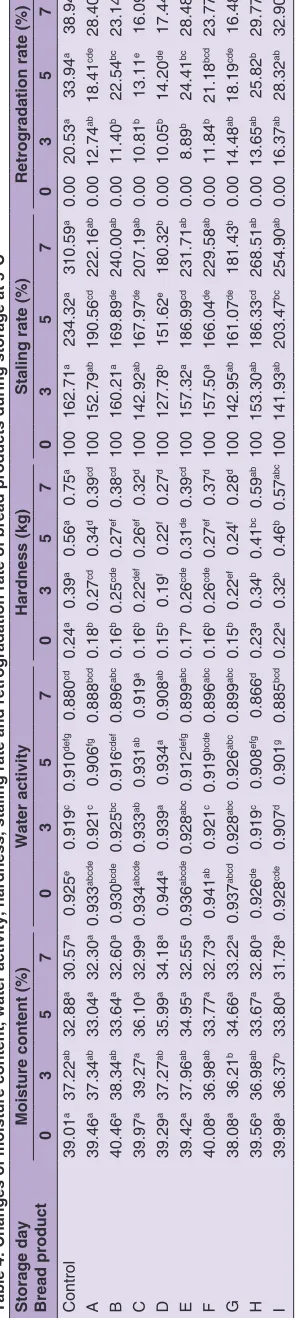
Berglund and Shelton (1993) reported that bread containing lower amount of moisture content could have more staling rate than the bread which containing higher amount of moisture content. Table 4 depicts the variances of moisture
content, aw, hardness, staling and retrogradation rate during storage of bread samples. The moisture content of
fresh breads was about 38.08-40.46%, and no significant
(P > 0.05) differences were found among all bread samples. This result from the present experiment is similar to Kulp
and Ponte (1981). A decreasing tendency of moisture content was observed during storage. This decrease in moisture content was primarily due to evaporation and
redistribution. Evaporation of water, though not the main
reason of staling, can still largely affect the staling rate of bread. For bread, it means that the higher the moisture
content the lower the staling rate. In the current study,
bread samples containing PWRF (groups A~G) which had a higher moisture content level, showed a lower staling rate. The aw of the bread will gradually decrease with the storage time. However, the addition of PWRF can not only increase the binding water, but also constrain the reduction aw of bread during storage, therefore delaying staling. A reasonable inference is the free water can fuse with hydrophilic substances, such as starch, in the bread
(Sidhu et al., 1997). Czuchajowska and Pomeranz (1989)
revealed the mechanism of the reduction of aw in bread central and the increasing of surface aw after three days storage and concluded that it was due to the moisture transport from interior to exterior.
Fig 2. Soluble amylose content of pregelatinized waxy rice flour (PWRF) (A) and bread products (B). A~G: Bread containing PWRF-A~G, respectively. H: Bread added α-amylase directly. I: Bread added monoglycerides directly. Bars with different superscript letters (a~c) indicate significant differences (P < 0.05).
On baking foods, emulsifier can not only make texture better but also inhibit retrogradation rebirth. For bread; however, emulsifier can be used as bread improver, dough
conditioner and enhancer, thereby improving the bread quality. The bread physico-chemical properties could be improved by adding suitable additive during storage (Curti
et al., 2016). Also, the bread staling process was found
to be affected by some selected parameter characteristic
(Lapčík et al., 2016). In the present study, it was found that
PWRF can also softening bread and does so much more
effectively than only use α-amylase or monoglycerides.
Staling causes the texture losing and reduces eating quality
were proved by Ji et al. (2007). The retrogradation is considered the major factor of staling; and further, the
staling has intimate relevance to hard texture in bread
(Krog et al., 1989). As shown in Table 4, staling rate of
PWRF-added bread samples were lower than the control, and as expect the group D bread had the lowest staling
rate. On the other hand, although group G bread also had
the second lowest staling rate, it possesses damp and sticky
properties which result in difficult to be cut. Emulsifier
can effectively temporize the hardness of starch colloid and extend retrogradation and staling rate during storage
(Keetels et al., 1996). Based on the results, the best bread
improver and anti-staling additive is the PWRF-D.
The starch retrogradation can also accompany with increase of enzyme hydrolysis (Ring et al., 1988). Amylose-lipid complexes can decrease starch retrogradation and restrain
the intra-action among amylose particles (Zobel, 1973). In this study, the retrogradation of the control group
was increased means that it has the largest staling after
storage. On the other hand, the retrogradation of bread sample groups A~G were lower than groups H, I and control, which means that PWRF could efficiently inhibit
retrogradation during storage.
Starch digestibility, SAC and soluble starch content The starch digestibility decreases with the storage time (Fig. 3). The higher absorbance means the lower staling. The PWRF-added breads have higher starch digestibility
than the control and group I bread after storage. This result
implies that bread staling can decrease starch digestibility and the staling could be inhibited by adding PWRF. The starch digestibility of group H bread is also higher than
the control and group I bread. This is probably due to the effect of α-amylase. Jeang et al. (1990) also emphasized
that starch digestibility of rice curd was decreased with the refrigeration time.
Kim and D’Appolonia (1977) reported that the increase
of hardness and recrystallization may result from retrogradation. We also pointed that the degree of
retrogradation and emulsifier could influence the SAC
Table 4: Changes of moisture content, water activity, hardness, staling rate and retrogradation rate of bread products during storage at 5°C Storage day Bread product
Moisture content (%)
Water activity
Hardness (kg)
Staling rate (%)
Retrogradation rate (%)
0 3 5 7 0 3 5 7 0 3 5 7 0 3 5 7 0 3 5 7 Control 39.01 a 37.22 ab 32.88 a 30.57 a 0.925 e 0.919 c 0.910 defg 0.880 cd 0.24 a 0.39 a 0.56 a 0.75 a 100 162.71 a 234.32 a 310.59 a 0.00 20.53 a 33.94 a 38.94 a A 39.46 a 37.34 ab 33.04 a 32.30 a0.933 abcde 0.921 c 0.906 fg 0.888 bcd 0.18 b 0.27 cd 0.34 d 0.39 cd 100 152.79 ab 190.56 cd 222.16 ab 0.00 12.74 ab 18.41 cde 28.40 bc B 40.46 a 38.34 ab 33.64 a 32.60 a 0.930 bcde 0.925 bc 0.916 cdef 0.896 abc 0.16 b 0.25 cde 0.27 ef 0.38 cd 100 160.21 a 169.89 de 240.00 ab 0.00 11.40 b 22.54 bc 23.14 cd C 39.97 a 39.27 a 36.10 a 32.99 a0.934 abcde 0.933 ab 0.931 ab 0.919 a 0.16 b 0.22 def 0.26 ef 0.32 d 100 142.92 ab 167.97 de 207.19 ab 0.00 10.81 b 13.11 e 16.09 d D 39.29 a 37.27 ab 35.99 a 34.18 a 0.944 a 0.939 a 0.934 a 0.908 ab 0.15 b 0.19 f 0.22 f 0.27 d 100 127.78 b 151.62 e 180.32 b 0.00 10.05 b 14.20 de 17.44 d E 39.42 a 37.96 ab 34.95 a 32.55 a0.936 abcde 0.928 abc 0.912 defg 0.899 abc 0.17 b 0.26 cde 0.31 de 0.39 cd 100 157.32 a 186.99 cd 231.71 ab 0.00 8.89 b 24.41 bc 28.48 bc F 40.08 a 36.98 ab 33.77 a 32.73 a 0.941 ab 0.921 c 0.919 bcde 0.896 abc 0.16 b 0.26 cde 0.27 ef 0.37 d 100 157.50 a 166.04 de 229.58 ab 0.00 11.84 b 21.18 bcd 23.77 cd G 38.08 a 36.21 b 34.66 a 33.22 a 0.937 abcd 0.928 abc 0.926 abc 0.899 abc 0.15 b 0.22 ef 0.24 f 0.28 d 100 142.95 ab 161.07 de 181.43 b 0.00 14.48 ab 18.19 cde 16.48 d H 39.56 a 36.98 ab 33.67 a 32.80 a 0.926 de 0.919 c 0.908 efg 0.866 d 0.23 a 0.34 b 0.41 bc 0.59 ab 100 153.30 ab 186.33 cd 268.51 ab 0.00 13.65 ab 25.82 b 29.77 bc I 39.98 a 36.37 b 33.80 a 31.78 a 0.928 cde 0.907 d 0.901 g 0.885 bcd 0.22 a 0.32 b 0.46 b 0.57 abc 100 141.93 ab 203.47 bc 254.90 ab 0.00 16.37 ab 28.32 ab 32.9 0 ab
a-eMeans with the different letter inside column are different significantly (
p
< 0.05). A
~G: Bread containing PWRF-A~G, respectively. H: Bread added
α
670 Emir. J. Food Agric ● Vol 29 ● Issue 9 ● 2017 (Wang et al., 2011). The starch staling is considered to
be related with these phenomena. Even though higher
retrogradation results in lower soluble amylose, the
emulsifier could inhibit retrogradation. In the present
experiment, the control group had the largest SAC followed
by group I bread. The SAC was slightly decreased after
storage. This is similar as the observation made by Schoch
and French (1947).
Sidhu et al. (1997) described that the reduction of SAC
and soluble starch was resulted from retrogradation and re-crystallization. Soluble starch content also decreased with storage time and this phenomenon obtained from our
study is similar to the previous report (Huang et al., 1988).
The control, groups H and I bread have higher decreasing
ratio than others.
TPA ANALYSIS RESULT
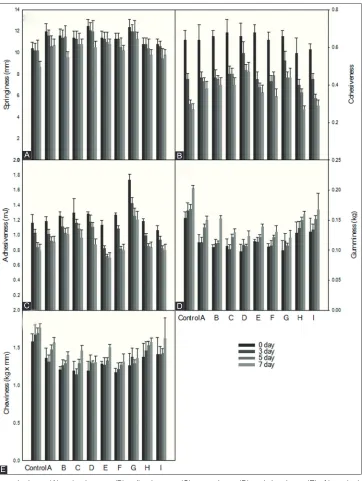
TPA analysis result is shown in Fig. 4. No significant (P >
0.05) differences of springiness was found among groups B, C, E, F, H, I and the control during storage; however, the springiness of groups D and G were significant (P < 0.05)
higher than the control (Fig. 4A). Regarding cohesiveness, no significant (P > 0.05) differences was observed between
PWRF-added breads and the control, except groups H
and I. Both results of springiness and cohesiveness are in agreement with the report of Curti et al. (2014). Giannone et al. (2016) also reported that added α-amylase could slow
down chewiness change during storage period. Fig. 3B
illustrates that groups H and I were significant (P < 0.05)
lower than the other PWRF-added groups. The group G bread had the highest adhesiveness (Fig. 4C) because of its
damp and sticky property as mentioned above. With regard to gumminess, the control had the highest gumminess
(0.15kg) followed by groups H and I, but the lowest values
were observed in those PWRF-added breads (Fig. 4D). The control also had the highest chewiness values (1.60 kg × mm), followed by groups H (1.42 kg × mm) and I (1.39 kg
× mm), but the lower values were found in those PWRF-added breads (Fig. 4E). The springiness, cohesiveness
and adhesiveness of all bread samples were decreased with storage time (Fig. 4A, 4B and 4C). On the contrary,
the gumminess, and chewiness of all bread samples were increased with storage time (Fig. 4D and 4E). These results were in accord with Caballero et al. (2007).
Sensory properties
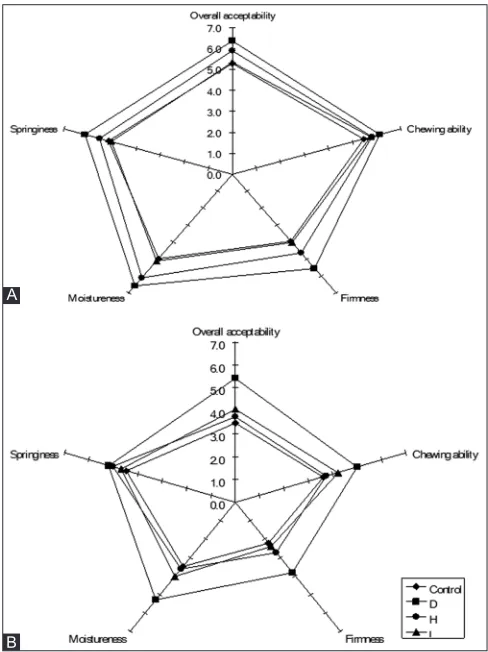
Fig. 5 radar chart shows the sensory properties of four
selected groups, i.e. control, D, H and I, which could on
behalf of all bread samples. For fresh bread samples, the
firmness of group D bread was lower than the control, groups H and I (Fig. 5A). Group D bread had the highest
springiness, chewiness and moistness; however, no significant (P > 0.05) differences were found among all
bread samples. As anticipated, the group D bread also
had the highest overall acceptability score after five-day
storage (Fig. 5B). Group D bread not only possessed softer texture but also had better springiness and moistness.
On the contrary, the control group had a damp and
sticky texture which results in a defect in springiness and
chewiness. Opposed to group D the control group had
the lowest overall acceptability score due to its decrease
in firmness and increase in springiness and moistness. Gómez et al. (2007) noticed that addition of hydrocolloid
could effectively improve the yellow layer cakes sensory Fig 3. Changes in starch digestibility (A), amylose content (B) and
soluble starch content (C) of breads during storage at 5°C. A~G: Bread containing PWRF-A~G, respectively. H: Bread added α-amylase directly. I: Bread added monoglycerides directly.
evaluation. Based on these research advocates and our findings, the PWRF-D significantly improves bread’s texture, springiness, moistness, chewiness and overall acceptability score regardless of fresh or after storage.
CONCLUSION
In many Western countries, the bread is considered the
one of the most important food and when it is ‘fresh’ is
the best time to consume; here ‘fresh’ means it can be maintained under the initial product status. Unfortunately,
both the staling and retrogradation are the major disturbs
for bread and many starchy foods. Regardless the water loss may escapes into the atmosphere or absorbed by
the crust (Monteau et al., 2017), both can diminished the
bread qualities and commodity value. Concerning bread qualities, to develop anti-staling formation and postpone retrogradation were very important jobs. Adding suitable additions in starch is considered to be simple and necessary
method in this stage. In the present study, we merged α-amylase and monoglycerides, and by pregelatinizing
and lyophilizing technologies to develop PWRF retarding agent, as well as to analyze chemical and physical qualities of bread samples with different levels of substitution of Fig 4. Changes in the springiness (A), cohesiveness (B), adhesiveness (C), gumminess (D) and chewiness (E) of breads during storage at 5°C. A~G: Bread containing PWRF-A~G, respectively. H: Bread added α-amylase directly. I: Bread added monoglycerides directly.
D C
B A
672 Emir. J. Food Agric ● Vol 29 ● Issue 9 ● 2017
PWRF. The results indicated that PWRF is an effective improvement for bread qualities and the addition of PWRF-D obtain the best sensory acceptability. The PWRF certainly acted a crucial role in decelerating the staling and
retrogradation of bread. Based on our findings, bread qualities can be improved significantly by means of PWRF
and it seems is a suitable alternative method for processing high quality bread.
Author contributions
Yang S. and Cheng P. contributed equally to conduct the
experiment and analyzed the results. Wang L. and Lin S.
assisted in data analysis. Yang C. designed the experiment and prepared materials. Wang T. designed the experiment, wrote the manuscript and commented by all authors.
REFERENCES
Amigo, J. M., A. O. Alvarez, M. M. Engelsen, H. Lundkvist and S. B. Engelsen. 2016. Staling of white wheat bread crumb and effect of maltogenic α-amylases. Part 1: Spatial distribution and kinetic modeling of hardness and resilience. Food Chem. 208: 312-325.
Fig 5. Sensory evaluation of breads with and without (control) different retarding agents before (A) and after (B) five days storage. D: Bread containing PWRF-D. H: Bread added α-amylase directly. I: Bread added monoglycerides directly.
B A
AOAC. 1990. Method 925.09. In: Official Methods of Analysis, 15th ed. Association of Official Analytical Chemists, Arlington, VA. Berglund, P. T. and D. R. Shelton. 1993. Effect of frozen storage
duration on firming properties of breads baked from frozen doughs. Cereal Foods World. 38(2): 89-90, 92-93.
Caballero, P. A., M. Gómez and C. M. Rosell. 2007. Improvement of dough rheology, bread quality and bread shelf-life by enzymes combination. J. Food Eng. 81(1): 42-53.
Curti, E., E. Carini, A. Diantom and E. Vittadini. 2016. The use of potato fibre addition in bread contributed to reduce bread staling. Food Chem. 195: 64-70.
Curti, E., E. Carini, G. Tribuzio and E. Vittadini. 2014. Bread staling: Effect of gluten on physico-chemical properties and molecular mobility. LWT Food Sci. Technol. 59(1): 418-425.
Czuchajowska, Z. and Y. Pomeranz. 1989. Differential scanning calorimetry, water activity and moisture contents in crumb center and near-curst zones of bread during storage. Cereal Chem. 66(4): 305-310.
Del-Rosario, R. R and C. R. Pontiveros. 1983. Retro-gradation of some starch mixtures. Starch Stärke. 35(3): 86-92.
Fiszman, S. M., M. Pons and M. H. Damasio. 1998. New parameters for instrumental texture profile analysis: Instantaneous and retarded recoverable springiness. J. Food Text. Stud. 29(5): 499-508.
Giannone, V., M. R. Lauro, A. Spina, A. Pasqualone, L. Auditore, I. Puglisi and G. Puglisi. 2016. A novel α-amylase-lipase formulation as anti-staling agent in durum wheat bread. LWT Food Sci. Technol. 65: 381-389.
Gómez, M., F. Ronda, P. A. Caballero, A. Blanco and C. M. Rosell. 2007. Functionality of different hydrocolloids on the quality and shelf-life of yellow layer cakes. Food Hydrocol. 21(2): 167-173. Hibi, Y. 2001. Effects of selected surfactants on amylopectin
recrystallization and on recoverability of bread crumb during storage. Starch Stärke. 53(5): 227-234.
Holm, J., I. Björck, N. G. Asp, L. B. Siöberg and I. Lundguist. 1985. Starch availability in vivo after flaking, steam-cooking and popping of wheat. J. Cereal Sci. 3(3): 193-206.
Huang, R. M., J. M. Tsiang and C. Y. Lii. 1988. The effect of sodium stearoyl 2-lactylateon the staling rate of Fon-Pen cake. Food Sci. 15(3): 287-295.
Jeang, C. L., S. J. Wu and T. C. Lin. 1990. Effects of treatments of different additive on the texture of frozen rice curd. J. Agric. Forestry. 39(2): 145-155.
Ji, Y., K. Zhu, H. Qian and H. Zhou. 2007. Staling of cake prepared from rice flour and sticky rice flour. Food Chem. 104(1): 53-58. Keetels, C. J. A. M., T. Van-Vliet, A. Jurgens and P. Walstra. 1996.
Effects of lipid surfactants on the structure and mechanics of concentrated starch gels and starch bread. J. Cereal Sci. 24(1): 33-45.
Kim, S. K. and B. L. D’Appolonia. 1977. Bread staling studies. II. Effect of protein content and storage temperature on the role of starch. Cereal Chem. 54: 216-219.
Krog, N., S. K. Olesen, H. Tørnæs and T. Jønsson. 1989. Retrogradation of the starch fraction in wheat bread. Cereal Foods World. 34(3): 281-285.
Kulp, K. and J. G. Ponte. 1981. Staling of a white pan bread: Fundamental causes. Crit. Rev. Food Sci. Nutr. 15(1): 1-48. Kweon, M. R., C. S. Park, B. M. Auh, N. S. Yang and K. H. Park. 1994.
bread staling by means of vibro-acoustic, tensile and thermal analysis techniques. J. Food Eng. 178: 31-38.
Maleki, M., J. L. Vetter and W. J. Hoover. 1981. The effect of emulsifiers, sugars, shortening and soya flour on the staling of Barbari flat bread. J. Sci. Food Agric. 32(12): 1209-1211. Matsukura, U., A. Matsunaga and K. Kainuma. 1983. Structural
studies of the retrogradation of gelatinized starch. J. Jpn. Soc. Starch Sci. 30(1): 106-109.
Monteau, J. Y., E. Purlis, E. Besbes, V. Jury and A. Le-Bail. 2017. Water transfer in bread during staling: Physical phenomena and modeling. J. Food Eng. 211: 95-103.
Rao, P. A., A. Nussinovitch and P. Chinachoti. 1992. Effects of selected surfactants on amylopectin recrystallization and on recoverability of bread crumb during storage. Cereal Chem. 69(6): 613-618.
Richardson, G., M. Langton, A. Bark and A. M. Hermansson. 2003. Wheat starch gelatinization-the effects of sucrose, emulsifier and the physical state of the emulsifier. Starch Stärke. 55(34): 150-161.
Riisom, T., N. Krog and J. Eriksen. 1984. Amylose complexing capacities of cis-and trans-unsaturated mono-glycerides in relation to their functionality in bread. J. Cereal Sci. 2(2): 105-118.
Ring, S. G., J. M. Gee, M. Whittam, P. Orford and I. T. Johnson. 1988. Resistant starch: Its chemical form in foodstuffs and effect on digestibility in vitro. Food Chem. 28(2): 97-109.
Sangnark, A. and A. Noomhorm. 2003. Effect of particle sizes on functional properties of dietary fibre prepared from sugarcane bagasse. Food Chem. 80(2): 221-229.
Schoch, T. J. and D. French. 1947. Studies on bread staling. I. The role of starch. Cereal Chem. 24: 231-249.
Shanthy, A. P., C. M. Sowbhagya and K. R. Bhattacharya. 1980. Simplified determination of water-insoluble amylose content of rice. Starch Stärke. 32(12): 409-411.
Shu, H. C., T. H. Huang, C. Y. Hsieh and T. T. Ku. 1999. Practical Bread Production Technology (in Chinese). China Grain Products Research and Development Institute, Taipei,. , pp. 349-366, 391-394.
Sidhu, J. S., J. Al-Saqer and S. Al-Zenki. 1997. Comparison of methods for the assessment of the extent of staling in bread. Food Chem. 58(1-2): 161-167.
Wang, T. C., S. C. Lin, Y. P. Shen, T. C. Wang-Mccall, K. P. Lan, M. H. Chin, P. Y. Cheng and C. C. Yang. 2011. Studies of retarding agent for decreasing starch retrogradation in Wan Kao (rice curd). J. Food Qual. 34(4): 268-277.