http://www.ijcmph.com pISSN 2394-6032 | eISSN 2394-6040
Original Research Article
Effect of arsenic safe water on manifestations of arsenicosis
Kunal Kanti Majumdar*
INTRODUCTION
Arsenic pollution in ground water has been considered as global public health problem. India and Bangladesh have been severely affected by this contamination. Though various states of eastern India have been affected with the arsenic problem, West Bengal has been affected most.1 In West Bengal, 26 million people are potentially at risk from drinking arsenic-contaminated water (above 0.05 mg/l). The estimated number of tube wells in 8 of the highly affected districts is 1.3 million, and estimated population drinking arsenic contaminated water above 10
and 50 µg/l were 9.5 and 4.2 million, respectively.2 The contamination of ground water with arsenic was first detected in 1978, and the first cases of chronic arsenic toxicity were reported in early 1980s.3-5 Most of the affected villages are located along the eastern side of the Ganges river. A survey which was limited to regions with levels >0.05 mg/l in West Bengal indicated that the arsenic concentration was generally between 50 to 500 µ/l in the drinking water supplies.6 However, concentrations have reached nearly 3400 µ/l in some villages (Guha Mazumder et al).7
ABSTRACT
Background: Reports are few in the literature on the long term effect of chronic arsenic toxicity after stoppage of drinking arsenic contaminated water. The object of the study is to ascertain the effect of drinking of arsenic safe water for prolonged period in an arsenic affected population in West Bengal, India.
Methods: A longitudinal intervention study was conducted from December 2017 to July 2018. Manifestations of various skin lesions and systemic diseases associated with chronic arsenic exposure were ascertained initially by carrying on baseline study on 200 families having 1200 family members in Madanpur village of Murshidabad district of West Bengal. The study population was taking water from tube wells with arsenic level >50 µg/l. The base line study findings were compared objectively at the end of six months follow up period after installation of a community filter in the village.
Results: 2% of the study population was having one or more dermatological and non dermatological manifestations of arsenicosis. There was 4.2% decrease in prevalence of pigmentation but no change in prevalence of keratosis in the follow up survey with 40% decrease in prevalence of non dermatological manifestations after taking arsenic safe water at the end of 6 months of follow up study. Around 60% of population was not aware about adverse health effects of arsenicosis and 70% not taking animal protein regularly.
Conclusions: Outcome of arsenical skin lesion following drinking of arsenic safe water depends on initial level and duration of arsenic exposure.
Keywords: Arsenic, Skin manifestations and systemic manifestations, Safe water, Diet and awareness
Department ofCommunity Medicine, KPC Medical College and Hospital, Jadavpur, Kolkata, West Bengal, India
Received: 10 August 2018
Revised: 17 September 2018
Accepted: 18 September 2018
*Correspondence:
Dr. Kunal Kanti Majumdar,
E-mail: [email protected]
Copyright: © the author(s), publisher and licensee Medip Academy. This is an open-access article distributed under the terms of the Creative Commons Attribution Non-Commercial License, which permits unrestricted non-commercial use, distribution, and reproduction in any medium, provided the original work is properly cited.
Mitigation action since the detection of the problem of arsenic in ground water in West Bengal, program of supply of arsenic safe drinking water had been completed by PHED, Govt. of West Bengal through deep tube wells from spot sources and supply of filtered surface water through pipe line system covering the nine arsenic affected blocks of the district of South 24 Parganas in the state since 2001.8 The reported clinical manifestations resulting from ingestion of arsenic-contaminated drinking water include pigmentation and keratosis of skin, weakness, conjunctival congestion, hepatomegaly, portal hypertension, respiratory system effects, poly neuropathy, solid edema of limbs, and malignant neoplasm.7 Skin abnormalities such as pigmentation change and keratosis have been known to be hallmark signs of chronic arsenic exposure. Skin lesions pose an important public health problem because advanced forms of keratoses are painful and debilitating.9 The arsenic-induced skin lesions may be associated with increased risks of skin, bladder and lung cancers, although increased cancer risks may result even without skin lesions being present.1
Reports are scanty in the literature on long term effect of chronic arsenic toxicity after stoppage of drinking arsenic contaminated water on skin manifestations. So the current study was therefore done to study the prevalence of arsenicosis and to assess change in the disease manifestations in regard to dermatological and systemic disease manifestation following intake of arsenic safe water (<50 µg/l).
The objective of the study is to ascertain the natural history of arsenical skin lesion following drinking of arsenic safe water in an arsenic affected population. METHODS
A longitudinal intervention study was conducted from December 2017 to July 2018 in Madanpur village in Bhagwangola II block of Murshidabad district of West Bengal to assess the occurrence of various dermatological and non dermatological manifestations of arsenicosis and the effect of taking safe water on these manifestations. Nineteen blocks of Murshidabad district were endemic for arsenicosis, of which Bhagwangola II block was selected randomly for the study. In the selected block the village Madanpur where there was no safe source of drinking water was selected randomly and a community filter was installed as an intervention measure. Arsenic content of the tube well in that area was >50 µg/l (PHED report Govt. of West Bengal 2008).200 families having 1200 family members taking water solely from a particular tube well with arsenic level >50 µg/l was selected as study population. A community filter was installed in December 2017 in that village. The selected families started using community filter water with
Technology (IIEST), Shibpur. So the selected families had a past history of taking water from an unsafe source before taking water from the community filter. The supplied filter removes Arsenic by adsorption method with activated alumina used as adsorbent along with electro coagulation which is a standardized method of removing Arsenic from water developed by IIEST and accredited by PHED, Govt. of West Bengal. Ethical clearance was done prior to the initiation of the study. The history of exposure to water containing arsenic level above permissible limit was verified with their residential address. After taking informed consent, the family members were also interviewed for their drinking and cooking water source for baseline data using a check list. They were also clinically examined for presence of signs and symptoms of suspected arsenicosis. Arsenical Manifestations was assessed by case definitions and diagnostic criteria of WHO (WHO Technical Publication, 2005).10 The family members were then motivated to use only filter water for their drinking and cooking purposes and were monitored continuously by the fieldworkers. The family members were subsequently re-examined in the months of July 2018 to determine the changes in clinical manifestations. The data obtained was compared with the baseline survey data. During follow up visit enquiries were made regarding any difficulty in using the filter water. Data collected were analyzed by suitable statistical methods.
Counselling, advice and treatment of minor ailments were also given to family members.
RESULTS
Table 1: Distribution of population having according to types skin lesions (n=27).
Type of skin lesion Number Percentage
(%)
Pigmentation+Keratosis 14 51.8
Only keratosis 1 3.7
Only pigmentation 9 33.3
No skin lesion 3 11.1
Table 2:Distribution of suspected arsenicosis in both baseline (December 2017) and follow up survey (July
2018) (n=24).
Male Female Total
N (%) N (%) N (%)
Suspected
arsenicosis 8 (33.3) 16 (66.7) 24 (100)
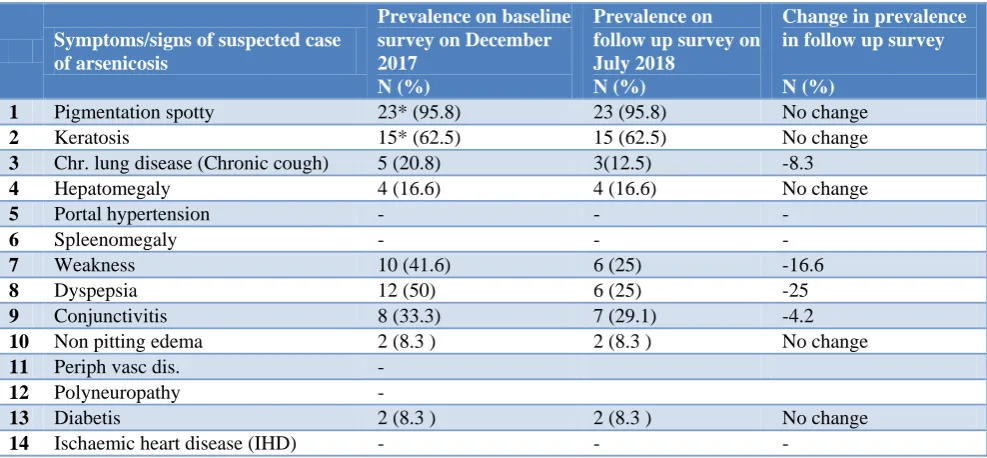
33.3% patients had only pigmentation (Table 1) and there was 4.2% decrease in prevalence of pigmentation (Figure 1 and 2) but no change in keratosis in the follow up survey (Table 3). Majority cases of pigmentation and keratosis were mild. Among the suspected cases 33.3% of participants were male and remaining 66.7% of participants were females (Table 2).
Among non dermatological manifestations 50% of the population complained of dyspepsia in the baseline survey (bloating, flatulence and a sense of distension in the upper part of abdomen.) with 25% decrease in follow up survey. Weakness (41.6%), chronic conjunctival congestion (33.3%) chronic cough (20.8%), hepato-megaly (16.6%), and bilateral oedema of the legs (8.3%) and diabetes (8.3%) were the other systemic manifestations present in the baseline survey with 16.6%, 8.3%, 4.2% decrease of weakness, chronic cough and chronic conjunctival congestion in the follow up survey (Table 2).
Only 40% of population was aware about adverse health effects of arsenicosis. 30% of study population was taking egg/fish/meat twice or thrice a week which are rich source of animal protein. 50% of population was taking plenty of green leafy vegetables and seasonal fruits which are rich in anti oxidants.
The families taking water from community filter were satisfied about the water regarding its taste and palatability. So the filter water was quite acceptable to them.
Figure 1: Raindrop pigmentation as detected in a lady in the baseline study.
Figure 2: Change in pigmentation in the same lady 6 months after taking safe water.
Table 3: Distribution of arsenic cases according to prevalence of dermatological and non dermatological manifestations (n=24).
Symptoms/signs of suspected case of arsenicosis
Prevalence on baseline survey on December 2017
N (%)
Prevalence on follow up survey on July 2018
N (%)
Change in prevalence in follow up survey N (%)
1 Pigmentation spotty 23* (95.8) 23 (95.8) No change
2 Keratosis 15* (62.5) 15 (62.5) No change
3 Chr. lung disease (Chronic cough) 5 (20.8) 3(12.5) -8.3
4 Hepatomegaly 4 (16.6) 4 (16.6) No change
5 Portal hypertension - - -
6 Spleenomegaly - - -
7 Weakness 10 (41.6) 6 (25) -16.6
8 Dyspepsia 12 (50) 6 (25) -25
9 Conjunctivitis 8 (33.3) 7 (29.1) -4.2
10 Non pitting edema 2 (8.3 ) 2 (8.3 ) No change
11 Periph vasc dis. -
12 Polyneuropathy -
13 Diabetis 2 (8.3 ) 2 (8.3 ) No change
14 Ischaemic heart disease (IHD) - - -
DISCUSSION
In this study the natural history of arsenical skin lesions in relation to ingestion of arsenic safe drinking water for a prolonged period in an arsenic exposed population has been presented with individual arsenic exposure data in the past. It was evident from the data presented in the study that there was slight (4.2%) decrease in prevalence of pigmentation but no change in keratosis after intake of arsenic free drinking water for a prolonged period of 6 months in an arsenic exposed population. Majority cases of pigmentation and keratosis were mild. Among the suspected cases majority of participants were females. At the end of 6 months of intervention study there was 25% 16.6%, 8.3%, and 4.2% decrease of non-dermatological manifestations like dyspepsia, weakness, chronic cough and chronic conjunctival congestion among participants in the follow up survey indicating beneficial effect of safe water on arsenical manifestations. However there was persistence of dermatological manifestations like keratosis and other manifestations like chronic cough, hepatomegaly, bilateral non pitting oedema and diabetes even after taking arsenic-safe water for 6 months. Only 40% of population was aware about adverse health effects of arsenicosis. Only 30% of populations were taking egg, fish, meat or any other animal protein regularly and 50% of population was taking plenty of green leafy vegetables and seasonal fruits which are rich in anti-oxidants. In a study conducted in South 24 Parganas district of West Bengal among arsenic exposed study population it was found that the risk of arsenic induced skin lesions may be increased due to deficiencies of some nutrients like animal protein, calcium, fiber, folate and vitamin C.11
A few studies conducted earlier investigated the effect of drinking arsenic free water on arsenical skin lesion caused by ground water arsenic contamination highlighting either improvement of skin lesion or new appearance in a few.12-16 However, the studies were carried out on small number of participants and for a short period of follow up. No study described increment of severity of skin lesion even after drinking arsenic safe water. Further individual exposure data in the past was not considered for assessing the outcome results of follow up study.
Guha Mazumder et al carried out a cohort follow-up study on 1074 people in South 24 Parganas, West Bengal.17 Among the arsenic-exposed population who were consuming safe water during the last 5 years the skin lesions cleared or decreased in 49.7% out of 199 people with skin lesion. However, new skin lesions appeared in 32 (10.5%) out of 306 people who were not diagnosed with such lesions previously.
some extent.18 However in a follow-up study for 5 yrs showed no significant improvement of skin lesions. The potential risk of arsenic-induced cancers after stoppage of high arsenic exposure was still remains uncertain and indefinite. The present study, documented that even after intake of arsenic-safe water for 6 months arsenical skin lesions like keratosis do not improve. However, in other studies it was documented that intake of safe water for least 5 to 10 years lead to improvement in skin score. So further longitudinal follow up studies with longer duration urgently needed. Thus, a major strength of this study is that it is the study with individual exposure data, followed up for a period of 6 months following drinking arsenic safe water, which can provide information with which to characterize the exposure-response relationship in regard to effect of drinking arsenic safe water.
CONCLUSION
It was evident from the baseline data presented in the study that over all prevalence of pigmentation and or keratosis was around 2% among participants having common source of exposure from tube well. There was slight decrease in prevalence of pigmentation but no change in keratosis after intake of arsenic free drinking water for a prolonged period of 6 months in an arsenic exposed population. But there is documentary evidence of improvement of skin manifestations following intake of safe water for 5 to 10 years indicating necessity for similar follow up studies for longer duration. Around 60% of population was not aware about adverse health effects of arsenicosis.
Recommendations
Identification of the problem early by the primary care providers of the local region and starting prompt intervention can prevent development of future complication of chronic arsenic toxicity like cancers and other systemic complications. Cessation of exposure to drinking water or items of elevated concentration of arsenic was believed to provide effective remedy. So, primary prevention by raising levels of awareness among primary care providers of the local region about manifestations of arsenicosis with availability of safe water supply will definitely help to mitigate this important public health problem.
ACKNOWLEDGEMENTS
The authors gratefully acknowledge the support provided by Prof Anirban Gupta, Professor, Department of Civil Engineering, IIEST, Shibpur, Howrah and Dr KabitaMaity to conduct the study is also acknowledged.
REFERENCES
1. IARC. Some drinking-water disinfectants and contaminants, including Arsenic. Monographs on the evaluation of carcinogenic risks to humans. Lyon, France, WHO. 2004;84:68-70,
2. Chakraborti D, Das B, Rahman MM, Chowdhury UK, Biswas B, Goswami AB, et al. Status of groundwater arsenic contamination in the state of West Bengal, India: A 20-year study report. Mol Nutr Food Res. 2009;53:542–51.
3. Garai R, Chakraborty AK, Dey SB, Saha KC. Chronic arsenic poisoning from tube well water. J Indian Med Assoc. 1984;82:34–5.
4. Chakraborty AK, Saha KC. Arsenical dermatosis from tubewell water in West Bengal. Indian J Med Res. 1987;85:326-34,
5. Guha Mazumder DN, Chakraborty AK, Ghosh A, Das Gupta J, Chakraborty DP, Dey SB, et al. Chronic arsenic toxicity from drinking tube-well water in rural West Bengal. Bull World Health Organ. 1988;66:499-506.
6. Das D, Chatterjee A, Samanta G, Mandal B, Chowdhury TR, Samanta G, et al. Arsenic contamination in groundwater in six districts of West Bengal, India: the biggest arsenic calamity in the world. Analyst. 1994;119(12):168N-70N. 7. Guha Mazumder DN. Chronic Arsenic Toxicity and
Human Health. Indian J Med Res. 2008;128:436-47. 8. WBPHED-Water Quality Survey Reports. http://www.wbphed.gov.in/main/index.php/compon ent/content/category/95-water-quality. Accessed on 28th May 2010.
9. NRC (Natioanl Research Council). Arsenic in drinking water. Washington DC: National Academic Press; 1999: 27-82.
10. WHO. Technical Publication No. 30. Clinical aspects of Arsenicosis. A Field Guide for Detection, management and surveillance of arsenicosis cases. In: Caussy D, editor. New Delhi: WHO Regional Office for South East Asia; 2005: 5-9.
11. Mitra SR, Mazumder DNG, Basu A, Blosk G, Haque R, Samanta S. Nutritional Factors and
susceptibility to arsenic caused skin lesions in West Bengal, India. Environ Med. 2004;112:1104–9. 12. Tseng WP, Chu HM, How SW, Fong JM, Lin CS,
Yeh S. Prevalance of skin cancer in an endemic area of chronic arsenicism in Taiwan. J Natl Canc Inst. 1968;40:453-63.
13. Yeh S. Skin cancer in chronic arsenicism. Human Pathol. 1973;4:465-85.
14. Guha Mazumder DN, Ghosh N, De BK, Santra A, Das S, Lahiri S, et al. Epidemiological study on various non carcinomatous manifestations of chronic arsenic toxicity in a district of West Bengal. In: C.O. Abernathy, R.L. Calderon and W.R. Chappell, eds. Arsenic Exposure and health effects IV, Oxford, UK: Elsevier Science; 2001: 153-164. 15. Sun G, Li X, Pi J, Sun Y, Li B, Jin Y, et al. Current
research problems of chronic arsenicosis in China. J Health Popul Nutr. 2006;24:176-81.
16. Guha Mazumder DN, Ghosh A, Deb D, Biswas A, Guha Mazumder RN. Arsenic exposure, health effects and biomarker and treatment of arsenicosis-experience in west Bengal, India. Proceedings of 5th International Congress on Arsenic in the environment, Buenos Airs, 2014, In One Century of the Discovery of Arsenicosis in Latin America (1914-2014)-Ed. Litter, Nicolli, Meichtry, Quici, Bundschu, Bhattacharya and Naidu. London, Taylor and Francis Group; 2014: 481-484.
17. Haque R, Guha Mazumder DN, Samanta S, Ghosh N, Kalman D, Smith MM, et al. Arsenic in drinking water and skin lesions: Dose-response data from West Bengal, India. Epidemiology. 2003;14:174-82. 18. Sun G, Li X, Pi J, Sun Y, Li B, Jin Y, et al. Current Research problems of chonic arsenicosis in China. J Health Popul Nutr. 2006;24:176-81.