Original Research Article
A study on awareness regarding HIV/AIDS among medical students
in Kancheepuram district, Tamil Nadu
L. Neerajaa*, M. Vijayakarthikeyan, R. Umadevi
INTRODUCTION
AIDS is acquired immuno-deficiency syndrome caused by a retrovirus known as Human Immunodeficiency Virus (HIV) which affects the body's immune system. Due to infection the victim is vulnerable to many life-threatening opportunistic infections.1,2 Since the discovery of HIV/AIDS in 1981, it has been an important public health problem and currently it is the fourth leading cause of death globally.3 Nearly 35.3 million people living with HIV in 2012 worldwide.4,5 Globally people with newly detected HIV infection is 2.7 million
and nearly 2 million deaths are due to AIDS. Among the new cases nearly, 40% of them belonged to the age group of 15-24 years.6,7 Globally as per WHO it has been estimated that about 40 million PLHA cases between the ages of 15-24 will be reached by 2020.8
The first case of HIV in India was detected in Chennai in the year 1986 and over the years AIDS has become one of the leading causes of morbidity and mortality in India. As per the report by National AIDS Control Organization of India, the prevalence of AIDS in India is 0.27% in the year 2011.9 It is estimated that nearly 7 million people are
ABSTRACT
Background: India has the third largest number of people living with HIV/AIDS. India is estimated to have 75,900 new adults with HIV infections. The prevalence of HIV infection was 0.7% in India, 0.26% in Tamil Nadu in the year 2017. HIV related stigma remains an important barrier in effectively fighting against HIV/AIDS. The objectives of the study were to assess knowledge regarding HIV/AIDS among medical students and to assess attitude towards HIV/AIDS among medical students.
Methods: A cross-sectional study conducted among 1st year undergraduates of Sree Balaji Medical College. Sample size was calculated using 4pq/L2, computed to a total of 240. Data collection was done using pretested structured questionnaire, containing 7 questions and 5 questions regarding knowledge and attitude towards HIV/AIDS respectively. Data was entered in MS excel and analysed using SPSS software version 22.
Results: Among the participtants, 46% were male and 54% were female. 91% of study participants had adequate knowledge (94% knew that HIV was preventable, 89% knew about the mode of spread, 90% knew about transmission prevention) and 84% of the study participants had good attitude.
Conclusions: This knowledge and attitude study was to assess the current level of knowledge among first year MBBS students about AIDS at the point of entry to medical course. Few misconceptions were found to exist regarding mode of transmission and prevention. Awareness programmes should be initiated among the MBBS students in the first year itself, so that these lacunae can be rectified.
Keywords: Awareness, STD, Risky behaviour, ICTC
Department ofCommunity Medicine, Sree Balaji Medical College, Chennai, Tamil Nadu, India
Received: 28 August 2018
Accepted: 15 September 2018
*Correspondence:
Dr. L. Neerajaa,
E-mail: [email protected]
Copyright: © the author(s), publisher and licensee Medip Academy. This is an open-access article distributed under the terms of the Creative Commons Attribution Non-Commercial License, which permits unrestricted non-commercial use, distribution, and reproduction in any medium, provided the original work is properly cited.
infected with HIV in India alone.10 Every year 2.6 million new cases of HIV occurs in India and globally India ranks 3rd in the burden of HIV.11,12
Younger generation is more prone for contracting HIV due to their tendency to follow high risk behaviour and improper guidance. There are many misconceptions prevailing in the community regarding HIV/AIDS.as there is no cure for AIDS and non-availability of vaccine places prevention as a main strategy in reducing the burden of the disease. The gaps in the knowledge and attitude towards HIV/AIDS can be bridged by proper health education by qualified persons. Health care professionals occupy a frontline position in the prevention of AIDS.
With this background this study was planned to assess the knowledge and attitude towards HIV/AIDS among 1st year MBBS students of Sree Balaji Medical College and Hospital.
METHODS
Study design
This is a descriptive cross sectional study.
Study area
The study was conducted in Sree Balaji Medical College and Hospital, Chromepet, Chennai.
Study population
Study population includes 1st year MBBS students studying in Sree Balaji Medical College and Hospital, Chromepet, Chennai.
Study period
This study was conducted from August 2017 to October 2017.
Inclusion and exclusion criteria
All the 1st year MBBS students who gave consent to participate were included in the study and those who didn’t give consent were excluded from this study.
Sample size
Sample size of this study was calculated using the previous study done by Kuruvila in which the knowledge about HIVAIDS is 64.9%.10 Using the formula 4pq/L², the sample size was calculated to be 214 with an absolute precision of 10%. Adding 10% refusal rate, the sample size was calculated to be 237, which was rounded off to 240.
Sampling method
Universal sampling method was used to select the study participants for this study.
Study tool
A pretested structured questionnaire was used to collect the data. Questionnaire consists of background information and questions to assess the knowledge, attitude towards HIV/AIDS. The interview schedule consisted of 9 questions on knowledge and 7 on attitude.
Data analysis
For each of the study component, the correct response to the question was given a score of ‘1’ and any other response was given ‘0’ score. The maximum score that could be obtained at the end of the interview was ‘9’for knowledge, ‘7’ for attitude. A score of 4 and above was taken as adequate knowledge and a score of 4 and above is considered as positive attitude. All the data collected were entered into the Microsoft excel. The data analysis was carried out using SPSS software version 22. The level of knowledge and attitude towards HIV/AIDS was calculated using percentage.
Ethical clearance
The study was carried out after obtaining clearance from the institutional ethical committee.
Informed consent
Data was collected after obtaining written informed consent.
RESULTS
Socio-demographic characteristics of the study population
Socio-demographic characteristics of the study population are depicted in Table 1. Among the study sample of 240, females were 57.5% and 42.5% of the respondents were male.in his study 72.3% were Hindus, 13.6% were Christians, 9.2% were Muslims and the rest 4.9% belonged to other religion. Majority of the study samples, nearly 80.1% belonged to nuclear type of family and 19.9% belongs to joint family.
Knowledge regarding HIV/AIDS among the study participants
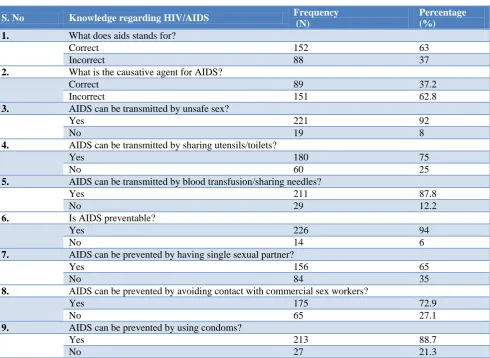
needles/blood transfusion. Almost 94% of the study samples knew AIDS is preventable. Regarding the modes of prevention 65% of them knew AIDS can be prevented by having single sexual partner, 72.9% of hem knew
AIDS can be prevented by avoiding contact with commercial sex worker and 88.7% knew that AIDS can be prevented by using condoms.
Table 1: Socio-demographic characteristics of the study population.
S. No Socio-demographic variable Frequency
(n=240)
Percentage (%)
1. Sex
Male 102 42.5
Female 138 57.5
2. Religion
Hindu 173 72.3
Christian 33 13.6
Muslim 22 9.2
Others 12 4.9
3. Family type
Nuclear family 192 80.1
Joint family 48 19.9
Table 2: Knowledge regarding HIV/AIDS among the study participants(n=240).
S. No Knowledge regarding HIV/AIDS Frequency
(N)
Percentage (%) 1. What does aids stands for?
Correct 152 63
Incorrect 88 37
2. What is the causative agent for AIDS?
Correct 89 37.2
Incorrect 151 62.8
3. AIDS can be transmitted by unsafe sex?
Yes 221 92
No 19 8
4. AIDS can be transmitted by sharing utensils/toilets?
Yes 180 75
No 60 25
5. AIDS can be transmitted by blood transfusion/sharing needles?
Yes 211 87.8
No 29 12.2
6. Is AIDS preventable?
Yes 226 94
No 14 6
7. AIDS can be prevented by having single sexual partner?
Yes 156 65
No 84 35
8. AIDS can be prevented by avoiding contact with commercial sex workers?
Yes 175 72.9
No 65 27.1
9. AIDS can be prevented by using condoms?
Yes 213 88.7
No 27 21.3
Attitude towards HIV/AIDS among the study participants
Attitude towards HIV/AIDS in this study is shown in Table 3. Among the study participants 87% of them are
with HIV/AIDS in their home. Only 57.9% of the participants are willing to stay with their friend with an HIV/AIDS. Around 55% of them only are willing to send
their sibling to a school with HIV/AIDS affected children.in this study only 39.2% of them feel that HIV/AIDS should not be out casted from the society.
Table 3: Attitude towards HIV/AIDS among the study participants (n=240).
S.no Attitude towards HIV/AIDS Frequency
(N)
Percentage (%) 1. Are you willing to get tested for HIV?
Yes 209 87
No 31 13
2. Premarital HIV testing should be made compulsory?
Yes 180 75
No 60 25
3. Even one unsafe intercourse could lead to HIV/AIDS?
Yes 158 65.8
No 82 34.2
4. I would take care of a relative with HIV/AIDS at my home?
Yes 148 61.6
No 92 38.4
5. I would stay with my friend with HIV/AIDS?
Yes 139 57.9
No 101 42.1
6. I would allow my siblings to go to a school which has children with HIV/AIDS?
Yes 132 55
No 108 45
7. Should an HIV/AIDS patient be outcast from the society?
Yes 94 39.2
No 146 60.8
Figure 1: Overall knowledge towards HIV/AIDS among the study population.
Overall knowledge towards HIV/AIDS among the study population
Overall, respondents had a mean (±SD) score of knowledge of 5 (±2.6) from 9 knowledge‐related questions.46.3% were classified as having a high level of
knowledge with a knowledge score of ≥7 correct responses, 31.3% as medium level of knowledge with 4-6 correct responses and 22.4% as low level of knowledge with ≤3 correct responses regarding knowledge on HIV/AIDS. Respondents with high and medium level of knowledge are considered to be having adequate knowledge. Nearly 77.6% of the study participants had adequate knowledge which is depicted in Figure 1.
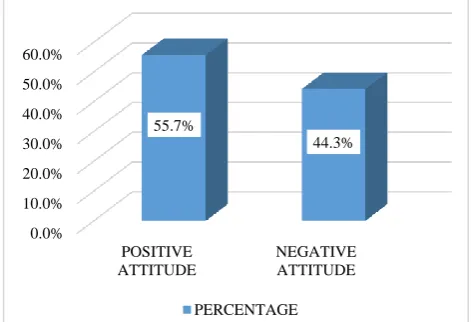
Figure 2: Overall attitude towards HIV/AIDS among the study population.
0 10 20 30 40 50 60 70 80
ADEQUATE KNOWLEDGE
INADEQUATE KNOWLEDGE 77.4
22.6
PERCENTAGE
0.0% 10.0% 20.0% 30.0% 40.0% 50.0% 60.0%
POSITIVE ATTITUDE
NEGATIVE ATTITUDE 55.7%
44.3%
Overall attitude towards HIV/AIDS among the study population
Of the 7 questions that addressed attitudes toward HIV transmission (3 questions) and PLHIV (4 questions), the scores ranged from 2 to 5 (mean score=3.5, SD±4.0). Accordingly, 55.7% of students scored equal or more than the mean and were classified as having a positive attitude towards PLHIV. A total of 44.3% were classified as having a negative attitude toward PLHIV because they scored less than the mean.
Association between socio-demographic variables and knowledge and attitude towards HIV/AIDS among the study participants
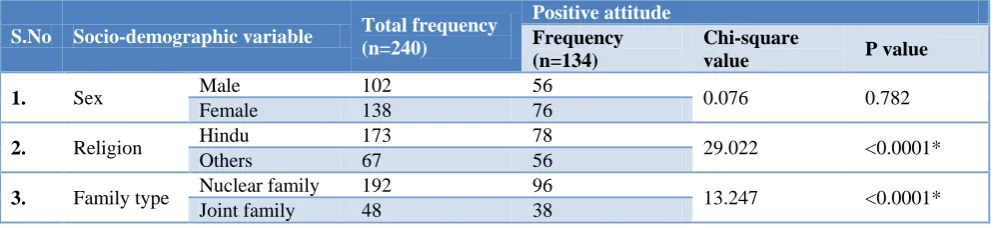
In this study there was a statistically significant association between sex and knowledge about HIV/AIDS (p<0.0001). Family type was also statistically significant associated with knowledge (p<0.0001). Religion was not associated with knowledge. Family type was statistically significant associated with positive attitude (p<0.0001). Religion was associated with positive attitude (p<0.0001). There was no association between sex and positive attitude in this study.
Table 4: Association between socio-demographic variables and knowledge about HIV/AIDS among the study participants
S.No Socio-demographic variable Total frequency
(n=240)
Adequate knowledge Frequency
(n=186)
Chi-square
value P value
1. Sex Male 102 62 25.617 <0.0001*
Female 138 124
2. Religion Hindu 173 132 0.511 0.474
Others 67 54
3. Family type Nuclear family 192 163 30.113 <0.0001* Joint family 48 23
Table 5: Association between socio-demographic variables and attitude towards HIV/AIDS among the study participants.
S.No Socio-demographic variable Total frequency
(n=240)
Positive attitude Frequency (n=134)
Chi-square
value P value
1. Sex Male 102 56 0.076 0.782
Female 138 76
2. Religion Hindu 173 78 29.022 <0.0001*
Others 67 56
3. Family type Nuclear family 192 96 13.247 <0.0001* Joint family 48 38
DISCUSSION
Socio-demographic characteristics of the study population
Regarding distribution of the socio-demographic factors in our study, 42.5% were males and 57.5% were females. In a study done by Baria et al in Valsad.5 In our study, the distribution of religion were Hindus 72.3%, Muslims 13.6%, Christians 9.2% and others 4.9%. Whereas in a study done by Hansson et al in Kazhikstan 52.8% were males and 47.1% were females. 47% were Muslims, 44% were Christians, others comprised of 9%.13
Knowledge regarding HIV/AIDS among the study participants
Regarding adequate overall knowledge in study participants was found to be 77.6% in our study. Whereas
in a study done by Indradevi et al.9 It was found to be 100%. In a study conducted by Mishra the overall knowledge among drug operators was found to 72.7%.14
Attitude towards HIV/AIDS among the study participants
in a study done by Thanavanh. Overall positive attitudes towards HIV/AIDS were observed among 55.7% of respondents.
CONCLUSION
In this study 77.4% of the study participants had adequate knowledge and 55.7% of them had positive attitude towards HIV/AIDS. This knowledge and attitude study was to assess the current level of knowledge among first year MBBS students about AIDS at the point of entry to medical course. Few misconceptions were found to exist regarding mode of transmission and prevention of HIV/AIDS.
Recommendations
This study gives a new insight to the existing problem. Still the gaps in knowledge and attitude has to be bridged by effective Information Education and Communication (IEC) methods and Behavioural Change Continuum (BCC) methods. Adequate awareness creation will curb the rates of this disease. National Aids Control Program (NACP) coverage must be widened and adequate funds must be allocated for prevention of HIV/AIDS related activities Awareness programmes should be initiated among the MBBS students in the first year itself, so that these lacunae can be rectified.
ACKNOWLEDGEMENTS
First of all, I would like to thank my college management and my department of community medicine for giving me this opportunity. I would like to extend my thanks to our department HOD and all my professors, associate professors and assistant professors for guiding me throughout the study. A special mention to all my co post graduates, friends and family members for helping me to complete the study.
Funding: No funding sources Conflict of interest: None declared
Ethical approval: The study was approved by the Institutional Ethics Committee, Sree Balaji Medical College and Hospital
REFERENCES
1. WHO. Techn Rep 9en. 1986: 736.
2. Patil SD, Bhovi RA. Study to Assess Awareness about HIV/AIDS among First Year MBBS Students in a Medical College, Vijaypur, Karnataka. Community Med. 2016;7(4):331-4.
3. Piot P, Bartos M, Ghys PD, Walker N, Schwartländer B. The global impact of HIV/AIDS. Nature. 2001;410:968–73.
4. HIV/AIDS. Fact sheets. Available at: http://www. who.int/mediacentre/factsheets/fs360/en/. Accessed on 7 May 2018.
5. Baria HG, Solanky P, Patel J, Chavda N, Sharma D, Mahayavanshi D. A study on knowledge and awareness regarding HIV/AIDS among first year MBBS students. Tuberculosis. 2014;90:65-2. 6. Geneva: UNAIDS and WHO; 2009. AIDS epidemic
update. ISBN 9789291738328.
7. Sachdeva S, Malik JS, Sachdeva R, Sachdev TR. HIV/AIDS knowledge among first year MBBS, Nursing, Pharmacy students of a health university, India. J Family Community Med. 2011;18(3):155. 8. Shankar R, Pandey S, Awasthi S, Pawat CM.
Awareness of HIV/AIDS among first year medical undergraduates in Nainital, Uttarakhand, India. Indian J Prev Soc Med. 2011;42(2):169.
9. Indradevi R, Govardhan J, Oudeacoumar P, Besra L, Karthikraja S, Preethi K, Azeemjaffer N, Sathyan S. KAP study on HIV/AIDS among first year nursing students. J Evol Med Dent Sci. 2014 Oct 27;3(56):12723-8.
10. Kuruvila M, Venugopalan PP, Sridhar KS. KAP study on HIV/AIDS among first year MBBS students. Indian J Dermatol Venereol Leprol. 1997;63(4):225.
11. Agarwal AS, Maurya AA, Siddiqui WA. Knowledge and attitude of medical students, interns and post graduate medical students regarding HIV/AIDS. Indian J Basic Applied Med Res. 2013;3:267-77.
12. Annual Report. National AIDS Control Organisation, Department of AIDS Control, Ministry of Health Family Welfare, Government of India. 2009-2010.
13. Hansson M, Stockfelt L, Urazalin M, Ahlm C, Andersson R. HIV/AIDS awareness and risk behavior among students in Semey, Kazakhstan: a cross-sectional survey. BMC Int Health Human Rights. 2008;8(1):14.
14. Mishra R. STDs and HIV/AIDS: a KAP study among drug operators. Health for the Millions. 1998;24(5):11-3.
15. Thanavanh B, Harun‐Or‐Rashid M, Kasuya H, Sakamoto J. Knowledge, attitudes and practices regarding HIV/AIDS among male high school students in Lao People's Democratic Republic. J the Int AIDS Society. 2013;16(1):17387.