R E V I E W
Open Access
Is pre-Darwinian evolution plausible?
Marc Tessera
Abstract
Background:This essay highlights critical aspects of the plausibility of pre-Darwinian evolution. It is based on a
critical review of some better-known open, far-from-equilibrium system-based scenarios supposed to explain processes that took place before Darwinian evolution had emerged and that resulted in the origin of the first systems capable of Darwinian evolution. The researchers’responses to eight crucial questions are reviewed. The majority of the researchers claim that there would have been an evolutionary continuity between chemistry and “biology”. A key question is how did this evolution begin before Darwinian evolution had begun? In other words the question is whether pre-Darwinian evolution is plausible.
Results:Strengths and weaknesses of the reviewed scenarios are presented. They are distinguished between
metabolism-first, replicator-first and combined metabolism-replicator models. The metabolism-first scenarios show major issues, the worst concerns heredity and chirality. Although the replicator-first scenarios answer the heredity question they have their own problems, notably chirality. Among the reviewed combined metabolism-replicator models, one shows the fewest issues. In particular, it seems to answer the chiral question, and eventually implies Darwinian evolution from the very beginning. Its main hypothesis needs to be validated with experimental data.
Conclusion:From this critical review it is that the concept of“pre-Darwinian evolution”appears questionable, in
particular because it is unlikely if not impossible that any evolution in complexity over time may work without multiplication and heritability allowing the emergence of genetically and ecologically diverse lineages on which natural selection may operate. Only Darwinian evolution could have led to such an evolution. Thus, Pre-Darwinian evolution is not plausible according to the author. Surely, the answer to the question posed in the title is a prerequisite to the understanding of the origin of Darwinian evolution.
Reviewers:This article was reviewed by Purificacion Lopez-Garcia, Anthony Poole, Doron Lancet, and
Thomas Dandekar.
Keywords:Metabolism-first, Replicator-first, Combined metabolism-replicator scenarios, Pre-Darwinian evolution,
Prebiotic evolution, Darwinian evolution, Origin of life, Origin of Darwinian evolution
Background
This essay highlights critical aspects of the plausibility of pre-Darwinian evolution. It is based on a critical review of some of the better-known open far-from-equilibrium system-based scenarios supposed to explain the likely processes that took place in times when Darwinian evo-lution had not yet emerged and resulted in the origin of the first systems capable of Darwinian evolution. Among the current views about the origin of “life” a phase of “prebiotic” chemical evolution is contemplated before the emergence of biological evolution, which the author prefers to call Darwinian evolution. According to those
researchers that propose “prebiotic evolution”, this de-scribes the chemical processes that took place on the “prebiotic Earth” about 4500 to 3500 mya ago. These events preceded biological evolution, a phase which led to the appearance of first “living cells” capable of self-reproduction at the expense of some rudimentary metabolism [1]. According to this view the study of the “origin of life”’ is an effort to understand the transition from chemistry to biology, a fundamental transition and a lengthy pathway comprising many stages, each of which is the subject of numerous scientific questions [2]. This would imply an evolutionary continuity between chemistry and biology [3–6]. The question then becomes how such a disordered (high entropy) primordial cell system can be re-organized into an evolving “living
Correspondence:[email protected] Meudon, France
state”, or whether there are compelling theoretical or technical reasons why this is impossible [3].
In other words how did evolution begin if the complex machinery for Darwinian evolution was not in place? [2]. When the emergence of Darwinian evolution is consid-ered (often cited as a key aspect of the definition of life with good reason, as Darwinian evolution is indeed the unifying characteristic of all of biology) once cells with genetically encoded advantageous functions existed, clas-sically defined Darwinian evolution had begun according to J. Szostak. But what is about the previous steps? [7]. Actually the expression “pre-Darwinian evolution” will be preferred in this article instead of “chemical evolu-tion” or “prebiotic evolution” except when the re-searchers the author cites used them. According to the author Darwinian evolution is a mechanism that can be clearly defined while the concept of life is questionable [8–12]. As the concept of pre-Darwinian evolution is de-batable (and questioned in this paper), such an evolution is only defined in reference to Darwinian evolution, i.e., as a chemical or metabolic evolution in complexity over time before Darwinian evolution had emerged. Systems with the ability of Darwinian evolution should have the following characteristics according to the author (1) be open far-from-equilibrium systems able to remain far-from-equilibrium by feeding from their environment; (2) capable of multiplication into similar systems, and (3) of heritability [10].
Pre-Darwinian or Darwinian evolution scenarios?
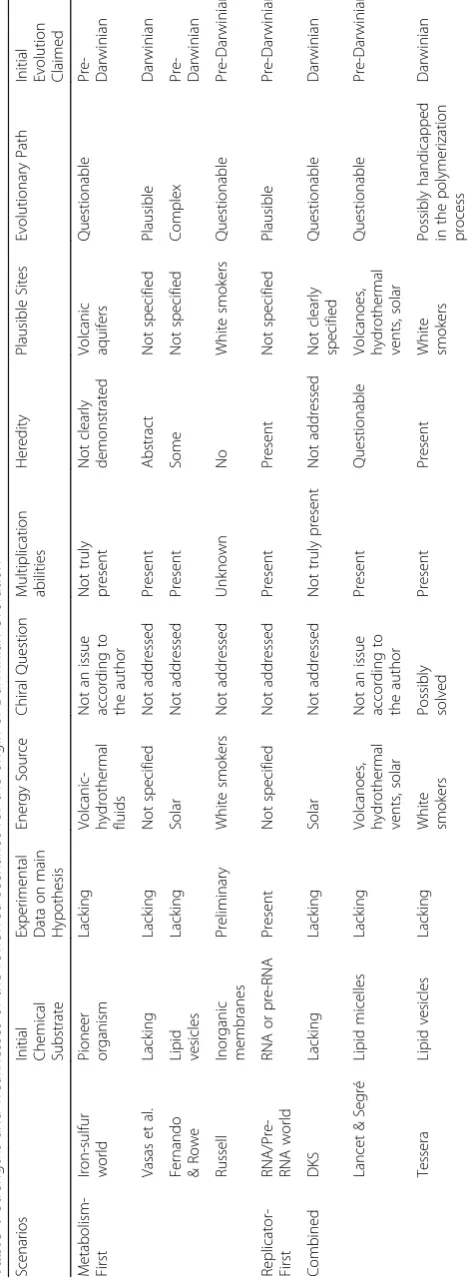
Most authors support the idea that only open far-fro-m-equilibrium systems are able to show“chemical evolu-tion”, pre-Darwinian evolution according to this author’s usage. Here, only seeming plausible scenarios or models within the paradigm of open far-from-equilibrium systems are reviewed. Each model is evaluated according to the following questions: (1) What was the initial chemical sub-strate? (2) Are there experimental data supporting the main hypothesis? (3) What was the energy source? (4) Is the chiral question solved? (5) What is the ability of multiplication of the systems? (6) Is there any hered-ity? (7) Were there plausible site(s) where the initial chemical substrates might arise? (8) Is the evolution-ary path plausible? (Table 1: Strengths and weaknesses of the reviewed scenarios for the origin of Darwinian evolution). The majority of the researchers highlight the chiral question. For example József Garay claims that any theory of origin of life that does not explain the origin of homochirality in biomolecules is not complete [13].
It is important to distinguish between metabolism-first, replicator-first and combined metabolism-replicator models. The metabolism-first hypothesis means that or-dered chemical reactions, and not replication was the
property of the initial form that led to“life”and the inter-locked networks of chemical reactions that evolved in complexity over time. Replicator-first scenarios require both replication and at least some heredity. Finally it will be attempted to specify which initial evolution is hypothe-sized by the authors in their model, i.e., pre-Darwinian or Darwinian.
Metabolism-first scenarios Iron-sulfur world model
any case, Wächtershäuser does not seem to consider chirality as an issue [14].
From a chemical point of view, the theory could be ex-perimentally tested on its predictive power, i.e. its power to predict hitherto unknown chemical reactions. Wäch-tershäuser admits that the reactions demonstrated so far may well be the tip of an iceberg of synthetic reac-tions for a pioneer organism that has yet to be dis-covered experimentally. Thus, the main hypothesis of the model, i.e., the possible existence of the so-called “pioneer organism” has not yet been confirmed by ex-perimental data. Another issue is, as noticed by Wächtershäuser, that fluid flow through a localized volcanic-hydrothermal flow duct is of a short dur-ation, too short to cover a long period of evolution. To overcome the issue the author hypothesizes that intense ejection and scattering of crustal materials, and their settlement in renewed flow beds would have caused the process to be resumed time and time again with ever more advanced catalytic endowments and cellular organization [14]. JF Allen points out a problem with autocatalysis. The product of a series of reactions is also their substrate. Autocatalysis be-comes more plausible if the autocatalytic cycle takes place in a confined space, so that the concentration of its components can build up. Surface catalysis alone cannot easily explain how a reactant becomes concentrated, since the volume of the solute is, for all practical purposes, infinite, being, one supposes, the volume of water in all the oceans of the World. On a flat surface, autocatalysis will tend to be prevented, or quenched, by dilution [14]. Wächtershäuser argues that inorganic compartments exist, and can also be produced, apparently, in the laboratory, as a result of mixing two solutions, which have solutes that react to form a ‘froth’ of insoluble precipitates, citing Russell’s hypothesis that such structures, consisting of vesicles bounded by sulphides of iron and nickel, served as the first ‘incubators’ of life by permitting, containing, and sustaining chemoautotrophic synthesis [15]. Wächtershäuser claims that there is reproduction be-cause some of the synthetic organic products exhibit an autocatalytic positive feedback into the synthetic reactions whence they arise. This is questionable as a true reproduction is not really the multiplication of specific chemical compounds but rather the multipli-cation of individual systems leading to a population of similar systems. The author adds that evolution oc-curs because the autocatalytic feedback effect exhibits variations and the existence of an autocatalytic feed-back cycle signifies the historic fact of its previous de novo ignition and in this sense, each autocatalytic feedback effect constitutes an instance of inheritance or a memory effect [14]. Such a speech is obscure to
me and does not sound very much scientific. Hence, Wächtershäuser’s claim that his model is able to evolve is questionable, at best. According to the au-thor the first stage of cellularization is the formation of acetyl thioester as evolutionary precursor of acetyl-CoA. Then, there would have been a very com-plex chemical evolutionary path leading to the forma-tion of the first lipids followed by a transiforma-tion from surface lipophilization to a surface-supported bilayer membrane. Another complex evolutionary path would have followed leading to semi-cellular structures, which would have constituted the beginning of indi-viduation. Finally, again another complex evolutionary path would have led to a full cellularization [14]. This is a nice story, but more a fairy tale than a scientific reasoning.
Non-templated systems of replicators model
sustains a molecular periphery (analogous to a pheno-type) [16]. More recently they state that they believe they have shown limited heredity of a few types hence limited evolvability. They also admit that the system size is unknown. They claim that the most exciting form of evolvability is indefinite, open-ended on going evolution, possibly leading to an increase in complexity, at least in certain lineages [19].
The model in Vasas et al.’s paper traditionally belongs to the metabolism-first scenarios granted they show that there are replicators in their system, but replicator in the strict sense only means an entity capable of autocatalytic growth. Thus, this model has been considered as metabolism-first. William Martin and Eugene Koonin noted the abstractness of the model, which far-removed from real chemistry and real metabolism. The authors also overlook the possibility of preexisting inorganic cat-alysts that are not part of their reaction products and the possibility that things chemical fall into place more along the lines of thermodynamics than along the lines of mathematics. Moreover, the model requires independ-ent viable autocatalytic cores embedded in a large mo-lecular network as units of evolution [16]. Eugene Koonin argued that it is difficult to understand how and where such large complex molecular networks could have emerged on early Earth and how such a putative non-templated system of replicators could have been stable in real time [16]. In addition, the authors specified that their model would only shown limited evolvability while they claim that the most exciting form of evolva-bility is indefinite, open-ended on going evolution. Be-sides the authors don’t address the chiral question compatible with their model.
Autocatalytic cycles in liposomes model
Vasas et al. say, in terms of “real” chemistry they have been inspired by the concept of autocatalytic protein networks but they mention the model by Fernando and Rowe that shows a similar evolutionary mechanism based on random biomolecular rearrangements rather than ligation and cleavage reactions [16]. Fernando and Rowe quote Maynard-Smith,“Natural selection is an al-gorithm that operates in populations of entities capable of multiplication, variation and heredity”[20]. The ques-tion they address is “what is the simplest ‘machine’ cap-able of implementing the natural selection algorithm, and how likely was this implementation to arise
spontan-eously?” Thus, they opt for an individual- or
compartment-first hypothesis based on a population of lipid aggregates. They hypothesize that a geophysical process would have produced such lipid aggregates with-out specifying the process. The lipid aggregates could have undergone division by externally-imposed agitation and the authors assume that specific intra-lipid
aggregate chemical reactions are not required for a base rate of lipid aggregate replication. Then a novel species has one probability of being in the lipid phase, so remaining within the lipid aggregate, and another prob-ability of being in the water phase, so being extruded from the lipid aggregate. During division approximately half of the lipophilic constituents of the lipid aggregate are inherited by each daughter cell. The authors make the assumption that a potential autotrophic reaction ex-ists that is capable of utilizing light energy to drive an otherwise non-spontaneous reaction. They claim segre-gation of the population into lipid aggregates allows harmful avalanches to be isolated to a compartment. Fi-nally the autocatalytic cycles would have evolved in the liposomes because they were necessary for the mainten-ance of chemical reaction networks that were beneficial at the liposome level. According to the authors, the sys-tem should have shown natural selection at both the level of autocatalytic molecules and lipid aggregates [21]. This model would have been able firstly to show pre-Darwinian evolution and latter on pre-Darwinian evolution.
Surely, their model is less abstract than Vasas et al.’s because it is based on lipid aggregates. While there are indeed possible processes that lead to symmetry break-ing the authors do not specify how these processes would have operated in their model and have thus solved the chiral question. In addition, they are unable to specify where on early Earth there would have been a geophysical process-producing lipid aggregates with a potential autotrophic reaction capable of utilizing light energy.
Inorganic membrane in alkaline hydrothermal vent model
at alkaline vents such as silicates, clays, carbonates, and sulfides. For example, at a Lost-City-type vent in an early-Earth setting, this chemistry delivers catalytic Fe(Ni)S minerals. [24]. This model would have followed chemical evolution (i.e., pre-Darwinian evolution) [23].
In favor of this model are the first results of recent ex-periments with a simple electrochemical reactor to simulate conditions in alkaline hydrothermal vents, allowing that abiotic vent chemistry could prefigure the origins of biochemistry. The precipitation of thin-walled, inorganic structures containing nickel-doped mackina-wite, a catalytic Fe(Ni)S mineral, under prebiotic ocean conditions showed the generation of low yields of simple organics while synthetic microporous matrices were able to concentrate organics by thermophoresis over several orders of magnitude under continuous open-flow vent conditions. These experiments provide empirical evi-dence that simple organics can be generated and con-centrated under mild alkaline hydrothermal conditions from H2and CO2 using Fe(Ni)S catalysts transected by natural proton gradients in microporous matrices [25]. It is questionable whether these processes could lead to something else than simple inactivated organics. More-over, there are severe problems for the natural pH gradi-ent hypothesis. Firstly, there is the difficulty of interposing a suitable, stable, thin inorganic membrane between the alkaline vent fluid and the acidic ocean that could hold a sharp pH gradient. At Lost City, there is lit-tle or no evidence for the existence of stable inorganic membranes, let alone of membranes holding sharp pH gradients. The second and even more difficult problem is that it is hard to accept that a molecular machine cap-able of abstracting useful energy from the naturalΔ pH was assembled within the inorganic membrane by chance on the prebiotic earth, that is before the advent of gene encoded proteins and the great power of natural selection. Thirdly, a simple, small,ΔpH-consuming mo-lecular machine, even if by chance adopting an as yet unknown chemical structure, and a set of barely sus-pected, facilitating, mechanistic principles, will be unable to function in an inorganic membrane of a thickness deemed acceptable by Russell et al. [26]. Even when the authors supposed that inorganic molecular machines might assemble by chance in the precipitate membranes, and be capable of using theΔpH to drive unfavourable reduction of CO2 by H2 to formate and formaldehyde (and indeed, these workers detected both of these com-pounds in their origin-of-life reaction vessel and con-tended that was proof of principle for their hypothesis) JB Jackson demonstrated by a straightforward calcula-tion that the formate produced was only that reached on approach to equilibrium without any driving force from ΔpH. Jackson therefore concluded that the reaction was facilitated by isotropic catalysts in the precipitate
membrane but not by an anisotropic ΔpH-driven mo-lecular machine [27]. Moreover, the problem of the tran-sition from inorganic to organic membranes is faced. According to Russell et al. the organic takeover from the mineral precursors would have been facilitated by the surface structure of amyloidal peptides between 6 and 10 amino acids long that behave as nests for inorganic clusters. Together these would do the work of proto-enzymes [28]. The authors do not specify how ho-mochiral amino acids would have been produced in their model and about the way their metabolic systems could replicate and transmit their characteristics to the pro-geny. Therefore the evolutionary path from the mineral precursors to amyloidal peptides is unlikely without solving the chiral issue. Moreover, the evolutionary path from vesicles with membranes composed of amyloidal peptides to the first anaerobic chemolithotrophy organ-isms using Earth’s inorganic geochemicals is not straight-forward without the existence of some kind of Darwinian evolution and in particular of heredity.
Conclusions on metabolism-first scenarios
The four metabolism-first scenarios discussed above are supposed to show pre-Darwinian evolution. They show major issues as follows: no practical chemical substrate is known (Vasas et al.); experimental data supporting the main hypothesis on which the model is based are lacking (iron-sulfur world, Fernando & Rowe, Vasas et al.) or preliminary (Russell); the source of energy is question-able (Fernando & Rowe’s) or not specified (Vasas et al.); the chiral question is not addressed (Fernando & Rowe, Russell, Vasas et al.) or not considered as an issue (iron--sulfur world); multiplication abilities are not truly present (iron-sulfur world) or unknown (Russell), hered-ity is not clearly demonstrated (iron-sulfur world) or ab-sent (Russell), a plausible site on early Earth is unknown or not specified (Fernando and Rowe and Vasas et al.); the system is unstable (Vasas et al); the evolutionary path seems either complex (Fernando and Rowe,) or questionable (iron-sulfur world, Russell).
Replicator-first scenarios: RNA and pre-RNA worlds
therefore the last common ancestor of all ribosomes used RNA to synthesize peptide bonds. In the model there would be first pre-Darwinian evolution until the emergence of RNA and then Darwinian evolution.
The idea of an RNA world was actually built upon the diverse roles of RNA in contemporary metabolism and not upon the limited catalytic role of these natural ribo-zymes. Anyway a major question is how do the first self-replicating ribozymes emerge in the absence of tem-plate-directed information replication? [28]. Admittedly, the group of Sutherland shows that activated pyrimidine ribonucleotides can be formed in a short sequence that bypasses free ribose and the nucleobases, and instead pro-ceeds through arabinose amino-oxazoline and anhydronu-cleoside intermediates [31]. Even among those searching for a prebiotic origin of RNA, Sutherland’s approach is not universally regarded as satisfactory and critics of that type of prebiotic chemistry find that an excessive Deus ex machina, but also note that if amino-oxazole is to be formed in a different locale than glyceraldehyde, the effort to find pH neutral conditions to form amino-oxazole (rec-ognizing the instability of glyceraldehyde at high pH) was unnecessary. If this were not sufficient, the final step re-quires yet another change of environments, to urea or formamide as a reaction mixture, not water [30]. More re-cently the same team provided experimental evidence in support of the hypothesis that precursors of ribonucleo-tides, of amino acids and of lipids have a common chem-ical origin [32]. In their experiments precursors of ribonucleotides, amino acids and lipids can all be derived by the reductive homologation of hydrogen cyanide and some of its derivatives, and thus that all the cellular sub-systems could have arisen simultaneously through com-mon chemistry [33]. In a very recent article Powner et al. demonstrated a divergent, prebiotically plausible reaction strategy for the synthesis of both pyrimidine and purine ri-bonucleotides on a single oxazoline scaffold [34]. One should nevertheless accept that an important gap remains in our understanding of the processes this could have spontaneously supported the emergence, maintenance and evolutionary potential of such a precellular world. Various chemical reactions traditionally involved in the artificial organic syntheses of RNA precursors are thermo-dynamically uphill or show high kinetic barriers in the ab-sence of activating molecules or catalysts, respectively [35]. All these experiments use enantiomers in their chemical reactions and thus the chiral question comes back. The origin of life, especially the origin of RNA world, cannot be disclosed without explaining the origin of chiral homogeneity of biomolecules [13]. There is ample research on the chirality of RNA. In particular, J. Garay’s hypothesis is the construction of complexes by the chemo-autotrophic metabolism on mineral surfaces, e.g., the iron-sulfur world proposed by Wächtershäuser [36].
population of 1015 random-sequence D-RNAs. In their experiments the authors used RNA molecules as ingredients [39]. Hence, again, the question of the abiotic synthesis of RNA is still there. It can be con-cluded, at least from these publications, that the chiral question is not yet clearly answered. Among in-surmountable problems of chemical and informational nature are the unreliability of the synthesis of initial components, the instability of the molecules which increases with chain elongation, the catastrophically low probability of meaningful sequences, the lacking mechanism of the formation of membrane-bound ves-icles permeable for the nitrogenous bases and other RNA precursors as well as able to divide on a regular basis [40]. The difficulty in synthesizing nucleotide monomers, not to mention the idea that RNA itself is too complex to have been the first genetic molecule, has focused researchers to search for non-standard molecules as earlier replicators and catalysts and on other means of transitioning to standard nucleic acids. For example, it was proposed the idea that pep-tide nucleic acids (PNAs) might have preceded RNA nucleotides [41]. This would have been the pre-RNA world. The difficulties remain open in synthesizing the initial components within the paradigm of open far from thermodynamic equilibrium systems and es-pecially because of the chiral question. Thus, it is understandable that Benner et al. note that it is not surprising that Joyce and Orgel called RNA a “pre-biotic chemist’s nightmare”. Moreover, there is a para-dox that all the efforts which have focused on making RNA under a gene first model for the origin of life curiously have come as close as any to providing a working example of a cycle reminiscent of models which put metabolism first. Another limitation of the RNA world has been hypothesized to be the paucity of building blocks in the RNA biopolymer. Certainly, proteins, with 20 amino acids, have a richer diversity of functionality than RNA, and this functionality is useful for binding and catalysis [30]. Finally, as Benner et al. specify it, some have abandoned all genetic biopolymers, suggest-ing instead that somethsuggest-ing like Darwinian evolution must have been supported by a set of small organic molecules dissipating free energy in a cycle that through its oper-ation can adapt to changing conditions and evolve in a Darwinian sense [30].
Conclusions on the RNA and pre-RNA world scenarios
The only replicator-first scenarios discussed above should show pre-Darwinian evolution, actually, firstly pre-Darwinian evolution and secondly Darwinian. There are crucial issues: the source of energy is not specified, the chiral question is not addressed, and a plausible site on early Earth is unknown. In addition,
it has its specific issues (see above). An alternative should be therefore found.
Combined metabolism-replicator scenarios
Dynamic autocatalytic systems within the dynamic kinetic stability concept (DKS)
Some researchers claim that a chemical environment held in a non-equilibrium state by kinetic barriers con-stitutes a prerequisite for the development of very spe-cific dynamic chemical systems of constituents and catalysts capable of circumventing these kinetic barriers. They support the concept of the dynamic kinetic stabil-ity, DKS [42–44]. According to these authors, the stabil-ity kind is the stabilstabil-ity associated with entities able to make copies of them at a rate that results in a non-equilibrium steady-state population of replicating entities being maintained over time. The replicated en-tity, the replicator, is a specific molecule of the autocata-lytic metabolic system but not the system per se. The authors claim that when there are several autocatalytic metabolic systems they will tend from less stable (per-sistent) to more stable (per(per-sistent) forms because of a lo-gical law of nature they term the persistence principle, i.e., only the most persistent systems will remain after a certain time. The model would be capable of Darwinian evolution according to the authors.
Compositional genomes in the lipid world model
At Weizmann in Israel D. Lancet conceptualized a model based on heterogeneous assemblies of diverse lipid-like mutually catalytic amphiphilic molecules [46]. The so-called “graded autocatalysis replication domain (GARD) model”utilizes chemical kinetics to simulate the behavior of mutually catalytic sets as an alternative to alphabet-based inheritance. A basic feature in GARD is that non-covalent, micelle-like molecular assemblies are capable of growing homeostatically, i.e. catalytically maintaining the assembly’s composition as it grows (dy-namic buffering). The maintained compositional infor-mation can be propagated to progeny assemblies upon occasional fission [47]. Energy sources available to drive the synthesis reactions leading to the amphiphilic mole-cules would range from volcanoes and hydrothermal vents to solar photochemistry and pyrite-dependent re-duction [48]. According to the authors their GARD model would have had some capacity for pre-Darwinian evolution [46].
Recently, it has been argued that collectively autocata-lytic metabolic networks, such as the GARD, do not allow for fitter compositional genomes to be maintained by selection [49]. The authors have replied, based on a large number of simulations, that when quasi-stationary composomes rather than arbitrary compositions serve as selection targets, GARD networks are capable of a sig-nificant response to selection. Importantly, this can hap-pen chiefly when a high proportion of mutual catalysis is present in a GARD network [47]. However, the authors’
hypothesis seems rather unlikely, i.e., that, in the condi-tions of the prebiotic earth, a high proportion of mutual catalysis could have emerged. In addition, it is question-able that “compositional information” could have been transferred to bilayer membrane lipid vesicles when these would have taken over the “micelle-like molecular assemblies”. In experiments looking at transitions from micelles to vesicles the fatty acid in micelles are just in-corporated into the preformed vesicles without any pos-sibility to transmit a“compositional information”present in the micelles [50–52]. Against this argument, accord-ing to D. Lancet (see his comment as a reviewer of this article), is that the GARD model would not invoke a capacity of a small micelle to confer its composition onto a much larger vesicular assembly when fusing with it. Ra-ther, it would invoke the possibility that homeostatic growth via single molecule accretion could gradually lead to increasingly larger assemblies having a similar compos-ition to that of the original micelle. Regarding the chiral question the authors described an extension of their Graded Autocatalysis Replication Domain (GARD) model. The new model called Chiral-GARD (or C-GARD) is in-troduced to explain the symmetry breaking between left-or right-handed biomolecules in the modern biosphere.
Their main conclusion is that a strong symmetry breaking may result from a relatively modest asymmetry in mutual (auto)catalytic activity: that is D-enantiomers which are more likely to catalyze other D-enantiomers than L-enantiomers, while L-enantiomers preferentially catalyze their L-brothers and sisters. The C-GARD model would highlight the possibility that chiral selection is a re-sult of, rather than a prerequisite for early life-like pro-cesses and thus would not have been an issue [53]. Actually, the authors assume that all molecules in the C-GARD simulation are asymmetric as they claim that for sufficiently complex molecular structures it is justified to assume that essentially all molecules are chiral. Thus, they disregard non-chiral isomers in their simulations. The au-thors’assertion seems unrealistic, i.e., that, in the prebiotic environment, there would have been sufficiently complex molecular structures allowing to assume that all molecules were chiral.
Lipid vesicles in alkaline hydrothermal field model
formation of larger products from small carbon-based molecules. Small molecules could easily penetrate the membrane while larger products would have tended to be retained because of difficulty of the larger produced molecules crossing back out of the membrane. Among larger products there were specific compounds able to catalyze the transformation of the local membrane ar-rangement into a stabilized membrane site by the forma-tion of covalent bonds (instead of intermolecular H-bonds) most likely between the hydrophilic poles of adjacent amphiphiles. Although the reaction of stabilization was theoretically reversible, practically it was not. This was because there was a very low likeli-hood of another interaction of the intra-vesicular soluble chemical catalyst with the membrane site due to the di-lution of the former in the inner volume of the vesicle. Hence, a hypercycle according to the terminology by Manfred Eigen [58] would have been formed. It was ac-tually a positive feedback produced by muac-tually catalytic soluble catalyst/membrane site pairs. In the meantime the increasing chemical catalyst concentration in the vesicle would have allowed the formation of new mem-brane sites by its interaction with the same kind of local membrane arrangements and the sites would have been more or less randomly distributed over the inner surface of the vesicle membrane. When the vesicle divided into daughter vesicles [59] the chemical catalyst and the mem-brane sites or only one element of the soluble catalyst/ membrane site pair was likely to be present in the daugh-ter vesicles leading to the transmission of the hypercycle [10]. Chirality would have occurred by chance when com-pounds with a chiral centre carbon atome were synthe-sized from specific small carbon-based molecules. In addition, the model would have had the potential to favor the polymerization of carbon-based molecules, for ex-ample leading to the synthesis of peptides [9]. As a re-minder, the kind of catalysis in the model mediated solely by small organic molecules is comparable to organocataly-sis. Organocatalysis or“small-molecule catalysis”is a field recently rediscovered in chemistry that in the past decade has become a thriving area of general concepts and widely applicable asymmetric reactions [60]. C. Barbas believed that this chemistry not only provides for fascinating and efficient syntheses of chiral molecules but also may serve to explain the emergence of homochirality in the prebiotic world [61]. This is one of our main hypotheses already de-veloped in a previous paper [9]. When the chemical cata-lyst is chiral it is possible to say that once a single chirality is developed, a proto-organism could grow this way, and divide, so propagating the chirality [62]. In the model the polymerization process of the carbon-based molecules (e.g., amino-acids) needs the migration of the sites in the membrane to allow the formation of bi-sites, tri-sites etc. and thus polymerization [9]. When vesicles divide a few
bi-sites, tri-sites etc. may be transmitted to the daughter vesicles but cannot be replicated as such. Migration of the sites in the daughter vesicles is needed again to form other bi-sites, tri-sites etc. Hence, this particular point should be tested in a research programme [10]. Darwinian evolution has been implemented in the model since the beginning. The only pre-Darwinian processes at work were the for-mation of lipid vesicles with multiplication abilities and the selection of the most viable. Before the emergence of hypercycles genetically and ecologically distinct lineages could not yet appear on which natural election might op-erate and the evolution over time of the composition and complexity of the vesicles was not yet possible. The main issue of the model is the absence of experimental data today supporting the hypothesis that mutual catalysis is possible in lipid vesicles with heterogeneous membranes in the environment of alkaline hydrothermal fields. A re-search programme has been proposed to confirm the plausibility of the model [10].
Conclusions on combined metabolism-replicator scenarios
Combined metabolism-replicator scenarios show major issues too: no practical chemical substrate is known (DKS), experimental data supporting the main hypoth-esis on which the model is based are lacking (all scenar-ios); the source of energy is questionable (DKS), the chiral question is not addressed (DKS) or considered as not essential (Lancet and Segré), replication is disputed (Lancet and Segré), a plausible site on early Earth is not clearly specified (DKS), the evolutionary path is ques-tionable (DKS) or unlikely (Lancet and Segré) or would
have been handicapped in case of a tedious
polymerization (Tessera).
Discussion
apparatus able to store and transmit information to their progeny, some sort of metabolism for gathering nutri-ents and energy from the environment, and a selectively permeable boundary that separates and distinguishes them from this environment. They deduce that it is necessary to develop chemistries which enable the syn-thesis of information-bearing polymers, protometabolic networks, and protocellular compartments under com-patible prebiotic conditions to explain how the first or-ganisms might have appeared on Earth, or elsewhere. If there is a consensus that the first“living systems”should have possessed a genetic apparatus able to store and transmit information to their progeny, i.e., systems with hereditary property, the issue is how protometabolic networks without heredity would have had the capability to evolve towards systems with heredity while Darwinian evolution had not started operating yet [27]. Reviewed scenarios were divided between metabolism-first, replicator-first and combined metabolic-replicator. All scenarios show major issues either because of the lack in the model of any practical example, experimental data, plausible sources of energy, or a convincing explanation of the emergence of chirality. There are indeed possible processes to lead to symmetry breaking. For example, counted among the most noteworthy findings of the last decade in asymmetric catalysis research must certainly be Soai and coworkers’discovery of asymmetric amplifi-cation in the autocatalytic alkylation of pyrimidyl alde-hydes with dialkylzincs [65]. In his exciting article Donna Blackmond confirmed the Soai reaction. Amplifi-cation of enantiomeric excess (ee) can only result if a means exists to suppress the catalytic action of the “wrong”hand of the catalyst. Experimental studies of the Soai reaction reveal that statistical formation of dimer catalyst species coupled with lower activity of the het-erochiral dimer is sufficient to rationalize the evolution of high ee from a tiny initial imbalance. This general mechanism could be effective in a world of simple or-ganic molecules such as those likely to have been present in the prebiotic world. Blackmond might agree that the Soai system represents a “triumph of reduction-ism” in helping us to understand the chemical origin of life in molecular terms [66]. In particular, Blackmond and her team notably highlight that the Soai reaction has inspired a wealth of studies– experimental, theoret-ical, and computational – aimed at understanding the processes of symmetry breaking and asymmetric amplifi-cation. They nevertheless notice that this most prominent experimental example of asymmetric autocatalysis exhibits significant constraints on substrates and reaction condi-tions. Finally, the search for further examples, in particular for reactions exhibiting chemistry of greater prebiotic relevance, continues apace but has proved inconclusive to date [67]. There are problems too regarding the
evolutionary path, information on the mechanism of replication (either inaccuracy or absence of replication), heredity, stability of the systems, existence of plausible sites on early Earth favoring the model emergence, reli-ability of the synthesis of primordial ingredients, in-stability of the molecules which increases with chain elongation, catastrophically low probability of meaning-ful sequences etc.
Regarding the metabolism-first scenarios there are specific issues well emphasized by Abel and Trevors [64]:
Only physicodynamic bias reduces through
self-ordering tendencies the vast sequence spaces needed for prebiotic molecular evolution. Even if vast se-quence spaces had been available in a theoretical primordial soup, no known mechanism exists for the prebiotic selection of prescriptive sequences;
In prebiotic molecular-evolution environment, no
differential survival or differential reproduction ex-ists yet. Natural selection in the context of Darwin-ian evolution does not exist yet in a prebiotic environment;
The wheel would have to be reinvented with each
new generation. Homeostatic metabolism is statistically prohibitive enough as it is as a one-time event;
No metabolism-first model can be sustained without
rapid incorporation of any minimal successes into a recorded, integrated, heritable, cybernetic scheme.
systems. Multiplication of self-organizing systems may be identified as the third level of evolution because it leads to populations of systems, which further extends persistence of the system’s dynamical cascade. Only the fourth fundamental level, i.e., Darwinian evolution, is able to promote the emergence of genetically and eco-logically distinct lineages on which natural selection may operate [68]. Metabolism-first systems may reach the third level of evolution at best but not the fourth be-cause heredity is lacking. Systems reaching the third level of evolution (i.e., able to multiply themselves) may improve their lifetime but still fully depend on their en-vironment for the evolution over time of their compos-ition and complexity. Without a mechanism of a phenotypic inheritance, which is independent from vari-ation in the local environment, metabolism-first systems cannot sustain any newly acquired composition or com-plexity. Szathmáry and co-workers notice that stable hereditary propagation is not possible without effective autocatalysis in contrast to reflexively autocatalytic net-works, complemented by rare uncatalyzed reactions and compartmentation. The latter networks, resting on the creation and breakage of chemical bonds, can generate novel (‘mutant’) autocatalytic loops from a given set of environmentally available compounds. Real chemical re-actions, which make or break covalent bonds, rather than mere incorporation of components, are necessary for open-ended evolvability. They conclude that the most exciting form of evolvability is indefinite, open-ended on going evolution, possibly leading to an increase in complexity, at least in certain lineages. They think the following conditions are required: (1) a rich chemical combinatorics, (2) digital inheritance based on template replication, (3) an environment made more complex by evolution itself, and (4) the fact that we can-not pre-state in general the possible preadaptations. How all this could have emerged in early evolution is a nut hard to crack [28]. In the lipid vesicles in alkaline hydrothermal field model the only pre-Darwinian pro-cesses at work were the formation of lipid vesicles with multiplication abilities and the selection of the most vi-able. Without the emergence of genetically and ecologic-ally diverse lineages on which natural election might operate the evolution over time of the composition and complexity of the vesicles was not possible. Only after Darwinian evolution would have emerged by chance in one step with the occurrence of specific arrangements of the amphiphiles among a huge number of combinations in the inner part of the bilayer membrane and thus lead-ing to the emergence of hypercycles. The emergence of Darwinian evolution was impossible as long as multipli-cation and heritability were lacking. Only Darwinian evolution could have led to an evolution in complexity over time.
The replicator-first scenario RNA/Pre-RNA world seems to solve the previous issues, as multiplication and heritability are present in its more advanced state. How-ever, it encounters its own insurmountable difficulties and remains a “prebiotic chemist’s nightmare” even if some of these difficulties seem to have been solved [30,
31, 33, 34]. In addition, all the efforts which have fo-cused on making RNA under a gene first model for the origin of life curiously have come as close as any to pro-viding a working example of a cycle reminiscent of models which put metabolism first. If the RNA and Pre-RNA world were rather metabolism-first models at their very beginning they would have encountered the same problems. As a combined metabolism-replicator scenario the DKS model would have been able to evolve through Darwinian evolution since the beginning ac-cording to the authors. The replicator was a specific molecule of the autocatalytic metabolic system but not the system per se. It is questionable to claim there was a true reproduction, as the system did not multiply. In addition Pross and Pascal say nothing about heredity. The two other combined metabolism-replicator sce-narios have also their own problems (see above and Table 1). The last scenario has the fewest issues. It only required small carbon-based molecules, i.e., without needing complex molecules like proteins and/or nucleo-tides at the beginning. It would also have taken the op-portunity of a combinatorial of all the possible local molecular arrangements of a heterogeneous lipid mem-brane composed of a mixture of amphiphiles. Such a combinatorial of the possible local molecular arrange-ments would have allowed the emergence of a hyper-cycle based on mutual catalysis and been a source of variation. The lipid vesicles of the model are open far-from-equilibrium systems generated by a continu-ously supplied flow of matter and energy from the alka-line hydrothermal fields, may multiply, and have hereditary properties. The model would have allowed Darwinian evolution to start operating from the begin-ning. Its catalyzing properties would have solved the issue of chirality. However, its evolutionary path of the systems would have been handicapped if the poly-merization was tedious. The main issue of the model is the present lack of experiments supporting the hypoth-esis that a hypercycle by mutual catalysis might emerge in lipid vesicles with a heterogeneous membrane in the conditions of a relatively high temperature (90 °C) and high pressures in alkaline hydrothermal vents in salty seawater. This is why a research program has been re-cently proposed to implement the different steps to support this new direction of research in the field.
seem the most plausible. They may reach the third level of evolution (i.e., able to multiply themselves in addition to involving self-organizing dynamics) but not the fourth level that requires the emergence of genetically and eco-logically distinct lineages on which selection may oper-ate. Among the scenarios that appeals to Darwinian evolution from the beginning, one seems to show the best profile although it has its own shortcomings.
Conclusion
Pre-Darwinian evolution is here defined as an evolutionary continuity between chemistry and Darwinian evolution. It is meant to describe the initial chemical steps before the emergence of Darwinian evolution. Some of the better-known open far-from-equilibrium system-based sce-narios are reviewed. No metabolism-first scenario is con-vincing enough to make such a pre-Darwinian evolution is plausible. Alternatives to metabolism-first scenarios are ei-ther replicator-first or combined metabolism-replicator sce-narios. The only so-called replicator-first scenarios, the RNA and the Pre-RNA world scenarios, remain a“prebiotic chemist’s nightmare”. Other approaches are combined metabolism-replicator scenarios implementing either pre-Darwinian evolution or Darwinian evolution. They nevertheless have their own issues. Among the reviewed models, one shows the least, although it has shortcomings. In particular, its main hypothesis needs to be validated by experimental data. Darwinian evolution is at work from the very beginning in this scenario. From this critical review it is inferred that the concept of “pre-Darwinian evolution” appears questionable, in particular because it is unlikely if not impossible that any evolution in complexity over time may work without multiplication and heritability allowing the emergence of genetically and ecologically distinct line-ages on which natural selection may operate. Only Darwin-ian evolution could have led to such an evolution. Thus, Pre-Darwinian evolution is not plausible according to the author. Surely, the answer to the question posed in the title is a prerequisite to the understanding of the origin of Dar-winian evolution.
Reviewers’comments
Review #1: P. Lopez-Garcia, Centre National de la Recherche Scientifique, France
The manuscript has some originality and comments on important aspects on the transition from chemistry to bio-logy. I find the style a bit complex and not very clear even if the ideas are interesting (though not necessarily novel). It deserves publication, the literary style could be improved.
I thank the reviewer for her comments, particularly when she finds that the manuscript has some originality. Regarding the literary style I tried to improve it.
In this manuscript, M. Tessera critically examines vari-ous models on the origin of life and more specifically inter-rogates about whether these models involve pre-Darwinian (chemical) evolution prior to the Darwinian evolution characteristic of open far-from-equilibrium systems that are considered alive. The subset of chosen models are classed in three categories: metabolism-first, replicator-first and coupled metabolism-replicator models. Many of the criticisms and concerns highlighted by Tessera have been already raised by previous authors; he revisits them in the context of a transition from chemical to Darwinian (bio-logical) evolution. Overall, the ideas summarized in this critical review are stimulating for research on the chemistry-biology transition. I have, however, some com-ments: - My major comment is that definitions of Darwin-ian and pre-DarwinDarwin-ian evolution are somewhat fuzzy and this affects whether a system is considered to evolve by Darwinian or pre-Darwinian evolution. The definition of Darwinian evolution is more obvious, this corresponds to encoded (genetically inherited) variation upon which natural selection acts. Pre-Darwinian evolution in-volves chemical evolution. But does a system where genotype and phenotype are not (yet) coupled (i.e., containing a replicator plus not-encoded components) evolve via pre-Darwinian or Darwinian evolution? For instance, Tessera claims that lipid vesicles produced in the surroundings of alkaline vents and acting as chemical reactors that eventually include replicators display Darwinian evolution since the beginning. However, these initial lipid-vesicle reactors are not encoded (even if there are replicators inside), so in principle, there should equally represent a pre-Darwinian to Darwinian evolution transition as in other models. - I personally find amphiphile-vesicle models involving co-evolving metabolism and replica-tor systems as the most practically plausible for the origin of life on Earth. However, even if these systems would show Darwinian evolution from the beginning (which I questioned above), does this mere fact (Dar-winian evolution from the beginning) qualify them as more likely than models where a pre-Darwinian/Dar-winian evolution transition is required? If so, why?
As I specify it in the“Background”of the manuscript I prefer to use the expression“pre-Darwinian evolution” instead of“prebiotic evolution”because the concept of life is very much debatable according to me,
four fundamental levels of evolution[67].
Unfortunately, the scientific community to refer to it does not yet accept this view. I find questionable the
“pre-Darwinian evolution”concept. Consequently, I cannot find an accurate definition of it. According to me,“Pre-Darwinian evolution”may only be defined in reference to the definition of“Darwinian evolution”. I agree with the reviewer that genotype and phenotype should be coupled. For instance, genotype is
represented by the membrane sites in my model and phenotype by the carbon-based molecules catalyzed by the latter as they may impact the structure and the functions of the membrane. Genotype and phenotype are clearly coupled as they form a hypercycle. When vesicles multiplied the daughter vesicles inherited both genotype (i.e.membrane sites) and phenotype (i.e., carbon-based molecules) either directly when the hypercycle was transmitted to the daughter vesicles or indirectly when only one element was transmitted but able to reconstruct the hypercycle[10]. Thus, separate lineages formed on which natural selection might have operated. Once lipid vesicles with multiplication abilities formed Darwinian evolution would have emerged in one step with the occurrence of specific arrangements of the amphiphiles among a huge number of combinations in the inner part of the bilayer membrane. The only Pre-Darwinian processes at work were the formation of lipid vesicles with multi-plication abilities and the selection of the most viable. Finally I think only Darwinian evolution could have led to an evolution in complexity over time. To avoid any ambiguity I now clearly answer the question of the plausibility of pre-Darwinian evolution. Of course, I confirm in the manuscript that the answer to the ques-tion posed in the title is a prerequisite to the under-standing of the origin of Darwinian evolution.
Why not including Wächtershäuser’s iron-sulfur world in the comparison? I understand that it has severe prob-lems, notably in the transition to cellularization. None-theless, this is one of the most influential models and not less problematic than the Russell’s chemical garden. At least, some of its chemical predictions were proved.– Chirality.
Wächtershäuser’s iron-sulfur world model is now ana-lyzed in the manuscript.
The fact that many models do not address the issue of chirality does not imply that they may not accommodate an explanation for chirality. The absence of proof is not the proof of absence. I guess that in many of these models, chirality is simply seen as some kind of conse-quence of chance. Once you start incorporating one
particular isomer, the choice was selectively main-tained. - This brings me to my last general comment. The role of chance is ignored in this review. Within the realm of biology, Darwinian evolution is not a full synonym of biological evolution because in addition to selective processes, there is genetic drift. What about pre-genetic drift? This is not trivial because even if one gets experimental evidence for a particu-lar model, this does not mean that historically life originated that way. This would only provide an argu-mental basis not to discard a particular model.
For sure chirality has emerged luckily. In my model chance would have been at work when mutual catalysis emerged for the first time in lipid vesicles with heterogeneous membranes. Even if the emergence of a mutual catalysis was allowed by the structure of the vesicle membrane composed of a mixture of amphiphiles chance would have played its part. This occurred when a specific arrangement of amphiphiles appeared among the huge number of possible
combinations of arrangements. It was able to catalyze the synthesis of a specific carbon-based molecule. This latter soluble compound had the property of catalyzing the transformation of the local membrane arrange-ment into a stabilized membrane site. Chance would have operated again when specific small carbon-based molecules led to the synthesis of a bigger molecule with a chiral centre carbon atome. Surely, in the other models chance may have played its part too to make chirality appear but the researchers should present a rational and plausible explanation. I agree that gen-etic drift should have played its part. There is no par-ticular reason why it would not have occurred in my model. I do not understand what the reviewer means by“pre-genetic drift”.
Review #2: A. Poole, Stockholm University, Sweden
title is not really discussed in any great depth, and, for me, did not expand the existing discussion around this inter-esting question. The impression I got from reading the article was that the author’s answer to the question he posed was,‘yes, but it’s not important’.
Thank to the reviewer I realized that my view on the plausibility of pre-Darwinian evolution was not so clear as there was a misunderstanding in the re-viewer’s impression of my opinion about it. This essay highlights critical aspects of the plausibility of pre-Darwinian evolution. It is based on a critical review of some better-known open, far-from-equilibrium system-based scenarios supposed to ex-plain processes that took place before Darwinian evolution had emerged and that resulted in the ori-gin of the first systems capable of Darwinian evolu-tion. Each model was evaluated according to the researchers’answers to eight crucial questions that should be addressed (Table1). I tried to summarize the models as well as possible by using the
researchers’ wording as far as possible but, surely, my reports cannot be fully exhaustive and unbiased. I appreciate the reviewer’s citation of our
proposition, G. Hoelzer and I, that there are four fundamental levels of evolution [67]. In accordance with our claim I would have preferred to use the term “level-4 evolution” instead of “Darwinian evolution”. Unfortunately, the scientific community to refer to it does not yet accept this view. I find the concept of “pre-Darwinian evolution”
questionable. It is unlikely if not impossible that any evolution in complexity over time could have worked without multiplication and heritability. Only Darwinian evolution would have led to such an evolution. By the way the only pre-Darwinian processes at work in the model I propose were the formation of lipid vesicles with multiplication abil-ities and the selection of the most viable. Only after Darwinian evolution would have emerged by chance in one step with the occurrence of specific arrange-ments of the amphiphiles among a huge number of combinations in the inner part of the bilayer mem-brane. To avoid any ambiguity I now clearly answer the question of the plausibility of pre-Darwinian evolution. Of course, I confirm in the manuscript that the answer to the question posed in the title is a prerequisite to the understanding of the origin of Darwinian evolution.
Review #3: D. Lancet, Weizmann Institute of Science, Israel
As instructed, I am checking whether the original referee comments have been addressed to satisfactory standards.
My own comments refer to the revised version (R1). Re-viewer 1 Points 1,3, are satisfactorily addressed by the author. Point 2 (beginning “In this manuscript, M. Tes-sera critically examines various models on the origin of life…”) is valid, and has not been fully addressed. In the abstract, the authors present the following conclusion: “From this critical review it is (inferred) that the concept of ‘pre-Darwinian evolution’ appears questionable, in particular because it is unlikely if not impossible that any evolution in complexity over time may work without multiplication and heritability. Only Darwinian evolution
could have led to such an evolution. Thus,
systems have dynamic properties that exist in a state close to chaotic behavior allowing the emergence of autocata-lytic cycles…” is not correct. In the GARD model (as in other similar models) the emergence of mutually catalytic networks (not“autocatalytic cycles”, which is a restrictive term) is afforded merely by the nature of the molecules, i.e. their capacity to exert catalysis on each other, irre-spective of chaotic behavior. 2) The author says: “…mutu-ally catalytic sets as an alternative to alphabet-based
inheritance”. The GARD model has a form of
alphabet-based inheritance. The crucial difference be-tween GARD and a templating biopolymer model is that the former accumulates and reproduces compositional in-formation (counts of chemical “alphabet” letters), while the latter encompasses sequence information (order of chemical“alphabet”letters). 3) The current text proclaims: “A basic feature in GARD is that non-covalent, micelle-like molecular assemblies capable of growing homeostatically (i.e., buffered enough as to maintain sta-bility) according to the assembly’s constitution store com-positional information can be propagated after occasional fission (i.e., assembly splitting)”. This confusing sentence should better read: “A basic feature in GARD is that non-covalent, micelle-like molecular assemblies are cap-able of growing homeostatically, i.e. catalytically maintain-ing the assembly’s composition as it grows (dynamic buffering). The maintained compositional information can be propagated to progeny assemblies upon occasional fis-sion”. 4) The author states, based on ref. 47, that “Regard-ing the evolvability of the system it has recently been demonstrated that replication of compositional informa-tion (in GARD) is so inaccurate that fitter composiinforma-tional genomes cannot be maintained by selection”. This criti-cism is hotly disputed, as exemplified in one of our papers [PMID: 22662913], and it would be fair to make this state-ment less unqualified and quote the alternative view. 5) The author says (based on Refs 49–51): “Moreover, there is no reason why‘compositional information’should have been transferred to bilayer membrane lipid vesicles when these would have taken over the ‘micelle-like molecular assemblies’.”This statement is based on a misunderstand-ing, and should be omitted. The GARD model does not invoke a capacity of a small micelle to confer its compos-ition onto a much larger vesicular assembly when fusing with it. Rather, it invokes the possibility that homeostatic growth via single molecule accretion could gradually lead to increasingly larger assemblies having a similar compos-ition to that of the original micelle. Returning to Reviewer 2 comments: A sweeping negativity of this reviewer is mani-fested in the statement“…the question posed in the title is not really discussed in any great depth, and, for me, did not expand the existing discussion around this interesting ques-tion”. This, in my opinion, is overstated. I feel there is value in this review, warranting publication in Biology Direct.
I thank the reviewer for his helpful comments. Regarding the GARD model I modified the sentence when I agreed with the reviewer that it was incorrect (e.g., the basic feature in GARD). When a question is disputed I still mention it with the arguments,i.e., the criticisms, and the counter-arguments,i.e., the
reviewer’s reply (e.g., the question of evolvability and of the transfer of the compositional information). With regards to the chiral question I cannot agree that homochirality should not serve as a yardstick for judging evolution in complexity over time. While it is not addressed in most models it does not mean that the chiral question is not crucial. As the reviewer noticed, I present the results of his simulations tending to support the reviewer’s view that chiral selection is a result of, rather than a prerequisite for early life-like processes and thus would not have been an issue. However, I also observe that the authors’assertion sup-porting the relevance of these simulations seems un-realistic,i.e., that, in the prebiotic environment, there would have been sufficiently complex molecular structures allowing them to assume that all molecules were chiral. Finally, I believe that the new title of the manuscript the reviewer proposes does not suit the aim of the manuscript,i.e., to support the view that Pre-Darwinian evolution is not plausible. According to this view, the likely processes that would have taken place and allowed evolution in complexity over time before Darwinian evolution emerged are not satisfac-tory. In my model, the only pre-Darwinian processes at work are the formation of lipid vesicles with multipli-cation abilities and the selection of the most viable. These processes are not sufficient to allow an evolution in complexity over time.
Review #4: T. Dandekar, Department of Bioinformatics, University of Wuerzburg, Germany
element (or information storage)? 4. Of course, choosing the suitable definition you can always be right as an au-thor, but probably by such a definition of evolution you largely ignore the more general and bigger class of self-organizing processes, right? 4b. So my main worry is that by defining terms and things as you do, you may get rid of pre-Darwinian evolution (as you claim that there is always heredity necessary), however, you then become blind for the large, interesting and important class of self organizing phenomena in physics and chemistry who happen without any gene storage or any other such dir-ect storage.
I agree with the reviewer that it would be less
constraining for the purposes of the search of the origin of life if pre-Darwinian evolution was plausible. It would open the search to include self organizing phe-nomena in physics and chemistry which happen with-out any gene storage or any other such direct storage. I don’t think it is a question of definition, like, for ex-ample the definition of life. Darwinian evolution is a mechanism. It works as it allows evolution in complex-ity over time, It is based, amongst other things, on nat-ural selection on distinct lineages. Without
information storage and the possibility of transfer to the progeny, no lineage may emerge. Thus, natural se-lection cannot operate and allow evolution in com-plexity over time.
Abbreviations
DKS:Dynamic kinetic stability; DNA: Deoxyribonucleic acid; D-RNA: Dextro-ribonucleic acid; ee: Enantiomeric excess; GARD: Graded autocatalysis replication domain; LUCA: Last universal common ancestor; MAR-complex: Metal-Amino-Ribo complexes; RNA: Ribonucleic acid; SMSB: Spontaneous mirror symmetry breaking
Acknowledgments
I thank Peter Walde for his comments, which allow me to improve the initial drafts. I thank Kepa Ruiz-Mirazo for the interesting discussions we have had on the topic.
Funding
I confirm that I am an independent researcher and that I have not received any funds.
Ethics approval and consent to participate Not applicable.
Consent for publication Not applicable.
Competing interests
The author declares that he has no competing interests.
Publisher’s Note
Springer Nature remains neutral with regard to jurisdictional claims in published maps and institutional affiliations.
Received: 29 December 2017 Accepted: 15 June 2018
References
1. Follmann H, Brownson C. Darwin’s warm little pond revisited: from molecules to the origin of life. Naturwissenschaften. 2009;96:1265–92. 2. Cronin L, Walker SI. Beyond prebiotic chemistry What dynamic network
properties allow the emergence of life? Science. 2016;352:1174–5. 3. Spitzer J, Pielak GJ, Poolman B. Emergence of life: Physical chemistry
changes the paradigm. Biol Direct. 2015;10:1–15.
4. Krishnamurthy R. On the Emergence of RNA. Isr J Chem. 2015;55:837–50. 5. Sahai N, Kaddour H, Dalai P. The transition from geochemistry to
biogeochemistry. Elements. 2016;12:389–94.
6. Mayer C, Schreiber U, Dávila MJ. Selection of prebiotic molecules in amphiphilic environments. Life. 2017;7:3–13.
7. Szostak JW. Attempts to define life do not help to understand the origin of life. J Biomol Struct Dyn. 2012;29:599–600.
8. Tessera M. Life began when evolution began: A lipidic vesicle-based scenario. Orig Life Evol Biosph. 2009;39:559–64.https://doi.org/10.1007/ s11084-009-9175-4.
9. Tessera M. Origin of evolution versus origin of life: a shift of paradigm. Int J Mol Sci. 2011;12:445–58.
10. Tessera M. Research program for a search of the origin of Darwinian evolution. Orig Life Evol Biosph. 2017;47:57–68.
11. Tessera M. Is a n+1 definition of life useful? J Biomol Struct Dyn. 2012;29:635–6.
12. Gayon J. Defining life: Synthesis and conclusions. Orig Life Evol Biosph. 2010;40:231–44.
13. Garay J. Active centrum hypothesis: The origin of chiral homogeneity and the RNA-world. Biosystems. 2011;103:1–12.
14. Wächtershäuser G. From volcanic origins of chemoautotrophic life to Bacteria, Archaea and Eukarya. Philos Trans R Soc Lond Ser B Biol Sci. 2006; 36:11787–806.
15. Martin W, Russell MJ. On the origin of cells: an hypothesis for the evolutionary transitions from abiotic geochemistry to chemoautotrophic prokaryotes, and from prokaryotes to nucleated cells. Philos Trans R Soc B. 2003;358:59–85.
16. Vasas V, Fernando C, Santos M, Kauffman S, Szathmáry E. Evolution before genes. Biol Direct. 2012;7:1–14.
17. Szathmáry E. Toward major evolutionary transitions theory 2.0. PNAS. 2015; 112:10104–11.
18. Ruiz-Mirazo K, Briones, de la Escosura A. Prebiotic systems chemistry: New perspectives for the origins of life. Chem Rev. 2014;114:285–366. 19. Vasas V, Fernando C, Szilágyi A, Zachár I, Santos M, Szathmáry E. Primordial
evolvability: impasses and challenges. Theor Biol. 2015;381:29–38. 20. Maynard-Smith J. The Problems of Biology. Oxford: Oxford University
Press; 1986.
21. Fernando C, Rowe J. The origin of autonomous agents by natural selection. Biosystems. 2008;91:355–37.
22. Russell MJ, Hall AJ, Turner D. In vitro growth of iron sulphide chimneys: possible culture chambers for origin-of-life experiments. Terra Nova. 1989;1:238–41.
23. Russell MJ, Hall AJ, Martin W. Serpentinization as a source of energy at the origin of life. Geobiology. 2010;8:355–71.
24. Lane N, Martin WF. The origin of membrane bioenergetics. Cell. 2012;151: 1406–16.
25. Herschy B, Whicher A, Camprubi E, Watson C, Dartnell L, Ward J, Evans JRG, Lane N. An origin-of-life reactor to simulate alkaline hydrothermal vents. J Mol Evol. 2014;79:213–27.
26. Jackson JB. Natural pH gradients in hydrothermal alkali vents were unlikely to have played a role in the origin of life. J Mol Evol. 2016;83:1–11. 27. Jackson JB. The“origin-of-life reactor”and reduction of CO2 by H2 in
inorganic precipitates. J Mol Evol. 2017;85:1–7.
28. Russell MJ, et al. The drive to life on wet and icy worlds. Astrobiology. 2014;14:308–43.
29. Kun A, Szilágyi A, Könnyú B, Boza G, Zachar I, Szathmáry E. The dynamics of the RNA world: insights and challenges. Ann N Y Acad Sci. 2015;1341:75–95. 30. Benner SA, Kim HJ, Yang Z. Setting the Stage: The history, chemistry, and
32. Monnard PA, Walde P. Current ideas about prebiological compartmentalization. Life. 2015;5:1239–63.
33. Patel BH, Percivalle C, Ritson DJ, Duffy CD, Sutherland JD. Common origins of RNA, protein and lipid precursors in a cyanosulfidic protometabolism. Nat Chem. 2015;7:301–7.
34. Stairs S, Nikmal A, Bučar DK, Zheng SL, Szostak JW, Powner MW. Divergent prebiotic synthesis of pyrimidine and 8-oxo-purine ribonucleotides. Nat Commun. 2017;8:15270–81.
35. Ruiz-Mirazo K, Briones C, de la Escosura A. Chemical roots of biological evolution: the origins of life as a process of development of autonomous functional systems. Open Biol. 2017;7:170050.
36. Wächtershäuser G. Groundworks for an evolutionary biochemistry: the iron–sulphur world. Prog Biophys Mol Biol. 1992;58:85–201.
37. Stich M, Ribó JM, Blackmond DG, Hochberg D. Necessary conditions for the emergence of homochirality via autocatalytic self-replication. J Chem Phys. 2016;145:074111.
38. Joshi PC, Aldersley MF, Ferris JP. Homochiral selectivity in RNA synthesis: Montmorillonite-ed quaternary reactions of d, l-purine with d, l- pyrimidine nucleotides. Orig Life Evol Biosph. 2011;41:213–36.
39. Sczepanski JT, Joyce GF. A cross-chiral RNA polymerase ribozyme. Nature. 2014;515:440–2.
40. Bregestovski PD.“RNA World”, a highly improbable scenario of the origin and early evolution of life on earth. J Evol Biochem Physiol. 2015;51:72–84. 41. Maurel MC, Leclerc F. From foundation stones to life: Concepts and results.
Elements. 2016;12:407–12.
42. Pascal R, Pross A. Stability and its manifestation in the chemical and biological worlds. Chem Commun. 2015;51:16160.
43. Pascal R. Kinetic barriers and the self-organization of life. Isr J Chem. 2015; 55:1–11.https://doi.org/10.1002/ijch.201400193.
44. Pross A, Pascal R. How and why kinetics, thermodynamics, and chemistry induce the logic of biological evolution. Beilstein J Org Chem. 2017; 13:665–74.
45. Blankenship RE. Early evolution of photosynthesis. Plant Physiol. 2010;154:434–8.
46. Segré D, Ben-Eli D, Lancet D. Compositional genomes: Prebiotic information transfer in mutually catalytic noncovalent assemblies. PNAS USA. 2000;97:4112–7.
47. Markovitch O, Lancet D. Excess Mutual Catalysis Is Required for Effective Evolvability. Artif Life. 2012;18:243–66.
48. Segré D, Ben-Eli D, Deamer DW, Lancet D. The lipid world. Orig Life Evol Biosph. 2001;31:119–45.
49. Vasas V, Szathmary E, Santos M. Lack of evolvability in self-sustaining autocatalytic networks constraints metabolism-first scenarios for the origin of life. PNAS. 2010;107:1470–5.
50. Söderman O, Herrington KL, Kaler EW, Miller DD. Transition from micelles to vesicles in aqueous mixtures of anionic and cationic surfactants. Langmuir. 1997;13:5531–8.
51. Hanczyc MM, Fujikawa SM, Szostak JW. Experimental models of primitive cellular compartments: Encapsulation, growth, and division. Science. 2003; 302:618–22.
52. Zhai L, Zhang J, Shi Q, Chen W, Zhao M. Transition from micelle to vesicle in aqueous mixtures of anionic/zwitterionic surfactants studied by fluorescence, conductivity, and turbidity methods. J Colloid Interface Sci. 2005;284:698–703.
53. Kafri R, Markovitch O, Lancet D. Spontaneous chiral symmetry breaking in early molecular networks. Biol Direct. 2010;5:38.
54. Budin I, Bruckner RJ, Szostak JW. Formation of protocell-like vesicles in a thermal diffusion column. J Am Chem Soc. 2009;131:9628–9.
55. Proskurowski G, Lilley MD, Seewald JS, Fruh-Green GL, Olson EJ, Lupton JE, Sylva SP, Kelley DS. Abiogenic hydrocarbon production at lost city hydrothermal field. Science. 2008;319:604–7.
56. Chen IA, Walde P. From self-assembled vesicles to protocells. Cold Spring Harb Perspect Biol. 2010;2:a002170.
57. Hanczyc MM, Monnard PA. The origin of life and the potential role of soaps. Lipid Technol. 2016;28:88–92.
58. Eigen M, Schuster P. The hypercycle. A principle of natural self-organization Part A: Emergence of the hypercycle. Naturwissenschaften. 1977;64:541–65. 59. Szostak JW. An optimal degree of physical and chemical heterogeneity for
the origin of life? Philos Trans R Soc B. 2011;366:2894–901.
60. Mitchinson A, Finkelstein J. Small-molecule catalysis. Nature. 2008;455:303–49.
61. Barbas CF. Organocatalysis Lost: Modern chemistry, ancient chemistry, and an unseen biosynthetic apparatus. Angew Chem Int Ed. 2007;46:2–8. 62. Woolf NJ. A Hypothesis About the Origin of Biology. Orig Life Evol Biosph.
2015;45:257–74.
63. Woese CR, Fox GE. Phylogenetic structure of the prokaryotic domain: The primary kingdoms. PNAS. 1977;74:5088.
64. Abel DL, Trevors JT. Self-organization vs. self-ordering events in life-origin models. Phys Life Rev. 2006;3:211–28.
65. Soai K, Shibata T, Morioka H, Choji K. Asymmetric autocatalysis and amplification of enantiomeric excess of a chiral molecule. Nature. 1995;378: 767–8.
66. Blackmond DG. Asymmetric autocatalysis and its implications for the origin of homochirality. PNAS. 2004;101:5732–6.
67. Hein JE, Gherase D, Blackmond DG. Chemical and Physical Models for the Emergence of Biological Homochirality. Top Curr Chem. 2013;333:83–108. 68. Tessera M, Hoelzer GA. On the thermodynamics of multilevel evolution.