R E S E A R C H P A P E R
Group-specific comparison of four lactobacilli isolated
from human sources using differential blast analysis
Eric Altermann•Todd R. Klaenhammer
Received: 26 July 2010 / Accepted: 9 October 2010 / Published online: 28 October 2010
ÓSpringer-Verlag 2010
Abstract Lactic acid bacteria (LAB) have been used in fermentation processes for centuries. More recent appli-cations including the use of LAB as probiotics have significantly increased industrial interest. Here we present a comparative genomic analysis of four completely sequenced Lactobacillusstrains, isolated from the human gastrointestinal tract, versus 25 lactic acid bacterial gen-omes present in the public database at the time of analysis.
Lactobacillus acidophilusNCFM, Lactobacillus johnsonii
NCC533, Lactobacillus gasseri ATCC33323, and Lacto-bacillus plantarumWCFS1are all considered probiotic and widely used in industrial applications. Using Differential Blast Analysis (DBA), each genome was compared to the respective remaining three otherLactobacillusand 25 other LAB genomes. DBA highlighted strain-specific genes that were not represented in any other LAB used in this analysis
and also identified group-specific genes shared within lactobacilli. Initial comparative analyses highlighted a significant number of genes involved in cell adhesion, stress responses, DNA repair and modification, and meta-bolic capabilities. Furthermore, the range of the recently identified potential autonomous units (PAUs) was broad-ened significantly, indicating the possibility of distinct families within this genetic element. Based on in silico results obtained for the model organism L. acidophilus
NCFM, DBA proved to be a valuable tool to identify new key genetic regions for functional genomics and also sug-gested re-classification of previously annotated genes. Keywords In silico analysis PAUAdhesion
Stress responseBacteriophage
Introduction
Historically lactic acid bacteria (LAB) have been used in many industrial fermentation processes. Only recently have some members of this group emerged as probiotics [36,37,
41] and several strains are also under consideration for delivery of biotherapeutics [19,27, 47]. LAB represent a remarkably heterogeneous group, with members assigned by their ability to produce lactic acid either by homo- or heterofermentative metabolism. The subgroup of the
Lactobacilluscomplex [38] is of particular interest due to the fact that many members occupy important ecological niches in the gastrointestinal tracts of humans and animals such as mice, piglets, dogs, cats, cattle, and others [12,45,
51, 54, 56]. Four complete Lactobacillus genomes were available at the time of analysis:Lactobacillus acidophilus
NCFM, Lactobacillus gasseri ATCC33323, Lactobacillus
johnsoniiNCC533, and Lactobacillus plantarumWCFS1.
Electronic supplementary material The online version of this
article (doi:10.1007/s12263-010-0191-9) contains supplementary material, which is available to authorized users.
Present Address: E. Altermann
AgResearch Limited, Rumiant Nutrition and Microbiology, Grasslands Research Center, Tennent Drive, Private Bag 11008 Palmerston North, New Zealand
e-mail: [email protected]
E. Altermann
Department of Food Science, Southeast Dairy Foods Research Center, North Carolina State University, 339 Schaub Hall, Box 7624, Raleigh, NC 27695-7624, USA
T. R. Klaenhammer (&)
Department of Food, Bioprocessing & Nutrition Sciences, Southeast Dairy Foods Research Center,
North Carolina State University, 339 Schaub Hall, Box 7624, Raleigh, NC 27695-7624, USA e-mail: [email protected]
Three more are completed:Lactobacillus brevisATCC367 [44], Lactobacillus bulgaricus [66], and Lactobacillus caseiATCC334 [44], and were pending public release.
Often, closely related strains display unique features and metabolic capabilities. However, the genetic background facilitating these attributes remained largely unknown. With the recent availability of complete genome sequen-ces, a plethora of new information became available, albeit that a significant proportion of predicted genes remain functionally unclassified. Furthermore, problems in the reliability of automated and manually verified annotation efforts aggravate functional predictions and the precision of targeted functional genomic efforts.
Previous genome analyses focused mainly on predicted metabolic features, relying on functional annotation, and genome composition and synteny [6,18,39,55].
However, these types of analyses seldom answer some of the most interesting questions. What enables related organ-isms to fill different niches and what genes are involved in their unique metabolic capabilities? What genes do single organisms or groups of organisms share with each other? Which genes are unique within these groups? What are the differences and similarities between different (related) groups of organisms? How can new genetic targets be selected that investigate the unique features found for smaller group-subsets or single organisms? Another challenge is to identify new genetic targets independent from functional classifications and presumed context, thus becoming more independent from mis-annotated and unidentified ORFs. Discovery of these genetic regions might prove to be a key to targeting functional genomic research in the future.
Here we present a comparison of four Lactobacillus
genomes of human origin. In contrast to previous analyses, we primarily focused on unique or group-specific genome regions using Differential Blast Analysis (DBA), identify-ing new genetic targets with a high likelihood of impor-tance to functional genomics. We attempt to analyze these genetic regions in context and propose possible mecha-nistic models based on gene synteny and function.
Materials and methods
In silico solutions
Genome visualizations were realized using Artemis v7 [57], Artemis Comparison Tool (ACT) [17], and Genewiz [52]. Data generation and processing for Genewiz were performed using in-house developed software (unpub-lished). Creation of customized databases and localized Blast analyses were realized using the stand alone Blast distribution from NCBI (ftp://ftp.ncbi.nih.gov/blast/
executables/LATEST/).
Database creation
Four completeLactobacillusgenomes from human origins,
L. acidophilus NCFM (ACC:CP000033) [6], L. gasseri
ATCC33323 (ACC:CP000413) [8], L. johnsoniiNCC533 (ACC:AE017198) [55], and L. plantarum WCFS1 (ACC:AL935263) [39] were analyzed and compared using BlastP and Differential Blast Analysis (DBA). Existing gene models (manually verified and published GAMOLA [4] model for L. acidophilus NCFM, the verified gene model for L. gasseri ATCC33323 [44], and published models for L. johnsonii NCC533 and L. plantarum
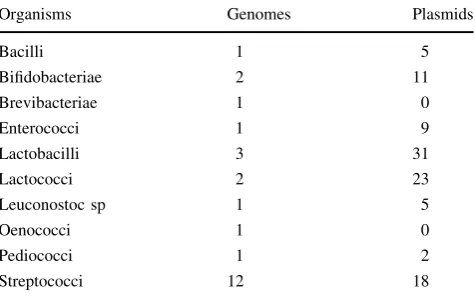
WCFS1) were used to deduce amino acid sequences for each predicted open reading frame (ORF). These amino acid sequences were used to compile the custom Lacto-bacillus BlastP-database (dbLB), utilizing formatdb from NCBI’s Blast distribution. Similarly, a second custom database (dbLAB), excluding the aforementioned four organisms, was created, consisting of 25 lactic acid bac-teria genomes and 104 plasmids, present at the time of analysis. A summary of the database content is shown in Table1 and a detailed description can be found in Supplemental Table 1.
BlastP and differential blast analyses
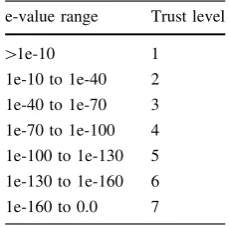
Each ORFeome of the four genomes was analyzed using BlastP and both custom databases. BlastP hits to the respective query organisms were ignored. The resulting best BlastP hit was used as basis for the respective trust level assignment. A trust level represents an empirically deduced range of probabilities, permitting a clustering of e-value ranges of similar significance. Trust level ranges and values are shown in Table2. The trust levels for each predicted ORF and each database are then directly dis-played (BlastP results) and differentially compared and
Table 1 Firmicutes and Actinobacteria used to generate the custom
LAB database
Organisms Genomes Plasmids
Bacilli 1 5
Bifidobacteriae 2 11
Brevibacteriae 1 0
Enterococci 1 9
Lactobacilli 3 31
Lactococci 2 23
Leuconostoc sp 1 5
Oenococci 1 0
Pediococci 1 2
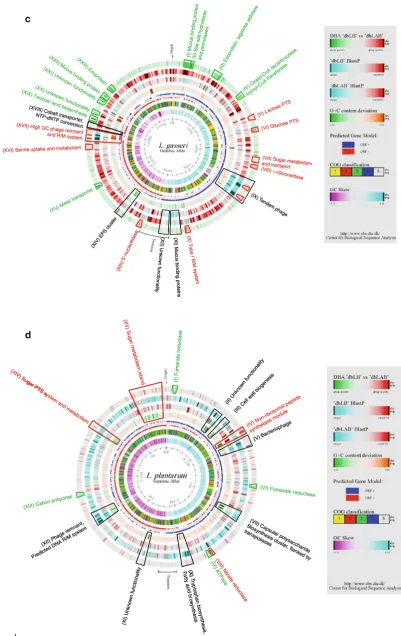
represented (DBA results) on the respective genome atlas circles (Fig.1a–d).
Differential Blast Analysis is both independent from ORF position on the respective reference and subject genomes, and from given ORF annotations. Thereby, impacts caused by genome rearrangements or mis-annota-tions are significantly reduced. Trust levels (tl) found for each investigated ORF of the reference genome were differentially analyzed against both databases (DDBA= tldbLB-tldbLAB). Extreme values range from -6 to ?6, indicating the complete lack of similarity of a deduced amino acid sequence to entries in one of the two databases. Ranges in between describe the relative difference between trust levels with respect to the chosen databases. DBA in combination with genome atlases created by Genewiz indicates group-specific genes by color shades in relation-ship to a reference genome (either red or blue in this study). The intensity of the respective color is a direct visual indicator of the relative affiliation of the subject ORF to a given group. In this study, regions marked in red indicate ORFs conserved within at least one member of dbLAB and the reference genome, but not within the other three lac-tobacilli (dbLB) and vice versa for regions shown in green. Because DBA does not rely on any annotation, ORFs without a functional classification can be taken into account, thus allowing for a more complete analysis of the ORFeome. Selected homologous genome regions high-lighted on the genome circles of more than one organism are described once in detail and referenced thereafter. Protein ACT
Genome similarity and synteny on amino acid level was realized using an in-house developed duplex BlastP algo-rithm that compares the complete ORFeome of two organisms (GAMOLA [4] annotated) and assigns up to 20 similarity hits per ORF based on a trust interval assignment. Raw data are then converted into an ACT-compatible for-mat. Sequential analyses of several genomes allowed the direct comparison of multiple complete genomes, simulta-neously. By changing the identity threshold in ACT, displayed hits can be varied from relaxed to stringent.
Software availability
All software scripts for in-house solutions were developed in PERL and are available from the authors upon request.
Results and discussion
Lactobacillus acidophilusNCFM
L. acidophilusNCFM was originally isolated from humans and has been used extensively in industrial applications as a probiotic culture. Its complete genome sequence and content have been described [6], highlighting various genome regions harboring potentially significant genes and gene clusters. These analyzes were performed using regular similarity and gene synteny searches using standard dat-abases. To investigate strain-specific traits within lactoba-cilli of human origin and other LAB, custom databases dbLB and dbLAB were utilized and revealed the presence of several unique regions, including three previously described genetic elements designated as pauLA-I through pauLA-III (potential autonomous unit; PAU). These ele-ments resemble features from both plasmids and phages and were not found in other lactic acid bacteria to date. Because the core region of each PAU is mostly unique with regard to amino acid sequence similarities to LAB, use of the custom databases dbLB and dbLAB highlighted all three regions on the respective genome atlas (Fig.1a, I, III, and VI, blue shading). In contrast, the genome regions adjacent to the core for pauLA-II and pauLA-III were identified by DBA due to the presence of a Type II and a Type III restriction endonuclease (LBA332 and 475), respectively, that was not present in the other three lacto-bacilli. However, homologs to these nucleases can be found in Streptococcus thermophilus, Bacillus subtilisand to a lesser degree, in the draft phase sequence of
Lacto-bacillus bulgaricus. The Doc-Phd system featured by
pauLA-I remained unique forL. acidophilusNCFM, with no close homologs among LAB. Strikingly, despite the lack of apparent core sequence similarities, more PAUs were identified by functional classifications and synteny analyses in other LAB and a detailed analysis was per-formed in reference toL. johnsoniiNCC533.
Another L. acidophilus NCFM-specific locus at
*250 kb features a potential DNA repair system (Fig.1a, II). The gene cluster describes a multidrug resistance pro-tein that may resemble a permease (Lba251 to 253) and a 6-O-methylguanine DNA methyltransferase (Lba255), likely to be arranged in an operon-like structure. The for-mation of O-6-alkylguanine represents one of the major mutagens for DNA [48]. The repair of such DNA is facilitated by DNA S-methyltransferases by transferring
Table 2 Trust level
assignments used for in silico analyses
e-value range Trust level
[1e-10 1
1e-10 to 1e-40 2
1e-40 to 1e-70 3
1e-70 to 1e-100 4
1e-100 to 1e-130 5
1e-130 to 1e-160 6
(I) pauLa
-I
(II) ABC transporter;DNA repair
(III) pauLA
-II
(IV) Auxin transporter
(VI) pauLA-III
(VIII)
prLA -I
(IX) Mucus binding protein
(X)
Arginine
metabolism and pH regulation
(XI) Energy productionand conversion
(XIV) PemK
(XV) MsmII-operon (XVI, XVII, XVIII) Arabinose
uptake and utilization (XIX) DNA replication and repair,
SPIDR region (XX)
Fibronectin
binding protein,
FmtB (XXI) Surface protein (XXII) Mucus binding and cell surface proteins
(XXIII) L -Aspartate -Alanine antiporter (XXIV) Pullulanase (XXV) EPS (XXVI) L -lactate permease (XXVII) Phage resistance
(XXVIII) ABC multidrug exporter (XXIX) Amino -acid permease (XXX) ABC transporter
(V) Oxalic acid degradation
(XII) Unknown Functionality
(XIII) Carbohydrate metabolism
(VII) msm operon (I)
pauLa
-I
(II) ABC transporter;DNA repair
(III) pauLA
-II
(IV) Auxin transporter
(VI) pauLA-III
(VIII)
prLA -I
(IX) Mucus binding protein
(X)
Arginine
metabolism and pH regulation
(XI) Energy productionand conversion
(XIV) PemK
(XV) MsmII-operon (XVI, XVII, XVIII) Arabinose
uptake and utilization (XIX) DNA replication and repair,
SPIDR region (XX)
Fibronectin
binding protein,
FmtB (XXI) Surface protein (XXII) Mucus binding and cell surface proteins
(XXIII) L -Aspartate -Alanine antiporter (XXIV) Pullulanase (XXV) EPS (XXVI) L -lactate permease (XXVII) Phage resistance
(XXVIII) ABC multidrug exporter (XXIX) Amino -acid permease (XXX) ABC transporter
(V) Oxalic acid degradation
(XII) Unknown Functionality
(XIII) Carbohydrate metabolism
(VII) msm operon
(I) Bacterio
cin
(II) Mu cus bind ing protein , Bile sa lthydro lase an d ex po rt
(III) EPS (IV) Unknow
n fu nctio
nal ity
(V) Unknow n fu
nctionalit y
(VI) Mura midase, Lysozy
me
(VIII) Phag e
(IX) Predicted protei n
transport
and modificatio
n
(X) Exoprotein
(XI) Similar to
Helveticin (XII) pH
reg ulat
ion, Sugar up take andmetabo lism (XV ) Unknow n fu nction alit y (X VI) Unknown function al ity (X VI I) E PS cl uster (X VIII) Unknow n fu nctionalit y (X IX) Surface
protein (XXI ) Pe ntose phosph ate m etabolis m (XXII) Phag e
(XXIII) Sugar PTS and 2CRS sensor
(XXIV) PTS tr ansporter (XXV) LPS bios
ynthesis (XXX I) P rtH (X XX II) ABC tr anspo rter
(VII) Ar
senite efflux transport
(XIII) Pe rmease (XIV) Tran
posas e (XXV
I) ABC transport er (XXV III) Unknow n fu nc tionalit y (XXI X) Me mb rane pr otein (X XX) Transp osase; mu
cus binding pr
otein
(XX ) DNA
dam age re
pai r (XXV II) pauLjo -I (I) Bacterio cin
(II) Mu cus bind ing protein , Bile sa lthydro lase an d ex po rt
(III) EPS (IV) Unknow
n fu nctio
nal ity
(V) Unknow n fu
nctionalit y
(VI) Mura midase, Lysozy
me
(VIII) Phag e
(IX) Predicted protei n
transport
and modificatio
n
(X) Exoprotein
(XI) Similar to
Helveticin (XII) pH
reg ulat
ion, Sugar up take andmetabo lism (XV ) Unknow n fu nction alit y (X VI) Unknown function al ity (X VI I) E PS cl uster (X VIII) Unknow n fu nctionalit y (X IX) Surface
protein (XXI ) Pe ntose phosph ate m etabolis m (XXII) Phag e
(XXIII) Sugar PTS and 2CRS sensor
(XXIV) PTS tr ansporter (XXV) LPS bios
ynthesis (XXX I) P rtH (X XX II) ABC tr anspo rter
(VII) Ar
senite efflux transport
(XIII) Pe rmease (XIV) Tran
posas e (XXV
I) ABC transport er (XXV III) Unknow n fu nc tionalit y (XXI X) Me mb rane pr otein (X XX) Transp osase; mu
cus binding pr
otein
(XX ) DNA
dam age re
the alkyl group at the O-6 position to a cysteine residue, consequently inactivating the enzyme in a suicide reaction. These enzymes are featuring two distinct domains: an N-terminal methyltransferase and a C-terminal binding domain. Lba255 revealed a well-conserved DNA-binding domain and although the methyltransferase domain was only weakly conserved, most of the absolutely con-served residues were maintained [48], indicating a preser-vation of the methylase function. An alternative function of the methyltransferase is that of a transcriptional activator which is mediated by self-methylation at Cys-38 [60]. The immediate presence of a predicted multidrug efflux system might point to a potential export mechanism for (conju-gated) alkylating agents [63,72]. The genetic arrangement of this locus may suggest a dual functionality of the methyltransferase, acting both as a DNA repair system and a chemosensor for adaptive response. AlthoughL. johnso-niiNCC533 features a related methyltransferase (Ljo252) at a similar genome position, no transport mechanism could be identified upstream of this gene, implicating this as a unique DNA repair mechanism inL. acidophilus NCFM. However, the transport system may be inactivated by a premature stop-codon and its functionality remains to be verified.
Located upstream of the terminus of replication, two large genome regions were identified (1.012–1.055 Mb and
1.073–1.092 Mb), predominantly specific toL. acidophilus
NCFM (Fig.1a, X and XI). Within the first region, a unique arginase (Lba1022, EC3.5.3.1) was identified, pre-ceded by a transcriptional regulator of the merR family (Lba1021). This enzyme might catalyze the hydrolysis of arginine into L-ornithine and urea. As reported earlier,
L. acidophilusNCFM encodes an ornithine decarboxylase (Lba996) that decarboxylates ornithine to putrescine and carbon dioxide [9], consuming a proton and potentially raising the cytoplasmic pH. The presence of a putrescine export system (Lba709 to 712) further strengthens the model of a specific internal mechanism to compensate for lowering pH during acidification. The presence of a peri-plasmatic-binding protein for putrescine (Lba713) points to the fact that under normal circumstances this ABC trans-porter is responsible for the uptake of this metabolite. However, it is noteworthy that under certain conditions ABC transporters may also act bi-directionally and are capable of generating ATP in the process [13].
Within the secondL. acidophilusNCFM–specific region (Fig.1a, XI), a gene cluster was identified, consisting of 16 genes (LBA1100 to 1115). This cluster might be divided into three groups, each consisting of a flavodoxin, an associated oxidoreductase, and some accessory proteins. Although no immediate functional assignment within the metabolic network could be performed, the close proximity of these genes to each other could indicate an intimate cooperation between the single gene sets. Furthermore, the COG classification of all three groups referred to energy production and conversion and the presence of two mem-brane transporters further suggests a strain-specific mech-anism for metabolite uptake and conversion. Despite the presence of several predicted premature stop-codons and frameshifts within the first set of genes, it certainly would be intriguing to further characterize this unusual genome region.
A ppGpp regulated growth inhibitor protein of the PemK family (Lba1405) has been described for L. aci-dophilusNCFM (Fig.1a, XIV). PemK is part of a plasmid maintenance system in E. coli, whereby PemK inhibits growth of host cells. PemK has also been reported to show DNA-binding capabilities, autoregulating its own synthesis (PFam2452). The antagonist, PemI, binds to PemK thus inactivating the protein [46]. However, the corresponding suppressor PemI was not identified in the L. acidophilus
NCFM genome. Alternatively, the presence of a predicted bacterial transcription activator (LBA1408) upstream of LBA1405 could indicate a possible interaction of LBA1405 and LBA1408 in transcriptional regulation of this genome region. While this system is unique to
L. acidophilus NCFM, a toxin–antitoxin system was
recently described for the L. johnsonii NCC2761 (closely related toL. johnsoniiNCC533) prophage LJ771. There is
Fig. 1 Comparative DBA analysis of fourLactobacillus genomes.
The atlases each represent a circular view of the complete genome sequences ofL. acidophilus NCFM (a), L. johnsoniiNCC533 (b),
L. gasseriATCC33323 (c), and L. plantarumWCFS1 (d),
respec-tively. Theright-handlegend describes the singlecirclesin thetop
-down- outermost-innermostdirection. Thecircle was created using
Genewiz and in-house developed software. Innermost circle 1,
GC-Skew. Circle 2, COG classification. Predicted ORFs were
analyzed using the COG database and grouped into the 4 major categories. 1, Information storage and processing; 2, Cellular processes and signaling; 3, Metabolism; 4, Poorly characterized; and 5, ORFs with uncharacterized COGs or no COG assignment.Circle 3,
ORF orientation. ORFs in sense orientation (ORF?) are shown in
blue; ORFs oriented in anti-sense direction (ORF-) in red.Circle 4, G?C content deviation. Deviations from the average GC content are shown in either green (lowGC spike) or orange (highGC spike). A boxfilter was applied to visualize contiguous regions ofloworhigh
deviations. Circles 5 and 6, Blast similarities, using LAB and
Lactobacillus custom databases, respectively. Deduced amino acid
sequences compared against the respective database using gapped
BlastP [7]. Regions in blue represent unique proteins in NCFM,
whereas highly conserved features are shown inred. The degree of color saturation corresponds to the level of similarity.Circle 7, DBA analysis. Predicted ORFs present in at least one member of the
Lactobacillus database (dbLB), but not equally conserved in any
member of the LAB database (dbLAB) are highlighted in green.
Geneproducts present in at least one member of the LAB database, but not equally conserved in any member of theLactobacillusdatabase are highlighted inred. Features described in more detail are indicated by
trapezoids in the corresponded color and roman numbers. Black
trapezoids represent unique genome regions, either not found in any custom database or otherwise outstanding within the genome (color figure online)
(I) Mucus binding protein(II) Bile salt hydrolsase and permeases (III) Exoprotein
, tagatose aldolase (IV) Oxalyl -CoA decarboxylase , formyl -CoA transferase
(V) Lactose PTS
(VI) Glucose PTS
(VII) Sugar metabolism and transport (VIII) -Glucosidase (IX) T andem phage
(X) Type I R/M system
(XIII) 5 ’-nucleotidase (XIV) EPS cluster (XV) Metal transporter (XVI) Serine uptake and metabolism
(XVII) High GC phage remnant and R/M system
(XVIII) Cobalt tr anspor ter, NTP-dNTP conversion (XIX) Teichoic acid biosynthesis (XXIII) Exoprotein
(XI) Mucus binding proteins
(XII) Unk o w n functionality (XX) Unknown functionality
(XXI) Unknown functionality
(XXII) Mucus binding protein (I) Mucus binding protein(II) Bile salt
hydrolsase
and permeases
(III) Exoprotein
, tagatose aldolase (IV) Oxalyl -CoA decarboxylase , formyl -CoA transferase
(V) Lactose PTS
(VI) Glucose PTS
(VII) Sugar metabolism and transport (VIII) α
-Glucosidase
(IX) T andem
phage
(X) Type I R/M system
(XIII) 5 ’-nucleotidase (XIV) EPS cluster (XV) Metal transporter (XVI) Serine uptake and metabolism
(XVII) High GC phage remnant and R/M system
(XVIII) Cobalt tr anspor ter, NTP-dNTP conversion (XIX) Teichoic acid biosynthesis (XXIII) Exoprotein
(XI) Mucus binding proteins
(XII) Unk o w n functionality (XX) Unknown functionality
(XXI) Unknown functionality (XXII) Mucus binding protein
(I) Fu ma rate reducta se (IV) No n-ribosomal peptide synthetase modul e
(V) Bacter iophag
e
(VI) Fumaratereductase
(VII I) N itrat e redu ctas e (IX) ATPase (X ) T ryp tophan biosynt hesis , Fa tty acid bi osynthesi s (X I) U nkno wn functionalit y
(XII) Phage rem
nant,
Predi cted DN
A R/M
system
(XIII)Cation
antiporter
(XIV) Sugar PTS s
yst em and me taboli sm (XV ) Su
gar me
ta bolism island
(V II) Ca psular polysacchar ide Bios ynthesis clus ter , flank ed b y transposases
(II) Unkno wn fu
nctionalit y (III) Ce llwa ll biogenesis (I) Fu ma rate reducta se (IV) No n-ribosomal peptide synthetase modul e
(V) Bacter iophag
e
(VI) Fumaratereductase
(VII I) N itrat e redu ctas e (IX) ATPase (X ) T ryp tophan biosynt hesis , Fa tty acid bi osynthesi s (X I) U nkno wn functionalit y
(XII) Phage rem
nant,
Predi cted DN
A R/M
system
(XIII)Cation
antiporter
(XIV) Sugar PTS s
yst em and me taboli sm (XV ) Su
gar me
ta bolism island
(V II) Ca psular polysacchar ide Bios ynthesis clus ter , flank ed b y transposases
(II) Unkno wn fu
nctionalit y (III) Ce llwa ll biogenesis c d
evidence that the mazE-pemK system contributes to pro-phage stability withinL. johnsoniiNCC2761, although the specific role of this system for both the phage and its host remains to be elucidated [20].
A putativeL-aspartate-L-alanine conversion system was
identified inL. acidophilusNCFM that was unique among the LAB examined (LBA1695 and 1696) (Fig.1a, XXIII). LBA1695 has been annotated as aspartate aminotransfer-ase, converting L-aspartate into oxaloacetate (EC2.6.1.1).
However, metabolic pathway mapping using Pathway-Voyager [5] and the KEGG database [33] also revealed a second highly conserved hit to anL-aspartate
beta-decar-boxylase (EC 4.1.1.12) that converts L-aspartate into L-alanine while releasing carbon dioxide. A
membrane-bound antiporter (LBA1696) then mediates the exchange of L-alanine and L-aspartate, generating a physiological
membrane potential. This system might be involved in yielding metabolic energy by generating a proton motif force and regulating internal pH. Similar systems have been described inTetragenococcus halophilaD10 and are generally referred to as proton motif metabolic cycles [1]. It is noteworthy that related systems were described for other lactobacilli (i.e. L. sakei ssp. sakei) that are not considered commensals.
The above-described genome regions highlighted strain-specific traits. DBA, however, identifies areas that are group-specific and may represent features shared by all or some members of this group, whereas the same regions are absent in another set of organisms. Among the most prominent regions identified by DBA are those harboring surface, mucus-, and fibrinogen-binding proteins (LBA1019, 1020, 1611, 1612, and 1634) (Fig.1a, IX and XXI). All of these regions (green) are generally conserved between at least one of the three lactobacilli, but not found in other LAB, indicating their importance in strain/group-specific cell–cell interactions. Functional analyses of selected surface genes confirmed their role in cell adhesion and potentially cell–host interactions, in vitro [16]. It might be noteworthy that besides these group-specific genes, a number of strain-specific genes, potentially involved in cell adhesion (LBA1495, 1496, and 1654) or located on the cell surface (LBA1654), were also identified (Fig.1a, XXII). Strain specificity of cell surface proteins appears to be a widespread and important factor mediating particular cell–cell interactions. Recently, a novel genetic locus,
spaABCDEF coding for LPXTG-like pilins and a pilin-dedicated sortase in Lactobacillus rhamnosus GG, was identified [34]. The functional characterization of this locus revealed a mucus adhesion mechanism not previously described in lactobacilli. Specifically, presence of the cell wall–bound SpaC pilin was of critical importance to mucus binding, directly affecting retention time ofL. rhamnosus
GG in the intestinal tract [68]. Because of the biological
significance, all four genomes analyzed here were screened for the presence of such a pilus cluster. A PSI-Blast over three iterations against the non-redundant database provided by NCBI and a BlastP analysis against the ORFeomes ofL. acidophilusNCFM,Lactobacillus gasseri
ATCC33323, Lactobacillus johnsonii NCC533, and
Lactobacillus plantarum WCFS1 were carried out. While
hits against other L. rhamnsosus and Lactobacillus casei
strains were identified for the spaABCDEF cluster, no significant matches were detected against L. acidophilus
NCFM, L. johnsonii NCC533, L. gasseri ATCC33323 or
L. plantarum WCFS1—with the exception of hits against
L. gasseri strain 224-1 (spaA, spaB, and spaE) and one weak hit tospaF inL. plantarumWCFS1. Similar results were found when the spaABCDEF cluster was compared to the four genomes directly. Only L. plantarum WCFS1 showed some weak matches, most of them unspecific hits to surface proteins. It may be interesting to point out that PSI-Blast analyses revealed an extensive number of mat-ches throughout the gene cluster to numerous enterococci, supporting the proposed model of acquisition of this gene cluster via horizontal gene transfer [34].
Directly adjacent to the strain-specific gene cluster LBA251 to LBA255 (Fig.1a, II), a three gene operon was identified potentially involved in drug resistance (Lba246 to Lba248). The operon consists of an ABC transport system (ATPase and permease component) and a LytR-type response regulator. Although the ATPase component was annotated as a Daunorubicin resistance protein, alignments of the Daunorubicin (DNR) resistance genes DrrA and DrrB fromStreptomyces peucetius [29] did not reveal a high degree of similarity between the respective protein sequences (DrrA: 32% identity, 53% positive; DrrB: no similarities detected) and it appears to be more likely for this operon to be involved in other types of drug transport. Only L. johnsonii NCC533 showed significant homologies to these genes, whereas other LAB merely displayed limited levels of conservation for certain con-served domains.
Oxalic acid is a strong dicarboxylic acid that can cause pathological disorders [49]. At this point, degradation of oxalic acid in the gastrointestinal tract has been reported to be linked exclusively to the bacterial commensal Oxalob-acter formigenes [21]. The reaction is carried out by two enzymes, a formyl CoA-transferase (frc) and an oxalyl CoA-decarboxylase (oxc). L. acidophilus NCFM and
L. gasseri ATCC33323, but not the closely related
L. johnsonii NCC533, show highly conserved homologs
indicate an operon-like structure spanning from LBA397 to LBA394, only LBA395 and LBA396 were inducible and expressed upon acid stress [10]. Functional characteriza-tion and gene expression analyses inL. acidophilusNCFM demonstrated the capability to degrade oxalate, potentially identifying one probiotic role [10]. Interestingly, both CoA-transferases were grouped into the PFam CoA-trans-ferase family 3, a novel family distinctively different from the two other, previously described families [30]. Based on gene synteny, functional classification, and the slightly higher GC content of 38.64 and 39.53% inL. acidophilus
NCFM andL. gasseriATCC33323 respectively, one might speculate that this region was acquired via horizontal gene transfer (HGT) and then subjected to subsequent deletion events that left only frc and oxc functional. To further investigate the possibility of HGT, we have analyzed dinucleotide frequencies and codon usage for both genes and compared them to the average found in the L.
aci-dophilusNCFM genome. A chi-squared test was used to
determine whether the observed forward strand dinucleo-tide counts for the genes of interest were similar to the expected counts under the assumption that the genes came from the genome of interest. Results clearly indicate a different dinucleotide frequency when compared to the average genome (chi-squared value: 100.6, degrees of freedom=15, p-value=1.00E-14). Similarly, a chi-squared test was used to compare the codon usage frequencies for the two genes to the overall genome fre-quencies. Rare codons (expected values\5) were pooled to create a single category before the test was done. Again, results indicate a different codon usage of both genes
(chi-squared value of 224.8, degrees of freedom=46, and
p-value=2.14E-25). Both the dinucleotide frequencies and codon usage differences support the hypothesis of HGT acquisition.
Carbohydrate metabolism is a central anchor of energy generation with living organisms. Transport and metabo-lism systems are often specific to certain sugars and rely on dedicated enzymes for processing [35]. DBA partially highlighted two divergently oriented gene clusters in
L. acidophilusNCFM, LBA1364 to 1367 and LBA1368 to
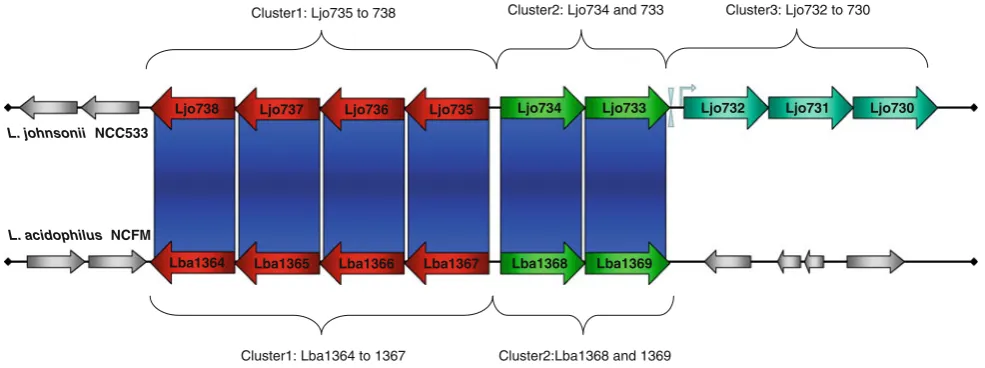
1369, respectively, likely to be involved in group-specific carbohydrate metabolism (Fig.1a, XIII and Fig.2, cluster 1 and 2). The first gene cluster consists of three alpha- and beta-galactosidases and a transcriptional regulator of the ROK family, predicted to be involved in galactose metabolism. Although the three structural genes feature many homologs throughout LAB, it is interesting to note that the transcriptional regulator LBA1367 is much less conserved and onlyL. johnsoniiNCC533 revealed a close homolog (LJO735) within the same gene synteny. The second gene cluster consisted of the cellobiose-specific phosphotransferase component EIIC,celB, (LBA1369) and a transcriptional regulator of the ROK family (LBA1368), similar to LBA1367. CelB is one of eight cellobiose-specific PTS EIIC components identified inL. acidophilus
NCFM, responsible for the phosphorylation during trans-location of the sugar. Both genes of this cluster show only very limited similarities throughout LAB, again with the exception ofL. johnsoniiNCC533 (Ljo733 and 734). It is tempting to speculate that the specific transcriptional reg-ulators found for these two gene clusters are involved in
Ljo738 Ljo734 Ljo733 Ljo732 Ljo731 Ljo730
Lba1364 Lba1368 Lba1369
Ljo737 Ljo736 Ljo735
Lba1365 Lba1366 Lba1367
Cluster1: Lba1364 to 1367 Cluster2:Lba1368 and 1369
Cluster1: Ljo735 to 738 Cluster2: Ljo734 and 733 Cluster3: Ljo732 to 730
L. johnsonii NCC533
L. acidophilus NCFM
Fig. 2 Schematic representation of a pACT analysis of two
homol-ogous genome regions in L. johnsonii NCC533 (upper panel) and
L. acidophilusNCFM (lower panel). Genomes are indicated by the
black horizontal lines(not to scale). Predicted ORFs are shown asred
(cluster 1), green (cluster 2), and cyan (cluster 3) arrows. ORF
numbers are indicated within the arrows. Gray arrows represent
ORFs with no similarity to the corresponding ORFs at the respective
modulating strain-specific degradation of complex sugars and moiety uptake. Based on gene synteny at this locus, it might be noteworthy to highlight a third gene cluster found exclusively inL. johnsoniiNCC533 (Fig.2, cluster 3). This
L. johnsonii NCC533–specific cluster is located immedi-ately downstream of Ljo733 and consists of three ORFs; two phosphatidyl-serine decarboxylases (Ljo730 and 732) and a predicted permease/antiporter (Ljo731). Detailed analysis of the intergenic region between Ljo732 and 733 revealed the presence of a predicted rho-independent terminator (-16.09 kcal/mol) and a highly conserved promoter-like structure, likely to control expression of the gene cluster independently from the upstream transcrip-tional regulator Ljo734. In silico analyses using Pathway-Voyager [5] and the KEGG database revealed a partial metabolic pathway for aminophospholipids, originating from serine and terminated at phosphatidylethanolamine. Phosphatidylserine decarboxylases (EC4.1.1.65) mediate the conversion of an activated serine (phosphatidyl-L-serine)
into phosphatidylethanolamine and CO2. Both decarboxy-lases identified in this cluster are highly conserved to each other at their respective N and C-termini (75% identity, 86% similarity) and show similarities only to LBA1607 in
L. acidophilusNCFM. However, neither gene synteny nor gene content is conserved in L. acidophilus NCFM and LBA1607 could not be placed into the same context. No genes could be identified in L. johnsonii NCC533 that might further convert phosphatidylethanolamine. However, the presence of the predicted permease/antiporter (Ljo731) might point to a different functionality than amino-phospholipid metabolism, thus employing an otherwise dead-end metabolic reaction. Decarboxylation reactions have the general potential of raising the internal pH. Hence, the decarboxylation of the activated serine might change the pH, and ethanolamine could subsequently be exported from the cell to avoid accumulation of a dead-end product in the organism. Based on this model, the gene cluster shows a possible involvement in internal pH regulation, unique to L. johnsonii NCC533. The presence of two decarboxylase genes has been reported for other organisms as well and both enzymes have the capability to comple-ment each other [65]. Interestingly, the KEGG database does not currently list the required serine-activating phos-phatidyltransferase (EC2.7.8.5) for L. johnsonii NCC533. However, reverse BlastP using a customized database featuring prokaryotic orthologs to the phosphatidyltrans-ferase listed in the KEGG database and the complete proteome of L. johnsonii NCC533 as queries revealed the presence of a predicted glycerophosphate phosphat-idyltransferases (Ljo838). Further analyses strengthened the functional classification of Ljo838 by disclosing the presence of CDP-alcohol phosphatidyltransferase domain (PFam 1066) and showing similarities to COG class
558, harboring phosphatidylglycerophosphate synthases. Therefore, Ljo838 might complete this strain-specific pathway, possibly giving L. johnsoniiNCC533 the ability to utilize more substrates for internal pH regulation.
Other prominently highlighted group-regions represent specific transport systems for other carbohydrates and amino acids (i.e. an auxin transporter LBA367, anL-lactate
permease LBA1768, an ABC-type multidrug exporter LBA1859, and an amino acid permease LBA1902 (Fig.1a, IV, XXVI, XXVIII, and XXIX)). Considering their similar ecological niches, the intestinal lactobacilli may share a large array of similar transport systems, not found in other LAB, reflecting their adaptation to the intestine.
A region likely involved in pentose uptake and con-version shows an intriguing mosaic structure of a gene cluster conserved inL. acidophilusNCFM and other LAB (red), flanked by two loci conserved only in at least one of the other three lactobacilli of human origin (green) (Fig.1a, XVI, XVII, and XVIII). The central region (LBA1481 to 1485) encodes for an ABC-type ribose transporter and a ribose kinase, likely activating the sugar moiety for further conversion after uptake [62]. Immedi-ately downstream of this cluster, an ORF was identified likely to encode for a cellulase (LBA1480). Only
L. johnsonii NCC533 showed a closely related homolog
(LJO1263). This particular cellulase was classified within the glycosyl hydrolase family 5, a widespread group of enzymes that hydrolyze the glycosidic bond between two or more carbohydrates and are known to act on both hex-oses (cellulose) and penthex-oses (xylans) [31]. While it has been shown thatL. acidophilusNCFM is able to grow on cellobiose and weakly on xylobiose (van Santen and Lah-tinen, personal communication), growth on cellulose has not yet been experimentally validated. Upstream of the central cluster, a predicted L-fucose isomerase was
identi-fied (LBA1486) and onlyL. johnsoniiNCC533 revealed a closely related homolog (LJO1264). However, the gene synteny between the two strains is not preserved. Whereas in L. johnsonii NCC533 the cellulase and the isomerase genes are located adjacent to each other and appear to be organized in one operon, the two genes are flanking the sugar ABC transporter (LBA1481–LBA 1485) in L. aci-dophilusNCFM. More interestingly,L-arabinose isomerase
revealed a very similar domain structure to L-fucose
activated by the ribose kinase. Sa-Nogueira et al. [58] reported the utilization of arabinose by Bacillus subtilis
to depend on three enzymes, namely an L-arabinose
isomerase, an L-ribulokinase, and an L
-ribulose-5-phos-phate 4-epimerase. Although the first two enzyme activities were identified in L. acidophilus NCFM, no 4-epimerase was predicted. However, the presence of a transposase (LBA1487) directly adjacent to the isomerase could indi-cate a previous genome rearrangement resulting in the loss of the epimerase gene. It might be interesting to investigate this predicted partial pathway by providing the missing enzyme activity in trans and analyze the organisms potential capability to utilize xylans or arabinans.
On the other hand, there are a number of genome regions conserved between L. acidophilus NCFM and at least one other member of the LAB database dbLAB that are not, or only weakly conserved in the other three lactobacilli (red). The multiple sugar metabolism (msm) operon (LBA500 to 507) (Fig.1a, VII) has been exten-sively analyzed and described previously [14]. A similar operon also involved in sugar uptake and metabolism has been identified and was designated msmII (LBA1437 to 1443) [6] (Fig.1a, XV). The enzymatic part (sucrose phosphorylase, LBA1437 and alpha galactosidase, LBA1438) and the energy conversion unit of the ABC transporter (ATPase, LBA1439) of the msmII operon are highly conserved in both the lactobacilli of human origin and many other LAB. However, the substrate-specific genes (permease subunits LBA1440 and 1441 and the sugar-binding component LBA1442) are unique toL.
aci-dophilus NCFM and two Streptococcus strains, namely
S. mutans and S. pneumoniae. The unique uptake and
binding proteins may indicate the possibility of varying substrate specificities for these systems.
Pullulanases are involved in the hydrolysis of (1-[ 6)-alpha-D-glucosidic linkages in pullulan, amylopectin, and glycogen. The smallest sugar released by its enzymatic activity is maltose. This enzyme (Lba1710) appears to be unique forL. acidophilus NCFM among the other lacto-bacilli (Fig.1a, XXIV). A BlastP search against the non-redundant database revealed further similarities to firmi-cutes, in particular to bacilli. Based on these results, a phylogenetic tree was constructed using the Cobalt multi-ple sequence alignment tool and the Fast Minimum Evolution algorithm [50] (data not shown). The closest homologs to Lba1710 were found in Lactobacillus
amylolyticus DSM11664 (beer malt and beer wort),
Lac-tobacillus crispatusJV-V01 andLactobacillus inersDSM 13335 (both are considered part of the normal human microbial flora), whereas bacilli and bifidobacteria exhib-ited weaker similarities. In particular, pullulanases from bifidobaceria were nearly twice the size than Lba1710– extending the N-terminal part of the protein while
maintaining a more conserved C-terminus. Further detailed analyses will be required to examine the differences in functionality between those enzyme groups. A SignalP analysis [22] revealed the presence of a signal peptide with a predicted cleavage site between position 35 and 36 of the deduced amino acid sequence, indicating an extracellular location and thus further supporting the proposed enzy-matic activity. The presence of this unique enzyme in
L. acidophilus NCFM could reflect an adaptation to the nutritional content of the hosts GI-tract. Amylopectin is a highly branched polymer of glucose found in plants and is one of the two components of starch. Glycogen is a poly-saccharide and the principal storage form of glucose in animal cells. Pullulan is a polysaccharide polymer con-sisting of maltotriose units and is produced from starch by the yeastAureobasidium pullulans. Because of its physical and biochemical properties, it is increasingly used in food industry as a non-digestible carbohydrate [70]. Hence, all three components are likely to be present in the GI tract as integral parts of a diet. Accordingly,L. acidophilusNCFM might be able to utilize some or all of these complex car-bohydrates. However, in vitro growth experiments have failed to show that NCFM can grow on pullulan (O’Flaherty & Klaenhammer, unpublished data).
As reported earlier,L. acidophilusNCFM is auxotrophic for many amino acids, including the branched chain amino acids leucine, isoleucine, and valine [6]. An ABC transport system was identified (Lba1943 to 1946), likely to be spe-cific for uptake of these amino acids (Fig.1a, XXX). Interestingly, no other Lactobacillus of human origin revealed a system with significant amino acid similarities. Only weak similarities were identified to the periplasmic and ATPase components. The substrate-specific permeases, however, were unique toL. acidophilusNCFM. In contrast, the branched chain amino acid ABC transporter was well conserved throughout LAB, most notably inLactobacillus delbrueckiissp.bulgaricus. Both gene synteny and content are highly conserved on amino acid level. Interestingly,
L. delbrueckii ssp.bulgaricus features a high overall GC content of 51.37%, and the ABC transporter exhibits an even higher GC content of 52.26%.L. acidophilusNCFM on the other hand belongs to the low GC branch of LAB and has an overall GC content of only 34.71%, with the ABC transporter featuring an only slightly higher GC content of 35.44%. This is also reflected by a DNA alignment of both regions that shows only a few regions to be conserved (data not shown). The observation that this system is, apart from
L. delbrueckii, almost exclusively conserved in low to medium GC content LAB, such asE. faecalis,S. pyogenes,
Lactobacillus johnsoniiNCC533
As described previously,L. johnsoniiNCC533 andL. gas-seri ATCC33323 share a significant amount of genetic information [55] and are considered closely related [24]. Despite this high level of similarity, a number of regions were identified unique to L. johnsonii NCC533 when compared to dbLB and dbLAB. Most prominent were the two prophages of L. johnsonii NCC533 (Lj965 ranging from Ljo288 to Ljo330 and Lj928, ranging from Ljo1418 to Ljo1465 [67]) (Fig.1b, VIII and XXII). Both elements were recognized by BlastP and DBA analyses, since some phage genes displayed similarities to LAB phages unre-lated to those of lactobacilli (data not shown).
Furthermore, a putative arsenite-efflux transport system was identified to be unique toL. johnsoniiNCC533 among LAB (Fig.1b, VII). This system is likely to be organized in an operon and consists of an operon repressor ArsR (Ljo230), an arsenite efflux transporter ArsB (Ljo231), and an arsenate reductase ArsC (Ljo232). This operon might provide an efficient detoxification system for arsenate by forming arsenite which, subsequently, is exported from the cell. This might reflect an interesting lifestyle adaption to the increasing concentrations of these substances in the environment (i.e. use of metal-containing pesticides) which have been shown to accumulate in higher organisms.
AnL. johnsoniiNCC533 unique region predicted to be involved in exopolysaccharide biosynthesis was also identified (Ljo1707 to Ljo1711) (Fig.1b, XXV). In this small gene cluster, four genes (Ljo1707 to Ljo1710) showed similarities to glycosyl transferases of family 8. This family includes enzymes that transfer sugar residues to donor molecules. Based on genome context analysis, the
gene product of Ljo1711, a 3039 aa protein with an LPXTG membrane anchor and a 10 amino acid repeat structure, might act as donor protein.
A region with strain-specific characteristics, analyzed previously [36], encodes an EPS cluster. Highly conserved genes (epsA, B, C, D, E, J, and I) flank a unique core consisting of sugar transferases and polymerases (Fig.1b, XVII).
Lastly, a genome region (Ljo1748 to Ljo1755) encoding a potential autonomous unit (PAU) has been identified (Fig.1b, XXVII), previously believed to be unique to
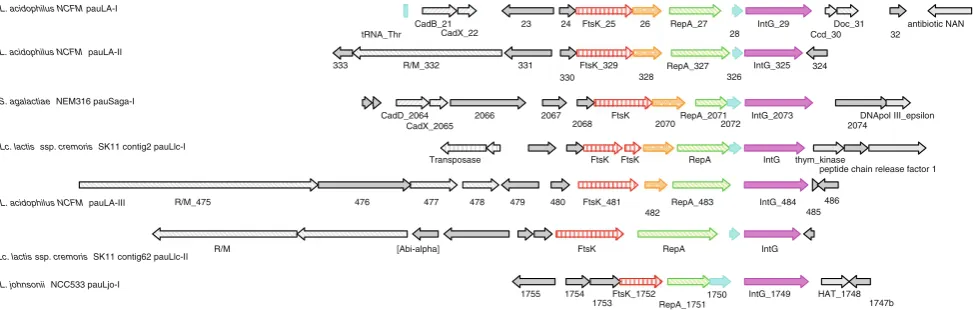
L. acidophilusNCFM [6]. PAUs inL. acidophilusNCFM resembled elements from both bacteriophage and plasmids. Analysis of pauLjo-I region in L. johnsonii NCC533 revealed a striking similarity in both functional classifica-tion and gene synteny to pauLa-I, pauLA-II, and pauLa-III
of L. acidophilus NCFM (Fig.3). Consequently, this
region was designated as pauLjo-I. Interestingly, the amino acid similarities of the conserved core genes (ftsK, repA and intG) were very low to the respective L. acidophilus
NCFM elements. Further analyses (gene ortholog neigh-borhoods) using the Integrated Microbial Genomes system (IMG) provided by the DOE Joint Genome Institute
(http://img.jgi.doe.gov/pub/main.cgi) revealed the presence
of three more genetic elements with significant similarities to the core region of PAUs. These elements comprise of pauSaga-I (ORFs2064 to 2075) found in Streptococcus
agalactiaeNEM316, and pauLlc-I (scaffold18, ORFs1220
to 1228, of the current draft phase genome) and pauLlc-II (scaffold6, ORFs 3359 to 3364, of the current draft phase genome) found in Lactococcus lactis ssp.cremoris SK11 (Fig.3). Gene synteny and functional classification remain highly conserved and little variation was observed in the
tRNA_Thr CadB_21
CadX_22
23 24 FtsK_25 26 RepA_27
28 IntG_29
Ccd_30 Doc_31
32 antibiotic NAN
R/M_475 476 477 478 479 480 FtsK_481
482
RepA_483 IntG_484
485 486
333 R/M_332 331
330 FtsK_329
328 RepA_327
326
IntG_325 324
1755 1754
1753 FtsK_1752
RepA_1751
1750 IntG_1749 HAT_1748
1747b CadD_2064
CadX_2065
2066 2067
2068 FtsK 2070RepA_20712072 IntG_2073 2074
DNApol III_epsilon
Transposase FtsK FtsK RepA IntG thym_kinase
peptide chain release factor 1
R/M [Abi-alpha] FtsK RepA IntG
L. acidophilus NCFM pauLA-I
L. acidophilus NCFM pauLA-II
S. agalactiae NEM316 pauSaga-I
Lc. lactis ssp. cremoris SK11 contig2 pauLlc-I
L. acidophilus NCFM pauLA-III
Lc. lactis ssp. cremoris SK11 contig62 pauLlc-II
L. johnsonii NCC533 pauLjo-I
Fig. 3 Potential autonomous units identified in LAB. Alignment of
previously described and newly identified PAUs inL. acidophilus
NCFM,L. johnsoniiNCC533,Lactococcus lactisssp.cremorisSK11,
andStreptococcus agalactiaeNEM316. Elements of the core region
are shown as colored arrows: DNA segregation ATPase FtsK,red
arrow; replication protein RepA, green arrow; Integrase IntG,pink
arrow; conserved hypothetical ORFs, orange and cyan arrows,
respectively. Flanking ORFs with predicted functions are displayed in
light gray arrows. Different functional classes are indicated by
distinct pattern. Adjacent ORFs with no functional characterization are indicated bysolid gray arrows. Predicted tRNAs are displayed as
vertical cyan boxes. Alignments are centered on the start position of
presence or absence of the two smaller hypothetical core genes. Like L. johnsonii NCC533, the amino acid simi-larities of the classified core elements remain very weak and do not cluster consistently among the three proteins (Supplemental Fig. 1). This suggests either a differentia-tion of a common ancestor or distinctive different roots of these elements. Adjacent of the core, PAUs displayed genes that might stabilize or maintain the respective PAU in the chromosome. In case ofL. acidophilus NCFM, the death on curing (doc) system and several restriction/mod-ification (R/M) systems were identified in close proximity to the core genes [6]. Similarly, pauLlc-II exhibited the presence of an R/M system, an adenine specific DNA methylase, and a putative abortive infection (abi) system alpha, upstream of FtsK. Interestingly, pauSaga-I exhibited a cadmium export system (CadD and CadX), similar to the one determined in pauLa-I (CadB and CadX). This system consists of a cadmium exporter (CadD family) and a regulatory protein (CadX). Amino acid alignments of CadD and CadB revealed a 60% identity (75% similarity), indicating similar transporter functionalities for both genes. Similarly, both regulatory proteins exhibited 44% sequence identity (67% similarity).
With the exceptions of pauLjo-I and pauLlc-I, every investigated PAU harbored genes adjacent to its core that might promote stabilization of the PAU in the chromo-some. The discovery of seven different PAUs in four dif-ferent organisms clearly suggests that PAUs are not a curiosity, but represent a new class of potentially mobile elements that might be further classified into different distinct families. However, no functional analyses have been performed to date and the in vivo activities remain to be investigated.
DBA analysis highlighted a large number of genes found to be shared betweenL. acidophilusNCFM, L. gas-seriATCC33323,andL. johnsonii NCC533 but which are not highly conserved within other LAB (green color shading). As described earlier, a significant portion of these regions are comprised of cell surface proteins mediating host–cell interactions (Ljo46, 47, 48, 484, and 1128), transport systems (Ljo733 and Ljo734), and metabolism islands (Ljo730, 731, 732 and Ljo1263 to Ljo1268) (Fig.1b, II, X, XII, XIX, and XXI).
A genome region located at*60 kbp (Ljo59 to Ljo63) was identified to harbor a partial exopolysaccharide (EPS) biosynthesis and transport cluster (Fig.1b, III). This cluster was highly conserved to L. gasseri ATCC33323 and
L. acidophilusNCFM and to a significantly lower degree in similarity and synteny to Lactobacillus bulgaricus. Inter-estingly, Ljo60 to Ljo62 show similarities to glycosyl transferases of family 8. Despite their chromosomal dis-tance, perhaps this gene cluster and the L. johnsonii
NCC533–specific cluster (Ljo1707 to Ljo1711) described
earlier may act synergistically by providing different moieties to the LPS structure.
Directly adjacent to the LPS cluster, a smaller set of genes was identified, coding for a bile salt hydrolase (Ljo56) and two bile salt transporters (Ljo57 and Ljo58) (Fig.1b, II). Not surprisingly, the bile salt hydrolase is highly conserved in L. acidophilus NCFM, L. gasseri
ATCC33323, and L. plantarum WCFS1, likely reflecting their common adaptation to the intestinal environment. Other LAB, in particular bifidobacteriae, show only a limited degree of similarity to Ljo56. In contrast, both bile salt transporters are only conserved in L. gasseri
ATCC33323 and L. johnsonii NCC533. It is not clear if bile salt hydrolases have a wide substrate spectrum, allowing the deconjugation of many different bile salts. In contrast, it is more likely that bile salt transporters might be dedicated to certain classes of bile salts.
Despite the exceptional degree of similarity toL. gasseri
ATCC33323, several genome regions were identified that were uniquely shared between L. johnsonii NCC533 and other LAB, but not present in either three of the other
Lactobacilli(red color shading).
Interestingly, a genome region close to the origin of replication was originally annotated to harbor an enzyme involved in thiamine biosynthesis (Ljo20, 21, 22) (Fig.1b, I). However, when analyzed in context, these ORFs are likely to encode for different functionalities. Ljo20 was annotated as a transcriptional regulator and is likely to control expression of Ljo21 and Ljo22. The gene product of Ljo21 shows significant similarities to COG0476. This cluster represents dinucleotide-utilizing enzymes involved in molybdopterin and thiamine biosynthesis, as indicated by the original annotation. The presence of Ljo22, a predicted efflux transporter, rendered the initial functional classification of Ljo21 questionable. Further analyses of Ljo 21 and Ljo22 revealed similarities to the microcin C51 production gene mccB in Escherichia coli [23] and the microcin C7 secretion proteinmccC inHeliobacter pylori
[32], respectively. Interestingly, the identified similarity of MccB to COG0476 has been described for both MccB of microcin C7 [26] and C51 [23]. It has been proposed that the adenylation conferred by MccB plays a role in the substi-tution of the C-terminus of the heptapetide by AMP [23] and is not involved in molybdopterin or thiamine biosynthesis. MccC has been shown to provide partial immunity, com-plemented by MccE. However, inL. johnsoniiNCC533, the microcin operon appears to be only partially conserved, as
transfer (HGT) as source of acquisition. This is further strengthened by the absence of this gene cluster in all other lactobacilli present in dbLB. Analysis of dbLAB revealed homologous proteins only in Streptococcus thermophilus
CNRZ1066 (CP000024: ORF 1944,mccB and 1943,pmrB). A similarly low GC content also indicates HGT as possible source of acquisition; however, the predicted transcriptional regulator (ORF1947) is separated from proposedmccB and
pmrB by two predicted transposase genes (ORFs1945 and 1946). It might be speculated that this genome region rep-resents an acquired resistance mechanism to microcin-like substances giving it a strain-specific competitive advantage. Alternatively, the gene cluster could resemble the remnants of a bacteriocin-producing operon, similar in structure to microcins.
An uptake system found in L. johnsonii NCC533, but not any other Lactobacillus, consisted of a PTS sugar transporter (predicted mannose specificity) and a 2-CRS sensor (Ljo1652 to 1660) (Fig.1b, XXIII). Ljo1653 to Ljo1656 represent PTS components A to D. These genes are relatively highly conserved in Enterococcus faecalis,
Lactobacillus casei,Streptococcus mutans, and Leuconos-toc mesenteroides, with decreasing levels of similarity from PTS EIID to EIIA. Located in the same operon-like gene cluster, Ljo1652 was found to share similarities to membrane proteins and permeases, potentially acting as an accessory protein to the PTS system. Homologous genes were identified inL. casei,S. mutans, andL. mesenteroides. Of the other lactobacilli in dbLB, only L. acidophilus
NCFM showed very weak levels of similarity to this gene cluster (except for Ljo1652), indicating only a general functional similarity that is unlikely to cover the same substrate spectrum. This uptake system might give
L. johnsonii NCC533 the advantage of using additional
sugars as carbon and energy sources in shared ecosystems. Genes likely to be involved in gene regulation were oriented in the opposite direction (Ljo1657 to Ljo1660) (Fig.1b, XXIII). Ljo1658 and 1659 encoded for a pre-dicted 2 CRS, with similarities of the histidine kinase indicating sugar specificity (COG2851). Interestingly, the flanking genes Ljo1657 and 1660 revealed similarities to periplasmatic sugar-binding protein. In addition, Ljo1657 revealed conserved domains indicating a possible role as primary receptor for sugar transport and transcriptional repressor (PFam00532 and COG1609). These four genes do not feature homologs in the other three lactobacilli and the closest relatives were found in streptococci.
Lastly, a gene likely to encode a cell-envelop-associated proteinase was identified in L. johnsonii NCC533 (Ljo1840) (Fig.1b, XXXI). Cell-envelop proteinases (CEP) facilitate the proteolysis of casein in lactic acid bacteria [53, 61] and are often essential for the growth in milk [25]. Furthermore, CEPs were also associated with
periodontal disease in Bacteroides forsythes [64]. Most CEPs require the presence of chaperones for maturation (lactococcal PrtP [69] and PrtH from Lactobacillus helv-eticus[53]), whereas others are capable of an autocatalytic process that substitutes the chaperone protein PrtM with an intramolecular chaperone (PrtB of L. delbrueckii spp.
bulgaricus [25]). The identified CEP of L. johnsonii
NCC533 is a unique gene among lactobacilli of human origins. Only L. acidophilus NCFM harbored a weakly conserved homolog (Lba1512). However, as described earlier, the homologs are present and conserved in other LAB, further implicating a key role in extracellular protein processing. Most notably, several lactobacilli (L. casei,
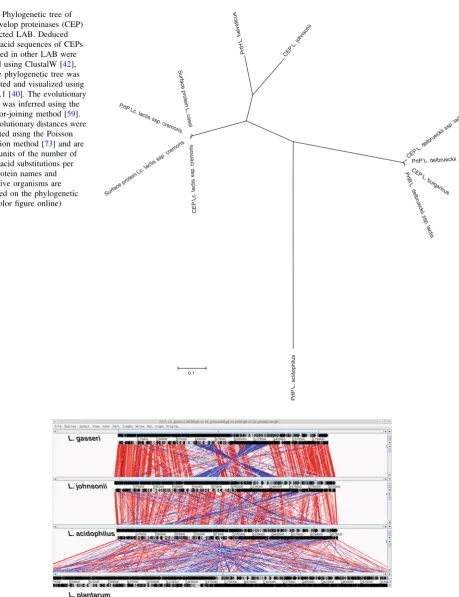
L. bulgaricus) and L. lactis ssp. cremoris showed con-served homologs of PrtH. A phylogenetic tree featuring previously described and predicted cell-envelop protein-ases from several lactobacilli and lactococci revealed a clear clustering of PrtH from L. helveticus and CEP of
L. johnsonii NCC533 (Fig. 4) likely positioning Ljo1840 into the same functional group (Group I) as PrtH, as was noted previously [55]. This is further supported by the presence of the divergently oriented maturation protein PrtM (Ljo1841). However, two of the five reported sub-strate-binding regions differ significantly in amino acid composition in Ljo1840, indicating a different specificity than previously reported CEPs. Interestingly, PrtP of
L. acidophilus NCFM is the phylogenetically most differ-ent protein included in the analysis, although many con-served regions remain intact. In contrast to Ljo1840, no adjacent maturation protein could be identified; the closest chaperone-like protein was found 70 kb downstream (PrtM, Lba1588) and it is unknown whether PrtM is involved in PrtH processing.
Lactobacillus gasseriATCC33323
Originally isolated from the human GI tract, L. gasseri
ATCC33323 occupies a similar ecological niche as
L. acidophilus NCFM and L. plantarum WCFS1 [8, 43]. However, overall genome synteny and similarity were found to be significantly more conserved betweenL. gas-seri ATCC33323 andL. johnsoniiNCC533, than between
L. gasseri ATCC33323 and the other two lactobacilli
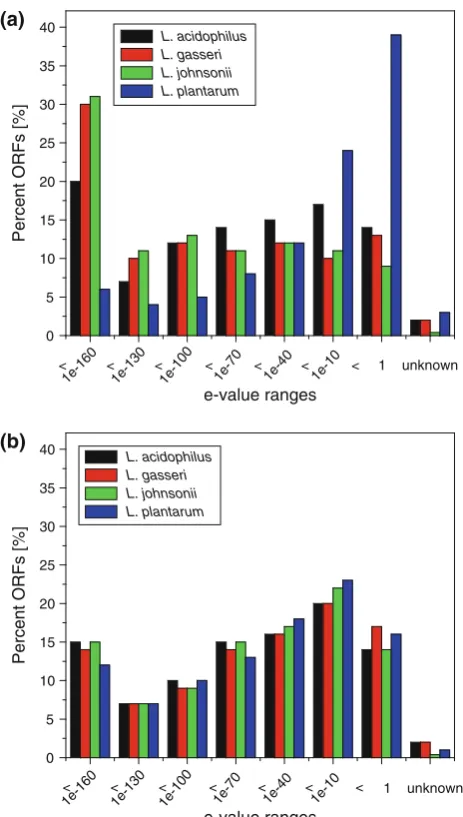
(Fig.5). More than 50% of the predicted ORFs in L. gas-seriATCC33323 share similarities toL. johnsoniiNCC533 ORFs at a level of 1e-100 and below (Fig.6a). This like-ness is not surprising as phylogenetically these two species are the most closely related of the members of theL. aci-dophilusNCFM complex. However, it is noted that the two species are often isolated from distinctly different hosts:
L. gasseri ATCC33323 from humans and L. johnsonii
CEP
Lc. lactis
ssp.
cremoris
Surface protein Lc. lactis
ssp. cremoris
PrtP
Lc. lactis
ssp. cremoris
Surface protein
L. casei
PrtH
L. helveticus
CEP
L. johnsonii
CEP L. delbrueckii
ssp. lactis
PrtP L. delbrueckii CEP
L. bulgaricus
PrtB L. delbrueckii
ssp. lactis
PrtP
L. acidophilus
0.1
Fig. 4 Phylogenetic tree of
cell-envelop proteinases (CEP) of selected LAB. Deduced amino acid sequences of CEPs identified in other LAB were aligned using ClustalW [42], and the phylogenetic tree was calculated and visualized using Mega3.1 [40]. The evolutionary history was inferred using the neighbor-joining method [59]. The evolutionary distances were computed using the Poisson correction method [73] and are in the units of the number of amino acid substitutions per site. Protein names and respective organisms are indicated on the phylogenetic tree (color figure online)
L. gasseri
L. johnsonii
L. acidophilus
L. plantarum
Fig. 5 Protein similarity and genome synteny of fourLactobacillus
genomes pACT were used to simultaneously analyze four complete
genomes on amino acid level.Double linesfeaturing pointedboxes
indicate predicted ORFs in their respective orientation.Redandblue lines in between the genomes represent amino acid similarities
between ORFs below the selected threshold. Red linesshow direct
TheL. johnsoniiNCC533 strain was sequenced and used in this analysis, however, was isolated from a human [55].
A significant percentage of ORFs are very similar between L. gasseri ATCC33323, L. johnsonii NCC533,
and L. acidophilus NCFM and only to a lesser degree
conserved to other LAB (green). Among the most domi-nant features identified are exoproteins like mucus- and fibrinogen-binding proteins (Lga130040, 130041, 130042, 130139, 130140, 131623, and 131641), as described ear-lier (Fig.1c, I, III, XXII, and XXIII). One of the largest proteins in the genome, a specific mucus-binding protein (Lga130041), was found in L. johnsonii NCC533
(Ljo0047) andL. acidophilusNCFM (Lba1019 and 1020), but was absent in L. plantarum WCFS1. Homologs in
L. gasseri ATCC33323 and L. johnsonii NCC533 were
located close to the origin of replication, whereas the corresponding ORF in L. acidophilus NCFM was found close to the terminus of replication. No evidence of apparent genome rearrangements was observed. Quite contrary, the region close to the origin shows a relatively high degree of synteny between all three genomes (Fig.5). Adjacent to this surface protein, a bile salt export system was identified (Fig.1C, II). This system consists of a bile salt hydrolase and two permeases. As described for the corresponding system in L. johnsonii NCC533, closely related genes to this export system can only be found in these two strains. Interestingly, one of the permease genes (Lga130054) appears to be truncated by a premature stop-codon and its integrity remains to be verified.
Furthermore, a tagatose-diphosphate aldolase was identified (Lga130142), present only in L. johnsonii
NCC533, L. gasseriATCC33323 and to a lesser degree, in certain LAB (Fig.1c, III). This enzyme is able to convert tagatose-1,6-diphospate into glycerone phosphate and glyceraldehyde-3-phosphate. Both metabolites can be directly fed into the glycolysis for further conversions. Although all genes necessary for lactose uptake and con-version are present in the L. gasseriATCC33323 genome (data not shown), the presence of a sugar phosphate per-mease (Lga130141) directly adjacent to the aldolase could indicate an additional tagatose-specific sugar uptake and metabolism system, not present in L. acidophilus NCFM
and L. plantarum WCFS1. Tagatose is widely used as a
commercial low-calorie sweetener in soft drinks and fruit juices but is otherwise present in only small amounts in dairy products. The increasing consumption of low-calorie foods and the resulting rising presence of tagatose in the GIT might represent a new source of energy, promoting the growth of L. gasseri ATCC33323 and L. johnsonii
NCC533.
A gene-pair which is conserved in L. gasseri
ATCC33323 and L. acidophilus NCFM, but not in any other LAB consists of an oxalyl CoA-decarboxylase (Lga130245) and a formyl CoA-transferase (Lga130244) (Fig.1c, IV). As described for L. acidophilus NCFM above, this system is likely involved in oxalic acid degradation.
The synthesis and modification of bacterial cell walls and the incorporated teichoic acids require the coordinated interaction of many different enzyme groups. The most predominant group is composed of glycosyltransferases, catalyzing the transfer of sugar moieties from activated donor molecules to specific acceptor molecules. A group of three genes (Lga131543 to 131545), presumably organized in an operon-like structure, has been identified inL. gasseri 0
5 10 15 20 25 30 35 40
< < < <
< <
Percent ORFs [%]
e-value ranges L. acidophilus
L. gasseri L. johnsonii L. plantarum
1e-160 1e-130 <1e-100 1e-70 1e-40 1e-10 1 unknown
0 5 10 15 20 25 30 35 40
< < < <
< <
Percent ORFs [%]
e-value ranges L. acidophilus
L. gasseri L. johnsonii L. plantarum
1e-160 1e-130 <1e-100 1e-70 1e-40 1e-10 1 unknown
(a)
(b)
Fig. 6 Differences in e-value distribution between the four
lactoba-cilli of human origin when compared to the two custom databases dbLB and dbLAB. Based on the best BlastP hit, similarities were
grouped within the assigned e-value ranges. Solid bars represent
results for the custom Lactobacillus database dbLB (a) and the
ATCC33323 that is likely involved in teichoic acid bio-synthesis (Fig.1c, XIX). All three genes were predicted to be glycosyltransferases and classified into separate fami-lies. Lga131544 represents a glycosyltransferase of group 1 which is highly conserved in L. acidophilus NCFM (Lba520),L. johnsoniiNCC533 (Ljo1736), and many other LAB. However, close homologs cannot be found in
L. plantarumWCFS1. A glycosyl transferase of the WecB/ TagA/CpsF family (Lga131543) might be involved in the synthesis of cell wall polymers and was highly conserved in many LAB, including the four lactobacilli. Notably, the last gene of this operon-like gene cluster, Lga131543, a glycosyltransferase of group 2 that transfers sugar moieties to teichoic acid, is unique toL. gasseri ATCC33323 and
L. johnsoniiNCC533. A comparison to other LAB revealed that this region appears to be highly variable.L. acidoph-ilus NCFM only harbors two genes (Lba 519 and 520),
L. johnsonii NCC533 and L. gasseri ATCC33323 each
feature a three gene cluster, whereas the region inL. bul-garicusconsists of five genes (ORFs 111644 to 111648). One could speculate that the components of the cell wall synthesized by the proteins encoded in this operon harbor a conserved core that then features strain-specific entities, possibly altering cell surface properties and consequently, immunological responses.
Despite the predominant similarity to L. johnsonii
NCC533, several genome regions were revealed inL. gas-seri ATCC33323 that exhibited more significant similari-ties to other LAB (red).
Two loci, separated by *40 kb, each harbored a car-bohydrate transport system (Fig.1c, V and VI). The first region (Lga130338 to Lga130341) consisted of four genes, composing a lactose-specific ABC transporter. LacE (Lga130340), representing the sugar-specific permease component, featured only very weak homologs in the other three lactobacilli. Similarly, LacG (Lga130341), a 6-phospho-galactosidase, was only weakly conserved in this dataset, with homologs displaying only certain con-served domains. However, highly concon-served homologs were identified in several streptococcal strains. The second locus (Lga130393 to 130395) also represents an ABC transporter. However, the permease (Lga130395) and sugar-specific hydrolase (Lga130396) feature relatively close homologs in both databases. Interestingly, BglX (Lga130394) a beta-glucosidase and the first structural gene of this operon-like structure, cannot be found in the three other lactobacilli but features close homologs in several E. faecalis and other LAB strains. Glycoside hydrolases of this specific family are known to accept larger carbohydrates as substrates and release beta-D-glu-cosides. InE. coliBglX homologs were found to be located in the periplasm or the cytoplasm [71], and the absence of a signal peptide sequence in Lga130394 could indicate a
cytoplasmic location. Substrate specificities for this pre-dicted carbohydrate transporter remain unresolved, and the presence of a BglX homolog might point to a different, more complex substrate for Lga130395 than glucose or maltose.
Another sugar metabolism and uptake system is located at *500 kb (Fig.1c, VII). It mainly consists of two PTS systems, likely to be specific for galactitol and cellobiose, respectively and an adjacent operon featuring both subunits of a galactose isomerase. A PTS system consisting of the three genes gatA,gatB, andgatC (Lga130491 to 130494) is likely to be specific for galactose uptake. In succession, the adjacent isomerase operon (Lga130487 to 130489), induced by the presence of galactose, may catalyze the conversion of D-galactose 6-phosphate to D-tagatose and 6-phosphate in the tagatose 6-phosphate pathway of gal-actose catabolism. Both systems are weakly conserved or not present in the other threeLactobacillusstrains, but can be readily found in many other LAB. The second PTS system identified in this genome region (Lga130496 to 130499) is likely to be specific for lactose or cellobiose. Similar to the other PTS system, significant similarities can be found almost exclusively outside the Lactobacillus
group.