R E S E A R C H A R T I C L E
Open Access
Implementing an initiative to promote
evidence-informed practice: part 1
—
a
description of the Evidence Rounds
programme
Aislinn Conway
1,2*, Maura Dowling
2, Áine Binchy
2,3, Jane Grosvenor
3, Margaret Coohill
4, Deirdre Naughton
2,4,
Jean James
2,3and Declan Devane
1,2Abstract
Background:
Evidence-informed practice is fundamental to the delivery of high quality health care. Delays and gaps
in the translation of research into practice can impact negatively on patient care. Previous studies have reported that
problems facing health care professionals such as information overload, underdeveloped critical appraisal skills, lack of
time and other individual, organisational and system-level contextual factors are barriers to the uptake of evidence.
Health services research in this area has been restricted largely to the evaluation of program outcomes. This paper aims
to describe the implementation process of an educational initiative for health care professionals working in midwifery,
neonatology or obstetrics aimed at disseminating evidence and enhancing evidence-informed clinical care.
Methods:
We designed and implemented an educational initiative called Evidence Rounds for health care professionals
working in the women and children
’
s division of an urban hospital in Ireland. It consisted of three core components: (1)
group educational sessions examining evidence on topics chosen by staff (2) a dedicated website and (3) facilitation,
enablement and support from a knowledge translation professional. We evaluated user engagement in the educational
program by monitoring attendance figures and website analytics. We followed up with staff at 3, 16 and 21-month
intervals after the last educational session to find out whether evidence had been implemented. We use Lavis
’
s
organising framework for knowledge transfer and the Template for Intervention Description and Replication (TIDieR)
checklist to describe the educational program and document the implementation process.
Results:
Six educational sessions presented by 18 health care professionals took place over a nine month period with
148 attendances of which 85 were unique (individuals who attended at least one session). During the period spanning
from one month before, during and one month after the running of the group sessions, 188 unique visitors, 331 visits
and 862 page views were recorded on our website.
Conclusions:
Audit and feedback processes can provide quantitative data to track practice outcomes. Achieving
sustainable educational programs can be challenging without dedicated resources such as staffing and funding.
Keywords:
Health services research, Education, Dissemination, Implementation, Knowledge translation,
Evidence-informed practice, Context, Adaptation, Sustainability, TIDieR
* Correspondence:[email protected]
This manuscript is Part 1 of a two part manuscript series. Part 2 is 10.1186/ s12909-019-1488-z - Implementing an initiative promote evidence-informed practice: part 2—healthcare professionals’perspectives of the Evidence Rounds programme.
1Health Research Board Trials Methodology Research Network, Galway, Ireland 2School of Nursing and Midwifery, National University of Ireland Galway,
Galway, Ireland
Full list of author information is available at the end of the article
Background
Evidence-informed practice is central to the delivery of
quality care and is associated with improvements in
pa-tient outcomes. Emparanza and colleagues [
1
]
demon-strated that mortality and duration of hospital stay figures
were reduced among patients treated in an evidence-based
practice unit, when compared to either a standard practice
unit or previous practice by the same health care
profes-sionals (HCPs). Nevertheless, a well-reported gap exists
between clinical practice and much of the evidence
avail-able to HCPs [
2
]. When evidence is not translated into
practice or there is a delay in the process, patients may be
exposed to unnecessary risks or suboptimal care.
There are multiple barriers to evidence uptake and
evidence-informed practice. Information overload [
3
–
5
]
is a barrier which can cause HCPs to become
over-whelmed by the volume of available literature when
seeking to access the most relevant and up to date
re-search [
6
]. We have long been in an era of information
overload with, for example, more than 1 million
publica-tions related to biomedical research captured within the
PubMed database each year [
7
]. Many health care
workers have limited time to devote to reading research
evidence [
2
]. Conversely, for some healthcare topics,
there can be a lack of evidence or indeed, high quality
evidence [
8
].
There is a need for evidence-informed, theory-based
educational and knowledge translation initiatives aimed at
HCPs to promote evidence-informed practice and the
im-plementation of evidence where appropriate. There is also
a knowledge gap regarding the implementation process of
these type of initiatives. One of the most frequently used
theories in research looking at the adoption of evidence
based practice and implementation science is Everett
Rog-ers
’
diffusion of innovations theory (1983). Rogers
identi-fied four key elements instrumental to the adoption of an
innovation; the innovation itself, communication channels
(hereby referred to as modes of delivery), time, and the
so-cial system. He categorised stakeholders into five groups
according to how they adopt innovations over time;
inno-vators, early adopters, early majority, late majority and
lag-gards [
9
].
Grimshaw and colleagues [
10
], highlight that there is a
considerable body of evidence relating to KT strategies
yet it remains incomplete. A much-debated question is
whether combined or single component strategies are
more effective [
11
]. Intuitively, a multicomponent
strat-egy might be more effective when seeking to engage as
many clinicians as possible, some of whom may have
preferences or circumstances that makes a particular
component work for them. However, Squires et al. [
12
]
found that interventions with multiple components were
no more effective than single component interventions.
They also concluded that the effectiveness of multifaceted
interventions did not increase incrementally as the
num-ber of components increased. It might be that multiple
components used in some studies addressed the same
ra-ther than diverse issues or barriers and if so, then this
might explain why they were not judged to be more
effect-ive. In a systematic review by McCormack et al. [
13
]
mul-ticomponent dissemination strategies focusing on reach,
motivation and ability strategies were more likely to affect
clinicians
’
behaviours than single-component strategies.
Another systematic review demonstrated that multifaceted
interventions focused on educational meetings to increase
implementation of physiotherapy clinical guidelines may
improve some outcomes relating to practice but failed to
have a positive impact on patient health outcomes or
re-ducing costs [
14
]. Educational meetings on their own or
in combination with other interventions may improve
clinical practice or patient outcomes but may not change
complex behaviours [
15
]. A Cochrane systematic review
reported that interprofessional education may improve
pa-tient outcomes and improve adherence to clinical
guide-lines although the evidence was judged to be low quality
[
16
]. Wallace and colleagues found that targeted
messa-ging, summaries of research evidence and educational
visits may improve the uptake of key research findings
[
17
]. The inclusion of local opinion leaders in an
interven-tion may make it more likely to align HCP behaviours
with the desired practice [
18
]. In a before-and-after study
by Segovis, the provision of food was identified by HCPs
as a motivating factor to attend grand rounds [
19
].
Ac-cording to the National Implementation Research
Net-work (NIRN) based in the United States, an enabling
context is an essential component of evidence-based
pro-grams for increasing their usefulness [
20
]. Implementation
outcomes and the use of evidence can be driven to a large
extent by contextual factors and their methods of delivery
[
21
–
23
]. Contextual influences on implementation can be
both barriers and enablers to different people at different
times, under varying circumstances. In a recent systematic
review, Geerligs et al. found that barriers and facilitators to
implementation processes identified by HCPs were
experi-enced at system, staff and intervention levels [
24
]. The
au-thors recommend taking these three domains into account
when designing implementation strategies. Hamilton and
Mittman [
21
] and Proctor [
25
] have highlighted the need
for further research to describe the implementation of
these types of initiatives in sufficient detail.
factors and adapted it when necessary throughout the
implementation process. We arranged for a local
cater-ing service to provide food at each session. Our
descrip-tion of the implementadescrip-tion of Evidence Rounds adds to
the literature on educational initiatives in applied health
services research. There is a general paucity in the
exist-ing literature of studies that provide insight into how
contextual factors have influenced dissemination and
implementation efforts.
Evidence Rounds was based loosely on an intervention
conceived by Jacqui Le May, former Head of Knowledge
Services at University Hospitals Coventry and
Warwick-shire, NHS Trust in the United Kingdom (UK). There,
members of the Clinical Evidence Based Information
Service (CEBIS) team run Evidence in Practice Groups
to examine evidence in various departments within the
hospital. Topics and questions are linked to a specific
patient cases, series of patient cases or other general
topics. As well as incorporating the best available
evi-dence into our group sessions, we used evievi-dence from
key findings of systematic reviews and other research to
inform the design and implementation of the initiative.
The goal of Evidence Rounds was to bridge the gap
be-tween evidence and practice through an educational
initia-tive aimed at HCPs. The objecinitia-tives were to disseminate
the best available evidence to HCPs on topics of their
choosing during group sessions; to promote
evidence-in-formed practice through the provision of an in-person
group platform for staff to discuss the implications of the
evidence, the barriers and facilitators to its
implementa-tion and, to enhance evidence-informed practice by
identi-fying and assigning resulting actions where appropriate.
The aims of this paper are to describe the process of
planning,
designing
and
implementing
this
multi-component educational initiative, to report data on
quanti-tative performance indicators monitoring engagement
dur-ing the implementation process and to provide follow up
information regarding the implementation or lack of
imple-mentation of the evidence. The second paper in this
two-part series reports the findings of focus groups and
in-terviews about Evidence Rounds with HCPs who attended
or presented at the group educational sessions [
26
].
Methods
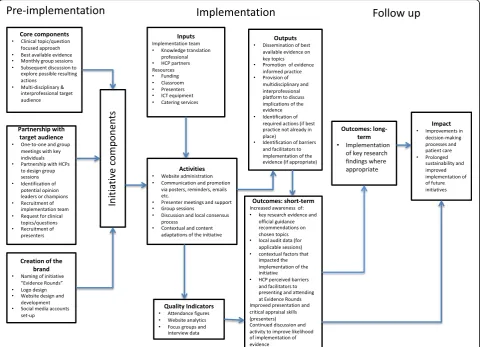
In Fig.
1
, we present a logic model developed iteratively to
demonstrate the underlying logic behind the
implementa-tion strategy for Evidence Rounds. We designed it with the
understanding that implementation processes and health
systems are complex. May and colleagues [
27
] advised that
implementation processes be understood as
“
non-linear,
emergent and dynamic events within systems.
”
The model
focuses on the components of the initiative, our planned
activities and what we hoped to achieve through the
initia-tive. We informed the pre-implementation and the
implementation phases by adapting aspects of the CEBIS
Evidence in Practice Groups, Rogers
’
diffusion of
innova-tions theory [
9
], the framework for knowledge transfer
[
28
] and the Knowledge Translation Planning Template
[
29
]. We used Rogers
’
diffusion of innovation theory to
drive the implementation strategy [
9
].
The organising framework for knowledge transfer
strategies conceived by Lavis et al. [
28
] was used to
de-velop the implementation strategy. This framework asks
five key questions: 1. What should be transferred to
de-cision makers? 2. To whom should research knowledge
be transferred? 3. By whom should research knowledge
be transferred? 4. How should research knowledge be
transferred? 5. With what effect should research
know-ledge be transferred?
1)
What should be transferred to decision makers?
To
improve the likelihood of evidence uptake, HCPs
were invited to select topics or clinical questions
relating to treatment or diagnostic interventions. A
member of staff who later confirmed with colleagues
their agreement on her chosen topic suggested the
topic for the first group session at a planning
meeting. For subsequent sessions, a collective
decision was made at group sessions about the topic
to be covered in the next session. Sometimes, several
suggestions were considered before a decision was
made. At the request of one HCP, a topic suggestion
sheet was passed around during sessions to
their own practice. The final selected topics are
pre-sented in Table
3
.
2)
To whom should research knowledge be transferred?
Our target audience consisted of HCPs working in
the neonatal and obstetric departments in the
women and children
’
s division of an urban hospital
in Ireland. We took a multi-disciplinary and
inter-professional approach to maximise the potential for
the dissemination and implementation of evidence
and to promote collaboration with the ultimate goal
of implementation of evidence where appropriate.
We also invited staff members outside of key
de-partments when deemed appropriate to the topic.
For example, laboratory staff were invited to attend
the fourth session: antenatal screening for group B
streptococcus. When these staff were identified,
in-vitations were extended through the presenting
HCPs. The implementation team also invited
stu-dents who were on placement in the departments
during the time of the sessions.
3)
By whom should research knowledge be transferred?
We took a team approach to the transfer of
knowledge. Three HCPs presented at each session
with representatives from both medical and nursing
and midwifery staff in each session. Staff from the
neonatal and obstetric departments presented when
the topic covered both disciplines. To recruit HCPs
to present, staff were asked to volunteer during
group sessions or previous presenters contacted
individuals they perceived as suitable candidates.
The KT professional who is an author on this paper
(AC) introduced each session, discussed the
literature search process, the breadth of the
literature on the chosen topic, and directed
discussion to decide on the next topic.
4)
How should research knowledge be transferred?
The
KT strategy involved both active and passive
methods of promotion, communication and
dissemination. In line with Rogers
’
diffusion of
innovations theory [
9
], we accepted that our
target audience was likely to adopt the evidence
presented in the educational initiative at different
points in time. Therefore, we deemed it
strategy. To increase the reach of the evidence:
We identified and arranged meetings with key
staff at the hospital - to build an implementation
team and identify potential champions or opinion
leaders that could help us communicate with
HCPs and disseminate evidence. Our group
sessions targeted multiple disciplines and
professions to increase the impact. We employed
a variety of communication and dissemination
modes of delivery (See Table
1
) e.g. face-to-face
meetings, telephone calls, emails, an open access
website, based on the assumption that we were
likely to encounter stakeholder groups similar to
those identified by Rogers [
9
] who may adopt the
initiative at different points in the process and
for a variety of reasons. To increase motivation
to use and apply the evidence: HCPs took
owner-ship by choosing topics that had the potential to
improve their practice and that were meaningful
and timely for them. We focused on the
applic-ability of the evidence to the local context. When
requested, we presented information on how
other national and international units were
pro-viding healthcare services relating to the topic
for benchmarking purposes. In 3 of the 6
ses-sions, retrospective audit data were presented to
capture data relating to recent practice and
po-tentially act as a driving force to change future
practice. To increase the ability to use and apply
the evidence: We addressed the issue of
informa-tion overload by designing and performing
prag-matic yet comprehensive search strategies, sifting
through the frequently large volume of search
re-sults and discarding obviously irrelevant records.
Searches were ran on appropriate databases and
websites including; the Cochrane Library
data-bases, Medline or PubMed, CINAHL, Embase,
Google (to identify guidelines and grey literature),
relevant professional bodies and organisations
’
websites, healthcare organisations
’
websites,
DynaMed, Trip Database Pro and the Geneva
Foundation for Medical Education and Research
(GFMER). Presenting HCPs were provided with a
significantly reduced number of records to screen
for inclusion. After feedback from the first
ses-sion, a
“
Quick Guide for Presenters
”
(see
Add-itional file
1
) was provided to HCPs who had
signed up to present. Key data and findings from
multiple studies were extracted and summarised
during group sessions. We fostered an
environ-ment where critical appraisal was key and
highlighted the strengths and weaknesses of
in-cluded evidence. The KT professional provided
support and enabling services to presenters to
reduce their workload and improve levels of
health information literacy e.g. obtaining full text
of papers, helping with interpreting statistical
data e.g. forest plots and key statistical concepts
such as
P
values and confidence intervals,
identi-fying appropriate critical appraisal tools, sourcing
images to put into presentations (in compliance
with licensing and copyright restrictions),
provid-ing feedback on presentation slides, populatprovid-ing
reference sections, extracting key information and
data, providing guidance on selecting papers for
inclusion etc. During the discussion forum,
obsta-cles to the implementation of evidence were
identified to increase the likelihood that they
would be addressed and plans for change could
be tailored [
30
].
At the initial planning meetings, we emphasized
that we did not intend on imposing the Evidence in
Practice Groups model from the UK on staff at our
hospital. Baumann recommends taking an adaptive
approach to implementation because no single
inter-vention will be a perfect fit in all settings [
31
].
Pro-active adaptation played a key role in our strategy
[
32
] so that we could shape the initiative in response
to important individual, organisational and contextual
factors. We tailored it to suit the local context with
currently available information before implementation
and adapted it iteratively throughout in accordance
with feedback loops, observations and performance
indicator monitoring. See the Table
2
for a list of core
components and some adaptations.
5)
With what effect should research knowledge be
transferred?
The main aims of Evidence Rounds
were to provide an educational program that
disseminated evidence to health care
facilitators to attending and presenting at
Evi-dence Rounds. We were better able to
under-stand the complexity of the behaviours and gauge
opinions on whether and how Evidence Rounds
was promoting evidence-informed practice for
them. These results are published in the second
paper of this two part series [
26
]. Fourthly, we
followed up with the implementation team to
check the status of evidence implementation.
Dis-semination strategies play an essential role but
on their own, do not guarantee the
implementa-tion of evidence [
13
,
33
]. For this reason, and
Table 1
Modes of delivery used in Evidence Rounds for promotional purposes, communication and dissemination
Mode of delivery Details and contextual influences
Group educational sessions and discussion forum
The presentations at all sessions had a similar structure with small differences if warranted by the topic eg. presenters carried out a retrospective local audit for 3 out of the 6 group sessions. Therefore, repeat attendees became familiar with the format and upcoming and potential presenters knew what to expect.
We found that the majority of staff remained behind for facilitated discussion. We promoted an informal and relaxed atmosphere where all disciplines and professions were encouraged to contribute their opinions. At times, it was necessary to refocus discussion on key points related to the topic, to bring the group’s attention to break-off conversations, to encourage discussion of the applicability of evidence to local practice and prac-tical aspects at the hospital that would influence how the evidence would be addressed/handled.
In-person meetings One-to-one and group meetings were arranged with key informants (eg. practice development and front-line staff interested in research) for implementation planning. These interactions were important for gaining an un-derstanding of the organizational context and choosing the implementation team. It was pivotal to our initia-tive to gain buy in, and collaborate and partner with HCPs to give them the opportunity to be involved in, contribute to and co-design and development of the initiative. Through recommendations from these meet-ings and additional contacts, we reached out to those who could be considered as potential opinion leaders and champions. A key intention was to identify people with different professional perspectives to identify their needs and bring them on board.
We held meetings with presenters for preparatory, enabling and support purposes. Presenters attended two preparatory meetings, the first after the search strategy was completed to give an overview of results and assign sources and another a few days before the presentation to merge slides, gain clarity about the format of the presentation, make final modifications, summarise information, and identify issues for discussion.
Website Using a web hosting platform, we designed a logo for Evidence Rounds, purchased a suitable domain name
and created a dedicated website. It was designed to present information in a minimalist and aesthetically-pleasing format. During the initiative, the site was updated regularly with current information. The website homepage contained six clickable links, each of which had a distinct core function:
•to explain the Evidence Rounds initiative
•to act as a repository of presentation slides from group sessions
•to provide links to informational resources about searching for, and critically appraising evidence •to present information requested by attendees and presenters. For example, explanations ofpvalues and
confidence intervals and a brief guide to creating slides for Evidence Rounds group sessions aimed at presenters
•to show the schedule of past and future group sessions •to provide contact details for the KT professional
We sought informal feedback from staff regarding its usefulness and accessibility. The site was flagged at group sessions, meetings, in email correspondence and on promotional posters (see Additional file2). When the term“Evidence Rounds”was searched for in the most commonly used search engine, the website did not appear directly and so a desktop shortcut was added to the computer in the neonatal unit. In hindsight, training in search engine optimisation (SEO) which would have been useful to optimise the findability of the website.
Social media Dedicated accounts on Twitter, Facebook and LinkedIn were set up. After discussion with staff regarding what they and their colleagues were finding useful, it was decided to discontinue updating each of these platforms and concentrate on modes of delivery preferred by staff such as email, word-of-mouth and the website. Staff were keen to manage work-life boundaries when it came to online technologies.
Email Reminders to attend group sessions were mostly sent via email to staff mailing lists by HCPs from the
implementation team. Email was used commonly for communication by the implementation team and presenters and was used to recruit participants for focus groups and interviews. Personalised certificates of attendance or participation (for presenters) were emailed to attendees on an opt-in basis (see Additional file3
and Additional file4).
Posters Staff reported that posters, although a more passive mode of delivery, were effective at reminding them about
upcoming group sessions when strategically located. They were designed using an online graphic design service called Canva.
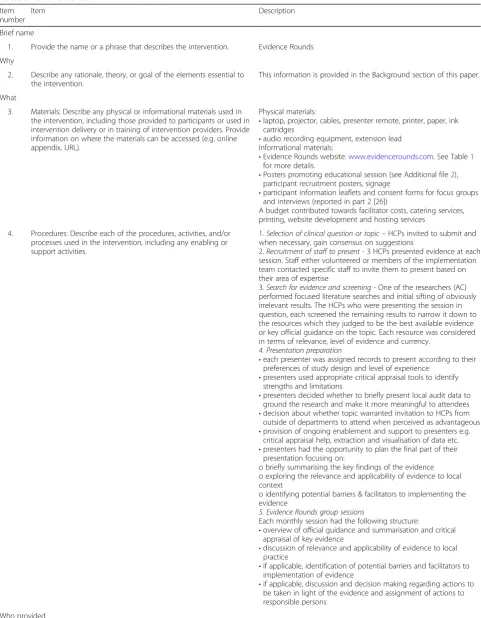
Table 2
TIDieR checklist
Item number
Item Description
Brief name
1. Provide the name or a phrase that describes the intervention. Evidence Rounds
Why
2. Describe any rationale, theory, or goal of the elements essential to the intervention.
This information is provided in the Background section of this paper.
What
3. Materials: Describe any physical or informational materials used in the intervention, including those provided to participants or used in intervention delivery or in training of intervention providers. Provide information on where the materials can be accessed (e.g. online appendix, URL).
Physical materials:
•laptop, projector, cables, presenter remote, printer, paper, ink cartridges
•audio recording equipment, extension lead Informational materials:
•Evidence Rounds website:www.evidencerounds.com. See Table1
for more details.
•Posters promoting educational session (see Additional file2), participant recruitment posters, signage
•participant information leaflets and consent forms for focus groups and interviews (reported in part 2 [26])
A budget contributed towards facilitator costs, catering services, printing, website development and hosting services
4. Procedures: Describe each of the procedures, activities, and/or processes used in the intervention, including any enabling or support activities.
1.Selection of clinical question or topic–HCPs invited to submit and when necessary, gain consensus on suggestions
2.Recruitment of staff to present- 3 HCPs presented evidence at each session. Staff either volunteered or members of the implementation team contacted specific staff to invite them to present based on their area of expertise
3.Search for evidence and screening- One of the researchers (AC) performed focused literature searches and initial sifting of obviously irrelevant results. The HCPs who were presenting the session in question, each screened the remaining results to narrow it down to the resources which they judged to be the best available evidence or key official guidance on the topic. Each resource was considered in terms of relevance, level of evidence and currency.
4. Presentation preparation
•each presenter was assigned records to present according to their preferences of study design and level of experience
•presenters used appropriate critical appraisal tools to identify strengths and limitations
•presenters decided whether to briefly present local audit data to ground the research and make it more meaningful to attendees •decision about whether topic warranted invitation to HCPs from
outside of departments to attend when perceived as advantageous •provision of ongoing enablement and support to presenters e.g.
critical appraisal help, extraction and visualisation of data etc. •presenters had the opportunity to plan the final part of their
presentation focusing on:
o briefly summarising the key findings of the evidence o exploring the relevance and applicability of evidence to local context
o identifying potential barriers & facilitators to implementing the evidence
5. Evidence Rounds group sessions
Each monthly session had the following structure:
•overview of official guidance and summarisation and critical appraisal of key evidence
•discussion of relevance and applicability of evidence to local practice
•if applicable, identification of potential barriers and facilitators to implementation of evidence
•if applicable, discussion and decision making regarding actions to be taken in light of the evidence and assignment of actions to responsible persons
Who provided
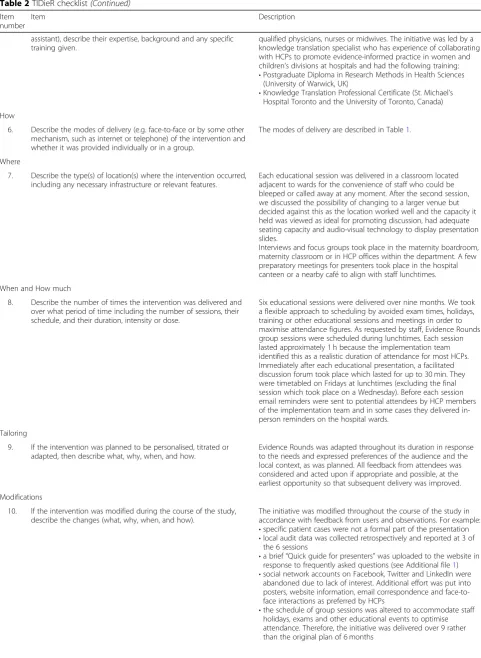
Table 2
TIDieR checklist
(Continued)
Item number
Item Description
assistant), describe their expertise, background and any specific training given.
qualified physicians, nurses or midwives. The initiative was led by a knowledge translation specialist who has experience of collaborating with HCPs to promote evidence-informed practice in women and children’s divisions at hospitals and had the following training: •Postgraduate Diploma in Research Methods in Health Sciences
(University of Warwick, UK)
•Knowledge Translation Professional Certificate (St. Michael’s Hospital Toronto and the University of Toronto, Canada)
How
6. Describe the modes of delivery (e.g. face-to-face or by some other mechanism, such as internet or telephone) of the intervention and whether it was provided individually or in a group.
The modes of delivery are described in Table1.
Where
7. Describe the type(s) of location(s) where the intervention occurred, including any necessary infrastructure or relevant features.
Each educational session was delivered in a classroom located adjacent to wards for the convenience of staff who could be bleeped or called away at any moment. After the second session, we discussed the possibility of changing to a larger venue but decided against this as the location worked well and the capacity it held was viewed as ideal for promoting discussion, had adequate seating capacity and audio-visual technology to display presentation slides.
Interviews and focus groups took place in the maternity boardroom, maternity classroom or in HCP offices within the department. A few preparatory meetings for presenters took place in the hospital canteen or a nearby café to align with staff lunchtimes.
When and How much
8. Describe the number of times the intervention was delivered and over what period of time including the number of sessions, their schedule, and their duration, intensity or dose.
Six educational sessions were delivered over nine months. We took a flexible approach to scheduling by avoided exam times, holidays, training or other educational sessions and meetings in order to maximise attendance figures. As requested by staff, Evidence Rounds group sessions were scheduled during lunchtimes. Each session lasted approximately 1 h because the implementation team identified this as a realistic duration of attendance for most HCPs. Immediately after each educational presentation, a facilitated discussion forum took place which lasted for up to 30 min. They were timetabled on Fridays at lunchtimes (excluding the final session which took place on a Wednesday). Before each session email reminders were sent to potential attendees by HCP members of the implementation team and in some cases they delivered in-person reminders on the hospital wards.
Tailoring
9. If the intervention was planned to be personalised, titrated or adapted, then describe what, why, when, and how.
Evidence Rounds was adapted throughout its duration in response to the needs and expressed preferences of the audience and the local context, as was planned. All feedback from attendees was considered and acted upon if appropriate and possible, at the earliest opportunity so that subsequent delivery was improved.
Modifications
10. If the intervention was modified during the course of the study, describe the changes (what, why, when, and how).
The initiative was modified throughout the course of the study in accordance with feedback from users and observations. For example: •specific patient cases were not a formal part of the presentation •local audit data was collected retrospectively and reported at 3 of
the 6 sessions
•a brief“Quick guide for presenters”was uploaded to the website in response to frequently asked questions (see Additional file1) •social network accounts on Facebook, Twitter and LinkedIn were
abandoned due to lack of interest. Additional effort was put into posters, website information, email correspondence and face-to-face interactions as preferred by HCPs
when appropriate during the discussion forum,
barriers, facilitators and specific actions to aid
implementation of evidence were identified,
dis-cussed and actions were assigned to specific
HCPs as appropriate. Three months after the
final group session, we followed up with HCPs
on the implementation team to see whether
Evi-dence Rounds had influenced practice. They
re-ported that a small number of recommendations
from Evidence Rounds had been implemented.
When implementation happens, the process can
be slow, particularly for more complex issues. In
the interviews and focus groups, several HCPs
explained that changes in practice often cannot
occur until the desired change is firstly made a
part of a clinical guideline [
26
]. Writing and
up-dating guidelines can be a lengthy process.
Fur-ther follow up with the same HCPs occurred 16
and 21 months later.
We took measures to plan for sustainability
(continu-ation of the initiative after support from the KT
Spe-cialist ended) such as developing tools that could be
handed over easily. For example, we chose a web
host-ing platform that allowed us to build the website and
create content using high quality templates without the
need for coding or programming skills. Our choice was
deemed the most likely option to promote sustainability
because at the end of the period of support from the
KT specialist, it could easily been handed over to a
HCP lacking advanced technical skills of website design
and administration/maintenance. We also linked in
with library staff to confirm that they would be willing
to design and conduct future searches, had
conversa-tions with key people, discussed it during our focus
groups and interviews and offered guidance during a
handover period. We planned to assess sustainability by
following up with the implementation team to find out
whether the educational initiative had continued to be
delivered.
We employed the Template for Intervention
Descrip-tion and ReplicaDescrip-tion (TIDieR) checklist, to complement
the reporting of the initiative [
34
]. This reporting
guide-line has been recommended for use to report
interven-tion implementainterven-tion [
35
].
We collected and report a number of quantitative
measures:
website analytics captured by our website hosting
platform. We report figures spanning the period
from one month before the first group session,
during the group sessions and one month after the
last group session:
1.
unique visitors
defined as the number of visitors
visiting for the first time
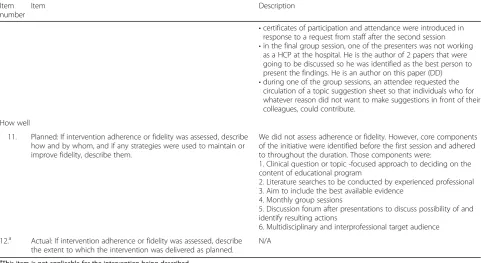
Table 2
TIDieR checklist
(Continued)
Item number
Item Description
•certificates of participation and attendance were introduced in response to a request from staff after the second session •in the final group session, one of the presenters was not working
as a HCP at the hospital. He is the author of 2 papers that were going to be discussed so he was identified as the best person to present the findings. He is an author on this paper (DD) •during one of the group sessions, an attendee requested the
circulation of a topic suggestion sheet so that individuals who for whatever reason did not want to make suggestions in front of their colleagues, could contribute.
How well
11. Planned: If intervention adherence or fidelity was assessed, describe how and by whom, and if any strategies were used to maintain or improve fidelity, describe them.
We did not assess adherence or fidelity. However, core components of the initiative were identified before the first session and adhered to throughout the duration. Those components were:
1. Clinical question or topic -focused approach to deciding on the content of educational program
2. Literature searches to be conducted by experienced professional 3. Aim to include the best available evidence
4. Monthly group sessions
5. Discussion forum after presentations to discuss possibility of and identify resulting actions
6. Multidisciplinary and interprofessional target audience
12.a Actual: If intervention adherence or fidelity was assessed, describe the extent to which the intervention was delivered as planned.
N/A
a
Table 3
Evidence Rounds session details and follow-up
Session number, topic and (number of attendees who signed in)
Specific questions/ issues explored Potential resulting actions identified Resulting actions and contextual factors
1. Premedication for non-emergency neo-natal intubations (17)
•What are the risks and benefits of using premedication for neonatal intubation?
•What are the risks and benefits of not using premedication?
•What are the most safe and effective premedications to use?
•What is the current practice in other units (national & international)?
•Develop a policy for premedication for non-emergency neonatal intubation. •It should recommend the following
medications:
o Administer remifentanil or fentanyl instead of morphine as it has a more rapid onset and a shorter duration of action
o Administer suxamethonium instead of pancurionium
o Add atropine a preventative, vagolytic agent to prevent bradycardia during intubation
•Arrange with pharmacy to stock medications
•Introduce colour-coded sticky labels to assist staff in ensuring that medica-tions are offered in the correct sequence
•Arrange staff training •Audit practice
Evidence Rounds identified as the ‘driving force’for the policy. The medical recommendations were added as an appendix to the neonatal intubation policy and all staff are required to confirm that they have read and understand the policy.
Colour-coded labels have been introduced.
While there is agreement for the need to audit practice, elective intubation is infrequently performed so an audit of practice has not yet been completed. When it does happen, there are plans to audit elements of each intubation.
2. Timing of umbilical cord clamping (32)
•The impact on delayed resuscitation at delivery
•Should resuscitation begin with the baby still attached to the cord? •What do the current guidelines say? •Benefits and risks to term and preterm
infants
•Obstetric implications for the mother
•Change discharge sheet to include optimal timing of cord clamping. •Offer delayed cord clamping (DCC) to
preterm infants in addition to term infants which has already been the case.
•Conduct audit to assure compliance with documentation
Staff report a‘concerted effort’to offer DCC to preterm infants since Evidence Rounds educational initiative. Audit conducted - 8 out of 11 babies
≤35/40 at birth were documented as having received DCC from between 30 to 60 s.
Staff report plan to audit preterm infants < 35 weeks every 3 months.
3. Medical management of patent ductus arteriosus (PDA) in preterm infants (20)
•What are the risks and benefits of using medical treatments (specifically indomethacin, paracetamol,
ibuprofen) for treating PDA in preterm infants?
•What are the risks and benefits of not using them in this population?
Confirmation that best practice was currently in place which is not to routinely treat asymptomatic cases of PDA.
Create a standard operating procedure (SOP) for management of PDA particularly for junior doctors who frequently rotate into the neonatal intensive care unit (NICU).
In December 2018, a doctor was writing this standard operating procedure using evidence presented during the educational session. The same doctor was reported to be planning an audit of practice.
4. Antenatal screening for group B
Streptococcus (GBS) (32)
•What is the rate of recurrence of GBS? •What is the optimal timing for
screening? General thinking = 35–37 weeks
•What are the long term effects on infants who have been treated with antibiotics for GBS?
•Should women with prolonged SROMs at term (of unknown GBS status) be offered screening? •Should women be offered a patient
information leaflet?
The evidence presented at this educational session highlighted a) the increased risk of early-onset group B Streptococcus (EOGBS) in infants of women with risk factors and b) the ex-istence of strategies (screening or intra-partum antibiotic prophylaxis (IAP)) that could reduce the risk. There was con-sensus amongst staff that there was a need for action because women with GBS in a previous pregnancy were not being offered either strategy. The rec-ommendations from this session were to offer screening to all women who had GBS in a previous pregnancy and to change the local guideline accordingly.
Audit patient charts regularly.
After this educational session, the Royal College of Obstetricians and
2.
visits
defined as the number of browsing sessions
and can involve multiple page views
3.
page views
defined as the number of times a
webpage from our website was fully loaded by a
browser
the total number of HCPs and other attendees who
attended each Evidence Round session (other
attendees included academic partners and students
from health-related higher education courses on
placement at the hospital site)
the total number of HCPs who presented at an
Evidence Rounds session.
We contacted the 5 HCP members of the
implementa-tion team three, 16 and 21 months after the initiative
ended to find out whether Evidence Rounds had led to
the implementation of research findings.
Results
Six Evidence Rounds group sessions were run over a
9-month period. There was a total of 148 attendees of
which 85 were unique (individuals who signed the
attend-ance sheet at a minimum of one session). See Table
3
for a
breakdown of attendance numbers by educational session.
Attendance numbers fluctuated according to factors such
as the chosen topic (some of which were common to
mid-wifery, neonatology and obstetrics, and some of which
were primarily neonatology-focused), level of interest in
the topic subject matter and clinical staffing levels.
Seventeen HCPs who worked at the hospital presented
during the period of implementation. One external HCP
(DD, who is an author of this paper), was asked to
present at a session because he authored two relevant
papers that were selected for inclusion in the
presenta-tion (session number 6).
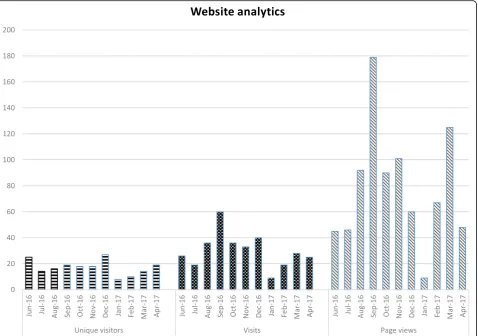
Between 01/06/2016 and 29/04/2017, 188 unique
visi-tors, 331 visits and 862 page views were recorded on the
website. See Fig.
2
for a breakdown of these figures.
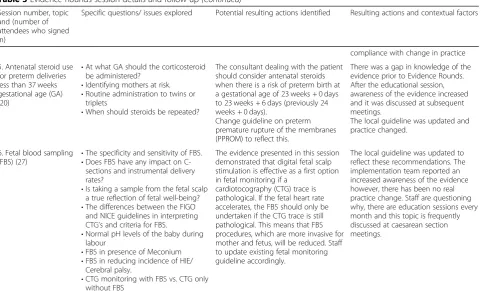
In Table
3
, we present the clinical questions and topics
explored, the resulting actions identified during the
dis-cussion forum and the actual resulting actions that were
carried out for each of the 6 educational sessions. This
information was gathered during follow up with the
im-plementation team.
Follow up with the implementation team also
con-firmed that the educational program was not sustained
beyond the period of support from the KT Specialist.
Discussion
Limitations and lessons learned
We would like to acknowledge that our study has several
limitations. Firstly, the six educational sessions were
car-ried out over nine months. It is unlikely that this was a
Table 3
Evidence Rounds session details and follow-up
(Continued)
Session number, topic and (number of attendees who signed in)
Specific questions/ issues explored Potential resulting actions identified Resulting actions and contextual factors
compliance with change in practice
5. Antenatal steroid use for preterm deliveries less than 37 weeks gestational age (GA) (20)
•At what GA should the corticosteroid be administered?
•Identifying mothers at risk. •Routine administration to twins or
triplets
•When should steroids be repeated?
The consultant dealing with the patient should consider antenatal steroids when there is a risk of preterm birth at a gestational age of 23 weeks + 0 days to 23 weeks + 6 days (previously 24 weeks + 0 days).
Change guideline on preterm premature rupture of the membranes (PPROM) to reflect this.
There was a gap in knowledge of the evidence prior to Evidence Rounds. After the educational session, awareness of the evidence increased and it was discussed at subsequent meetings.
The local guideline was updated and practice changed.
6. Fetal blood sampling (FBS) (27)
•The specificity and sensitivity of FBS. •Does FBS have any impact on
C-sections and instrumental delivery rates?
•Is taking a sample from the fetal scalp a true reflection of fetal well-being? •The differences between the FIGO
and NICE guidelines in interpreting CTG’s and criteria for FBS.
•Normal pH levels of the baby during labour
•FBS in presence of Meconium •FBS in reducing incidence of HIE/
Cerebral palsy.
•CTG monitoring with FBS vs. CTG only without FBS
The evidence presented in this session demonstrated that digital fetal scalp stimulation is effective as a first option in fetal monitoring if a
cardiotocography (CTG) trace is pathological. If the fetal heart rate accelerates, the FBS should only be undertaken if the CTG trace is still pathological. This means that FBS procedures, which are more invasive for mother and fetus, will be reduced. Staff to update existing fetal monitoring guideline accordingly.
sufficient duration of implementation to allow for the
initiative to realise its full potential, become fully
inte-grated or adopted by staff that Rogers [
9
] might describe
as the late majority and laggards. In this way, the
poten-tial of Evidence Rounds to demonstrate sustainability
may have been restricted. Secondly, our theoretical
ap-proach did not include pedagogical theory to develop
our educational initiative. Thirdly, attendance data
col-lected through sign-in sheets can be viewed as a
conser-vative estimate of actual attendance figures. We are
aware of several attendees who did not sign in during
sessions for reasons such as being bleeped or called away
to attend to a patient. Fourthly, the number of unique
visitors recorded using website analytics may be
inaccur-ate because the same person could potentially access the
website multiple times using more than one IP address
or computer. This would have resulted in them being
counted as more than one user. Fifthly, our initiative
was implemented at one institution and may be received
differently by HCPs in other settings. Sixthly, the
infor-mation presented in Table
3
regarding follow up lacks
quantitative data measures of practice changes following
the educational sessions, compared to prior practice.
The study by Emparanza [
1
] provides a good example of
quantitative outcome measurement.
In terms of implications for practice, the issue of
sus-tainability is important to consider. Despite the steps we
describe in the Methods section aimed at increasing the
sustainability of the initiative, it was not sustained
be-yond the period of support from the KT professional.
Without a nominated person or team with dedicated
professional hours and taking into consideration the
time spent planning and developing, we were aware that
there was reduced potential to sustain the initiative at
our busy hospital setting. Ideally, future initiatives will
have a longer period of implementation to allow for
ap-propriate capacity building and so that they have a better
chance of integration and becoming accepted and
adopted by staff.
interprofessional approach worked very successfully for
Evidence Rounds and according to informal feedback and
our focus group and interview data [
26
] it was highly
val-ued by our target audience. We engaged with them,
lis-tened to their feedback and found ways to address their
identified needs when possible. Our key message in this
regard would be to network and engage with champions,
opinion leaders, enthusiastic individuals, early adopters
and do not wait around for
laggards
. Involving an
Infor-mation Specialist or Librarian or someone who has
know-ledge of appropriate databases and other online resources
and is experienced in carrying out systematic and detailed
literature searches is essential. They can help to address
is-sues of information overload and reduce the workload of
HCPs involved in presenting.
Adaptation and adherence to a small number of core
components was a fundamental of the initiative. Baker
et al. [
37
], found that positive outcomes are more likely
if an adaptive approach is taken to implementing
inter-ventions when compared to no intervention or
dissem-ination alone. Feedback from HCPs who participated in
our focus groups and interviews suggested that
choos-ing topics based on when guidelines are bechoos-ing created
or updated increases the likelihood of implementation
of evidence.
Further studies are required to assess the effectiveness
of Evidence Rounds, similar educational initiatives
in-cluding those implemented in settings in the developing
world. Evaluation could include pre and post-testing of
knowledge of topics the initiative addressed, impact on
HCP behaviour and patient care outcomes. More studies
are needed to better understand and identify additional
underlying mechanisms and contextual factors that
in-fluence educational programs. Additional research is also
needed to understand how a social media strategy might
be optimised for use in the delivery of similar initiatives.
Conclusion
Evidence Rounds presents a novel educational initiative
to support a knowledge translation strategy targeted at
HCPs. It moves beyond the journal club model that was
familiar to our target audience. It was designed and
im-plemented based on feedback obtained by proactively
engaging with staff. We have helped address the need
for more research that provides a detailed account of the
implementation of knowledge translation strategies [
21
,
22
]. We have also highlighted the contextual factors and
modes of delivery that influence implementation
out-comes. This paper therefore, will help others to
under-stand
the
process
involved
in
implementing
an
educational initiative. Evidence Rounds was a complex
initiative to implement due to individual, contextual and
intervention-level factors. We used a multi-faceted
strat-egy to disseminate key research findings to our clinical
audience and promote evidence-informed practice. We
collaborated with and involved our target audience from
the start of the planning phase and throughout
imple-mentation. This paper provides useful insight into
pro-cesses and mechanisms involved in rolling out an
initiative. We describe the practical aspects or the
process of implementing an educational initiative. The
level of detail we have provided will aid reproducibility
for those wishing to roll out a similar program or
ele-ments of the program. We highlighted contextual factors
that had an impact on implementation in our setting so
that others might use them to inform the planning of
their own initiatives.
Additional files
Additional file 1:Quick guide for presenters (DOCX 59 kb)
Additional file 2:Sample poster promoting Evidence Rounds (PDF 8151 kb)
Additional file 3:Sample certificate of attendance (PDF 103 kb)
Additional file 4:Sample certificate of participation (PDF 103 kb)
Abbreviations
AB:Áine Binchy; AC: Aislinn Conway; CEBIS: Clinical evidence based information service; CREC: Clinical research ethics committee; DCC: Delayed cord clamping; DD: Declan Devane; DN: Deirdre Naughton; EOGBS: Early-onset group B Streptococcus; GA: Gestational age; GBS: Group B Streptococcus; HCP: Healthcare professional; HRB-TMRN: Health Research Board Trials Methodology Research Network; IAP: Intrapartum antibiotic prophylaxis; JG: Jane Grosvenor; JJ: Jean James; KT: Knowledge translation; MC: Margaret Coohill; MD: Maura Dowling; NCHD: Non-consultant hospital doctor; NICU: Neonatal intensive care unit; NMPDU: Nursing Midwifery Planning and Development Unit; RCOG: Royal College of Obstetricians and Gynaecologists; SOP: Standard operating procedure
Acknowledgements
The authors wish to thank the participants who generously gave their time to take part in our research. We would like to express our appreciation to the staff of the women and children’s directorate at University Hospital Galway. We gratefully acknowledge the contribution of Claire Beecher, PhD Fellow, National University of Ireland Galway, who took on the role of Assistant Moderator for our focus groups. We thank Jacqui LeMay, former Head of Knowledge Services at University Hospitals Coventry and Warwickshire NHS Trust who established Evidence in Practice Groups and the Clinical Evidence Based Information Service (CEBIS) and which provided inspiration for Evidence Rounds. Finally, we thank our funding bodies; the Health Research Board-Trials Methodology Research Network (HRB-TMRN); the College of Medicine, Nursing and Health Sciences, National University of Ireland Galway; Nursing Midwifery Planning and Development Unit (NMPDU) West/Mid-West, HSE West, Ireland.
Funding
AC’s PhD studentship was funded by the Health Research Board Trials Methodology Research Network and the College of Medicine, Nursing and Health Sciences, National University of Ireland Galway, Ireland. Evidence Rounds was supported by funding from the Nursing Midwifery Planning and Development Unit (NMPDU) West/Midwest, Health Service Executive (HSE) West, Ireland.
Availability of data and materials
Not applicable.
Authors’contributions
and JJ provided follow up data. AC wrote the first draft of the paper. DD and AC worked on subsequent drafts and feedback was given by all authors. All authors approved the final version of the paper.
Ethics approval and consent to participate
This study was granted approval by the Galway University Hospitals Clinical Research Ethics Committee (CREC) on the 2nd of June, 2016, Ref: C.A. 1505. Focus group and interview participants provided written, informed consent for their participation.
Consent for publication
Not applicable.
Competing interests
The authors declare that they have no competing interests.
Publisher
’
s Note
Springer Nature remains neutral with regard to jurisdictional claims in published maps and institutional affiliations.
Author details
1Health Research Board Trials Methodology Research Network, Galway, Ireland. 2School of Nursing and Midwifery, National University of Ireland Galway,
Galway, Ireland.3St. Clare’s Neonatal Intensive Care Unit, Galway University Hospitals, Galway, Ireland.4University Hospital Galway, Galway University Hospitals, Galway, Ireland.
Received: 30 July 2018 Accepted: 8 February 2019 References
1. Emparanza JI, Cabello JB, Burls AJ. Does evidence-based practice improve patient outcomes? An analysis of a natural experiment in a Spanish hospital. J Eval Clin Pract. 2015;21(6):1059–65.https://doi.org/10.1111/jep.12460. 2. Grimshaw JM, Eccles MP, Walker AE, Thomas RE. Changing physicians’ behavior: what works and thoughts on getting more things to work. J Contin Educ Heal Prof. 2002;22:237–43.https://doi.org/10.1002/chp. 1340220408.
3. Klerings I, Weinhandl AS, Thaler KJ. Information overload in healthcare: too much of a good thing? Evid Fortbild Qual Gesundhwes. 2015;109(4–5):285– 90.https://doi.org/10.1016/j.zefq.2015.06.005.
4. Greenhalgh T, Howick J, Maskrey N. Evidence based medicine: a movement in crisis? BMJ. 2014;348:g3725.https://doi.org/10.1136/bmj.g3725. 5. Bastian H, Glasziou P, Chalmers I. Seventy-five trials and eleven systematic
reviews a day: how will we ever keep up? PLoS Med. 2010;7(9):e1000326. https://doi.org/10.1371/journal.pmed.1000326.
6. Grandage KK, Slawson DC, Shaughnessy AF. When less is more: a practical approach to searching for evidence-based answers. J Med Libr Assoc. 2002; 90(3):298–304.
7. Landhuis E. Scientific literature: information overload. Nature. 2016; 535(7612):457–8.
8. Waddell C. So much research evidence, so little dissemination and uptake: mixing the useful with the pleasing. Evid Based Nurs. 2002;5:38–40.https:// doi.org/10.1136/ebn.5.2.38.
9. Rogers EM. Diffusion of innovations. 3rd Edition. New York: The Free Press; 1983.
10. Grimshaw JM, Eccles MP, Lavis JN, Hill SJ, Squires JE. Knowledge translation of research findings. Implement Sci. 2012;7:50. https://doi.org/10.1186/1748-5908-7-50.
11. Hulscher M, Wensing M, Grol R. Chapter 18 Multifaceted strategies for improvement. In: Grol R, Wensing M, Eccles M, Davis D, editors. Improving patient care: the implementation of change in health care. 2nd edition. West Sussex: Wiley; 2013.
12. Squires JE, Sullivan K, Eccles MP, Worswick J, Grimshaw JM. Are multifaceted interventions more effective than single-component interventions in changing health-care professionals’behaviours? An overview of systematic reviews. Implement Sci. 2014;9:152. https://doi.org/10.1186/s13012-014-0152-6.
13. McCormack L, Sheridan S, Lewis M, Boudewyns V, Melvin CL, Kistler C et al. Communication and Dissemination Strategies To Facilitate the Use of Health-Related Evidence. Evidence Report/Technology Assessment
No. 213. (Prepared by the RTI International–University of North Carolina Evidence-based Practice Center under Contract No. 290–2007–10056-I.) AHRQ Publication No. 13(14)-E003-EF. Rockville: Agency for Healthcare Research and Quality; 2013.https://effectivehealthcare.ahrq.gov/topics/ medical-evidence-communication/.
14. van der Wees PJ, Jamtvedt G, Rebbeck T, de Bie RA, Dekker J, Hendriks EJ. Multifaceted strategies may increase implementation of physiotherapy clinical guidelines: a systematic review. Aust J Physiother. 2008;54(4):233–41. https://doi.org/10.1016/S0004-9514(08)70002-3.
15. Forsetlund L, Bjørndal A, Rashidian A, Jamtvedt G, O’Brien MA, Wolf FM, Davis D, Odgaard-Jensen J, Oxman AD. Continuing education meetings and workshops: effects on professional practice and health care outcomes. Cochrane Database Syst Rev 2009; Issue 2. Art. No.: CD003030. doi:https:// doi.org/10.1002/14651858.CD003030.pub2.
16. Reeves S, Perrier L, Goldman J, Freeth D, Zwarenstein M. Interprofessional education: effects on professional practice and healthcare outcomes (update). Cochrane Database Syst Rev 2013; Issue 3. Art. No.: CD002213. DOI:https://doi.org/10.1002/14651858.CD002213.pub3.
17. Wallace J, Byrne C, Clarke M. Improving the uptake of systematic reviews: a systematic review of intervention effectiveness and relevance. BMJ Open. 2014;4:e005834.https://doi.org/10.1136/bmjopen-2014-005834.
18. Flodgren G, Parmelli E, Doumit G, Gattellari M, O’Brien MA, Grimshaw J et al. Local opinion leaders: effects on professional practice and health care outcomes. Cochrane Database Syst Rev 2011; Issue 8. Art. No.: CD000125. doi:https://doi.org/10.1002/14651858.CD000125.pub4.
19. Segovis CM, Mueller PS, Rethlefsen ML, LaRusso NF, Litin SC, Tefferi A, et al. If you feed them, they will come: a prospective study of the effects of complimentary food on attendance and physician attitudes at medical grand rounds at an academic medical center. Med Educ. 2007;7:22.https:// doi.org/10.1186/1472-6920-7-22.
20. National Implementation Research Network (NIRN): Implementation defined. https://nirn.fpg.unc.edu/learn-implementation/implementation-defined. Accessed May 1 2018.
21. Hamilton AB, Mittman BS. Chapter 23: Implementation science in healthcare. In: Brownson RC, Colditz GA, Proctor EK, editors. Dissemination and implementation research in health: translating science to practice. 2nd edition. Oxford: Oxford University Press; 2018.
22. Rycroft-Malone J. Evidence-informed practice: from individual to context. J Nurs Manag. 2008;16(4):404–8.https://doi.org/10.1111/j.1365-2834.2008.00859.x. 23. Rycroft-Malone J, Seers K, Chandler J, et al. The role of evidence, context,
and facilitation in an implementation trial: implications for the development of the PARIHS framework. Implement Sci. 2013;8:28.https://doi.org/10.1186/ 1748-5908-8-28.
24. Geerligs L, Rankin NM, Shepherd HL, Butow P. Hospital-based interventions: a systematic review of staff-reported barriers and facilitators to
implementation processes. Implement Sci. 2018;13:36.https://doi.org/10. 1186/s13012-018-0726-9.
25. Proctor EK, Powell BJ, McMillen JC. Implementation strategies:
recommendations for specifying and reporting. Implement Sci. 2013;8:139. https://doi.org/10.1186/1748-5908-8-139.
26. Conway A, Dowling M, Devane D. Implementing an initiative to promote evidence-informed practice: part 2 healthcare professionals’ perspectives of the Evidence Rounds programme.https://doi.org/10. 1186/s12909-019-1488-z.
27. May CR, Johnson M, Finch T. Implementation, context and complexity. Implement Sci. 2016;11:141.https://doi.org/10.1186/s13012-016-0506-3. 28. Lavis JN, Robertson D, Woodside JM, McLeod CB, Abelson J. Knowledge
transfer study group. How can research organizations more effectively transfer research knowledge to decision makers? Milbank Q. 2003;81(2):221– 48, 171-2.https://doi.org/10.1111/1468-0009.t01-1-00052.
29. Barwick M. Knowledge translation planning template. Ontario: The Hospital for Sick Children; 2008, 2013.
30. Grol R. Personal paper. Beliefs and evidence in changing clinical practice. Br Med J. 1997;315(7105):418–21.
31. Baumann AA, Cabassa LJ, Stirman W. Adaptation in dissemination and implementation science. In: Brownson RC, Colditz GA, Proctor EK, editors. Dissemination and implementation research in health: translating science to practice. 2nd ed. Oxford: Oxford University Press; 2018.
33. Rabin BA, Brownson RC. Chapter 2: developing the terminology for dissemination and implementation research. In: Brownson RC, Colditz GA, Proctor EK, editors. Dissemination and implementation research in health: translating science into practice. Oxford: Oxford University Press; 2012. 34. Hoffmann TC, Glasziou PP, Boutron I, Milne R, Perera R, Moher D, et al.
Better reporting of interventions: template for intervention description and replication (TIDieR) checklist and guide. BMJ. 2014;348:g1687.https://doi. org/10.1136/bmj.g1687.
35. Wilson PM, Sales A, Wensing M, Aarons GA, Flottorp S, Glidewell L, et al. Enhancing the reporting of implementation research. Implement Sci. 2017; 12:13.https://doi.org/10.1186/s13012-017-0546-3.
36. Hughes RG, Brocklehurst P, Steer PJ, Heath P, Stenson BM, on behalf of the Royal College of Obstetricians and Gynaecologists. Prevention of early-onset neonatal group B streptococcal disease. Green-top guideline no. 36. BJOG. 2017;124:e280–305.