Comparison of three methods for marking a small
floodplain minnow
Bangs
et al.
R E S E A R C H
Open Access
Comparison of three methods for marking a small
floodplain minnow
Brian L Bangs
1*, Matthew R Falcy
2, Paul D Scheerer
1and Shaun Clements
1Abstract
Background:Evaluation of the movement patterns of small-bodied fish is often hindered by the lack of a suitable long-term mark. We evaluated several techniques for long-term group and individual identification of adult (40–70 mm total length [TL]) Oregon chub (Oregonichthys crameri). We marked Oregon chub with one of two different sized passive integrated transponder (PIT) tags (a 9 × 2.12 mm, 0.067 g PIT tag [PIT-tag] or a 8.4 × 1.4 mm, 0.033 g PIT tag [PICO-tag]), a red visible implant elastomer (VIE) tag, or a freeze brand. We monitored survival, tag retention, and mark quality over 150 days. In addition, we assessed the minimum length and weight thresholds to achieve 80% and 90% survival of PIT-tagged fish.
Results:Marking with a freeze brand, PICO-tag, or VIE tag had no effect on survival (P>0.05). In contrast, marking with a PIT-tag was associated with significantly lower (P<0.05) survival than in the control group. Survival was significantly higher (P= 0.002) for fish implanted with a PICO-tag than with the larger PIT-tag.
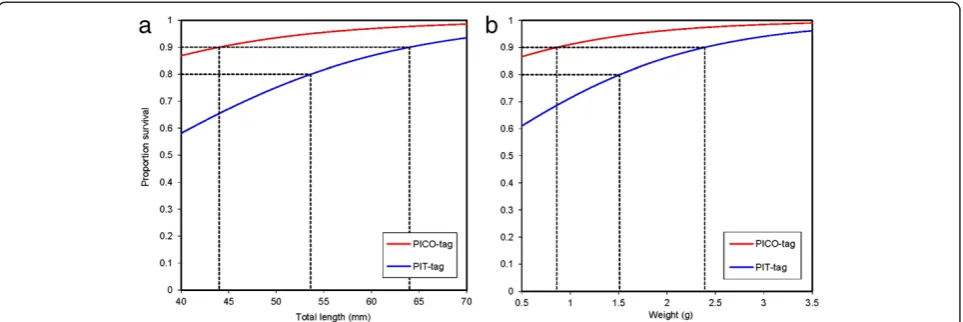
The initial minimum TL for 80% and 90% survival was 54 mm and 64 mm TL, respectively, for the PIT-tag treatment. The 90% survival threshold for PICO-tagged fish was 44 mm TL. The 80% survival threshold was outside the range of sizes used in our experiment (<40 mm TL). Similarly, the 80% and 90% survival weight thresholds for the PIT-tag treatment were 1.5 g and 2.4 g, respectively, and the 90% survival threshold for PICO-tagged fish was 0.9 g.
Tag retention was 94% and 95% in the PIT-tag and PICO-tag treatments, respectively; 80% of the freeze branded fish had easily recognizable tags after 150 days and 88% of the fish marked with VIE had easily recognizable tags after 150 days.
Conclusions:PICO-tags, VIE marks, and freeze brands are all feasible long-term marking techniques for Oregon chub with negligible effects on survival through 150 days. The selection of a particular technique should be based on the study design and objectives (e.g., individual versus group identification), cost, ease, speed of tagging, and survival.
Keywords:Freeze brand, Minimum size, Oregon chub, Passive integrated transponder tag, Retention, Survival, Visual implant elastomer
Background
The small- and large-scale movements of small bodied fish (<70 mm total length (TL)) are poorly understood. Such information is critical to assess population dynam-ics, physiology, and behavior, and inform conservation planning. Research to address individual movement and population dynamics has been hindered by the lack of a suitable long-term mark for individuals or groups of indi-viduals that is both innocuous and has a high retention
rate. Larger fishes are commonly marked with a variety of techniques including, but not limited to, passive integrated transponder (PIT) tags, visual implant elastomer (VIE) tags, and mutilation and scarring of dermal tissue through freeze branding. Each of these approaches, as well as the method of application, has limitations related to costs, ease of application, longevity or retention of the mark, and effects on the behavior or survival of the individual [1-5].
PIT tags offer a powerful tool for the unique identifi-cation of individual fish in a population. Until the recent development of smaller sized (e.g., 9 × 2.12 mm, 0.067 g and 8.4 × 1.4 mm, 0.033 g) PIT tags, their utility for use with small-bodied fish was limited because of their size
* Correspondence: [email protected]
1
Oregon Department of Fish and Wildlife, Corvallis Research Lab, 28655 Hwy 34, Corvallis, OR 97333, USA
Full list of author information is available at the end of the article
and weight. Bridger and Booth recommended that fish should not be implanted with tags weighing more than 2% of their body weight [6]. However, Jepsen et al. argued that this rule be disregarded, and that appropriate size is driven by the objectives of the study, implantation method, and the species or life stage in question [2]. Although rela-tively few studies have determined the minimum size at tagging for small-bodied species [4,5,7-9], survival and retention appear to vary by species, implantation method, and tag size. Thus, minimum length and weight thresholds should be established for target species, or as new PIT-tags are developed [5,10], prior to implementation in field studies. Such information is critical when evaluat-ing the potential effects of a taggevaluat-ing procedure on the study design.
VIE is a biologically compatible, brightly colored, fluor-escent polymer that cures into a flexible tag that is visible after subcutaneous injection in unpigmented tissue. These tags have a number of benefits for marking small-bodied fish, as their application is not limited to fish of a certain size [11,12], retention is often high, up to 99% in small bodied fish after four months [13,14], and individuals can be identified by application of different colors at different places on the body [15,16]. However, the suitability of marking locations on the body and availability of colors limits the number of unique identifiers, and retention rate is influenced by the location of the tag on the body and varies among different fish species (e.g., [17-19]). There-fore, group marks at a single suitable location may be the only acceptable application of the VIE mark for some spe-cies or for studies requiring the tagging of large numbers of individual fish.
Freeze branding is another technique used to mark indi-viduals. Freeze branding is the scarring of dermal tissue using liquid nitrogen and has been widely used to mark fish of all sizes [3]. Individuals or groups of individuals can be identified by freeze branding using different symbols on different parts of the body [3,20]. While high survival and retention is typical in small fish [1,3,21], brand reten-tion and recognireten-tion is usually poor in salmon fry smaller than 50 mm fork length (FL) [22] and is likely influenced by dermal morphology. Thus, there is a need to quantify freeze brand retention and recognition rates in the species of interest prior to their implementation in field studies.
Oregon chub are a small floodplain cyprinid endemic to the Willamette Valley, Oregon, USA. The species was listed as endangered under the federal Endangered Species Act in 1993, and was downlisted to threatened in 2010. Oregon chub prefer off-channel habitats, such as sloughs, oxbows, stable backwaters, and low gradient streams with little to no flow. Oregon chub are thought to be poor swimmers [23] and genetic data suggests there is not a substantial genetic exchange among populations [24]. However, in certain reaches of the Willamette
River tributaries, we have found Oregon chub to be well distributed and have documented the colonization of newly created habitats (unpublished observation, B. Bangs). Our objective was to determine the optimal method for marking Oregon chub for future evaluation of seasonal movement patterns, based on high tag retention, mark quality, and survival. We tested the effects of three marking techniques on the survival of Oregon chub. Fish were marked with two different sized PIT tags, a VIE mark, or a freeze brand. We monitored survival and tag retention over a period of 150 days. In addition, given that exposure to high tempera-tures typically exacerbates the effects of a stressor such as tagging [25], we tested whether exposure to a more natural thermal regime that incorporated large daily fluctuations in temperature would influence survival or tag retention in fish with the heaviest tag burden. The results provide insight into methods that may be used to mark Oregon chub and other small fishes.
Results
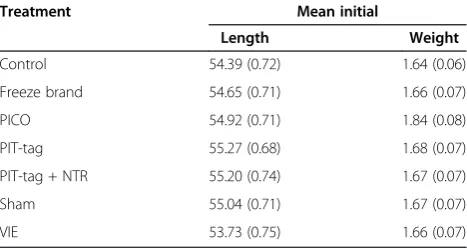
The initial mean length and weight of Oregon chub were not significantly different between treatments (ANOVA: P= 0.788, df = 6, F value = 0.527 andP= 0.349, df = 6, F value = 1.12, respectively) (Table 1). Most (72%) of the early (30 days) mortality for all treatments occurred by day 5. At day 30, we observed no mortality in the control and freeze brand treatments and very low mortality in the sham injection and VIE treatments, which were not sig-nificantly different from the control (Figure 1, Table 2). The survival probability of the PICO-tagged fish was sig-nificantly higher than that of fish in the PIT-tag (binomial test:P = 0.009, with alternative one-tailed hypothesis of higher PICO survival; n = 120 in each group) and PIT-tag + natural temperature regime (NTR) groups (binomial test: P = 0.014, with alternative one-tailed hypothesis of higher survival of PICO; n = 120 in each group). Within each of the PIT tag treatment groups (PICO-tag, PIT-tag, and PIT-tag + NTR), the survival of large fish (61– 70 mm) was significantly higher than that of small fish (40–50 mm) (Generalized linear mixed model (GLMM):
Table 1 Mean (±SE) initial total length (TL; mm) and weight (g) for Oregon chub in each of the treatment groups
Treatment Mean initial
Length Weight
Control 54.39 (0.72) 1.64 (0.06) Freeze brand 54.65 (0.71) 1.66 (0.07) PICO 54.92 (0.71) 1.84 (0.08) PIT-tag 55.27 (0.68) 1.68 (0.07) PIT-tag + NTR 55.20 (0.74) 1.67 (0.07) Sham 55.04 (0.71) 1.67 (0.07) VIE 53.73 (0.75) 1.66 (0.07)
Bangset al. Animal Biotelemetry2013,1:18 Page 2 of 9
P = 0.012, Table 3) but was not different than that of medium fish (51–60 mm) (GLMM:P = 0.856, Table 3). Similarly, the survival of the small fish was significantly lower than that of medium fish (GLMM: P = 0.017, Table 3).
After 150 days, the survival probabilities for the freeze brand, PICO-tag, and VIE treatments were not signifi-cantly different from the control (binomial tests:P>0.05, with alternative one-tailed hypotheses of higher survival of control; n = 120 in each group; Table 2). Conversely, survival was significantly lower in the tag and PIT-tag + NTR treatments than in the control group
(binomial tests: P <0.05, with alternative one-tailed hypotheses of higher survival of control; n = 120 in each group). Survival was significantly higher in the PICO-tag treatment than the PIT-tag and PIT-tag + NTR treatment groups (binomial test: P = 0.002 and P = 0.0008, re-spectively, with alternative one-tailed hypothesis of higher survival of PICO; n = 120 in each group). For all PIT tagged groups (n = 3) combined, large fish had significantly higher survival than small fish (GLMM: P = 0.002, Table 4); however, the survival of large fish was not different from that of medium sized fish (GLMM: P = 0.20, Table 4). Small fish had significantly 90%
100%
ercent
a
70% 80%
0 25 50 75 100 125 150
Pe
PIT-tag
80% 90% 100%
Percent
b
70%
0 25 50 75 100 125 150
PIT-tag + NTR
100%
c
80% 90%
Percent
Survival Retention Cumulative PICO-tag
100%
d
70%
0 25 50 75 100 125 150
Survival Retention Cumulative
80% 90%
Percent
C t l F b d VIE
70%
0 25 50 75 100 125 150
Day Control Freeze brand VIE
lower survival than medium sized fish (GLMM:P= 0.05, Table 4).
The initial minimum TL for 80% and 90% survival was 54 and 64 mm, respectively, for the PIT-tag treatment (Figure 2a). The 90% survival threshold for PICO-tagged fish was 44 mm TL. The 80% survival threshold was out-side the range of sizes used in our experiment (<40 mm). Similarly, the 80% and 90% survival weight thresholds for the PIT-tag treatment were 1.5 g and 2.4 g, respectively, and the 90% survival threshold for PICO-tagged fish was 0.9 g (Figure 2b). The equations for the 80% and 90% survival thresholds for weight and length are given in Additional file 1.
PIT tag retention was consistent across treatments over the first 30 days (Figure 1). At 30 days, tag retention was 95% in all three PIT tag treatment groups (Table 2). All in-dividuals in the freeze brand treatment group had easily recognizable marks at 30 days, with 98% receiving a score of 0, and 2% receiving a score of 1. At 30 days, 90% of the fish marked with VIE tags had an easily recognizable tag (score = 0), 8% were somewhat recognizable (score = 1), and only 2% were unrecognizable (score = 2). At 150 days, PIT-tag retention was similar to retention at 30 days, and was 91%, 96%, and 95% in the PIT-tag, PIT-tag + NTR, and PICO-tag treatments, respectively. At 150 days, 80%
of the freeze-branded fish had easily recognizable tags (score = 0), 18% were somewhat recognizable (score = 1), and only 2% were unrecognizable (score = 2). In fish marked with VIE, 88% had easily recognizable tags (score = 0), 11% were somewhat recognizable (score = 1), and 1% were unrecognizable (score = 2) at 150 days. One of the VIE tags was only observable under UV illumin-ation, otherwise all remaining VIE tags were recognizable under ambient light.
Discussion
Our results suggest that PICO PIT-tags, VIE tags, and freeze branding are all effective methods for the long-term marking of small bodied fishes like Oregon chub. Tag re-tention was similar among the VIE, freeze brand, and PICO-tag treatments over 150 days. However, because we observed some scar tissue regeneration, fragmentation or loss of VIE, and shedding of PICO tags throughout the study, we do not assume perfect detection of marks after 150 days. PICO tags offer the greatest power to monitor fish, allowing unique identification of large numbers of individuals and allowing assessment of individual growth and time extant. Passive monitoring stations can be effect-ive for PIT-tag interrogation and the greater detection range associated with larger tags enable the use of larger
Table 2 Percent survival and percent tag/mark retention (±SE) for Oregon chub 30 and 150 days after treatment
30 days 150 days
Survival Retention Retention
Treatment Mean Range Pvalue Overt mark Tag Survival Pvalue Overt mark Tag
Control 100 - NA - 96 -
-Freeze brand 100 - NA 98 (1.7) 100 97 0.788 81 98 PICO-tag 96 (2.2) 90-100 0.019 98 (1.0) 94 0.5 95 PIT-tag 86 (2.5) 80-90 <0.001 91 (3.2) 82 0.001 89 PIT-tag + NTR 85 (3.9) 77-90 <0.001 95 (2.8) 82 <0.001 95 Sham 98 (1.8) 93-100 0.123 - NA - -VIE 99 (0.8) 97-100 0.5 91 (4.1) 98 (1.7) 98 0.5 88 99
Data for each treatment group represents the mean of four replicate tanks (n = 30 fish/tank).Pvalues reflect a one-way binomial significant test and were not adjusted for multiple comparisons. Overt marks were tags that were subjectively scored a 0.
Table 3 Statistical output for GLM (binomial distribution; link: logit) at day 30
Fixed effects Estimate SE Z value Pvalue
Intercept: PICO, large fish 3.459 0.5483 6.309 <0.001 PIT-tag −1.229 0.4983 −2.467 0.014 PIT-tag + NTR −1.173 0.501 −2.341 0.019 Medium fish −0.088 0.485 −0.181 0.856 Small fish −1.078 0.427 −2.526 0.012 Small fish, when medium
is intercept −
1.078 0.427 −2.526 0.012
Small, medium, and large size categories were 40–50, 51–60, and 61–70 mm TL, respectively.
Table 4 Statistical output for GLM (binomial distribution; link: logit) at day 150
Fixed effects Estimate SE Z value Pvalue
Intercept: PICO, large fish 3.693 0.540 6.838 <0.001 PIT-tag −1.426 0.489 −2.916 0.004 PIT-tag + NTR −1.548 0.485 −3.192 0.001 Medium fish −0.575 0.450 −1.279 0.201 Small fish −1.286 0.419 −3.068 0.002 Small fish, when medium
is intercept −
0.711 0.369 −1.960 0.05
Small, medium, and large size categories were 40–50, 51–60, and 61–70 mm TL, respectively.
Bangset al. Animal Biotelemetry2013,1:18 Page 4 of 9
antennas that can span a greater area [26]. However, for use with Oregon chub in large, complex, and dynamic floodplain habitats, the utility of PICO tags may be limited due to the limited read range of the tag versus the size of antenna needed to adequately cover the area through which fish are moving. Similarly, to allow individual iden-tification, each PICO-tagged fish must be captured and manually scanned, which could be cumbersome when handling large numbers of fish in the field. In contrast, VIE and freeze brands are highly visible during handling, and should allow rapid identification of marked individ-uals in the field. Unique identification with VIE and freeze brands is limited by the number of body locations available to mark, availability of colors or brand designs, and longev-ity. Because of these limitations, VIE or freeze brands appear to be the most feasible methods for group marking of large numbers of small-bodied fish. Depending on the objectives and study design, cost may factor in the decision to choose a particular tagging technique. Although PIT tags offer a number of advantages relative to VIE tags and freeze brands, the cost of the tag may be prohibitive for some studies.
The implantation technique and the relationship be-tween tag weight and fish size are important factors in determining the effect of the tag on fish survival [2,10]. Ombredane suggested that survival after PIT tag im-plantation was influenced more by fish handling and tag-ging time than by the tag itself [27]. We observed no significant difference in survival between the sham treat-ments and the control treattreat-ments; however, survival dif-fered significantly between the two sizes of PIT tags used in the current study. Although there were slight differences in the gauge of the needle used to implant these two tag types, the effect of needle size is likely neg-ligible given that we did not insert the needle into the peritoneal cavity. The results are in contrast to previous studies which compared PIT tag implantation tech-niques in small-bodied fish and concluded that survival
was higher using an incision technique [4,5]. However, as noted earlier, our method for implanting PIT tags al-lows us to minimize the chance of needle overinsertion, which has been attributed to internal organ damage and increased mortality with small fish [9]. McCormick and Smith used a similar technique to implant 11.5 × 2.1 mm PIT tags into marine damselfish (Pomacentrus amboinensis) as small as 5.2 g [28]. We urge researchers to assess the effect of PIT tag implantation method on survival of their target species prior to their implementa-tion in field studies, as success appears to be species and/or size dependent and is influenced by the implant-ation technique.
read range, limiting their ability to be utilized in pas-sive interrogation.
We tagged and reared fish in a laboratory environ-ment where temperatures were cooler than temperatures typically encountered during the spring and summer months when Oregon chub are studied in the field. Sur-vival and tag retention is often inversely correlated with water temperature for PIT-tagged fish. For example, hybrid striped bass Morone saxitilis × Morone chrysops and bluegills Lepomis macrochirus that were tagged and reared in warmer water had significantly lower survival than those reared in cooler water [29,30]. However, expos-ure to a thermal regime similar to that experienced in the wild had no effect on long-term survival or tag retention in Oregon chub following PIT tagging in the present study. This suggests that our estimates of long-term survival and tag retention are applicable to the field. We suspect that the higher initial mortality in the PIT-tag + NTR group was due to stress associated with rapid temperature change following tagging (i.e., from 12.8°C to between 12.8°C and 20°C). Despite our attempt to mimic natural temperature fluctuations, we did not simulate other factors that may also affect survival and tag retention in the field conditions (e.g., pathogens, predators) so our estimates of survival and tag retention should be viewed as maximum estimates.
Our results with VIE tags in Oregon chub are consistent with other studies demonstrating high survival, tag reten-tion, and visibility in small-bodied fish (e.g., [31-34]). However, success with VIE tags appears to vary with body location and species. For example, barbel Barbus barbus tagged at the base of the anal fin had high retention (82.6%) over two months [17], yet retention rates were low in the anal fin of largemouth bassMicropterus salmoides, blacktail shiner Cyprinella venusta, channel catfish Ictalurus punctatus [19], Colorado squawfish Ptycholcheilus lucius, and razorback suckers Xyrauchen texanus[1]. In Oregon chub, the tissue around the base of the anal fin is relatively thick, unpigmented, and translu-cent, with little chance of damaging organs by overinsert-ing the taggoverinsert-ing needle. Our marks were highly visible in and out of the water at 150 days (approximately five months). Furthermore, we have since observed these tags in the field 407 days after marking (unpublished observa-tion, B. Bangs). VIE tag retention of juvenile brook trout Salvelinus fontinalisreared in an indoor hatchery and lake environment was 100% after 970 days [33]. The visibility of the tag in hatchery reared fish was >95% through 585 days, but decreased to 55–70% between 700 and 900 days. In the lake environment, visibility of the VIE tag was 50– 70% through 400 days, and 0% at 959 days. Josephson et al. used blue filtered light and amber glasses in dark conditions to increase tag visibility, and observed 100% re-tention for lake reared fish at 959 days and 75% rere-tention
in hatchery fish at 970 days [33]. This suggests that UV il-lumination may increase tag visibility and recognition in long-term field studies.
Because VIE tags often make fish highly visible, several studies have evaluated the relationship between brightly colored marks and vulnerability of small-bodied fish to predation. No significant differences in predation between marked and unmarked small bodied or juvenile fish have been reported [1,19,35,36]. However, juvenile bluegill marked with highly visible fluorescent photonic dyes had significantly higher susceptibility to predation by large-mouth bass than cryptically marked fish in a controlled la-boratory environment [31]. The vulnerability to increased predation of VIE-marked fish should be considered prior to implementation of this tagging method in field studies.
The results from studies of survival, retention, and recognition of freeze brands used with small fish are in-consistent. Fingerling walleye (50–170 mm TL) had high survival and 95% freeze brand retention at 5 months in a rearing pond, and brands were observed in wild fish after 40 months [37]. Juvenile (65–160 mm FL) ChinookOncorhynchus tshawytscha, CohoOncorhynchus kisutch, and sockeye salmonOncorhynchus nerkahad high survival and tag retention at 14 months [38]; however, the author noted that retention in fish <55 mm (FL) was less than 3 weeks. Chinook, Coho, and sockeye salmon have high survival with freeze brands, but marks become faded and difficult to discern within four months [22]. In con-trast, another study reported that initial mortality was high in Coho (8.3%), although survival was not signifi-cantly different from control fish and freeze brands be-came unrecognizable after 6 weeks [39]. Furthermore, in Oregon chub marked with two marks (i.e., VIE and freeze brand) in the field, we have observed high retention of freeze brands after 172 days, and poor retention after 407 days (unpublished observation, B. Bangs). Here, we inad-vertently found that body placement affected the recogni-tion of freeze brands on Oregon chub. Brands placed below the lateral line were more difficult to recognize than brands above the lateral line, because there were slight variations of freeze brand placement on each fish, and be-cause of the differential Oregon chub pigment patterns on lateral surfaces. Even though we noted 98% retention through 150 days, 19% of these fish had poor quality brands. When brands were placed below the lateral line, the horizontal element of the “L” shape was sometimes absent. This may have been caused by inadequate pressure or duration against the branding terminal, build-up of ice on the iron, or a combination of these factors.
Conclusions
We evaluated several techniques for long-term group and individual identification of Oregon chub. We found that small bodied Oregon chub could be VIE-tagged or
Bangset al. Animal Biotelemetry2013,1:18 Page 6 of 9
freeze-branded with no appreciable effect on survival to 150 days. We predict 95% survival and retention from PICO-tagged Oregon chub ≥44 mm TL (0.9 g). PICO PIT-tags, VIE marks, and freeze brands are all feasible long-term marking techniques for Oregon chub, yet selection of a particular technique should be based on the species, size range, research objectives, cost, ease, and speed of tagging, and effects of the technique on survival, retention, and detection. Our results will fa-cilitate future research on the population dynamics and behavior of Oregon chub by enabling us to moni-tor for movement within and between basins and within microhabitats.
Methods
We collected 840 Oregon chub from an abundant popula-tion in the Willamette Valley, Oregon, USA, with equal numbers of fish collected from each of the following size categories: 40–50, 51–60, and 61–70 mm TL. These fish were transferred to the Oregon State University Salmon Disease Laboratory (Corvallis, Oregon, USA) facility and initially held separately by size class in 100 L fiberglass tanks supplied with 12.8°C flow-through, pathogen-free well water. Fish were acclimated to the laboratory environ-ment for 7 days prior to initiating the study.
At the beginning of the study, fish were separated ran-domly into seven treatment groups, with four replicates per treatment. The treatment groups included: 1) control; 2) fish that were tagged with a Biomark® (Boise, Idaho, USA) HTP9 full-duplex PIT tag (9 × 2.12 mm, 0.067 g) via injection into the peritoneal cavity and reared at 12.8°C, hereafter referred to as the PIT-tag treatment; 3) fish that were tagged with the same tag via injection into the peritoneal cavity and reared on a diurnal fluctuating temperature cycle (range: 12.8–20.0°C) to mimic the nat-ural daily temperature cycle observed in the field, hereafter referred to as the PIT-tag + NTR treatment; 4) fish that were tagged with a Biomark® HTP8 PICO full-duplex PIT tag (8.4 × 1.4 mm, 0.033 g) and reared at 12.8°C, hereafter referred to as the PICO-tag treatment; 5) fish that received an injection into the peritoneal cavity but were not PIT tagged, hereafter referred to as the “sham” treatment; 6) fish that were marked with a freeze brand; and 7) fish that were marked with red VIE tags. For treatments 2 and 3, we used a 12-gauge Biomark N125 hypodermic needle attached to a MK10 implanter. For treatment 4, we used an 18-gauge Biomark N165 needle attached to a MK165 implanter. We pre-recorded PIT tag numbers prior to the tagging day and stored tags on a numbered foam cradle. We recorded the PIT tag number implanted in each fish in the PIT tag treatments. The method for implanting PIT and PICO tags differed from prior studies [40]. With a tag loaded and partially exposed in the needle, we placed the lancet nearly parallel to the epidermis and applied gentle
pressure until the peritoneal cavity was breached. We then rotated the needle 180°, using the lancet to hold open the incision, and pressed the plunger to insert the tag. The tag was partially exposed after the needle was withdrawn, and we massaged the tag into the peritoneal cavity with a wetted thumb. This method resulted in higher survival in a preliminary study. To freeze brand fish, we used a 2 L modified Dewars flask fixed with an “L” shaped brass branding terminal (4 × 1 mm) extending from the reser-voir and cooled with liquid nitrogen. We held the fish (left side) against the branding terminal for 2 s. To VIE tag fish, we implanted red fluorescent elastic polymer gel sub-cutaneously near the point of anal fin insertion with a 29-gauge needle on a 0.3 cc syringe. We injected the elastomer as the needle was being withdrawn, stopping before the needle bevel reached the dermal surface. We gently wiped over the insertion point with the thumb to remove excess elastomer. We anesthetized, weighed, mea-sured, and handled control fish using the same protocol as the fish in the other treatments (described below), except we did not perform marking or implant tags.
We collected 10 fish at a time from the tank holding the appropriate size class, placed them in a 20 L bucket, and transferred the bucket to the workstation. We randomly assigned each fish to a treatment group and immersed it in tricaine methanesulfonate (MS-222; 30 mg/L), buffered with sodium bicarbonate (30 mg/L), and held it there until it was in stage III anesthesia. We recorded the weight (±0.01 g) and total length (mm) of each individual. The appropriate treatment was then applied and the fish were allowed to recover from the anesthetic in an aerated ob-servation tank until they regained equilibrium and were actively swimming. After recovery, the fish were assigned randomly to one of the four replicate experimental tanks (25 L, n = 30 fish/tank) within the appropriate treatment group. The replicate tanks (n = 30 tanks total) were ran-domly distributed among the block of tanks to minimize the effect of tank location. We then reared the fish for a period of 150 days. The fish were fed a ration of 3% body weight once per day of 1.5 mm diameter Omega One™ (Painesville, Ohio, USA) Marine Pellets with garlic.
tagging method and fish size on survival. For fish in the PIT tag treatments, we scanned for the presence of PIT tags.
After 30 days, we combined replicates within treatment groups, and reared the control, PIT-tagged, VIE, and freeze brand treatments in 100 L tanks at 12.8°C for an additional 120 days. After a total of 150 days, we tallied the cumulative mortality and cumulative tag loss/detection for each treat-ment group. In addition, we compared the detection of VIE tags using ambient light and with the aid of ultraviolet light, which causes the VIE tag to fluoresce, potentially aiding detection.
We used a one-way analysis of variance (ANOVA) to assess whether initial fish length and weight differed be-tween treatments. The model was fitted with the AOV function in the base stats package of program R. Visual inspection of the quantile-quantile plots suggested non-normality; however, estimates of coefficients and their standard errors are robust to the non-normality assump-tion of ANOVA [41]. More importantly, plots of resid-uals against fitted treatment means indicated excellent homogeneity of variance and no outliers. We tested for differences in survival between treatments with a one-sided binomial test using the prop test function in the base stats package of program R. We used one-sided tests because we hypothesized that fish with PICO-tags would have higher survival than those with the larger PIT-tags. We also hypothesized that fish in the control group would have higher survival than fish receiving treatments. Significance levels were not adjusted for multiple comparisons. We assessed differences in the final survival rates among treatments and size classes using a GLMM (binomial distribution, link: logit), with treatment and size class as fixed effects, and tagger and tank as the random effects. The model was fitted using the lmer function in the lme4 package for program R. Generalized linear models (GLMs) (binomial distribu-tion; link: logit) were used to predict the expected length and weight of PIT- and PICO-tagged fish that will result in 80% and 90% survival, regardless of tank or tagger ef-fects. These thresholds were selected because they fell within the observed range of survival probabilities. Note that the ‘size’variable in the GLMM is an ordinal-scale category assigned to each fish upon death. The purpose of the GLM is to use continuous-scale measurements of size of each fish at the beginning of the study as a predictor of survival. Unlike the GLMM, the GLM ig-nores tank and tagger effects. All significance tests were assessed at theα= 0.05 level.
Additional file
Additional file 1:Statistical analyses used to generate equations for 80% and 90% thresholds for length and weight.
Abbreviations
ANOVA:Analysis of variance; FL: Fork length; GLM: Generalized linear model; GLMM: Generalized linear mixed model; NTR: Natural temperature regime; PIT: Passive integrated transponder; TL: Total length; UV: Ultraviolet; VIE: Visual implant elastomer.
Competing interests
BioMark donated a portion of the PIT tags utilized in this study.
Authors’contributions
BB, PS, and SC designed the study, collected data, and drafted the manuscript. MF advised on the study design and completed statistical analysis. All authors read and approved the final manuscript.
Acknowledgements
All husbandry and experimental procedures of fish were carried out under the approval of the Institutional Animal Care and Use Committee of Oregon State University (ACUP 4077 and 4242). Funding for this project was provided by the U.S. Army Corps of Engineers task order W9127N-09-2-0007. We would like to thank R. Craig, P. Hayden, R. Jacobsen, J. Sneddon, and M. Weeber for assistance tagging and marking fish. We would like to thank B. Block, K. Kliman, R. Milston-Clements, and J. Patterson at the John L. Fryer Salmon Disease Laboratory for assistance rearing the fish.
Author details
1Oregon Department of Fish and Wildlife, Corvallis Research Lab, 28655 Hwy
34, Corvallis, OR 97333, USA.2Oregon Department of Fish and Wildlife, 3406
Cherry Ave, Salem, OR 97303, USA.
Received: 3 July 2013 Accepted: 17 September 2013 Published: 5 November 2013
References
1. Haines GB, Severson SH, Modde T:Evaluation of razorback sucker and Colorado squawfish batch marking techniques.Progress Fish Cult1998,
60:272–275.
2. Jepsen N, Koed A, Thorstad EB, Baras E:Surgical implantation of telemetry transmitters in fish: how much have we learned?Hydrobiologia2002,
483:239–248.
3. Raymond HL:Marking fishes and invertebrates. I. State of the art of fish branding.Mar Fish Rev1974,36:1–6.
4. Baras E, Westerloppe L, Mélard C, Philippart J-C, Bénech V:Evaluation of implantation procedures for PIT-tagging juvenile Nile tilapia.North Amer J Aquaculture1999,61:246–251.
5. Archdeacon TP, Remshardt WJ, Knecht TL:Comparison of two methods for implanting passive integrated transponders in Rio Grande silvery minnow.North Amer J Fisheries Manag2009,29:346–351.
6. Bridger CJ, Booth RK:The effects of biotelemetry transmitter presence and attachment procedures on fish physiology and behavior.Rev Fisheries Sci2003,11:13–34.
7. Navarro A, Oliva V, Zamorano MJ, Ginés R, Izquierdo MS, Astorga N, Afonso JM:Evaluation of PIT system as a method to tag fingerlings of gilthead seabream (Sparus auratus L.): effects on growth, mortality and tag loss.
Aquaculture2006,257:309–315.
8. Acolas ML, Roussel JM, Lebel JM, Bagliniere JL:Laboratory experiment on survival, growth and tag retention following PIT injection into the body cavity of juvenile brown trout (Salmo trutta).Fisheries Res2007,
86:280–284.
9. Baras E, Malbrouck C, Houbart M, Kestemont P, Melard C:The effect of PIT tags on growth and physiology of age-0 cultured Eurasian perchPerca
fluviatilisof variable size.Aquaculture2000,185:159–173.
10. Dixon CJ, Mesa MG:Survival and tag loss in Moapa white river Springfish implanted with passive integrated transponder tags.Trans Amer Fisheries Soc2011,140:1375–1379.
11. Frederick JL:Evaluation of fluorescent elastomer injection as a method for marking small fish.Bull Marine Sci1997,61:399–408.
12. Olsen EM, Vøllestad LA:An evaluation of visual implant elastomer for marking age-0 brown trout.North Amer J Fisheries Manag2001,
21:967–970.
13. Dewey MR, Zigler SJ:An evaluation of fluorescent elastomer for marking bluegills in experimental studies.Progress Fish Cult1996,58:219–220.
Bangset al. Animal Biotelemetry2013,1:18 Page 8 of 9
14. Bonneau JL, Thurow RF, Scarnecchia DL:Capture, marking, and enumeration of juvenile bull trout and cutthroat trout in small, low-conductivity streams.North Amer J Fisheries Manag1995,15:563–568. 15. Gordon SP, Reznick DN, Kinnison MT, Bryant MJ, Weese DJ, Räsänen K,
Millar NP, Hendry AP:Adaptive changes in life history and survival following a new guppy introduction.Amer Naturalist2009,174:34–45. 16. Jung RE, Droege S, Sauer JR, Landy RB:Evaluation of terrestrial and
streamside salamander monitoring techniques at Shenandoah National Park.Environ Monit Assess2000,63:65–79.
17. Farooqi MA, Morgan CE:Elastomer visible implant (EVI) tag retention and the effect of tagging on the growth and survival of barbell,Barbus
barbus(L.).Fisheries Manag Ecol1996,3:181–183.
18. Fitzgerald JL, Sheehan TF, Kocik JF:Visibility of visual implant elastomer tags in Atlantic salmon reared for two years in marine net-pens.
North Amer J Fisheries Manag2004,24:222–227.
19. Reeves KS, Buckmeier DL:Mortality, predation, and tag visibility of fish marked with visible implant elastomer tags.North Amer J Fisheries Manag
2009,29:323–329.
20. Sorensen PW, Bianchini M, Winn HE:Individually marking American eels by freeze branding.Progress Fish Cult1983,45:62–63.
21. Clemon WF, Pardue GB:Freeze brands and submandibular latex injections as identifying marks on rainbow trout.North Amer J Fisheries Manag1985,5:248–251.
22. Smith JR:Branding chinook, coho, and sockeye salmon fry with hot and cold metal tools.Progress Fish Cult1973,35:94–96.
23. Pearsons T:Ecology and Decline of a Rare Western Minnow: the Oregon Chub (Oregonichthys crameri), MS thesis. Oregon: Oregon State University, Department of Fisheries and Wildlife Corvallis; 1989.
24. DeHann PW, Scheerer PD, Rhew R, Ardren WR:Analyses of genetic variation in populations of Oregon chub, a threatened floodplain minnow in a highly altered environment.Trans Amer Fisheries Soc2012,
141:533–549.
25. Strange RJ, Schreck CB, Golden JT:Corticoid stress responses to handling and temperature in Salmonids.Trans Amer Fisheries Soc
1977,106:213–218.
26. Zydlewski GB, Horton G, Dubreuil T, Letcher B, Casey S, Zydlewski J:Remote monitoring of fish in small streams.Fisheries2006,31:492–502.
27. Ombredane D, Baglinière J-L, Marchand F:The effects of passive integrated transponder tags on survival and growth of juvenile brown trout (Salmo trutta L.) and their use for studying movement in a small river.Hydrobiologia1998,371/372:99–106.
28. McCormick MI, Smith S:Efficacy of passive integrated transponder tags to determine spawning-site visitations by a tropical fish.Coral Reefs2004,
23:570–577.
29. Knights BC, Lasee BA:Effects of implanted transmitters on adult bluegills at two temperatures.Trans Amer Fisheries Soc1996,125:440–449. 30. Walsh MG, Bjorgo KA, Isely JJ:Effects of implantation method and
temperature on mortality and loss of simulated transmitters in hybrid striped bass.Trans Amer Fisheries Soc2000,129(2):539–544.
31. Catalano MJ, Chipps SR, Bouchard MA, Wahl DH:Evaluation of injectable fluorescent tags for marking Centrarchid fishes: retention rate and effects on vulnerability to predation.North Amer J Fisheries Manag2001,
21:911–917.
32. Skinner MA, Courtenay SC, Parker WR, Curry RA:Evaluation of techniques for the marking of mummichogs with emphasis on visible implant elastomer.North Amer J Fisheries Manag2006,26:1003–1010.
33. Josephson DC, Robinson JM, Weidel BC, Kraft CE:Long-term retention and visibility of visible implant elastomer tags in brook trout.North Amer J Fisheries Manag2008,28:1758–1761.
34. Leblanc CA, Noakes DL:Visible implant elastomer (VIE) tags for marking small rainbow trout.North Amer J Fisheries Manag2012,32:716–719. 35. Roberts JH, Kilpatrick JM:Predator feeding preferences for a benthic
stream fish: effects of visible injected marks.J Freshwater Ecol2004,
19:531–538.
36. Bouska WW, Paukert CP:Effects of visible implant elastomer mark colour on the predation of red shiners by largemouth bass.Fisheries Manag Ecol
2010,17:294–296.
37. Lajeone LJ, Bergerhouse DL:A liquid nitrogen freeze-branding apparatus for marking fingerling walleyes.Progress Fish Cult1991,53:130–133. 38. Mighell JL:Rapid cold-branding of salmon and trout with liquid nitrogen.
J Fisheries Res Board Canada1969,26:2765–2769.
39. Peters RJ, Knudsen EE, Pauley GB:Effects of Freeze Branding on Growth and Survival of Coho Salmon Fry.United States Fish and Wildlife Service; 1994. http://www.fws.gov/wafwo/fisheries/Publications/FP117.pdf.
40. Prentice EF, Flagg TA, McCutcheon CS, Brastow DF, Cross DC:Equipment, methods, and automated data-entry station for PIT tagging.In
Fish-marking Techniques.Edited by Parker NC, Giorgi AE, Heidinger RC, Jester DB Jr, Prince ED, Winans GA. Bethesda: American Fisheries Society; 1990:335–340. 41. Ramsey FL, Schafer DW:The Statistical Sleuth: A Course in Methods of Data
Analysis.2nd edition. Duxbury: Pacific Grove; 2002.
doi:10.1186/2050-3385-1-18
Cite this article as:Bangset al.:Comparison of three methods for marking a small floodplain minnow.Animal Biotelemetry20131:18.
Submit your next manuscript to BioMed Central and take full advantage of:
• Convenient online submission
• Thorough peer review
• No space constraints or color figure charges
• Immediate publication on acceptance
• Inclusion in PubMed, CAS, Scopus and Google Scholar
• Research which is freely available for redistribution