www.atmos-meas-tech.net/4/1471/2011/ doi:10.5194/amt-4-1471-2011
© Author(s) 2011. CC Attribution 3.0 License.
Measurement
Techniques
A field-deployable, chemical ionization time-of-flight
mass spectrometer
T. H. Bertram1, J. R. Kimmel2,3,4, T. A. Crisp1, O. S. Ryder1, R. L. N. Yatavelli5, J. A. Thornton5, M. J. Cubison3,4, M. Gonin3, and D. R. Worsnop2,6
1Department of Chemistry, University of California San Diego, La Jolla, CA, USA 2Aerodyne Research Incorporated, Billerica, MA, USA
3Tofwerk AG, Thun, Switzerland
4Cooperative Institute for Research in Environmental Sciences, University of Colorado, Boulder, CO, USA 5Department of Atmospheric Sciences, University of Washington, Seattle, WA, USA
6Department of Physics, University of Helsinki, Helsinki, Finland
Received: 7 March 2011 – Published in Atmos. Meas. Tech. Discuss.: 22 March 2011 Revised: 7 July 2011 – Accepted: 8 July 2011 – Published: 20 July 2011
Abstract. We constructed a new chemical ionization time-of-flight mass spectrometer (CI-TOFMS) that measures at-mospheric trace gases in real time with high sensitivity. We apply the technique to the measurement of formic acid via negative-ion proton transfer, using acetate as the reagent ion. A novel high pressure interface, incorporating two RF-only quadrupoles is used to efficiently focus ions through four stages of differential pumping before analysis with a compact TOFMS. The high ion-duty cycle (>20 %) of the TOFMS combined with the efficient production and transmission of ions in the high pressure interface results in a highly sensi-tive (>300 ions s−1pptv−1formic acid) instrument capable of measuring and saving complete mass spectra at rates faster than 10 Hz. We demonstrate the efficient transfer and detec-tion of both bare ions and ion-molecule clusters, and char-acterize the instrument during field measurements aboard the R/V Atlantis as part of the CalNex campaign during the spring of 2010. The in-field short-term precision is better than 5 % at 1 pptv (pL/L), for 1-s averages. The detection limit (3σ, 1-s averages) of the current version of the CI-TOFMS, as applied to the in situ detection of formic acid, is limited by the magnitude and variability in the background determination and was determined to be 4 pptv. Applica-tion of the CI-TOFMS to the detecApplica-tion of other inorganic and organic acids, as well as the use of different reagent ion molecules (e.g. I−, CF3O−, CO−3) is promising, as we have demonstrated efficient transmission and detection of both bare ions and their associated ion-molecule clusters.
Correspondence to: T. H. Bertram
1 Introduction
The atmospheric measurement of reactive trace gases pose unique instrumental challenges that differ significantly from those found in the laboratory (Farmer and Jimenez, 2010). Selective detection at trace levels necessitates high sensi-tivity with response factors that are robust against dramatic changes in sampling conditions (e.g. temperature, relative humidity, and trace gas and aerosol loadings). Further, in-strument physical size and power consumption must be min-imized for deployment aboard research platforms with lim-ited space and power. In recent years, chemical ionization mass spectrometry (CI-MS) has been successfully applied to the sensitive, selective, and accurate detection of a large suite of trace gases from a variety of sampling platforms (Huey, 2007). CI-MS detection techniques permit the simultane-ous observation of a variety of compounds determined by the choice of reagent ion, where the specificity of the ion-ization process is dependent on the ion-molecule reaction mechanism. For example, SF−6 has been routinely used as a generic reagent ion, where analyte ions are formed following either charge transfer or fluorine adduct formation (Huey et al., 1995). In addition to the suite of general reagent ions that are used extensively in the laboratory, there is great interest in the atmospheric community in the development of selec-tive chemical ionization methods that target specific classes of molecules (Morrison and Howard, 2001; Slusher et al., 2001; Veres et al., 2008).
1472 T. H. Bertram et al.: A field-deployable, chemical ionization time-of-flight mass spectrometer Detection thresholds of less than two ppqv (5-min averages)
have been achieved with atmospheric pressure/chemical ion-ization mass spectrometers (Berresheim et al., 2000). Typical sampling routines consist of tuning the quadrupole mass fil-ter sequentially through a series of selected mass-to-charge ratios (m/Q), where the dwell time at each m/Q value is of order 0.1 s. This routine is often punctuated by intermit-tent scans over the full range of mass-to-charge ratios ac-cessible by the QMS configuration. As the number of mon-itored values increases, the sampling duty cycle for each in-dividual component decreases, resulting in a corresponding increase in the limit of detection. The scanning procedure impacts data coverage and causes a misalignment in both time and space for data corresponding to different m/Q val-ues obtained from instruments on mobile platforms. When sampling from mobile platforms or when attempting quasi-continuous measurements used in analyses such as eddy co-variance, researchers often monitor only a single or very small number of compounds, in order to maintain spatial and/or temporal continuity in data. Beyond this, typical CI-QMS instruments used for atmospheric measurements are unable to resolve ions having the same nominal mass, mak-ing analysis of complex mass spectra challengmak-ing. To ad-dress these issues, recent instrumental development has been focused on the coupling of high-pressure chemical ioniza-tion sources with time-of-flight (TOF) (Blake et al., 2004, 2006; Ennis et al., 2005; Graus et al., 2010; Jordan et al., 2009; Tanimoto et al., 2007; Wyche et al., 2007) and ion trap (Mielke et al., 2008; M¨uller et al., 2009; Prazeller et al., 2003; Steeghs et al., 2007; Warneke et al., 2005) mass spectrometers. The higher resolving power and improved sample coverage (i.e. complete mass spectra at kHz sam-pling rates) achieved with TOF mass spectrometers make TOF-based CI-MS instruments particularly well suited for atmospheric measurements of trace gases. To a first approx-imation, the relative sensitivity of QMS and TOFMS based instruments using the same ion source and interface optics is the ratio of their respective duty cycles (DeCarlo et al., 2006; Guilhaus et al., 2000). Where-as the sampling duty cycle of a QMS is inversely proportional to the number of
m/Q values monitored, the duty cycle of an orthogonal
ex-traction (OE) TOFMS (as used in this work) is inversely pro-portional to the extraction frequency (or the square root of the maximum m/Q value monitored). Typical OETOFMS sampling duty cycles are in the range of 10 to 50 %, and, for fixed conditions, the value increases as the square root of the mass-to-charge ratio. For experiments aiming to measure the concentration and m/Q values of a large number of differ-ent substances, the TOFMS has clear advantages in terms of both data continuity and sampling duty cycle. Additionally, the use of reagent ions capable of ionizing a specific class of compounds, such as acids (Veres et al., 2008), enables the si-multaneous detection of a broad range of compounds, further exploiting this advantage.
This paper characterizes a high-pressure chemical ioniza-tion time-of-flight mass spectrometer (CI-TOFMS), which was built by adapting a well-known flow-tube CI source (Kercher et al., 2009) with a commercial atmospheric-pressure interface compact TOFMS (API-CTOF, Tofwerk AG, Thun, Switzerland) (Junninen et al., 2010). We demon-strate that the newly developed CI-TOFMS has the sensi-tivity, accuracy, and precision required for atmospheric ob-servations from a wide array of measurement platforms. In the following manuscript we assess the performance of the CI-TOFMS configured as a negative-ion proton-transfer mass spectrometer, using acetate ion chemistry (Veres et al., 2008), however a number of different negative (e.g. I−, CF3O−, SF−6) or positive (e.g. H3O+, NO+) reagent ions (Hearn and Smith, 2004) could easily be employed using similar hardware.
2 Experimental section 2.1 Instrument description
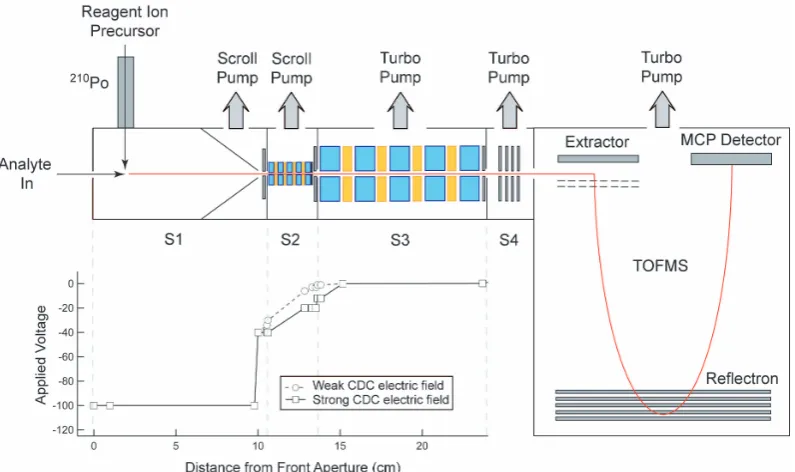
The CI-TOFMS consists of five differentially pumped stages as shown in Fig. 1. Here, ambient air is sampled through a critical orifice at 1.5 l min−1into the ion-molecule reaction (IMR) chamber. The first section of the stainless steel reac-tion chamber is 2.5 cm long and has an inner diameter (ID) of 3.5 cm. The second section of the IMR chamber is 5 cm in length, and is linearly tapered to reduce the ID to 0.6 cm at the exit. The IMR chamber is pumped by a 100 l min−1dry scroll pump (Varian SH-110), that is typically throttled down to achieve a sampling pressure of 85 mbar, however diagnos-tic experiments have been run in the pressure range of 20– 130 mbar. Reagent ions are introduced into the IMR chamber orthogonal to the sample flow at a flow rate of 2.0 l min−1, approximately 2 cm from the entrance orifice. In this ap-plication, acetate ions (CH3C(O)O−) are formed by passing trace acetic anhydride in ultra high purity (UHP) nitrogen (N2, 99.9995 %) through a commercial210Po alpha emitter (NRD, P-2021 EOL Ionizer), following the initial work of Veres et al. (2008). Under typical sampling conditions, the ion-molecule reaction time is of order 0.1 s in the IMR cham-ber. The entire IMR chamber, including the ionizer, is elec-trically isolated and biased to−100 V to facilitate efficient transport of ions to the entrance aperture of the second pump-ing stage.
Fig. 1. Schematic of the chemical ionization source and four stage (S1–S4) differentially pumped interface coupled to the time-of-flight mass spectrometer (TOFMS, 5×10⁻⁷mbar). The high pressure interface consists of: (i) ion-molecule reaction (IMR) chamber (S1, 85 mbar), (ii) collisional dissociation chamber (CDC) (S2, 2 mbar), (iii) stage 3 that houses a second RF-only segmented quadrupole (S3, 1.5×10⁻²mbar), and (iv) stage 4 that houses a series of DC optics that focus and accelerate the primary beam into the TOFMS (S4, 3.5×10⁻⁵mbar). DC voltages applied to the focusing electrodes under two different declustering conditions, are shown in the inset figure, as a function of the distance from the entrance aperture.
aperture is electrically biased to−40 V and followed by a weak electric field along the axis of the CDC quadrupole. The CDC electric field can be tuned to either transmit or dissociate weakly bound clusters with less than 10 % im-pact on the total ion throughput, as discussed below. The CDC pressure is controlled to 2 mbar by a 250 l min−1dry scroll pump (Varian TriScroll 300) that also serves as a back-ing pump for the split-flow turbo pump used in the down-stream, low-pressure stages. The focused ion beam exits the CDC through a 1 mm, electrically biased aperture into a sec-ond RF-only quadrupole, housed at 1.5×10⁻²mbar. The ion beam is then directed into the fourth stage of differential pumping, held at 3.5×10⁻⁵mbar, which houses a series of DC optics that focus and accelerate the primary beam into the orthogonal extraction, reflectron TOFMS (5.0×10⁻⁷mbar). The interface stages tailor the spatial and energetic profile of the primary ion beam to match the requirements of the OETOFMS. This work uses a compact TOFMS to achieve high sensitivity; the same ion source and interface is also suitable for higher resolution TOFMS platforms (Junninen et al., 2010). The second quadrupole chamber, the DC op-tics chamber, and the TOFMS are pumped by three isolated stages of a split flow turbo pump (Pfeiffer), with speeds of 20, 155, and 200 l s−1, respectively. The compact TOFMS has an effective ion path length of approximately 0.5 m, and is configured for analysis of positive or negative ions. Typical
extraction frequencies in this work were on the order of 15 µs (66 kHz), corresponding to a recorded m/Q range of 0–200 thomson (Th, 1 Th = 1 u e−1). In its current configu-ration, the CI-TOFMS, excluding the two scroll pumps and power supplies, is contained within a 50 cm×40 cm×40 cm frame, permitting it to be deployed to a wide range of sam-pling platforms.
2.2 Data acquisition and signal quantification
1474 T. H. Bertram et al.: A field-deployable, chemical ionization time-of-flight mass spectrometer ion signals observed in this system without compensating
the system’s ability to accurately record low intensity sig-nals. Accurate recording of small signals is further enhanced by the noise-suppression-accumulation functionality of the AP240 ADC, which discards digitized samples having inten-sity below a user-defined threshold, prior to averaging of data in the ADC memory.
Areas of ion peaks in digitized mass spectra are converted to units of ions s−1 by normalization, using a value repre-senting the TOFMS response to single-ion detection events. To measure this value, data are recorded with the TOFMS extraction electrodes held at 0 V. Under these conditions, the MCP detector detects randomly scattered ions at a low rate. Ion events are distinguished from electronic noise based on a user-adjusted threshold. An average single-ion detection peak shape is established based on a collection of recorded events (typically thousands), and the area of this “single ion signal” is used for calibrating the intensity of MS data. Data are saved as Hierarchical Data Format Version 5 (HDF5) files (HDF Group, Champaign, IL, www.hdfgroup.org). For each averaged MS written to disk, two data structures are stored: a time-of-flight spectrum having units of accumulated signal intensity versus ion time-of-flight and a list of summed areas for user-defined regions of the mass spectrum, called “peak data”. The TOF spectrum can be calibrated in post process-ing and used for exact mass analysis and/or peak integration, whereas the peak data contains the result of the peak inte-gration, based on the mass calibration established at the time the data were recorded. In this work, peak data summation regions were centered on integer m/Q values, with width suf-ficient to capture all ions of equal nominal mass. For the remainder of this manuscript we report ion count rates as “unit mass resolution” (UMR) peak areas. Fitting peaks in the mass-calibrated TOF spectrum allows determination of exact m/Q, whereas integration to UMR peaks (as illustrated in Fig. 3) enables quantification, assuming no interferences. 2.3 Ion chemistry
Here, we report the application of the CI-TOFMS toward the selective detection of formic acid via negative-ion pro-ton transfer, using acetate as the reagent ion. We note that acetate ion chemistry has been shown to be effective in the selective detection of a wide array of both organic and in-organic acids (Roberts et al., 2010), and while not specifi-cally addressed here, it is expected that the CI-TOFMS de-scribed here has the capability to measure other acids as well. Acetate ions have been shown to react selectively with acids having a gas-phase acidity larger than that of acetic acid (1G= 341.5 kcal mol−1) (Veres et al., 2008). As dis-cussed in Graul et al. (1990) the ion-molecule reaction pro-ceeds through either proton transfer from the target acid to the reagent ion (Reaction R1) or adduct formation (Reac-tion R2).
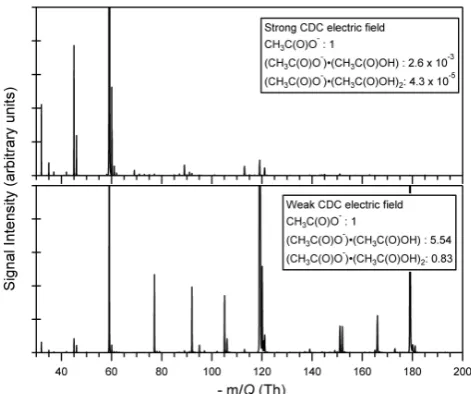
Fig. 2. Sample mass spectrum taken at 2 Hz on ambient air using the two declustering schemes shown in Fig. 1b. In a strong CDC electric field, acetate ions are primarily observed as bare ions (top), while in a weak CDC electric field acetate can be observed in sig-nificant quantities in both the (CH3C(O)O−)·(CH3C(O)OH) clus-ter (−119.034 Th) and the (CH3C(O)O−)×(CH3C(O)OH)2 clus-ter (−179.055 Th) (bottom). The ratio of the cluster ion count rate to the bare ion count rate is shown in the figure legend.
CH3C(O)O− +HX−→ CH3C(O)OH+X− (R1) CH3C(O)O− +HX−→ CH3C(O)O−(HX) (R2) The branching ratio between these two product chan-nels is likely dependent on the pressure and reaction time in the IMR region, however we note that under the sampling conditions used here (PIMR= 20–100 mbar,
Fig. 3. Negative ion CI-TOFMS mass spectrum, acquired at 2 Hz using acetate (CH3C(O)O−) reagent ions. The spectrum was taken on ambient air measured aboard the R/V Atlantis during the CalNex Campaign in May 2010. Inset figure Formic and nitrous acid peaks, observed at−44.99 Th and−45.99 Th, respectively. The yellow shaded region represents the UMR peak integration window, and the grey shaded region the background determination window. The resolving power (M/1M) at−44.99 Th is 900 Th Th−1.
from higher order acetate-acetic acid clusters. In contrast, at weak electric field strength, reagent ions are observed primarily as (CH3C(O)O−)·(CH3C(O)OH) (−119.034 Th), with substantial contributions from both the bare acetate ion and higher order clusters. It is important to note that the total ion count rate for reagent species (3.0×10⁷ions s−1) in this experiment was conserved (to within 10 %) between the two choices of CDC electric field, demonstrating the ef-ficient transfer, extraction, and detection of weakly bound ion-molecule clusters.
2.4 Field operation
The CI-TOFMS, operated as a negative ion proton transfer system, was deployed aboard the Research Vessel (R/V)
At-lantis as part of the CalNex field campaign in the spring
of 2010. Data were collected for 25 days off the coast of California. In the following sections we describe the perfor-mance of the CI-TOFMS under operating conditions charac-teristic of atmospheric sampling, concentrating specifically on instrumental response to formic acid (HC(O)OH). We as-sess the CI-TOFMS performance using formic acid, due to the availability of an accurate and stable calibration source. Ambient observations of the complete suite of detectable acids and a detailed discussion of inlet sampling conditions will be described in a second, separate manuscript that is in preparation. For the duration of the field campaign, MS data were acquired for the negative m/Q range 10–200 Th and saved at a rate of 2 Hz. The system was operated at the pressures depicted in Fig. 1 and with a strong CDC electric
field (−80 V cm−1). A representative ambient mass spec-trum is shown in Fig. 3, where signal associated with hy-drochloric, formic, nitrous, nitric, as well as a host of or-ganic acids are readily apparent. Acquisition of the com-plete spectrum is advantageous for atmospheric observations, as it permits simultaneous measurement of many molecules, including those with unrecognized importance at the time of measurement. The acetate reagent ion count rate during CalNex, determined as UMR peak−59 Th, was on average 3.0×10⁷ions s−1. Detrimental ringing is not observed fol-lowing the large reagent ion peak at−59 Th. While the sig-nal from this peak does have a measurable falling edge tail (scattered ions), it does not prevent us from observing ions at −60 Th. The baseline count rate at −60 Th, calculated from the tail of the reagent ion peak at−59 Th, was less than 1000 ions s−1, indicating that electronic or chemical noise as-sociated with high reagent count rates has little impact on detection at adjacent masses.
2.5 Mass resolving power and mass accuracy
1476 T. H. Bertram et al.: A field-deployable, chemical ionization time-of-flight mass spectrometer al., 2006), is attributed to the less energetic beam
gener-ated by the high-pressure chemical ionization source and in-terface. As an example of what this resolving power en-ables, at −45 Th, this instrument can resolve ions differ-ing by more 0.04 Th (45 Th/1100). It cannot, for instance, resolve the deprotonated carbon-13 isotopologue of formic acid (−46.001 Th) and nitrous acid (−45.993 Th), which dif-fer by only 0.008 Th. As discussed earlier, this work chose the compact TOF platform for its speed and sensitivity. The same design can easily be adapted for use with the Tofwerk HTOF platform, which has higher resolution but lower sensi-tivity. The mass accuracy was determined as the deviation in the observed peak center from the expected exact mass for a series of peaks not used in the mass calibration. The relative mass accuracy for data obtained during CalNex was less than 0.1 mTh Th−1(<100 ppm).
3 Results and discussion
3.1 Sensitivity and absolute accuracy
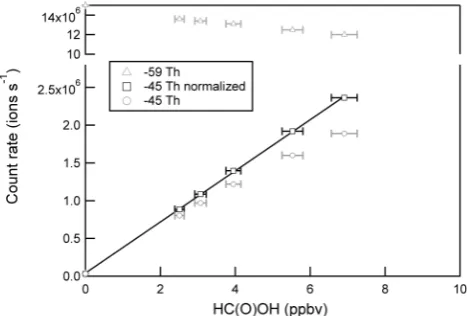
The sensitivity of the CI-TOFMS to formic acid was as-sessed by direct calibration of the instrument response to known concentrations of formic acid carried in UHP zero air. Atmospherically relevant concentrations of formic acid (0–10 ppbv) were produced by mixing UHP zero air with 10 cm3min−1N2that was passed over a gravimetrically cal-ibrated permeation tube (Kin-Tek, SRT-2, 21.6 ng min−1at 50◦C). The permeation tube, housed in a PFA Teflon tube, was contained in an insulated aluminum block, temperature controlled to 50±0.1◦C by a PID temperature controller (Omega, model CNi16). The absolute accuracy of the CI-TOFMS technique is driven primarily by uncertainty in the emission rate of the permeation tube standard. We estimate, conservatively, that this is 20 %, based on ion chromatogra-phy analysis. Instrument response to formic acid was mea-sured as the UMR peak at −45 Th, and was observed to be a linear function of the delivered formic acid concentra-tion up to approximately 1 ppbv, where titraconcentra-tion of the ac-etate reagent ions led to decreased sensitivity. The observed count rate at −45 Th was normalized by the ratio of the reagent ion count rate in the absence of formic acid to that observed at each calibration step.The normalized sensitivity of the CI-TOFMS towards formic acid, as shown in Fig. 4, was observed to be 338 ions s−1pptv−1. Similar to Veres et al. (2008) we do not observe a humidity dependence in the sensitivity. In Fig. 4, both the measured and normalized count rate at−45 Th and the reagent ion count rate at−59 Th are shown as a function of the formic acid concentration. 3.2 Limit of detection
The detection limit of the CI-TOFMS is a strong function of the magnitude and variability in the instrument zero. In the
Fig. 4. Normalized calibration to formic acid (detected as HC(O)O−at−45 Th). Both the measured (gray circles) and nor-malized (black squares) count rate at−45 Th and the reagent ion count rate at−59 Th (gray triangles) are shown as a function of the formic acid concentration.
following section, we assess the detection limit during rou-tine atmospheric sampling for the field deployable system as operated aboard the R/V Atlantis during CalNex. The CI-TOFMS response at−45 Th, while sampling UHP zero air, was routinely 3×10⁴ions s−1 (100 pptv). The high back-ground concentration is attributed to a steady flux of formic acid from the inlet manifold, and can be reduced to less than 3×10³ions s−1(10 pptv) in laboratory measurements. The background count rate for peaks not associated with trace acids is routinely observed to be less than 10 ions s−1, indi-cating that the formic acid background is not related to elec-tronic noise in the TOFMS.
Assuming that random uncertainty in the observed counts follows Poisson statistics, the uncertainty in the signal and background count rate should be equivalent to the square root of the count rate, and thus the signal-to-noise ratio can be expressed as:
S
N =
Cf[X]t
√
Cf[X]t +2B t (1)
whereB is the background count rate, Cf is the calibration factor, [X] is the mixing ratio, andt is the integration time. Using the measured calibration factor of 338 ions s−1pptv−1, and a background count rate of 3×10⁴ions s−1, we calculate a detection limit of 3 pptv, for 1-s averaging, for a signal-to-noise ratio of 3.
Fig. 5. Frequency distributions of ion count rate at−45 Th of 1 Hz data taken from 5 min sampling periods while sampling zero air, clean marine air, and polluted air aboard the R/V Atlantis.
the calculated detection limit, we report the 3σ uncertainty of 23 pptv for the collection of all background determina-tions made over the course of a 24 h sampling period. In most cases, uncertainty in the background count rate varies slowly in time and an accurate representation of the uncer-tainty can be taken as the 3σ uncertainty of successive zero determinations. To illustrate this point, we sample UHP zero air for 5 min and calculate the 3σ uncertainty in the zero de-termination, from a Gaussian fit to the observations. At the background count rate measured here (3×10⁴ions s−1), the variability in the background can be assessed using Gaus-sian statistics, as there is little difference between GausGaus-sian and Poisson statistics at high count rates. For measurements made during CalNex, we calculate a 3σ and 10σ value of 4 pptv and 13 pptv, respectively (for 1-s averages). The 3σ
value of 4 pptv is representative of our measurements dur-ing CalNex, and indicates that if we were to characterize the background at five-minute intervals during field obser-vations, a detection limit of 4 pptv (with 1-s averaging) can be achieved. For comparison, the distribution of measured count rates for five minutes of sampling in both remote and polluted air masses are shown in Fig. 5, indicating that the detection limit is well below the atmospheric abundance of formic acid even in pristine conditions. The concentrations reported in Fig. 5, for clean marine air (50–100 pptv) and off-shore pollution (650–850 pptv) are within the range of val-ues reported in the literature for measurement of formic acid concentrations in urban areas (1–10 ppbv) and remote con-tinental and marine areas (<1 ppbv) (Grosjean et al., 1990; Keene et al., 1989; Paulot et al., 2011; Veres et al., 2008). At present, the formic acid detection limit is limited by the magnitude and variability in the background. We are focus-ing our current efforts on reducfocus-ing this and expect that future versions of the instrument will have significantly improved detection limits as a result.
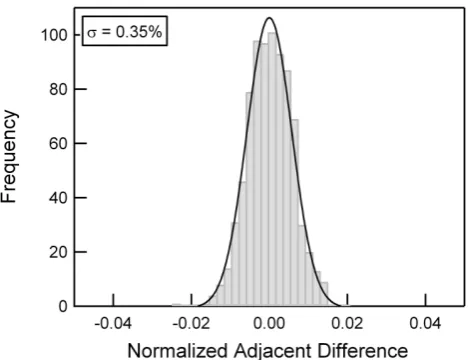
Fig. 6. Distribution of normalized adjacent differences, as measured on a formic acid concentration of 2.3 ppbv at 1 Hz, yielding an upper limit to the instrument precision (1σ) of 0.35 % at 2.3 ppbv.
3.3 Short and long term precision
To assess the short-term precision of the CI-TOFMS, we cal-culate the normalized difference between adjacent points for 15 min of measurement at 1 Hz, at a constant formic acid concentration via Eq. (2).
NAD = [X]n −[X]n−1 p
[X]n [X]n−1 (2)
1478 T. H. Bertram et al.: A field-deployable, chemical ionization time-of-flight mass spectrometer
Fig. 7. Dependence of instrument short-term precision on the mea-sured ion count rate.
(Fig. 7). As shown in Fig. 7, the 1σ short-term precision in the CI-TOFMS is better than 5 % for count rates associated with formic acid concentrations of 1 pptv or higher.
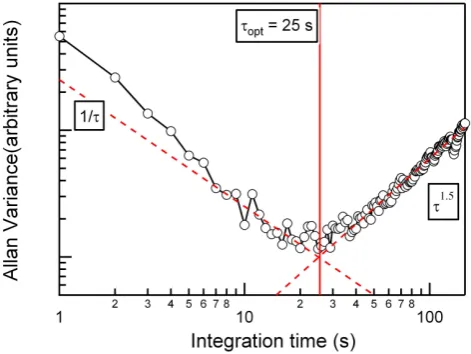
In theory, detection limits can be improved by signal aver-aging, where the signal-to-noise ratio increases as the square root of the integration time (Eq. 1). However, instrumental drift, in background or calibration factors, can often become significant on timescales shorter than the desired averaging time. The timescale for which averaging no longer improves signal-to-noise can be determined through calculation of the Allan variance (Werle et al., 1993). The Allan variance was calculated using the normalized count rate at−45 Th from 15 min of continuous sampling on a constant formic acid mixing ratio. Here, the count rate was normalized by the ratio of the reagent ion count rate in the absence of formic acid to that observed at this specific formic acid concentra-tion. This analysis shows that the optimal integration time is 25 seconds, leading to a detection limit of 0.5 pptv within 25 s (Fig. 8).
4 Conclusions
We report a new field-deployable, chemical ionization time-of-flight mass spectrometer. Instrument performance was as-sessed using acetate ion chemistry, with application to the selective detection of formic acid. The instrument as cur-rently packaged is compact enough to be deployed to a broad range of sampling platforms, as demonstrated here through measurements obtained aboard the R/V Atlantis off the coast of California. We show that the CI-TOFMS, as configured is sensitive (>300 ions s−1pptv−1) and precise (5 % at 1 pptv), leading to a 3σ detection limit of 4 pptv (1 s averages). The detection limit of the current version of the CI-TOFMS is limited by the magnitude and variability in the background
Fig. 8. Allan variance plot, calculated using the normalized count rate at−45 Th, from 15 min of continuous 1 Hz sampling on the formic acid calibration standard. At low integration times, white noise is the dominate source of drift.
determination. The sensitivity, detection limit, and time re-sponse reported here, suggests that the CI-TOFMS will likely be capable of measuring trace gas fluxes of a host of com-pounds simultaneously via eddy correlation techniques. Ap-plication of CI-TOFMS to the detection of other inorganic and organic acids, as well as the use of different reagent ion molecules (e.g. I−, CF3O−, CO−3) is promising, as we have demonstrated efficient transmission and detection of both bare ions and their associated ion-molecule clusters. Acknowledgements. We thank J. L. Jimenez for sharing laboratory space during the testing of the initial CI-TOFMS prototype. Development efforts at ARI were supported by DOE and NOAA, grants DE-SC0004577 and NA09AR4310125, respectively.
Edited by: E. C. Apel
References
Berresheim, H., Elste, T., Plass-Dulmer, C., Eisele, F. L., and Tan-ner, D. J.: Chemical ionization mass spectrometer for long-term measurements of atmospheric OH and H2SO4, Int. J. Mass Spec-trom., 202(1–3), 91–109, 2000.
Blake, R. S., Whyte, C., Hughes, C. O., Ellis, A. M., and Monks, P. S.: Demonstration of proton-transfer reaction time-of-flight mass spectrometry for real-time analysis of trace volatile organic compounds, Anal. Chem., 76(13), 3841-3845, 2004.
Blake, R. S., Wyche, K. P., Ellis, A. M., and Monks, P. S.: Chem-ical ionization reaction time-of-flight mass spectrometry: Multi-reagent analysis for determination of trace gas composition, Int. J. Mass Spectrom., 254(1–2), 85–93, 2006.
Ennis, C. J., Reynolds, J. C., Keely, B. J., and Carpenter, L. J.: A hollow cathode proton transfer reaction time of flight mass spectrometer, Int. J. Mass Spectrom., 247(1–3), 72-80, 2005. Farmer, D. K. and Jimenez, J. L.: Real-time Atmospheric
Chem-istry Field Instrumentation, Anal. Chem., 82(19), 7879–7884, 2010.
Graul, S. T., Schnute, M. E., and Squires, R. R.: Gas-Phase Acidi-ties of Carboxylic-Acids and Alcohols from Collision-Induced Dissociation of Dimer Cluster Ions, Int. J. Mass Spectrom., 96(2), 181–198, 1990.
Graus, M., Muller, M., and Hansel, A.: High Resolution PTR-TOF: Quantification and Formula Confirmation of VOC in Real Time, J. Am. Soc. Mass Spectrom., 21(6), 1037–1044, 2010.
Grosjean, D., Tuazon, E. C., and Fujita, E.: Ambient Formic-Acid in Southern-California Air – a Comparison of 2 Meth-ods, Fourier-Transform Infrared-Spectroscopy and Alkaline Trap Liquid-Chromatography with UV Detection, Environ. Sci. Tech-nol., 24(1), 144–146, 1990.
Guilhaus, M., Selby, D., and Mlynski, V.: Orthogonal acceleration time-of-flight mass spectrometry, Mass Spectrom. Rev., 19(2), 65–107, 2000.
Hearn, J. D. and Smith, G. D.: A chemical ionization mass spec-trometry method for the online analysis of organic aerosols, Anal. Chem., 76(10), 2820–2826, 2004.
Huey, L. G.: Measurement of trace atmospheric species by chem-ical ionization mass spectrometry: Speciation of reactive nitro-gen and future directions, Mass Spectrom. Rev., 26(2), 166–184, 2007.
Huey, L. G., Hanson, D. R., and Howard, C. J.: Reactions of SF−6 and I−with Atmospheric Trace Gases, J. Phys. Chem., 99(14), 5001–5008, 1995.
Jordan, A., Haidacher, S., Hanel, G., Hartungen, E., Mark, L., Seehauser, H., Schottkowsky, R., Sulzer, P., and Mark, T. D.: A high resolution and high sensitivity proton-transfer-reaction time-of-flight mass spectrometer (PTR-TOF-MS), Int. J. Mass Spectrom., 286(2–3), 122–128, 2009.
Junninen, H., Ehn, M., Pet¨aj¨a, T., Luosuj¨arvi, L., Kotiaho, T., Kos-tiainen, R., Rohner, U., Gonin, M., Fuhrer, K., Kulmala, M., and Worsnop, D. R.: A high-resolution mass spectrometer to mea-sure atmospheric ion composition, Atmos. Meas. Tech., 3, 1039– 1053, doi:10.5194/amt-3-1039-2010, 2010.
Keene, W. C., Talbot, R. W., Andreae, M. O., Beecher, K., Berresheim, H., Castro, M., Farmer, J. C., Galloway, J. N., Hoff-mann, M. R., Li, S. M., Maben, J. R., Munger, J. W., Norton, R. B., Pszenny, A. P., Puxbaum, H., Westberg, H., and Winiwarter, W.: An Intercomparison of Measurement Systems for Vapor and Particulate Phase Concentrations of Formic and Acetic-Acids, J. Geophys. Res.-Atmos., 94(D5), 6457–6471, 1989.
Kercher, J. P., Riedel, T. P., and Thornton, J. A.: Chlorine activation by N2O5: simultaneous, in situ detection of ClNO2and N2O5 by chemical ionization mass spectrometry, Atmos. Meas. Tech., 2, 193–204, doi:10.5194/amt-2-193-2009, 2009.
Mielke, L. H., Erickson, D. E., McLuckey, S. A., Muller, M., Wisthaler, A., Hansel, A., and Shepson, P. B.: Development of a Proton-Transfer Reaction-Linear Ion Trap Mass Spectrometer for Quantitative Determination of Volatile Organic Compounds, Anal. Chem., 80(21), 8171–8177, 2008.
Morrison, G. C. and Howard, C. J.: Selective detection of gas-phase aldehydes and ketones using protonated hydrazine, Int. J. Mass
Spectrom., 210(1–3), 503–509, 2001.
M¨uller, M., Mielke, L. H., Breitenlechner, M., McLuckey, S. A., Shepson, P. B., Wisthaler, A., and Hansel, A.: MS/MS stud-ies for the selective detection of isomeric biogenic VOCs us-ing a Townsend Discharge Triple Quadrupole Tandem MS and a PTR-Linear Ion Trap MS, Atmos. Meas. Tech., 2, 703–712, doi:10.5194/amt-2-703-2009, 2009.
Paulot, F., Wunch, D., Crounse, J. D., Toon, G. C., Millet, D. B., DeCarlo, P. F., Vigouroux, C., Deutscher, N. M., Gonz´alez Abad, G., Notholt, J., Warneke, T., Hannigan, J. W., Warneke, C., de Gouw, J. A., Dunlea, E. J., De Mazi`ere, M., Griffith, D. W. T., Bernath, P., Jimenez, J. L., and Wennberg, P. O.: Im-portance of secondary sources in the atmospheric budgets of formic and acetic acids, Atmos. Chem. Phys., 11, 1989–2013, doi:10.5194/acp-11-1989-2011, 2011.
Prazeller, P., Palmer, P. T., Boscaini, E., Jobson, T., and Alexander, M.: Proton transfer reaction ion trap mass spectrometer, Rapid Commun. Mass Sp., 17(14), 1593–1599, 2003.
Roberts, J. M., Veres, P., Warneke, C., Neuman, J. A., Washen-felder, R. A., Brown, S. S., Baasandorj, M., Burkholder, J. B., Burling, I. R., Johnson, T. J., Yokelson, R. J., and de Gouw, J.: Measurement of HONO, HNCO, and other inorganic acids by negative-ion proton-transfer chemical-ionization mass spectrom-etry (NI-PT-CIMS): application to biomass burning emissions, Atmos. Meas. Tech., 3, 981–990, doi:10.5194/amt-3-981-2010, 2010.
Slusher, D. L., Pitteri, S. J., Haman, B. J., Tanner, D. J., and Huey, L. G.: A chemical ionization technique for measurement of per-nitric acid in the upper troposphere and the polar boundary layer, Geophys. Res. Lett., 28(20), 3875–3878, 2001.
Steeghs, M. M. L., Sikkens, C., Crespo, E., Cristescu, S. M., and Harren, F. J. M.: Development of a proton-transfer reaction ion trap mass spectrometer: Online detection and analysis of volatile organic compounds, Int. J. Mass Spectrom., 262(1–2), 16–24, 2007.
Tanimoto, H., Aoki, N., Inomata, S., Hirokawa, J., and Sadanaga, Y.: Development of a PTR-TOFMS instrument for real-time measurements of volatile organic compounds in air, Int. J. Mass Spectrom., 263(1), 1–11, 2007.
Veres, P., Roberts, J. M., Warneke, C., Welsh-Bon, D., Zahniser, M., Herndon, S., Fall, R., and de Gouw, J.: Development of negative-ion proton-transfer chemical-negative-ionizatnegative-ion mass spectrometry (NI-PT-CIMS) for the measurement of gas-phase organic acids in the atmosphere, Int. J. Mass Spectrom., 274(1–3), 48–55, 2008. Warneke, C., de Gouw, J. A., Lovejoy, E. R., Murphy, P. C.,
Kuster, W. C., and Fall, R.: Development of proton-transfer ion trap-mass spectrometry: On-line detection and identification of volatile organic compounds in air, J. Am. Soc. Mass Spectrom., 16(8), 1316–1324, 2005.
Werle, P., Mucke, R., and Slemr, F.: The Limits of Signal Averaging in Atmospheric Trace-Gas Monitoring by Tunable Diode-Laser Absorption-Spectroscopy (TDLAS), Appl. Phys. B-Photo., 57(2), 131–139, 1993.