Chinese Text Zero-Watermark Based on
Three-dimensional Space Model
Yingjie Meng
School of Information Science & Engineering, Lanzhou University, Lanzhou, China Email: [email protected]
Liming Gao
School of Information Science & Engineering, Lanzhou University, Lanzhou, China Email: [email protected]
Mingwen Liu
School of Information Science & Engineering, Lanzhou University, Lanzhou, China Email: [email protected]
Lixin Bai
School of Information Science & Engineering, Lanzhou University, Lanzhou, China Email: [email protected]
Abstract—Aiming at the limitation of existing Zero-Watermark algorithm in the copyright protection, a Chinese text Zero-Watermark scenario based on three-dimensional space model was proposed. In the scenario, the three-dimensional model was constructed by using the features of high frequency words, sentence length and its weights. Afterwards, the algorithm generates a watermark based on the text abstract-set which can be extracted later by comparing the distance of each sentence point with the centre of model. In case of any copyright conflict, the extraction algorithm extracts the abstract-set from the copyright disputes text again, and by calculating the semantic distance to define original copyright owner. Furthermore, the effectiveness and feasibility of the proposed algorithm was proved with algorithm simulation. The simulation results also showed that the algorithm had good robustness, especially for syntactic transfer, synonyms replacement and shear attacks occurring randomly.
Index Terms—Digital text; Copyrights Protection; Zero-watermark; Three-Dimensional Space
I. INTRODUCTION
With the widespread use of Internet and other communication technologies in recent years, the network delivery of novels, journals and documents in digital way is more and more popular. In addition to getting the benefits of information exchange, the digital community is confronted with authentication, forgery, and copyright protection issues. Most of this kind information can be categorized or directly converted to text formatting,
Causing them to be copied easily. Thus, how to protect the information effectively has attracted people's close attention, and text digital watermark technology are increasingly used to meet this challenge and identify the copyright.
Currently, research on the text digital watermark can be divided into two main categories. The traditional one belongs to embedded watermark in text image. Brassil, et al. first proposed a few text watermarking methods by changing the editorial format(shifting the words and sentences upwards and downwards) to embed watermark bits [1,2]. Later Maxemchuk and Low, et al [3,4,5] evaluated and analyzed the efficiency of above mentioned methods. Atallah and some others proposed syntactic watermark by using syntactic structure of text [6,7]. Another embed algorithm based on text meaning representation (TMR) string has also been proposed [8]. Although these treatments can protect the text, the watermark is embedded in the text will affect the value of original data. In this paper, we proposed the other algorithm called watermark. A typical zero-watermark divided in two processes: embedding algorithm and extraction algorithm. Watermark embedding is done by original author and extraction done later by Certifying Authority (CA) to prove ownership. This scheme does not change the feature of text, but utilize the characters of original text to construct watermark so that the value of original one can be well protected.
semantic and structural information, and it can not outstandingly express theme characteristic of the whole text content.
Based on the description of above, this article introduces three-dimensional space model to select the sentence-set that reflect the main feature of text, then calculate the similarity of the watermark by semantic distance, and on the basis of this, a text digital watermarking algorithm based on three-dimensional space model was proposed. The result of experiment shows that our scenario has greater ability of anti-attack and more robustness than other watermark scenarios.
This paper is organized as follows: The definition of the algorithm is given in section 2. Section 3 described the scheme design of watermark. The proposed embedding and extraction algorithm are illustrated in detail in section 4. Section 5 presents the experimental result on texts with random attacks. Performance of the proposed algorithm is analyzed with multiple attack volumes. The last section concludes the along with direction for future research.
II. DEFINITION
In order to construct and describe the watermarking scheme, we represent the T as the Chinese text to be protected and we will give some definitions and stipulations to illustrate the watermark scenario.
Definition 1 Word-set W, a set which comprises n words after trim punctuations, word segmentation and delete the stop-words and other useless information. Wi(1≤i≤n) is the ith word of W, Wi.data, Wi.freg, Wi.lengh, Wi.count1, Wi.count2, Wi.count3, Wi.weight respectively mean the value of Wi, word-frequency, word length, a ratio of the times of this word appears in the title, in the first-sentences, at the end of the paragraphs and weights.
The weight of word Wi.weight, it reflects the importance of word Wi in the text. Based on the idea of [11], we constructed formulas as described in (1).
a
1 1
10 ( 5 2 3 3 2)
c
i i
i
i i
i i i
W . freg W
W .weight = b
+W . freg +W
W .count1 W .count W .count n .lengh .lengh (1)
Among them, a, b and c are the proportionality factors, which used to indicated various factors in the proportion of wighted formula, and a+b+c=1.
Definition 2 Sentence-set S, a set which comprises m sentences after trim punctuations, Sj(1≤j≤m) is the jth sentences of T, Sj.data, Sj.lengh, Sj.num, Sj.weight, Sj.position respectively mean the value of Si, the number of words, the number of high frequency words, weights, and importance of the position of the sentence, among them, the value of Sj.position is :
1
j
j 1
m
S .position = j m
The weights of sentences Sj.position, it reflects Sj status of the entire text, which is the weight, location, length and other information of words contained in Sj.
The calculation formula as (2)
1
j j j jS .weight
S .lengh
S . position
+ S .lengh
i Wi weight max
wi sj
wi sj
W weight
.
.
Among them, α, β and γ are the proportionality factors, which used to indicated various factors in the proportion of wighted formula, and α+β+γ=1
Definition 3 π is threshold of high frequency words, namely the number of high frequency words selected from Text set.
Definition 4 Text focusO k k k( ,x y, z), is the centre of the text three-dimensional model, The calculation formula as (3)
1 1 1 1 1 1 m x jx i m y jy i m z jz i k S m k S m k S m
(3)Definition 5 ε is threshold of summary, namely the number of summary selected from Sentence-set.
Definition 6 Abstract-set Abs, is the set that containing ε summaries.
Definition 7 semantic distance distance(Si,Sj), show the sentence Si and Sj semantic distance, which is the calculation of two sentences on the content similarity, any two sentence Si and Sj semantic distance is defined as follows:
(S ) ( , )=1
(S ) (S )j
i j
i j
i
samewc ,S
distance S S
len len
(4) Among them, samewc(Si,Sj) is the same number of words in the two sentences. We count the less number when a word appear in Si is not the same as the number of Sj. Obviously, the sentence semantic distance between the range located in the interval [0,1], the greater the semantic distance, indicating that the difference in the content is larger.
Definition 8 ω is threshold of text similarity, namely the similar degree of text based on the semantic distance.
III. CHINESE TEXT ZERO-WATERMARK SCHEME DESIGN
A. The Three-Dimensional Space Model of Text
paper, therefore, we use sentence-level description, which will make text semantic understanding more detailed and accurate, at the same time, can better grasp text important characteristics.
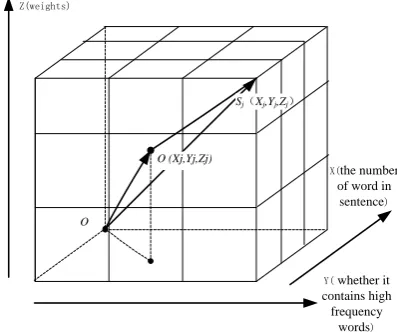
Using the length of sentence and whether it contains high frequency words of text as the two basic attributes of the text, On that basis, we can construct the three-dimensional space model Sj(Xj,Yj,Zj)of text T. As shown in Fig 1, the value of Y axis follow: No high frequency words in Sj, we take 0, while the number less than π, take 1, otherwise take 2.
According to the figure1, mapping all sentences of the text in this model can produce three-dimensional space model of entire text. After the structure, we can calculate the centre of this three-dimensional space model through the formula (3), which is the text focus, then calculate the distance of each sentence point Sj(Xj,Yj,Zj) to the centre of model, show as Disj ,finally generate distance-set Dis and select first ε sentences as the summaries from this set.
O
O (Xj,Yj,Zj)
Sj(Xj,Yj,Zj)
Y( whether it contains high frequency
words) X(the number
of word in sentence) Z(weights)
Figure 1. Three-dimensional space model of Sj
B. Structure of Test Zero-Watermarking
In order to reduce the amount of work and complexity of whole scenario, pre-process work for the text should be done firstly. Primary work of this part is to divide the text into sentences and words, so that we will get word-set W, and this specific method has been relatively mature, which was mentioned as in [12]. Considering our research focuses is the extraction and examination of zero-watermarking. So these work and its details are not discussed here.
Chinese text zero-watermarking in three-dimensional space model consists of two main components: the constructing and the detecting
1) structure of zero-watermarking
The structuring of zero-watermarking based on word-set W. Firstly, we constructed the three-dimensional space model of text T. Then calculate the distance of each sentence point to the centre of model, in order to selecting the abstract-set of text, and this set is used as watermark of text. Finally, we can introduce a third-party authoritative organization like Certifying Authority (CA)
to register watermark. According to the above parts, concrete construction process can be designed as Fig 2
text
C set Ωword- frequency wordextract high
caculate weight
generate 3D coordinate
find the centre of model selecting the
abstract-set of the text C
watermark encrypt
register
database register
archive
calculate the distance
constructthe space model of text
watermark construction extracting features Pre-processing
Figure 2. Construction process of text zero-watermark
2) detecting of zero-watermarking
Watermark detecting is to judge the watermark when copyright dispute appeared. Work of this part is similar to the constructing watermark, which also need to construct disputed-text’s watermark again, then calculate the similarity of disputed-text’s watermark and stored watermark by detecting algorithm in order to determine copyright ownership. The overview of watermark detecting is shown in Fig 3.
text C′
word-set Ω
extract high frequency word
caculate the weight
generate 3D coordinate
find the centre of model selecting the
abstract-set of the text C′
watermark
decrypt
Register database
calculate the distance
constructthe space model of text
copyright Judgment
secondary construction Pre-processing
caculate the simiarity
judg result
Figure 3. Detect process of text zero-watermark
IV. ALGORITHM OF WATERMARK CONSTRUCTION
Based on the description of above and Fig 2, the construct algorithm of text zero-watermark can be designed as followings. The algorithm conducts on the word-set W, The procedure of constructing watermark comprises three algorithms, including getting three-dimensional coordinates of sentences, extracting the summaries and generating watermark.
In the whole construction process of watermark, we can get three-dimensional coordinates of sentences according to the figure 1, the process can be divided into two phases:
1) Generating high-frequency words set; 2) Coordinate generation
Generating high-frequency words set is the most basic part of watermark construction, which is got by calculate the weights of each word in word-set. The algorithm Keyword-Select executes as following.
PROCEDURE Keyword-Select (W, π, a, b, c, KP) Input: T’ word-set W[1…m], threshold π, proportionality
factors a, b, c;
Output: high-frequency words set KP[1…π] BEGIN
FOR i←1 TO n DO
W[i].weight←a*W[i].freg/(1+W[i].freg)+b*W[i].le ngh/(1+W[i].lengh)+c*10* (W[i].count1*5
+W[i].count2*3+ W[i].count3*2)/n; Call Sort(W); //order W by W[i].weight descending FOR i←1 TOπ DO
KP[i] ←W [i] END
After the high-frequency words set KP was generated, we can construct three-dimensional space model of text, in this process, Let S[j].lengh, S[j].num represent the number of words in Sj and the number of high-frequency words. The X, Y and Z axis which stored by record array TS[1…m]. The data item TS[j].X, TS[j].Y, TS[j].Z represent the X, Y and Z axis of sentences Sj respectively. The specific algorithm is shown as following:
PROCEDURE Coordinate-Create (S, W, π, a, b, c, α, β, γ) Input: T’ word-set W[1…n], threshold π, proportionality
factors α, β, γ, high-frequency words set KP Output: a array stored 3d coordinates of sentences
TS[1…m] BEGIN
FOR j←1 TO m DO
[ i←1; S[j]. lengh←0; S[j].num←0; WHILE (i≤n) DO
[ IF (W[i].data∈S[j].data) THEN //Counting the number of words in Sj
S[j].lengh←S[j].num+1; IF (W[i].data∈KP [i].data THEN
//Counting the high-frequency words in Sj S[j].num←S[j].num+1;
i←i+1 ] ] FOR j←1 TO m DO [ //generate X axis
TS[j].X←S[j].lengh;
CASE
S[j].num=0: TS[j].Y←0; S[j].num=π: TS[j].Y←2; ELSE TS[j].Y←1; ENDCASE
//generate Z axis
sum←0; max←0; i←1;
WHILE (i≤n )and (W[i].data∈S[j].data) DO [ //calculate sum
sum←sum+ W[i].weight; IF (W[i].weight >max) THEN
// calculate max max←W[i].weight; // calculate max i←i+1; ]
S[j].position←2-j/m ; // calculate the weight of Sj
S[j].weight←α*sum/max+β*S[j].lengh/(1 + S[j].lengh) +γ*S[j].position TS[j].Z←S[j].weight ]
END
2) algorithm of extracting sumarries
After getting the three-dimensional coordinates of sentences, we calculate the centre of the three-dimensional space model, that is O k k k( ,x y, z) , then selecting the abstract-set Abs through calculating the distance between the each sentence point and
( ,x y, z)
O k k k , the process can be divided into two phases:
Generating the distance-set Dis;Abstract-set Abs getting. PROCEDURE abstract-create(S, TS[1…m], ε)
Input: a array stored 3d coordinates of sentences TS[1…m] Output: the Abstract-set
BEGIN
// calculate the text focus
1 1 m
x jx
i
k S
m
;1 1 m
y jy
i
k S
m
;1 1 m
z jz
i
k S
m
;// generate distance-set Dis FOR i←1 TO n DO
[ 2 2 2
i x y z
Dis .value (TS[i].X - k ) +(TS[i].Y - k ) +(TS[i].Z - k ) ; .
i
Dis indexi; ]
//order Dis by dis.value ascending Call sort(Dis)
FOR i←1 TO ε Do Abs[i] ←S[Disi.index];
END
3) algorithm of getting watermark
calling Coordinate-Create and abstract-create through the word-set W[1…n] and sentence-set S [1…m] generate the abstract-set Abs, in order to improve the security of the watermark, TS[1…m]is encrypted with SHA-1 encryption as in paper [13]. Encrypted watermarking information stored in the one-dimensional array List[1…m], and the algorithm Structuringis shown as following:
PROCEDURE Structuring (S, W, List, Key)
Input: sentence set S[1…m], word-set W[1…n], Key Output: watermark List[1…m]
BEGIN
// generate high-frequency words set CALL Keyword-Select (W, π, a, b, c); // generate 3d coordinates of sentences
CALL Coordinate-Create (S, W, π, a, b, c, α, β, γ); //generate abstract-set
CALL abstract-create (S, TS[1…m], ε); FOR j←1 TO ε DO
// use SHA-1 encryption List[j] ←SHA-1(Abs[j], Key); END
B. Watermark Detection
The watermark scenario is on the base of zero-watermark, so before detection for disputed-text T′, we still need to construct the watermark Abs′ again, and the procedure is similar to that of construction. The semantic distance of Abs′ and archived Abs are calculated in order to determine copyright ownership.
1) calculate similarity
The main work of similarity calculation is to calculate the similarity of disputed-text and the original one, and estimate whether the two watermarks are same to each other, which use the formula (4), and the algorithm Calculate-Similarity is shown as following:
PROCEDURE Calculate-Similarity (Abs, Abs′) Input: abstract-set Abs, Abs ′
Output: Similarity BEGIN
Similarity ← 0 ; For i←1 TO ε DO
[ len1= len(Absi);// get length of sentence len2= len(Abs′i);
samewc←0;
IF len1 >= len2 THEN For j←1 TO len2 DO
[ //if Abs′i has word in Absisamewc add 1 IF Abs′i[j] in Absi THEN
samewc++;[ ELSE
For j←1 TO len1 DO
[ //if Absi has word in Abs′isamewc add 1 IF Absi[j] in Abs′i THEN
samewc++;]
distance
1
samewc len
/ (
1
len
2)
;Similarity
Similarity + distance /
;] END2) watermark detection algorithm
Based on the similarity calculations mentioned above, the main process of detection algorithm detecting is described below
PROCEDURE Detecting (S′, W′, List, ω, Key) Input: disputed-text, S′, W′, List, threshold ω, Key Output: whether watermark can be detected BEGIN
// generate high-frequency words set
KP ′← CALL Keyword-Select (W′, π, a, b, c); // generate 3d coordinates of sentences
TS′←CALL Coordinate-Create (S′, W′, π, α, β, γ, KP′);
//generate abstract-set
Abs′←CALL abstract-create (S′, TS′[1…m], ε); //get Abs from Watermark
List←Watermark; FOR j←1 TO ε DO
// use SHA-1 decryption
Abs[j]←SHA-1-1(List [j], Key); //calculate the similarity
Similarity←Calculate-Similarity (Abs, Abs′) IF Similarity>ω THEN
Writeln(’ watermark exits.’) ELSE
Writeln(’no watermark’); END
V. EXPERIMENT AND PERFORMANCE ANALYSIS
In order to verify the feasibility and availability of the proposed model, we conducted a simulation experiment. The experimental environment is listed as below: CPU: Intel Core2 Duo E4600/2.80GHz, RAM: 1.0GB, Windows XP; language Visual C + + 6.0. Subjects: a word document named "The life of blue sky". The total word is 1382. The process for segmenting the text uses the algorithm of [14]. Relevant parameters for experimental are as follows: threshold of keywords π is set to 3, the similarity threshold ω set to 0.6, Based on the experiments in [11,12], we set proportionality factor a as1.5, b as 1.0, c as 0.8; α as 0.3, β as 0.3 and γ as 0.4. Firstly we discuss the threshold in this algorithm, then verify the robustness of watermark after implementing three most common attacks: syntactic transfer, synonym replacement, and modification, in order to test the performance of the algorithm.
A. The Impact of Summary Extraction Threshold on Watermark
The analysis about the watermark construction show that summary extraction threshold ε determine the robustness of watermark to a large extent. So, this experiment mainly analysis the influence of the threshold ε to the algorithm. The experiment use word document named "The life of blue sky". The total word is 1382.
represents the drawing of ε, the vertical axis represents similarity of text, similarity threshold ω set to 0.6.
0 0.1 0.2 0.3 0.4 0.5 0.6 0.7 0.8
2 4 6 8 10 12 14 16 18 20
Threshold of ε
Similarity
cut attack syntactic transfer synonym replacement
Figure 4. The Influence of summary extraction threshold on watermark
The three curves show that when text under the three attacks mentioned in the figure 4, the watermark detection level is rising with the increase of summary extraction threshold ε, when setting the summary extraction threshold ε as 6, watermark detection can achieve the best degree, higher than our default text similarity threshold 0.6. The watermark detection level presents the downward trend after the threshold ε increased further. So we set the topic paragraph to 6.
B. Syntactic Transfer Attack
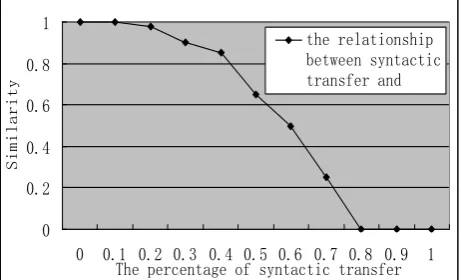
Syntactic transfer is one of the most frequent text attacks, such as the conversion between the two sentences turns active into passive, bring words to the preposition and tenses changes. When text received such attack, the relationship between watermark existence and converted text is shown as Fig 4.
0 0.2 0.4 0.6 0.8 1
0 0.1 0.2 0.3 0.4 0.5 0.6 0.7 0.8 0.9 1 The percentage of syntactic transfer
Similarity
the relationship between syntactic transfer and watermark
Figure 5. Watermark detection rate on syntactic transfer attack
From the fig 5 we can see that to the whole text, when sentences of the text has been syntactic transformed is equal or below 20%, the watermark existence rate can reach 100%, when the transform rate in the text equal to 50%, this algorithm can still maintain 60% of the watermark extraction rate. However, with the transform rate beyond 50%, the text will gradually lose its value. Based on the description of above, the algorithm has good robustness under the syntactic transformed attack.
C. Anti-attack Test
When use synonyms to replace part of the text words, the experimental results are shown below, synonyms used in the experiment are generated by the natural language processing technology. The result of the experiment is shown as Fig 6.
0.6 0.65 0.7 0.75 0.8 0.85 0.9 0.95 1
0 0.2 0.4 0.6 0.8 1
The percentage of synonyms replace
Similarity
this paper reference 10
Figure 6. Watermark detection rate comparison on the synonyms replace attack
It can be seen from Fig 6, when synonym replace rate beyond 20%, this algorithm is superior to the algorithm of [10], especially, when the replacement rate exceeds 60%, the watermark existing probability is over 85%, it can still extract the zero-watermark effectively. According to this, under the synonym replace attack, our watermark detection algorithm efficiency has been significantly improved when compared with reference [10].
D. Robust Test
Robustness is an important index of watermark, the strength of the robustness directly influence the performance and the application of the watermarking algorithm, we use the text modification as an example for robustness analysis.
1) Modification Attack
In this experiment, modification divided into two types: insertion and deletion, we used 3 samples of different size text from data set designed in [15] to perform our experiments, these samples have been collected from Center for Chinese Linguistics PKU.
Insertion and deletion of data was performed at multiple randomly selected locations in text. Text category divided into 4 sizes: Small Size Text(SST), Medium Size Text(MST), Large Size Text(LST) and Very Large Size Text(VLST) respectively. Each sample was attacked with different insertion and deletion volume.
TABLE I.
THE ACCURACY OF WATERMARK
WITH INSERTION, DELETION RE-ARRANGING OF WORDS ATTACK
Text Category
Original Text
Watermark Accuracy under 3 ATTACKS
ATTACKS Volume Insertion Deletion
re-arranging of words
SST 283
98.3% 97.2% 96.7% 5%
96.5% 95.8% 94.2% 10%
88.6% 89.3% 84.2% 20%
78.2% 76.9% 75.4% 50%
MST 549
94.8% 96.5% 95.4% 5%
95.2% 94.8% 93.6% 10%
88.7% 85.3% 84.2% 20%
75.6% 72.2% 71.3% 50%
LST 1089
98.1% 97.8% 95.4% 5%
95.8% 96.2% 91.2% 10%
85.3% 82.4% 81.6% 20%
77.2% 70.3% 75.4% 50%
VLST 4216
97.6% 93.4% 89.4% 5%
83.2% 90.4% 89.6% 10%
78.1% 82.4% 79.3% 20%
76.2% 75.8% 75.1% 50%
As is shown in table 1, we can see that the accuracy of extracted watermark is always greater than 70%, and Small Size Text(SST) has the best performance with small attack volumes. For MST, it can be observed that watermark sensitive toward insertion attack.
In case of LST sample, the accuracy of extracted watermark is maximum in deletion attack and minimum under re-arranging attack.
Similarly, it can be seen from the table 1 that the VLST is more resilient towards different towards 3 different attacks since the accuracy is always above 75%.
In general, from the table 1 we can clearly see that our algorithm make a good performance under these modification attack.
2) Comparative Test
In order to further proof the algorithm presented in this paper has the good robustness, we carried out the comparative trial with reference [10]. The experiment use word document named "The life of blue sky". The total word is 1382. Comparison diagram of the experimental results is shown in Fig 7.
0 0.1 0.2 0.3 0.4 0.5 0.6 0.7 0.8 0.9 1
this paper reference10 Attack Volume
Robustness
10%insertion 20%insertion 50%insertion
0 0.1 0.2 0.3 0.4 0.5 0.6 0.7 0.8 0.9 1
this paper reference10 Attack Volume
Robustness
10%deletion 20%deletion 50%deletion
0 0.1 0.2 0.3 0.4 0.5 0.6 0.7 0.8 0.9 1
this paper reference10 Attack Volume
Robustness
10%re-arranging 20%re-arranging 50%re-arranging
Figure 7. Comparision of robustness
It can be seen from Fig 7, robustness factor of watermark decreased with the text changes increasing. With different insertion, deletion and re-arranging of words attack volumes, this performance of algorithm in this paper is superior to the algorithm of [10]. Especially under re-arranging of words attack my algorithm has a significant advantage over the reference [10]. In practice, if a text has been modified more than 50% of the content, the text gradually lost its protective value. Therefore, the above two robust experiments show that this algorithm in robustness has certain advantages.
VI. CONCLUSION
construction. Finally, the experiment evaluate and analyze the performance of the proposed algorithms under three different attacks with increasing attack volume. In comparison with other existing algorithms, our method has the better robustness and anti- aggressiveness.
In the further work, we can improve the final similarity calculation algorithm to make it more effective and our result will be improved at the same time. Moreover, our next step is to search a better method of extracting the semantic feature of text, so as to produce a more reasonable and general method to construct the abstract-set.
REFERENCES.
[1] J. T. Brassil, S. Low, N. F. Maxemchuk, and L. O’Gorman, “Electronic Marking and Identification Techniques to Discourage Document Copying,” IEEE Journal on Selected Areas in Communications, vol 13, no. 8, October 1995, pp. 1495-1504.
[2] J. T. Brassil, S. Low, N. F. Maxemchuk, “Copyright protection for the election distribution of text document”. Proceeding of IEEE, vol. 87, no. 7, July 1999, pp. 1181-1196
[3] N. F. Maxemchuk, S. H.Low. “Performance Comparision of Two Text Marking Methods,” IEEE Journal of Selected Areas in Communication(JSAC), May 1998. vol. 16 no. 4 1998. pp. 561-572.
[4] N. F. Maxemchuk, “Electronic Document Distribution,” AT&T Technical Journal, September 1994, pp. 73-80.6.
[5] S. H.Low, N. F. Maxemchuk, and A. M. Lapone, “Document Identification for Copyright Protection Using Centroid Detection,” IEEE Transactions on Communications, Mar. 1998, vol. a5, no. 3, pp. 372-381
[6] M. J. Atallah, C. McDonough, S. Nirenburg, and V. Rakin, “Natural Language Pricessing for Inmation Assurance and Security: An Overview and Implementations”, Proceedings 9th ACM/SIGSAC New Security Paradigms Workshop, September, 2000, Cork, Ireland, pp. 51-65.
[7] M. J. Atallah, V. Raskin, M. C. Crogan, C. F. Hempelmann, F. Kerschbaum, D. Mohamed, and SNaik, “Natural language watermarking: Design, analysis, and proof-of-concept implementation”, Proceedings of the Fourth Information HidingWorkshop, vol. LNCS 2137, 25-27 April 2001, Pittsburgh, PA.
[8] P. Lu et al. “An optimized natural language watermarking algorithm based on TMR”, on proceedings of 9th International Conference for Young Computer Scientists, 2009.
[9] Meng Yingjie, Si Lei, ShiYao, “A Chinese Texts Zero-Watermarking Algorithm Based on Vector Graphics”. Journal of Computer Research and Development, 2009, Vol. 46(supp).22-26.
[10] Meng Yingjie, Guo Tao, Guo Zhihua, Gao Liming. “Chinese Text Zero-watermrk Based on Sentence's Entropy”. ICMT2010: proceedings of the International Conference on Multimedia Technology, IEEE Computer Society, 864-867.
[11] Yanling Li, Jing Yuan; Xia Ye, “Method for Feature word weight caculating,” on proceeding of Intelligent Computing and Intelligent Systems, ICIS 2009, PP:309-312.
[12] Kai-Ying Liu, Jia-Heng Zheng, “Research of automatic Chinese word Segmentation,” on proceeding of Machine Learing and Cybernetics, ICMLC 2002, vol2, PP:805-809.
[13] Guoping Wang. An Efficient Implementation of SHA-1 Hash Function. In IEEE International.Conference on Electro/information Technology, 2006, PP:575–579.
[14] Sun X M, Luo G, Huang H J. Component-based digitial watermarking of Chinese texts[C]. Shanghai: Proc of the Third International Conference on Information Security, 2004: 76-81
[15] Z. Jalil and A. M. Mirza, “A Novel Text Watermarking Algorithm Based on Double Lettle”, International Journal of Computer Mathematics.
Yingjie Meng born in 1964, Shanxi, China. He is currently a associate professor in LanZhou University. So far, he was published more than 20 papers in international conference proceedings and journals. His main research interests include data security, information processing.
Liming Gao born in 1986, Gansu, China. She is currently pursuing the M.S degree in LanZhou university. Her main research interests include data security, information processing.
Mingwen Liu born in 1987, Gansu, China. He is currently pursuing the M.S degree in LanZhou university. His main research interests include data security.