ANALYTICAL RP-HPLC METHOD FOR DEVELOPMENT AND
VALIDATION OF CITICOLINE SODIUM AND
METHYLCOBALAMIN IN
COMBINED TABLET FORMULATION
SHWEA D. SINGH*, FALGUN A. MEHTA1, DIMAL A. SHAH2, USMANGANI K. CHHALOTIYA3
1
Department of Pharmaceutical Analysis, Indukaka Ipcowala College of Pharmacy, New Vallabh Vidayanagr, Anand, Gujarat, India.
Date Received:
20thApr2014
Date of Accepted:
28thApr2014
Date Published:
12thMay2014
432
Abstract:
Reverse Phase-High Performance Liquid Chromatography (RP-HPLC) method have been developed and validated for the estimation of Citicoline Sodium and Methylcobalaminin Bulk drug and Pharmaceutical dosage form. The developed method is rapid, accurate, precise, simple and economical than the previous methods. The separation was carried out usingPhenomenex Luna , C18, column having 250mm X 4.6mm, 5μm particle size, in isocratic mode, with mobile phase containing Acetonitrile: 0.02M KH2PO4 [60: 40, v/v]. The flow rate is 1 ml / min and effluents are monitored at 554 nm. Chromatogram showed peak at a retention time of 3.8 min for Citicoline sodium and 2.3 min for Methylcobalamin . The method is validated for system suitability, linearity, precision, accuracy specificity, ruggedness, robustness, LOD and LOQ. Recovery of Citicoline Sodium and Methylcobalamin is found to be in the range of 99.76 - 101.79 % and 110.92% and 111.79%, respectively. The LOD and LOQ for estimation of Citicoline Sodium and Methylcobalamin are found to be 0.003 μg / ml, 0.0.01 μg / ml, and 0.01μg / ml, 0.05 μg / ml respectively. Proposed method can be successfully applied for the quantitative determination of Citicoline Sodiumand Methylcobalamin in Bulk drug and Pharmaceutical dosage form.
Keywords:
Citicoline (CITI), Methylcobalamin(MCA), RP-HPLC, Method Development, Validation.
Introduction
Citicoline is an intermediate in the generation of phosphatidyl choline from choline. It ischemically 5'-O [hydroxyl ({hydroxyl [2(trimethylammonio) ethoxy] phosphoryl}oxy) phosphoryl] cytidine. Citicoline is a white or offwhite amorphous, hygroscopic powder having molecular weight 488.3g/mol1. It helps toimprove focus and mental energy and may possibly be useful in the treatment of attention deficit disorder [1]
. Methylcobalamin (MC) is a coenzyme of Vitamin B12 which is biologically active[2]. The importance of the combination of citicoline and methylcobalmine known to health care system to boost memory, production of brain energy, sustain cognitive function and motor skill and enhance focus and decision making
433
MATERIALS AND METHODSInstrument:
High performance liquid chromatography (Perkin Elmer USA Series 200) were used for all measurements. Electronic balance (Shimadzu AX-200, Japan was used for weighing the samples. Double distilled water and Whatmann filter paper (no.41) were used throughout the experimental work.
Materials:
Multicomponent tablet Storax plus (500mg CITI and 0.75mg MCA) manufactured by Intas Pharmaceutical Ltd. All chemicals and reagents used were of AR grade.
Reagents:
All the chemicals used were of AR grade.
METHODS
Preparation of Mobile Phase:
Buffer 0.02 M KH2PO was prepared by weighing 2.64 g of KH2PO4 and dissolving in 1000 ml of water.Mobile
phase was prepared by mixing 400 ml of 0.02M KH2PO4
Buffer and 600 ml of acetonitrile.The pH was adjusted to 6 using o-phosphoric acid (1%) or triethyl amine (1%) of the mobile phase was 6.Solution was filtered through Whatman filter paper No. 41 and sonicated for 10 min and this solution was used as a mobile phase.
Preparation of Standard Stock Solutions:
CITI (10 mg) and MCA (10 mg) were accurately weighed and transferred to two separate 10 ml volumetric flask and dissolved in few ml of acetonitrile. Volumes were made up to the mark with acetonitrile to yield a solution containing 1000 μg/ml of CITI and 1000
μg/ml of MCA, respectively. Appropriate aliquot from above solutions were taken and diluted with mobile phase to obtain final concentration of 100 μg/ml and 100
μg/ml of CITI and MCA respectively.
Selection of Analytical wavelength
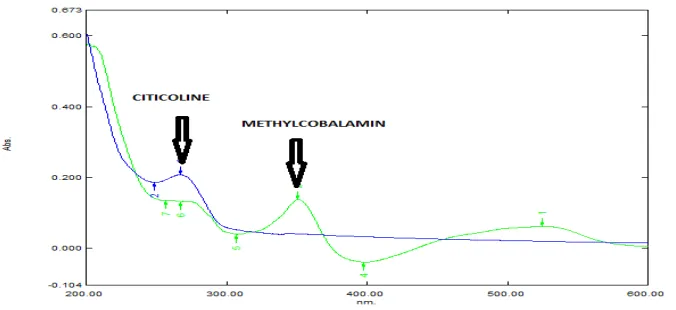
The sensitivity of HPLC method that uses UV detection depends upon proper selection of detection wavelength. An ideal wavelength is the one that gives good response for the drugs that are to be detected. Overlay UV spectra of both the drugs showed that CITI and MCA absorbed appreciably at 254 nm, so detection was carried out at 254 nm(Figure 1).
Optimization of Mobile Phase
The objective of the method development was to resolve chromatographic peaks for active drug ingredients. Various mixtures containing methanol and water, methanol and various buffer, acetonitrile and water, acetonitrile and various bufferswere tried as mobile phases in the initial stage of method development such as shown in table 1.
Chromatographic conditions:
PhenomenexLuna C18 column (250 x 4.6 mm id, 5μm particle size) chromatographic column equilibrated with mobile phase 0.02M KH2PO4 buffer: acetonitrile (40:60,
v/v) was used. Mobile phase flow rate was maintained at 1 ml min-1and effluents were monitored at 254 nm. The sample was injected using a 20 μL fixed loop, and the total run time was 6 min.
CALIBRATION CURVE FOR CITI AND MCA
Appropriate aliquot of stock solution of CITI and MCA was taken in same 10 ml volumetric flasks. The volume was made up to the mark with mobile phase to obtain final concentration of 0.01, 0.1, 0.5, 1, 5, 10 μg/ml of CITI and 0.05, 0.1, 0.5, 1, 5, and 10μg/ml of MCA, respectively.(Figure 3 & 4).
METHOD VALIDATION[5,6]
The method was validated for accuracy, precision, linearity, detection limit, quantitation limit and robustness.
1.Linearity
Appropriate aliquots of CITI and MCA working standard solutions were taken in different 10 ml volumetric flasks and diluted up to the mark with mobile phase to obtain final concentrations of 0.01, 0.1, 0.5, 1, 5, 10 μg/ml of CITI and 0.05, 0.1, 0.5, 1, 5, and 10μg/ml of MCA, respectively.
The solutions were injected using a 20 µL fixed loop system and chromatograms were recorded. Calibration curves were constructed by plotting average peak area versus concentrations and regression equations were computed for both the drugs (n=6). (Figure 3 & 4).
2.Precision
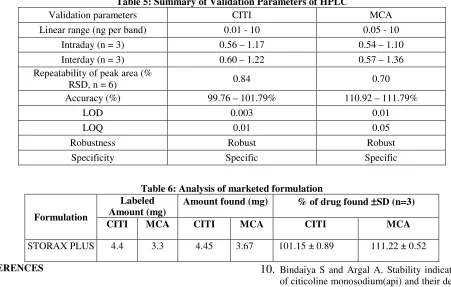
The repeatability studies were carried out by estimating response of CITI (0.1µg/ml) and MCA (0.5 µg/ml) six times and results are reported in terms of relative standard deviation. The intra-day and inter-day precision studies were carried out by estimating the corresponding responses 3 times on the same day and on 3 different days for three different concentrations of CITI (0.01, 0.5, 10 µg/ml) and MCA (0.05, 1, 10 µg/ml), and the results are reported in terms of relative standard deviation. The %RSD is within 2.0 indicating the method is precise.(Table 5).
3.Accuracy
The accuracy of the method was determined by calculating recoveries of CITI and MCA by method of standard additions. Known amount of CITI (0, 0.5, 1,1.5
434
MCA were estimated by measuring the peak areas and by fitting these values to the straight-line equation of calibration curve. The %RSD was found to be within 2.0 indicating the method is accurate. (Table 2).
4.LOD and LOQ
The limit of detection (LOD) is defined as the lowest concentration of an analyte that can reliably be differentiated from background levels. Limit of quantification (LOQ) of an individual analytical procedure is the lowest amount of analyte that can be quantitatively determined with suitable precision and accuracy. LOD and LOQ were calculated using following equation as per ICH guidelines.
LOD = 3.3 ×σ /S;
LOQ = 10 ×σ /S;
Where σ is the standard deviation of y-intercepts of regression lines and S is the slope of the calibration curve. (Table 5).
5.Robustness
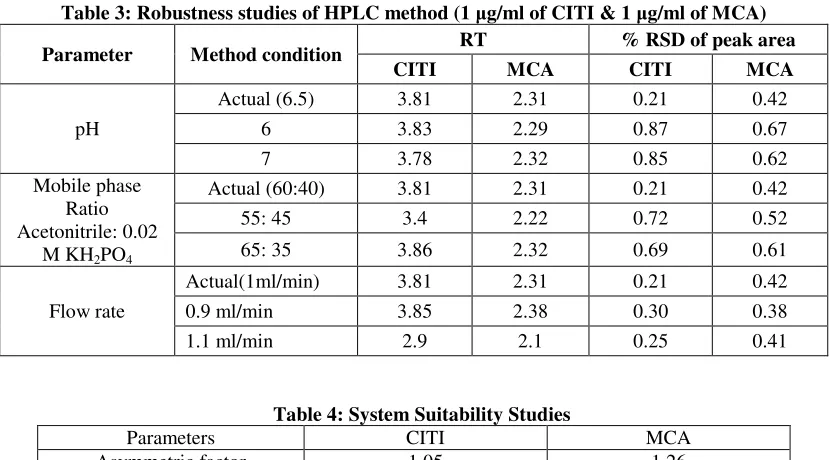
Robustness of the method was studied by deliberately changing the experimental conditions like pH of mobile phase and mobile phase ratio. Robustness of the method was determined in triplicate at a concentration level of 0.5μg /ml and 0.5 μg/ml of CITI and MCA respectively. The mean and % RSD of peak areas were calculated. The %RSD was found to be within 2.0 indicating the method is robust. (table 3)
6.Specificity
The specificity of the method was ascertained by analyzing CITI and MCA in presence of excipients like Starch (50%), Lactose (25%), and Magnesium stearate (1.25%) were used for preparation of tablet formulations. Interference due to excipients was noted and amount of drug recovered were calculated. (Table 5).
7.Solution stability
Stability of sample solutions were studied at ambient temperature for 24 h. The solution was found to be Stable.
8.System suitability
A system suitability test was an integral part of the method development to verify that the system is adequate for the analysis of CITI and MCA to be performed. Retention time (Rt), asymmetry factor, resolution and theoretical plates were determined. (Table 4).
ANALYSIS OF MARKETED FORMULATION:
Twenty tablets were weighed and finely powdered. Tablet powder equivalent to 22 mg CITI (and 0.33 mg
MCA) was weighed and transferred in to a 10 ml volumetric flask containing few ml of mobile phase. The flask was sonicated for 5 minutes. The solution was filtered through Whatman filter paper No. 41 in another 10 ml volumetric flask and volume was made up to the mark using mobile phase(STOCK A). Estimation of MCA was carried out from stock A at 254 nm. From the stock A 1 ml aliquot was pipette out in 10 ml volumetric flask and make up the volume with mobile phase(STOCK B).From the stock B 1 ml aliquot was pipette out in 10 ml volumetric flask and make up the volume with mobile phase to obtain the 4.4 µg/ ml of CITI. Estimation of CITI was carried out at 254 nm. (Table 6).
STORAX PLUS® manufactured by Intas Pharmaceutical Ltd. Containing 0.75 mg of Methylcobalamin and 500 mg Citicoline Sodium. Overages of Methylcobalamin is added.
RESULT AND DISCUSSION
Linearity was observed in the concentration range of 0.01-10 μg/ml for Citicoline sodium and 0.05-10 μg/ml for Methylcobalamin. Marketed brand of tablet (Storax plus) was analyzed and amount of drug determined by proposed method was found to be 101.15% for CITI and 111.22% for MCA as shown in Table 6. The proposed method was validated as per ICH guideline. The accuracy of method was determined at 50, 100 and 150 % level. The percent recovery ranges from 100.56%to 103.20% for CITI and 109.18% to 111.91% for MCA as shown in Table 2. Precision was calculated as interday and intraday variations (% RSD found to be less than 2 for both drugs. From the interday and intraday studies it is supposed that the drug in solution state is stable for a period of 24hour. The proposed method was found to be simple, accurate and rapid for the routine determination of Citicoline sodium and Methylcobalamin in tablet formulation. This method can be successfully used for simultaneous estimation of Citicoline sodium and Methylcobalamin in combined dosage.
Acknowledgements
435
Figure 1: Overlain Spectra Of 10ppm Solutions Of Citicoline Sodium And Methylcobalamin
Table 1: Optimazation of Mobile Phase
MOBILE PHASE OBSERVATION
Methanol: Water (60:40) CITI and MCA peaks merge with each other 0.02 M KH2PO4: Methanol (10:90) pH(6.5) CITI and MCA eluted at same Rt
0.02 M KH2PO4: Methanol (40:60) pH(6.5) CITI and MCA eluted at same Rt
Acetonitrile: Water (60:40) pH(5.5) Both the peak were well resolved but Rtwas near
Acetonitrile: 0.02 M KH2PO4 (90:10)
pH(6.5)
Both the peak were well resolved but Rtwas near
Acetonitrile: 0.02 M KH2PO4 (60:40)
pH(6.5)
CITI peak comes at 3.8 min and MCA peak comes at 2.3 min
The mobile phase acetonitrile: 0.02 M KH2PO4 (60:40 v/v) pH(6.5) was found to be satisfactory and gave two symmetric and
well-resolved peaks for CITI and MCA (Figure 2).
Figure 2: Acetonitrile: 0.02 M KH2PO4(60:40%v/v) (Ph: 6.5)
Figure 3: Calibration curve for CITI
y = 27480x + 8058. R² = 0.999
0 100000 200000 300000
0 2 4 6 8 10 12
A
R
E
A
CONC.
CITI
Series1
436
Figure 4: Calibration curve for MCATable 2: Accuracy data of CITI and MCA (n=3)
Amount of drug added initially from formulation
Amount of standard drug
added (μg/ml)
% recovery ±SD (n = 3) %RSD
CITI MCA CITI MCA CITI MCA CITI MCA
10 1 0 0 100.56±0.92 111.65±1.70 1.00 1.70
10 1 5 0.5 101.40±0.51 109.18±1.52 0.52 1.56
10 1 10 1 103.20±0.49 110.72±0.62 0.50 0.66
10 1 15 1.5 101.71±0.41 111.91±0.51 0.49 0.52
Table 3: Robustness studies of HPLC method (1 μg/ml of CITI & 1 μg/ml of MCA)
Parameter Method condition RT % RSD of peak area
CITI MCA CITI MCA
pH
Actual (6.5) 3.81 2.31 0.21 0.42
6 3.83 2.29 0.87 0.67
7 3.78 2.32 0.85 0.62
Mobile phase Ratio Acetonitrile: 0.02
M KH2PO4
Actual (60:40) 3.81 2.31 0.21 0.42
55: 45 3.4 2.22 0.72 0.52
65: 35 3.86 2.32 0.69 0.61
Flow rate
Actual(1ml/min) 3.81 2.31 0.21 0.42 0.9 ml/min 3.85 2.38 0.30 0.38
1.1 ml/min 2.9 2.1 0.25 0.41
Table 4: System Suitability Studies
Parameters CITI MCA
Asymmetric factor 1.05 1.26
Resolution 2.92
Theoretical plates 3754.15 4189.52
y = 23735x + 8934. R² = 0.999
0 100000 200000 300000
0 2 4 6 8 10 12
A
R
E
A
CONC.
MCA
Series1
437
Table 5: Summary of Validation Parameters of HPLCValidation parameters CITI MCA
Linear range (ng per band) 0.01 - 10 0.05 - 10 Intraday (n = 3) 0.56 – 1.17 0.54 – 1.10 Interday (n = 3) 0.60 – 1.22 0.57 – 1.36 Repeatability of peak area (%
RSD, n = 6) 0.84 0.70
Accuracy (%) 99.76 – 101.79% 110.92 – 111.79%
LOD 0.003 0.01
LOQ 0.01 0.05
Robustness Robust Robust
Specificity Specific Specific
Table 6: Analysis of marketed formulation
Formulation
Labeled Amount (mg)
Amount found (mg) % of drug found ±±±±SD (n=3)
CITI MCA CITI MCA CITI MCA
STORAX PLUS 4.4 3.3 4.45 3.67 101.15 ± 0.89 111.22 ± 0.52
REFERENCES
1. The Merck Index – An Encyclopedia of Chemicals, Drugs and Biologicals, 14th Edn, Merck Co. Inc: 2319, (2001).
2. Japanese Pharmacopoeia; 16th Edition, The Ministry of Health, Labour and Welfare: The Controller and Publication, Japan:1066, 10687, (2011).
3. Pathan AB, Doijad RC, and Gaikwad SL. Therapeutic application of citicoline and methylcobalamin combination.Advance Res. in Pharm. and Bio. 2012;
2(3):242-249.
4. Synder LR, Kirkland JJ, and Glajch LJ.In Practical HPLC Method Development, 2nd edn;John Wiley & sons, Inc: 21-57, 653-660, (1997).
5. ICH guidelines, Validation of Analytical Procedures, Text and Methodology Q2(R1); I.C.H. Tripartite Guidelines: 5-17, (2005).
6. USP-NF 2004; Asian edition; United States Pharmacopoeia; Convention Inc: 1586-1589.
7. Sharma O, and Chand T. Analytical method development and its validation for estimation of citicoline sodium by RP-HPLC.Int. J. of Res. in Pharm. and Biomed. Sci. 2013;4(2): 550-558.
8. Patel JA, Panigrahi B, Patel CN, Ramalingan B and Modh K. Stress degradation studies on citicoline sodium and development of validated stability indicating HPLC assay.Chron. of Young Sci. 2011;2(3): 150-154.
9. Maradiya HK and Pansara VH. Development & validation of reverse phase high performance liquid chromatography method for estimation of citicoline sodium in bulk and dosage form. Ind. J. of Pharm.l Sci. 2013;75(2): 238-241.
10.
Bindaiya S and Argal A. Stability indicating assay of citicoline monosodium(api) and their degradation products by HPLC. Der Pharmacia Sinica. 2013;4(3): 109-115.11. Raveendra G, Sri M, Rao M, Ajay CH, Reddy PJ and Nagaraju D. A validated specific stability indicating RP-LC method for citicoline and its related substancesin oral drops. Int. J. of Pharm. Tech. 2010;2(3): 652-667.
12. Surani S, Kabra P, Kimbahune R, Sunil K and Nargund LG. A reverse phase liquid chromatography analysis of citicoline sodium in pharmaceutical dosage form using internal standard method. Int. J. of Pharmtech. Res. 2012;4(3): 1136-1141.
13. Ganduri RB, Peddareddigari JR, Dasari NR and Saiempu RK. Stability indicating LC method for the determination of citicoline sodium in injection formulation.Int. J. of Pharmtech Res. 2010;2(1): 427-433.
14. Raga PE, Prashanthi D and Ismail Y. Method development and validation of RP-HPLC for simultaneous estimation of citicoline and piarcetam in tablet dosage form.Int. J. of Chem. and Pharm. Sci. 2012;3(2): 76-79.
15. Panda SS, Ravi BV, Mohante G and Panda G. Reverse phase ultrafast liquid chromatography method for simultaneous estimation of citicoline sodium and piracetam in tablets. Int. J. of Pharm. Sci. And Nano. Tech. 2013;6(1): 1952-1957.
438
Pharm. Sci. 2010;1(2): 13-16.
17. Chattopadhyaya and Akhtar J. Development and validation of a sample isocratic hplc method for estimation of methylcobalamin in capsule formulation.Inventi Rapid- Pharmanalysis & Quality Assaurance. 2012,http:// www.inventi.in/ Article/ ppaqa/ 335/ 12.aspx.
18. Narmada P, Vijaylakshmi G, Nali G, Gowthan Y, Subasini B and Jogi KV. RP-HPLC method development and validation for the determination of methylcobalamin and pregabalin combined capsule dosage form.Int. J. of Res. in Pharm. Sci;4(1): 25-29.
19. Muthukumar S, Reddy S, Selvakumar D and Banji D. Development and validation of rp-hplc method for the quantification of piarcetam and mecobalamin.Int. J. of Bio .& Pharm. Res. 2013;4(10): 681-684.
20. Pai NR and Sawant SS. A simple and validated rp-hplc method for the estimation of methylcobalamin and alphalipoic acid in soft gelatin capsule dosage form.Der Pharmacia Sinica. 2013;4(5): 46-53. 21. Kamble R, Vaidya I, Nangude S, and Gaikwad J.
Method development and validation for the simultaneous estimation of b- group vitamins and atorvastatin in pharmaceutical solid dosage form by RP-HPLC.Int. J. of Pharm. and Chem. and Bio. Sci. 2013;3(2): 330-335.