Original Research Article.
Depression, Anxiety and Stress among Mothers of Autism Spectrum
Disorder Children
Ruqayyah. M Bilali
1*, Asma S. Alqahtani
1, Aisha J. Asiri
1, Fatmah A. Hakami
1,
Mohammad Abdu M .Otain
2, Halima A. Asseri
1, Mousa Al-Zaalah
31MBBS, Interns, Collage of Medicine,
King Khalid University, Abha and Dammam, Kingdom of Saudi Arabia. 2MBBS, College of Medicine, Hamdard University, Karachi, Pakistan. 3Consultant of Child Psychiatry, Assistant Professor,
Psychiatry Medicine Department, College of Medicine, Jazan University, Jazan, Kingdom of Saudi Arabia. ABSTRACT
Background: Mothers of children with autism experience more stress, anxiety, depression and other psychiatric problems than those of children with other disabilities. Also, they have an increased rate of antidepressant and psychoactive medications use than the fathers of children with autism.
Objectives: To estimate the prevalence and determinants of psychological problems among mothers of children with Autism and to explore the impact of those psychological problems on their life.
Subjects and Methods: A retrospective cohort study was carried out at one hundred mothers of children diagnosed with Autism were identified as cases. Age matched control of equal size of mothers who had healthy children has been selected for comparison. The Arabic version of Depression, Anxiety and Stress scale (DASS- 42) was utilized for data collection. Results: There was no statistically significant difference between cases and controls regarding marital status, educational level, occupation, and number of siblings. Depression was reported among 80% of cases, compared to 68% of control group. The difference between cases and controls was statistically significant, p=0.010. Anxiety was reported among 84% of cases, compared to 77% of control group. The difference between cases and controls was
statistically significant, p=0.037. Stress was reported among 72% of cases, compared to 54% of control group. The difference between cases and controls was statistically significant, p=0.014.
Conclusion: Psychological disorders are very common among mothers of children diagnosed with autism compared to general population. Psychological care and social support are highly recommended for those mothers.
Keywords: Autism, Depression, Anxiety, Stress, KSA.
*Correspondence to:
Ruqayyah. M Bilali,
MBBS, Interns, Collage of Medicine, King Khalid University,
Abha and Dammam, Kingdom of Saudi Arabia. Article History:
Received: 02-12-2017, Revised: 01-01-2018, Accepted: 25-01-2018
Access this article online
Website:
www.ijmrp.com
Quick Response code
DOI:
10.21276/ijmrp.2018.4.1.094
INTRODUCTION
Autism Spectrum Disorder (ASD) is a range of neurodevelopmental disorders in which a child interacts and communicates inadequately, and his behavior becomes restricted and repetitive. It is usually diagnosed during the early childhood most commonly during the first 2 or 3 years of child's life.1,2 The disease is characterized by inadequate processing of information in the brain due to nerve cells malfunction. However, the exact pathophysiology of the disease is still not well understood.3
According to the World Health Organization (WHO), 1 out of every 160 children has autism. In Saudi Arabia, it is estimated that out of each 10,000 children, 18 are diagnosed with autism considering that there may be many other cases that are undiagnosed.4,5
The severity of ASD differs significantly among diagnosed cases. Some patients can live independently while others need life-long support due to the severe disabilities. It has been proven that psychosocial interventions including behavior modification and training programs for parents of children with ASD can have beneficial effect on communication skills and behavior of ASD children. This will definitely improve the quality of life of children with ASD as well as their parents.3
burden on parents and caregivers. There are several potential
causes for the negative effect of ASD on parents’ psychological
health. However, social criticism due to autism-related behavior stays the main cause.
This effect of autism on the psychological health of parents depends mainly on the severity and frequency of nuclear characteristics of the disease including mental retardation and Behavioral problems such as self-injury or aggressiveness.6-9 A study conducted by Pozo P, et al (2014) revealed that behavioral problems have negative effects on family adaptation including quality of life and psychological well-being) due to the sense of coherence (SOC). These effects were significantly correlated to severity of the disease.10 Another study conducted in 2015 revealed that mothers of ASD children have more stress rates and have an increased rate of antidepressant and psychoactive medications use than the fathers of ASD children.11 This study was conducted to explore the effect of having children with ASD on the psychological health of their mothers through estimating the prevalence and determinants of depression, anxiety and stress among mothers as well as exploring the impact of those psychological problems on their life.
MATERIALS AND METHODS Subjects
This retrospective cohort study was conducted in Maternity and pediatrics hospital in Khamis Mushait city (Saudi Arabia).There were two groups of participants; 100 mothers of at least one child with autism (cases) and 100 age –matched mothers with normally developing children (controls). All included mothers were intellectually able to adequately complete the questionnaire. Mothers in each group were asked to fill a different anonymous questionnaire about their psychological health in addition to some general information. The study was conducted during the period from 1435 to 1436 H. All eligible mothers of autistic children (cases) attending maternity and pediatrics hospital in Khamis Mushait city throughout the study duration were asked to take
participate until the required sample size was reached while controls were selected through systematic random sampling from mothers of non-autistic children attending into 4 different primary health care centers to the well-baby until the required sample size was reached. Institutional review board approval was obtained before conducting any study-related procedures.
Data Collected
The self-reported questionnaire filled by mothers of healthy children (controls) was consisted of 46 questions. Four questions
collected general information about mother’s marital status,
educational level, occupation and number of children. The remaining 42 questions were the Arabic version of Depression Anxiety and Stress Scale (DASS-42). A 4-point liker scale was included for each question.
While the questionnaire filled by mothers of children with autism (cases) was consisted of 58 questions. Six questions collected
general information about mother’s marital status, educational
level, occupation and number of children, number of children in the family, number of children with autism and current age of the child with autism. Ten questions collected data about handling the child with autism and the direct effect of having an autistic child on
mother’s life. The remaining 42 questions were the Arabic version
of Depression Anxiety and Stress Scale (DASS-42). A 4-point likert scale was included for each question.
Based on collected data, rate and severity of depression, anxiety and stress were assessed and compared between the 2 groups. Statistical Analysis
Data were statistically described in terms of frequencies (number of cases) and percentages for categorical variables. Comparison of categorical data between subgroups was carried-out using Chi-square (X2) test. Spearman's correlation was used to investigate the relationship between 2 scoring systems. P values less than 0.05 were considered statistically significant. All statistical calculations were done using computer program IBM SPSS (Statistical Package for the Social Science; IBM Corp, Armonk, NY, USA) release 21 for Microsoft Windows.
Table 1: (DASS score interpretation was done according to the following table).21,22
Meaning Depression Anxiety Stress
Normal 0-9 0-7 0-14
Mild 10-13 8-9 15-18
Moderate 14-20 10-14 19-25
Severe 21-27 15-19 26-33
Extremely severe 28+ 20+ 34+
RESULTS
Participants’ Characteristics in the 2 Groups
There was no difference between the cases and controls regarding marital status (p=1.00). Out of 100 cases, 98% were married and 2% were divorced. The same percentages were exactly reported among the control group. (Table 2)
The same was revealed for educational status as no significant difference was found between the cases and controls (p=0.993). Out of 100 cases, 40% were university graduates, 22% received secondary education, 20% received primary education, 13% received moderate education, 3% were illiterate while 2% made postgraduate studies. And out of 100 controls, 40% were university graduates, 24 % received secondary education, 19%
Table 2: Marital status of cases and controls
Groups Total
Control Cases
Marital status Married Count 98 98 196
% within groups 98.0% 98.0% 98.0%
Divorced Count 2 2 4
% within groups 2.0% 2.0% 2.0%
Total Count 100 100 200
% within groups 100.0% 100.0% 100.0% Chi-Square Test revealed p=1.000
Table 3: Educational level among cases and controls
Groups Total
Control Cases Educational
level
Illiterate Count 3 3 6
% within groups 3.0% 3.0% 3.0%
Primary Count 19 20 39
% within groups 19.0% 20.0% 19.5%
Moderate Count 11 13 24
% within groups 11.0% 13.0% 12.0%
Secondary Count 24 22 46
% within groups 24.0% 22.0% 23.0%
University Count 40 40 80
% within groups 40.0% 40.0% 40.0%
Post graduate Count 3 2 5
% within groups 3.0% 2.0% 2.5%
Total Count 100 100 200
% within groups 100.0% 100.0% 100.0% Chi-Square Test revealed p=0.993
Table 4: Occupation among cases and controls
Groups Total
Control Cases Mother's
occupation
Housewife Count 71 71 142
% within groups 71.0% 71.0% 71.0%
Employer Count 29 29 58
% within groups 29.0% 29.0% 29.0%
Total Count 100 100 200
% within groups 100.0% 100.0% 100.0% Chi-Square Test revealed p=1.000
Table 5: Number of siblings of cases and controls
Groups Total
Control Cases Number of
siblings
1-3 Count 49 43 92
% within groups 49.0% 43.0% 46.0%
3-6 Count 42 45 87
% within groups 42.0% 45.0% 43.5%
>6 Count 9 12 21
% within groups 9.0% 12.0% 10.5%
Total Count 100 100 200
% within groups 100.0% 100.0% 100.0% Chi-Square Test revealed p=0.630
Table 6: Depression among cases and controls
Groups Total
Control Cases
Depression Normal Count 32 20 52
% within groups 32.0% 20.0% 26.0%
Mild Count 13 8 21
% within groups 13.0% 8.0% 10.5%
Moderate Count 16 10 26
% within groups 16.0% 10.0% 13.0%
Severe Count 14 13 27
% within groups 14.0% 13.0% 13.5%
Very severe Count 25 49 74
% within groups 25.0% 49.0% 37.0%
Total Count 100 100 200
Table 7: Anxiety among cases and controls
Groups Total
Control Cases
Anxiety Normal Count 23 16 39
% within groups 23.0% 16.0% 19.5%
Mild Count 9 4 13
% within groups 9.0% 4.0% 6.5%
Moderate Count 14 8 22
% within groups 14.0% 8.0% 11.0%
Severe Count 12 8 20
% within groups 12.0% 8.0% 10.0%
Very severe Count 42 64 106
% within groups 42.0% 64.0% 53.0%
Total Count 100 100 100
% within groups 100.0% 100.0% 100.0% Chi-Square Test revealed p=0.037
Table 8: Stress among cases and controls
Groups Total
Control Cases
Stress Normal Count 46 28 74
% within groups 46.0% 28.0% 37.0%
Mild Count 10 5 15
% within groups 10.0% 5.0% 7.5%
Moderate Count 14 14 28
% within groups 14.0% 14.0% 14.0%
Severe Count 11 19 30
% within groups 11.0% 19.0% 15.0%
Very severe Count 19 34 53
% within groups 19.0% 34.0% 26.5%
Total Count 100 100 100
% within groups 100.0% 100.0% 100.0% Chi-Square Test revealed p=0.014
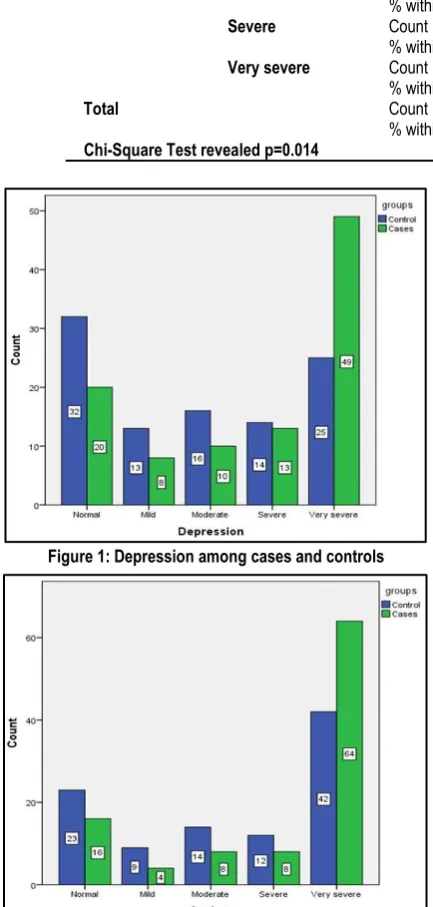
Figure 1: Depression among cases and controls
Figure 2: Anxiety among cases and controls
Figure 3: Stress among cases and controls
Depression, Anxiety and Stress Rates in the 2 Groups Depression was reported among 80% of cases; being severe and very severe among 13% and 49% of them, respectively compared to 68% of control group; being severe and very severe among 14% and 25% of them, respectively. The difference between cases and controls was statistically significant, p=0.010. (Table 6 and figure 1)
54% of control group; being severe and very severe among 11% and 19% of them, respectively. The difference between cases and controls was statistically significant, p=0.014. (Table 8 & figure 3) Characteristics of Mothers with Autistic Child
Among mothers of autistic children, DAS score didn’t differ
significantly between married cases and divorced cases (p=0.074). The same was revealed between groups of different educational levels (p=0.614), between housewives and employed mothers (p=0.933) and between mothers with different number of
siblings (p=0.521). Moreover, the score didn’t differ significantly
between mothers with 1 autistic child and those with 2 autistic children (p=0.376). And the same was reported for the current age of the autistic child that was found to have no significant effect on DAS score (p=0.454).
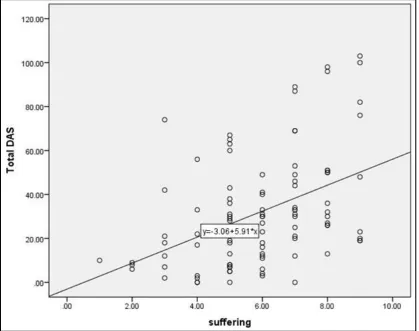
On the other hand, there was a nearly moderate uphill (positive)
relationship between DAS score and mothers’ suffering score
among studied mothers having autistic child (Spearman's correlation coefficient is 0.446, p<0.001). (figure 4)
Figure 4: Scatter plot chart for the correlation between DAS score and mothers’ suffering score
DISCUSSION
According to WHO factsheet 2017 entitled “Autism spectrum disorders”, the disease imposes significant economic and
emotional burdens not only on the patients but also on their families and caregivers.5
Previous studies conducted in several countries worldwide revealed high rates of stress, anxiety, and depression among parents with autistics children. This psychological burden may be due to having to look after a child with special needs.12-16
This retrospective cohort study was conducted in Saudi Arabia to estimate the prevalence and determinants of depression, anxiety and stress among mothers of children with autism as well as to explore the impact of those psychological problems on their life. A total of 100 mothers of autistic children (cases) and 100 age-matched mothers of normally developing children (controls) took part in this study. Two anonymous questionnaires were filled by participating mothers (one for the cases and the other for the controls). Both questionnaires included the Arabic version of the 42-item depression Anxiety Stress Scale (DASS-42) to measure the emotional state of participating mothers in each group.17
There was no significant differences between characteristics of cases and controls in terms of marital status (p=1.00), educational level (p=0.993), occupation (p=1.00), and number of siblings (p=0.631).
association between parental anxiety, autistic Child Behavior and Parenting Self-Efficacy suggested that there is a bidirectional relationship between autistic child behavior and parenting
self-efficacy. This relationship is mediated through parent’s anxiety.
And the same was found for stress that was reported among 72% of cases; being severe and very severe among 19% and 34% respectively compared to 54% of controls; being severe and very severe among 11% and 19% respectively with a statistically significant difference between the 2 groups (p=0.014). This consistent with the results of a case-control study conducted by Duarte et al (2005) to examine the determinants of stress in mothers with autistic children. The study revealed several factors
to be associated with mothers’ stress however; having an autistic
child was the primary factor responsible for developing stress.20
CONCLUSION
The current study findings support the evidence that mothers of children with ASD are more prone to develop depression, anxiety and stress compared to mothers with non-autistic children. They are a vulnerable group having special emotional needs that should be taken into consideration while planning the care interventions for children with ASD.
Providing adequate support to caregivers of ASD children will minimize the potential risks of developing psychological disorders and improve their wellbeing and self-efficacy which is a critical component to enhance the care provided to ASD children and to ensure a better quality of life.
REFERENCES
1. Landa RJ. Diagnosis of autism spectrum disorders in the first 3 years of life. Nat Clin Pract Neurol. 2008;4(3):138–47.
2. Black DW, Grant JE. DSM-5 TM guidebook the essential companion to the Diagnostic and statistical manual of mental disorders, fifth edition. Washington, DC: American Psychiatric Publishing; 2014.
3. Johnson CP, Myers SM; American Academy of Pediatrics Council on Children with Disabilities. Identification and evaluation of children with autism spectrum disorders. Pediatrics. 2007; 120:1183-1215. 4. Al-Salehi SM, Al-Hifthy EH, Ghaziuddin M. Autism in Saudi Arabia: Presentation, Clinical Correlates and Comorbidity. Transcultural Psychiatry. 2009;46(2):340–7.
5. Autism spectrum disorders [Internet]. World Health Organization. World Health Organization; [cited 2017Dec8]. Available from:
http://www.who.int/mediacentre/factsheets/autism-spectrum-disorders/en/
6. Almansour MA, Alzahrani MK, Algeffari MA. Depression and anxiety among parents and caregivers of autistic spectral disorder children. Neurosciences. 2013;18(1):58-63.
7. Al-Farsi O, Al-Farsi Y, Al-Sharbati M, Al-Adawi S. Stress, anxiety, and depression among parents of children with autism spectrum disorder in Oman: a case–control study. Neuropsychiatric Disease and Treatment. 2016;12:1943–51.
8. Gray DE, Holden WJ. Psycho-social well-being among the parents/care giver of children with autism. Australia and New Zealand Journal of developmental disabilities. 1992;18:83-93.
9. Pozo P, Brioso Ángeles, Sarriá Encarnación. Psychological Adaptation in Parents of Children with Autism Spectrum Disorders. INTECH Open Access Publisher; 2011.
10. Pozo P, Sarriá E, Brioso A. Family quality of life and psychological well-being in parents of children with autism spectrum disorders: a double ABCX model. Journal of Intellectual Disability Research 2013;58:442–58. doi:10.1111/jir.12042
11. Soltanifar A, Akbarzadeh F, Moharreri F, Soltanifar A, Ebrahimi A, Mokhber N, et al. Comparison of parental stress among mothers and fathers of children with autistic spectrum disorder in Iran.Iran J Nurs Midwifery Res. 2015;20(1):93-8.
12. Steijn DJV, Oerlemans AM, Aken MAGV, Buitelaar JK, Rommelse NNJ. The Reciprocal Relationship of ASD, ADHD, Depressive Symptoms and Stress in Parents of Children with ASD and/or ADHD. Journal of Autism and Developmental Disorders. 2013 Oct; 44(5):1064–76.
13. Prince M, Patel V, Saxena S, et al. No health without mental health. Lancet. 2007;370(9590):859–877.
14. Bader SH, Barry TD. A longitudinal examination of the relation between parental expressed emotion and externalizing behaviors in children and adolescents with autism spectrum disorder. J Autism Dev Disord. 2014;44(11):2820–2831.
15. Mitchell C, Holdt N. The search for a timely diagnosis: parents’
experiences of their child being diagnosed with an Autistic Spectrum Disorder. J Child Adolesc Ment Health. 2014; 26(1):49–62.
16. Feinberg E, Augustyn M, Fitzgerald E, et al. Improving maternal
mental health after a child’s diagnosis of autism spectrum disorder:
results from a randomized clinical trial. JAMA Pediatr. 2014; 168(1):40–46
17. Depression Anxiety Stress Scales - DASS. Psychology Foundation of Australia; 2014 [cited 2017Dec9]. Available from: http://www2.psy.unsw.edu.au/dass/
18. Cohrs A, Leslie D. Depression in Parents of Children Diagnosed with Autism Spectrum Disorder: A Claims-Based Analysis. J Autism Dev Disord. 2017. DOI 10.1007/s10803-017-3063-y.
19. Rezendes DL, Scarpa A. Associations between Parental Anxiety/Depression and Child Behavior Problems Related to Autism Spectrum Disorders: The Roles of Parenting Stress and Parenting Self-Efficacy. Autism Research and Treatment. 2011;2011:1–10. 20. Duarte CS, Bordin IA, Yazigi L, Mooney J. Factors associated with stress in mothers of children with autism. Autism. 2005;9(4):416–27. 21. Lovibond, S.H. & Lovibond, P.F. (1995). Manual for the Depression Anxiety & Stress Scales (second edition). Psychology Foundation.
22. Crawford, J.R & Henry, J.D. (2003). The Depression Anxiety Stress Scales (DASS): Normative data and latent structure in a large non-clinical sample. British Journal of Clinical Psychology (2003),
Source of Support: Nil. Conflict of Interest: None Declared.
Copyright: © the author(s) and publisher. IJMRP is an official publication ofIbn Sina Academy of Medieval Medicine & Sciences, registered in 2001 under Indian Trusts Act, 1882. This is an open access article distributed under the terms of the Creative Commons Attribution Non-commercial License, which permits unrestricted non-commercial use, distribution, and reproduction in any medium, provided the original work is properly cited.