e- ISSN: 2278-067X, p-ISSN: 2278-800X, www.ijerd.com
Volume 14, Issue 5 (May Ver. I 2018), PP.45-51
Estimation of Generation
Cost For Multi Capacity Thermal
Power Generators Using MATLAB
P V Narendra Kumar
1, Dr Ch.Chengaiah
2, J V K Prasad
3 1Research Scholar, Department of Electrical Engineering, Sri Venkateswara University, Tirupati, AP, INDIA.
2Professor, Department of Electrical Engineering, Sri Venkateswara University, Tirupati, AP, INDIA. 3Divisional Engineer, SDSTPS, Muthukur,APGENCO, AP, INDIA.
Corresponding Author: P V Narendra Kumar
ABSTRACT:- This document gives The cost generated per unit in a thermal power station is dependent on fixed cost and variable cost. The duty of an electrical engineer is to generate power without outage of power keeping the cost of power generated per unit as low as possible. An engineer can able to reduce the cost of generated power only when he knows on what factors the cost of generated power depends. Hence he must know on what factors the fixed cost and variable cost may depend. The Central Electricity Regulatory Commission (CERC) has the power of deciding the tariff for electricity generated by various power stations. Tariff is calculated on the basis of fixed cost and variable cost. The power plants have fixed and variable costs. The fixed cost dependent on return on equity, interest on capital loan, depreciation, interest on working capital, operation & maintenance cost and the cost of secondary oil. The variable cost dependent on primary fuel costs, secondary fuel oil consumption and auxiliary energy consumption In the Available Tariff mechanism, the fixed and variable cost components are treated separately. Cost index is a useful parameter to monitor and compare the cost of energy for specific products manufactured by the industry. In the event of an increase or decrease (perhaps due to a conservation measure) in cost index, the particular source can be investigated immediately. In this paper, first case study of three Power Stations namely Simhapuri Thermal Power Station, Nellore, Andhra Pradesh and Koradi Thermal Power Station, Koradi, Nagpur and Sri Damodaram Sanjeevaiah Thermal Power Station, Muthukur, Nellore, Andhra Pradesh and second case study of two generators in Sri Damodaram Sanjeevaiah Thermal Power Station, Muthukur, Nellore, Andhra Pradesh has been considered and for Tariff calculations, Cost Index of thermal power plants have been implemented with MATLAB environment and the effectiveness of the work will be verified and compared with real time analysis. The generated program in MATLAB is applicable for any capacity of Thermal power station and any number of power stations.
KEYWORDS:- Plant load factor, fixed cost and variable cost, Generation Cost, Cost Index, Electricity Act, Electricity tariff, MATLAB
--- --- Date of Submission: 02-05-2018 Date of acceptance: 17-05-2018
---I INTRODUCTION
In most of the industrialized countries, electric power is provided by generating facilities that serve a large number of customers. These generating facilities, known as central station generators, are often located in remote areas, far from the point of consumption [1]. The economics of central station generation is largely a matter of costing. Like any other production technology [2-3], central station generation entails fixed and variable costs. The fixed costs are relatively straightforward, but the variable cost of power generation is remarkably complex. The fixed costs of power generation are essentially capital costs and land. The capital cost of building Central Station generators vary from region to region, largely as a function of labor costs and "regulatory costs," which include components like obtaining site permits, environmental approvals, and so on. It is important to realize that building Central Station generation takes an enormous amount of time. In a state like Gujarat (where building power plants are relatively easy), the time-to-build can be as short as two years. In Delhi, where bringing new energy infrastructure to fruition is much more difficult (due to higher regulatory costs) the time-to-build may exceed to ten years.
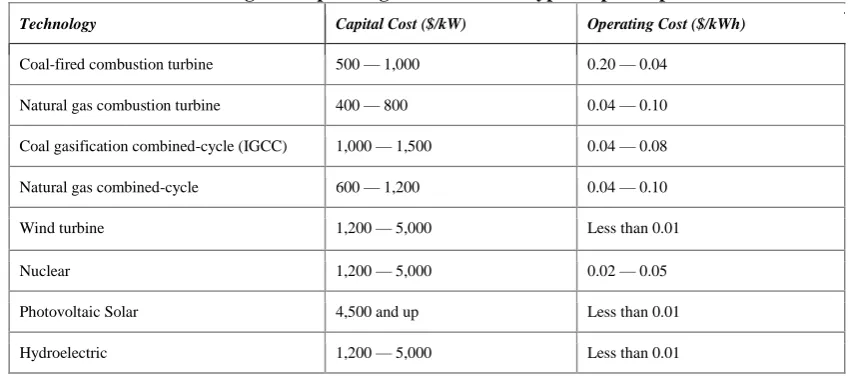
In general, central station generators face a tradeoff between capital and operating costs. Those types of plants that have higher capital costs tend to have lower operating costs. Further, generators, which run on fossil fuels tend to have operating costs that are extremely sensitive to changes in the underlying fuel price. The right-most column of Table 1 shows typical ranges for operating costs of various types of power plants.
Table I: ranges for operating costs of various types of power plants
Technology Capital Cost ($/kW) Operating Cost ($/kWh)
Coal-fired combustion turbine 500 — 1,000 0.20 — 0.04
Natural gas combustion turbine 400 — 800 0.04 — 0.10
Coal gasification combined-cycle (IGCC) 1,000 — 1,500 0.04 — 0.08
Natural gas combined-cycle 600 — 1,200 0.04 — 0.10
Wind turbine 1,200 — 5,000 Less than 0.01
Nuclear 1,200 — 5,000 0.02 — 0.05
Photovoltaic Solar 4,500 and up Less than 0.01
Hydroelectric 1,200 — 5,000 Less than 0.01
The minimum run time and ramp time determine how flexible the generation source is; these vary greatly among types of plants and are a function of regulations, type of fuel, and technology. Generally speaking, plants that are less flexible (longer minimum run times and slower ramp times) serve base load energy, while plants that are more flexible (shorter minimum run times and quicker ramp times) are better-suited to meeting peak demand. It is important to realize that, in some extend, these are "soft" constraints. For example, it is possible to run a nuclear plant for five hours and then shut it down. However, this involves a large cost in the form of wear and tear on the plant's components. The cost of loading a given transmission line with additional electricity is basically zero (unless the line is operating at its rated capacity limit)[6-7]. Capital cost thus dominates the economics of transmission and distribution.
II TARIFF CALCULATIONS
The Electricity Act (supply) 1948 has been replaced by Electricity Act 2003 by Government of India [3]. According to this act, the rights of determination of tariffs, for the power generated by central, state and private power generating stations, based on specific terms and conditions has been given to the Central Electricity Regulatory Commission (CERC).Section 61 of the Act empowers the Commission to specify and regulate the terms and conditions for determination of tariff in accordance with the provisions of the said section along with the National Electricity Policy and Tariff Policy. As per the Electricity Act 2003, the CERC in March 2004, had put forth tariff regulations for the FY 2004-09 and on expiry of this, CERC had notified new tariff regulations on January 19, 2009 for the next regulatory period of FY 2009-14. The new regulations were applicable to all power generating stations (excluding stations based on non-conventional energy sources) and transmission licensees, except those entities which are determined through bidding process in accordance with the guide lines issued by the Central Government.
Operation and Maintenance Expenses such as expenditure incurred for operation and maintenance of the project, or part thereof, which includes the expenditure on manpower, repairs, maintenance spares, consumables, insurance and overheads but excludes fuel expenses and water charges. The CERC has specified O&M Costs for thermal power stations on the normative parameters (Rs. lakh/MW), depending on the class of the machine installed by the power station. The normative O and M expenses in table II .
Table II: . Operations & Maintenance Costs in Rs:Lakh/MW for different capacity power plants.
Year 200MW 350MW 500MW 600MW & Above
2011-2012 20.34 17.88 14.53 13.08
2012-2013 21.51 18.91 15.36 13.82
2013-2014 22.74 19.99 16.24 14.62
2014-2015 23.90 19.95 16.00 14.40
2015-2016 25.40 21.21 17.01 15.31
2016-2017 27.00 22.54 18.08 16.27
2018-2019 30.51 25.47 20.43 18.38
From this table, the data corresponding to Operations & Maintenance Costs in Rs:Lakh/MW for different capacity power plants for the financial year 2015-2016 was considered.
Auxiliary Energy Consumption in relation to a period in case of a generating station is the quantum of energy consumed by auxiliary equipment of the generating station, such as the equipment being used for the purpose of operating plant and machinery including switch yard of the generating station and the transformer losses within the generating station, expressed as a percentage of the sum of gross energy generated at the generator terminals of all the units of the generating station: provided that auxiliary energy consumption shall not include energy consumed for supply of power to housing colony and other facilities at the generating station and the power consumed for construction works at the generating station;
Declared Capacityin relation to a generating station means, the capability to deliver ex-bus electricity in MW declared by such generating station in relation to any time-block of the day as defined in the Grid Code or whole of the day, duly taking into account the availability of fuel or water, and subject to further qualification in the relevant regulation;
Expenditure Incurred means the fund, whether the equity or debt or both, actually deployed and paid in cash or cash equivalent, for creation or acquisition of a useful asset and does not include commitments or liabilities for which no payment has been released.
Generating Unit in relation to a thermal generating station(other than combined cycle thermal generating station)means steam generator, turbine- generator and auxiliaries, or in relation to a combined cycle thermal generating station which means a turbine-generator and auxiliaries; and in relation to a hydro generating station involving turbine-generator and its auxiliaries;
Gross Calorific Value in relation to a thermal generating station is the heat produced in k Cal by complete combustion of one kilo gram of solid fuel or one liter of liquid fuel or one standard cubic meter of gaseous fuel, as the case may be;
Gross Station Heat Rateis the heat energy in put in k Cal required to generate one kWh of electrical energy at generator terminals of a thermal generating station;
Generating Station means any station for generating electricity, including any building and plant with step-up transformer, switch-gear, switch yard, cables or other appurtenant equipment, if any, used for that purpose and the site there of; as it intended to be used for a generating station, and any building used for housing the operating staff of a generating station, and where electricity is generated by water-power, including penstocks, head and tail works, main and regulating reservoirs, dams and other hydraulic works, but does not in any case include any sub-station[6];
Energy Charges (for recovery of Primary fuel costs) Energy charges for thermal power stations are linked to the normative operational parameters as specified by the regulator[7]. The normative parameters are given in table III.
III RESULTS&DISCUSSIONS
Sri Damodaram Sanjeevaiah Thermal Power Station is one of the power generating stations in Andhra Pradesh. The power station was installed in 2010 with a capacity of 800MW. At present, two 800MW generators are running leading to the total capacity of 1600MWs. The power plant is located at a distance of 23 km from Nellore district. The water requirement for the plant is met from the Bay of Bengal Sea which is 4 km from away from the plant. As for as raw material is concerned the thermal power plant gets coal from Krishnapatnam port. (30% from foreign and 70% from India)
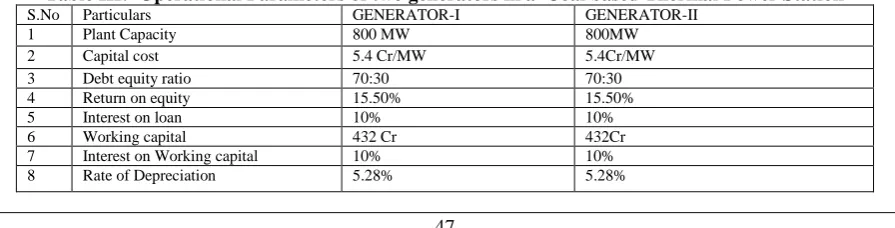
A MATLAB Program was written by considering the data of two generators in Sri Damodaram Sanjeevaiah Thermal Power Station, Muthukuru, Nellore, Andhra Pradesh and data of three Coal Based Thermal Power Stations. The following table 1 and table 2 shows operational parameters of of two generators in Sri Damodaram Sanjeevaiah Thermal Power Station, Muthukuru, Nellore, Andhra Pradesh and data of Coal based Thermal Power Station respectively.
Table III: Operational Parameters of two generators in a Coal based Thermal Power Station
S.No Particulars GENERATOR-I GENERATOR-II
1 Plant Capacity 800 MW 800MW
2 Capital cost 5.4 Cr/MW 5.4Cr/MW
3 Debt equity ratio 70:30 70:30
4 Return on equity 15.50% 15.50%
5 Interest on loan 10% 10%
6 Working capital 432 Cr 432Cr
7 Interest on Working capital 10% 10%
9 O&M cost 17.3 17.3
10 Plant Load Factor 90% 75%
11 Plant Availability Factor 90% 70%
12 Specific Oil Consumption 0.58ml/KWh 1.24 ml/KWh 13 Price of Oil (Per KLtrs) Rs35,000 Rs.50,000
14 G C value of Oil 10,000 10,000
15 Station Heat Rate(Kcal/Kg 2586.91 2506
16 Cost of Coal(Per Ton) Rs2500 Rs2950
17 Auxiliary Power 10.19% 11.04%
18 Plant Life 25 Years 25 Years
19 G C value of Coal 4277.56 4282.2
Table IV: Operational Parameters for Coal based Thermal Power Stations.
S.no Particulars Plant-1 Plant-2 Plant-3
1 Plant Capacity 600 MW 660MW 1600MW
2 Capital cost 5 Cr/MW 6 Cr/MW 5.4 Cr/Mw
3 Debt equity ratio 70:30 70:30 70:30
4 Return on equity 15.50% 15.50% 15.50%
5 Interest on loan 10% 10% 10%
6 Working capital 300 Cr 396 Cr 960 Cr
7 Interest on Working capital 10% 10% 10%
8 Rate of Depreciation 5.28% 5.28% 5.28%
9 O&M cost 15.31 15.62 16.27
10 Plant Load Factor 78.11% 85% 90%
11 Plant Availability Factor 93.56% 85% 90% 12 Specific Oil Consumption 1 ml/KWh 1 ml/KWh 2 ml/KWh 13 Price of Oil 56000 Rs. 35000 /KL Rs. 35000 /KL 14 Gross Calorific value of Oil 92000 10000
Kcal/L
10000 Kcal/L 15 Station Heat Rate 2685 Kcal/Kg 2425 Kcal/Kg 2302 Kcal/Kg 16 Cost of Coal Rs 3036 /Tonnes Rs 2000 /Tonnes Rs 2000 /Tonnes
17 Auxiliary Power 10.18% 6.5% 6.5%
18 Plant Life 25 Years 25 Years 25 Years
19 Gross Calorific value of Coal 4200 Kcal/Kg 3800 Kcal/Kg 3500 Kcal/Kg 20 Generation Cost 4.25 Rs/Unit 4.55 Rs/Unit 4.00 Rs/Unit
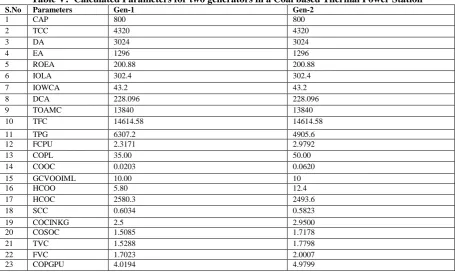
Table.III and Table IV are used for calculation of parameters. With that data the proposed program was tested and the corresponding results are shown in table.V and VI.
Table V: Calculated Parameters for two generators in a Coal based Thermal Power Station
S.No Parameters Gen-1 Gen-2
1 CAP 800 800
2 TCC 4320 4320
3 DA 3024 3024
4 EA 1296 1296
5 ROEA 200.88 200.88
6 IOLA 302.4 302.4
7 IOWCA 43.2 43.2
8 DCA 228.096 228.096
9 TOAMC 13840 13840
10 TFC 14614.58 14614.58
11 TPG 6307.2 4905.6
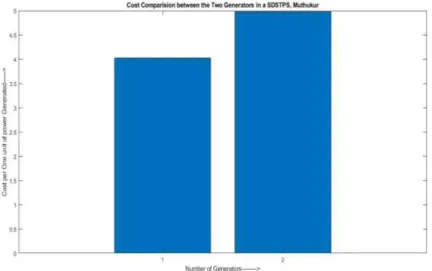
12 FCPU 2.3171 2.9792
13 COPL 35.00 50.00
14 COOC 0.0203 0.0620
15 GCVOOIML 10.00 10
16 HCOO 5.80 12.4
17 HCOC 2580.3 2493.6
18 SCC 0.6034 0.5823
19 COCINKG 2.5 2.9500
20 COSOC 1.5085 1.7178
21 TVC 1.5288 1.7798
22 FVC 1.7023 2.0007
23 COPGPU 4.0194 4.9799
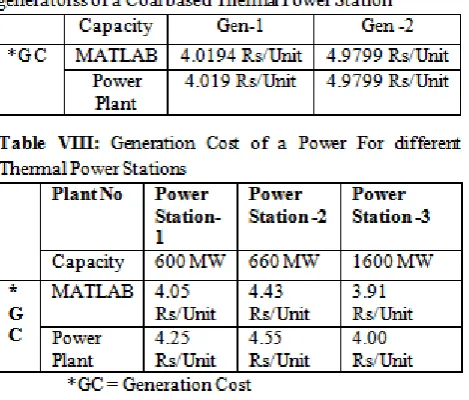
Table VI: Calculated Parameters for Coal based Thermal Power Station
Fig 1: Various Costs of a Coal Fired Thermal Station
Fig 2: Variable Cost, Fixed Cost and Total Generation Cost of Three Coal Fired Thermal Generating Stations.
From the Fig 1 and Fig 2, it is concluded that the generation cost will be lesser if the power station improves the Gross Calorific Value Of coal, Heat rate of a stationand Heat Contribution Of Coal. The Generation cost values shown in the figure shows that the generation cost of a Coal fired thermal power stations are low by increasing the capacity of a power station.
IV CONCLUSIONS
power generating capacity. This technique will also be extended to calculate the generation cost by virtually operating any change in the parameter which is practically not possible.
REFERENCES
[1]. S C Shrivastava , Joint Chief (Engg) CERC, New Delhi , ―Bulk Power Generation Tariff - Commercial Issues and Regulatory Perspective‖, Department of Industrial and Management Engineering, Indian Institute of Technology Kanpur, 18 – 23 July, 2011 [2]. Vilas S. Motghare, R. K. Cham , ―Generation Cost Calculation for 660 MW Thermal Power Plants,‖ IJISET - International Journal
of Innovative Science, Engineering & Technology, Vol. 1 Issue 10, December 2014.PP 660-664. [3]. Tariff Determination Methodology for Thermal Power Plants in India.
[4]. National productivity council volume on energy management
[5]. R. K. Rajput, Power Plant Engineering: Laxmi Publications, Delhi, ( Edition 3) 2006 [6]. Paul Breeze, (2010)The Cost of Power Generation
[7]. Paul Breeze. (2009). The Future of Energy Storage. Business Insights [8]. Coal Based Electricity Generation in India
[9]. APGENCO Power Generation Cost Manuals