Volume 14, Issue 5 (May Ver. II 2018), PP.01-07
Acylation And Structural Characterization Of
5-(2,6-Dichlorobenzyl)-1,3,4-Thiadiazole-2-Amine
Ali Hasin Bawah
11
Minister of Education, Misurata, Libya. Corresponding Author: Ali Hasin Bawah
ABSTRACT:- This paper will focus on possible new properties in hetero ring thanks to new compounds obtained by means of adding various substitute groups in thiadiazoles, which may contribute to medicine and industry. The main objective of this paper is to carry out synthesis and characterization of new compounds containing substitute thiadiazole ring and their substitute acyl groups, which have potential biological activity. Firstly, 5-(2,6-dichlorobenzyl)-1,3,4-thiadiazole-2-amine (2) was synthesized with high yields. Then, the target compounds N-(5-(2,6-dichlorobenzyl)-1,3,4-thiadiazole-2-yl)-3,4,5-substitute benzamide derivatives (4a-n) were synthesized from reactions of these compounds with various acyl chloride derivatives with medium-high yields (76-91%).
KEYWORDS:- Thiadiazole, acylation, heterocyclic
--- Date of Submission: 05-05-2018 Date of acceptance: 21-05-2018 ---
---I INTRODUCTION
Heterocyclic molecules are widespread in nature and are used in many fields. Among these, hetero ring compounds containing nitrogen and sulfur are known to have various biological activities. They have an important place in our live due to their biological activities. These compounds can be found in nature, but it is also possible to obtain them quickly and easily using synthetic methods, which increases their significance even more. In addition to pharmaceutics, these compounds are used in many other industries including the paint industry.
Thiadiazoles have an important place among compounds with hetero rings containing nitrogen and sulfur hetero and extensively used in pharmaceutics due to their biological activity. Fungicidal properties enabled by the –N=C-S bond contribute to drug and paint industries in particular.
1,3,4 thiadiazoles are also used in the polymer industry, which is one of the noteworthy industries of our time. Thermal behaviors of N and S atoms play a significant role in conductivity, hence 1,3,4 thiadiazoles are used for semi-conductivity and coating in polymer applications with electrical conductivity. Commonly used in medicine, acetazolamide is a derivative of 1,3,4-thiadiazole and used in treatment of glaucoma, heart failure, and epilepsy. To sum up, this paper consists of two parts: a literature review and experimental trials. These two sections are also divided into sub-sections. Structure formulas of compounds synthesized in experimental trials can be seen in the Table of formulas. The second part of the study presents general information related to thiadiazole and derivatives, earlier and recent studies, and synthesis methods based on a review of the literature.
The third part of the study involving experimental trials explains how 2-amino-1,3,4-thiadiazole compounds were obtained from reactions of appropriate nitrile compounds with thiosemicarbazide, and acylation reactions of these compounds. Since the yield calculation for synthesized compounds was performed after the purification process, yields are given as pure yield.
The four part involving experimental results and discussion presents the spectral data for all compounds in charts and interprets the data based on literature data.
The fifth section containing the results presents reactions mechanisms for synthesized compounds in equations.
II THIADIAZOLES A. Structure and Characteristics
Thiadiazole has four isomers depending on the position of heteroatom in the ring: 1,2,3-thiadiazole(1), 1,2,4-thiadiazole(2), 1,2,5-thiadiazole(3), and 1,3,4-thiadiazole(4) as ashown in the sub-Figures 1.1
Figure 1.1. Thiadiazole isomers.
1,3,4-thiadiazole is a colorless substance with aromatic character. It has a melting point of 45 oC and boiling point of 203 oC. It is quite resistant against acids. It can be decomposed in 30% hydrogen peroxide and diluted alkaline zinc.
B. Spectral Properties of 2-Amino-1,3,4-Thiadiazoles.
1) IR Spectra: IR spectroscopy using KBr tablets in studies on 2-amino-1,3,4-thiadiazole derivatives show absorption bands for C=N stretching vibration in the 1665-1672 cm-1 range, C-N stretching vibration in the 1300-1280 cm-1 range, N-H deflection in the 1620-1600 cm-1 range, and amino group N-H stretching vibration in the 3350-3100 cm-1 range [1].
2) 1H-NMR Spectra: According to the structure of the substituents at the amino nitrogen of 2-amino-1,3,4-thiadiazoles, 1H-NMR spectra of the protons in secondary amine are in the 10.20-10.30 ppm range [2]. 3) Methods Used to Obtain Thiadiazole: The first compound known to contain a 1,3,4-thiadiazole ring is the 2-phenylamino-1,3,4 thiadiazole compound synthesized by Pulvermacher in 1894 by formic acid treatment of 4-phenyl-thiosemicarbazide [3].
H
N
N N
S
Figure 1.2. Synthesis of 2-phenylamino-1,3,4-thiadiazole
3.1 From Thiosemicarbazides:1,3,4-thiadiazoles are usually formed as a result of cyclization reactions. Many syntheses of thiadiazoles occur in the form of cyclization reaction of thiosemicarbazide or substitute thiosemicarbazide. 2-amino-5-substitute-1,3,4-thiadiazole is obtained as a result of cyclization from the reaction of thiosemicarbazide with acetyl chloride [4].
3.2 From Thiosemicarbazones: In 1901, Compounds containing 1,3,4-thiadiazole ring from the reaction of thiosemicarbazones with iron(III) chloride were synthesised by Young and Eyre [5].
3.3 From hydrazines: Disubstituted-1,3,4-thiadiazoles are obtained from the reaction of diacetyl hydrazines with diphosphorus pentasulfide [6].
III SIGNIFICANCEOF1,3,4-THIADIAZOLEANDDERIVATIVES
Biological activity of a compound essentially depends on its molecular structure. Heterocyclic compounds show high biological activity due to their structure. Thiadiazole having N=C-S structure in the ring is a versatile compound that can be used a wide rang of applications.
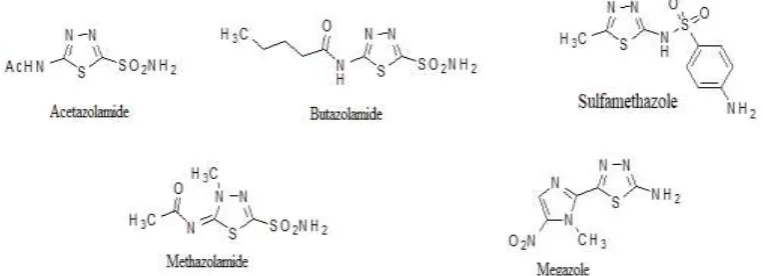
It has become a significant heterocyclic class due to its wide range of biological activities. Commercially available drugs containing 1,3,4-thiadiazole nucleus include acetazolamide, methazolamide, butazolamide, sulfamethazole, and megazol. Also, other analogs of thiadiazole are used for paints, pesticides, lubricants, and conductive polymers [7]. For more details see the Figure 1.3.
Studies in the literature have shown that compounds with thiadiazole nucleus have a broad spectrum of pharmacological activities including antimicrobial, antitubercular, anti-inflammatory, analgesic, CNS depressant, anticonvulsant, anticancer, antioxidant, antidiabetic, molluscicidal, antihypertensive, and diuretic activities.
IV EXPERIMENTALSTUDIES
The 1H-NMR and 13C-NMR spectra of the compounds were assessed using an Agilent Annual Refill (400 MHz) device in the Central Research Laboratory of Recep Tayyip Erdoğan University. Mass spectrum was determined by the ESI (+) method using a Thermo TSQ Quantum Access device in the Central Research Laboratory of Recep Tayyip Erdoğan University.
The elemental analysis of the compounds was performed using a LECO 932 CHNS (Leco-932, St. Joseph, MI, USA) device in the Central Research Laboratory of Recep Tayyip Erdoğan University. The melting points of the compounds were determined using a Thermo Scientific IA9000 device.
V SYNTHESIS OF 2-AMINO-1,3,4-THIADIAZOLE DERIVATIVES (2)
The solution of the compound 1 (0.075 mol) in 40 ml trifluoroacetic acid is added thiosemicarbazide (0.100 mol) in a flask with a round bottom and then the mixture is heated at 60 oC for 4 hours on a condenser with the drying tube attached. At the end of 4 hours, the reaction mixture is poured on 200 ml ice-water mixture and neutralized with diluted ammonia. The resulting substance is filtered through a funnel. The solid substance obtained is rinsed with pure water, ethyl alcohol, and diethyl ether, respectively. Then, the substance is purified by crystallizing with an appropriate solvent or solvent mixture. The pure substance is dried with P2O5 vacuum oven. Finally, structures of the synthesized compounds are illuminated with FT-IR, 1H NMR, 13C NMR, mass spectroscopy, and elemental analysis.
VI. GENERAL ACYLATION REACTIONS OF 2-AMINO-1,3,4-THIADIAZOLE DERİVATIVES (4A-N) :
In a two-necked flask, compound (2) (0.004 mol) was suspended in dry benzene (40 mL) and pyridine (1 mL). Acyl chloride derivatives (0.004 mol) were added drop-wise to this solution at room temperature with the assistance of a dropping funnel. The mixture was then refluxed and stirred for 4-6 h. The progress of the reaction was monitored by TLC at appropriate time intervals. After completion of the reaction, the solution was filtered and the solid matter was obtained. It was washed with deionized water, ethanol and diethyl ether, respectively. The solid matter was recrystallized from the appropriate solvent. All physical properties and spectral data derived from the obtained products are given in the Supplementary Material Section.
Table 1-a: Physical properties of compounds (2) and (4a-n)
VII. FINDINGSANDDISCUSSION
SYNTHESISANDCHARACTERIZATIONOFSOMENEW N-(5-(2,6-DICHLOROBENZYL)-1,3,4-THIADIAZOLE-2-YL)-3,4,5-SUBSTITUTEDBENZAMIDECOMPOUNDS
In this study, the target compounds N-(5-(2,6-dichlorobenzyl)-1,3,4-thiadiazole-2-yl)-3,4,5-substituted benzamide derivatives (4a-n) were synthesized using the synthetic pathway shown in Figure 1.4.
HCl N N H Cl a: b: c: d: e: f: g: h: i: j: m: k: -CH3
-OCH2CH3
NO2 Cl S Cl F F O O Cl Cl O O F F R R F F F l: CN n: Cl Cl S N N N H R O Cl Cl C N S NH2 N H H2N
1 2 i ii 3a-n Cl Cl S N N NH2 4a-n
i : Trifluoroacetic acid (TFA), 60 0C, reflux, 3 h
ii : Dry Benzene, dry pyridine, reflux, 4h
Reaction conditions:
Cl O
R
Figure 1.4. The synthetic pathway used to synthesize N-(5-(2,6-dichlorobenzyl)-1,3,4-thiadiazole-2-yl)-3,4,5-substituted benzamide derivatives (4a-n).
In our study on synthesis and acylation of some new compounds containing 2-amino-1,3,4-thiadiazole ring, a total of 15 substances were synthesized, 1 recorded in the literature and 14 originals. 2-amino-1,3,4-thiadiazole derivatives and acylation reactions of these compounds were examined, and 5-(2,6-dichlorobenzyl)-1,3,4-thiadiazole-2-amine (2) was obtained from the reaction of 2-(2,6-dichlorophenyl)acetonitryl (1) with thiosemicarbazide in TFA.
In the following reaction, an addition occurs as a result of the thiosemicarbazide’s nucleophilic attack on the positively charged iminium carbon, which forms under the catalytic effect of trifluoroacedic acid according to the literature data, from the hydrazine end, which is more basic. Although an intermediate stable product is not observed in the reaction, in parallel with the intermediate products observed in similar reactions, the elimination of the ammonia ion following the addition and then the nucleophilic attack of the sulfur atom on the carbon atom where the elimination occurs addition gives a 2-amino-1,3,4-thiadiazole derivative (2) as a result of heterocyclization [8].
C N CF3COOH C NH CF3COO CNH CF3COO
C NH NH2 NH
NH2 S
H2N HN
NH2 S C NH2
HN HN
NH2 S C NH2
HN HN
NH2 S
C NH3 N N NH2 SH N N S NH2 -NH4 Cl Cl Cl Cl Cl Cl Cl Cl Cl Cl Cl Cl Cl Cl Cl Cl
Figure 1.5. Formation mechanism of 2-amino-1,3,4-thiadiazole derivative (2).
accompanied by pyridine (Figure 1.4). The suggested reaction mechanism related to the formation of these compounds is shown in Figure 1.6.
HCl
N N
H Cl N N
S NH2
C R Cl
O
N N S H2
N C O R
Cl N N
S HN C O R ClH N N S H N C O R Cl Cl Cl Cl Cl Cl Cl Cl a: b: c: d: e: f: g: h: i: j: m: k: -CH3
-OCH2CH3
NO2 Cl S Cl F F O O Cl Cl O O F F R R 4a-n F F F l: CN n: 2
Figure 1.6. Formation mechanism of the target compounds (4a-n).
This reaction is a typical nucleophilic acyl substitution reaction which occurs through nucleophilic addition to and elimination from the carbonyl group. Acyl compounds give displacement reactions as expected, because it is a group bonded to the chloride carbonyl carbon and has sufficient ease of elimination. Acyl chlorides usually give reactions by losing the chloride ion.
The chloride ion is a very weak base and thus eliminates very well. Lone electron pairs on the nitrogen atom in the amino group of 2-amino-1,3,4-thiadiazole engage in nucleophilic attack on the acyl carbonyl as a nucleophile, and the carbonyl group in the sp2 hybridized trigonal planar structure turns into a sp3 hybridized tetrahedral structure with the opening of the double bond on the oxygen atom. Thus, the nucleophilic addition is completed. One of the protons in the amino group passes on to the chloride to facilitate the elimination. Then, the load on the oxygen atom attacks the carbon atom to form a double bond, and eliminate together with hydrogen chloride bond electrons. Hydrogen chloride are kept as pyridinium chloride by pyridin, which is the weak base in the environment.
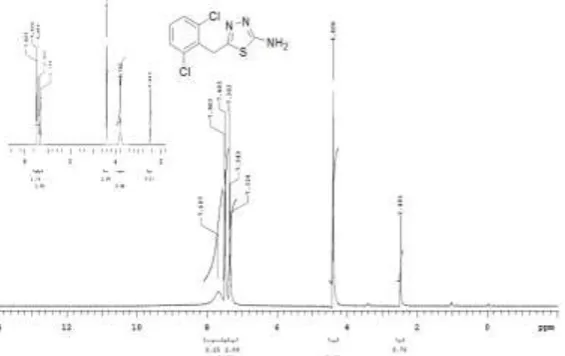
The following Figures are shown 1H NMR spectra, 13C NMR spectra for (2) compound and (4k) compound.
Figure 1.8 1H NMR spectra for N-(5-(2,6-dichlorobenzyl)-1,3,4-thiadiazole-2-yl)-4-(trifluoromethyl) benzamide (4k) compound (DMSO-d6).
Figure 1.9 13C NMR spectra for 5-(2,6-dichlorobenzyl)-1,3,4-thiadiazole-2-amine (2) compound (DMSO-d6).
VIII. CONCLUSIONS
In our study on synthesis and acylation of some new compounds containing 2-amino-1,3,4-thiadiazole ring, a total of 15 substances were synthesized, 1 recorded in the literature and 14 originals. 2-amino-1,3,4-thiadiazole derivatives and acylation reactions of these compounds were examined, and 5-(2,6-dichlorobenzyl)-1,3,4-thiadiazole-2-amine (2) was obtained from the reaction of 2-(2,6-dichlorophenylacetonitryl) (1) with thiosemicarbazide in TFA. The structures of the resulting compounds were characterized using IR, 1H-NMR,
13C-NMR, MS, and Elemental Analysis.
REFERENCES
[1]. Nelson J. A., Rose L. M. and Bennett L.L., “Effect of 2-amino-1,3,4-thiadiazole on Ribonucleotide Pools of Leukemia L1210 Cells” Cancer Research, 36: 1375-1378 (1976).
[2]. Gulerman, N., Rollas, S., Ulgen, M. and Gorrod, J. W., “Synthesis and evaluation of some substituted 1,3,4-thiadiazole derivatives”, Boll Chim. Farmaceutico-Anno, 7: 375–379 (1995).
[3]. Pulvermacher, G., “Ueber einige akommlinge des thiosemicarbazids und umsetzungpoducte derselben”, Berlin, 27: 613-630 (1894). [4]. Partt, E. F. and Kamlet, M. M., “Reaction rates by distillation. IX the condensation of anilines with benzadeydes”,
J. Org. Chem., 26: 4029-4032 (1961).
[5]. Young G., and Eyre W., “III-Oxidation of benzalthiosemicarbazone” J. Chem. Soc. Trans, 79: 54-60 (1901
[6]. Schenone, S. Brullo, C. Bruno, O. Bondavalli, F. Ranise, A. Flippeli, W. Rinaldi, B. Capuano, A. and Falcone, G., “New 1,3,4-thiadiazole derivatives and owed with analgesic and anti-inflammatory activities”, Bioorg. Med. Chem., 14: 1698-1705 (2006). [7]. Raj MM, Patel HV, Raj LM, Patel NK. Synthesis and biological evaluation of some new 1, 3, 4- thiadiazole derivatives for their
antimicrobial activities. Int J Pharm Chem Biol Sci 2013; 3(3):814-820.
[8]. Er M, Isildak G, Tahtaci H, and Karakurt T., “Novel 2-amino-1,3,4-thiadiazoles and their acyl derivatives: Synthesis, structural characterization, molecular docking studies and comparison of experimental and computational results” J Mol Struct, 1110:102– 113 (2016).