138
International Journal of Pharmaceutical Sciences and Drug Research
2015; 7(2): 138-142
Research Article
CODEN (USA): IJPSPP
ISSN: 0975-248X
Development of Compression Coated Pantoprazole Tablets Using Spray
Dried Polymer Blend: Evaluation and Process Optimisation by Extreme
Vertices Design
Seemanchala Rath
*, Arna Pal, Somnath Surai, Debanjan Das, Richinandan Maiti,
Nripendra Nath Bala, Krishnanghu Ray, Bijan Kumar Gupta
BCDA College of Pharmacy and Technology, 78, Jessore Road (south), Hridaypur, Barasat, Kolkata- 700127, West Bengal, India
ABSTRACT
In the present investigation, a combination of Eudragit L 30 D 55 and ethyl cellulose are used as enteric materials in a spray dried form to constitute the barrier layer for compression coating of directly compressed PSS core tablets. The study also includes analysis of the effect of Eudragit L 30 D 55 and ethyl cellulose and their optimisation using an extreme vertices design. Dissolution profile of compression coated tablets was best fitted to zero order and first order dissolution models. Mechanism of drug release was found to be Super case - II transport in all the batches as evidenced from the release exponent values of the Korsmeyer Peppas model. Mixture regression equations have indicated that Eudragit L 30 D 55 has more contribution towards the delayed drug release pattern, because it controls drug release below pH 6 in the acidic medium. Normal probability plots supported the accuracy of the chosen mixture design model for studying the effect of independent mixture variables, and had also shown that the residual values of response variables were minimal. Press coated tablets prepared using these optimised ratios of two mixture components have shown no statistical significant difference between their predicted and observed values of response variables as evidenced from the paired t-test (p-value > 0.2 in all the cases).
Keywords: Delayed release, dissolution, Eudragit L 30 D 55, mixture regression equations, normal probability plots, press coating.
INTRODUCTION
Direct compression is an accepted pharmaceutical manufacturing technique because of its many advantages such as low equipment costs, short processing time and limited steps, low labour and
*Corresponding author: Dr. Seemanchala Rath, Assistant Professor, BCDA College of Pharmacy and Technology, 78, Jessore Road (south), Hridaypur, Barasat, Kolkata- 700127, West Bengal, India; Tel.: +91-9903858927; E-mail: [email protected]
Received: 27 February, 2015; Accepted: 26 March, 2015
energy requirements, and use of non solvent processes. This technique has been applied to prepare different solid dosage forms, such as fast-disintegrating tablets or controlled-release formulations. Time-controlled release preparations have been extensively developed to achieve time- and/or site-specific release. In order to achieve the chronopharmaceutical design for these time-controlled release preparations, currently formulation design to control the lag time is prior to the substantial release of drug. [1] Press coated tablets
Int. J. Pharm. Sci. Drug Res. March-April, 2015, Vol 7, Issue 2 (138-142)
drugs from moisture, light, oxygen or other environmental ill effects or decomposition of acid-labile drugs by gastric fluids; to separate incompatible drugs from each other; to achieve a sustained release in that the drug in the core is embedded in waxes or fats constituting a depot; to protect the gastric mucosa from irritation by certain drugs through using enteric coating material in the outer press-coating granules; or to achieve intermittent release by incorporating one portion of drug in the core and the other in the coat, separated by a film-coat or a second press-coat. However, common drawbacks of the press-coating technique are the multistep processes involved, and the requirement for reliable and reproducible central positioning of the core tablet within press-coated tablet (PCT), a major challenge for large scale industrial manufacturing. The lag time of drug release from PCTs depends upon the thickness and the composition of the barrier layer. In other words, the thicker the barrier layer, the longer the lag time. The composition of the barrier layer controls the mechanism of affecting a lag time. [2] In the present investigation, a novel method of
compression coating is explored to observe the effect of barrier layer compositions on the lag time using an extreme vertices design. The model drug chosen for development of press coated tablets is Pantoprazole sodium sesquihydrate (PSS), a proton pump inhibitor, used in the treatment of digestive ulcers, gastro-esophageal reflux disease and Helicobacter pylori
infections. [3] It is a prodrug, chemically known as
Sodium 5-(difluoromethoxy)-2-[(RS)-[(3, 4-dimethoxypyridin-2-yl)methyl]sulphinyl]
benzimidazol-1-ide sesquihydrate [4] that degrades once
protonated in acidic media. So, the drug protonation for activation must occur inside the gastric parietal cells, and the tetracyclic form of pantoprazole binds irreversibly to cystein residues of the proton pump (H+/K+ ATPase). In this way, pantoprazole must be
absorbed intact before activation and, because of this; it requires an enteric drug delivery system. [5] Therefore, a
combination of Eudragit L 30 D 55 (EL) and Ethyl cellulose (EC) are used as enteric materials in a spray dried form to constitute the barrier layer for press coating. PSS core tablets are prepared by direct compression using microcrystalline cellulose (MCC, Avicel PH-112), croscarmellose sodium (CCS, Ac-Di-Sol) and magnesium stearate (MS). EL is available as 30% aqueous dispersion of an anionic copolymer based on methacrylic acid and ethyl acrylate and soluble at pH above 6. The ratio of the free carboxyl groups to the ester groups is approximately 1:1 in Eudragit L 30 D 55.
[6] Ethyl cellulose is a well-known water-insoluble
polymer that has long been used as a rate-controlling membrane in medication dosage forms to regulate drug release. The study also includes optimization of the ratio of EL and EC to develop enteric press coated PSS tablets in order to protect the drug from the acidic
environment of stomach by achieving sufficient lag time.
MATERIALS AND METHODS Materials
Pantoprazole sodium sesquihydrate (PSS) was obtained as a gift sample from Alkem Laboratories. Pvt. Ltd., Mumbai, India. Microcrystalline cellulose (Avicel PH-112) (MCC) and croscarmellose sodium (CCS) were obtained as gift samples from Torrent Pharmaceuticals, Baddi, H.P., India. Eudragit L 30 D-55 (EL) - 30% aqueous dispersion was obtained as a gift sample from Alembic Pvt. Ltd., Vadodara, Gujurat, India. Magnesium stearate (MS) and ethyl cellulose (EC) were purchased from Loba chemie. Pvt. Ltd, Mumbai. Sodium hydroxide (NaOH), potassium dihydrogen phosphate (KH2PO4) and hydrochloric acid (HCl) were
purchased from Merck Pvt. Ltd. Double distilled water (DDW) was prepared in the laboratory from demineralised water. All the reagents used were of analytical grade and were used as received.
Formulation of core tablets
The inner core tablets were prepared by direct compression method. Powder mixtures of PSS, MCC (Avicel PH-112) and CCS (Ac-Di-Sol) were dry blended for 30 minutes followed by addition of MS. The mixtures were then further blended for 15 minutes and subjected to compression by a 6 mm (diameter) round flat faced Cadmatch single station tablet compression machine. Amount of PSS, Avicel PH-112, Ac-Di-Sol and MS used were 44.76, 73.24, 4 and 3 mg/tablet. Amount of PSS (44.76) used was equivalent to 40 mg of pantoprazole.
Formulation of barrier layer
EL and EC were dissolved in ethanol and the resultant clear solution was kept for stirring on a magnetic stirrer for 30 minutes to ensure complete mixing of the polymers. Spray drying was carried out using a laboratory scale spray dryer (Jay Instruments and System Pvt. Ltd., India) under the following set of conditions: inlet temperature 115°C, outlet temperature 55°C, atomization air pressure 120 kPa, aspiration pressure –2.5 kPa, flow rate 10 ml/min. The powder sample was sieved through a 250µm sieve and stored in a desiccator over silica gel self-indicating coarse for further use. An extreme vertices design was employed to formulate five different batches of powder mixture (barrier layer) according to different ratios of EL and EC. Spray drying technology is explored in the study to produce directly compressible polymeric mixtures as an enteric material. [7]
Preparation of press-coated tablets
Int. J. Pharm. Sci. Drug Res. March-April, 2015, Vol 7, Issue 2 (138-142)
20 seconds to prepare the compression-coated tablets. [1-2]
Evaluation of tablets
Core tablets (CT) and different batches of press coated tablets (C1 to C5) were subjected to hardness test, friability test and drug content determination in a triplicate manner. The friability test of all the tablets was conducted using a Roche friabilator by taking 5 tablets in each replicate. Monsanto hardness tester was used for the determination of hardness of tablets. Weight variation test of CT was carried out by taking 20 tablets as per USP. [8] For the determination of drug
content, total 10 tablets were weighed, triturated and powder equivalent to 44.76 mg of pantoprazole was weighed and dissolved in phosphate buffer solution having pH 7.4 (PBS) followed by dilution up to 1000 ml with PBS. Then 5 ml of the above solution was added to 5 ml of 0.1 M HCl and the resulting solution was diluted up to 25 ml with PBS. The final solution was subjected to absorbance measurement under UV-visible spectrophotometer at 289 nm against a mixture of 0.1 M HCl and PBS in the ratio of 1:4 v/v as reference standard or blank.
In-vitro dissolution study and mechanism of drug
release
For the in vitro dissolution study of directly compressed core tablets as well as different batches of press coated tablets containing PSS, United States Pharmacopeia (USP) apparatus-1 (basket type, LABINDIA, DISSO) was used. Dissolution of core tablets was carried out in 900 ml of 0.1 M HCl at 37 ± 0.5°C and the basket was rotated at 60 rpm. Samples withdrawn at an interval of 5 minutes from the starting of dissolution were diluted up to 25 ml with PBS and analysed for the amount of PSS released under UV-visible spectrophotometer at 289 nm against a mixture of 0.1 M HCl and PBS in the ratio of 1:4 v/v as reference standard. Each time after sample withdrawn 5 ml of 0.1 M HCl was also replaced. In case of press coated tablets, dissolution was carried out in 900 ml of 0.1 M HCl (acidic medium) for 2 hour followed by 4 hour in 900 ml of PBS (alkaline medium) at 60 rpm at a temperature of 37 ± 0.5°C. [9]
Samples withdrawn at an interval of 0.5 hour from the starting of dissolution were diluted up to 25 ml with PBS (for first four samples in case of acidic medium) and analysed for the amount of PSS released under UV-visible spectrophotometer at 289 nm against a mixture of 0.1 M HCl and PBS in the ratio of 1:4 v/v as reference standard. After 2 hour, samples withdrawn (5 ml) from alkaline medium were added to 5 ml of 0.1 M HCl and diluted up to 25 ml with PBS followed by analysis for the amount of PSS released as above. Data of the in-vitro dissolution study were fitted into different mathematical models [10] such as Zero order, [11] First order, [12] Higuchi, [13] Hixson Crowell [14] and
Korsmeyer Peppas model [15] and their correlation
coefficient (R2) values were used as an indicator of the
best fitting for each of the models. Korsmeyer Peppas model was fitted to identify the mechanism of drug
release, [16] which was determined from the slope of the
model or release exponent (n) values. [17]
Mathematical and statistical analyses
An extreme vertices design was employed considering amount of EL (X1) and amount of EC (X2) as two
mixture components (independent variables) and 5 different batches of spray dried directly compressible polymeric mixture were prepared in a triplicate manner (Table 1). Percentage of drug released (% DR) at 2 hour (Q2) and 4 hour (Q4) were taken as two response
variables to study the effect of EL and EC on the release profile of PSS from its press coated tablets. Regression coefficients of the mixture components were determined to emphasize the effect of EL and EC on the response variables. Residuals and percentage bias were calculated along with construction of normal probability plot to check the model accuracy. Analysis of variance (ANOVA) was performed to study the statistical significance of mixture components and the interaction term (quadratic model; two linear terms with one interaction term). Minitab 15 and SAS (for optimisation) were used for statistical and mathematical analyses. [18]
Table 1: Formulations of barrier layers (300mg) by extreme vertices design
Formulation code C1 C2 C3 C4 C5 EL : EC (Ratio in
percentage) 100 : 0 75 : 25 50 : 50 25 : 75 0 : 100
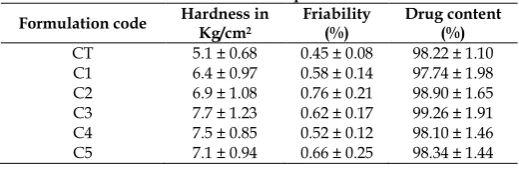
Table 2: Evaluation of core tablets and press coated tablets Formulation code Hardness inKg/cm2 Friability(%) Drug content(%)
CT 5.1 ± 0.68 0.45 ± 0.08 98.22 ± 1.10
C1 6.4 ± 0.97 0.58 ± 0.14 97.74 ± 1.98
C2 6.9 ± 1.08 0.76 ± 0.21 98.90 ± 1.65
C3 7.7 ± 1.23 0.62 ± 0.17 99.26 ± 1.91
C4 7.5 ± 0.85 0.52 ± 0.12 98.10 ± 1.46
C5 7.1 ± 0.94 0.66 ± 0.25 98.34 ± 1.44
RESULTS AND DISCUSSION Evaluation of tablets
In all formulations, the hardness test indicated good mechanical strength, which is sufficient to render them tamper proof. Hardness was ranged from 6.4 to 7.7 Kg/cm2 in case of press coated tablets, whereas it was
5.1 ± 0.68 Kg/cm2 in case of core tablets (CT). Friability
Int. J. Pharm. Sci. Drug Res. March-April, 2015, Vol 7, Issue 2 (138-142)
absorption maxima was determined by scanning different concentration of PSS solution in PBS. Absorption maxima was 289 nm and method obeys Beer's law in concentration range 1 to 20μg/ml, with good correlation coefficient (0.9994 ± 0.0002, n=3).
In-vitro dissolution study and mechanism of drug
release
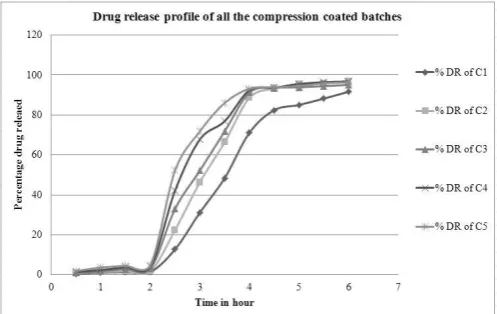
All the batches of press coated tablets shown a delayed drug release pattern, having maximum % DR of 4.91 (in case of C5) after 2 hour. However, more than 95% of PSS was released from the core tablets within 30 minutes. A sufficient lag time of 2 hour was achieved by compression coating with directly compressible polymeric mixtures of EL and EC as an enteric material. It was clearly evident from the dissolution profile that as the ratio of EL decreases consequently drug release increases from the press coated tablets (Figure 1). After 2 hour, % DR was minimal from C1 (1.45 ± 0.39%), whereas highest from C5 (4.91 ± 0.86 %). This drug release pattern may be attributed to the highest ratio of EL (100 %) in C1 and absence of EL in C5. Drug release markedly goes up from all the formulations after 2 hour, because EL allows drug release above pH 6. [6] R2
values of different mathematical models depicted that all the formulations from C2 to C5 were best fitted to First order model whereas C1 was best fitted to Zero order dissolution model ( R2 = 0.9272). The n value of
Korsmeyer Peppas model ranges from 1.9335 to 2.6093 (Table 3) in case of all the batches which indicates that the drug release occurred through Super case - II transport mechanism (n – value > 0.89). [16-17] Core
tablets have also shown the same drug release mechanism that is Super case - II transport (n – value = 0.9963). As evident from the R2 values, dissolution
profile of core tablets follows Korsmeyer Peppas model (R2 = 0.9683). R2 values of all the five batches for
different mathematical models along with slope of Korsmeyer Peppas model were shown in Table 3. Mathematical and statistical analyses
Mixture regression equations including linear and interaction terms were utilised to evaluate the effect of EL and EC on the response variables (Q2 and Q4). The
regression equations describing percentage of drug released (% DR) at 2 hour (Q2) and 4 hour (Q4) were as
follows.
It was clearly indicated by the mixture regression equations that EC produces higher value of both Q2
and Q4 and EL has more contribution towards delayed
release, because coefficient of EC (X2) is higher than
that of EL (X1) in their respective equations. Moreover,
coefficient of interaction term (X1X2) is negative in the
equation of Q2, which indicates, mixture of EL and EC
produces delayed drug release at 2 hour (in the acidic medium). This lag time is indeed essential for the therapeutic activity of PSS, which degrades in the acidic medium. However, after 4 hour (in alkaline medium) mixture regression equation revealed that
release controlling effect of the polymer blend decreases, because the coefficient of interaction term (X1X2) is positive. [18] This effect is attributed to the
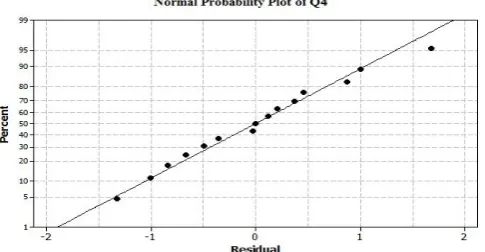
solubility of EL in alkaline medium. According to the results of ANOVA, linear as well as interaction terms were having statistically significant effect (p – value < 0.0001) on the response variables. Normal probability plots for the residuals of Q2 and Q4 were shown in
Figure 2 and 3 respectively. The points on these plot lie reasonably close to a straight line (R2 value = 0.9850 for
Q2 and 0.9910 for Q4 respectively) lending support to
the mixture model chosen for studying the effect of independent mixture variables. [18] Normal probability
plots had also shown that the residual values were minimal and vary within -0.25 to +0.25 in case of Q2
and within -1.5 to +2 in case of Q4.
Fig. 1: Drug release profile of all the compression coated batches
Table 3: R2 values and release exponent of different mathematical models
R2-values and Release
exponent C1 C2 C3 C4 C5
R2-value of Zero Order 0.9272 0.9082 0.8978 0.8802 0.8486 R2-value of First Order 0.908 0.9097 0.907 0.9377 0.9375 R2-value of Korsmeyer
Peppas 0.8988 0.8664 0.8803 0.8692 0.8567 R2-value of Hixson
Crowell 0.9134 0.8717 0.8533 0.8256 0.7979 R2-value of Higuchi 0.8726 0.8804 0.8869 0.8854 0.8682 Release Exponent (n)
value of Korsmeyer
Peppas 2.6093 2.3541 2.3114 2.0447 1.9335
Int. J. Pharm. Sci. Drug Res. March-April, 2015, Vol 7, Issue 2 (138-142) Fig. 3: Normal probability plot of Q4
Optimisation
Amount of EC and EL were optimised by SAS using prediction profiler having target value of 2% for Q2 and
80% for Q4. Therefore, two optimised values were
obtained, such as 78.4 : 21.6 percentage ratio of EL : EC (predicted values of Q2 and Q4 were 2.01% and 83.68%
respectively) and 85 : 15 percentage ratio of EL : EC (predicted values of Q2 and Q4 were 1.8% and 80.77%
respectively). Press coated tablets prepared using these optimised values had shown no statistical significant difference between their predicted and observed values of Q2 ad Q4 as evidenced from the paired t-test (p-value = 0.2481 and 0.3436 for Q2 and Q4 respectively in case of 78.4 : 21.6 percentage ratio of EL : EC; and p-value = 0.2170 and 0.2707 for Q2 and Q4 respectively in case of 85 : 15 percentage ratio of EL : EC).
Compression coated tablets of pantoprazole sodium sesquihydrate were successfully prepared with sufficient lag time using combination of Eudragit L 30 D 55 and ethyl cellulose in a spray dried form. All the compression coated tablets had shown delayed drug release profile of approximately 5 % within 2 hour in the acidic medium and a sustained release pattern in the alkaline medium. In addition, hardness, friability, weight variation and content uniformity tests have shown satisfactory results. Dissolution profile of C1 was best fitted to zero order model, whereas that of others were best fitted to first order dissolution model. Drug release was found to be occurred through Super case - II transport mechanism as evidenced from the release exponent values of Korsmeyer Peppas model. Mixture regression equations have indicated that Eudragit L 30 D 55 has more contribution towards the delayed drug release pattern, because it controls drug release below pH 6 in the acidic medium. Normal probability plots supported the accuracy of the chosen mixture design model for studying the effect of independent mixture variables, and had also shown that the residual values of response variables were minimal. Press coated tablets prepared using these optimised ratios of two mixture components have shown no statistical significant difference between their predicted and observed values of response variables as evidenced from the paired t-test (p-value > 0.2 in all the cases).
ACKNOWLEDGEMENTS
Authors would like to thank BCDA Governing body members and BCDA Members Benevolent Trust.
REFERENCES
1. Lin SY, Li MJ, Lin KH. Hydrophilic excipients modulate the time lag of time-controlled disintegrating press-coated tablets. AAPS PharmSciTech. 2004; 5 (4) Article 54: 1-5. 2. Janugade BU, Patil SS, Patil SV, Lade PD. Formulation and
evaluation of press-coated montelukast sodium tablets for pulsatile drug delivery system. Int J ChemTech Res. 2009; 1(3): 690-695.
3. Raffin RP, Jornada D, Haas S, Pohlmann AR, Silvia S, Guterres SS, Pantoprazole sodium-loaded controlled release microparticles prepared by spray drying. 15th International Symposium on Microencapsulation, Sep 2005, pp.18-21; Parma, Italy.
4. British Pharmacopoeia Commission Office. The British Pharmacopoeia Vol. II. The Stationery Office, London; 2009: 5872.
5. Sharma HK, Pradhan SP, Sarangi B. Preparation and in vitro evaluation of enteric controlled release pantoprazole loaded microbeads using natural mucoadhesive substance from
Dillenia indica L. Int J PharmTech Res. 2010; 2(1): 542-551. 6. Blanco-Prieto MJ, Delie F. Particulate systems for oral drug
delivery. In: Benita S (ed). Microencapsulation methods and industrial applications. Edn 2, Taylor and Francis Group, New York: CRC Press, 2006, pp. 533-535.
7. Pokharkar V, Khanna A, Venkatpurwar V, Dhar S, Mandpe L, Ternary complexation of carvedilol, β-cyclodextrin and citric acid for mouth-dissolving tablet formulation. Acta Pharm.2009; 59: 121-132.
8. Banker GS, Anderson NR. Tablets. In: Lachman L, Lieberman HA, Kanig JL (eds). The theory and practice of industrial pharmacy. Edn 3, Varghese Publishing House, Bombay, 1990, pp. 297-301.
9. Prakash K, Raju PN, Shanta KK, Lakshmi MN. Preparation and characterization of lamivudine microcapsules using various cellulose polymers. Trop J Pharm Res. 2007; 6 (4): 841-847.
10. Rath S, Gupta BK, Datta D, Bala NN, Banik K. Solid dispersion of telmisartan using full factorial design. Am J Pharm Health Res. 2013; 1(7): 51-59.
11. Shoaib MH, Tazeen J, Merchant HA, Yousuf RI. Evaluation of drug release kinetics from ibuprofen matrix tablets using HPMC. Pak J Pharm Sci. 2006; 19(2): 119-124.
12. Donbrow M, Samuelov Y. Zero order drug delivery from double-layered porous films: release rate profiles from ethyl cellulose, hydroxypropylcellulose and polyethylene glycol mixtures. J Pharm Pharmacol. 1980; 32 (7): 463-470.
13. Higuchi, T. Mechanism of sustained-action medication. Theoretical analysis of rate of release of solid drugs dispersed in solid matrices. J Pharm Sci. 1963; 52(12): 1145-1149. 14. Sinko PJ. Martin’s Physical Pharmacy and Pharmaceutical
Sciences. Edn 5, New York: Lippincott William’s & Wilkins Publishers, 2006.
15. Korsmeyer RW, Gurny R, Doelker EM, Buri P, Peppas NA. Mechanism of solute release from porous hydrophilic polymers. Int J Pharm. 1983; 15(1): 25-35.
16. Peppas NA. Analysis of Fickian and non-Fickian drug release from polymers. Pharm Acta Helv. 1985; 60: 110-111.
17. Avachat A, Kotwal V. Design and evaluation of matrix-based controlled release tablets of diclofenac sodium and chondroitin sulphate. AAPS Pharm Sci Tech. 2007; 8: 51-56. 18. Montgomery DC. Design and analysis of experiments. Edn 5,
New York: John Willey & Sons, Inc., 2000.