Vol. 05, Issue 11 (November. 2015), ||V2|| PP 10-15
Cation Exchanges on Stabilized Soft Clay Using
Electrokinetic Process
Nahesson Hotmarama Panjaitan
1, Arwadi Sinuraya
21 Lecturer of Department of Civil Engineering State University of Medan, Indonesia, 2
Lecturer of Department of Electrical Engineering State University of Medan, Indonesia
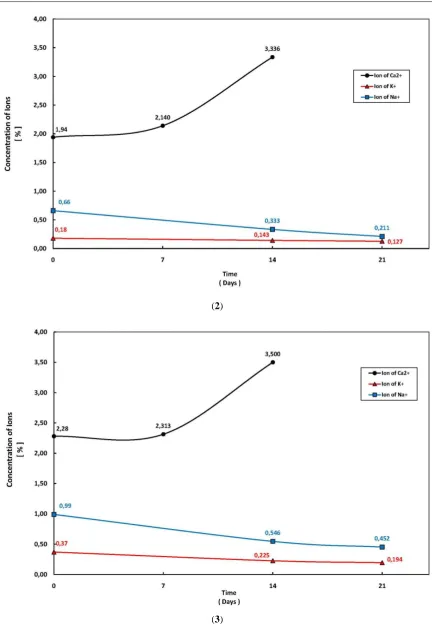
Abstract: This research study is a part of research of soft clay and expansive clay stabilization with electrokinetic process. The movement of electricity in the clay caused to several phenomena including electrochemistry, electrophoresis, and elektroosmosis. In this study, the author discusses the phenomenon of cation exchange on expansive clays that occur during the electrokinetic process. Exchanger ions in this study is a calcium ions (Ca2+) which is used as a stabilizer. Research carried out on 3 types of soft clay and expansive to get the behavior of cation exchange phenomenon is more valid and complete on clay soil. Electrokinetic process is done by using direct current (DC) with capacity 5 until 10 Volt. Observation of the phenomenon of cation exchange is done by measuring the concentration of calcium ion (Ca2+) and compared to other ion concentration contained in clay for a certain period by using the AAS method (Atomic Absorption Spectrum). The results showed that an increase in the concentration of Ca2+ ions in the clay during the electrokinetic process. Increased Ca2+ offset by a reduction in other cations, such as sodium (Na+), and pottasium (K+) in the clay. The results could be used as a basic knowledge in developing electrokinetic processes as an alternative to expansive clay stabilization effort.
Keywords: Cation exchange, electrokinetics process, soft clay, expansive clay, stabilization, lime
I.
INTRODUCTION
The ability of electrons moving inside a conductor media, including clay that has a very high plasticity, is one of the advantages of electrokinetic that can be developed and used in the stabilization effort expansive clays. The movement of electrons during the electrokinetic process causes an electric field and allow the release of charged ions that are bound on the surface of the clay molecules. The effect of charged ions that dislocated on the surface of clay molecules cause of changes equilibrium of the electrical charge in clay soil. To establish equilibrium electric charge, the molecules of clay are known to have a negative charge [1] attract and bind positively charged ions (cations) which are located around the molecule clay. This study was conducted to observe the phenomenon of cation exchange on clay due electrokinetic process.
II.
LITERATURE
REVIEW
2.1. Clay Soil
Fig. 1. Some types of clay minerals by comparison bonding silica and alumina at its constituent molecules [1]
2.2. Electrokinetics Process
Electrokinetic is the movement of particles or minerals on a conductor medium that is caused by the electrical. The movement of particles or minerals is caused by an electric field that occurs in media conductor. The electric field in the conductor medium formed by the movement of electrons from the negative (anode) to the positive pole (cathode) [4]. In the basic theory,the movement of electricity in clay can cause phenomena like electrochemical, electrophoresis, elektroosmosis, and also the phenomenon of cation exchange. In real terms this study may also indicate the occurrence of these phenomena, among others, the movement of ions during the electrokinetic process [5] (Fig. 2), and phenomenon of cation exchange [6]. The electric field that formed by the movement of electricity in clay, cause changes electrical charge in the clay. To establish a new equilibrium, molecule of clay need cations. The cations can be obtained from water molecules that have a bipolar nature and also the free cations which are located around the clay molecules. Lime (in the form of solutions, Ca (OH)2) which is used as a stabilizer, due to electrokinetic process undergoes a chemical reaction (electrochemical). If placed in the chamber of negative electrode (cathode), lime will react and produce hydroxyl ions (OH-), and the calcium ion (Ca2+) if placed in the chamber of positive electrode (anode). The chemical reaction of the aqueous solution of lime (Ca (OH)2) during the electrokinetic process is as follows:
Anode : 2H2O 4H+ + O2 [1] Cathode : 2H2O 2(OH)- + H2 [2]
Fig. 2. Visual observation of the movement of ions caused electrokinetics process on clay sample (a). condition at cathode chamber (upper left corner of the image is condition before electrokinetics) (b). traces of lime on the
finger [6]
2.3. Cation Exchange
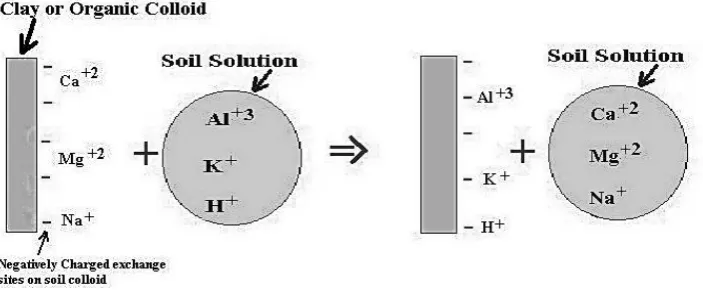
Cation exchange on clay stabilization process with the use of stabilizers, usually influenced by several factors, including: valence of ions, ion size and electronegativity potential of ion. These factors influence the rate of reactivity of an ion, which ions with a higher valence and larger size, able to replace ions with the smaller number valence and size. Ions (cations and anions) have the potential electronegativities to bind the free ion else around, to establish a new equilibrium charge. Potential electronegativity is a chemical property that describes the ability of an atom to attract electrons towards itself in ionic bonds [7]. Sequence of ions based on its reactivity level, compiled from the ions that have a small reactivity to ions that have a large reactivity is as follows [1]: Li+ - Na+ - K+ - Rb+ - Cs+ - Mg2+ - Ca2+ - Ba2+ - Cu2+ - Al3+ - Fe3+ - Th4+. The sequence of these ions is also known as Volta series. Under terms of the cation exchange, ion which is located to the left of other ions can be replaced by ion on the right. For example Ca2+ can replace ions Mg2+, Na+, K+, Na+ and Li+ (Fig. 3).
Fig. 3. Analogy of cation exchange on clay particles
In the electrokinetic process, the exchange of cations on the surface of clay accelerated with the advent of the electric field due to the movement of electricity on clay. The electric field causes the electric force that can attracts cations on the surface of the clay. Cations that apart from the surface of the clay leads to changes of the electric charge equilibrium, where the surface of the clay have excess negative charge. To establish a new equilibrium charge, then clay attract cations free which are its around. Stabilizers material (in this case is lime), during the electrokinetic process undergoes a chemical reaction at the positive pole (anode) generates Ca2+. The movement of electrons from the cathode to the anode causes Ca2+ ions move towards the cathode. When the speed of Ca2+ ions are in ideal conditions (not too fast or too slow), the surface of the clay will draw Ca2+ and form new bonds. The phenomenon of cation exchange will be completed if the number of positive charges is relatively similar to the amount of negative charge on the surface of the clay.
III.
SCOPE
AND
LIMITATIONS
connected to the main power supply, and additional electrodes were placed along the clay sample with a certain distance and connected with AVO meter.
Fig. 4. Schematic of testing of electrokinetics process on expansive clay [6]
V.
RESULT
AND
DISCUSSION
The test results of changes in the concentration of some cations on the clay during the electrokinetic process occurs can be seen in Fig. 5 below.
(2)
(3)
Fig. 5. Step by step the phenomenon of cation exchange on (1). Clay A, (2). Clay B, and (3). Clay C
VII.
ACKNOWLEDGEMENTS
This research funded by the Indonesian government c/q Ministry of Research, Technology and Higher Education (RISTEKDIKTI) through the program of Competitive Grants 2014 with contract number: 016A/UN33.8/KU/2015.
REFERENCES
[1] J.K. Mitchell, Fundamentals of Soil Behavior, 2nd Ed. (John Wiley & Sons, Inc, 1992). [2] C.E.Weaver, Clays, Muds, and Shales (Amsterdam: Elsevier, 1989).
[3] H. Van Olphen, Clay Colloid Chemistry, Second Edition, (John Wiley & Sons, United State of America, 1977).
[4] N.C. Brady, & R. R. Weil, The Nature and Properties of Soils, 14th Edition. (New Jersey: Pearson Prentice Hall, 2008).
[5] Panjaitan. Nahesson Hotmarama, Rifa’i. Ahmad, Adi. Agus Darmawan, Sumardi. P, The Phenomenon of Electromigration During Electrokinetics Process On Expansive Clay Soil, International Journal of Civil & Environmental Engineering IJCEE-IJENS, 2011, Vol:12 No:04.
[6] Panjaitan. Nahesson Hotmarama, Rifa’i. Ahmad, Adi. Agus Darmawan, Sumardi. P, Experimental Study of Cation Exchange on Expansive Clay with Electrokinetics Process, International Journal of Civil & Environmental Engineering IJCEE-IJENS, 2013, Vol:13 No:02.
![Fig. 4. Schematic of testing of electrokinetics process on expansive clay [6]](https://thumb-us.123doks.com/thumbv2/123dok_us/7824990.1665817/4.595.75.522.510.770/fig-schematic-testing-electrokinetics-process-expansive-clay.webp)