A Survey on How Black Hole and Worm Hole
Attack Evolves on AODV Routing Protocol
Mr. R. A. Mukkawar Prof. S. Y. Gawali
M.E Student Assistant Professor
Department of Computer Science & Engineering Department of Computer Science & Engineering B.N.C.O.E. Pusad. Dist. Yavatmal (MS) INDIA B.N.C.O.E. Pusad. Dist. Yavatmal (MS) INDIA
Abstract
Mobile ad-hoc network (MANET) is a collection of wireless mobile nodes dynamically forming a temporary network without any standard infrastructure. The network topology changes in MANET that’s why these are decentralized networks where the nodes communicate with each other on the basis of mutual trust. MANET cannot prevent itself from the attack because of it’s feature like dynamic infrastructure less nature and decentralized networks, wireless Ad-hoc networks are unprotected and vulnerable to the attack. So the one type of attack is Black hole attack, in this the false node will sending fake routing reply to the all nodes, malicious node advertises itself as having the shortest path resulting to the packet loss. And the other type of attack is the Wormhole attack in which a pair of attackers creates the tunnels to transfer the data packets from one end to another end by corrupting it. These attacks can affect the performance of routing protocol. This paper focuses on the study of the wormhole attack and black hole attack on AODV routing protocol.
Keywords: AODV Routing Protocol, Ad-hoc, Black hole, MANET, Worm hole
________________________________________________________________________________________________________
I. INTRODUCTION
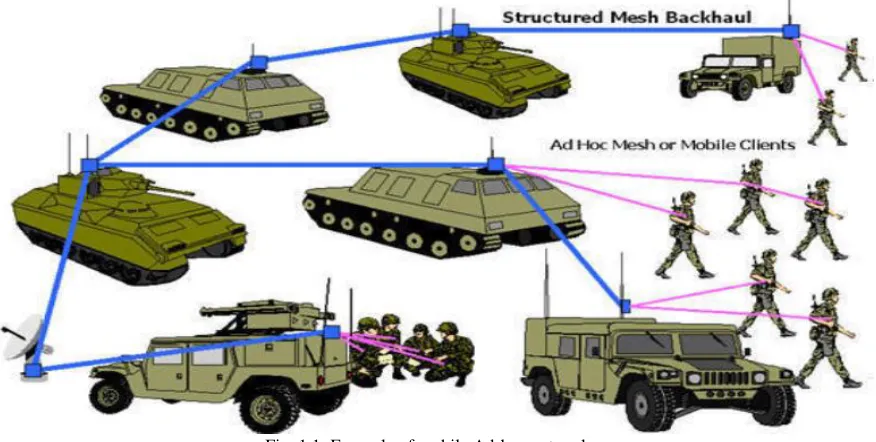
We are living in the information age. Information is an asset that has a value like any other assets. As the information is distributed, information needs to be secured from attacks and needs to be hidden from confidentiality, integrity and availability. Wireless Networking is a technology in which two or more computers communicate with each other using standard network protocols wirelessly [1]. It can be either infrastructure or infrastructure-less. In infrastructure based network, communication takes place only between the wireless nodes and the access points. In infrastructure-less network, there is no pre-existing infrastructure such as routers in wired networks or access points in wireless networks. Ad-hoc network is an infrastructure-less network and thus decentralized type of wireless network. In ad-hoc network, every node participates in routing by forwarding data to all the nodes in the network and then determining dynamically, on the basis of network connectivity, the nodes which forward data [3].
Fig. 1.1: Example of mobile Ad-hoc network.
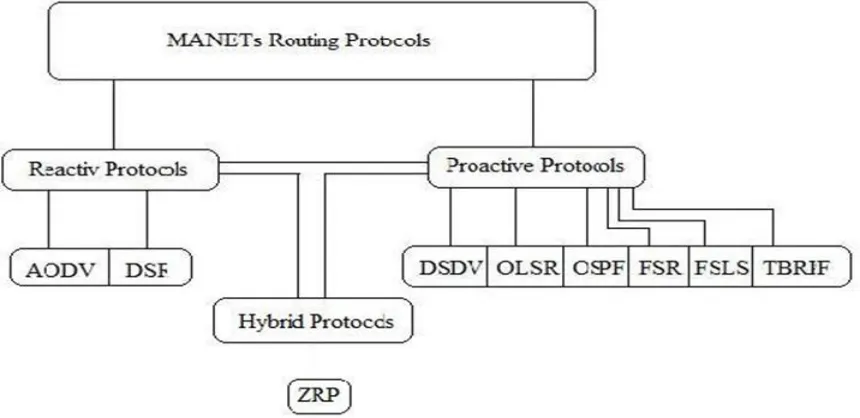
mobile device capable to maintain the information which is necessary to route the traffic. A MANET is a collection of mobile nodes that can communicate with each other without the use of predefined infrastructure or centralized administration [2]. Since no fixed infrastructure or centralized administration is available, these networks are self-organized and end-to-end communication may require routing information via several intermediate nodes. Nodes can connect each other randomly and forming arbitrary topologies. Each node in MANET acts both as a host and as a router to forward messages for other nodes that are not within the same radio range. For deployment of MANETs several routing protocols have been proposed. The protocols differ in terms of routing methodologies and the information used to make routing decisions [6]. On the behalf of their different working methodologies, these routing protocols are divided into three different categories as Reactive Protocols, Proactive Protocols and Hybrid Protocols shown in fig 2.
Fig. 1.2: Categories of MANETs Routing Protocols.
Proactive protocols, such as Optimized Link State Routing (OLSR) attempt to monitor the topology of the network in order to have route information between any source and destination available at all time. Proactive Routing Protocols are also called table driven routing protocols as all the routing information is usually kept in tables. Reactive routing protocols such as Ad hoc On Demand Distance Vector (AODV) find the route only when there is data to be transmitted and as a result, generate low control traffic and routing overhead. Hybrid protocols such as Gathering-based routing protocol (GRP) could be derived from the two previous ones, containing the advantages of both the protocols, using some quality of one type and enhancing it with the participation of the other one [5].
In wormhole attack, pair of attackers creates the tunnels to transfer the data Packets and reply them into the network. This attack has a tremendous effect on wireless networks, especially against routing protocols. In type of two ended wormhole, Wormhole attacker records packets at one end in the network and tunnels them to other end-point in the network. One end tunnels the packet via wormhole link and other end on receiving the packets and replies them to the local area [4].
In a black hole attack, malicious node waits for neighboring nodes to send RREQ messages. When the malicious node receives an RREQ message, without checking its routing table, immediately sends a false RREP message giving a route to destination over itself, assigning a high sequence number to settle in the routing table of the victim node, before other nodes send a true one. Therefore requesting nodes assume that route discovery process is completed and ignore other RREP messages and begin to send packets over malicious node. Malicious node attacks all RREQ messages this way and takes over all routes. Therefore all packets are sent to a point when they are not forwarding anywhere [10].
II. LITERATURE REVIEW
In [1], in this paper the existing techniques for detection of black hole attacks with their defects are presented. All the techniques and methodologies proposed are detection techniques which make use of proactive routing protocol which have better packet delivery ratio and correct detection probability, but have higher overheads.
In [2], a performance analysis of each technique is being discussed in detection of black hole attack. With this the protocol used to detect the attack is also explained. All the techniques and methodologies proposed by researchers are detection techniques with simulator used is described.
In [3], in this the analysis of the effect of black hole attack on AODV protocol is done. After that the degradation in performance of ad hoc on demand vector routing protocol (AODV) under black hole attack is seen.
In [5], AODV protocol is modified in such a way that black hole attack is reduced and network can be made more reliable and secured. To implement this technique used is by changing the AODV protocol in such a way that only destination will send reply message to the source to reduce the misbehavior of intermediate node. By this technique it is clear that modified ADOV has better capability to cope with black hole attack than existing AODV protocol.
In [9], A worm hole attack is been introduced and also there is focuses on its classification and the modes by which they are launched. Various detection techniques proposed for wormhole attack and effect of wormhole attack on various performance parameters is given.
Here in [10], Protocols like AODV, OLSR and ZRP are being analyzed under black hole attack using performance parameters like packet delivery ratio, average throughput, and average end to end delay.
III. AODV ROUTING PROTOCOL
Ad-hoc On Demand Distance Vector (AODV) routing protocol is used for finding a path to the destination in an ad-hoc network. To find the path to the destination all mobile nodes work in cooperation using the routing control messages. AODV Routing Protocol offers quick adaptation to dynamic network conditions, low processing and memory overhead, low network bandwidth utilization with small size control messages. The most distinguishing feature of AODV compared to the other routing protocols is that it uses a destination sequence number for each route entry. The destination sequence number is generated by the destination when a connection is requested from it. Using the destination sequence number ensures loop freedom [5]. AODV makes sure the route to the destination does not contain a loop and is the shortest path. Route Requests (RREQs), Route Replay (RREPs), Route Errors (RERRs) are control messages used for establishing a path to the destination, sent using UDP/IP protocols. When the source node wants to make a connection with the destination node, it broadcasts an RREQ message. This RREQ message is propagated from the source, received by neighbors (intermediate nodes) of the source node. The intermediate nodes broadcast the RREQ message to their neighbors. This process goes on until the packet is received by destination node or an intermediate node that has a fresh enough route entry for the destination [10].Actually the routing operations of AODV generally consist of two phases: Route discovery and Route maintenance.
Route Discovery
Route discovery is performed through broadcasting RREQ message. Whenever a node needs to send data packets to a destination, it first checks if it has an existing route in the routing table. If not, the source node will initiate a RREQ and broadcast this request to all the neighbors. Then neighboring nodes will update their routing table according to the received message.
When RREQ reaches the destination a RREP will be generated by the destination node as a response to RREQ. The RREP will be transmitted back to the originator of RREQ in order to inform the route. If an intermediate node has an active route towards destination, it can reply the RREQ with a RREP, which is called Gratuitous Route Reply. The intermediate node will also send an RREP to destination node. The RREP will be sent in reverse route of RREQ if a bidirectional link exists. As shown in figure 3.
Route Maintenance
This phase is performed with two additional messages: Hello and RRER messages. Each node broadcast Hello messages periodically to inform neighbors about its connectivity. The receiving of Hello message proves that there is an active route towards the originator. Each forwarding node should keep track of its continued connectivity to its active next hops. If a link to the next hop cannot be detected during a period of timeout, a RRER message will be broadcasted to inform the loss of connectivity. On receiving this RRER, usually a local repair will be performed just for maintenance. The expired route will be deleted after the confirmation of its unavailability.
IV. BLACK HOLE ATTACK
In a black hole attack, malicious node waits for neighboring nodes to send RREQ messages. When the malicious node receives an RREQ message, without checking its routing table, immediately sends a false RREP message giving a route to destination over itself, assigning a high sequence number to settle in the routing table of the victim node, before other nodes send a true one [1]. Therefore requesting nodes assume that route discovery process is completed and ignore other RREP messages and begin to send packets over malicious node. Malicious node attacks all RREQ messages this way and takes over all routes. Therefore all packets are sent to a point when they are not forwarding anywhere. This is called a black hole. If malicious node masquerades false RREP message as if it comes from another victim node instead of itself, all messages will be forwarded to the victim node [2]. By doing this, victim node will have to process all incoming messages and is subjected to a sleep deprivation attack [10].
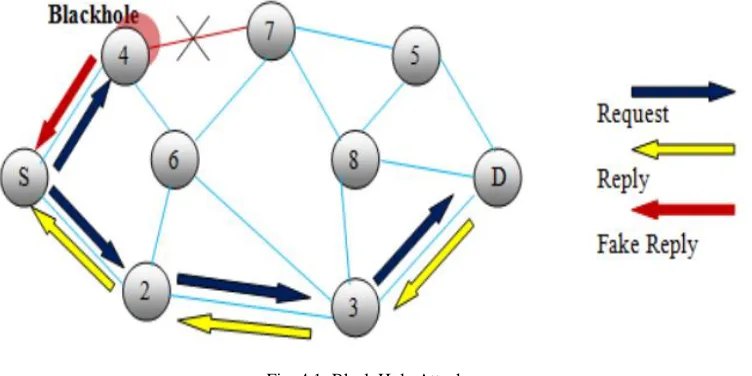
Fig. 4.1: Black Hole Attack
In above figure 4, malicious node “4” advertises itself in such a way that it has a shortest route to the destination. When source node “S” wants to send data to destination node “D”, it initiates the route discovery process. The malicious node “4” when receives the route request, it immediately sends response to source. If reply from node “4” reaches first to the source than the source node “S” ignores all other reply messages and begin to send packet via route node “2”. Now this node is Black Hole Node that will be absorbing whole packet send by node “S”. As a result, all data packets are consumed or lost at malicious node ultimately resulting into increase in throughput.
If there is one node is doing this then that will be the single type and if multiple nodes are doing this then that will be the multiple Black-Hole attack. As this kind of attack is difficult to find the most important type is this one [8].
V. WORMHOLE ATTACK
Wormhole attack consists of two nodes the attacker nodes that are connected to each other with a link basically this link is known as tunnel. The attacker node present in the network at one side captures the packet from the legitimate node and encapsulates the packet and with the help of tunnel transmits it to the other attacker node or malicious node present in the network. It consists of one or two malicious nodes and a tunnel between them [9].
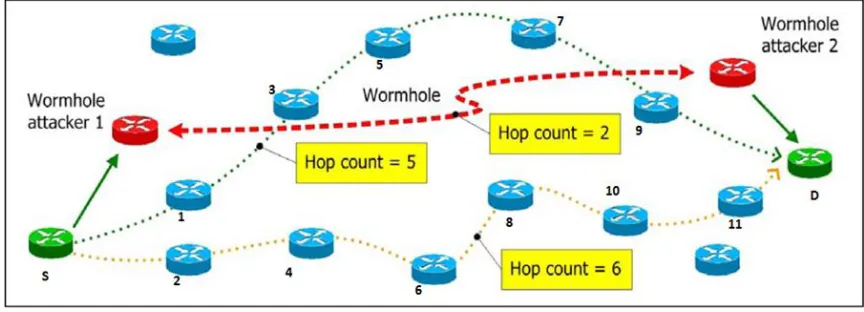
Fig. 5.1: Wormhole attack in MANET
Wormhole attack commonly involves two remote malicious nodes shown as Attacker1 and Attacker 2 as in figure 5. These two nodes connected with each other with the help of a link, the link can be wired or wireless, the link is referred as tunnel, “the wormhole tunnel” through which attacker nodes communicate with each other and all traffic passes through this tunnel and they target to attack the source node. The tunnel can be formed via in-band channel or by out-of band channel or through high transmission power. Now the source node will forward the RREQ packet to the legitimate neighbors i.e. node 1 and node 2. From the node S packet reaches to the destination node D via 1-3-5-7-9 for this way the Hop count=5. Also there is another way from S to D is via 2-4-6-8-10-11 for this route the Hop Count=6. But now as two malicious nodes are present so these two will be connected by link is known as tunnel. These nodes create an illusion to source and destination that they are immediate neighbors and they can hear each other request so transmission take place between node S and node D via attacker_1 and attacker_2. However, as attacker_1 and attacker_2 are connected via a high speed bus, RREQ from S-Attacker_1- Attacker_2-D reaches fist to D. On the other hand, other RREQ packet is also forwarded through the path 1-3-5-7-9 and 2-4-6-8-10-11 have hop count 5 and 6 respectively resulting into time required to be more than S-Attacker_1- Attacker_2-D path. And as destination D ignores the RREQ that reaches later, so chooses D-Attacker_2- Attacker_1-S to unicast an RREP packet to the source node S. Thus, a wormhole attack is not that difficult to set up, but still can be immensely harmful for a MANET. Moreover, finding better techniques for detection of wormhole attacks and securing AODV against them still remains a big challenge in Mobile Ad-hoc Networks [9].
VI. CONCLUSIONS
This paper focuses on attacks attack on routing protocol AODV in MANETs and explains the type of attack and the modes by which they are operated also the impact of wormhole attack on network. In this section the black hole attack is more effective in MANETs as compared to the wormhole attack. This is due to the fact that in black hole attack the attacker forcefully makes himself an intermediate node on a selected route. And about wormhole attack the intensity of this kind is depending on the position of both the malicious nodes i.e. attackers
REFERENCES
[1] Himani Yadav, Rakesh Kumar,“A Review on Black Hole Attack in MANET”, International Journal of Engineering Research and Applications (IJERA)
ISSN: 2248-9622 www.ijera.com Vol. 2, Issue 3, May-Jun 2012, pp.1126-1131.
[2] Dr.Hariganesh P, Jemimma Ilakia Nancy.C, “A SURVEY:PERFORMANCE ANALYSIS OF BLACK HOLE ATTACK IN MANET”, International
Journal of Advancements in Research & Technology, Volume 3, Issue 6, June-2014 72 ISSN 2278-7763, pp 72-75.
[3] Mangesh Ghonge, S.U.Nimbhorkar,“Simulation of AODV under Black hole Attack in MANET”, International Journal of Advanced Research in Computer
Science and Software Engineering, 2012.
[4] Ankita M. Shendurkar, Nitin R. Chopde, “A Review of Black Hole and Worm Hole Attack on AODV Routing Protocol in MANET”, International Journal
of Engineering Trends and Technology (IJETT), 2014.
[5] D.S.Patil, A.M.Ghorpade,“Cope with black hole attacks in AODV protocol in MANET by end to end route discovery”, IOSR Journal of Electronics &
Communication Engineering.
[6] Priyanka Goyal, Vinti Parmar, Rahul Rishi, “MANET: Vulnerabilities, Challenges, Attacks, Application”, International Journal of Computational
Engineering &Management (IJCEM), pp. 32-37, 2011.
[7] Mamta Sengar, Pawan Prakash Singh, Savita Shiwani, “Detection of Black Hole Attack In MANET Using FBC Technique”, International Journal of
Emerging Trends & Technology in Computer Science (IJETTCS), Volume 2, Issue 2, March – April 2013, pp. 269-272.
[8] Chander Diwaker, Chanchal Aghi, Kulvinder Singh, ”Detection and Prevention of Black hole Attack in MANET: A Review‖, International Journal of Emerging Technologies in Computational and Applied Sciences (IJETCAS), ISSN (Print): 2279-0047, 2013, pp. 294-297.
[8] Akansha Shrivastava, Rajni Dubey, ”Wormhole Attack in Mobile Ad-hoc Network: A Survey”, International Journal of Security and Its Applications,
2015.