The Study of Information Retrieval
Ms. J. Sharmeli Ms. V. Sanjeeya
B.E Student B.E Student
Department of Computer Science & Engineering Department of Computer Science & Engineering Valliammai Engineering College, Kattankulathur,
Kanchipuram
Valliammai Engineering College, Kattankulathur, Kanchipuram
Ms. G. Sangeetha
Assistant Professor
Department of Computer Science & Engineering Valliammai Engineering College, Kattankulathur, Kanchipuram
Abstract
The meaning of the term information retrieval can be very broad. Just getting a credit card out of your wallet so that you can type in the card number is a form of information retrieval. An information retrieval is a system where the end users extract information from www. However, as an academic field of study information retrieval might be defined as Information retrieval (IR) is finding material (usually documents) of an unstructured nature (usually text) that satisfies an information need from within large collections (usually stored on computers).
Keywords: Information Retrieval, IR Process, IR Models
________________________________________________________________________________________________________
I. INTRODUCTION
As defined in this way, information retrieval used to be an activity that only a few people are engaged in: reference librarians, paralegals, and similar professional searchers. Now the world has changed, and hundreds of millions of people engage in information retrieval every day when they use a web search engine or search their email. Information retrieval is fast becoming the dominant form of information access, overtaking traditional database style searching.
Information retrieval is a field concerned with the structure, analysis, organization, storage, searching, and retrieval of information.” (Salton, 1968).
General definition that can be applied to many types of information and search applications. Primary focus of IR since the 50s has been on text and documents. The purpose of establishing an information retrieval system
IR can also cover other kinds of data and information problems beyond that specified in the core definition above. The term “unstructured data” refers to data which does not have clear, semantically overt, easy-for-a-computer structure. It is the opposite of structured data, the canonical example of which is a relational database, of the sort companies usually use to maintain product inventories and personnel records.
In reality, almost no data are truly “unstructured”. This is definitely true of all text data if you count the latent linguistic structure of human languages. But even accepting that the intended notion of structure is overt structure, most text has structure, such as headings and paragraphs and footnotes, which is commonly represented in documents by explicit markup (such as the coding underlying web pages).
II. TYPES OF INFORMATION SYSTEM
Database Management Systems (DBMS)
Relatively small schema, large body of homogeneous data Minor or no deductive capability, Extensive formal update capability, Shared use for both read and write
Information-Retrieval Systems (IR)
Search large bodies of information which are not specifically formatted as formal data bases. Web search engine, Keyword search of a text base, typically read-only.
Knowledge-Base Systems (KBS)
III. INFORMATION RETRIEVAL PROCESSING SYSTEM
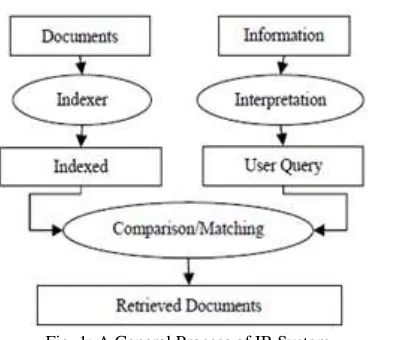
The general process of IR system has three primary processes to support: 1) representation of the information of the documents,
2) interpretation of the user's information need, and 3) Comparison of these two representations.
In the figure 1, square shape box represent data and round shape box represent processes.
Fig. 1: A General Process of IR System
Indexer collects, parses, and stores data to facilitate fast and accurate information retrieval. Index design incorporates interdisciplinary concepts from linguistics, cognitive psychology, mathematics, informatics, and computer science. Popular search engines focus on the full-text indexing of online, natural language documents. Media types such as video and audio and graphics are also indexed and searchable.
The user need information is interpreted as query. The process of representing the information need of the user is called query formulation process.
The three broad categories of web search queries can be grouped into (i) informational, (ii) navigational and (iii) transactional. Informational queries seek general information on a broad topic. There is typically not a single web page that contains all the information sought; indeed, users with informational queries typically try to assimilate information from multiple web pages. Navigational queries seek the website or home page of a single entity that the user has in mind, say Spicejet airlines. In such cases, the user's expectation is that the very first search result should be the home page of Spicejet. The user is not interested in documents containing the term Spicejet; for such a user, the best measure of user satisfaction is precision at 1.
A transactional query is one that the user performing a transaction on the Web - such as purchasing a product, downloading a file or making a reservation. In such cases, the search engine should return results listing services that provide form interfaces for such transactions.
User queries are matched against the database information. However, as opposed to classical SQL queries of a database, in information retrieval the results returned may or may not match the query, so results are typically ranked.
This ranking of results is a key difference of information retrieval searching compared to database searching.
IV. IR MODELS
An IR model specifies the details of the document representation, the query representation and the retrieval functionality. The fundamental IR models can be classified into Boolean, Vector, Probabilistic and Inference network model.
Boolean Model
The Boolean model is the first model of information retrieval and probably also the most criticized model. The Boolean model of information retrieval is a classical information retrieval (IR) model and, at the same time, the first and most adopted one. It is used by many IR systems to this day.
Vector Space Model
Gerard Salton and his colleagues suggested a model based on Luhn's similarity criterion that has a stronger theoretical motivation (Salton and McGill 1983). They considered the index representations and the query as vectors embedded in a high dimensional Euclidean space, where each term is assigned a separate dimension. The vector space model can best be characterized by its attempt to rank documents by the similarity between the query and each document [10].In the Vector Space Model(VSM), documents and query are represent as a Vector and the angle between the two vectors are computed using the similarity cosine function.
Vector Space Model have been introduce term weight scheme known as if-idf weighting. These weights have a term frequency (tf ) factor measuring the frequency of occurrence of the terms in the document or query texts and an inverse document frequency (idf) factor measuring the inverse of the number of documents that contain a query or document term .
It is a simple model based on linear algebra and computes continuous degree of similarity between queries and documents. But still long documents are poorly represented because they have poor similarity values. Semantic sensitivity; documents with similar context but different term vocabulary won't be associated, resulting in a "false negative match”.
Probabilistic Model
Whereas Maron and Kuhns introduced ranking by the probability of relevance, it was Stephen Robertson who turned the idea into a principle. He formulated the probability ranking principle, which he attributed to William Cooper, as follows (Robertson 1977). The most important characteristic of the probabilistic model is its attempt to rank documents by their probability of relevance given a query. Documents and queries are represented by binary vectors ~d and ~q, each vector element indicating whether a document attribute or term occurs in the document or query, or not. Instead of probabilities, the probabilistic model uses odds O(R), where O(R) = P(R)/1 − P(R), R means ‟document is relevant‟ and ¯R means ‟document is not relevant‟.
Inference Network Model
Do In this model, document retrieval is modeled as an inference process in an inference network. Most techniques used by IR systems can be implemented under this model. In the simplest implementation of this model, a document instantiates a term with certain strength, and the credit from multiple terms is accumulated given a query to compute the equivalent of a numeric score for the document. From an operational perspective, the strength of instantiation of a term for a document can be considered as the weight of the term in the document, and document ranking in the simplest form of this model becomes similar to ranking in the vector space model and the probabilistic models described above. The strength of instantiation of a term for a document is not defined by the model, and any formulation can be used effectively.
V. THE VARIOUS INFORMATION RETRIEVAL SCHEMES THAT HAS BEEN DONE BY OTHER AUTHORS ARE STUDIED BELOW
Paper Title Author Year Concept Advantage
Ontology-based Digital Photo Annotation Using
Multi-source Information
Yanmei Chai, Xiaoyan Zhu, Sen Zhou, Yiting Bian, Fan Bu, Wei Li and Jing Zhu
Tsinghua University
May 11-13, 2009
To overcome the difficulties of Users who encounter severe difficulties with the management
and retrieval of information, especially when they want to find a
desired one among tens of thousands of photos using just a
simple query.
It provides manual annotation by automatically extracting semantic concepts from text, EXIF metadata and face
detection result. It improves the performance of annotation by allowing users to
freely edit the annotation information. Research and Implementation of Automatic Question Answering System based on Ontology
Xingbo Xie, Wei Song, Lizhen
Liu, Chao Du, Hanshi Wang. 2015
To implement the automatic question answering system. After fusing Ontology into the automatic question-answering, the system not
only can analyze the user’s questions in the semantic level but
also combine with the user’s questions for semantic reasoning. Therefore, the users can get a better
understanding an more accurate result.
Ontology has a good concept hierarchy and supports logical
reasoning. It is better in reflecting the
logical and hierarchical relationships between knowledge than ordinary
database.
This system is not only able to answer user’s questions but
also can provide relevant recommendations, which can
help students study systematically. Document
Retrieval Using Knowledge-Based Fuzzy Information
Shyi-Ming Chen and Jeng-Yih Wang
5, MAY 1995
The knowledge is represented by a concept matrix, where the elements
in a concept represent relevant values between concepts. The implicit relevant values between
Efficient retrieving capability and flexible user’s queries are
Retrieval Techniques
concepts are inferred by the transitive closure of the concept
matrix based on fuzzy logic.
This system has implemented a fuzzy information retrieval
system called
MASTER based on the proposed method using Turbo C version
2.0 on a PC/AT Resource
Discovery and Intelligent Image
Retrieval in a Distributed
system
Sudha Ram, Shailaja Venkatasubramanyan, Stuart
Marsh and George Ball
1997
It proposes an intelligent agent based mechanisms to locate the appropriate sources of
satellite data, processing algorithms, and ancillary data that may be required at various levels of Processing to answer different types of temporal and spatial queries.
This approach makes the system scalable.
It allows users to pose high level queries and relieves the
user from the burden of deciding which resources to access, how to access them, and
how to process the data.
Paper Title Author Year Concept Advantage
Document Storage and Retrieval in a Neural
Database
P. Parodi, R.Brancaleon , F. Venuti, G. Musso, V.
Torre.
. It is mainly a document database, collecting papers on the
leech nervous system, which is maintained in a largely automatic
fashion.
This method is accurate and fast. It deals successfully with documents with an arbitrary layout, documents where graphical features are added.
Web Mining: A Key Enabler in E-Business
Nivedita Roy, Tapas
Mahapaatra. 2005
In this paper, it has been shown how web mining is integrated to the knowledge discovery process, its
potential applications, and Techniques. An integrated architecture has been presented showing b how web contribute to ebusiness via the new
technologies.
This technology helps in gaining meaningful
insights related to the day-to-day business activities by using the useful information made accessible through the web. It not only enables discovery of relevant information from mounds of data on
the WWW, but it also monitors and predicts user visit habits.
OntoWrap- Extracting Data Records from Search Engine Results
Pages Using Ontological Technique
Jer Lang Hong, Eu-Gene Siew, Simon
Egerton
2010
ontological technique using existing lexical database for
English (WordNet) for the extraction of data records. We
find that wrappers designed based on ontological technique are able to reduce the number of potential data regions to be extracted, thus they are
able to improve the data extraction accuracy.
ontological technique could extract data records effectively. It is robust in its performance. This is an advantage as the list of potential data regions for extraction
of relevant data region is significantly reduced. enhances the
extraction accuracy.
Movie Related Information Retrieval Using Ontology Based
Semantic Search
R.Suganyakala, Dr.R.R.Rajalaxmi.
A query interface which requires the user to enter the query in natural language is provided. A domain-specific ontology based on movies is
used to develop a prototype of the proposed model which improves search
accuracy.
This ontology based search model improves search accuracy. user need not have a prior knowledge of ontology based query
language which is very complex. This kind of interface tends to improve the usability of the
retrieval system VI. CONCLUSION
Through this paper, we have tried to highlight how to gain information, by using the WWW, which is considered to be the largest pool of information resources. Before starting the information retrieval process the knowledge to be extracted must be clearly identified. This technology helps in gaining meaningful insights related to the day-to-day activities by using the useful information made accessible through the web. It not only enables discovery of relevant information from millions of data on the WWW, but it also monitors and predicts user visit habits.
REFERENCES
[1] Monika Yadav and Pradeep Mittal, “Web Mining: An Introduction”, vol.3 issue 3, Mar. 2013, pp.683-687.
[2] Technical note on Data Mining prepared by Anderson Graduate school of Management at UCLA, Spring 1996. Available: http://www.anderson.ucla.edu/faculty/jason.frand/teacher/technologies/palace/datamining.htm
[3] Bharatiand M. Ramageri, “Data Mining Techniques and Applications”,Indian Journal of Computer Science and Engineering, Vol. 1 No. 4, pp.301-305. [4] MoawiaElfaki Yahia1, Murtada El-mukashfi El-taher, “A New Approach for Evaluation of Data Mining Techniques”,International Journal of Computer
Science Issues, Vol. 7, Issue 5,pp.181-186, September 2010. [5] SveinNordbotten, “Data mining with neural networks”,Bergen 2006.
[6] Alaa al Deen ,Mustafanofal and suliemanbani-Ahmed,“Classification Based Onassociation-Rule Mining Techniques: A General Surveyand Empirical Comparative Evaluation” Ubiquitous Computing and Communication Journal,vol.5,No.3,pp.9-17.
[7] C.Pabitha,G.Sangeetha “Refining SERP – Search Engine Result Page For Enhanced Information Retrieval “– IIR- IJDMTA Jan 2013
[8] G.Sangeetha,B.Saranya “An Effective Approach for Increasing the Efficiency of Web searching with Feedback Session”. – IJIRSET March 2014. [9] G.Anishya .G.Sangeetha “Efficient Information Retrieval Using PWS Framework” – IJSRD - Feb – 2015