Development Of A Re-Training Programme For
Electronics Technicians On Basic Electronics
Troubleshooting And Repairs
Abdulkadir, M; A.B. Kagara; Isah, M and Ibrahim, D
Department of Industrial and Technology Education Federal University of Technology, Minna
Abstract: This study was designed to develop a re-training programme for electronic technicians in basic electronic troubleshooting and repairs. Three research questions and two hypotheses were formulated to guide the conduct of the study. A descriptive research survey design was used for the study. A simple random sampling was used to select 150 respondents comprising of 50 electrical/electronic teachers and 100 master craftsmen as a population for the study. A structured questionnaire containing 67 items developed by the researchers and validated by experts from Industrial and Technology Edu-cation Department was used for data collection. The data collected was analyzed using mean, standard deviation; while t-test statistics was used to the hypotheses at 0.05 level of significant. The findings among others revealed that roadside technicians need training in the following areas: Identification of basic electronic component and their functions used of voltmeters to measured voltage or resistance of any components in an electronic device and analysis of electronic components and various principle of signal tracing. Based on the findings it was recommended that adequate training should be given to roadside technicians in the area of identification of basic electronic component and their functions and government should frequently organize vocational training for the roadside technicians virtually every year.
Keywords: Development, Retraining, Electronic Technician, Troubleshooting, Repairs
1 Introduction
Re-training programme have been realized as an strengthen-ing skill acquisition among electronic technicians in trouble-shooting and repairs like developed nations, they allowed eco-nomic stability through their consistent ability in reinforcing all human and material resources. With all the advances in mod-ern electronics equipment’s, trouble are still caused, most of the time by short circuit, open circuit or low direct current supply voltage (Grap, 2003). Troubleshooting as a form of problem solving most often applied to repairs of failed product or processes. It is a local systematic search for the source of a problem so that it can be solved, and so the product and process can be made operational again. According to long (1974), troubleshooting is the ability is not something someone is born with, but is the result of combining a proper procedure with skills and knowledge of the theory of the circuit. In order to trouble shoot a detective circuit, you must have a good un-derstanding of how the circuit is, and how is supposed to work in the first instance. Effective troubleshooting results from se-lective acquisition of pertinent quickly about the cause of ob-served effects. (Gupta 2000) Good trouble shooting is a matter of observing the symptoms analyzing the possible cause and effect the possible measure. There is more there just a chance that the real cause of problem is not where the symptom (Schulder, 1999).Trouble shooting requires identification of the malfunction or symptoms within a system. Experience and skill is used to generate possible causes of the symptoms. Some of these symptoms among others include: reproducing symp-tom; intermittent symptoms: and multiple problems. Usually, troubleshooting is applied to something that has suddenly stopped working, it requires critical and logical thinking troub-leshooting can also take the form of systematic checklist, pro-cedures flowchart or table that is made before problems oc-curs developing troubleshooting procedures in advance al-lows sufficient thought about the steps to take to trouble-shooting (Glen, 1998).Furthermore, it should be noted that
worth-opment activities. From the foregoing it can be seen that elec-tronic technician is a skilful person that must have a good un-derstanding of electronics circuit and concepts quickly isolate faulty component and repair the defective circuit in trouble-shooting process. Miller (1997) noted that an effective trouble shooter must have skills in troubleshooting skills like signal tracing skill test and measurement skill, skill to isolate a fault, skill to read schematic diagrams, skill to read component and find replacement. However, evidences from the literature re-vealed that road side electronic technicians, some of which are dropout from secondary schools seem to have inadequate knowledge and skills in troubleshooting. It is often said that roadside electronic technician do encounter some difficulties when troubleshooting electronic equipment (schulder, 1999). This may be as a result of inadequate training received by their masters, alongside advancement in technology and in-creasing complexity of electronic equipments. It is against this background that it becomes necessary to develop a re-training programme for electronics technicians.
2 Purpose of the Study
The purpose of the study is to develop a re-training pro-gramme for roadside electronic technicians in basic electronic troubleshooting and repairs specifically, the study sought to:
1. Identify the training need of roadside electronic techni-cians on basic skills in isolating faults in electronic equip-ment.
2. Identify the training skill content in testing and measuring voltage and resistance in electronic equipments which could facilitate troubleshooting of electronics systems.
3. Identify the signal -tracing skills in electronic devices re-quired for training these road side lectronic technicians in troubleshooting.
3 Research Questions
The following research questions were formulated to guide the study:
1. What are the training needs of road side electronic techni-cians on basic skills in isolating fault in electronic equip-ment?
2. What are the training needs of road side technicians on basic skills in testing and measuring of voltage and resis-tance in electronic equipment?
3. What are signal- tracing skills in electronics devices are required for training the road side electronic technicians in troubleshooting?
4 Hypotheses
The following hypotheses were formulated and tested at 0.05 level of significant:
1. There will be no significant difference between the mean responses of electrical/electronic teachers and electronic master craftsmen towards the training needs of roadside electronic technicians on basic skills in isolating fault in electronic equipment.
2. There will be no significant difference between the mean responses of electrical/electronic teachers and electronic master craftsmen towards the needs of road side techni-cians on basic skills in testing and measuring of measur-ing of voltage and resistance in electronic equipment.
5 Methodology
A descriptive survey research was employed for this study. A total of 150 respondents consisting of 50 electrical/electronic teachers from all the seven technical colleges in Niger State and 100 master craftsmen selected through simple random sampling from electronic workshops in Minna metropolis were used as a population for the study. The study covered the en-tire electronic technician workshop in Minna metropolis of Nig-er State. A structure questionnaire developed by the re-searcher and validated by three experts from Industrial and Technology Education Department was used for data collec-tion. The questionnaire items employed a four points rating scale of Strongly Agree (4), Agree (3), Disagree (2), and Strongly Disagree (1). 270 copies of were distributed to elec-trical/electronic teachers and electronic master craftsmen and 266 copies were dully filled by the respondents and were re-turned. Mean, Standard Deviation and t-test statistical tool were used to analyze the data for answering the research questions. Mean score of 2.50 was chosen as a decision point for accepting or rejecting items. Therefore items with mean score of 2.50 and above were considered accepted, while items with mean score of 2.49 and below were considered rejected. The null hypotheses were tested at 0.05 level of sig-nificant.
6 Results
Research Question 1
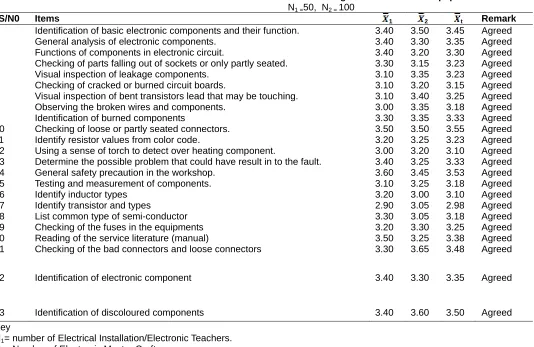
Table 2: Mean responses of Electrical Installation/Electronic Teachers and Electronic Master Craftsmen on the training need of roadside electronic technicians on basic skills in isolating fault in electronic equipment.
N1 =50, N2 = 100
S/N0 Items 1 2 t Remark
1 Identification of basic electronic components and their function. 3.40 3.50 3.45 Agreed
2 General analysis of electronic components. 3.40 3.30 3.35 Agreed
3 Functions of components in electronic circuit. 3.40 3.20 3.30 Agreed
4 Checking of parts falling out of sockets or only partly seated. 3.30 3.15 3.23 Agreed
5 Visual inspection of leakage components. 3.10 3.35 3.23 Agreed
6 Checking of cracked or burned circuit boards. 3.10 3.20 3.15 Agreed
7 Visual inspection of bent transistors lead that may be touching. 3.10 3.40 3.25 Agreed
8 Observing the broken wires and components. 3.00 3.35 3.18 Agreed
9 Identification of burned components 3.30 3.35 3.33 Agreed
10 Checking of loose or partly seated connectors. 3.50 3.50 3.55 Agreed
11 Identify resistor values from color code. 3.20 3.25 3.23 Agreed
12 Using a sense of torch to detect over heating component. 3.00 3.20 3.10 Agreed 13 Determine the possible problem that could have result in to the fault. 3.40 3.25 3.33 Agreed
14 General safety precaution in the workshop. 3.60 3.45 3.53 Agreed
15 Testing and measurement of components. 3.10 3.25 3.18 Agreed
16 Identify inductor types 3.20 3.00 3.10 Agreed
17 Identify transistor and types 2.90 3.05 2.98 Agreed
18 List common type of semi-conductor 3.30 3.05 3.18 Agreed
19 Checking of the fuses in the equipments 3.20 3.30 3.25 Agreed
20 Reading of the service literature (manual) 3.50 3.25 3.38 Agreed
21 Checking of the bad connectors and loose connectors 3.30 3.65 3.48 Agreed
22 Identification of electronic component 3.40 3.30 3.35 Agreed
23 Identification of discoloured components 3.40 3.60 3.50 Agreed
Key
N1= number of Electrical Installation/Electronic Teachers.
N2= Number of Electronic Master Craftsmen.
1 = Mean of Electrical Installation/Electronic Teachers. 2 =Mean of Electronic Master Craftsmen.
a = Average Mean of Mean of Electrical Installation/Electronic Teachers and Electronic Master Craftsmen.
The data presented in table 1 revealed that the respondents with agreed with all the items as training needs of road side elec-tronics on basic skills in isolating faults in elecelec-tronics equipment.
Research Question 2
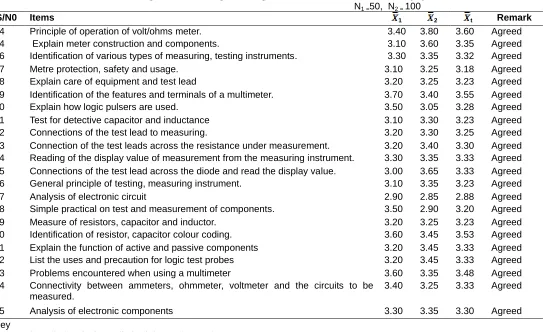
Table 2: Mean responses of Electrical Installation/Electronic Teachers and Electronic Master Craftsmen on basic skill contents in testing and measuring of voltage and resistance in electronic equipments.
N1 =50, N2 = 100
S/N0 Items 1 2 t Remark
24 Principle of operation of volt/ohms meter. 3.40 3.80 3.60 Agreed
24 Explain meter construction and components. 3.10 3.60 3.35 Agreed
26 Identification of various types of measuring, testing instruments. 3.30 3.35 3.32 Agreed
27 Metre protection, safety and usage. 3.10 3.25 3.18 Agreed
28 Explain care of equipment and test lead 3.20 3.25 3.23 Agreed
29 Identification of the features and terminals of a multimeter. 3.70 3.40 3.55 Agreed
30 Explain how logic pulsers are used. 3.50 3.05 3.28 Agreed
31 Test for detective capacitor and inductance 3.10 3.30 3.23 Agreed
32 Connections of the test lead to measuring. 3.20 3.30 3.25 Agreed
33 Connection of the test leads across the resistance under measurement. 3.20 3.40 3.30 Agreed 34 Reading of the display value of measurement from the measuring instrument. 3.30 3.35 3.33 Agreed 35 Connections of the test lead across the diode and read the display value. 3.00 3.65 3.33 Agreed 36 General principle of testing, measuring instrument. 3.10 3.35 3.23 Agreed
37 Analysis of electronic circuit 2.90 2.85 2.88 Agreed
38 Simple practical on test and measurement of components. 3.50 2.90 3.20 Agreed
39 Measure of resistors, capacitor and inductor. 3.20 3.25 3.23 Agreed
40 Identification of resistor, capacitor colour coding. 3.60 3.45 3.53 Agreed 41 Explain the function of active and passive components 3.20 3.45 3.33 Agreed
42 List the uses and precaution for logic test probes 3.20 3.45 3.33 Agreed
43 Problems encountered when using a multimeter 3.60 3.35 3.48 Agreed
44 Connectivity between ammeters, ohmmeter, voltmeter and the circuits to be measured.
3.40 3.25 3.33 Agreed
45 Analysis of electronic components 3.30 3.35 3.30 Agreed
Key
N1= number of Electrical Installation/Electronic Teachers.
N2= Number of Electronic Master Craftsmen.
1 = Mean of Electrical Installation/Electronic Teachers. 2 =Mean of Electronic Master Craftsmen.
a = Average Mean of Mean of Electrical Installation/Electronic Teachers and Electronic Master Craftsmen.
The data presented in table 2 revealed that the respondents agreed with all the items as basic contents in testing and measuring voltage and resistance in electronics equipment.
Research Question 3
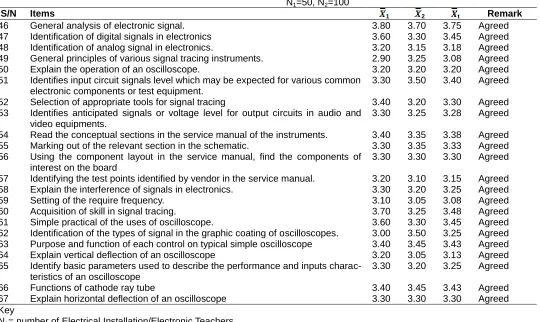
Table 3: Mean responses of Electrical Installation/Electronic Teachers and Electronic Master Craftsmen on the signal-tracing skills in electronic devices required for training roadside electronic technicians in troubleshooting. N1=50, N2=100
S/N Items 1 2 t Remark
46 General analysis of electronic signal. 3.80 3.70 3.75 Agreed
47 Identification of digital signals in electronics 3.60 3.30 3.45 Agreed
48 Identification of analog signal in electronics. 3.20 3.15 3.18 Agreed
49 General principles of various signal tracing instruments. 2.90 3.25 3.08 Agreed
50 Explain the operation of an oscilloscope. 3.20 3.20 3.20 Agreed
51 Identifies input circuit signals level which may be expected for various common electronic components or test equipment.
3.30 3.50 3.40 Agreed
52 Selection of appropriate tools for signal tracing 3.40 3.20 3.30 Agreed 53 Identifies anticipated signals or voltage level for output circuits in audio and
video equipments.
3.30 3.25 3.28 Agreed
54 Read the conceptual sections in the service manual of the instruments. 3.40 3.35 3.38 Agreed 55 Marking out of the relevant section in the schematic. 3.30 3.35 3.33 Agreed 56 Using the component layout in the service manual, find the components of
interest on the board
3.30 3.30 3.30 Agreed
57 Identifying the test points identified by vendor in the service manual. 3.20 3.10 3.15 Agreed 58 Explain the interference of signals in electronics. 3.30 3.20 3.25 Agreed
59 Setting of the require frequency. 3.10 3.05 3.08 Agreed
60 Acquisition of skill in signal tracing. 3.70 3.25 3.48 Agreed
61 Simple practical of the uses of oscilloscope. 3.60 3.30 3.45 Agreed
62 Identification of the types of signal in the graphic coating of oscilloscopes. 3.00 3.50 3.25 Agreed 63 Purpose and function of each control on typical simple oscilloscope 3.40 3.45 3.43 Agreed
64 Explain vertical deflection of an oscilloscope 3.20 3.05 3.13 Agreed
65 Identify basic parameters used to describe the performance and inputs charac-teristics of an oscilloscope
3.30 3.20 3.25 Agreed
66 Functions of cathode ray tube 3.40 3.45 3.43 Agreed
67 Explain horizontal deflection of an oscilloscope 3.30 3.30 3.30 Agreed Key
N1= number of Electrical Installation/Electronic Teachers.
N2= Number of Electronic Master Craftsmen.
1 = Mean of Electrical Installation/Electronic Teachers. 2 =Mean of Electronic Master Craftsmen.
a = Average Mean of Mean of Electrical Installation/Electronic Teachers and Electronic Master Craftsmen.
The data presented in table 3 revealed that respondents agreed with all the items as the signal-tracing skills in electronics devic-es are required for training the roadside electronic technicians in trouble shooting.
8 Hypotheses Testing
Table 4: t-test analysis ofElectrical Installation/Electronic Teachers and Electronic Master Craftsmentraining needs of roadside electronic technicians on basic skills in isolating fault in electronic (P< .05).
Respondents Standard Deviation t- Cal t- Critical Remark
Electrical/electronic teachers 0.308
0.048 1.96 No Significant Electronic master craftsmen 0.123
Table 5: t-test analysis of Electrical Installation and Electronic Teachers and Electronic Master Craftsmen on the basic training skill contents in testing and measuring voltage and resistance in electronic equipment. (P< .05).
Respondents Standard Deviation t- Cal t- Critical Remark
Electrical/electronic teachers 0.208
0.018 1.96 No Significant Electronic master craftsmen 0.339
Table 5 revealed that calculated t does not exceed the t- critical value; this signified that there is no significant difference be-tween the means responses of electrical/electronic teachers and electronic master craftsmen on the basic training skill contents in testing and measuring voltage and resistance in electronic equipment.
9 Findings/ Discussions
The analysis in Table 1 revealed that trainees need training in the area of identification of basic electronic components and their functions, meaning that adequate knowledge should be given to them (roadside electronic technicians) on how to iden-tify various components and their, this serve as a means to understand the operation of the component and to know if they are functioning well. This is in line with the views of Henry (2010), who pointed out that an electronic technician should have a relatively practical knowledge and understanding of general theoretical principle of how electronic components. The finding also revealed that visual inspection of bent transis-tors lead that may be touching should be given to the trainees. Meaning that all the transistors or any other components be inspected to determine whether it is touching to know what kind of symptom could have caused the problems. This is In agreement with Charles (1999), who declared that trouble-shooting involves visual inspection of the interior of the elec-tronic equipment.
The analysis in Table 2 revealed that roadside electronic tech-nicians need to be equipped with principles of operations of volt/ohms meter. Meaning that they should be able to measure the voltage or resistance of any component in an electronic device, roadside electronic technicians need to understand the working principle of a volt/ohm meters. This finding is in line with the curriculum of the National Coalition for Electronic Education (2005), which says that any electronic troubleshoot-ing traintroubleshoot-ing on test and measurement of voltage and resis-tance in electronic component should included principles of operation of multimetre. This is will enable them to measure accurately the voltage and resistance of any components. The analysis in Table 3 revealed that analysis of electronic components and general principle of various signal tracing be given to road side electronic technicians. This conforms with the views of long (1974), ability to measure and test accurately is the result of adequate knowledge of theory of the various electronic devices or equipment and how they function. This is to enable the technicians understand the extent or condition to which a device could function or malfunctions during mea-surement and testing.
10 Conclusion
Vocational training programme has been an integral part of national development strategies in many societies because of its important on human resources development, produc-tivity and economic growth. The Nation can only achieved her visions if special attention be given to vocational training and technological growth, promotion and rewarding creativity. The government must recognize the significance of vocational skill trainings especially among the electronic technicians in our
country. It can be seen that in spite of the vocational training received by their trainers in troubleshooting, road side elec-tronic technicians would have to meet the need to have the basic skills in troubleshooting and repairs of electronic equip-ment as this will contribute to the developequip-ment of the country.
11 Recommendations
Based on the findings of this study, the following recommenda-tions were made:
1. Adequate training in the area identification of basic elec-tronic component and their functions should be given to roadside electronic technicians.
2. Adequate training should be given to roadside electronic technicians in the of analysis of electronic components and various principle of signal tracing.
3. Government should support any vocational training pro-gramme organized, with either fund or equipment.
4. The vocational education planners should consider this findings in developing vocational education curriculum.
5. In developing a vocational training programme the needs and the interest of the trainees should be consideration.
12 References
[1]
Charles, R (1999). An Introduction to Electronic for the Technicians. London. John Wiley & Sons Inc.[2] Glari M. (1998). Electronic Material and Devices. Sydney John Wiley & Sons Inc.
[3] Grab A. (2003). Foundation of Analog and Digital Electron-ics Devices. New York. McGrawHill Compa nies Inc.
[4] Gupta, J.B (2000). Digital Electronics for Technicians. New Delhi. A Division of Reed Educational and Profes-sional Publishing Ltd.
[5] Henry A.K (2010). Common Misspellings of Technicians. New York. Barron’s Educational Hill Com anies Inc.
[6] Long, P.R. (1974): Digital electronic in perspective for be-ginners. Canada. Ekah & Gwanga Publishers.
[7] Long, W.L. (2006): Electronic principles and circuits. An introduction to electronic for the technicians. York. John Wily and Son Inc.
[9] National Coalition for Electronic Education (2005). Basic Electronic, Competencies. Delton Horn McGraw Hill Ltd. NCEE.
[10]Rumbarger, W (1995). Educational Implication of High Technology. IFG Project Report 98-174 February Standard C.A.
[11]Sahdev, G. (2006). Electronic Principles Delhi. Educational & Technical Publishers.
[12]Schulder, C.A (1999). Electronic Principles and Application Fifth Edition USA: McGraw Series Inc.
[13]Siachiano, J.W (1997). Course Construction in Industrial Art. Vocational and Technical Education USA. Machigan.