FPGA Implementation of HHT for Feature
Extraction of Signals
Mahesh Baban Shinde Manish Sharma
PG Student Professor
Department of Electronics & Telecommunication Engineering Department of Electronics & Telecommunication Engineering D. Y. Patil College of Engineering Akurdi, Pune-44 D. Y. Patil College of Engineering Akurdi, Pune-44
Abstract
In the analysis of real time signals accuracy plays very important role in most of the biomedical and bioelectrical applications. All real signals have some nonlinearity and time dependency. But methods used for their analysis assumes that signal is either linear or stationary. Hilbert Huang Transform (HHT) is an experimental time-recurrence technique for nonlinear and nonstationary signal analysis. Real signals can be processed with no presumptions by using this technique. Performance of HHT system in terms of time is up to the mark as HHT calculation requires more time. It puts limitation on its applications for real time signal handling. To improve the time efficiency of system hardware accelerated HHT framework taking into account Field Programmable Gate Array (FPGA) is used. Hardware software co design method is used to enhance processing time. It has major applications in ECG, EEG signal analysis. The 2D transposition of the Hilbert-Huang Transform (HHT) is also proposed for considering momentary amplitudes and periods of nonlinear and nonstationary information.
Keywords: HHT, EMD, IMF, FPGA, Hardware Accelerator, Sifting
_______________________________________________________________________________________________________
I. INTRODUCTION
For data analysis of signals traditionally it is expected that signal is linear and stationary. But all natural and real information has nonlinearity and time dependency. Recently some new methods like wavelet analysis and the Wagner-Ville distribution were developed for linear but nonstationary data while various nonlinear time-series-analysis methods were designed for nonlinear but stationary and predictable systems [1]. Analyzing the data from such time dependent and nonlinear system is a major problem. For nonlinear and nonstationary signal processing N. E. Huang proposed Hilbert Huang Transform (HHT), an empirical time-frequency analysis method [7].
Fourier transform and Wavelet transforms are generally used methods for data analysis. HHT has various advantages over Fourier transform and Wavelet transform that are listed in the Table I.
Table – 1
Comparison of different transforms [1]
Fourier Transform Wavelet Transform Hilbert Transform
Basis a priori a priori Adaptive
Presentation Energy-Frequency Energy-time-frequency Energy-time-frequency
Frequency Convolution:
Global uncertainty
Convolution: Regional uncertainty
Differentiation: Local Certainty
Nonlinear No No Yes
Non-stationary No Yes Yes
Feature Extraction No Discrete: No,
Continuous: Yes Yes
Theoretical Base Theory complete Theory complete Empirical
1D-HHT Basically Consists of Two-Steps:
Empirical Mode Decomposition (EMD): Used to extract the Intrinsic Mode Functions (IMFs) from the information.
A Hilbert Spectral Analysis: To get instantaneous amplitude and phase from extracted IMF Hilbert transform is applied on each IMF. To get immediate sufficiency and stage from removed IMF Hilbert change is connected on every IMF [1].
m j t IMF t x 1 ) ( )( + r ……. (1)
An IMF contains variable amplitude and frequency as functions of time. Intrinsic mode function (IMF) should satisfy the following conditions: In the whole dataset, the number of zero-crossings and the number of extrema must either equal or differ by one. In total data at any instant, the mean value of the envelope defined by the local maxima and the envelope defined by the local minima is zero [12]. To implement EMD sifting using parallel processing is unrealistic due to interdependency of IMFs. But some part of EMD sifting algorithm can be implemented using parallel processing. Hence novel hardware and software co-design method based on FPGA to implement EMD sifting and Hilbert transform is proposed in this work.
Using this technique HHT can be processed in real time which is useful in various biomedical applications such de-noising ECG signal[4], removal of baseline wander in ECG [5], Frequency analysis of eye open eye closed EEG signal[11], analysis of Heart Rate Variability (HRV) [6], Blood Pressure Estimation and so on. The 2D transposition of HHT is also proposed to separate an image into elementary components and extract their instantaneous amplitudes, phases, and orientations. Potential applications of this 2D-HHT are encountered in ocean wave characterization, fingerprint analysis, or texture classification.
II. HILBERT HUANG TRANSFORM
Hilbert Huang transform (HHT) is a relatively new method. It seems to be very promising for the different applications in signal processing because it could calculate instantaneous frequency and amplitude which is also important for the linear and non-stationary signals in many applications like MRI Images. To get instantaneous amplitude and frequency first the complicated signal needs to get decomposed into simple parts called IMF. To get IMF from complicated data EMD is applied on it. Sifting algorithm for EMD is as follows:
1) Initialize residue and index numbers. 2) Get original information (signal).
3) Extract maxima, minima and zero crossing points from original signal. 4) Calculate upper and lower envelopes with cubic spline.
5) Find the mean of envelopes.
6) Get difference between mean and original signal as ‘h’. 7) Extract maxima, minima and zero crossing points from ‘h’. 8) Calculate upper and lower envelopes with cubic spline. 9) Find the mean of envelopes.
10) If it is not IMF then set ‘h’ to original signal and go to step 5. 11) If it is IMF save it and calculate residue ‘r’=x(t)-IMF
12) Check stopping condition. If it is true then stop otherwise set ‘r’ to original signal and go to step 2. 13) Stop.
The Hilbert transform is applied on all extracted IMF’s. Hilbert Transform of signal x(t) is given by
H[x(t)] = P* 1
( ') ) ' ( t t t x *dt’ =t
1
*x(t) ……… (2)
Where P is Cauchy principal value
Hilbert transform gives us the analytic signal using which the instantaneous amplitude, phase and frequency can be calculated. This one dimensional EMD can be extended to bi-dimensional EMD. A one-dimensional sifting process is an iterative procedure that depends both on an interpolation method and on a stopping criterion that ends the procedure. In bi-dimensional EMD sifting process is based on Delaunay triangulation and then cubic interpolation on triangles and also on a fixed number of iterations to build IMFs. The major advantage of this interpolation method over existing ones is that it takes into account the geometry while preserving a low computational cost [3]. The bi-dimensional EMD can also be realized using morphological operators to detect regional maxima and radial basis function for surface interpolation. This algorithm can be effectively used for texture extraction and image filtering [2].
III. PROPOSED WORK
This paper proposes the implementation of HHT based on FPGA to optimize the processing speed. This section lights on the system design architecture, software implementation and hardware accelerated implementation of HHT.
System Design Architecture:
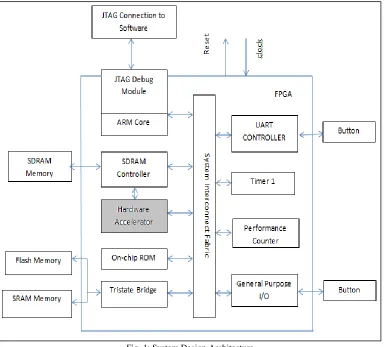
Fig. 1: System Design Architecture
System consists of different peripherals such as UART, Timer, SDRAM, general purpose IO etc. The Zynq Evaluation & Development board (ZedBoard) has been used in order to implement HHT for data analysis. Software tool used for writing code and programing FPGA is SDSoC which provides support with Xilinx Vivado HLS, Xilinx API etc. Xilinx Vivado leverage the idea of using Intellectual Property (IPs) as block designs and later bit file is generated for the implemented design. It contains necessary interfaces and let the user choose which interface to enable by making custom processor logic. SDSoC provides C to HDL compiler necessary for hardware accelerated implementation and different tools for software hardware profiling and performance measurement. The expandability features of the board make it ideal for rapid prototyping and proof-of-concept development.
Software Implementation:
The software implementation of EMD algorithm and Hilbert transform is done using Zynq ARM hardcore processor. The programming language used is C.
EMD algorithm basically consists of two main loops. One of which determines whether the given signal is decomposed completely and other checks whether decomposed signal is IMF or not. Complete algorithm can be divided into four parts. First part extracts the extrema and zero crossing points from original information. In second part the boundary conditions for interpolation are computed. In next subroutine the interpolation of extracted data points is done using Cubic Spline interpolation for getting upper and lower envelopes. In last part the Stopping criteria for sifting as defined is used to determine the IMFs. The Hilbert transform is also implemented using software program.
The input signal used for experiment is ECG signal ‘sig100a’ obtained from MIT-BIH arrhythmia data base. EMD algorithm is implemented by using C program that process 1024 data points of ECG signal in Zynq ARM core. Table II below shows the approximate timing results for discussed four subroutines of the program.
Table – 2
From table II it is clear that very small percentage of time is spent for boundary conditions and stop sifting. Most of the time is utilized to find extrema and implementation of cubic spline interpolation. To improve the processing time one of the option is to use parallel processing. But it is hard to implement compete EMD using parallel processing due to high interdependency of IMFs. With the help of hardware accelerated system the part of the algorithm that is possible to implement with parallel structure can be implemented using parallel processing and rest of the part can be implemented with software. In above algorithm out of most time consuming parts the Extrema extraction can’t be implemented by using parallel structure because it has some data dependency but cubic spline routine can be implemented using hardware accelerator.
Hardware Acceleration Implementation:
The hardware platform used is Xilinx’s Zedboard that consist of zynqTM-7000 AP SoC XC7Z020-CLG484-1. The processor sends an instruction to peripherals and data is switched with the help of system interconnect fabric which is implemented with Avalon Bus. The ECG signal ‘sig100a’ obtained from MIT-BIH arrhythmia database is floating point data. Using MATLAB fixed point data is obtained from ‘sig100a’ and sent to FPGA through UART and saved in SDRAM. The result is again sent back to MATLAB through UART and output is displayed in MATLAB.
IV. RESULT
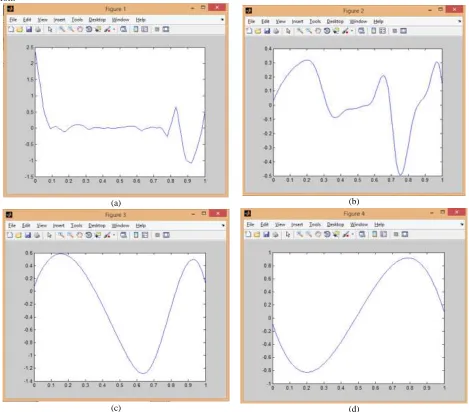
To verify the effectiveness of EMD first it is implemented using MATLAB EMD algorithm is applied on synthesized ECG signal and corresponding IMF’s are observed as shown in Figure 3. Figure 3(a) shows synthesized input signal and 3(b), 3(c), 3(d) shows IMF’s after first, second and third iteration respectively. The stopping criteria used for sifting is based on standard deviation.
(a) (b)
(c) (d)
In Table III the time utilized for each subroutine is shown for 10 iterations of EMD sifting. From table it is clear that time required for cubic spline routine is reduced from 47% to 18% from total execution time. Cubic spline implementation becomes around ten times faster than software only implementation.
Table – 3
Comparison of Software only and Hardware accelerated system Subroutine Time (%)
Hardware accelerated system using Zedboard
Extract Extrema 31.52 Boundary conditions 2.181 Cubic spline 9.432 Stop sifting 0.7
Software only system
Extract Extrema 26.7 Boundary conditions 2.139
Cubic spline 88.343 Stop sifting 20.8
Performance of system in terms of speed and cost of hardware resources used can be improved if instead of C to HDL compiler directly HDL code is written for hardware accelerator. So in future work the subroutines will be implemented with HDL based hardware accelerator.
V. CONCLUSION
The hardware accelerated implementation of HHT is presented that provides real time processing of EMD sifting algorithm. The cost of hardware resource is more which can be reduced to certain extent if the HDL based design is used instead of C to HDL compiler and high end FPGA. Performance of system in terms of speed and cost of hardware resources used can be improved if instead of C to HDL compiler directly HDL code is written for hardware accelerator.
REFERENCES
[1] N.E. Huang, Z. Shen, S.R. Long, M.C. Wu, H. Shih, Q. Zheng, N.-C. Yen, C.C. Tung, and H.H. Liu, “The Empirical Mode Decomposition and the Hilbert
spectrum for nonlinear and nonstationary time series analysis,” Proc. R. Soc. A, vol. 454, no. 2074, pp. 903–995, October 1998.
[2] J.C. Nunes, Y. Bouaoune, E. Delechelle, O. Niang, Ph. Bunel, “Image analysis by bidimensional empirical mode decomposition”, Image and Vision
Computing, pp.1019–1026, Nov. 2003.
[3] Christophe Damerval, Sylvain Meignen and Val´erie Perrier “A Fast Algorithm for Bidimensional EMD”, Signal Processing Letters, IEEE (Volume:12
, Issue: 10), pp.701-704, Oct. 2005.
[4] Binwei Weng; Blanco-Velasco,M.; Earner,K.E.“ECG Denoising Based on the Empirical Mode Decomposition” Engineering in Medicine and Biology
Society, 2006. EMBS'06. 28th Annual International Conference of the IEEE, 2006, 1-4.
[5] Na Pan; Vai Mang I; Mai Peng Un; Pun Sio hang, “Accurate Removal of Baseline Wander in ECG Using Empirical Mode Decomposition,” Noninvasive
Functional Source Imaging of the Brain and Heart and the International Conference on Functional Biomedical Imaging, 2007. NFSI-ICFBI 2007. Joint Meeting of the 6th International Symposium on, 2007, 177-180
[6] Shafqat,K.; Pal,S.K.; Kumari,S.; Kyriacou,P.A.; “ Empirical mode decomposition (EMD) analysis of HRV data from locally anesthetized patients,”
Engineering in Medicine and Biology Society, 2009. EMBC 2009. Annual International Conference of the IEEE, 2009, 2244-2247
[7] Lei Wang, Mang I Vai, Peng Un Mak, Chio In Ieong, “Hardware-accelerated Implementation of EMD Hardware and Software Co-design Evalution for
HHT”, 2010,3rd International Conference on Biomedical Engineering and Informatics (BMEI 2010) , pp. 912-915, 2010.
[8] Q. Chen, N. Huang, S. Riemenschneider, and Y. Xi, “A B-spline approach for Empirical Mode Decomposition,” Adv. Comput. Math., vol. 24, pp. 171–
195, 2010.
[9] B. Huang and A. Kunoth, “An optimization based Empirical Mode Decomposition scheme for images,” J. Comput. Appl. Math., vol. 240, pp. 174–183,
March 2012.
[10] N. Pustelnik, P. Borgnat, and P. Flandrin, “A multicomponent proximal algorithm for Empirical Mode Decomposition,” in Proc. Eur. Sig. Proc.
Conference, pp. 1880 – 1884, August 2012.
[11] Ranjit A. Thuraisingham, Yvonne Tran, Ashley Craig and Hung Nguyen, “Frequency analysis of eyes open and eyes closed EEG signals using the
Hilbert-Huang Transform”, 34th Annual International Conference of the IEEE EMBS, pp.2865-2868, 1 September, 2012
[12] Jeremy Schmitt, Nelly Pustelnik, Pierre Borgnat, Patrick Flandrin, “2D HILBERT-HUANG TRANSFORM”, 2014 IEEE International Conference on
Acoustic, Speech and Signal Processing (ICASSP), pp.5377 – 5381, 9 May 2014.
[13] G. Rilling, P. Flandrin and P. G.: On empirical mode decomposition and its algorithms, IEEE-EURASIP workshop on Nonlinear Signal and Image