2018, Vol. 6, No. 2 DOI: 10.15678/EBER.2018.060203
Export Intensity, Geographic Diversification
and the Role of Public Support:
The Evidence from Old and New Europe SMEs
Mariola Ciszewska-Mlinarič
A B S T R A C T
Objective: The objective of the article is to investigate how public support (both financial and non-financial) affects the geographic scope and export intensity of SMEs originating from Old (EU15) and New Europe (the CEE12 region). In particular, the work considers the direct and indirect effects (via geographic scope) of public support on the export intensity of SMEs.
Research Design & Methods: The empirical analyses use a large, country, cross-industry dataset of 2 375 European SMEs from 27 countries.
Findings: The study findings indicate that only financial public support is positively, di-rectly and indidi-rectly associated with the export intensity of European SMEs, regardless of the origin. The results related to non-financial public support are less conclusive. Additionally, the study reveals that despite significant, firm-level differences character-ising internationally oriented SMEs from Old and New Europe, the examined relation-ships and effects of control variables are largely the same.
Implications & Recommendations: The article offers clear insights into the significance of financial vs. non-financial public support programmes for internationalisation activi-ties of SMEs, encouraging further research to focus on the question which firms should receive public support and how to increase the awareness and propensity of the own-ers/managers of SMEs to consult public support providers.
Contribution & Value Added: The originality of this work lies in investigating the impact of public support for internationalisation efforts (export intensity and geographic diversi-fication) of SMEs originating from different contexts of the EU15 and CEE12 countries. Article type: research paper
Keywords: public support; export intensity; geographic diversification; SMEs; CEE JEL codes: F23
Received: 13 December 2017 Revised: 29 January 2018 Accepted: 24 May 2018
Suggested citation:
INTRODUCTION
The role of small and medium sized enterprises (SMEs) for national economies is well rec-ognized. They constitute majority of business entities, create new jobs, and are increas-ingly involved in international operations. However, in comparison with large firms, SMEs have limited managerial and financial resources, which makes the expansion into foreign markets more risky for them. Therefore, recognizing the role of SMEs for national econo-mies, but also their resource deficiencies, governments and their agencies develop public programmes to support international efforts of SMEs.
Prior research on this topic offers several interesting insights that can be grouped un-der three main themes. Firstly, given that the awareness of public support programmes among SMEs is relatively low (European Commission, 2010), factors determining both the awareness and the use of such programmes are often examined (Fischer & Reuber, 2003a; Audet & St-Jean, 2007; Audet, Berger-Douce, & St-Jean, 2007; North, Smallbone, & Vickers, 2001). Secondly, a question concerning the effectiveness of public support is often asked (e.g. Liu, Jiang, Zhang, & Zhao, 2013; Bannò, Piscitello, & Varum, 2014; Yoo, Mackenzie, & Jones-Evans, 2012; Alonso-Nuez & Galve-Gorriz, 2012), although it is still not clear what type of support (financial versus non-financial) is of particular significance for SMEs. Thirdly, prior research has also provided some answers to the question which firms should receive support, and what allocation criteria should be used by the providers of public support. There are claims that from the economic point of view, public support pro-grammes should be oriented on high-growth firms, as they are the most promising in terms of creating jobs (Fisher & Reuber, 2003b; Mason & Brown, 2013).
This study contributes to the second stream of research. In the light of often inconclu-sive, anecdotal, and contradictory evidence on the effectiveness of public support (Yoo et al., 2012), reported by studies that are mostly undertaken within one-country samples, the question concerning the tangible outcomes of such support remains valid. Taking ad-vantage of the broad context of 2 375 European SMEs originating from 27 countries, this study employs linear regression analyses to investigate the relationships between public support (financial and non-financial) and international activities of SMEs in terms of export intensity and geographic scope. Therefore, a key question in this study is: Does public sup-port enhance SME exsup-port intensity and geographic diversification? And what kind of public (financial and non-financial) is beneficial in this respect?
The article is structured as follows. The first section presents the theoretical back-ground to develop the research hypotheses. Next, methodological details are provided, followed by a presentation of results and analysis. The article concludes with a discussion of the implications and limitations of the findings.
LITERATURE REVIEW
Public Support for SMEs
con-text of internationally oriented firms – to help them successfully enter and build the position on foreign markets. Public support programmes may include free or subsidised services in such areas as: business advice and consulting services, including access to information on foreign markets; training for employees; and financing (subsidies, loans, grants).
With an increase in public support programmes and their budgets, one of the most important research questions is whether public support pays off, helping the assisted firms to develop and making a good use of taxpayers’ money. Indeed, the resulting answers are often contradictory (Yoo et al., 2012). On the one hand, there is evidence that the use of public support enhances firm performance. For instance, Sarder, Ghosh and Rosa (1997) observed that firms using support services achieved higher performance (in terms of growth in sales, employment, and productivity) than their peers without support. More recently, Liu et al. (2013) observed that high level of domestic institutional effort exerted a positive moderating effect on the relationship between strategic flexibility and interna-tional venturing of Chinese firms. Also Bannò et al. (2014) investigated the impact of fi-nancial public support on outward FDI of Italian SMEs and found it to be beneficial for such performance indicators as domestic turnover and productivity growth.
On the other hand, there is also strong evidence that public support brings no gains or might be wrongly targeted. Ramsden and Bennet (2005) assessed the role of external busi-ness advice on ‘soft’ outcomes (improved ability to manage, ability to cope) and ‘hard’ out-comes (profitability, turnover, reduced costs) on satisfaction levels. They observed, however, that high level of owners/managers satisfaction from the advice was not necessarily associ-ated with its specific ‘hard’ impact; they explained this phenomenon in terms of reassurance, which – in their opinion – was equally (if not more) important as specific ‘hard’ or ‘soft’ out-comes. Also Norman and Bager-Sjorgen (2006) found no significant effect of a financial sup-port programme on the financial performance of new ventures. Examining the effectiveness of public support for technology-based SMEs, Yoo et al. (2012, p. 101) found that ‘high per-forming firms benefited less from the public support services than low performers’. Finally, Alonso-Nuez and Galve-Gorriz (2012) found that public programmes that supported the cre-ation of companies in Spain did not result either in higher survival rate or in higher net income among companies that received subsidy in comparison with those without such support. Sim-ilarly, in the context of Argentinian microenterprises, Berrone, Gertel, Giuliodori, Bernard and Meiners (2014) noticed that public policy may have a pro-poor character, as public support is directed to enterprises arising from unemployment, and these enterprises ‘proved to be less successful in relation to the microenterprises’ performance’ (2014, p. 496).
in-tensity and geographical scope. Bannò et al. (2014) argue that financial support helps SMEs invest in foreign markets as it lowers one of the most significant barriers related to the lack of capital, but additionally they point out that financial support may be easily converted into other kinds of needed resources. Building on prior research (Kuivalainen, Puumalainen, Sintonen, & Kyläheiko, 2010; Wiklund & Shepherd, 2003; see also Yiu, Lau, & Bruton, 2007; Wach, 2012; Bruton, Lau, & Obloj, 2014), Bannò et al. (2014, p.24) indi-cate that: ‘Improved internal organizational capabilities, especially financial, managerial, marketing, and technical capabilities, enhance firms’ performance in a context of inter-nationalization’, and ‘obtaining sufficient financing serves as a cushion against unfore-seen setbacks’ (2014, p. 25). Additionally, these authors mention that cooperation with a subsidising agency may result in organisational learning and eventually in ‘an adjust-ment of manageadjust-ment processes’ (2014, p. 25).
In a similar vein, but in the context of export-oriented SMEs, this article builds on re-source-based view (RBV), proposing that public support, both financial and non-financial, will have beneficial effects on SMEs’ competencies (as it should enlarge the available re-source pool), and in consequence help them to overcome the liability of foreignness (Zaheer, 1995; Johanson & Vahlne, 2009), liability of smallness (Kale & Arditi, 1998; Aldrich & Auster, 1986), liability of outsidership (Johanson & Vahlne, 2009), and/or liability of new-ness (Aldrich & Auster, 1986; Kale & Arditi, 1998). Following that logic, it is expected that public support will exert a positive impact upon international activities of SMEs, in partic-ular export intensity and geographic scope:
H1: Public support (both financial and non-financial) positively impacts a degree of SME internationalisation (export intensity), regardless of the origin of SMEs. H2: Public support (both financial and non-financial) positively impacts geographic
diversification of SMEs, regardless of the origin of SMEs.
It is also argued that public support may have not only a direct effect (as predicted in H1) but also an indirect effect on export intensity, via geographic diversification. This no-tion is based on the assumpno-tion that firms using public support can expect to achieve higher intensity of exports by relying on more geographically diverse strategies. It should be noted, however, that geographic diversification increases the complexity of firms’ op-erations. Indeed, prior research suggests that up to a point it is beneficial for performance, but at high levels geographic diversification may be associated with lower performance gains. In short, the relationship between diversification and performance may take the inverted U-shape (Driffield, Du, & Girma, 2008; Capar & Kotabe, 2003).
also trigger new opportunities to learn, and leverage knowledge/resources in a higher number of markets, leading to the growth of export sales.
On the other hand, the complexity that has to be faced by SMEs results from broader geographic scope, and differences in technology and culture existing between export mar-kets (Zahra, Ireland, & Hitt, 2000). Prior studies offer several explanations as to why inter-national expansion might not always bring performance gains. Summarising such argu-ments in the context of multinational companies from developed markets, Driffield et al. (2008, p. 146) point to: bounded rationality that lowers managers’ capacity to face greater complexity, which in turn has negative impact on performance (Grant, 1987); and perfor-mance decline that may result from spreading managerial capabilities and coordination problems (Hitt, Hoskisson, & Kim, 1997).
Analysing the sample of emerging market firms, Nachum (2004, p. 290) found a strong association between geographical diversification and firm performance, sug-gesting that ‘This route to growth, which until recently has been less developed by most developing country firms relative to the extent of their industrial diversification, is likely to prove rewarding’. In the context of developed market firms – British multinationals, Driffield et al. (2008) observed a strong non-linear relationship between performance and multinationality (defined by the number of markets).
To sum up, it is argued that public support enhances geographic scope, and broader geographic scope may in turn allow SMEs to spread risk and provide new learning and busi-ness opportunities, exerting a positive (but inverted U-shape) impact on export intensity. In other words, the geographic diversification will mediate the relationship between the usage of public support by SMEs and their export intensity (degree of internationalisation), thus:
H3: The scope of geographic diversification mediates the relationship between public support and degree of the internationalisation of SMEs, regardless of theorigin of SMEs.
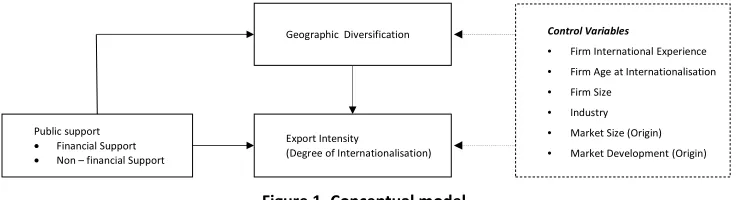
The hypothesised relationships are presented in Figure 1.
Figure 1. Conceptual model Source: own elaboration.
MATERIAL AND METHODS
Data and Sample
This study uses the database of European SMEs originating from 33 countries, the 27 EU states plus Croatia,1 Iceland, Lichtenstein, Macedonia, Norway and Turkey. As SMEs firms
1 At the time of the survey Croatia, now the EU member, was a candidate for accession.
Export Intensity
(Degree of Internationalisation) Public support
• Financial Support • Non – financial Support
Control Variables
• Firm International Experience
• Firm Age at Internationalisation
• Firm Size
• Industry
• Market Size (Origin)
with between 1 and 249 employees were classified. The creation of the database was sponsored by the European Commission, within the scope of the research project Interna-tionalisation of European SMEs, (European Commission, DG Enterprise and Industry, 2010). Directorate General for Enterprise and Industry of the European Commission com-missioned the project, and Dutch EIM Business & Policy Research implemented it. In the spring of 2009, 9 480 SME owners or managers (key decision makers) were interviewed on their firms’ international involvement (including, for example, propensity, intensity, and scope of foreign expansion). This database was also used in other studies, for instance by Hernández and Nieto (2015), to perform their analyses on the relationship between institutional distance and entry mode decisions.
Considering the objectives of this study (the role of public support targeted at in-ternationally oriented SMEs for their international activities/performance), it focuses only on SMEs that reported to have been active exporters between 2006 and 2008, so the number of relevant cases was 3 669 SMEs (38.7% of the original 9 480 records). Then, SMEs from countries other than the EU15 or CEE12, thus those originating from Cyprus, Iceland, Malta, Liechtenstein, Norway and Turkey, were not included in the sample. Finally, the sample was further reduced by dropping all firm-records, in case of missing or unreliable values for such variables as export intensity (degree of interna-tionalisation), the scope of geographic diversification, and time to internationalise. This reduced the total number of SMEs to 2 375. The size (in terms of the number of firms) and the scope (in terms of number of countries) covered by the database support the generalisability of the study results to different contexts.
The sample was next divided into two subsamples; the first one including 1 368 SMEs from the EU15 countries (Old Europe), and the second one – 1 007 SMEs from the CEE12 countries (New Europe). The EU15 sample comprises firms from 15 member countries in the European Union prior to the enlargement of the EU on 1st of May 2004, including the following ones: Austria, Belgium, Denmark, Finland, France, Germany, Greece, Ireland, It-aly, Luxembourg, Netherlands, Portugal, Spain, Sweden, and the United Kingdom.
The term Central and Eastern Europe (CEE) or Central and Eastern European Countries (CEECs), denoting former communist states in Europe, was popularised in scholarly writings after the collapse of the Iron Curtain in 1989, but its roots can be traced to Winston Church-ill’s speech (1946). The CEE12 sample comprises firms from 12 countries belonging to the group of Central and Eastern Europe, which is defined by the former and shared communist past (OECD, 2007), including: former Eastern Bloc countries (Bulgaria, Czech Republic, Hun-gary, Poland, Romania and Slovakia); three Baltic countries, prior republics of the Soviet Union (Estonia, Latvia, and Lithuania); and several states of former Yugoslavia (Croatia, FYR Macedonia, Slovenia).2 This list of the CEE countries is congruent with the OECD (2007) def-inition with two exceptions. Firstly, OECD includes also Albania; but due to the fact that the original survey was not conducted in Albania, there are no Albanian SMEs in the sample. Secondly, although not listed by OECD (2007), FYR Macedonia is also counted as one of the CEE countries due to the fact that it is one of former Yugoslavia states, and at present one of candidate countries, on the way to the EU membership. Among the CEE12 countries in the sample, as of the beginning of 2009, 10 of them already joined the EU in two waves of
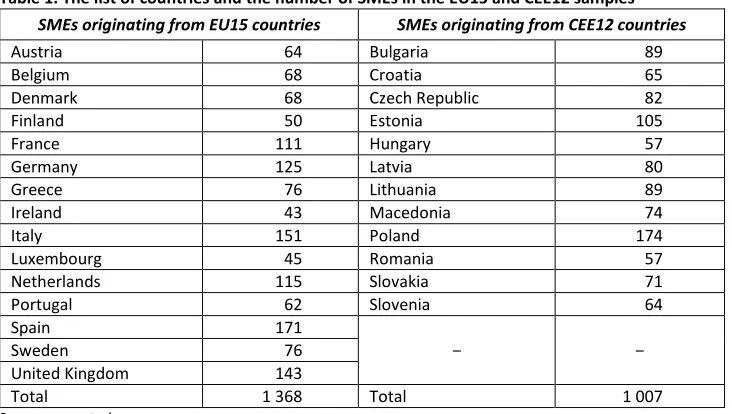
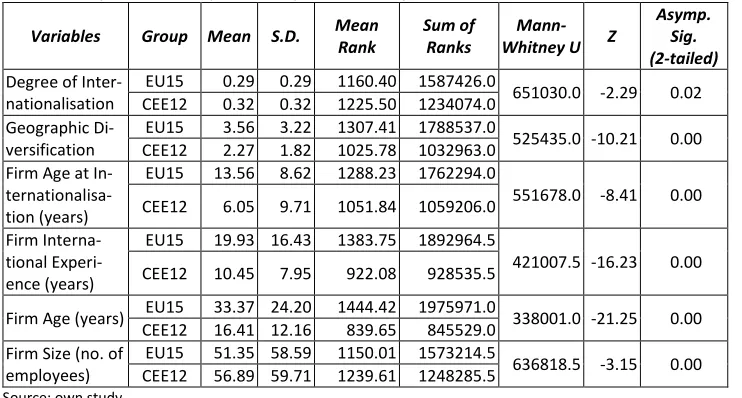
accession (in 2004, and 2007).3 The exact number of SMEs originating from each country is presented in Table 1, and the comparison of Old and New Europe samples across the key variables – in Table 2. As the samples are of different size, a non-parametric Mann-Whitney U test for independent samples was applied. Null hypothesis, that states that the distribu-tion of the ‘variable’ is the same across groups, is rejected in case of all variables. In other words, the EU15 SMEs in comparison with the CEE12 SMEs are different in terms of: export intensity, geographic diversification, time to internationalisation, international experience, age and size. These findings are further discussed in the concluding section.
Table 1. The list of countries and the number of SMEs in the EU15 and CEE12 samples SMEs originating from EU15 countries SMEs originating from CEE12 countries
Austria 64 Bulgaria 89
Belgium 68 Croatia 65
Denmark 68 Czech Republic 82
Finland 50 Estonia 105
France 111 Hungary 57
Germany 125 Latvia 80
Greece 76 Lithuania 89
Ireland 43 Macedonia 74
Italy 151 Poland 174
Luxembourg 45 Romania 57
Netherlands 115 Slovakia 71
Portugal 62 Slovenia 64
Spain 171
– –
Sweden 76
United Kingdom 143
Total 1 368 Total 1 007
Source: own study.
Measures
Dependent Variables. Export Intensity and Geographic diversification. Export intensity, or degree of internationalisation, is one of the commonly employed operationalisations of firm international performance or international activities (Javalgi & Grossman, 2014; Gashi, Hashi, & Pugh, 2014; Nummela, Saarenketo, & Puumalainen, 2004; Kyvik, Saris, Bonet, & Felício, 2013; Rodríguez & Nieto, 2012; Reuber & Fischer, 1997; Ruigrok, Amann, & Wagner, 2007). According to Katsikeas, Leonidou and Morgan’s (2000) review of export performance measures, export intensity measured as a foreign-sales-to-total-sales ratio (FSTS) is the most popular performance indicator, used in 61% of studies selected for the review. Although export performance measures based on sales were criticised as they ‘can be affected by factors other than better exporting operations’ (Katsikeas et al., 2000, p. 498), Sousa (2004) indicates that it is still appropriate to use FSTS ratio to evaluate the export performance of SMEs. Taking into consideration the sample size and the available data, in this study export intensity is operationalised in a typical way, as the share of foreign
sales in total sales, with values ranging from 0.01 to 1.00 in both samples. All respondents were asked to indicate the share of exports in total turnover for the enterprise in 2008. Table 2. Comparison of samples: descriptive and non-parametric tests
Variables Group Mean S.D. Mean
Rank
Sum of Ranks
Mann-Whitney U Z
Asymp. Sig. (2-tailed) Degree of
Inter-nationalisation
EU15 0.29 0.29 1160.40 1587426.0
651030.0 -2.29 0.02 CEE12 0.32 0.32 1225.50 1234074.0
Geographic Di-versification
EU15 3.56 3.22 1307.41 1788537.0
525435.0 -10.21 0.00 CEE12 2.27 1.82 1025.78 1032963.0
Firm Age at In- ternationalisa-tion (years)
EU15 13.56 8.62 1288.23 1762294.0
551678.0 -8.41 0.00 CEE12 6.05 9.71 1051.84 1059206.0
Firm Interna-tional Experi-ence (years)
EU15 19.93 16.43 1383.75 1892964.5
421007.5 -16.23 0.00 CEE12 10.45 7.95 922.08 928535.5
Firm Age (years) EU15 33.37 24.20 1444.42 1975971.0 338001.0 -21.25 0.00 CEE12 16.41 12.16 839.65 845529.0
Firm Size (no. of employees)
EU15 51.35 58.59 1150.01 1573214.5
636818.5 -3.15 0.00 CEE12 56.89 59.71 1239.61 1248285.5
Source: own study.
Independent Variable. Public Support. Similarly to Fischer and Reuber’s (2003) ap-proach, the use of public support programmes for internationalisation was operational-ised according to the respondents’ answers to the questions whether or not they used such support programmes, and if they did,- what kind, financial or non-financial, the sup-port was. In order to operationalise the public supsup-port for internationally oriented firms, SMEs in both samples (EU15 and CEE12) were grouped into three categories representing different situations considering the usage of public support for internationalisation be-tween 2006-2008: (i) firms that did not use any public support for internationalisation (‘No support’ coded as ‘1’, otherwise ‘0’), (ii) firms that used only non-financial support, such as counselling, information, etc. (‘Non-financial support’ coded as ‘1’, otherwise ‘0’), and (iii) firms that used financial support, for instance subsidies, guarantees, tax incentives (‘Fi-nancial support’ coded as ‘1’, otherwise ‘0’). Thus, there are three dummy variables. A sim-ilar approach was also adapted by Bannò et al. (2014) to operationalise public support for the outward FDI of SMEs. In the regression analyses, the variable depicting firms that did not use any public support (‘No support’) is not included in the models, as it represents a reference level for the interpretation of the results for two other binary variables (‘Non-financial support’ and ‘Financial support’).
In the EU15 sample, only 9.14% (125 firms) used public support, including 2.27% (31 firms) that used only non-financial support, and 6.87% (94 firms) that used finan-cial support. Among SMEs originating from the CEE region, only 7.84% (79 firms) used public support, including 1.19% (12 firms) that used only non-financial, and 6.65% (67 firms) that used financial programmes.
the number of employees. Although Bonaccorsi (1992) has found that the firm size is pos-itively associated with export propensity, but no with intensity, the variable is still recog-nized as important. For instance, Hall and Tú (2004) indicate that (sunk) internationalisa-tion costs, resulting for instance from market search, business negotiainternationalisa-tions, or accommo-dation to foreign regulations, may be too high for SMEs. Bannò et al. (2014) observed that the positive effect of public incentives on performance was stronger in the case of smaller and younger firms. Also Williams (2011) found that firm size was associated with its inter-nationalisation. Fourth, industry was operationalised with dummy variables. The indus-tries were divided into manufacturing (Industry 1), construction (Industry 2), wholesale (Industry 3), retail (Industry 4), transport and communication (Industry 5), business ser-vices (Industry 6), and personal serser-vices (Industry 7). In the analytical section of this article, the binary variable for manufacturing (Industry 1) is not included in the regression models as it represents a reference level for other industry variables. In both samples, majority of SMEs operate in manufacturing industry, respectively 43.5% (595 firms) in the EU15 sam-ple, and 43.4% (437 firms) in the CEE12 sample.
Finally, the controls of the origin market size and market development are also included in the study. In line with a conventional theorising, it is argued that firms from smaller mar-kets are more likely to be involved in international activities, achieving higher degrees of internationalisation as their domestic options might be limited, as small domestic market cannot support much growth (Reuber & Fischer, 1997; Ciszewska-Mlinarič & Mlinarič, 2010). Both the market size and the market development of the origin (that is domestic country), are measured respectively with the natural logarithm of the population size, and with the natural logarithm of the 2008 GDP per capita of the country. The data about the market size and development were collected from the UNCTAD STAT database.
Correlations and descriptive statistics for all variables in both samples are shown in Tables 3 and 4.
Methods of Analyses
The impact of public support for international activities of SMEs from Old and New Europe was examined according to the conceptual model (Figure 1). To test the significance of key independent variables (that is financial and non-financial public support) for dependent variables (that is export intensity and geographic diversification), a hierarchical regression approach was employed, separately in the EU15 and CEE12 samples. To test for the medi-ation effect of the geographic scope on the relmedi-ationship between public support and ex-port intensity, the study follows Baron and Kenny’s (1986) approach that was adapted in a numerous studies (for example, Reuber & Fischer, 1997; Lee & Park, 2006; Rodríguez & Nieto, 2012). Additionally, the alternative framework of Cohen and Cohen (1983), based on Sobel and Aroian tests, is applied to check mediation.
RESULTS AND DISCUSSION
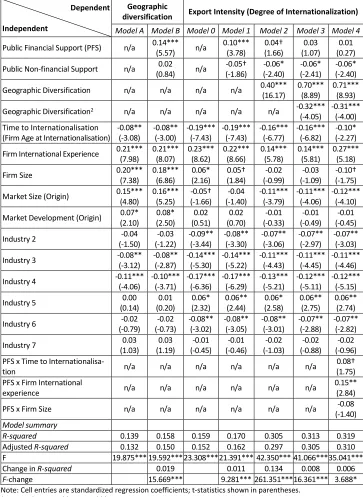
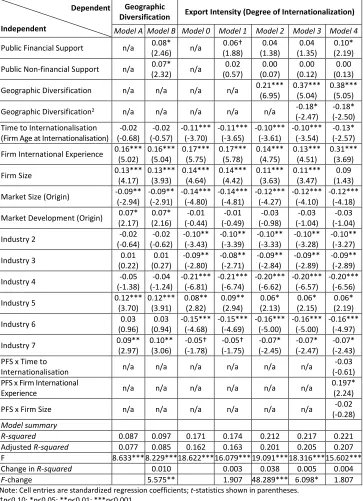
Hypothesis 1 predicts that the use of public support (both financial and non-financial) pos-itively impacts a degree of the internationalisation of SMEs regardless of the origin. In or-der to test H1, we employ a hierarchical regression analysis, entering the predictors in a theory-driven order and assessing the incremental ‘change in R-squared. In other words, we compare the explanatory power of the baseline model, which examines only the ef-fects of control variables, with the full model which includes independent variables, that is financial and non-financial public support. Two sets of regression models that are nec-essary to examine the mediation effect in both samples are presented in Table 5 (the EU15 sample) and Table 6 (the CEE12 sample). The baseline and the full models in both samples are significant at p<0.001 (see Model 0 and Model 1 in Table 5 and Table 6).
In the case of the EU15 sample, the inclusion of public support variables increases the explanatory power of Model 1 in a statistically significant way (captured by the change in R-squared), although the effect is rather small (Model 1 in Table 5: change in R-squared =0.011; F-change=9.281, p<0.001). Considering the direct effect of public support varia-bles on export intensity, we found that financial support is positively associated with ex-port intensity, supex-porting H1 (p<0.01). However, contrary to the expectations, the use of non-financial support is actually significantly (p<0.1) but negatively related to export in-tensity. This finding is further addressed in the discussion section. In the CEE12 sample, the inclusion of both public support variables does not significantly increase the explana-tory power of Model 1 (Model 1 in Table 6: change in R-squared=0.003; F-change = 1.907, p = 0.149). Only one of public support variables – financial support - occurred to be a sig-nificant (p = 0.060) predictor of export intensity. Therefore, our results provide partial sup-port for H1 in both samples: regardless of the SME origin, the use of financial supsup-port programmes increases the likelihood of achieving higher level of export intensity.
In Hypothesis 2 it is argued that there is a positive relationship between public sup-port (both financial and non-financial) and the scope of geographic diversification. As before, H2 is tested with hierarchical regressions, based on comparison of baseline Model A and full Model B, presented in Table 5 and Table 6. All models in both samples are statistically significant at p<0.001.
In the case of SMEs originating from the EU15 countries, the inclusion of public sup-port variables increases the explanatory power of Model B (Model B in Table 5: change in R-squared = 0.019; F-change = 15.669, p<0.001). According to the results, the use of finan-cial support is positively and significantly (p<0.001) associated with the broader scope of geographical diversification of exports, supporting H2. However, the effect of non-finan-cial support is not supported for Old Europe SMEs. Considering the second sample of SMEs from the CEE12 countries, both types of public support (that is financial and non-financial) occurred to be positively and significantly (p<0.05) related to the geographic diversifica-tion. Therefore, H2 is supported in the CEE12 sample.
Factor 1 2 3 4 5 6 7 8 9 Mean SD VIFa VIFb
1 Degree of Internationalization 1 0.29 0.29
2 Geographic Diversification 0.46** 1 3.56 3.22 1.19
3 No Public Support -0.08** -0.16** 1 0.91 0.29
4 Public Financial Support 0.12** 0.16** -0.86** 1 0.07 0.25 1.03 1.05 5 Public Non-financial Support -0.04 0.03 -0.48** -0.04 1 0.02 0.15 1.01 1.01 6 Firm Age at Internationalization -0.19** -0.04 0.00 0.00 0.00 1 13.56 18.62 1.07 1.08 7 Firm International Experience 0.27** 0.26** -0.02 0.02 0.00 -0.05* 1 19.93 16.43 1.10 1.15 8 Firm Size 0.07** 0.23** -0.11** 0.11** 0.03 0.19** 0.19** 1 3.17 1.38 1.15 1.19 9 Market Size (Origin) -0.08** 0.11** 0.02 -0.03 0.02 0.08** -0.06* 0.08** 1 9.99 1.20 1.52 1.55 10 Market Development (Origin) 0.06* -0.03 0.06** -0.04† -0.04 -0.01 0.11** -0.14** -0.57** 10.70 0.28 1.56 1.57 Note: Correlation is significant: **at the 0.01 level (2-tailed); *at the 0.05 level (2-tailed); †at the 0.10 level (2-tailed). aRefers to Model B in Table 5; brefers to Model 2 in Table 5.
Source: own study.
Table 4. Correlations, Descriptives and Collinearity Statistics in CEE12 Sample (N=1007)
Factor 1 2 3 4 5 6 7 8 9 Mean SD VIFa VIFb
1 Degree of Internationalization 1 0.32 0.32
2 Geographic Diversification 0.29** 1 2.27 1.82 1.11
3 No Public Support -0.08** -0.10** 1 0.92 0.27
Table 5. Linear Regression Results in EU15 Sample (N=1368)
Dependent
Independent
Geographic
diversification Export Intensity (Degree of Internationalization)
Model A Model B Model 0 Model 1 Model 2 Model 3 Model 4
Public Financial Support (PFS) n/a 0.14*** (5.57) n/a
0.10*** (3.78) 0.04† (1.66) 0.03 (1.07) 0.01 (0.27)
Public Non-financial Support n/a 0.02
(0.84) n/a
-0.05† (-1.86) -0.06* (-2.40) -0.06* (-2.41) -0.06* (-2.40)
Geographic Diversification n/a n/a n/a n/a 0.40***
(16.17)
0.70*** (8.89)
0.71*** (8.93)
Geographic Diversification2 n/a n/a n/a n/a n/a -0.32***
(-4.05)
-0.31*** (-4.00) Time to Internationalisation
(Firm Age at Internationalisation) -0.08** (-3.08) -0.08** (-3.00) -0.19*** (-7.43) -0.19*** (-7.43) -0.16*** (-6.77) -0.16*** (-6.82) -0.10* (-2.27)
Firm International Experience 0.21*** (7.98) 0.21*** (8.07) 0.23*** (8.62) 0.22*** (8.66) 0.14*** (5.78) 0.14*** (5.81) 0.27*** (5.18)
Firm Size 0.20***
(7.38) 0.18*** (6.86) 0.06* (2.16) 0.05† (1.84) -0.02 (-0.99) -0.03 (-1.09) -0.10† (-1.75)
Market Size (Origin) 0.15***
(4.80) 0.16*** (5.25) -0.05† (-1.66) -0.04 (-1.40) -0.11*** (-3.79) -0.11*** (-4.06) -0.12*** (-4.10)
Market Development (Origin) 0.07* (2.10) 0.08* (2.50) 0.02 (0.51) 0.02 (0.70) -0.01 (-0.33) -0.01 (-0.49) -0.01 (-0.45)
Industry 2 -0.04
(-1.50) -0.03 (-1.22) -0.09** (-3.44) -0.08** (-3.30) -0.07** (-3.06) -0.07** (-2.97) -0.07** (-3.03)
Industry 3 -0.08**
(-3.12) -0.08** (-2.87) -0.14*** (-5.30) -0.14*** (-5.22) -0.11*** (-4.43) -0.11*** (-4.45) -0.11*** (-4.46)
Industry 4 -0.11***
(-4.06) -0.10*** (-3.71) -0.17*** (-6.36) -0.17*** (-6.29) -0.13*** (-5.21) -0.12*** (-5.11) -0.12*** (-5.15)
Industry 5 0.00
(0.14) 0.01 (0.20) 0.06* (2.32) 0.06** (2.44) 0.06* (2.58) 0.06** (2.75) 0.06** (2.74)
Industry 6 -0.02
(-0.79) -0.02 (-0.73) -0.08** (-3.02) -0.08** (-3.05) -0.08** (-3.01) -0.07** (-2.88) -0.07** (-2.82)
Industry 7 0.03
(1.03) 0.03 (1.19) -0.01 (-0.45) -0.01 (-0.46) -0.02 (-1.03) -0.02 (-0.88) -0.02 (-0.96) PFS x Time to
Internationalisa-tion n/a n/a n/a n/a n/a n/a
0.08† (1.75) PFS x Firm International
experience n/a n/a n/a n/a n/a n/a
0.15** (2.84)
PFS x Firm Size n/a n/a n/a n/a n/a n/a -0.08
(-1.40)
Model summary
R-squared 0.139 0.158 0.159 0.170 0.305 0.313 0.319
Adjusted R-squared 0.132 0.150 0.152 0.162 0.297 0.305 0.310
F 19.875*** 19.592*** 23.308***21.391*** 42.350*** 41.066***35.041***
Change in R-squared 0.019 0.011 0.134 0.008 0.006
F-change 15.669*** 9.281*** 261.351***16.361*** 3.688*
Note: Cell entries are standardized regression coefficients; t-statistics shown in parentheses. †p<0.10; *p<0.05; **p<0.01; ***p<0.001
Table 6. Linear Regression Results in CEE12 Sample (N=1007)
Dependent
Independent
Geographic
Diversification Export Intensity (Degree of Internationalization)
Model A Model B Model 0 Model 1 Model 2 Model 3 Model 4
Public Financial Support n/a 0.08*
(2.46) n/a
0.06† (1.88) 0.04 (1.38) 0.04 (1.35) 0.10* (2.19)
Public Non-financial Support n/a 0.07* (2.32) n/a
0.02 (0.57) 0.00 (0.07) 0.00 (0.12) 0.00 (0.13)
Geographic Diversification n/a n/a n/a n/a 0.21***
(6.95)
0.37*** (5.04)
0.38*** (5.05)
Geographic Diversification2 n/a n/a n/a n/a n/a -0.18*
(-2.47)
-0.18* (-2.50) Time to Internationalisation
(Firm Age at Internationalisation) -0.02 (-0.68) -0.02 (-0.57) -0.11*** (-3.70) -0.11*** (-3.65) -0.10*** (-3.61) -0.10*** (-3.54) -0.13* (-2.57)
Firm International Experience 0.16*** (5.02) 0.16*** (5.04) 0.17*** (5.75) 0.17*** (5.78) 0.14*** (4.75) 0.13*** (4.51) 0.31*** (3.69)
Firm Size 0.13***
(4.17) 0.13*** (3.93) 0.14*** (4.64) 0.14*** (4.42) 0.11*** (3.63) 0.11*** (3.47) 0.09 (1.43)
Market Size (Origin) -0.09**
(-2.94) -0.09** (-2.91) -0.14*** (-4.80) -0.14*** (-4.81) -0.12*** (-4.27) -0.12*** (-4.10) -0.12*** (-4.18)
Market Development (Origin) 0.07* (2.17) 0.07* (2.16) -0.01 (-0.44) -0.01 (-0.49) -0.03 (-0.98) -0.03 (-1.04) -0.03 (-1.04)
Industry 2 -0.02
(-0.64) -0.02 (-0.62) -0.10** (-3.43) -0.10** (-3.39) -0.10** (-3.33) -0.10** (-3.28) -0.10** (-3.27)
Industry 3 0.01
(0.22) 0.01 (0.27) -0.09** (-2.80) -0.08** (-2.71) -0.09** (-2.84) -0.09** (-2.89) -0.09** (-2.89)
Industry 4 -0.05
(-1.38) -0.04 (-1.24) -0.21*** (-6.81) -0.21*** (-6.74) -0.20*** (-6.62) -0.20*** (-6.57) -0.20*** (-6.56)
Industry 5 0.12***
(3.70) 0.12*** (3.91) 0.08** (2.82) 0.09** (2.94) 0.06* (2.13) 0.06* (2.15) 0.06* (2.19)
Industry 6 0.03
(0.96) 0.03 (0.94) -0.15*** (-4.68) -0.15*** (-4.69) -0.16*** (-5.00) -0.16*** (-5.00) -0.16*** (-4.97)
Industry 7 0.09**
(2.97) 0.10** (3.06) -0.05† (-1.78) -0.05† (-1.75) -0.07* (-2.45) -0.07* (-2.47) -0.07* (-2.43) PFS x Time to
Internationalisation n/a n/a n/a n/a n/a n/a
-0.03 (-0.61) PFS x Firm International
Experience n/a n/a n/a n/a n/a n/a
0.197* (2.24)
PFS x Firm Size n/a n/a n/a n/a n/a n/a -0.02
(-0.28)
Model summary
R-squared 0.087 0.097 0.171 0.174 0.212 0.217 0.221
Adjusted R-squared 0.077 0.085 0.162 0.163 0.201 0.205 0.207
F 8.633*** 8.229*** 18.622***16.079*** 19.091*** 18.316*** 15.602***
Change in R-squared 0.010 0.003 0.038 0.005 0.004
F-change 5.575** 1.907 48.289*** 6.098* 1.807
Note: Cell entries are standardized regression coefficients; t-statistics shown in parentheses. †p<0.10; *p<0.05; **p<0.01; ***p<0.001
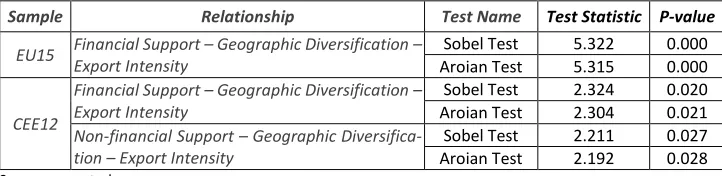
H2, Model B in Table 5 and Table 6), the use of financial support is associated with an increase in geographic scope in both samples, but the effect of non-financial support was found significant only in the CEE12 sample. Secondly, the independent variable (public support) must affect the dependent variable (export intensity). The results of the analysis are presented in section concerning H1, and indicate that only the use of financial support is positively and significantly related to export intensity in both samples. Therefore, the effect of non-financial support on export intensity cannot be mediated by the geographic scope, either because the first condition (in the EU15 sample), or the second (in the CEE12 sample) is not fulfilled. Thirdly, the mediator (geographic diversification) must affect the dependent variable (export intensity), and fourth, the relationship between the inde-pendent variable (public financial support) and deinde-pendent variable (export intensity) is significantly reduced when the mediator (geographic scope) is included in regressions. These final conditions were tested in Model 2 and Model 3 (Tables 5 and 6). In Model 2 and Model 3 there is a positive and significant (p<0.001) relationship between the geo-graphic scope and export intensity in both samples. Additionally, recognizing previously presented arguments on a non-linear (inverted U-shape) character of this relationship, Model 3 includes also a squared term of geographic diversification, which is negative and significant in both samples (in EU15, p<0.001; in CEE12, p<0.05). After the inclusion of the geographic scope, the effect of financial support on export intensity has been either significantly reduced (EU15: p<0.1, Model 2), or is no longer significant (EU15: p>0.1, Model 3; CEE12: p>0.1, Model 2 and Model 3). In order to validate the statistical signifi-cance of the mediation effect, the Sobel and Aroian tests were conducted (Table 7). The results provide significant evidence that geographic scope is a mediator between finan-cial support and export intensity (EU15: Sobel-test statistic = 5.32, p<0.001, the test statistic = 5.32, p<0.001; CEE12: Sobel-test statistic = 2.32, p<0.05, the Aroian-test statistic = 2.30, p<0.05). Thus, H3 is partially supported, suggesting the indirect effect only of financial support on export intensity.
Table 7. Tests of mediating role of geographic diversification
Sample Relationship Test Name Test Statistic P-value
EU15 Financial Support – Geographic Diversification – Export Intensity
Sobel Test 5.322 0.000 Aroian Test 5.315 0.000
CEE12
Financial Support – Geographic Diversification – Export Intensity
Sobel Test 2.324 0.020
Aroian Test 2.304 0.021
Non-financial Support – Geographic Diversifica-tion – Export Intensity
Sobel Test 2.211 0.027
Aroian Test 2.192 0.028 Source: own study.
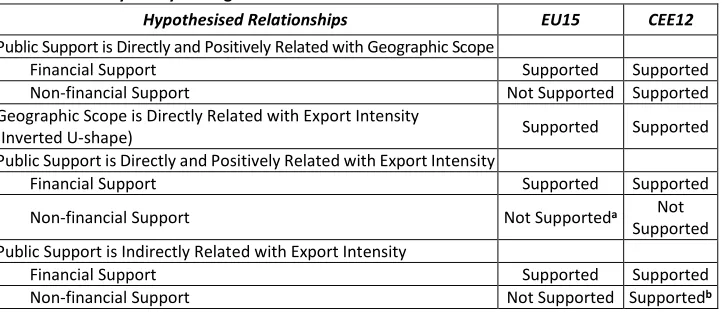
between non-financial support and geographic scope is not significant). In order to exam-ine the mediation effect, the Sobel and Aroian tests are used (see Table 7, CEE12: Sobel-test statistic=2.21, p<0.05, the Aroian-Sobel-test statistic=2.19, p<0.05). These results imply that in the CEE12 sample, the geographic scope mediates the relationship between non-finan-cial support and the export intensity. All key findings are summarised in Table 8.
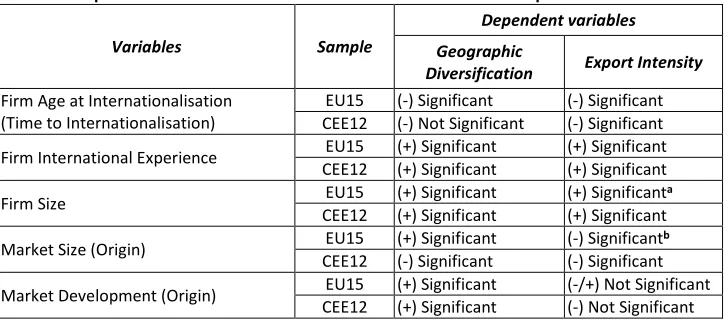
Effects of control variables in both samples are shown in Table 9. Considering the ef-fects of firm-level control variables (including firm age at internationalisation, interna-tional experience and size), no large differences were observed between samples.
Firm age at internationalisation is negatively associated with both dependent variables in both samples, indicating that SMEs that have decided to internationalise later in their life cycle have a more narrow scope of geographic diversification (in the case of the CEE12 sam-ple, the effect is negative but insignificant), and achieve a lower level of export intensity. This finding is in line with an argument of learning advantages of newness (Autio et al., 2000; Zhou, 2007). Nonetheless, firm international experience occurred to support the export ge-ographic scope and export intensity in both samples, which indicate that experience and re-sulting knowledge is a valuable resource enhancing operations of SMEs in foreign markets. Similarly, firm size (which is often used as a proxy of firm resources) is also positively and significantly associated with both dependent variables in both samples (but in the EU15 sam-ple this effect holds only in control Model 0 and Model 1; when geographic diversification is added, firm size becomes an insignificant predictor of export intensity).
Table 8. Summary of key findings
Hypothesised Relationships EU15 CEE12
Public Support is Directly and Positively Related with Geographic Scope
Financial Support Supported Supported
Non-financial Support Not Supported Supported
Geographic Scope is Directly Related with Export Intensity
(Inverted U-shape) Supported Supported
Public Support is Directly and Positively Related with Export Intensity
Financial Support Supported Supported
Non-financial Support Not Supporteda Not
Supported Public Support is Indirectly Related with Export Intensity
Financial Support Supported Supported
Non-financial Support Not Supported Supportedb
Note: aSignificant (p<0.1) but negative relationship (in contrary to H1, see Model 1 in Table 5). bSupported only
by an alternative mediation framework of Cohen and Cohen (1983) (see Model B, Model 1, Model 2 in Table 6).
Source: own study.
export intensity, therefore supporting the argument that SMEs originating from smaller domestic market (which offer more limited growth opportunities) are more likely to focus on foreign markets searching for growth (Reuber & Fischer, 1997; Ciszewska-Mlinarič & Mlinarič, 2010). Finally, SMEs originating from more developed domestic markets were also more likely to follow more diversified export strategies (in both samples), but there was no significant effect of the development of the domestic market for the export intensity in none of the samples. The implications of the findings are discussed in the next section. Table 9. Comparison of control variables’ effects in EU15 and CEE12 samples
Variables Sample
Dependent variables
Geographic
Diversification Export Intensity
Firm Age at Internationalisation (Time to Internationalisation)
EU15 (-) Significant (-) Significant CEE12 (-) Not Significant (-) Significant Firm International Experience EU15 (+) Significant (+) Significant
CEE12 (+) Significant (+) Significant
Firm Size EU15 (+) Significant (+) Significant
a
CEE12 (+) Significant (+) Significant Market Size (Origin) EU15 (+) Significant (-) Significant
b
CEE12 (-) Significant (-) Significant Market Development (Origin) EU15 (+) Significant (-/+) Not Significant
CEE12 (+) Significant (-) Not Significant
Note: aPositive and significant in Model 0 and Model 1, but insignificant in Model 2 and 3 (see Table 5).
bNegative and significant in Model 0, Model 2 and Model 3, but insignificant in Model 1 (see Table 5).
Source: own study.
CONCLUSIONS
The study findings reveal that only a small portion of SMEs actively use the public support programmes (as already reported, only 9.1% and 7.9% of SMEs used them, respectively in the EU-15 and the CEE12 countries). This may be attributed to the low awareness of such programmes among SME owners/managers (Fischer & Reuber, 2003a; Orser, Fischer, Hooper, Reuber, & Riding, 1999; European Commission, 2010), which is a significant issue in itself, however, this article attempts to verify the rele-vance of such programmes for benefitting SMEs.
prior research (Bannò et al., 2014). Undoubtedly, they suggest that public financial support programmes have a positive impact on SME export activities, so governments’ and/or gov-ernmental agencies’ assumptions behind such programmes seem to be well-justified.
Moreover, the current study supports the existence of the curvilinear relationship be-tween export diversification and intensity in a new context of small and medium-sized firms, originating from developed and advanced emerging economies of Europe.
The situation is, however, much less clear when evaluating the impact of non-financial public support programmes. First, SMEs from the EU15 countries do not experience any sig-nificant and positive results for the geographic scope that could result from the use of non-financial support. On the contrary, such SMEs (using only non-non-financial support) are charac-terised by a lower level of export intensity than firms that use no public support at all. This effect is even stronger when we control for the mediating effect of the geographic scope (Model 2 in Table 5). Given that the overall usage of public support programmes by SMEs in the EU15 sample is relatively low (9.1%), it may indicate that SMEs using only non-financial support (2.3%) are those that experience problems trying to increase their foreign sales. Thus, they may see non-financial programmes as the means to improve international expo-sure. Unfortunately, due to the study design, it is not possible to answer the question whether in a longer term such support would occur beneficial. Secondly, SMEs from the CEE12 countries that use the non-financial export support programmes (only 1.2% of the sample) are likely to expect an increase in the geographic scope, however, only the alterna-tive framework for mediation effect (Cohen & Cohen, 1983) supports the indirect relation-ship between non-financial support and export intensity. Therefore, according to the study results, it is not possible to formulate any direct and unequivocal recommendations for in-stitutions providing non-financial support for internationally oriented SMEs.
In the background of the study findings there is, however, one additional important question: which firms should be supported by public money? Taking into consideration the death rate among new firms, limited growth potential and limited public funds, many researchers claim that public institutions should support not all, but only those most prom-ising firms, usually categorised as high-growth firms, or ‘gazelles’. Such arguments are well grounded in macro-level research. For instance, Onkelinx and Sleuwaegen (2010) found that SME export growth was ‘driven by a small group of born global firms, accounting for 60 per cent of the total increase in SME exports between 1998 and 2005. (…) we find born globals to be more productive and characterized by a higher R&D spending and intangible asset intensity compared to other types of traders. (…) We find that born globals grow faster in terms of export sales, have a stronger commitment to export markets and are more likely to continue exporting’ (Onkelinx & Sleuwaegen, 2010, p. 1). However, these authors also noticed that born-global firms were also characterised by a higher failure rate than traditional internationalisers.
support, regardless of their origin. However, the inclusion of several interaction terms4 revealed a few interesting effects. First, in both samples the positive effect of firm inter-national experience on export intensity is accentuated by the use of financial support pro-grammes. Additionally, in the EU15 sample, the negative effect of time to internationali-sation (in other words, age at internationaliinternationali-sation) on export intensity was smaller in the case of SMEs using financial support programmes. Thus, it is possible to conclude that firms with a more pronounced prior international experience are better prepared to achieve benefits (in terms of export intensity) that result from the use of financial support. Such conclusions may be important for government agencies and other providers of ex-port supex-port that are in charge of the distribution of usually limited public funds. However, it is not argued here that prior international experience should be the only criterion taken into account. Interesting insights in this respect are offered by Fischer and Reuber (2003a), who argue that not only firms’, but also managers/owners’ personal experience should be considered by providers of export support so that programmes are customised in terms of product/service offerings, and the communication and distribution tactics. More broadly, Mion and Muûls (2014) recommended the UK government to develop policies enhancing domestic firms to capture the full potential of growing BRIC (Brazil, Russia, India, China) markets, as well as ‘Policies to help ensure a continuing annual influx of new exporters, and to help ensure successful persistence in exporting among more of those who begin to export’ (Mion & Muûls, 2014, p. 9).
In this article, the empirical analyses of the large, cross-country sample reveal that there are significant, firm-level differences characterising internationally oriented SMEs from Old and New Europe (Table 2). For instance, SMEs from the EU15 follow more geographically diversified export strategy but achieve slightly lower export intensity. They are also older, have longer international experience, decide to internationalise later in their life cycle, and on average are slightly smaller. Many of these differences can be explained by different in-stitutional/historic background of Old and New Europe SMEs, communist heritage and tran-sition period (from centrally planned communist economies to market driven economic sys-tem). Thus, it is not surprising that SMEs in the CEE12 sample are younger, or that their in-ternational experience is shorter. However, originating from ‘late-comer’ economies in terms of the global economic integration, international trade and investment flows, New Europe SMEs decide to internationalise much earlier in their life cycle than peers from Old Europe, and achieve a higher level of export intensity, but more narrow geographic scope (this can be also explained in terms of colonial ties that many Old Europe countries devel-oped in their history). New Europe firms are pushed for earlier internationalisation to catch up with Old Europe SMEs. To sum up, it is evident that Old and New Europe SMEs are differ-ent. But from that it cannot be concluded that either international business or international entrepreneurship fields are in need of new theories.
4 In additional analyses, that are presented in Model 4 in Table 5 and Table 6, several interaction terms were added,
When it comes to the comparison of the studied relationships, including the effects of control variables, the key findings across Old and New Europe SMEs are the same: public financial support has a direct and an indirect (via geographic scope) effect on export tensity; and relationship between the geographic scope and export intensity has an in-verted U-shape. Moreover, as already mentioned, firm-level control variables (including time to internationalisation, firm international experience, and firm age) have the same effect on the geographic scope and export intensity, regardless of the SMEs’ origin. Thus, recognizing differences existing between Old and New Europe SMEs, the relationships ex-plaining the studied phenomena are indeed the same.
Although the article offers clear insights into the significance of financial vs. non-financial public support programmes for internationalisation activities of SMEs, the study suffers from several limitations. First, the operationalisation of export intensity as a FSTS ratio may be criticised on the grounds that variables other than public support or geographic scope may affect it. To deal with this issue, the study controls for many firm- and environment-level variables and employs the hierarchical regression modelling to validate the significance of key independent variables. Secondly, the operationalisation of public support as a dichotomous variable – though employed also in other studies (e.g. Bannò et al., 2014) – led to obvious limitations, thus, future research should employ more nuanced operationalisations, including the issue of the size of the public support or the very character of the support programme.
Thirdly, the cross-sectional character does not make it possible to evaluate longer term effects of public support, especially non-financial support. Therefore, studies using longitu-dinal analytical methods are needed to examine the effectiveness of public support properly, indicating how it helps to overcome liabilities of smallness, foreignness, outsidership and/or newness. Most studies on public support effects, and/or on the link between the diversifica-tion of developed and emerging market firms, including this one, are based on one point in time, which obviously renders the generalisability of findings questionable (Nachum, 2004). The popularity of a single year studies results from the challenge to collect reliable longitu-dinal and firm-level data from many countries at the same and multiple points in time.
Fourthly, it should be also recognized that in the face of major changes in both internal and external processes of SMEs in the post-crisis time (after 2010), the presented results that cover the period before the crisis should be treated with caution. Thus, more recent research on internationally oriented SMEs is needed.
nuanced way the type of exporters (born-globals vs. traditional internationalisers). Finally, given that the awareness and propensity of owners/managers of SMEs to consult public sup-port providers is resup-portedly shown as low the question how to change it is still relevant.
REFERENCES
Aldrich H.E., & Auster, E. (1986). Even dwarfs started small: Liabilities of size and age and their stra-tegic implications. Research in Organizational Behavior, 8, 165-198.
Alonso-Nuez, M.J., & Galve-Gorriz, C. (2012). The impact of public programs on the survival and profits of stratups: Evidence from a region of Spain. Journal of Developmental Entrepreneurship, 17(2), 1-23. Audet, J., Berger-Douce, S. & St-Jean, E. (2007). Perceptual barriers preventing small business
owners from using public support services: Evidence from Canada. International Journal of Entrepreneurship, 11, 27-48.
Audet, J., & St-Jean, E. (2007). Factors affecting the use of public support services by SME owners: Evidence from a periphery region of Canada. Journal of Developmental Entrepreneurship, 12(2), 165-180. https://doi.org/10.1142/S1084946707000629
Autio, E., Sapienza, H.J., & Almeida, J.G. (2000). Effects of age at entry, knowledge intensity, and imitability on international growth. Academy of Management Journal, 43(5), 909-924. https://doi.org/10.5465/1556419
Bannò, M., Piscitello, L. & Varum, C.A. (2014). The Impact of Public Support on SMEs’ Outward FDI: Evidence from Italy. Journal of Small Business Management, 52(1), 22-38.
https://doi.org/10.1111/jsbm.12029
Baron, R.M., & Kenny, D.A. (1986). The moderator-mediator variable distinction in social psycholog-ical research: Conceptual, strategic, and statistpsycholog-ical considerations. Journal of Personality and Social Psychology, 51(6), 1173-1182.
Berrone, P., Gertel, H., Giuliodori, R.,Bernard, L., & Meiners, E. (2014). Determinants of Perfor-mance in Microenterprises: Preliminary Evidence from Argentina. Journal of Small Business Management, 52(3), 477-500. https://doi.org/10.1111/jsbm.12045
Bonaccorsi, A. (1992). On the relationship between firm size and export intensity. Journal of Inter-national Business Studies, 23, 605-635. https://doi.org/10.1057/palgrave.jibs.8490280 Bruton, G.D., Lau, C.N., & Obloj, K. (2014). Institutions, Resources, and Firm Strategies: A
Compara-tive Analysis of Entrepreneurial Firms in Three Transitional Economies. European Journal of In-ternational Management, 8(6), 697-720. https://doi.org/10.1504/EJIM.2014.064905
Capar, N., & Kotabe, K. (2003). The relationship between international diversification and perfor-mance in service firms. Journal of International Business Studies, 34(4), 345-355.
https://doi.org/ 10.1057/palgrave.jibs.8400036
Churchill, W. (1946). Speeches of Winston Churchill: Sinews of Peace, March 5, 1946, Westminster College, Fulton, Missouri. Retrieved on February 1, 2016 from: http://www.ntanet.net/sinewsofpeace.htm Cieślik, J., Kaciak, E., & Welsh, D. (2012). The impact of geographic diversification on export
performance of small and medium-sized enterprises (SMEs). Journal of International En-trepreneurship, 10(1), 70-93. https://doi.org/10.1007/s10843-012-0084-7
Cieślik, J., & Kaciak, E. (2009). The speed of internationalization of entrepreneurial start-ups in a transition environment. Journal of Developmental Entrepreneurship, 14(4), 375-392. https://doi.org/10.1142/S1084946709001375
Cohen, J., & Cohen, P. (1983). Applied multiple regression/correlation analysis for the behavioural sciences (2nd ed.). Hillsdale, NJ: Lawrence Erlbaum Assocites.
Dejo-Oricain, N., & Ramírez-Alesón, M. (2009). Export Behaviour: a Study of Spanish SMEs. GCG: Re-vista de Globalización, Competitividad & Gobernabilidad, 3(2), 52-67.
Driffield, N., Du, J., & Girma, S. (2008). Optimal geographic diversification and firm performance: evidence from the U.K. Journal of Productivity Analysis, 30(2), 145-154.
Erramilli, M.K. (1991). The Experience Factor in Foreign Market Entry Behaviour of Service Firms. Journal of International Business Studies, 22(3), 479-501. https://doi.org/10.1057/pal-grave.jibs.8490312
European Commission. (2010). Internationalisation of European SMEs. Entrepreneurship Unit Directorate-General for Enterprise and Industry, European Commission & EIM Business & Policy Research, Brussels.
Fischer, E., & Reuber, A.R. (2003a). Targeting Export Support to SMEs: Owners’ International Experi-ence as a Segmentation Basis. Small Business Economics, 20(1), 69-82.
Fischer, E., & Reuber, A.R. (2003b). Support for Rapid-Growth Firms: A Comparison of the Views of Founders, Government Policymakers, and Private Sector Resource Providers. Journal of Small Business Management, 41(4), 346-365.
Gashi, P., Hashi, I., & Pugh, G. (2014). Export behaviour of SMEs in transition countries. Small Busi-ness Economics, 42(2), 407-435. https://doi.org/10.1007/s11187-013-9487-7
Grant, R.M. (1987). Multinationality and performance among British manufacturing companies. Journal of International Business Studies, 18(3), 79-89. https://doi.org/10.1057/pal-grave.jibs.8490413
Hall, G., & Tú, C. (2004). Internationalization and size, age and profitability in the United King-dom. In L.P. Dana (Ed.) Handbook of Research on International Entrepreneurship (pp. 596-613). Cheltenham: Edward Elgar.
Hernández, V., & Nieto, M.J. (2015). The effect of the magnitude and direction of institutional dis-tance on the choice of international entry modes. Journal of World Business, 50(1), 122-132. https://doi.org/10.1016/j.jwb.2014.02.002
Hitt, M.A., Hoskisson, R.E., & Kim, H. (1997). International diversification: effects on innovation and firm performance in product diversified firms. Academy of Management Journal, 40, 767-798. https://doi.org/10.2307/256948
Javalgi, R.G., & Grossman, D.A. (2014). Firm Resources and Host-Country Factors Impacting In-ternationalization of Knowledge-Intensive Service Firms. Thunderbird International Busi-ness Review, 56(3), 285-300.
Johanson, J., & Vahlne, J.E. (2003). Business Relationship Learning and Commitment in the Internationalization Process. Journal of International Entrepreneurship, 1(1), 83-101. https://doi.org/10.1023/A:1023219207042
Johanson J., & Vahlne, J.E. (2009). The Uppsala internationalization process model revisited: From liability of foreignness to liability of outsidership. Journal of International Business Studies, 40(9), 1411-143. https://doi.org/10.1057/jibs.2009.24
Kale S., & Arditi, D. (1998). Business failures: Liabilities of newness, adolescence, and smallness. Jour-nal of Construction Engineering & Management, 124(6), 458-464.
Kuivalainen, O., Puumalainen, K., Sintonen, S., & Kyläheiko, K. (2010). Organisational Capabilities and Internationalisation of the Small and Medium-Sized Information and Communications Technol-ogy Firms. Journal of International Entrepreneurship, 8(2), 135-155.
Kyvik, O., Saris, W., Bonet, E., & Felício, J. (2013). The internationalization of small firms: The rela-tionship between the global mindset and firms’ internationalization behaviour. Journal of Inter-national Entrepreneurship, 11(2), 172-195.
Lee, H-U., & Park, J-H. (2006). Top Team Diversity, Internationalization and the Mediating Effect of International Alliances. British Journal of Management, 17(3), 195-213. https://doi.org/ 10.1111/j.1467-8551.2006.00501.x
Liu, H., Jiang, X., Zhang, J., & Zhao, X. (2013). Strategic Flexibility and International Venturing by Emerging Market Firms: The Moderating Effects of Institutional and Relational Factors. Journal of International Marketing, 21(2), 79-98.
Mason, C., & Brown, R. (2013). Creating good public policy to support high-growth firms. Small Busi-ness Economics, 40(2), 211-225.
Mion, G., & Muûls, M. (2014). Investigation into the Extensive and Intensive margins of Growth in the Value of UK Exports and the Role of SME Exporters. Research report available at
https://www.gov.uk/government/uploads/system/uploads/attach-ment_data/file/473293/2013_Extensive_Intensive_margins_FINAL_03_Dec_13.pdf
Musteen, M., & Datta, D. (2011). Learning about foreign markets: A study of Czech SMEs. Journal of International Entrepreneurship, 9(2), 91-109.
Nachum, L. (2004). Geographic and Industrial Diversification of Developing Country Firms. Journal of Management Studies, 41(2), 273-294. https://doi.org/10.1111/j.1467-6486.2004.00432.x Neter, J., Kutner, M.H., Nachtsheim, C.J., & Wasserman, W. (1996). Applied Linear Regression
Mod-els. Irwin Press, Illinois.
Norman, C., & Bager-Sjorgen, L. (2006). Public support to innovative ventures: Does it have any impact?. paper presented at the Nordic Conference on Small Business Research, Stockholm, Sweden. North, D., Smallbone, D., & Vickers, I. (2001). Public Sector Support for Innovating SMEs. Small
Busi-ness Economics, 16(4), 303-317. https://doi.org/10.1023/A:1011164801073
Nummela, N., Saarenketo, S., & Puumalainen, K. (2004). A global mindset: a prerequisite for success-ful internationalization?. Canadian Journal of Administrative Sciences, 21(1), 51-64.
OECD. (2007). Glossary of Statistical Terms. Organisation for Economic Co-operation and Develop-ment. Retrieved on February 1, 2016 from http://stats.oecd.org/glossary/download.asp Onkelinx, J., & Sleuwaegen, L.E. (2010). Internationalization Strategy and Performance of Small and
Medium Sized Enterprises (National Bank of Belgium Working Paper No. 197). Available at SSRN: https://ssrn.com/abstract=1692583 or http://dx.doi.org/10.2139/ssrn.1692583. Orser, B., Fischer, E., Hooper, S., Reuber, R., & Riding, A. (1999). Beyond Borders, Ottawa:
Depart-ment of Foreign Affairs and International Trade.
Paus, E. (2012). Confronting the Middle Income Trap: Insights from Small Latecomers. Studies in Comparative International Development, 47(2), 115-138.
Ramsden, M., & Bennet, R.J. (2005). The benefits of external support to SMEs: “Hard” versus “soft” out-comes and satisfaction levels. Journal of Small Business and Enterprise Development, 12(2), 227-243. Reuber, A.R., & Fischer, E. (1997). The influence of the management team’s international experience on the internationalization behaviors of SMEs. Journal of International Business Studies, 28(4), 807-825. Rodríguez, A., & Nieto, M.J. (2012). The internationalization of knowledge-intensive business
Ruigrok, W., Amann, W., & Wagner, H. (2007). The internationalization-performance relationship at Swiss firms: a test of the S-shape and extreme degrees of internationalization. Management International Review, 47(3), 349-368.
Sapienza, H.J., De Clercq, D., & Sandberg, W. (2005). Antecedents of international and domestic learning effort. Journal of Business Venturing, 20(4), 437-457. https://doi.org/ 10.1016/j.jbusvent.2004.03.001
Sapienza, H.J., Autio, E., George, G., & Zahra, S.A. (2006). A capabilities perspective on the effects of early internationalization on firm survival and growth. Academy of Management Review, 31(4), 914-933. https://doi.org/ 10.5465/AMR.2006.22527465
Sarder, J.H., Ghosh, D., & Rosa, P. (1997). The importance of support services to small enterprise in Bangladesh. Journal of Small Business Management, 35(2), 26-36.
Sousa, C.M.P. (2004). Export performance measurement: an evaluation of the empirical research in the literature. Academy of Marketing Science Review, 9(12), 1-23. https://doi.org/10.12691/jbe-3-3-1 Wach, K. (2012). Europeizacja małych i średnich przedsiębiorstw: rozwójprzez umiędzynarodowienie.
Warszawa: Wydawnictwo Naukowe PWN.
Wheeler, C.N., Ibeh, K.I.N., & Dimitratos, P. (2008). UK export performance research – review and implications. International Small Business Journal, 26(2), 207-239.
Wiklund, J., & Shepherd, D.A. (2003). Aspiring for, and Achieving Growth: The Moderating Role of Resources and Opportunities. Journal of Management Studies, 40(8), 1911-1941.
https://doi.org/10.1046/j.1467-6486.2003.00406.x
Williams, D. (2011). Impact of firm size and age on the export behaviour of small locally owned firms: a fresh insight. Journal of International Entrepreneurship, 9(2), 152-174.
Yiu, D.W., Lau, C.M., & Bruton, G.D. (2007). International venturing by emerging economy firms: The effects of firm capabilities, home country networks, and corporate entrepreneurship. Journal of International Business Studies, 38(4), 519-540.
Yoo, S-J., Mackenzie, N.G., & Jones-Evans, D. (2012). Public sector support and technology-based SMEs in peripheral areas – The case of North Wales. Journal of Enterprising Culture, 20(1), 83-104.
Zaheer, S. (1995). Overcoming the liability of foreignness. Academy of Management Journal, 38(2), 341-363. https://doi.org/10.5465/256683
Zahra, S.A., Ireland, R.D., & Hitt. M.A. (2000). International Expansion by New Venture Firms: Inter-national Diversity, Mode of Market Entry, Technological Learning, and Performance. The Acad-emy of Management Journal, 43(5), 925-950. https://doi.org/10.5465/1556420
Zhou, L. (2007). The effects of entrepreneurial proclivity and foreign market knowledge on early internationalization. Journal of World Business, 42(3), 281-293.
Author
Mariola Ciszewska-Mlinarič
Assistant Professor of Strategic Management and International Business Strategy at Kozminski University. She received Ph.D. in Economics, with specialisation in strategic management, from Kozminski University, and her M.A. in Management from University of Warsaw.
Correspondence to: Dr Mariola Ciszewska-Mlinarič, Kozminski University, Department of Strat-egy, Jagiellonska 59, 03-301 Warsaw, Poland, e-mail: [email protected]
Acknowledgements and Financial Disclosure
The author would like to thank the editor and anonymous reviewers for their insightful com-ments, guiding the improvement of the article.
Copyright and License
This article is published under the terms of the Creative Commons Attribution – NoDerivs (CC BY-ND 4.0) License
http://creativecommons.org/licenses/by-nd/4.0/ Published by the Centre for Strategic and International Entrepreneurship – Krakow, Poland