Article
Three-Stage Sequential Estimation of the Inverse
Coefficient of Variation of the Normal Distribution
Ali Yousef1,* and Hosny Hamdy2
1 Department of Mathematics, Kuwait College of Science and Technology, Doha District B. O. Box 27235, Kuwait
2 Faculty of Management Sciences, October University for Modern Sciences and Arts, 6th October City 12566, Cairo, Egypt; [email protected]
* Correspondence: [email protected]
Received: 8 November 2019; Accepted: 3 December 2019; Published: 4 December 2019
Abstract: This paper sequentially estimates the inverse coefficient of variation of the normal distribution using Hall’s three-stage procedure. We find theorems that facilitate finding a confidence interval for the inverse coefficient of variation that has pre-determined width and coverage probability. We also discuss the sensitivity of the constructed confidence interval to detect a possible shift in the inverse coefficient of variation. Finally, we find the asymptotic regret encountered in point estimation of the inverse coefficient of variation under the squared-error loss function with linear sampling cost. The asymptotic regret provides negative values, which indicate that the three-stage sampling does be er than the optimal fixed sample size had the population inverse coefficient of variation been known.
Keywords: inverse coefficient of variation; normal distribution; regret; squared-error loss function; three-stage procedure
1. Introduction
Let𝑋1, 𝑋2, …be a sequence of independent and identically distributed IID random variables from a normal distribution𝑁(𝜇, 𝜎2)with mean𝜇 ∈Rand variance𝜎2∈R+, where both parameters are finite but unknown. The population coefficient of variation is the population standard deviation divided by the population mean that is𝜎/𝜇,𝜇 ≠ 0, mostly presented as a percentage. It is useful when we seek relative variability rather than the absolute variability. It is a dimensionless quantity, which enables researchers to compare different distributions, regardless of their measurable units. Such practicality makes it widely used in different areas of science, such as engineering, finance, economics, medicine, and others. Nairy and Rao [1] conducted a survey of several applications in engineering, business, climatology, and other fields. Ahn [2] used the coefficient of variation to predict the unknown number of flaw trees, while Gong and Li [3] used it to estimate the strength of ceramics. Faber and Korn [4] applied the measure in the mean synaptic response of the central nervous system. Hammer et al. [5] used the measure to test the homogeneity of bone samples in order to determine the effect of external treatments on the properties of bones. Billings et al. [6] used it to study the impact of socioeconomic status on hospital use in New York City. In finance, Brief and Owen [7] used the coefficient of variation to evaluate the project risks considering the rate of return as a random variable. Pyne et al. [8] used the measure to study the variability of the competitive performance of Olympic swimmers. In health sciences, see Kelley [9] and Gulhar et al. [10].
The disadvantage of the measure lies in the singularity point𝜇 = 0. Therefore, it is preferable to work with the reciprocal of the measure, inverse coefficient of variation,𝜃 = 𝜇/𝜎 defined overR. The inverse coefficient of variation is equal to the signal-to-noise ratio, which measures the signal
strength relative to background noise. In quality control, it represents the magnitude of the process mean compared to its variation. In other words, it quantifies how much signal has been corrupted by noise, see McGibney and Smith [11]. In finance, it is called Sharpe’s index, which measures portfolio performance, for example, see Knight and Satchell [12].
Having observed a random sample 𝑋1, 𝑋2, … , 𝑋𝑛 of size(𝑛 ≥ 2) from the normal population, we continue to use both 𝑋𝑛and 𝑆𝑛 as the sample mean and the sample standard deviation point estimates of the normal distribution mean𝜇and standard deviation𝜎, respectively. Consequently, we define the sample inverse coefficient of variation𝜃𝑛̂ = 𝑋𝑛/𝑆𝑛.
Hendricks and Robey [13] studied the sampling distribution of the coefficient of variation. Koopmans et al. [14] showed that without any prior restriction to the range of the population mean, it is impossible to obtain confidence intervals for the population coefficient of variation that have finite length with a probability one, uniformly for all values of𝜇 𝑎𝑛𝑑 𝜎except by using purely sequential procedure. Rao and Bha a [15] approximate the distribution function of the sample coefficient of variation using the Edgeworth series to obtain a more accurate large-sample test for the population coefficient of variation under normality. McKay [16] derived a confidence interval for the population coefficient of variation, which is based on the chi-squared distribution. He found that the constructed confidence interval works well when the coefficient of variation is less than 0.33, see Umphrey [17]. Later Vangel [18] modified McKay’s confidence interval, which shown to be closely related to McKay’s confidence interval, but is more accurate and nearly exact under normality. Miller [19] discussed the approximate distribution function of the sample coefficient of variation and proposed the approximate confidence interval for the coefficient of variation under normality. Lehmann [20] found an exact form for the distribution function of the sample coefficient of variation, which depends mainly on the non-central𝑡-distribution (defined overR), so it is computationally cumbersome. Curto and Pino [21] studied the distribution of the sample coefficient of variation in the case of non-IID random variables.
Sharma and Krishna [22] mathematically derived an asymptotic confidence interval for the population inverse coefficient of variation without any prior assumption regarding the underline distribution. Albatineh, Kibria, and Zogheib, [23] studied the performance of their constructed confidence interval using Monte Carlo simulation. They used randomly generated data from different distributions—normal, log-normal,𝜒2(Chi-squared-distribution), Gamma, and Weibull distributions.
Regarding sequential estimation, Chaturvedi and Rani [24] proposed a sequential procedure to construct a fixed-width confidence interval for the population inverse coefficient of variation of a normal distribution with a preassigned coverage probability. They mathematically showed that the proposed procedure a ains asymptotic efficiency and consistency in the sense of Chow and Robbins [25]. Cha opadhyay and Kelley [26] used the purely sequential procedure [25] to estimate the population coefficient of variation of the normal distribution under a squared-error loss function using a Nagar-type expansion.
Yousef and Hamdy [27] utilized Hall’s three-stage sampling procedure to estimate the population inverse coefficient of variation of the normal distribution using a Monte Carlo Simulation. They found a unified stopping rule, which is a function of the unknown population variance that tackles both a fixed-width confidence interval for the unknown population mean with a pre-assigned coverage probability and a point estimation problem for the unknown population variance under a squared-error loss function with linear sampling cost. In other words, they found the asymptotic coverage probability for the population mean and the asymptotic regret incurred by estimating the population variance by the sample variance. As an application, they write FORTRAN codes and use Microsoft Developer Studio software to find the simulated coverage probability for the inverse coefficient of variation and the simulated regret. The simulation results showed that the three-stage procedure a ains asymptotic efficiency and consistency in the sense of Chow and Robbins [25].
is different than in Yousef and Hamdy [27]; the stopping rule depends directly on the sample inverse coefficient of variation. We derive mathematically an asymptotic confidence interval for the population inverse coefficient of variation that has a fixed-width2𝑑(> 0)and coverage probability at least100(1 − 𝛼)%.
Moreover, we tackle a point estimation problem for the population inverse coefficient of variation using a squared-error loss function with linear sampling cost. Then we examine the capability of the constructed confidence interval to detect any potential shift that occurs in the population inverse coefficient of variation. Here, the stopping rule depends on the asymptotic distribution of the sample inverse coefficient of variation.
The Layout of the Paper
In Section 2, we present preliminary asymptotic results that facilitate finding the asymptotic distribution of the sample inverse coefficient of variation. In Section3, we present Hall’s three-stage procedure and find the asymptotic characteristics for both the main-study phase and the fine-tuning phase. In Section4, we find the asymptotic coverage probability for the population inverse coefficient of variation. In Section5, we discuss the capability of the constructed interval to detect any shift in the inverse coefficient of variation. In Section6, we find the asymptotic regret.
2. Preliminary Results
The following Corollaries are necessary to find the asymptotic distribution of the sample inverse coefficient of variation𝜃𝑛̂ = 𝑋𝑛/𝑆𝑛.
Corollary 1.Let𝑋1, 𝑋2, … , 𝑋𝑛be a random sample from𝑁(𝜇, 𝜎2). Let𝑆𝑛2= ∑𝑛𝑖=1(𝑋𝑖− 𝑋)2/(𝑛 − 1),𝑛 ≥ 2 and𝑋 = ∑𝑛1𝑋𝑖/𝑛for𝑛 ≥ 1. Then for all𝑛 ≥ 6,we have
(i) 𝐸(𝑆𝑛) = 𝜎 −4𝑛𝜎 + 𝑂(𝑛−2)
(ii) 𝐸(𝑆𝑛) = 𝜎4 4+2𝜎𝑛4+ 𝑂(𝑛−2)
(iii) 𝐸(𝑆𝑛−1) = 𝜎−1+3𝜎
−1
4𝑛 + 𝑂(𝑛 −2
)
(iv) 𝐸(𝑆𝑛−2) = 𝜎−2+2𝜎
−2
𝑛 + 𝑂(𝑛 −2
)
(v) 𝐸(𝑆𝑛−4) = 𝜎−4+6𝜎
−4
𝑛 + 𝑂(𝑛 −2
)
Proof. By using the fact (𝑛−1)𝜎2 𝑆𝑛2 ∼ 𝜒2(𝑛 − 1)we get𝐸(𝑆𝑛) = √𝑛−12 Γ(𝑛2) Γ(𝑛2−
1 2)
𝜎,𝐸(𝑆𝑛4) = (𝑛+1𝑛−1)𝜎4,
𝐸(𝑆𝑛−1) = √𝑛−12 Γ(
𝑛 2−1)
Γ(𝑛2− 1 2)
𝜎−1, 𝐸(𝑆𝑛−2) = 𝑛−3𝑛−1𝜎−2, and 𝐸(𝑆𝑛−4) = (𝑛−1)
2
(𝑛−3)(𝑛−5)𝜎
−4, where Γ(𝑢) =
∫0∞𝑡𝑢−1𝑒−𝑡𝑑𝑡. The asymptotic expansion of√𝑛−12 Γ(
𝑛 2) Γ(𝑛2−
1 2)
= 1 −4𝑛1 + 𝑂(𝑛−2), the asymptotic expansion
of √𝑛−12 Γ(
𝑛 2−1)
Γ(𝑛2− 1 2)
= 1 + 4𝑛3 + 𝑂(𝑛−2), (𝑛+1𝑛−1) = 1 +2𝑛+ 𝑂(𝑛−2), while the asymptotic expansion of
(𝑛−1)2
(𝑛−3)(𝑛−5) = 1 + 6 𝑛+ 𝑂(𝑛
−2
). By direct substitution, we get the results. The proof is complete.□
The next corollary provides the asymptotic characteristics of𝜃𝑛̂ = 𝑋𝑛/𝑆𝑛in the case of fixed sample size𝑛,as shown in Chaturvedi and Rani [24].
Corollary 2.For all𝑛 ≥ 8,as 𝑛 → ∞we have
(ii) 𝐸( ̂𝜃𝑛) = 𝜃2 2+1𝑛(1 + 2𝜃2) + 𝑂(𝑛−1)
(iii) 𝑉 𝑎𝑟( ̂𝜃𝑛) = 1𝑛(1 +𝜃22) + 𝑂(𝑛−1)
(iv) 𝐸( ̂𝜃𝑛) = 𝜃4 4+6𝜃
2
𝑛 (1 + 𝜃 2
) + 𝑂(𝑛−1)
(v) 𝑉 𝑎𝑟( ̂𝜃𝑛) =2 2𝜃
2
𝑛 (2 + 𝜃 2
) + 𝑂(𝑛−1).
Proof.The proof follows from Lemma 1 and Lemma 2 in Chaturvedi and Rani [24].□
For simplicity, let us consider 𝑉 𝑎𝑟( ̂𝜃𝑛) ≅ 𝜃2𝑛2, then from the central limit theorem as
𝑛 → ∞, 𝑄 = √2𝑛( ̂𝜃𝑛−𝜃)
𝜃 → 𝑁(0, 1) in distribution. To satisfy the requirement of having a confidence interval for𝜃that has a fixed-width2𝑑and coverage probability with at least100(1 − 𝛼)%, we need
𝑃 (|
√2𝑛( ̂𝜃𝑛− 𝜃)
𝜃 |≤
𝑑√2𝑛
𝜃 )≥ 1 − 𝛼,
From which we get,
𝑛 ≥ 𝑛∗= 𝜉𝜃2, 𝜉 = 𝑎 2
2𝑑2 (1)
where𝑎 = 𝑍𝛼/2is the upper𝛼/2cut off point of the𝒩 (0, 1).
Since 𝜃 is unknown, then no fixed sample size procedure can achieve the above confidence interval uniformly for all𝜇,and𝜎, see Dan ig [28]. Therefore, we resort to the three-stage procedure to estimate the unknown population inverse coefficient of variation𝜃via estimation of𝑛∗.
3. Three-Stage Sequential Estimation
Hall [29,30] introduced the idea of sampling in three-stages for constructing a confidence interval for the mean of the normal distribution that has prescribed width and coverage probability. His findings motivated many researchers to utilize the procedure to generate inference for other distributions; for a complete list of research, see Ghosh, Mukhopadhyay, and Sen [31]. Others have introduced point estimation under some error loss functions or tried to improve the quality of inference like protecting the inference against type II error probability, studying the operating characteristic curve, or/and discussing the sensitivity of the three-stage sampling when the underline distribution departs away from normality. For details, see Costanzo et al. [32], Hamdy et al. [33], Son et al. [34], Yousef et al. [35], Hamdy et al. [36], and Yousef [37,38].
In the following lines, we present Hall’s three-stage procedure, as described by Hall [29,
30]. The procedure based on three phases: The pilot phase, the main-study phase, and the fine-tuning phase.
The Pilot Phase: In the pilot study phase a random sample of size (𝑚 ≥ 3) is taken from the normal distribution say,(𝑋1, 𝑋2, 𝑋3, … , 𝑋𝑚)to initiate sample measure,𝑋𝑚for the population mean𝜇and 𝑆𝑚for the population standard deviation𝜎. Hence, we propose to estimate the inverse coefficient of variation𝜃by the corresponding sample measure𝜃𝑚̂ .
The Main Study Phase: We estimate only a portion𝛾(0 < 𝛾 < 1)of𝑛∗to avoid possible oversampling. In literature,𝛾is known as the design factor.
𝑁1= 𝑚𝑎𝑥{𝑚, [𝛾𝜉 ̂𝜃2𝑚] + 1} (2)
where,[·]means the largest integer function.
If≥ 𝑁1, then we stop at this stage; otherwise, we continue to sample an extra sample of size 𝑁1− 𝑚, say(𝑋𝑚+1, 𝑋𝑚+2, 𝑋𝑚+3, … , 𝑋𝑁1), then we update the sampling measures𝑋𝑁1, 𝑆𝑁1 and
̂
The Fine-Tuning Phase:In the fine-tuning phase, the decision to stop sampling or continue based on the following stopping rule
𝑁 = 𝑚𝑎𝑥{𝑁1, [𝜉 ̂𝜃𝑁2
1] + 1} (3)
If𝑁1≥ 𝑁, sampling is terminated, else we continue to sample and an additional sample of size 𝑁 − 𝑁1, say(𝑋𝑁1+1, 𝑋𝑁1+2, 𝑋𝑁1+3, … , 𝑋𝑁).Hence, we augment the previously collected𝑁1samples
with the new𝑁 − 𝑁1to update the sample estimates to𝑋𝑁, 𝑆𝑁and𝜃𝑁̂ for the unknown parameters 𝜇, 𝜎,and𝜃. Upon terminating the sampling process, we propose to estimate the unknown inverse coefficient of variation𝜃with the fixed2𝑑confidence interval𝐼𝑁= ( ̂𝜃𝑁− 𝑑, ̂𝜃𝑁+ 𝑑).
The following asymptotic results are developed under the general assumptions set forward by Hall [28] to develop a theory for the three-stage procedure, condition (A) by definition, 𝜉 > 0,
𝑛∗→ ∞ ⇒lim𝑠𝑢𝑝(𝑛𝑚∗) < 𝛾and𝜉(𝑚) = 𝑂(𝑚
𝑘
),𝑘 > 1.
The following Helmert’s transformation is necessary to obtain asymptotic results regarding𝑆𝑁2𝑘
1
and𝑆𝑁2𝑘for any real number𝑘. We need to express the sample variance𝑆𝑛2as an average of IID random variables. To do so let
{
𝑊𝑖 = ∑𝑖𝑗(𝑍𝑗− 𝑖𝑍𝑖+1)/√𝑖(𝑖 + 1), 𝑖 = 1, 2, … , 𝑛 − 1 𝑊𝑛= 𝑛−1∑𝑛𝑗=1𝑍𝑗
where𝑍𝑖 = 𝑋𝑖−𝜇
𝜎 , ∀𝑖 = 1, … , 𝑛. It follows that𝑊𝑖is IID𝑁(0, 1)∀𝑖 = 1, 2, … , 𝑛. If we set𝑉𝑖 = 𝜎 2𝑊2
𝑖 then 𝑉𝑖 ∼ 𝜎2𝜒2(1) for ∀𝑖 = 2, … , 𝑛. From Lemma 2 of Robbins [39], it follows that 𝑆𝑛2 and 𝑉𝑛 = (𝑛 − 1)−1∑𝑛𝑖=2𝑉𝑖are identically distributed. So, in all the proofs we use𝑉𝑛instead of𝑆𝑛2,𝑛 ≥ 2 to develop asymptotic results regarding𝐸(𝑆𝑁2
1)and𝐸(𝑆
2 𝑁). Under condition (A),
𝑃 (𝑁 = ([𝜉 ̂𝜃𝑁21] + 1)) → 1, and 𝑁1
𝛾𝑛∗ → 1in probability as𝑚 → ∞.
From Anscombe’s [40] central limit Theorem, we have as 𝜉 → ∞,
(i) √2𝑁1(𝜃𝑁̂ 1− 𝜃) → 𝒩 (0, 𝜃2) in distribution
(ii) √𝑁1(𝜃𝑁̂2
1− 𝜃
2
) → 𝑁(0, 2𝜃4) in distribution
Now,𝑁 = [𝜉 ̂𝜃𝑁2
1] + 1, except possibly on a set𝜂 = (𝑁1< 𝑚 ∪ 𝜉 ̂𝜃
2 𝑁1< 𝛾𝜉 ̂𝜃
2
𝑚+ 1)of measure zero. Therefore, for real𝑟, we have
𝐸(𝑁𝑟) = 𝐸(𝜉 ̂𝜃2𝑁1+ 𝛽𝑁1)
𝑟 +
∫𝜂 𝑁 𝑟
𝑑𝑃 ⇒ 𝐸(𝑁𝑟) = 𝐸(𝜉 ̂𝜃𝑁21+ 𝛽𝑁1)
𝑟
+ 𝑜(𝜉𝑟−1)
Provided that the𝑟𝑡ℎmoment exists and as 𝜉 → ∞, 𝛽𝑁1= (𝜉 ̂𝜃𝑁21) − [𝜉𝜃̂
2
𝑁1] ∼ 𝑈 (0, 1).
3.1. The Asymptotic Characteristics of the Main-Study Phase
The following theorem gives a second-order approximation regarding the 𝑘𝑡ℎ moment of the sample average of the main-study phase.
Theorem 1. For the three-stage sampling rule in Equation (2), if condition (A) holds then, as𝜉 → ∞,
𝐸(𝑋𝑘𝑁1) = 𝜃𝑘𝜎𝑘+
𝑘(𝑘 − 5)𝜃𝑘−2𝜎𝑘 2𝛾𝑛∗ + 𝑜(𝜉
Proof.We write
𝐸(𝑋𝑘𝑁1) = 𝜃𝑘𝜎𝑘𝐸 (1 +
∑𝑁1
𝑖=1𝑍𝑖 𝜃𝑁1 )
𝑘
Then, we expand the above expression in infinite series while conditioning on the 𝜎–field generated by𝑍1, 𝑍2, … , 𝑍𝑚, where𝑍𝑖= (𝑋𝑖𝜎−𝜇)are standard normal variates. Notice also that,
𝐸 (
𝑁1− 𝑚 𝑁1 )
𝑘
= 𝑜(𝜉−1)as𝜉 → ∞.
Thus
𝐸(𝑋𝑘𝑁1) = 𝜃𝑘𝜎𝑘𝐸(1 +
∑𝑚𝑖=1𝑍𝑖 𝜃𝑁1 )
𝑘 .
Consider the first three terms in the infinite Binomial series and expand(𝑁1)−𝑘in Taylor series around𝛾𝑛∗and taking the expectation all through, the statement of Theorem 1 is immediate.□
Special cases of Theorem 1, when𝑘 = 1and𝑘 = 2, provide
𝐸(𝑋𝑁1) = 𝜇 −
2𝜎 𝜃𝛾𝑛∗ + 𝑜(𝜉
−1
) (4)
𝐸(𝑋2𝑁1) = 𝜇2−3𝜎 2
𝛾𝑛∗+ 𝑜(𝜉 −1
) (5)
It follows from Equations (4) and (5),
𝑉 𝑎𝑟(𝑋𝑁1) =
𝜎2 𝛾𝑛∗+ 𝑜(𝜉
−1
) (6)
Theorem 2 below gives the 𝑘𝑡ℎ moment of the three-stage sample variance of the main-study phase.
Theorem 2. For the three-stage sampling rule in Equation (2), if condition (A) holds then, for real k and as 𝜉 → ∞
𝐸(𝑆𝑁2𝑘1) = 𝜎2𝑘+
𝑘(𝑘 − 1)𝜎2𝑘 𝛾𝑛∗ + 𝑜(𝜉
−1 ).
Proof. First, write𝐸(𝑆𝑁2𝑘
1) = 𝐸(𝑉
2𝑘
𝑁1). Hence, we condition on the𝜎−field generated by𝑉1,𝑉2,𝑉3, …,𝑉𝑚−1write
𝐸(𝑆𝑁2𝑘1) = 𝐸(𝑁1− 1)
−𝑘
𝐸(∑𝑚−1𝑖=1𝑉𝑖+ ∑𝑁1−1
𝑖=𝑚 𝑉𝑖) 𝑘
|𝑉1, 𝑉2, 𝑉3, … , 𝑉𝑚−1.
Then we expand the binomial term as an infinite series as
𝐸(𝑆𝑁2𝑘1) = 𝐸{(𝑁1− 1) −𝑘
∑∞𝑗=0𝜁 (𝑘, 𝑗)(∑𝑚−1𝑖=1𝑉𝑖)𝑘−𝑗𝐸(∑𝑁1−1
𝑖=𝑚 𝑉𝑖) 𝑗
}|𝑉1, 𝑉2, 𝑉3, … , 𝑉𝑚−1
where𝜁 (𝑘, 𝑗) = 1, when𝑗 = 0,and𝜁 (𝑘, 𝑗) = ∏
𝑗 𝑟=1(𝑘−𝑟+1)
Conditioning on𝑉1, 𝑉2,𝑉3,…,𝑉𝑚−1the random variable (∑𝑁1−1
𝑖=𝑚 𝑉𝑖)is distributed according to 𝜎2𝜒𝑁2
1−𝑚 and therefore𝐸(∑
𝑁1−1 𝑖=𝑚 𝑉𝑖)
𝑗
= (𝑁1− 𝑚)𝑗𝜎2𝑗(1 + 𝑂(𝑁1−1)).Thus,
𝐸(𝑆𝑁2𝑘1) = 𝜎
2𝑘𝐸 (1 +
∑𝑚−1𝑖=1 𝑤𝑖 𝑁1− 1 )
𝑘
+ 𝑜(𝜉−1)
where𝑤𝑖= 𝑉𝑖−𝜎
2
𝜎2 , with𝐸(𝑤𝑖) = 0,and𝑉 𝑎𝑟(𝑤𝑖) = 2.
Consider the first three terms in the infinite expansion of the above expression in addition to a remainder term, and then we have
𝐸(𝑆𝑁2𝑘1) = 𝜎2𝑘+ 𝜎2𝑘𝑘𝐸(
∑𝑚−1𝑖=1 𝑤𝑖 𝑁1− 1 )
+1 2𝜎
2𝑘𝑘(𝑘 − 1)𝐸 (
∑𝑚−1𝑖=1 𝑤𝑖 𝑁1− 1 )
2
+ 𝐸(𝑅(𝑤)).
Recall𝐸(𝑅(𝑤))=𝑀𝐸 (
∑𝑚−1𝑖=1 𝑤𝑖
𝑁1−1 ) 3
, where𝑀is a generic constant. Since−1 ≤ 𝑁1− 1, we have
𝐸(𝑅(𝑤)) = 𝑀𝐸 (
∑𝑚−1𝑖=1 𝑤𝑖 𝑚 − 1 )
3
= 𝑀(𝑚 − 1)3𝐸(𝑉𝑚− 𝜎2)3/(𝑚 − 1)3= 𝑀𝐸(𝑉𝑚− 𝜎2)3= 0.
Consider the second term𝜎2𝑘𝑘𝐸 (
∑𝑚−1𝑖=1 𝑤𝑖
𝑁1−1 ), and expand (𝑁1− 1)
−1in Taylor series
(𝑁1− 1)−1= (𝛾𝑛∗)−1− (𝑁1− 𝛾𝑛∗)(𝛾𝑛∗)−2+ (1/2)(𝑁1− 𝛾𝑛∗)2(𝜌)−3,
where𝜌is a random variable lies between𝑁1and𝛾𝑛∗. It is not hard to show that
𝐸{(∑𝑚−1𝑖=1𝑤𝑖)(𝑁1− 𝛾𝑛∗)2(𝜌)−3} = 𝑜(𝜉−1).
We omit details for brevity.
𝜎2𝑘𝑘𝐸 (
∑𝑚−1𝑖=1 𝑤𝑖 𝑁1− 1 )
= 𝜎2𝑘−2𝑘𝑚𝐸{(𝑉𝑚− 𝜎2){(𝛾𝑛∗)−1− 𝑚(𝑋2𝑚𝑉−1𝑚 − 𝜃2)/𝜃2(𝛾𝑛∗) +o(𝜉−1)}}
𝜎2𝑘𝑘𝐸 (
∑𝑚−1𝑖=1 𝑤𝑖 𝑁1− 1 )= −
𝜎2𝑘−2𝑘𝑚2 𝜃2(𝛾𝑛∗) {−𝐸(𝑋
2 𝑚𝑉
−1
𝑚𝑉𝑚) + 𝜎2𝐸(𝑋 2 𝑚𝑉
−1
𝑚 )} + 𝑜(𝜉−1) = 𝑜(𝜉−1)
Likewise, we recall the third term and expand (𝑁1− 1)−2in Taylor series we get
1 2𝜎
2𝑘𝑘(𝑘 − 1)𝐸 (
∑𝑚−1𝑖=1 𝑤𝑖 𝑁1− 1 )
2
= 𝜎
2𝑘𝑘(𝑘 − 1)
(𝛾𝑛∗) .
Finally, collect terms, and the statement of Theorem 2 is complete.□
A particular case for Theorem 2 at𝑘 = −12and𝑘 = −1are as follows
𝐸(𝑆𝑁−11) = 𝜎
−1+ 3 4𝛾𝑛∗𝜎
−1
+ 𝑜(𝜉−1) (7)
and
𝐸(𝑆𝑁−21) = 𝜎−2+𝛾𝑛2∗𝜎 −2
Asymptotic results of the sample inverse coefficient of variation of the main-study phase Theorems 1, and 2, above provided the following approximate upper bound estimates
Corollary 3.For the three-stage sampling rule in Equation (2), if condition (A) holds, then as 𝜉 → ∞we have
(i) 𝐸( ̂𝜃𝑁1) = 𝜃 +
3𝜃 4𝛾𝑛∗ + 𝑜(𝜉
−1)
(ii) 𝐸( ̂𝜃𝑁 1) = 𝜃2 2+2𝜃
2
𝛾𝑛∗+ 𝑜(𝜉
−1 )
(iii) 𝑉 𝑎𝑟( ̂𝜃𝑁1) = 2𝛾𝑛𝜃2∗+ 𝑜(𝜉−1)
Proof. The proof of (i), and (ii) follows immediately from Equations (4), (5), (7) and (8). Part (iii) follows from (i) and (ii). The proof is complete.□
3.2. The Asymptotic Characteristics of the Fine-Tuning Phase Recall the representation of𝑁and write
𝐸(𝑁) =𝐸𝜉 ̂𝜃2𝑁
1+ 𝐸(𝛽𝑁1) + 𝑜(1) = 𝑛
∗+4+𝛾 2𝛾 + 𝑜(1)
𝐸(𝑁2) = 𝑛∗+6𝛾−1𝑛∗+ 𝑜(𝜉) (9)
and
𝑉 𝑎𝑟(𝑁) = (2 − 𝛾) 𝛾 𝑛
∗+ 𝑜(𝜉) (10)
Theorem 3 gives a second-order approximation of a continuously differentiable and bounded real-valued function of𝑁.
Theorem 3.If condition (A) holds and (
1
> 0) be a real-valued continuously differentiable and bounded function, such that sup
𝑛>𝑚 |ℎ‴
(𝑛)| = 𝑜|ℎ‴
(𝑛∗)|, then
𝐸
1 (𝑁) =
1
(𝑛∗) + (4 + 𝛾2𝛾 )
1 ′
(𝑛∗) + (2 − 𝛾2𝛾 )𝑛∗
1
″
(𝑛∗) + 𝑜(𝜉2
1
‴
(𝑛∗)).
Proof. The proof follows by expanding ℎ(𝑁) around 𝑛∗ using the Taylor series. Then utilizing Equations (9) and (10) in the expansion, we get the result.□
Theorem 4. For the three-stage sampling rule in Equation (3), if Condition A holds then, as𝜉 → ∞,
𝐸(𝑋𝑘𝑁) = 𝜃𝑘𝜎𝑘+
𝑘𝜃𝑘−2𝜎𝑘{𝛾(𝑘 − 1) − 4}
2𝑛∗ + 𝑜(𝜉
−1 ).
Proof.First, write
𝐸(𝑋𝑘𝑁) = 𝜃𝑘𝜎𝑘𝐸 (1 +
∑𝑁𝑖=1𝑍𝑖
𝑁𝜃 )
𝑘
,
then write down the binomial expression as an infinite series as
𝐸 (1 +
∑𝑁𝑖=1𝑍𝑖
𝑁𝜃 )
𝑘
=∑∞
𝑗=0𝜁 (𝑘, 𝑗)𝐸{(∑ 𝑁 𝑖=1𝑍𝑖)
𝑗
(𝑁𝜃)−𝑗},
where,𝜁 (𝑘, 𝑗) = 1, when𝑗 = 0,and𝜁 (𝑘, 𝑗) = ∏
𝑗 𝑟=1(𝑘−𝑟+1)
Now, conditioning on the𝜎−field generated by𝑍1, 𝑍2, 𝑍3, … , 𝑍𝑁1and we write the conditional
sum (∑𝑁𝑖=1𝑍𝑖)𝑗|𝑍1, 𝑍2, 𝑍3, … , 𝑍𝑁1 = (∑𝑁1
𝑖=1𝑍𝑖+ ∑𝑁𝑖=𝑁1+1𝑍𝑖)
𝑗
|𝑍1, 𝑍2, 𝑍3, … , 𝑍𝑁1 as a binomial
expansion, then take the conditional expectation we get
𝐸(𝑋𝑘𝑁) = 𝜃𝑘𝜎𝑘𝐸 (1 +
∑𝑁1
𝑖=1𝑍𝑖
𝑁𝜃 )
𝑘
,
where𝑍𝑖are standard normal variates.
(∑𝑁𝑖=𝑁1𝑍𝑖)|𝑋1,𝑋2, 𝑋3, … , 𝑋𝑁1is distributed𝑁(𝜇 = 0, 𝜎
2= 𝑁 − 𝑁 1)
Therefore,(∑𝑁𝑖=𝑁
1𝑍𝑖/√(𝑁 − 𝑁1)
2
|𝑋1, 𝑋2, 𝑋3, … , 𝑋𝑁1is distributed as𝜒12. Hence,
𝐸 (
∑𝑁𝑖=𝑁
1𝑍𝑖
𝑁 )
𝑘
|𝑋1, 𝑋2, 𝑋3, … , 𝑋𝑁1≈ 𝐸 (
√𝑁 − 𝑁1
𝑁 )
𝑘
= 0
as 𝜉 → ∞. and finally, we have 𝐸(𝑋𝑘𝑁) = 𝜃𝑘𝜎𝑘𝐸 (1 +
∑𝑁1𝑖=1𝑍𝑖 𝑁𝜃 )
𝑘
, where 𝑍𝑖 are standard normal
variates.
Consider the first three terms and the remainder in the infinite series, expand𝑁−1, and𝑁−2and take the expectation through, then the statement of Theorem 4 is proved. It is not hard to prove the remainder term is of order𝑜(𝜉−1). We omit any further details.□
Special cases of Theorem 4, for𝑘 = 1, 2, 𝑎𝑛𝑑 4are particularly important
𝐸(𝑋𝑁) = 𝜇 −𝜃𝑛2𝜎∗ + 𝑜(𝜉−1) (11)
𝐸(𝑋2𝑁) = 𝜇2+(𝛾 − 4)𝜎 2
𝑛∗ + 𝑜(𝜉 −1
) (12)
𝐸(𝑋4𝑁) = 𝜇4+2(3𝛾 − 4)𝜃 2𝜎4
𝑛∗ + 𝑜(𝜉 −1
) (13)
Theorem 5 gives a second-order approximation for the 𝑘𝑡ℎ moment of the fine-tuning sample variance.
Theorem 5.For the three-stage sampling rule in Equation (3), if condition (A) holds then, for real k as𝜉 → ∞
𝐸(𝑆𝑁2𝑘) = 𝜎2𝑘+𝛾𝜎
2𝑘𝑘(𝑘 − 1)
𝑛∗ + 𝑜(𝜉 −1
).
Proof.The proof of Theorem 5 can be justified along the lines of the proof of Theorem 4 if we condition on the𝜎−field generated by𝑉1, 𝑉 , 𝑉3, … , 𝑉𝑁1and expand(∑𝑁1
𝑖=1𝑉𝑖+ ∑𝑁𝑖=𝑁1𝑉𝑖)
𝑘
as an infinite series, to get,
𝐸(𝑉𝑘𝑁) = 𝐸(∑∞
𝑗=0𝜁 (𝑘, 𝑗)(∑ 𝑁−1 𝑖=1 𝑉𝑖)
𝑘−𝑗
𝐸(∑𝑁−1 𝑖=𝑁1𝑉𝑖)
𝑗
)|𝑉1, 𝑉 , 𝑉3, … , 𝑉𝑁1,
where,𝜁 (𝑘, 𝑗) = 1, when𝑗 = 0,and𝜁 (𝑘, 𝑗) = ∏
𝑗 𝑟=1(𝑘−𝑟+1)
𝑗! for𝑗 = 1, 2, 3, … The random sum(∑𝑁−1𝑖=𝑁
1𝑉𝑖)|𝑉1, 𝑉2, 𝑉3, … , 𝑉𝑁1 is distributed as a𝜎
2𝜒2
(𝑁−𝑁1)and
𝐸(∑𝑁𝑖=𝑁
1𝑉𝑖)
𝑗
Thus,𝐸(𝑉𝑘𝑁) = 𝜎2𝑘+𝜎2𝑘𝐸 (1 +
∑𝑁1𝑖=1𝑊𝑖
𝑁 )
𝑘
+ 𝑜(𝜉−1), where𝑊𝑖′𝑠are as defined before.
Consider the first three terms in the infinite series and the remainder, then write down𝑁−1,𝑁−2 In the Taylor series, then take the expectation all through while applying Wald’s first and second equations [41], and then the statement of Theorem 5 is justified.□
Special cases of Theorem 5, at𝑘 = −12, −1 𝑎𝑛𝑑 𝑘 = −2,are particularly among our interest to obtain the moments of𝜃𝑁̂ .
𝐸(𝑆𝑁−1) = 𝜎−1+3𝛾𝜎 −1
4𝑛∗ + 𝑜(𝜉 −1
) (14)
𝐸(𝑆𝑁−2) = 𝜎−2+2𝛾𝜎 −2
𝑛∗ + 𝑜(𝜉 −1
) (15)
𝐸(𝑆𝑁−4) = 𝜎−4+6𝛾𝜎 −4
𝑛∗ + 𝑜(𝜉 −1
) (16)
Corollary 4.For the three-stage sampling rule in Equation (3), If condition (A) holds, then as 𝜉 → ∞we have
(i) 𝐸( ̂𝜃𝑁) = 𝜃 +(3𝛾𝜃
2
−8) 4𝜃𝑛∗ + 𝑜(𝜉
−1 )
(ii) 𝐸( ̂𝜃𝑁) = 𝜃2 2+(𝛾(2𝜃
2
+1)−4) 𝑛∗ + 𝑜(𝜉
−1 )
(iii) 𝑉 𝑎𝑟( ̂𝜃𝑁) = 𝛾(𝜃
2
+2)
2𝑛∗ + 𝑜(𝜉−1)
(iv) 𝐸( ̂𝜃𝑁) = 𝜃4 4+6𝛾𝜃
2
(𝜃2+1)−8𝜃2 𝑛∗ + 𝑜(𝜉
−1 ).
Proof. Part (i) and Part (ii) follow from Equations (11), (12), (14) and (15). Part (iii) follows from (i) and (ii) while part (iv) follows from Equations (13) and (16). The proof is complete.□
3.3. The Asymptotic Coverage Probability of the Inverse Coefficient of Variation
Recall the three-stage sampling confidence interval 𝐼𝑁 = ( ̂𝜃𝑁− 𝑑, ̂𝜃𝑁+ 𝑑) of the inverse coefficient variation, the coverage probability is given by
𝑃 (𝜃 ∈ 𝐼𝑁) = ∑∞𝑛=𝑚(𝑃 | ̂𝜃𝑁− 𝜃| ≤ 𝑑, 𝑁 = 𝑛) = ∑ ∞
𝑛=𝑚(𝑃 | ̂𝜃𝑁− 𝜃| ≤ 𝑑|𝑁 = 𝑛)𝑃 (𝑁 = 𝑛).
From Anscombe [39], we have as 𝜉 → ∞,√2𝑁( ̂𝜃𝑁−𝜃)
𝜃 → 𝒩 (0, 1) which is independent of the random variable𝑁 = 𝑚, 𝑚 + 1, 𝑚 + 2, …, thus
𝑃 (𝜃 ∈ 𝐼𝑁) = ∑∞𝑛=𝑚(𝑃 |
√2𝑛( ̂𝜃𝑁− 𝜃)
𝜃 |≤
𝑑√2𝑛
𝜃 )𝑃 (𝑁 = 𝑛) = 𝐸{2Φ( 𝑑√2𝑁
𝜃 )− 1}.
Utilizing Theorem 3, we get
𝑃 (𝜃 ∈ 𝐼𝑁) = (1 − 𝛼) +𝑎𝜙(𝑎)4𝛾𝑛∗(𝑎 2
(𝛾 − 2) + 3(𝛾 + 2)) + 𝑜(𝑑2) (17)
where,Φ(.)and𝜙(.)are the cumulative and the density functions of the standard normal distribution, respectively.
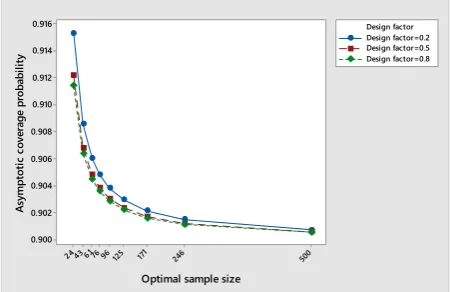
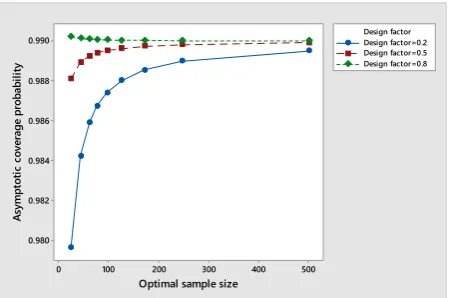
To study the effect of changing𝛾 on the performance of the asymptotic coverage probability in Equation (17) as the optimal sample size increases, we take𝑛∗= 24, 43, 61, 76, 96, 125, 171, 246and 500as preferred by Hall [29] and take𝛾 = 0.2, 0.3and0.5. Table1below shows the results for90%, 95%, and99%confidence coefficients. We noticed that at 90%, the asymptotic coverage probability exceeds 0.9for all chosen𝛾, while at 95%, the asymptotic coverage probability exceeds 0.95 only at𝛾 = 0.5and 𝛾 = 0.8. At 99%, the asymptotic coverage probability exceeds 0.99 only at𝛾 = 0.8.
Table 1. Asymptotic coverage probabilities for different values of 𝛾 as the optimal sample size increases.
1−𝛼=0.90 1−𝛼=0.95 1−𝛼=0.99
n* 𝛾 = 0.2 𝛾 = 0.5 𝛾 = 0.8 𝛾 = 0.2 𝛾 = 0.5 𝛾 = 0.8 𝛾 = 0.2 𝛾 = 0.5 𝛾 = 0.8
24 0.91528 0.91216 0.91138 0.94812 0.95415 0.95565 0.97964 0.98810 0.99021 43 0.90853 0.90679 0.90635 0.94895 0.95231 0.95315 0.98422 0.98894 0.99012 61 0.90601 0.90478 0.90448 0.94926 0.95163 0.95222 0.98592 0.98925 0.99008 76 0.90482 0.90384 0.90359 0.94941 0.95131 0.95178 0.98673 0.98940 0.99007 96 0.90382 0.90304 0.90285 0.94953 0.95104 0.95141 0.98741 0.98952 0.99005 125 0.90293 0.90233 0.90218 0.94964 0.95080 0.95109 0.98801 0.98962 0.99004 171 0.90214 0.90171 0.90160 0.94974 0.95058 0.95079 0.98855 0.98973 0.99003 246 0.90149 0.90119 0.90111 0.94982 0.95040 0.95055 0.98899 0.98981 0.99002 500 0.90073 0.90058 0.90055 0.94991 0.95020 0.95027 0.98950 0.98991 0.99001
This means that the three-stage procedure a ains consistency or asymptotic consistency in the sense of Chow and Robbins [25], depending on the choice of the design factor and the confidence coefficient. It looks like the three-stage procedure loses consistency as(1 − 𝛼)increases. Figure 1, FigureComputation2, and Figure2019, 7, 69 3show the results of the tables as graphs for clarification. 10 of 15
Figure 1. Performance of the asymptotic coverage probability at 90%.
Figure 2. Performance of the asymptotic coverage probability at 95%.
Figure 3. Performance of the asymptotic coverage probability at 99%.
3.4. The Sensitivity of Three-Stage Sampling to Shift in the Population Inverse Coefficient of Variation
The word sensitivity of sequential procedures means either sensitivity to departure from the underline distribution or sensitivity to shifting in the true parameter value. Bhattacharjee [43], Blumenthal and Govindarajulu [44], Ramkaran [45], Sook and DasGupta [46] were the first who examined the robustness of Stein’s two-stage sampling procedure [47] to departure from normality. Costanza et al. [32] and Son et al. [34], were the first to address the issue of the sensitivity of the three-stage confidence interval against the type II error probability while estimating the mean of the normal distribution. Hamdy [33] studied the same problem for the exponential distribution. However, Hamdy et al. [36] provided a more comprehensive analysis of the departure of both the underline distribution and the shift in the true parameter.
500 246 171 125 96 76 61 43 24 0.916 0.914 0.912 0.910 0.908 0.906 0.904 0.902 0.900
Optimal sample size
As ym pt ot ic c ov er ag e p ro ba bilit y Design factor=0.2 Design factor=0.5 Design factor=0.8 Design factor 500 400 300 200 100 0 0.956 0.955 0.954 0.953 0.952 0.951 0.950 0.949 0.948
Optimal sample size
As ym pt ot ic co ve ra ge p ro ba bilit y Design factor=0.2 Design factor=0.5 Design factor=0.8 Design factor 500 400 300 200 100 0 0.990 0.988 0.986 0.984 0.982 0.980
Optimal sample size
As ym pt ot ic co ve ra ge p ro ba bilit y Design factor=0.2 Design factor=0.5 Design factor=0.8 Design factor
Figure 1.Performance of the asymptotic coverage probability at 90%.
Computation2019, 7, 69 10 of 15
Figure 1. Performance of the asymptotic coverage probability at 90%.
Figure 2. Performance of the asymptotic coverage probability at 95%.
Figure 3. Performance of the asymptotic coverage probability at 99%.
3.4. The Sensitivity of Three-Stage Sampling to Shift in the Population Inverse Coefficient of Variation
The word sensitivity of sequential procedures means either sensitivity to departure from the underline distribution or sensitivity to shifting in the true parameter value. Bhattacharjee [43], Blumenthal and Govindarajulu [44], Ramkaran [45], Sook and DasGupta [46] were the first who examined the robustness of Stein’s two-stage sampling procedure [47] to departure from normality. Costanza et al. [32] and Son et al. [34], were the first to address the issue of the sensitivity of the three-stage confidence interval against the type II error probability while estimating the mean of the normal distribution. Hamdy [33] studied the same problem for the exponential distribution. However, Hamdy et al. [36] provided a more comprehensive analysis of the departure of both the underline distribution and the shift in the true parameter.
500 246 171 125 96 76 61 43 24 0.916 0.914 0.912 0.910 0.908 0.906 0.904 0.902 0.900
Optimal sample size
As ym pt ot ic c ov er ag e p ro ba bilit y Design factor=0.2 Design factor=0.5 Design factor=0.8 Design factor 500 400 300 200 100 0 0.956 0.955 0.954 0.953 0.952 0.951 0.950 0.949 0.948
Optimal sample size
As ym pt ot ic co ve ra ge p ro ba bilit y Design factor=0.2 Design factor=0.5 Design factor=0.8 Design factor 500 400 300 200 100 0 0.990 0.988 0.986 0.984 0.982 0.980
Optimal sample size
As ym pt ot ic co ve ra ge p ro ba bilit y Design factor=0.2 Design factor=0.5 Design factor=0.8 Design factor
Computation2019,7, 69 12 of 17
Figure 1. Performance of the asymptotic coverage probability at 90%.
Figure 2. Performance of the asymptotic coverage probability at 95%.
Figure 3. Performance of the asymptotic coverage probability at 99%.
3.4. The Sensitivity of Three-Stage Sampling to Shift in the Population Inverse Coefficient of Variation
The word sensitivity of sequential procedures means either sensitivity to departure from the underline distribution or sensitivity to shifting in the true parameter value. Bhattacharjee [43], Blumenthal and Govindarajulu [44], Ramkaran [45], Sook and DasGupta [46] were the first who examined the robustness of Stein’s two-stage sampling procedure [47] to departure from normality. Costanza et al. [32] and Son et al. [34], were the first to address the issue of the sensitivity of the three-stage confidence interval against the type II error probability while estimating the mean of the normal distribution. Hamdy [33] studied the same problem for the exponential distribution. However, Hamdy et al. [36] provided a more comprehensive analysis of the departure of both the underline distribution and the shift in the true parameter.
500 246 171 125 96 76 61 43 24 0.916 0.914 0.912 0.910 0.908 0.906 0.904 0.902 0.900
Optimal sample size
As ym pt ot ic c ov er ag e p ro ba bilit y Design factor=0.2 Design factor=0.5 Design factor=0.8 Design factor 500 400 300 200 100 0 0.956 0.955 0.954 0.953 0.952 0.951 0.950 0.949 0.948
Optimal sample size
As ym pt ot ic co ve ra ge p ro ba bilit y Design factor=0.2 Design factor=0.5 Design factor=0.8 Design factor 500 400 300 200 100 0 0.990 0.988 0.986 0.984 0.982 0.980
Optimal sample size
As ym pt ot ic co ve ra ge p ro ba bilit y Design factor=0.2 Design factor=0.5 Design factor=0.8 Design factor
Figure 3.Performance of the asymptotic coverage probability at 99%.
The quantity{𝑎2(𝛾−2)+3(𝛾+2)4𝛾 }known as the cost of ignorance (the cost of not knowing the variance 𝜎2), see Simons [42] for details.
4. The Sensitivity of Three-Stage Sampling to Shift in the Population Inverse Coefficient of Variation
The word sensitivity of sequential procedures means either sensitivity to departure from the underline distribution or sensitivity to shifting in the true parameter value. Bha acharjee [43], Blumenthal and Govindarajulu [44], Ramkaran [45], Sook and DasGupta [46] were the first who examined the robustness of Stein’s two-stage sampling procedure [47] to departure from normality. Costanza et al. [32] and Son et al. [34], were the first to address the issue of the sensitivity of the three-stage confidence interval against the type II error probability while estimating the mean of the normal distribution. Hamdy [33] studied the same problem for the exponential distribution. However, Hamdy et al. [36] provided a more comprehensive analysis of the departure of both the underline distribution and the shift in the true parameter.
Suppose we need to investigate the capability of the constructed fixed-width confidence interval 𝐼𝑁to signify potential shifts in the true population inverse coefficient of variation𝜃0of distance𝑙(≥ 0) occurring outside the interval when it is incorrectly thought that such shifts never took place. In some applications, like in quality control, it is a ma er of concern to closely monitor the sensitivity of the interval to depict any departure from the centerline in order to ensure the creditability of the interval. In this regard, we derive both the null and alternative hypotheses as follows:
𝐻0: 𝜃 = 𝜃0𝑣𝑠. 𝐻𝑎: 𝜃 = 𝜃1= 𝜃0± 𝑑(𝑙 + 1) ∉ 𝐼𝑁for all𝑙 ≥ 0, (18)
where 𝐻0 : 𝜃 = 𝜃0, claims that no departure of the true parameter𝜃0has taken place, against the alternative hypotheses𝐻𝑎which alleges that the parameter value differs from𝜃0by a distance1 + ℓ measured in units of the precision𝑑.
The probability of not detecting a shift in the true parameter can statistically measure by the corresponding type II error probability (𝛽-risk), which is, in fact, the conditional probability of not depicting a departure from𝜃0, when, in fact, the departure actually occurred. In quality assurance (𝛽-risk), is known as the operating characteristic function
𝛽(ℓ) = 𝑃 (𝜃0∈ 𝐼𝑁|𝐻𝑎) = 𝑃 ( ̂𝜃𝑁− 𝑑 ≤ 𝜃 ≤ ̂𝜃𝑁+ 𝑑|𝜃1= 𝜃0±d(𝑙 + 1)).
Let𝜏 be the probability of commi ing a type II error probability, which is the probability of no shift occurring given that an actual shift occurred. Our objective is to control the probability of commi ing a type II error probability. We do so by finding the characteristic operating curve𝑂𝐶 that gives the probability of acceptance of various possible values of𝜃1. The minimum sample size required to control both𝛼 𝑎𝑛𝑑 𝜏is
𝑛0= (𝑎 + 𝑏) 2
2𝑑2 𝜃
2 (19)
where𝑏 = 𝑍𝜏/2 is the upper𝜏/2point of𝑁(0, 1). For more details, see Nelson [48,49], Hamdy [33], and Son et al. [34].
The second-order approximation of the characteristic operating function under Equations (18) and (19) as 𝜉 → ∞
𝛽(𝑙) = 𝑃 (𝜃 ∈ 𝐼𝑁|𝐻𝑎) = ∑∞𝑛=𝑚𝑃 (| ̂𝜃𝑁− 𝜃1| ≤ 𝑑|𝑁 = 𝑛)𝑃 (𝑁 = 𝑛) = ∑∞𝑛=𝑚𝑃 (−(2 + 𝑙)𝑑 ≤ ̂𝜃𝑁− 𝜃0≤ −𝑙𝑑)𝑃 (𝑁 = 𝑛) = 𝐸𝑁(Φ(−𝑙𝑑√2𝑁/𝜃)) − 𝐸𝑁(Φ(−(2 + 𝑙)𝑑√2𝑁/𝜃)).
Utilizing Theorem 3, we obtain
𝐸𝑁(Φ(−𝑙𝑑√2𝑁/𝜃)) = Φ(−𝑙(𝑎 + 𝑏)) −(𝑎 + 𝑏)
8𝛾𝑛0 𝜙(−𝑙(𝑎 + 𝑏))𝑙{(𝑎 + 𝑏)
2(𝛾 − 2)𝑙2+ 3(𝛾 + 2)}.
Similarly for𝐸𝑁(Φ(−(2 + 𝑙)𝑑√2𝑁/𝜃)). Hence,
𝛽(𝑙) = Φ(−𝑙(𝑎 + 𝑏)) − Φ(−(2 + 𝑙)(𝑎 + 𝑏)) − 𝑄1 − 𝑄2 + 𝑜(𝜉−2) (20)
where
𝑄1 = (𝑎 + 𝑏)
8𝛾𝑛0 𝜙1𝑙{(𝑎 + 𝑏)
2(𝛾 − 2)𝑙2+ 3(𝛾 + 2)},
and
𝑄2 = −(𝑎 + 𝑏)
8𝛾𝑛0 𝜙2(2 + 𝑙){(𝑎 + 𝑏)
2(𝛾 − 2)(𝑙 + 2)2+ 3(𝛾 + 2)}
𝜙1= 𝜙(−𝑙(𝑎 + 𝑏))and𝜙2= 𝜙(−(2 + 𝑙)(𝑎 + 𝑏)).
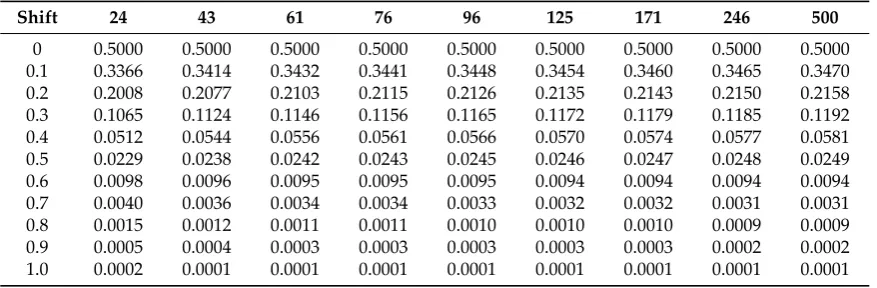
Costanza et al. [32] and Son et al. [34] treated the case of the mean of the normal distribution. Equation (20) depends on the shift𝑙,the design factor𝛾,and the optimal sample size𝑛0. Table2
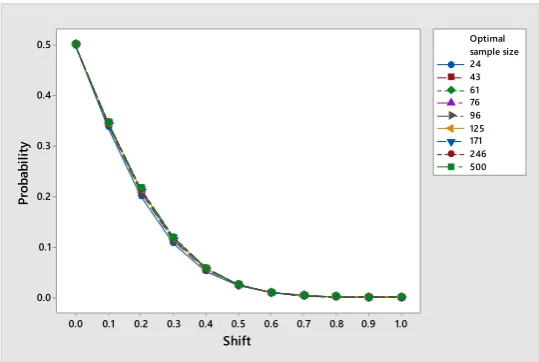
below shows the𝛽 − 𝑟𝑖𝑠𝑘values as the shift𝑘increases, and the optimal sample size increases, taking 𝑘 = 0, 0.1, … , 1. As the shift increases, the risk decreases. Figure4below demonstrates this idea.
Table 2.The sensitivity of the three-stage procedure as the shift and the optimal sample size increases
𝛾 = 0.5 𝑎𝑛𝑑 𝛼 = 𝜏 = 5%.
Shift 24 43 61 76 96 125 171 246 500
0 0.5000 0.5000 0.5000 0.5000 0.5000 0.5000 0.5000 0.5000 0.5000
0.1 0.3366 0.3414 0.3432 0.3441 0.3448 0.3454 0.3460 0.3465 0.3470
0.2 0.2008 0.2077 0.2103 0.2115 0.2126 0.2135 0.2143 0.2150 0.2158
0.3 0.1065 0.1124 0.1146 0.1156 0.1165 0.1172 0.1179 0.1185 0.1192
0.4 0.0512 0.0544 0.0556 0.0561 0.0566 0.0570 0.0574 0.0577 0.0581
0.5 0.0229 0.0238 0.0242 0.0243 0.0245 0.0246 0.0247 0.0248 0.0249
0.6 0.0098 0.0096 0.0095 0.0095 0.0095 0.0094 0.0094 0.0094 0.0094
0.7 0.0040 0.0036 0.0034 0.0034 0.0033 0.0032 0.0032 0.0031 0.0031
0.8 0.0015 0.0012 0.0011 0.0011 0.0010 0.0010 0.0010 0.0009 0.0009
0.9 0.0005 0.0004 0.0003 0.0003 0.0003 0.0003 0.0003 0.0002 0.0002
Computation2019,7, 69 14 of 17
Equation (20) depends on the shift 𝑙, the design factor 𝛾, and the optimal sample size𝑛 . Table 2
below shows the 𝛽 − 𝑟𝑖𝑠𝑘 values as the shift𝑘 increases, and the optimal sample size increases,
taking 𝑘= 0, 0.1, … ,1. As the shift increases, the risk decreases. Figure 4 below demonstrates this
idea.
Table 2. The sensitivity of the three-stage procedure as the shift and the optimal sample size increases
𝛾= 0.5 𝑎𝑛𝑑𝛼=𝜏= 5%.
Shift 24 43 61 76 96 125 171 246 500
0 0.5000 0.5000 0.5000 0.5000 0.5000 0.5000 0.5000 0.5000 0.5000 0.1 0.3366 0.3414 0.3432 0.3441 0.3448 0.3454 0.3460 0.3465 0.3470 0.2 0.2008 0.2077 0.2103 0.2115 0.2126 0.2135 0.2143 0.2150 0.2158 0.3 0.1065 0.1124 0.1146 0.1156 0.1165 0.1172 0.1179 0.1185 0.1192 0.4 0.0512 0.0544 0.0556 0.0561 0.0566 0.0570 0.0574 0.0577 0.0581 0.5 0.0229 0.0238 0.0242 0.0243 0.0245 0.0246 0.0247 0.0248 0.0249 0.6 0.0098 0.0096 0.0095 0.0095 0.0095 0.0094 0.0094 0.0094 0.0094 0.7 0.0040 0.0036 0.0034 0.0034 0.0033 0.0032 0.0032 0.0031 0.0031 0.8 0.0015 0.0012 0.0011 0.0011 0.0010 0.0010 0.0010 0.0009 0.0009 0.9 0.0005 0.0004 0.0003 0.0003 0.0003 0.0003 0.0003 0.0002 0.0002 1.0 0.0002 0.0001 0.0001 0.0001 0.0001 0.0001 0.0001 0.0001 0.0001
Figure 4. Performance of the characteristic operating curve as the shift increases.
3.5. The Asymptotic Regret Encountered in Point Estimation of the Inverse Coefficient of Variation
In this section, we aim to find the asymptotic regret that occurs when we use the sample inverse coefficient of variation rather than the population inverse coefficient of variation. We use squared-error loss function with linear sampling cost. A typical situation is in constructing a quality control chart to the inverse coefficient of variation where both estimation of control limits (the upper and the lower control limits) and the centerline are required.
What if we want to utilize the available data to provide a point estimate of𝜃 (the centerline) under the squared-error loss function with linear sampling cost. Therefore, we assume that the cost incurred in estimating 𝜃 is given by
𝐿 (𝐴) =𝐴 𝜃 − 𝜃 +𝑐𝑛,
where 𝑐 is the cost per unit sample. Regarding𝐴, the literature in sequential point estimation customarily assumes that 𝐴 is a known constant, which reflects the cost of estimation and can be permitted to approach ∞. However, here, we try to give a better understanding of the nature of 𝐴 in this context. First, the risk associated with the above loss function is given by
𝑅 (𝐴) =𝐸𝐿 (𝐴) =𝐴 + 𝑐𝑛.
1.0 0.9 0.8 0.7 0.6 0.5 0.4 0.3 0.2 0.1 0.0 0.5
0.4
0.3
0.2
0.1
0.0
Shift
Pr
ob
ab
ilit
y
24 43 61 76 96 125 171 246 500 sample size Optimal
Figure 4.Performance of the characteristic operating curve as the shift increases.
5. The Asymptotic Regret Encountered in Point Estimation of the Inverse Coefficient of Variation
In this section, we aim to find the asymptotic regret that occurs when we use the sample inverse coefficient of variation rather than the population inverse coefficient of variation. We use squared-error loss function with linear sampling cost. A typical situation is in constructing a quality control chart to the inverse coefficient of variation where both estimation of control limits (the upper and the lower control limits) and the centerline are required.
What if we want to utilize the available data to provide a point estimate of𝜃(the centerline) under the squared-error loss function with linear sampling cost. Therefore, we assume that the cost incurred in estimating𝜃is given by
𝐿𝑛(𝐴) = 𝐴( ̂𝜃𝑛− 𝜃)2+ 𝑐𝑛,
where 𝑐 is the cost per unit sample. Regarding 𝐴, the literature in sequential point estimation customarily assumes that𝐴 is a known constant, which reflects the cost of estimation and can be permi ed to approach∞. However, here, we try to give a be er understanding of the nature of𝐴in this context. First, the risk associated with the above loss function is given by
𝑅𝑛(𝐴) = 𝐸𝐿𝑛(𝐴) = 𝐴𝜃 2
2𝑛+ 𝑐𝑛.
Minimizing the risk associated with the loss function provides the optimal sample size
𝑛0 = √2𝑐𝐴𝜃. If we have to use the optimal sample size used to construct a fixed2𝑑 confidence interval for𝜃, where the coverage probability is at least the nominal value, to propose𝜃𝑛̂ for𝜃under the squared error loss function, the constant𝐴should be chosen such that
𝐴 = 𝑐𝑎 4𝜃2
2𝑑4 = 𝑎2 𝑑2(𝑐𝑛
∗ ).
Clearly as𝑑 → 0, 𝐴 → ∞, where
𝐴 =
(𝐹 𝑖𝑠ℎ𝑒𝑟 𝑖𝑛𝑓 𝑜𝑟𝑚𝑎𝑡𝑖𝑜𝑛, 𝑎2
𝑑2)× (𝑡ℎ𝑒 𝑜𝑝𝑖𝑚𝑎𝑙 𝑐𝑜𝑠𝑡 𝑜𝑓 𝑠𝑎𝑚𝑝𝑙𝑖𝑛𝑔 𝑐𝑛 ∗
).
In this case, the optimal risk is given by𝑅𝑛∗(𝑑) = 2𝑐𝑛∗. The asymptotic regret, which is defined
as the difference between the risk of using the three-stage procedure minus the optimal risk see, Robbins [38] would be
where
𝑅𝑁(𝑑) = 𝐴𝐸( ̂𝜃𝑁− 𝜃)2+ 𝑐𝐸(𝑁).
The risk of the three-stage sampling can be approximated by the upper bound
𝑅𝑁(𝑑) = 𝑐𝑛∗(𝛾 + 1) + 𝑐( 4 + 𝛾
2𝛾 ).
Hence, the asymptotic regret is
𝜔(𝑑) = 𝑐𝑛∗(𝛾 − 1) + 𝑐 (
4 + 𝛾
2𝛾 )as𝑑 → 0.
Which provides negative regret. This means that the three-stage procedure does be er than the optimal fixed sample size had𝜃been known. Martinsek [50] discussed the issue of negative regret in sequential point estimation.
6. Conclusions
This paper theoretically tackles three estimation problems for the population inverse coefficient of variation of the normal distribution under Hall’s three-stage procedure. We obtain asymptotic mathematical forms for the population inverse coefficient of variation, the asymptotic coverage probability, the characteristics operating function, and the asymptotic regret. We find the range of the design factor that makes the three-stage procedure achieve consistency or asymptotic consistency as the width of the interval approaches zero. The asymptotic regret has negative values for all possible values of the design factor.
Author Contributions: Conceptualization, A.Y.; Methodology, A.Y. and H.H.; software, A.Y.; Validation, A.Y. and H.H.; formal analysis, A.Y.; investigation, A.Y. and H.H.; resources, A.Y.; data curation, A.Y. and H.H.; writing original draft, A.Y.; Preparation, A.Y.; Writing review and editing, A.Y.; Visualization, A.Y. and H.H.; Supervision, A.Y.; Project administrator, A.Y.
Funding:This research received no external funding.
Conflicts of Interest:The authors declare no conlict of interest.
References
1. Nairy, K.S.; Rao, K.A. Tests of Coefficients of Variation of Normal Population.Commun. Stat. Simul. Comput.
2003,3, 641–661. [CrossRef]
2. Ahn, K. On the use of coefficient of variation for uncertainty analysis in fault tree analysis. Reliab. Eng. Syst. Saf.1995,47, 229–230. [CrossRef]
3. Gong, J.; Li, Y. Relationship between the Estimated Weibull Modulus and the Coefficient of Variation of the Measured Strength for Ceramics.J. Am. Ceram. Soc.1999,82, 449–452. [CrossRef]
4. Faber, D.S.; Korn, H. Applicability of the coefficient of variation method for analyzing synaptic plasticity.
Biophys. J.1991,60, 1288–1294. [CrossRef]
5. Hammer, A.J.; Strachan, J.J.; Black, M.M.; Ibbotson, C.; Elson, R.A. A new method of comparative bone strength measurement.J. Med. Eng. Technol.1995,19, 1–5. [CrossRef] [PubMed]
6. Billings, J.; Zeitel, L.; Lukomnik, J.; Carey, T.S.; Blank, A.E.; Newman, L. Impact of socioeconomic status on hospital use in New York City.Health Aff.1993,12, 162–173. [CrossRef] [PubMed]
7. Brief, R.P.; Owen, J. A Note on earnings risk and the coefficient of variation. J. Financ. 1969,24, 901–904. [CrossRef]
8. Pyne, D.B.; Trewin, C.B.; Hopkins, W.G. Progression and variability of competitive performance of Olympic swimmers.J. Sports Sci.2004,22, 613–620. [CrossRef]
10. Gulhar, M.; Kibria, B.M.; Albatineh, A.N.; Ahmed, N.U. A Comparison of some confidence intervals for estimating the population coefficient of variation: A simulation study.SORT Stat. Oper. Res. Trans. 2012,
36, 45–68.
11. McGibney, G.; Smith, M.R. An unbiased signal to noise ratio measure for magnetic resonance images.
Med. Phys.1993,20, 1077–1079. [CrossRef] [PubMed]
12. Knight, J.L.; Satchell, S. A Re-Examination of Sharpe’s Ratio for Log-Normal Prices. Appl. Math. Financ.
2005,12, 87–100. [CrossRef]
13. Hendricks, W.A.; Robey, K.W. The Sampling Distribution of the Coefficient of Variation. Ann. Math. Stat.
1936,7, 129–139. [CrossRef]
14. Koopmans, L.H.; Owen, D.B.; Rosenbla , J.I. Confidence intervals for the coefficient of variation for the normal and log-normal distribution.Biometrika1964,51, 25–32. [CrossRef]
15. Rao, K.A.; Bha a, A.R. A note on test for coefficient of variation.Calcu a Stat. Assoc. Bull.1989,38, 225–229. [CrossRef]
16. McKay, A.T. Distribution of the coefficient of variation and the extended t distribution.J. R. Stat. Soc.1932,
95, 695–698. [CrossRef]
17. Umphrey, G.J. A comment on McKay’s approximation for the coefficient of variation. Commun. Stat. Simul. Comput.1983,12, 629–635. [CrossRef]
18. Vangel, M.G. Confidence intervals for a normal coefficient of variation.Am. Stat.1996,50, 21–26.
19. Miller, E.G. Asymptotic test statistics for coefficient of variation. Commun. Stat. Theory Methods1991,20, 3351–3363. [CrossRef]
20. Lehmann, E.L.Theory of Point Estimation, 2nd ed.; Wiley: New York, NY, USA, 1983.
21. Curto, J.D.; Pinto, J.C. The coefficient of variation asymptotic distribution in the case of non-iid random variables.J. Appl. Stat.2009,36, 21–32. [CrossRef]
22. Sharma, K.K.; Krishna, H. Asymptotic sampling distribution of inverse coefficient-of variation and its applications.IEEE Trans. Reliab.1994,43, 630–633. [CrossRef]
23. Albatineh, A.; Kibria, B.M.; Zogheib, B. Asymptotic sampling distribution of inverse coefficient of variation and its applications: Revisited.Int. J. Adv. Stat. Probab.2014,2, 15–20. [CrossRef]
24. Chaturvedi, A.; Rani, U. Fixed-width confidence interval estimation of the inverse coefficient of variation in a normal population.Microelectron. Reliab.1996,36, 1305–1308. [CrossRef]
25. Chow, Y.S.; Robbins, H. On the asymptotic theory of fixed width confidence intervals for the mean.
Ann. Math. Stat.1965,36, 457–462. [CrossRef]
26. Cha opadhyay, B.; Kelley, K. Estimation of the Coefficient of Variation with Minimum Risk: A Sequential Method for Minimizing Sampling Error and Study Cost.Multivar. Behav. Res.2016,51, 627–648. [CrossRef] [PubMed]
27. Yousef, A.; Hamdy, H. Three-stage estimation for the mean and variance of the normal distribution with application to inverse coefficient of variation.Mathematics2019,7, 831. [CrossRef]
28. Dan ig, G.B. On the Non-Existence of Tests of Student’s Hypothesis Having Power Function Independent ofς.Ann. Math. Stat.1940,11, 186–192. [CrossRef]
29. Hall, P. Asymptotic Theory and Triple Sampling of Sequential Estimation of a Mean. Ann. Stat. 1981,9, 1229–1238. [CrossRef]
30. Hall, P. Sequential Estimation Saving Sampling Operations.J. R. Stat. Soc.1983,45, 1229–1238. [CrossRef] 31. Ghosh, M.; Mukhopadhyay, N.; Sen, P.Sequential Estimation; Wiley: New York, NY, USA, 1997.
32. Costanza, M.C.; Hamdy, H.I.; Haugh, L.D.; Son, M.S. Type II Error Performance of Triple Sampling Fixed Precision Confidence Intervals for the Normal Mean.Metron1995,53, 69–82.
33. Hamdy, H.I. Performance of Fixed Width Confidence Intervals under Type II Errors: The Exponential Case. South African.J. Stat.1997,31, 259–269.
34. Son, M.S.; Haugh, L.D.; Hamdy, H.I.; Costanza, M.C. Controlling Type II Error while Constructing Triple Sampling Fixed Precision Confidence Intervals for the Normal Mean. Ann. Inst. Stat. Math. 1997, 49, 681–692. [CrossRef]
36. Hamdy, H.I.; Son, S.M.; Yousef, S.A. Sensitivity Analysis of Multi-Stage Sampling to Departure of an underlying Distribution from Normality with Computer Simulations. J. Seq. Anal. 2015, 34, 532–558. [CrossRef]
37. Yousef, A. Construction a Three-Stage Asymptotic Coverage Probability for the Mean Using Edgeworth Second-Order Approximation. InInternational Conference on Mathematical Sciences and Statistics; Springer: Singapore, 2014; pp. 53–67. [CrossRef]
38. Yousef, A. A Note on a Three-Stage Sequential Confidence Interval for the Mean When the Underlying Distribution Departs away from Normality.Int. J. Appl. Math. Stat.2018,57, 57–69.
39. Robbins, H. Sequential Estimation of the Mean of a Normal Population. In Probability, and Statistics; Almquist and Wicksell: Uppsala, Sweden, 1959; pp. 235–245.
40. Anscombe, F.J. Large-sample theory of sequential estimation. InMathematical Proceedings of the Cambridge
Philosophical Society; Cambridge University Press: Cambridge, UK, 1952; Volume 48, pp. 600–607.
41. Wald, A.Sequential Analysis; Wiley: New York, NY, USA, 1947.
42. Simons, G. On the cost of not knowing the variance when making a fixed-width interval estimation of the mean.Ann. Math. Stat.1968,39, 1946–1952. [CrossRef]
43. Bha acharjee, G.P. Effect of non-normality on Stein’s two-sample test.Ann. Math. Stat. 1965,36, 651–663. [CrossRef]
44. Blumenthal, S.; Govindarajulu, Z. Robustness of Stein’s two-stage procedure for mixtures of normal populations.J. Am. Stat. Assoc.1977,72, 192–196. [CrossRef]
45. Ramkaran. The robustness of Stein’s two-stage procedure.J. Seq. Anal.1983,5, 139–168. [CrossRef] 46. Oh, H.S.; Dasgupta, A. Robustness of Stein’s two-stage procedure.Seq. Anal.1995,14, 321–334.
47. Stein, C.A. Two-sample test for a linear hypothesis whose power is independent of the variance.
Ann. Math. Stat.1945,16, 243–258. [CrossRef]
48. Nelson, L.S. Comments on significant tests and confidence intervals. J. Qual. Technol. 1990,22, 328–330. [CrossRef]
49. Nelson, L.S. Sample sizes for confidence intervals with specified length and tolerances. J. Qual. Technol.
1994,26, 54–63. [CrossRef]
50. Martinsek, A.T. Negative regret, optimal stopping, and the elimination of outliers.J. Am. Stat. Assoc.1988,
10, 65–80.