Page 150
DETERMINING THE PERCEPTIONS OF HIGH SCHOOL STUDENTS ABOUT THE CONCEPT OF FOREST BY USING THE METAPHORS THAT THEY IMPROVED
Caner Aladağ1*, Baştürk Kaya1, Yasin Duran2, Tahsin Tapur1 1Necmettin Erbakan Üniversitesi, Konya, 42090, Turkey
2Sarayönü Ladik Çok Programlı Anadolu Lisesi, Konya, 42090, Turkey
Abstract
This study was conducted to reveal the metaphors that high school students have about the concept of “forest”. 40 students (16 girls 24 boys) studying in the 10th
grade of Ladik Ahmet Hüdai Anatolian Imam Hatip (religious vocational) High School (Konya) attended the study. The data of the study were collected by qualitative research method and designed on the phenomenology pattern. The obtained data were subjected to content analysis. In order to determine the perceptions of the students about the concept of forest, a semi-structured form is prepared and students are asked to complete the sentence in the form as "Forest is like a ... because ...". Thus, in the survey, it was researched which metaphors the high school students use to explain their mental perceptions about the concept of forest and what the common characteristics of these metaphors are. According to the findings of the research, students produced 45 valid metaphors. These metaphors were coded according to their common characteristics and 8 different conceptual categories were created. The most important of these categories are gathered under titles such as "forest as a place and protection ", "forest as a source of sensitivity" and "forest as a living area". At the end of the research; when the metaphors that high school students produce about the concept of forest are examined, it is seen that the perceptions of them are rich and different. As a result, it can be said that the metaphor is a valid method for determining the perceptions of different participants about the concept of forest.
Keywords:metaphor, high school students, forest, phenomenology
1. INTRODUCTION
While meeting the needs of the people, we have to be economical to the forests which are the most important natural assets, and in doing so we must ensure continuity without disturbing the natural balance of the forest (Odabaşı & Özalp, 1994). It is not right to understand the term forest as just a tree community. It is necessary to regard forest as a natural system or unit together with trees and other natural factors such as other plants, fauna, microorganisms, soil, air water and climate which have mutual influence and relations between them. Such an asset is called forest ecosystem (Çepel, 1988). Forests contribute to the protection of the environment, serve as natural habitats and shelter for animals, provide timber and forest products, provide recreational opportunities and environments where people can gain spiritual calmness (Demirkaya & Genç, 2006).
The forests are rapidly decreasing in our country as well as in the world. This can happen for a variety of reasons. One of the main causes is forest fires. Anthropogenic activities such as aim for using the field for grazing, providing firewood, and clearing the land for farming cause the forests to lose their character and disappear. The preservation and sustainability of this natural asset which is precious in its place is only possible with realizing and teaching the characteristics of the forests. So, knowing how the concept of forest is shaped in individuals' thoughts may reveal both measures to be taken and what kind of training should be given. Because people often reflect their attitudes and thoughts on their behaviour, some techniques can be used to determine their attitude towards forests. One of these techniques is metaphor. According to Genç et al. (2010), knowing how forests are perceived by students can give clues for future studies about forests.
Page 151
structure shows the ability of metaphor to re-conceptualize, associate, and express different aspects of a phenomenon or an object (Eraslan, 2011). Metaphors reveal the schematics that exist in the minds of individuals with the help of symbols. Metaphor is a tool whose validity has been proven in teaching unknown things, keeping learned knowledge in mind and remembering it (Arslan & Bayrakçı,2006). Metaphors reveal an important feature of language and creativity. Metaphor is the level, form, and thought of humans in perceiving the world and the reality (Kıral, 2015).
Metaphor is a kind of thinking or view that is appropriate for one's perception of the world. The metaphor, with this aspect, can enable a person to see a certain phenomenon as another phenomenon by allowing one to turn from one form of comprehension to another form of comprehension. Metaphors can bring out new thinking and this way they can lead to the emergence of different lenses for the meaning of the world. In fact, metaphors are things used to make a person understand a situation, an event, or a phenomenon more clearly. The metaphorical view of events and phenomena attracts attention only to one point, and thus the person consciously exhibits myopia. The conscious myopia means that the person focuses on just one point and turns off the perceptions related to the other points. As a result, this myopia is a desired myopia, and this myopia helps people look more deeply than looking superficially. (Kıral, 2015). In other words, metaphors try to explain and tell something that has a complex structure by familiarizing it with something that is very well known (Şahin & Baturay, 2013).
Thus, a new or complex concept, phenomenon or event is tried to be explained by the simpler concept, phenomenon or event. For this reason, metaphor analysis can be a very useful method especially in researching new or complex subjects in scientific researches (Güneş & Fırat, 2016). Metaphor is an important tool in learning concepts and keeping learned knowledge in mind. The structuring of hard-to-remember concepts in the mind can easily be achieved through metaphors. In this way, it is possible to establish strong links between concepts and thus meaningful learning takes place.
Keeping in mind is also improving when strong links are established between new learning and pre-existing information. One of the most important aspects of metaphor as an educational tool is its being able to create an environment that provides a long-term remembering (Arslan & Bayrakçı, 2006). According to Forceville (2002), in the context of any metaphor, the existence of at least three basic items must be mentioned. These are; the subject of metaphor, the source of metaphor and the properties that are considered to be attributed from the source of metaphor to the subject of metaphor (as cited in Gökçe, 2016). Therefore, in any metaphor context; it is expected from the source of the metaphor to function as a filter in understanding the subject of metaphor with a different point of view (Gökçe, 2016).
1.1. Objective of the Research
The aim of this study is to determine the perceptions of high school students about the concept of "forest" through metaphors. Thus, the metaphors of high school students about the concept of "forest" will be determined and it will be revealed what conceptual categories the metaphors are collected under.
2. METHOD
Page 152
2.1. Working Group
The study was carried out with a total of 40 students (16 girls, 24 boys studying at the 10th grade of Ladik Ahmet Hüdai Anatolian İmam Hatip High School (religious vocational high school in Sarayönü / Konya) in 2016-2017 academic year (Table 1). The students who participated in the research were selected according to voluntary basis.
Table 1. Frequency (f) and percentage (%) distributions of the students participating in the survey according to their genders
Gender N %
Girl 16 40
Boy 24 60
Total 40 100
2.2. Data Collection
The students participated in the research were asked to write their opinions on the form and an open-ended question as “Forest is like a ...; because ...” was given to them to answer. At the beginning of the research, students were informed about the metaphor and examples related to the metaphor were shown. Students were then asked to fill in these blanks in these forms within 20 minutes.
2.3. Data Analysis
In the analysis of the data, content analysis was used for coding of the data, finding the themes, organizing and defining the data according to the codes and the themes and interpreting the data (Yıldırım & Şimşek, 2016). The common ground of content analysis techniques is their being based on inference / deduction. All of them carry out the purpose of bringing a comment taking into account the items observed and depicted in the messages (Bilgin, 2014). Metaphors and responses that participants developed regarding the questions in the form were analyzed in four stages. According to Aydın & Apaydın (2013), these steps are: (1) coding the data, (2) creating the categories, (3) arranging the data according to the codes and categories, and (4) ensuring the validity and reliability.
2.4. Coding the Data
Before carrying out the analysis of the data, the answer sheets of the students were coded with numbers from 1 to 40. The answers given by the students to the first and second questions on the answer sheets were gathered under the headings "metaphor" and "explanation". The metaphors detected among the data were classified using the content analysis technique, based on the analogy directions.
2.5. Creating the Categories
Metaphors, which are similar to each other in terms of their subjects, were categorized by gathering them under the same headings, and they were converted into tables together with their frequency values. The process of creating categories is a process in which similar concepts obtained in content analysis are classified under a certain category. At this stage, common features of metaphor perceptions about the phenomena of forest produced by students for open-ended questions on the answer sheet were examined. Metaphors used in answers of each student for each question and the reasons for choosing these metaphors were given in tables
2.6. Arranging the Data According to Codes and Categories
Page 153
researchers created a system in which they could organize the data they collected and performed the arrangement process according to this system.
The validity of this study was determined on the basis of the criteria determined by Yıldırım & Şimşek (2011). Expert examination was also carried out for the validity of the research. The codes and categories related to codes of the researchers were compared in order to confirm whether the codes given under the conceptual categories obtained from the research data represent the corresponding conceptual categories. The reliability of the data analysis conducted in this manner calculated with using the formula of; [Consensus / (Consensus + Dissidence) x 100] (Miles and Huberman, 1994). The average reliability between coders was calculated as %88 and consensus was provided.
3. FINDINGS
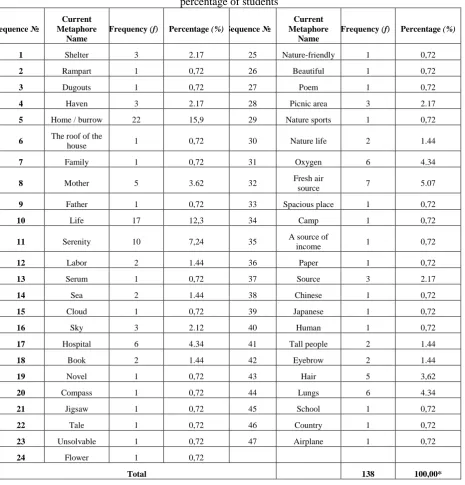
In this section, the findings were discussed in general terms. Then, 8 conceptual categories developed in this research about the concept of "forest" and the characteristics of each category were analysed by supporting sample metaphors and images produced by the students.
General findings about the metaphors that students have about the concept of forest
Page 154
Table 2. Metaphors developed by high school students about the concept of "forest", number and percentage of students
Sequence №
Current Metaphore
Name
Frequency (f) Percentage (%) Sequence №
Current Metaphore
Name
Frequency (f) Percentage (%)
1 Shelter 3 2.17 25 Nature-friendly 1 0,72
2 Rampart 1 0,72 26 Beautiful 1 0,72
3 Dugouts 1 0,72 27 Poem 1 0,72
4 Haven 3 2.17 28 Picnic area 3 2.17
5 Home / burrow 22 15,9 29 Nature sports 1 0,72
6 The roof of the
house 1 0,72 30 Nature life 2 1.44
7 Family 1 0,72 31 Oxygen 6 4.34
8 Mother 5 3.62 32 Fresh air
source 7 5.07
9 Father 1 0,72 33 Spacious place 1 0,72
10 Life 17 12,3 34 Camp 1 0,72
11 Serenity 10 7,24 35 A source of
income 1 0,72
12 Labor 2 1.44 36 Paper 1 0,72
13 Serum 1 0,72 37 Source 3 2.17
14 Sea 2 1.44 38 Chinese 1 0,72
15 Cloud 1 0,72 39 Japanese 1 0,72
16 Sky 3 2.12 40 Human 1 0,72
17 Hospital 6 4.34 41 Tall people 2 1.44
18 Book 2 1.44 42 Eyebrow 2 1.44
19 Novel 1 0,72 43 Hair 5 3,62
20 Compass 1 0,72 44 Lungs 6 4.34
21 Jigsaw 1 0,72 45 School 1 0,72
22 Tale 1 0,72 46 Country 1 0,72
23 Unsolvable 1 0,72 47 Airplane 1 0,72
24 Flower 1 0,72
Total 138 100,00*
* Figures on the table may not give the total due to rolling.
Conceptual categories created by using the metaphors that students have about the concept of forest
Page 155
Category 1. Forest as a space and protection
When this category is examined it is seen that 6 (% 12,7) different metaphors were developed by 31 (% 22,5) students. The metaphors that have the most frequent frequencies developed by students are;
home (f=22), sanctuary (f=3) and shelter (f=3). When the data are examined, it is seen that the forest was compared to home the most in this category. Examples of expressions written by students for this category are as follows; "It is the place where all animals live in", "It is one of the most beautiful places where all animals can live", "Because it contains the living things in it", "It holds all the living things / it is the place in which the animals live / It is the place where the animals can shelter / The forest is the home for living things and it protects them.”
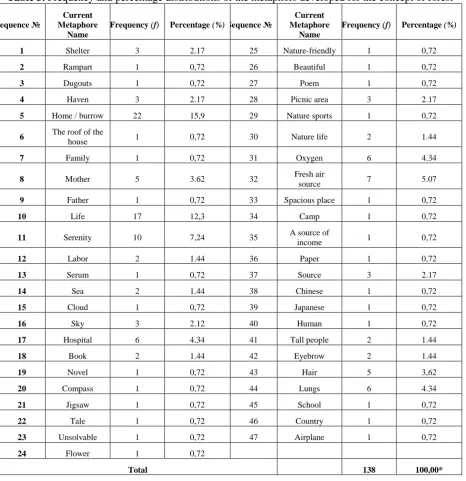
Table 3. Frequency and percentage distributions of the metaphors developed for the concept of forest
Sequence №
Current Metaphore
Name
Frequency (f) Percentage (%) Sequence №
Current Metaphore
Name
Frequency (f) Percentage (%)
1 Shelter 3 2.17 25 Nature-friendly 1 0,72
2 Rampart 1 0,72 26 Beautiful 1 0,72
3 Dugouts 1 0,72 27 Poem 1 0,72
4 Haven 3 2.17 28 Picnic area 3 2.17
5 Home / burrow 22 15,9 29 Nature sports 1 0,72
6 The roof of the
house 1 0,72 30 Nature life 2 1.44
7 Family 1 0,72 31 Oxygen 6 4.34
8 Mother 5 3.62 32 Fresh air
source 7 5.07
9 Father 1 0,72 33 Spacious place 1 0,72
10 Life 17 12,3 34 Camp 1 0,72
11 Serenity 10 7,24 35 A source of
income 1 0,72
12 Labor 2 1.44 36 Paper 1 0,72
13 Serum 1 0,72 37 Source 3 2.17
14 Sea 2 1.44 38 Chinese 1 0,72
15 Cloud 1 0,72 39 Japanese 1 0,72
16 Sky 3 2.12 40 Human 1 0,72
17 Hospital 6 4.34 41 Tall people 2 1.44
18 Book 2 1.44 42 Eyebrow 2 1.44
19 Novel 1 0,72 43 Hair 5 3,62
20 Compass 1 0,72 44 Lungs 6 4.34
21 Jigsaw 1 0,72 45 School 1 0,72
22 Tale 1 0,72 46 Country 1 0,72
23 Unsolvable 1 0,72 47 Airplane 1 0,72
24 Flower 1 0,72
Page 156
Category 2. Forest as a source of sensitivity
36 (% 26) students developed 6 (% 12) different metaphors in the category of “Forest as a source of sensitivity”. So this is the category that has the most metaphor. In this category, the most frequently
repeated metaphors are life (f = 17), peace (f = 10) and mother (f = 5). Below are examples of how the metaphors that make up this category were defined by the students. "The trees in the forest are like the family standing together and clinging to each other." "It embraces all living organisms." “Because it protects all the living things in it.” "A lifestyle full of life, greenery and beauty / you feel the breath / it produces oxygen / it has water, fruit and life / it gives oxygen to us.” “One feels peaceful in greenery and fresh air.” “Green gives peace to human / when I go into the forest, I feel comforted / green makes people feel comforted.”
Category 3. Forest as an expression of life
13 (% 9,5) high school students developed 5 (% 10,6) different metaphors in the category of “Forest as an expression of life”. The most frequently repeated metaphors are; hospital (f=6) and sky (f=3).
Here are some examples of expressions written by students for this category. “As people look and go
into the forest, they get lost there. / When you go into it, you will be the part of it”. “The forest also gives peace to the people like clouds”. “Endless adventure / I feel relaxed when I go to forest like I feel relaxed when I look into the sky”. “You relax and get healed in hospital and also in forest / all the plants heal us”.
Category 4. Forest as a necessity for discovering and learning
Students developed 6 (% 12,7) different metaphors in the category of “Forest as a necessity for discovering and learning”. The most frequently repeated metaphor is the book (f = 2). Other metaphors were repeated just once. With reference to these findings; the students wrote the following statements. “Thing which is difficult to discover but nice to understand / you discover new things as
you read and also as you walk around the forest”. “You discover new things as you walk through the forest like you discover as read the pages of the book”. “We find our path in the forest according to the moss on the trees", "Every piece has a meaning and we live and complete what we need in our life in those pieces." “The thing whose every side is the same and which has no solution and direction.”
Category 5. Forest as a source of life
25 (% 18,2) students developed 11 different metaphors in the category of “Forest as a source of life”.
The percentage of these metaphors is 23,4. The most frequently repeated ones are; oxygen (f=6), fresh air source (f=7), picnic area (f=3) and nature life (f=2). Below are examples of how the metaphors that make up this category were defined by the students.
"For the smell of fresh air". "The creatures in the forest are as beautiful as the poetry, and the forest is as meaningful as poetry". “Fresh air, oxygen, fun and peace. / it becomes our source of fun”. “Nature sports are done in the forest thoroughly”. “The trees in the forest take the dirty air and give it back as clean air / it is the source of breathe / because the trees in the forest clean the nature.”
Category 6. Forest as a source
It is seen that students improved 3 different metaphors (f= 5) for the category of “Forest as a source”. The most frequently repeated metaphor is source (f= 3). Here are some examples of expressions written by students for this category. “At least it is the source for those who are unemployed for their cutting and selling the tree". "The trees in the forest are cut and turned into paper". “Oxygen in the forest is nowhere to be found, oxygen in forest is a source of relief for people / Trees that dry in the forest are used to cut and burn, to make table, desk, etc./ A lot of materials are made by using the forest”.
Category 7. Forest as a part of humanity and resemblance to human
Students developed 7 different metaphors in the category of “Forest as a part of humanity and resemblance to human” and the frequency is 18 (%13). Those who have the most frequencies from the
Page 157
They expressed their opinions in relation to this category as follows; "The trees in the forest are similar to each other". “They are all similar”. "If people can be ungrateful, hungry, lonely, enemy or friend, this is also valid for the living things in the forest." “Because some people are tall and the trees in the forest are also long / when people come together, I compare them to forest”. "Forest is a very strong place". “Hair strands of people resemble the branches of trees / Branches and leaves dancing harmoniously together with the wind’s blowing".
Category 8. "Forest as an environment containing diversity”
Students developed 3 different metaphors in the category of “Forest as an environment containing
diversity”. The frequency of these metaphors is 3 and percentage is 2.2. These metaphors were repeated just once. These are; school (f=1), country (f=1) and plane (f=1). Some sample sentences from this category are; “It is a community”, “There are unity, ties and hostilities in all countries”. “In
the forest, living things pass through many challenging conditions to survive.” "There are all the greenery things in the forest just like a plane’s carrying passengers”.
4. RESULT
Metaphors were used to reach high school students’ ideas about the concept of forest directly and to reveal their mental imagery. The metaphors developed by students were collected under conceptual categories according to their common characteristics by evaluating the data. 47 valid metaphors were produced by students about the concept of forest. 27 of these total 47 metaphors were produced by just one student (walls, shelter, house roof, family, father, serum, cloud, novel, compass, puzzle, fairy tale, unsolvable, flower, nature friendly, beautiful, poet, nature sports, spacious place, camp, means of living, paper, Chinese, Japanese, people, school, country, plane).
The number of students representing the remaining 20 valid metaphors varies between 2 and 22. The most used metaphors for the concept of "forest" by students are; home (f=22), life (f=17), peace (f=10), fresh air source (f=7), hospital (f=6), oxygen (f=6), lung (f=6), mother (f=5), hair (f=5), sanctuary (f=3).
The students developed 47 different metaphors for the concept of forest, and the frequency of these metaphors was calculated as 138. 47 metaphors were grouped under 8 categories according to their semantic relations. These categories are; “Forest as a space and protection”, "Forest as a source of sensitivity", "Forest as an expression of life", "Forest as a necessity for discovering and learning", "Forest as a living space", "Forest as a source", "Forest as a part of humanity and resemblance to human” and "Forest as an environment containing diversity".
When the results of the research are examined, it is seen that most of the students created metaphors related to the category of "forest as a source of sensitivity". The frequency of this category is f=36 and its percentage is 26. The most frequently repeated metaphors are life (17) and Peace (10). Another important category is the category of "forest as space and protection". The number of metaphors of this category is 6, frequency is f=31 and percentage is % 22,5. The most frequently repeated metaphor is the metaphor of “home” with its 22 frequency. “Forest as a living space“ is also one of the
important categories. Students have presented 11 different metaphors in this category. The percentage of these 11 different metaphors produced by 25 students was 18.2. In some of the other categories, the number of metaphors is high, but the frequencies are low.
As a result, it appears that at every stage of education, metaphor may be a good tool to find out what the situation is in the minds of students about concepts. In this study, it is determined how the students understand the concept of forest and how the concept of forest relates to other concepts. A significant number of students was able to write a large number of valid metaphors related to the concept of forest here. This shows that the students have enough information about the forest. However, methods should be developed to make this information available in practice.
Page 158
information and awareness. As pointed out by Odabaşı & Özalp (1994), from approaches such as exploitation forestry, production forestry, multi-functional forestry, and forestry suitable for nature, it is especially very significant to establish the forestry consciousness suitable for nature.
The creation of a nature-conscious society will be ensured by giving the forestry consciousness suitable for nature to students and by taking the ecology into consideration. This will result in the formation of a social structure that respects natural beings. The role of education is very important in the formation of sensitive individuals and society at the point of protection of natural beings. It is the duty of the educators to take care to teach the concepts correctly and thoroughly. Therefore, it is important to carry out studies that determine such perceptions from time to time in the context of creating correct perceptions.
REFERENCES
1. Arslan, M. M. & Bayrakçı, M. (2006). Metaforik Düşünme ve Öğrenme Yaklaşımının Eğitim-Öğretim Açısından İncelenmesi. Milli Eğitim Dergisi, 171, 100-108.
2. Aydın, F. (2011). The Metaphoric Perceptions of University Students Towards “Environment” Concept. Eastern Geographical Review. 16(26), 25-44.
3. Aydın, F. & Ünaldı, Ü. E. (2010), The Analysis of Geography Teacher Candidates’ Perceptions towards “Geography” Concept with the Help of Metaphors, International Online Journal of EducationalSciences, 2 (2), s.600-622.
4. Bilgin, N. (2014), Sosyal Bilimlerde İçerik Analizi (Teknikler ve Örnek Çalışmalar), Siyasal Kitapevi, Ankara.
5. Çepel, N. (1988), Orman Ekolojisi, İstanbul Üniversitesi Orman Fakültesi Yayınları, Orman Fak. Yayını No:399, İstanbul.
6. Demirkaya, H. & Genç, H. (2006), Development Of An Attıtude Scale To Measure Attıtudes Toward Forests, Kastamonu Education Journal, 14(1), 39-46.
7. Eraslan, L. (2011), Socıologıcal Metaphors, Akademik Bakış dergisi, 27, 1-22.
8. Forceville, C. (2002). The identification of target and source in pictorial metaphors, Journal of Pragmatics, 34, 1-14.
9. Güneş, A. & Fırat, M. (2016), Açık ve uzaktan öğrenmede metafor analizi araştırmaları, Açıköğretim Uygulamaları ve Araştırmaları Dergisi, 2 (3), 115‐129.
10. Kıral, E. (2015), Teacher Metaphors According to the Perceptions of Prospective Teachers, Journal of Educational Sciences, Adnan Menderes Üniversitesi Eğitim Fakültesi Eğitim Bilimleri Dergisi, 6(1), 57-65.
11. Levine, P.M. (2005). Metaphors And Images Of Classrooms. Erıc Document: Ej724893.
12. Miles, M., & Huberman, A.M. (1994). Qualitative Data Analysis. Thousand Oaks, CA: Sage Publications.
13. Odabaşı, T. & Özalp, G. (1994), Ormanların İşletilmesi Yöntemleri ve Doğaya Uygun Ormancılık Anlayışı, İstanbul Üniversitesi, Orman Fakültesi Dergisi, B, 44(1-2), 35-47.
14. Şahin, Ş. & Baturay, M. H. (2013), Evaluatıon Of The Secondary School Students’ Perceptıons Regardıng The Concept Of Internet: A Metaphor Analysıs Study, Kastamonu Education Journal, 21(1), 177-192.