https://doi.org/10.5194/amt-10-3651-2017 © Author(s) 2017. This work is distributed under the Creative Commons Attribution 3.0 License.
The effects of meteorological parameters and diffusive barrier reuse
on the sampling rate of a passive air sampler for gaseous mercury
David S. McLagan, Carl P. J. Mitchell, Haiyong Huang, Batual Abdul Hussain, Ying Duan Lei, and Frank Wania Department of Physical and Environmental Sciences, University of Toronto Scarborough, 1065 Military Trail, M1C 1A4, Toronto, Ontario, Canada
Correspondence to:Frank Wania ([email protected]) Received: 15 March 2017 – Discussion started: 2 May 2017
Revised: 4 September 2017 – Accepted: 5 September 2017 – Published: 5 October 2017
Abstract.Passive air sampling of gaseous mercury (Hg) re-quires a high level of accuracy to discriminate small differ-ences in atmospheric concentrations. Meteorological param-eters have the potential to decrease this accuracy by impact-ing the samplimpact-ing rate (SR), i.e., the volume of air that is ef-fectively stripped of gaseous mercury per unit of time. We measured the SR of a recently calibrated passive air sam-pler for gaseous Hg in the laboratory under varying wind speeds (wind still to 6 m s−1), temperatures (−15 to+35◦C), and relative humidities (44 to 80 %). While relative humidity has no impact on SR, SR increases slightly with both wind speed (0.003 m3day−1increase in SR or 2.5 % of the previ-ously calibrated SR for every m s−1increase for wind speeds
>1 m s−1, typical of outdoor deployments) and temperature
(0.001 m3day−1increase in SR or 0.7 % for every 1◦C
in-crease). The temperature dependence can be fully explained by the effect of temperature on the molecular diffusivity of gaseous mercury in air. Although these effects are relatively small, accuracy can be improved by adjusting SRs using measured or estimated temperature and wind speed data at or near sampling sites. We also assessed the possibility of reusing Radiello® diffusive barriers previously used in the passive air samplers. The mean rate of gaseous Hg uptake was not significantly different between new and previously used diffusive barriers in both lab and outdoor deployments, irrespective of the applied cleaning procedure. No memory effect from Radiellos®previously deployed in a high Hg at-mosphere was observed. However, a loss in replicate preci-sion for the dirtiest Radiellos®in the indoor experiment sug-gests that cleaning is advisable prior to reuse.
1 Introduction
Fine spatial resolution measurements of atmospheric con-taminants are difficult and expensive, especially at remote locations and in developing countries. By allowing for simul-taneous, cost-effective measurements at a multitude of sites, passive air samplers (PASs) are useful, complementary mon-itoring tools in atmospheric science. PASs can be deployed in high numbers, at sites away from sources of electricity, and in locations where the costs and logistics of active sampler deployments can be prohibitive (McLagan et al., 2016a). In order for a PAS to yield volumetric air concentration data, a sampling rate (SR), i.e., the volume of air that is effectively stripped of the contaminant of concern per unit of time, needs to be derived. This is done either in calibration experiments that deploy the PAS concurrently with reliable active sam-pling techniques or theoretically based on an understanding of the processes controlling mass transfer from atmosphere to PAS sorbent (Armitage et al., 2013; Gustin et al., 2011; Skov et al., 2007). Any uncertainty and bias in the SR is di-rectly propagated to the volumetric air concentration derived from a PAS. Accordingly, a reliable PAS requires that the impact of various factors influencing the SR is, in order of preference, either eliminated, minimized, or quantifiable and predictable.
standardizing the molecular diffusion distance to the sorbent and thereby ensuring that the diffusive component of con-taminant transfer is the rate limiting step (Huang et al., 2014; Lozano et al., 2009; McLagan et al., 2016a). For PASs with diffusive barriers the ASBL is shifted from the outside of the sorbent to the outside of the diffusive barrier (McLagan et al., 2016b). While a diffusive barrier thus reduces the rel-ative contribution of the ASBL to the overall diffusion dis-tance, it cannot entirely mitigate SR variability caused by wind (Pennequin-Cardinal et al., 2005; Plaisance et al., 2002; Skov et al., 2007). Protective shields around the sorbent or diffusive barrier are often employed to further reduce the in-fluence of wind by reducing the face velocities at these sur-faces. However, like diffusive barriers, they too are not likely to completely eliminate the influence of wind on the thick-ness of the ASBL (Huang et al., 2014).
Temperature has the potential to affect SR in two ways: (i) changing the rate of gas phase diffusion of the contami-nant due to the temperature dependence of molecular diffu-sion coefficients (Armitage et al., 2013; Huang et al., 2014; Lozano et al., 2009) and (ii) shifting the partitioning equilib-ria between the sorbent and the gas phase (Armitage et al., 2013; Lozano et al., 2009; McLagan et al., 2016a). Rela-tive humidity (RH) may affect SRs by influencing the sorp-tive properties of certain sorbents for target analytes (Huang et al., 2014). Other factors that may affect the sorption of contaminants to PAS sorbents include passivation of sor-bents (interfering compounds blocking sorbent uptake sites or stripping analytes through reaction) (Brown et al., 2012; Gustin et al., 2011), degradation of the sorbent over time (Brown et al., 2011; McLagan et al., 2016a), and uptake of the contaminant to the sampler housing or diffusive barrier (Gustin et al., 2011; Huang et al., 2014; McLagan et al., 2016a).
Mercury is a persistent, bioaccumulative, and toxic con-taminant of global concern that has come under greater in-ternational scrutiny with the adoption of the Minamata Con-vention (UNEP, 2013). A key stipulation under Article 19 of the convention “Research, Development and Monitoring” is the requirement of participating parties to improve current monitoring networks (UNEP, 2013). A PAS for measuring atmospheric Hg could play an important role in this con-text, if it can be shown to be suitable for monitoring long-term background concentrations, concentration gradients in and around Hg sources, and personal exposure levels (McLa-gan et al., 2016a). Gaseous elemental Hg (GEM) is gener-ally the dominant form of atmospheric Hg (typicgener-ally making up >95 %), due to its high atmospheric residence time of ∼1 year (Driscoll et al., 2013; Pirrone et al., 2010; Selin, 2009), especially at sites remote from combustion sources (McLagan et al., 2016a; Peterson et al., 2009; Rutter et al., 2009). The long atmospheric residence time of GEM results in relatively uniform background concentrations within each hemisphere, with much of the global atmosphere having lev-els within<25 % of the hemispheric average (Gustin et al.,
2011). PASs capable of discriminating such small concentra-tion variability require high accuracy and precision; i.e. SRs need to be well characterized and repeatable. Existing PASs for gaseous mercury have struggled to achieve the accuracy and precision necessary for background monitoring due to inadequate detection limits or highly variable SRs (Huang et al., 2014; McLagan et al., 2016a).
We recently introduced a PAS for gaseous Hg with a precision-based uncertainty of 2±1 % that uses an activated carbon sorbent and a Radiello®diffusive barrier (McLagan et al., 2016b). While it is believed that the sampler takes up predominantly GEM, we cannot rule out the possibility for gaseous oxidized Hg to also pass through the diffusive barrier (McLagan et al., 2016b). We therefore use the term gaseous Hg to define the target analyte. An earlier calibration of this PAS at one outdoor location yielded a SR of 0.121 m3day−1 (McLagan et al., 2016b). Here we report on a series of lab-oratory experiments that quantified the effect of wind speed, temperature, and RH on the SR of that sampler. We addition-ally explored the possibility of reusing the Radiello® diffu-sive barrier in multiple deployments in order to further re-duce the costs associated with the sampler’s use. During de-ployment, the inside of the Radiello®can become covered in sorbent dust. It is also possible that atmospheric components, e.g. atmospheric particulate matter and oxidants, sorb to or react with the diffusive barrier during deployment. Thus, in addition to meteorological impacts on the PAS’s SR, we also explored the effect of prior use and cleaning of the diffusive barrier on the uptake of Hg in the PAS.
2 Methods
2.1 Sampler design
The sampler consists of a porous stainless steel mesh cylinder, filled with ∼0.7 g of sulfur-impregnated acti-vated carbon sorbent (HGR-AC; Calgon Carbon Corp.), which is inserted into a Radiello® radial diffusive body (Sigma Aldrich), which itself is placed inside a polyethylene-terephthalate protective shield that also doubles as a storage container. During deployments the opening of the jar, cov-ered with a polypropylene (PP) mesh screen, is facing down. After sampling the protective shield is sealed tightly with a PP cap, PTFE tape wrapped around the seal, and placed in double resealable plastic bags for transport and storage. McLagan et al. (2016b) provide more detail on the PAS de-sign.
2.2 Study design 2.2.1 Wind
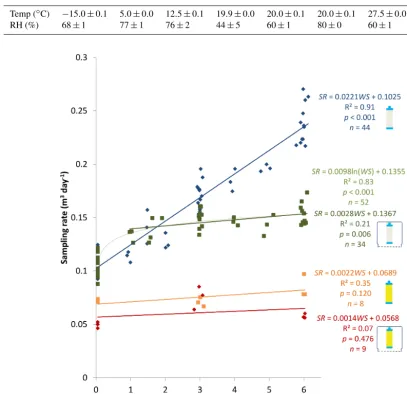
protective shield; (2) white Radiello® without protective shield; (3) thick-walled, less porous, yellow Radiello®with protective shield; and (4) yellow Radiello® without pro-tective shield. Adopting the experimental setup of Zhang et al. (2013), electronic fans (Delta Electronics Inc., model number: BFC1212B) were employed to generate wind for each individual sampler. The angle of wind incidence was always 90◦; i.e. we simulated wind that is blowing parallel to the surface. Wind speeds of 1, 1.5, 2, 3, 4, 5, and 6 m s−1 were achieved by manipulating the distance between PASs and fan (see Figs. S1 and S2 in the Supplement). For each wind speed triplicate PASs were deployed. Wind speeds for each individual PAS were measured every 5 s with a hot-wire anemometer/thermometer (Traceable®, VWR International) for 5 min before and 5 min after each deployment. As such, average wind speeds of individual samplers within each wind speed treatment varied slightly (Fig. 1). “Wind-still” exper-iments without fans were performed for comparison (with wind speed assumed to be 0.05 m s−1).
While experiments with white Radiellos (configuration 1 and 2) generally lasted 1 week, additional experiments last-ing 2, 3, and 4 weeks were performed at selected wind speeds (3 and 6 m s−1). Experiments with yellow Radiellos (con-figurations 3 and 4) lasted 2 weeks (the lower SR of yel-low Radiello®requires longer deployment times to reach de-tection limits) and were only performed at wind speeds of 3 and 6 m s−1, as well as without fans. Additionally, a 3-month uptake experiment under wind-still conditions was performed in order to obtain a precise SR of the PAS with a white Radiello deployed indoors with a protective shield. Eighteen samplers were deployed at the same time and tripli-cates were removed after 15, 28, 46, 56, 70, and 84 days. The earlier indoor calibration experiment described in McLagan et al. (2016b) had been performed without a protective shield. Temperature and RH, monitored before, after, and period-ically during each individual experiment, ranged from+21.9 to +24.2◦C and from 32 to 53 %. While there was some variation in the gaseous Hg concentration as recorded by the Tekran 2537A between deployments, the average concentra-tion across all wind experiments was 1.9±0.3 ng m−3.
2.2.2 Temperature and relative humidity
The regular PAS configuration (configuration 1) was ex-posed to eight different combinations of temperature and RH (Table 1) for 2-week periods in climate-controlled walk-in chambers located at the Biotron Facility of Western Univer-sity in London, Ontario. Each treatment included five repli-cates, all deployed in the same chamber over the same time period. Samplers were attached to metal shelving units near the centre of the chambers where a continuous flow of air from the outflow of the climate control units of 1.1–2.3 m s−1 was observed using the hot-wire anemometer over a 2 min period at the completion of each experiment. The average
actively measured gaseous Hg concentration across all tem-perature and RH experiments was 2.2±0.9 ng m−3.
2.2.3 Radiello®reuse
The potential impacts of sorbent dust accumulation or atmo-spheric contamination during prolonged deployment periods on SRs and therefore on the ability to reuse the Radiello® diffusive barriers are unknown. Currently, new diffusive bar-riers are used for each deployment. In this experiment, previ-ously used Radiellos®were redeployed after different clean-ing procedures were applied. Six cleanclean-ing treatments were applied: “new” (unused Radiellos®), “uncleaned” (unaltered after previous deployments), “physical” (physical agitation with funnel brushes and compressed air blow down), “soap” (Citranox®detergent, cleaning brushes, and deionized water, compressed air blow down, deionized water rinse and sonica-tion and air drying), “acid” (6-hour soak in 20 % HNO3bath,
deionized water rinse, compressed air blow down, deionized water rinse and sonication, and air drying), and “heat-acid” (6-hour soak in 20 % HNO3 bath at 40◦C, deionized
wa-ter rinse, compressed air blow down, deionized wawa-ter rinse and sonication and air drying). All Radiellos®in each clean-ing treatment were cleaned once accordclean-ing to the aforemen-tioned methods. Prior to cleaning, diffusive bodies were cat-egorized based on the extent of visible dust coating using a five-point scale (0 – new, 1 – very low, 2 – low, 3 – mod-erate, 4 – high, and 5 – very high; see Fig. S3). To the ex-tent this was possible with a limited stock of previously de-ployed Radiellos®, we evenly distributed Radiellos®of vari-able dust coating among the treatments (see Tvari-able S2 for de-tails). We also tested Radiellos®previously deployed in con-taminated environments with very high gaseous Hg concen-trations (∼100–10 000 ng m−3) to assess whether such de-ployments led to a memory effect whereby sorbed Hg is re-leased from the diffusive body during subsequent uses. All samplers from this “memory” treatment contained moderate dust coating and were not cleaned.
Table 1.Combinations of temperature and relative humidity during the eight experiments performed in climate-controlled chambers. The three relative humidity treatments were 44, 60, and 80 % while the temperature was held constant at 20◦C. All treatments were used for the temperature experiments.
Temp (◦C) −15.0±0.1 5.0±0.0 12.5±0.1 19.9±0.0 20.0±0.1 20.0±0.1 27.5±0.0 35.0±0.0 RH (%) 68±1 77±1 76±2 44±5 60±1 80±0 60±1 45±3
Figure 1.The effect of wind speed on the sampling rate of four different configurations of a passive air sampler for gaseous mercury. Configuration 1: white Radiello®, with protective shield (, green); configuration 2: white Radiello®, without protective shield (, blue); configuration 3: yellow Radiello®, with protective shield (, orange); configuration 4: white Radiello®, without protective shield (, red). Standard error of slope andyintercept are give in Table S1 in the Supplement.
2.2.4 Active gaseous mercury measurements
A Tekran 2537A (Tekran Instruments Corp.) was used to measure the gaseous Hg concentrations at 5 min intervals throughout all wind, temperature, and RH experiments. A sampling inlet that combined a 2 m Teflon tube con-nected to a 0.2 µm PTFE filter was used (detailed setup is given in Cole and Steffen, 2010; Steffen et al., 2008). Auto-calibrations were made using the internal Hg permeation unit every 25 h and these were verified through manual injec-tions from a Tekran 2505 Mercury Vapor Primary Calibration Unit (Tekran Instruments Corp.) before and after each set
of experiments. Quality control and assurance of the Tekran 2537A data sets followed the Environment Canada Research Data Management and Quality Control system (Steffen et al., 2012).
2.2.5 Sampling rate calculation SRs (m3day−1) were calculated using SR= m
(Ct ), (1)
(ng m−3), andt is the deployment time of the PAS (days). With the exception of the 3-month experiment, the SRs were derived from the sorbed Hg (m) in individual PAS ments using Eq. (1). SRs derived from a single deploy-ment generally have a higher uncertainty than SRs derived from experiments involving multiple simultaneous deploy-ments of variable length, such as those described in McLa-gan et al. (2016b). This uncertainty is further increased when deployment times are short and gaseous Hg concentrations are low, as mwill be closer to quantification limits. In or-der to constrain the uncertainties from the experiments de-scribed here, we performed a high number of replications, which allows an average and SD for the SR of each deploy-ment. In the wind experiments, true replication was not possi-ble, as wind speed varied slightly between each deployment. While they cannot be called replicates, we performed a very large number of individual experiments, which allowed for the derivation of a robust relationship between SR and wind speed. Additionally, the variable length of the experiments at selected wind speeds not only added to the number of data points but also allowed us to assess if there was any effect of deployment time on SR.
2.3 Analyses
Total Hg in the activated carbon sorbent was quantified us-ing thermal combustion, amalgamation, and atomic absorp-tion spectroscopy in oxygen (O2) carrier gas (USEPA method
7473) using an AMA254 (Leco Instruments Ltd.) (USEPA, 2007). Because the sorbent in a PAS cannot be assumed to take up Hg homogeneously, the entire carbon from each PAS was analyzed in two aliquots of up to 0.45 g each. In or-der to increase the lifetime of AMA254 catalyst tubes while processing samples with high sulfur content, catalyst tubes were amended with 5 g of sodium carbonate (Na2CO3) and
≈0.15 g of Na2CO3was added directly to each sample boat
(McLagan et al., 2017). Samples were dried for 30 s at 200◦C and thermally decomposed at 750◦C for 330 s, while gaseous elemental Hg was trapped on the gold amalgamator. After combustion the system was purged for 60 s to ensure all py-rolysis gases were removed from the catalyst. Throughout the analysis the catalyst was heated to 550◦C. After purging, the amalgamator was heated to 900◦C for 12 s to release the trapped Hg into the cuvette where absorption at 253.65 nm was measured by dual detector cells for both low and high absolute amounts of Hg.
The instrument was calibrated by adding varying amounts of Hg liquid standard for AAS (1000±5 mg L−1; in 10 % w/w HCl; Inorganic Ventures) to≈0.22 g of clean (un-exposed) HGR-AC. Approximately 0.15 g of Na2CO3 was
added on top of the liquid standard and HGR-AC. In all ex-periments absolute amounts of Hg were less than 20 ng and the high cell was therefore not required for quantification. The low cell calibration included standards of 0, 0.1, 0.25,
0.5, 1, 2.5, 5, 10, 15, and 20 ng of Hg (uncertainty in au-topipette is 1±0.004 ng) fitted with a quadratic relationship. 2.4 Quality assurance and control
Both analytical and field blanks were included in all ex-periments. Analytical blanks represented analyses of clean HGR-AC with mean concentration of 0.3±0.2 ng g−1 of HGR-AC (n=14). Field blanks, taken both at the start and end of each experiment, were taken to the site, opened, deployed, and then immediately taken down, sealed with PTFE tape and stored for analysis in double resealable plas-tic bags. The mean field blank concentration for the wind ex-periments (n=7), the temperature/RH experiments (n=5), and the Radiello®reuse experiments (n=4) were 0.5±0.2, 0.58±0.15, and 0.38±0.08 ng g−1of HGR-AC, respectively. All results are blank adjusted by subtracting the mean field blank concentration for each experiment multiplied by the mass of HGR-AC in that sample from the sorbed Hg in each sample.
Analytical precision was monitored throughout the experi-ments (approximately every 10–15 instrumental runs) by an-alyzing 5 or 10 ng Hg liquid standards for AAS added to ≈0.22 g of HGR-AC. Recoveries for precision testing were 100.1±1.6 (n=62), 100.0±1.3 (n=24), and 100.0±1.3 (n=21) % for the wind, temperature/RH, and reuse experi-ments, respectively. Recovery was monitored throughout the experiments (approximately every 10–15 runs) by analyzing a high sulfur, bituminous coal standard reference material, NIST 2685c (S=5 wt %; National Institute of Standards and Technology), or our own in-house reference material, RM-HGR-AC1 (powdered HGR-AC loaded with Hg by expo-sure to air for 4 months then homogenized; 23.1±0.8 ng g−1
based on 198 analytical runs). Recoveries of NIST 2685c were 101±3 (n=35), 102±3 (n=14), and 99±4 (n= 10) % for the wind, temperature/RH, and reuse experiments, respectively. Recoveries of RM-HGR-AC1 were 98±3 (n= 43), 97±2 (n=13), and 96±2 (n=10) % for the wind, tem-perature/RH, and reuse experiments, respectively. All statis-tical tests were either performed by hand or using R v3.3.2 (R Foundation for Statistical Computing).
3 Results and discussion 3.1 Wind
Previ-ous investigators, using the white Radiello®(without protec-tive shield) to monitor varying atmospheric contaminants, fit-ted logarithmic (Pennequin-Cardinal et al., 2005; Plaisance, 2011; Skov et al., 2007) or quadratic (Plaisance et al., 2004) relationships to data describing the effect of wind speed on SR. The SR was most sensitive at lower wind speed (typically
<1 m s−1). However, due to the limited number or range of measured wind speeds, or high data uncertainty, a linear rela-tionship fits some of these data equally well (McLagan et al., 2016a).
The addition of the protective shield (configuration 1), which is the current method of practice for the PAS, reduced the effect of wind speed on the SR, particularly at higher wind speeds. The best fit of the data was a logarithmic re-lationship (linear fit:r2=0.83;p <0.001 for exponentially transformed data;n=52) in which SR was most sensitive to wind speed between 0 and 1 m s−1 (Fig. 1). While average
wind speeds of less than 1 m s−1are common for indoor
de-ployments, outdoors average wind speeds typically exceed 1 m s−1 (98.3 % of data from 0◦100 resolution global data set of monthly averaged wind speeds at 10 m a.g.l.between 1961 and 1990; New et al., 2002). When we consider only the data>1 m s−1we observe a slight, but significant, positive linear relationship between SR and wind speed (r2=0.21;
p=0.006;n=34) corresponding to a 0.003 m3day−1 (or 2.5 % or the previously calibrated SR) increase in SR for ev-ery m s−1 increase in wind speed (Fig. 1). Neither config-uration with the thicker, yellow Radiello® led to a signifi-cant effect (p >0.05) of wind speed on SR (Fig. 1). When the protective shield is in place the SR was approximately 10 % lower than without the protective shield for the yellow Radiello®. Plaisance (2011) also noted a negligible effect of wind speed on SR using a yellow Radiello®PAS without any protective shield when monitoring benzene.
The importance of a diffusive barrier is illustrated by the very strong effect of wind speed on the SR of another PAS for gaseous Hg that also utilizes an activated carbon sorbent, but has no diffusive barrier: the SR increased by 0.126 m3day−1 (or 97 % of the calibrated SR) for every m s−1 increase in wind speed (Guo et al., 2014; Zhang et al., 2012). This infor-mation and the results here demonstrate the merit of employ-ing both diffusive barriers and protective shields in reducemploy-ing the effect of wind speed on SR. The diffusive path length of the PAS has three components: (1) the ASBL, (2) the dif-fusive barrier (adjusted for the porosity of the difdif-fusive bar-rier), and (3) the internal airspace of the Radiello® (McLa-gan et al., 2016b). Employing a thicker, less porous diffusive barrier (yellow Radiello®) increases the diffusive path length of the diffusive barrier component, in turn reducing the SR. By reducing turbulence on the outside of the diffusive bar-rier, the protective shield essentially increases the thickness of the ASBL (McLagan et al., 2016b), leading to a reduction in SR.
Because the samplers were not exposed to exactly the same wind speeds, it is not possible to construct
up-take curves from the experiments with variable deployment length. It is, however, possible to test whether the measured SRs depend on the length of each PAS deployment. The re-lationship between deployment length and SR was not sig-nificant (p >0.05), irrespective of the applied wind speed (wind still,∼3, and∼6 m s−1) or configuration (1 and 2); see Fig. S4 for details. This confirms that the SRs derived from short 1-week deployments were neither biased high or low.
The 3-month uptake experiment under wind-still condi-tions produced a SR of 0.106±0.009 m3day−1 when cal-culated as the average of each PAS deployment (see Fig. S5 for uptake curve). The slope of the regression ofmagainst
C×t (McLagan et al., 2016b; Restrepo et al., 2015) gave a very similar SR of 0.109±0.009 m3day−1. Because the latter method is thought to give a slightly more reliable SR (McLagan et al., 2016b; Restrepo et al., 2015), we suggest using this SR for indoor deployments of the PAS using the white Radiello and a protective shield (configuration 1). This SR is 9.9 % lower than the SR obtained in an earlier outdoor calibration study, despite the higher temperature (∼23◦C) indoors than outdoors (mean temperature across all deploy-ments: 7.6◦C). Additionally, the replicate precision of sam-plers from this uptake experiment for the wind-still data with the protective shield (11±8 %) was significantly poorer (p <0.001) than in the outdoor calibration study with the same sampler setup (2±1.3 %; mean wind speed 1.89 m s−1) (McLagan et al., 2016b). Both the lower SR and the greater uncertainty of the SR are consistent with the effect of wind observed for this configuration (green markers in Fig. 1): at the low wind speeds of indoor deployments (<1 m s−1), the SR is expected to be both lower and more sensitive to changes in wind speed. Although, conditions for this experi-ment were labelled “wind still”, in reality any activity within the laboratory (movement of lab personnel, opening and clos-ing of doors, etc.) will result in small variations in wind speeds around the PAS within the range where the SR is most sensitive to such variations (Zhang et al., 2013). Thus, for in-door deployments of the passive sampler, especially using the white Radiello®, we can expect somewhat less precise results. The effect of laboratory activity may also cause dis-turbances in the wind measured at higher wind speed treat-ments. Wind speeds could only be measured for 5 min before and after each experiment and there may be some difference between measured and actual average wind speed for each deployment. These issues may have contributed to the higher variability in the wind experiments compared to the temper-ature and relative humidity experiments (see below), which were conducted in closed chamber experiments.
3.2 Temperature and relative humidity
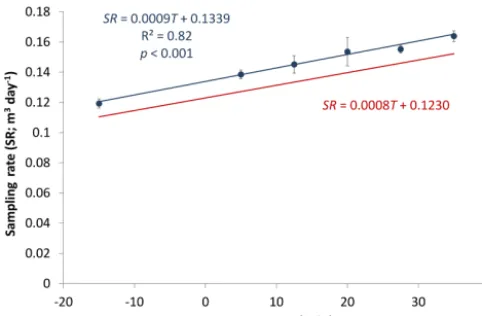
sim-Figure 2.The effect of temperature on the sampling rate of a pas-sive air sampler for gaseous mercury as determined experimentally (blue) and as calculated using the diffusion model (red) by McLa-gan et al. (2016b). The measured and calculated temperature depen-dence, given by the slopes of the relationships, is not significantly different.
ilar to Guo et al. (2014), who also observed no effect from relative humidity on the SR of their PAS that uses the same sulfur-impregnated activated carbon sorbent. It is therefore appropriate to analyze the effect of temperature on SR de-spite small variations in RH at different temperatures. We observed a significant, positive, linear relationship between SR and temperature (r2=0.82;p <0.001;n=36; Fig. 2) corresponding to a 0.001 m3day−1 increase in SR for ev-ery 1◦C increase in temperature (or 0.7 % of the calibrated SR). This relationship remained linear across the tested range from−15 to 35◦C.
Temperature can affect the SR because of its impact on (i) the partitioning equilibrium between the sorbent and the gas phase and (ii) the diffusion coefficient (McLagan et al., 2016a; Pennequin-Cardinal et al., 2005). The uptake capac-ity of the HGR-AC for gaseous Hg is extremely high and we suspect that any change in the sorption equilibrium caused by changing temperatures should have a negligible effect on the SR. The increase in diffusivity caused by an increase in temperature is easily quantified. Figure 2 also displays SR as a function of temperatures predicted with a previously de-scribed model based on Fick’s first law of diffusion (McLa-gan et al., 2016b). While the predicted SRs are∼8 % lower than the measured ones, the slope of the relationship between SR and temperature is the same (no significant difference,
zscore test,p=0.427), confirming that the effect of temper-ature on the diffusivity of gaseous Hg is sufficient to explain the observed temperature dependence of the SR.
Earlier studies on PAS for gaseous Hg did not observe an effect of temperature on SR in laboratory chamber ex-periments. Guo et al. (2014) found no significant effect of temperature on the SR of their activated carbon-based PAS between−10 and+35◦C. Similarly, there was no effect of
temperature on the SR of a PAS using a solid gold sorbent and a white Radiello®diffusive body (Skov et al., 2007). In neither case, however, was the precision of the measurement sufficient to detect the small dependence of SR on tempera-ture caused by the effect of temperatempera-ture on diffusivity. Such a small temperature effect can only be detected in a highly precise sampler.
3.3 Radiello®reuse
In the Radiello®reuse experiment conducted indoors, no sig-nificant difference in the amount of sorbed Hg was observed between new, uncleaned, or any of the cleaned Radiellos® (ANOVA, p=0.467; Fig. 3a). Similarly, when we ignore the effect of cleaning, no significant difference in the sorbed amount of Hg was observed between Radiellos®with differ-ent degrees of dust coatings, including the new Radiellos®
(ANOVA,p=0.841; Fig. 3b). The cleaning treatments also did not differ in terms of the observed variances (Levene’s test, p=0.307). However, the amount of Hg taken up in Radiellos® with the most dust (category 5) had a signifi-cantly higher variance than all other treatments (p=0.004, Levene’s test with Tukey’s honest significant difference post hoc test). Although the differences between all Radiello® treatments in the indoor Radiello® reusability experiments are small, the significantly higher variability observed for Radiellos®with the highest dust coating suggests some form of cleaning would be better in maintaining the high level of precision of this PAS. Effect size, using Cohen’sdvalue (see Sect. S5), was then applied to examine differences in treat-ments without the use of traditional binary hypotheses testing (See Table S4). In comparison to new Radiellos®soap, acid, and heat-acid were the most effective treatments. While there was no significant difference in means (ANOVA;p=0.548) or variances (Levene’s test;p=0.221) for the outdoor ex-periment testing new, uncleaned, and soap Radiellos®, effect size analysis (see Sect. S5) confirmed that soap cleaning is an effective method in preparing used Radiellos® for rede-ployment (Fig. 3c).
Figure 3.Mean sorbed mercury for differing Radiello®cleaning treatments and at varying degrees of HGR-AC dust coating inside the Radiello® (panelb) from indoor experiment. Cleaning treat-ments and degree of dust coating is described in Sect. 2.2.3. Panel (a) also includes the memory effect treatment, which were un-cleaned Radiellos®from deployments in a high concentration envi-ronment. Panel(c)presents the mean sorbed mercury for differing Radiello®cleaning treatments from outdoor experiment.
4 Recommendations and conclusions
While the SR of the PAS in its standard configuration (white Radiello® with protective shield) was found to depend on both wind speed and temperature, the effects are both small and predictable. The accuracy of volumetric air concentra-tions derived from the PAS can be improved by applying adjustment factors to the SR, especially for deployments at or close to background gaseous Hg concentrations. The SR of the standard configuration PAS (white Radiello® with shield) deployed outdoors of 0.121 m3day−1 was obtained for a mean wind speed of 1.89 m s−1 and a mean tempera-ture of 7.6◦C.15We recommend to use the increments from Figs. 1 and 2, i.e. 0.003 m3day−1 increase in SR for every m s−1 increase in wind speed and 0.001 m3day−1 increase in SR for every 1◦C increase in temperature to adjust the SR of 0.121 m3day−1to the average temperature and wind speed of each PAS deployment (See Sect. S6 for SR adjust-ment equation and sample calculation).
The experiments here predict a SR of 0.142 m3day−1for an average wind speed of 1.89 m s−1 (Fig. 1) and a SR of 0.141 m3day−1for an average temperature of 7.6◦C (Fig. 2). Both these values are greater than the SR of 0.121 m3day−1 from the calibration study (McLagan et al., 2016b). While we presently do not know the reason for this discrepancy, it may be related to the relatively short deployment periods used in the present experiments. As mentioned above, short deploy-ment at background concentrations yield a SR with a higher uncertainty. Also, McLagan at al. (2016b) observed that SR for PAS deployed outdoors for less than 1–2 months were higher than the SR derived for the entire 1-year sampling pe-riod. Despite this slight discrepancy, we note that they
inter-cepts of the relationships reported here (the magnitude of the SR) are less important than their slopes (i.e. the temperature and wind speed adjustment factors). An ongoing study mea-suring the uptake of gaseous Hg in PASs deployed at several locations with widely different temperature and wind speed conditions will help refine both the SR applicable to outdoor deployments and the validity of the laboratory derived adjust-ment factors for temperature and wind speed reported here.
When designing a PAS, there is a need to strike a balance between maximizing the SR and minimizing the variability in the SR caused by factors such as wind speed, objectives that are contradictory in nature (McLagan et al., 2016a). Al-though using a thicker, yellow Radiello® with or without a protective shield are the methods least affected by wind, the SR for these methods is approximately half that of the white Radiello®with a shield. A lower SR translates to lower amounts of sorbed Hg, which means that longer deployments are required to reach method quantification limits (MQL). The PAS configuration with white Radiello®and protective shield needs to be exposed to typical background concentra-tions of gaseous Hg (∼1.5–2 ng m−3) for approximately 1 week to reach levels above MQL (McLagan et al., 2016b). A PAS with yellow Radiello would presumably require ployments twice as long. For either configuration, longer de-ployments of a month or more are likely to yield greater ac-curacy. Given the possibility of adjusting the SR for the slight effect caused by wind speeds above 1 m s−1and the shorter minimum deployment times, we recommend the PAS con-figuration with a shielded white Radiello for most outdoor deployments. Nonetheless, there may be long deployments under highly variable winds that warrant the use of the yel-low Radiello®. A full long-term calibration study outdoors would be advisable prior to using this configuration.
Finally, our results suggest that previously deployed Radiello®are indeed reusable as long as the Radiellos®are cleaned between deployments. Because the different clean-ing methods were generally equally effective, we recommend the use of the soap method because of its overall ease and health, safety, and waste benefits over using acids (Anastas and Warner, 1998). Additionally, Gustin et al. (2011) sug-gested the porosity of high-density polyethylene diffusive barriers can be affected by cleaning with HCl. While in this study we used HNO3 for cleaning purposes, the possibility
of porosity changes caused by acid cleaning is further incen-tive to clean previously used Radiellos®with soap rather than acid or heat-acid treatments.
Data availability. Data can be found in the paper, the Supplement, or via communication with the corresponding author.
Competing interests. The authors declare that they have no con-flicts of interest.
Acknowledgements. We acknowledge funding from Strategic Project Grant no. 463265-14 by the Natural Sciences and Engi-neering Research Council of Canada (NSERC) and an NSERC Alexander Graham Bell Canada Graduate Scholarship. We thank Alexandra Steffen of Environment and Climate Change Canada for the loan of the Tekran instrument and Brian Branfireun, Steve Bartlett, Carrie Hamilton, and Aaron Craig from Western University for providing access to the BIOTRON facility.
Edited by: Thomas F. Hanisco
Reviewed by: Seth Lyman and two anonymous referees
References
Anastas, P. T. and Warner, J. C.: Green Chemistry: Theory and Prac-tice, Oxford University Press, New York, USA, 152 pp., 1998. Armitage, J. M., Hayward, S. J., and Wania, F.: Modeling the uptake
of neutral organic chemicals on XAD passive air samplers un-der variable temperatures, external wind speeds and ambient air concentrations (PAS-SIM), Environ. Sci. Technol., 47, 13546– 13554, 2013.
Bartkow, M. E., Booij, K., Kennedy, K. E., Müller, J. F., and Hawker, D. W.: Passive air sampling theory for semivolatile organic compounds, Chemosphere, 60, 170–176, https://doi.org/10.1016/j.chemosphere.2004.12.033, 2005. Brown, R. J. C., Kumar, Y., Brown, A. S., and Kim, K.-H.:
Mem-ory effects on adsorption tubes for mercury vapor measurement in ambient air: elucidation, quantification, and strategies for mit-igation of analytical bias, Environ. Sci. Technol., 45, 7812–7818, 2011.
Brown, R. J. C., Burdon, M. K., Brown, A. S., and Kim, K.-H.: As-sessment of pumped mercury vapour adsorption tubes as passive samplers using a micro-exposure chamber, J. Environ. Monitor., 14, 2456–2463, https://doi.org/10.1039/C2EM30101F, 2012. Cole, A. S. and Steffen, A.: Trends in long-term gaseous mercury
observations in the Arctic and effects of temperature and other atmospheric conditions, Atmos. Chem. Phys., 10, 4661–4672, https://doi.org/10.5194/acp-10-4661-2010, 2010.
Driscoll, C. T., Mason, R. P., Chan, H. M., Jacob, D. J., and Pir-rone, N.: Mercury as a global pollutant: sources, pathways, and effects, Environ. Sci. Technol., 47, 4967–4983, 2013.
Guo, H., Lin, H., Zhang, W., Deng, C., Wang, H., Zhang, Q., Shen, Y., and Wang, X.: Influence of meteorological factors on the atmospheric mercury measurement by a novel passive sam-pler, Atmos. Environ., 97, 310–315, 2014.
Gustin, M. S., Lyman, S. N., Kilner, P., and Prestbo, E.: Develop-ment of a passive sampler for gaseous mercury, Atmos. Environ., 45, 5805–5812, https://doi.org/10.1016/j.atmosenv.2011.07.014, 2011.
Huang, J., Lyman, S. N., Hartman, J. S., and Gustin, M. S.: A re-view of passive sampling systems for ambient air mercury mea-surements, Environ. Sci. Process. Impacts, 16, 374–392, 2014. Lozano, A., Usero, J., Vanderlinden, E., Raez, J.,
Contr-eras, J., and Navarrete, B.: Air quality monitoring
net-work design to control nitrogen dioxide and ozone, ap-plied in Malaga, Spain, Microchem. J., 93, 164–172, https://doi.org/10.1016/j.microc.2009.06.005, 2009.
McLagan, D. S., Mazur, M. E. E., Mitchell, C. P. J., and Wania, F.: Passive air sampling of gaseous elemental mer-cury: a critical review, Atmos. Chem. Phys., 16, 3061–3076, https://doi.org/10.5194/acp-16-3061-2016, 2016a.
McLagan, D. S., Mitchell, C. P. J., Huang, H., Lei, Y. D., Cole, A. S., Steffen, A., Hung, H., and Wania, F.: A high-precision passive air sampler for gaseous mercury, Environ. Sci. Tech. Let., 3, 24–29, https://doi.org/10.1021/acs.estlett.5b00319, 2016b.
McLagan, D. S., Huang, H., Lei, Y. D., Wania, F., and Mitchell, C. P. J.: Prevention of catalyst poisoning in automated atomic absorption spectroscopy instruments for analysis of total mercury samples with high sulphur content, Spectrochim. Acta B, 133, 60–62, 2017.
Moeckel, C., Harner, T., Nizzetto, L., Strandberg, B., Lindroth, A., and Jones, K. C.: Use of depuration compounds in passive air samplers: results from active sampling-supported field deploy-ment, potential uses, and recommendations, Environ. Sci. Tech-nol., 43, 3227–3232, 2009.
New, M., Lister, D., Hulme, M., and Makin, I.: A high-resolution data set of surface climate over global land areas, Clim. Res., 21, 1–25, https://doi.org/10.3354/cr021001, 2002.
Pennequin-Cardinal, A., Plaisance, H., Locoge, N., Ra-malho, O., Kirchner, S., and Galloo, J.-C.: Performances of the Radiello® diffusive sampler for BTEX measurements: influence of environmental conditions and determination of modelled sampling rates, Atmos. Environ., 39, 2535–2544, https://doi.org/10.1016/j.atmosenv.2004.12.035, 2005.
Peterson, C., Gustin, M., and Lyman, S.: Atmospheric mercury concentrations and speciation measured from 2004 to 2007 in Reno, Nevada, USA, Atmos. Environ., 43, 4646–4654, https://doi.org/10.1016/j.atmosenv.2009.04.053, 2009.
Pirrone, N., Cinnirella, S., Feng, X., Finkelman, R. B., Friedli, H. R., Leaner, J., Mason, R., Mukherjee, A. B., Stracher, G. B., Streets, D. G., and Telmer, K.: Global mercury emissions to the atmosphere from anthropogenic and natural sources, At-mos. Chem. Phys., 10, 5951–5964, https://doi.org/10.5194/acp-10-5951-2010, 2010.
Plaisance, H., Sagnier, I., Saison, J., Galloo, J., and Guillermo, R.: Performances and application of a passive sampling method for the simultaneous determination of nitrogen dioxide and sulfur dioxide in ambient air, Environ. Monit. Assess., 79, 301–315, 2002.
Plaisance, H., Piechocki-Minguy, A., Garcia-Fouque, S., and Gal-loo, J. C.: Influence of meteorological factors on the NO2
mea-surements by passive diffusion tube, Atmos. Environ., 38, 573– 580, https://doi.org/10.1016/j.atmosenv.2003.09.073, 2004. Plaisance, H.: The effect of the wind velocity on the uptake rates
of various diffusive samplers, Int. J. Environ. An. Ch., 91, 1341– 1352, https://doi.org/10.1080/03067311003782625, 2011. Restrepo, A. R., Hayward, S. J., Armitage, J. M., and Wania, F.:
Evaluating the PAS-SIM model using a passive air sampler cal-ibration study for pesticides, Environ. Sci. Process. Impacts, 17, 1228–1237, 2015.
mercury and the identification of source regions in the Mex-ico City Metropolitan Area, Atmos. Chem. Phys., 9, 207–220, https://doi.org/10.5194/acp-9-207-2009, 2009.
Selin, N. E.: Global biogeochemical cycling of mer-cury: a review, Annu. Rev. Env. Resour., 34, 43–63, https://doi.org/10.1146/annurev.environ.051308.084314, 2009. Shoeib, M. and Harner, T.: Characterization and comparison of
three passive air samplers for persistent organic pollutants, En-viron. Sci. Technol., 36, 4142–4151, 2002.
Skov, H., Sørensen, B. T., Landis, M. S., Johnson, M. S., Sacco, P., Goodsite, M. E., Lohse, C., and Christiansen, K. S.: Performance of a new diffusive sampler for HgO deter-mination in the troposphere, Environ. Chem., 4, 75–80, https://doi.org/10.1071/EN06082, 2007.
Steffen, A., Douglas, T., Amyot, M., Ariya, P., Aspmo, K., Berg, T., Bottenheim, J., Brooks, S., Cobbett, F., Dastoor, A., Dommergue, A., Ebinghaus, R., Ferrari, C., Gardfeldt, K., Goodsite, M. E., Lean, D., Poulain, A. J., Scherz, C., Skov, H., Sommar, J., and Temme, C.: A synthesis of atmospheric mercury depletion event chemistry in the atmosphere and snow, Atmos. Chem. Phys., 8, 1445–1482, https://doi.org/10.5194/acp-8-1445-2008, 2008.
Steffen, A., Scherz, T., Olson, M., Gay, D., and Blanchard, P.: A comparison of data quality control protocols for atmospheric mercury speciation measurements, J. Environ. Monitor., 14, 752– 765, 2012.
UNEP: Minamata Convention on Mercury: Text and Annexes, United Nations Environmental Programme, Geneva, Switzer-land, 67, 2013.
USEPA: Method 7473: Mercury in solids and solutions by ther-mal decomposition, ather-malgamation, and atomic absorption spec-trophotometry, United States Environmental Protection Agency, Washington, 17, 2007.
Zhang, W., Tong, Y., Hu, D., Ou, L., and Wang, X.: Characteriza-tion of atmospheric mercury concentraCharacteriza-tions along an urban–rural gradient using a newly developed passive sampler, Atmos. Envi-ron., 47, 26–32, https://doi.org/10.1016/j.atmosenv.2011.11.046, 2012.