CHALLENGES OF E-LEARNING IN IMPLEMENTATION OF REMIGRATION PLAN OF LATVIA
Grabovnicka Ksenija, Gundega Lapina
RISEBA, 3 Meža Street, Riga, LV-1048, Latvia
Abstract
The research paper is focusing in finding new target group, particularly emigrants, for University learning products. As a result of qualitative and quantitative research, the benefits and barriers of e-learning are described and the main reasons and barriers of emigrants for choosing e-e-learning as a study form are identified. The research is made based on the example of Ireland. Results show that the University e-learning has remarkable potential in remigration of Latvian citizens.
Key words: e-learning, emigrants, barriers, university education, remigration plan
1. CHALLENGES OF E-LEARNING IN IMPLEMENTATION OF REMIGRATION PLAN OF LATVIA
In the first chapter “The portrait” of obvious potential e-learning student is offered and analyzed. Special attention is paid to the role of emigrants as the potential students of e-learning in the context of remigration plan of Latvia. The advantages and weaknesses of e-learning as a study form in university are analysed. The specifics of RISEBA e-learning is described, as well as RISEBA e-learning products are defined.
1.1. Target audience of e-learning
Many people are choosing e-learning as a study form because they have no other opportunity to get the education, continue or to finish their studies by many different reasons, like many people are too busy, so they do not have time to study, their career is put to the first place, they have a long working day, and they do not have time to go to the University to visit the lectures. “Those who joined workforce without completing their studies or education due to different reasons are unable to combine their work with studies and very few of them who have strong desire for higher studies could not do so because of the limited offer in traditional institutions of higher learning” (Ajady, Adeoye and Salawy, 2008).
Other reasons of choosing e-learning study form are: not enough money to pay for studies; it is obvious that full time studies cost much more, than e-learning studies. Also family conditions may be a reason for choosing e-learning, for example, a woman can’t continue her studies because she got pregnant, she gave a birth and has to care about her baby, therefore she has no time and possibility to go every day to the lectures. These are the most popular reasons for choosing e-learning education as a study form, proved by researchers: “Distance education is a system of education characterized by physical separation between the teacher and the learner in which instructions is deliver through a variety of media including print ICT (Information and Communication technologies) to learner who may either have missed the opportunity earlier in life or have been denied the face-to-face formal education due to socio-economic, career, family and other circumstances. Also, the learner could “miss the opportunity earlier” to study, which one more time proves that e-learning education could be chosen not just by the people, who just finished the High school, but also by people who are older (sometimes much more older)” (Ajady, Adeoye and Salawy, 2008).
Another author, Sarah Guri-Rosenblit (2005) writes, that “there are at least three groups of the people, who can be potential e-learning students, can be defined:
- Second-chance students
- Professional workers
- Adults seeking to broaden their education in order to become better acquainted with new fields of knowledge” (Guri-Rosenblit, 2005, p.484).
Moreover, she believes, that the potential e-learning student is an adult, not the young person, who just graduated the school.
According to Criu and Ceobanu (2013) there are also three categories of people, who can be interested in choosing e-learning as a study form and they are also adults:
- Employed individuals who strive for promotion
- Individuals whose activities does not allow for a regular schedule
- Parents with children, who, due to their family responsibilities, can’t allow them to attend a traditional form of education (Criu and Ceobanu, 2013, p.58).
Criu and Ceobanu (2013) name the e-learning as “a vehicle to facilitate access to the underserved populations, but also expands student access to universities that are not in their geographical area including international locations” (Criu and Ceobanu, 2013, p.58).
E-learning is basically designed for adults, who are sufficiently motivated and are able to organize their active studies, for people who feel the need and are willing to donate time and energy to self-improvement and acquisition of new skills.
The idea that e-learning is basically designed for adults also is proved by the study of James Kotch (2005), in which it was stated that the average age of the e-learning student was around 30 years old: „The men age of these e-learning students was 33.4, with the typical woman student being slightly older, 33.9.” (Kotch, 2005).
In the study of Ying Wang (2008) the characteristics of the e-learning students such as their motivation, applied strategies for learning of the study material, self-efficacy and the learning outcomes were examined. These properties were examined from three characters - the individual characteristics (motivation, progress, strategy), self-organizing properties (learning habits, frequency, intensity) and the determining factor, such as family, work, society, demography, have been taken into account. The study was focused on the results of the Chinese students, which showed that in order to achieve the maximum efficiency, it is necessary to help the student to get used to the e-learning process and environment. So the lecturer needs to encourage and support the student.
Secondly, attention should be paid to the chosen teaching methods for the e-learning students. The study results showed that the students have different motivation levels and motivation, which is associated with the studies and is directly affected by the learning assessment or the end result. This shows that it is significant to work with the e-learning students and to raise their motivation by encouraging and supporting them. This motivation is stronger for the adults (Badere, 2012).
One important point, connected with the process of getting e-learning education is how do students feel about e-learning. The author Deborah Barreau (2000) believes that the factors, that influence student’s performance, as well as the level of their satisfaction are usually dependent on two main factors: student’s individual attitudes (believes, expectation, thoughts) and readiness to study in e-learning form. It happens because every student has his own expectations and preferences before enrolling to the e-learning course. These expectations are very likely to influence the quality of the student’s experience in negative or in positive way.
The potential e-learning students should understand before choosing e-learning as a study form, what are the necessary competences and technological requirements. As it was already said before, e-learning is a very special study form that means e-e-learning can be different for all students: for somebody it is acceptable, for other people not. As other researchers Banas (1998) and Emory (1998) indicate that students of e-learning have to be more focused than students of the traditional forms. The students have to be able to know how to manage the time and do it effectively, they have to work independently, they have to be assertive, self-disciplined and, of course, they need to have a strong
will to start the studies, that means that they need to have a very strong self-motivation (Banas and Emory, 1998).
Another very important target audience of e-learning are emigrants - people, who by different reasons have left their home-country and miss the opportunity to get the education in mother-tongue. The current paper research was done based on the example of emigrants from Latvia, who moved to Ireland for work. At the moment, there are more than 20 000 citizens and non-citizens of Latvia (people who were living in Latvia) registered in Ireland (Central Statistics Office, 2011). Nevertheless, people, who are living in Ireland believe that the current real number is twice larger - around 40 000 people. The official statistics for year 2014 is not yet available. Moreover, in Ireland there are about 80 000 Russian - speaking emigrants from different countries (Central Statistics Office, 2011). Many of them have not started or finished Bachelor studies. While they are working abroad many of them do not have the opportunity to study because of the three main reasons, already mentioned in the paper: they do not have time for it, the study programme fee is too high for them, and their English level is not appropriate for in-depth studies.
In order to keep its citizens in Latvia, the Ministry of Economics of Latvia has developed a Remigration plan. The idea of integration of Latvian emigrants in the Latvian education system reflects the economic importance. The main goal of this plan is to support those Latvian nationals and their families who live abroad, who consider the possibility or have already decided to return and work in Latvia or those who wish to establish their own enterprise or develop business network with Latvia (Latvijas Republikas Ekonomikas ministrijas Reemigrācijas atbalsta pasākumu plāns, 2013). According to the Remigration plan different activities will offer a practical help for emigrants, their families, for those who wish to return, see the possibility to return and are ready to do it (Latvijas Republikas Ekonomikas ministrijas Reemigrācijas atbalsta pasākumu plāns, 2013.). For example, universities can offer the emigrants to get the education through e-learning. ) E-learning as a study form of getting education can be very useful in this case. One of the main support activities of the Remigration plan is offering the opportunity to study Latvian language or in Latvian language, by offerening specialized Latvian language courses. Another activity is to offer support for students and their parents who return back into the Latvian education system. With the help of university e-learning emigrants can be integrated again in Latvian Higher education system, studying in mother-tongue (Latvian or Russian), still living abroad, that means, that they can return to Latvia with Latvian diploma of Higher education, without loosing the time. After graduating Latvian university they will get a European diploma of Higher education. Also, the Latvian professional Bachelor diploma is recognized in Ireland as the same Bachelor degree diploma according to National Framework of Qualifications in Ireland (Quality and Qualifications in Ireland, 2014).
National Framework of Qualifications (NQF) is linked to similar frameworks in Europe. NQF helps people considering employment or study opportunities outside Ireland to compare Irish and international awards (Quality and Qualifications in Ireland, 2014). Professional Latvian Bachelor diploma is recognized in Ireland by NFQ as 8 level diploma (Quality and Qualifications in Ireland, 2014), that means, that Latvian Bachelor degree is recognized as the same Bachelor degree in Ireland. A student, who got Bachelor degree in Latvia, can easily continue Master studies in University in Ireland, or legally pretend on vacancies, which require Bachelor degree in Ireland.
1.2. Advantages of e-learning as a study form
Some researchers share the opinion, that e-learning has many advantages comparing with traditional study forms. Benta, Bologa, Dzitac (2014) wrote a scientific paper (case study) about their experience in using e-learning platforms to support traditional studies. They used Moodle as interactive e-learning tool. The aim of this experiment was to motivate students and involve them in preparing individual and team homework tasks via e-learning. During the research authors came to the conclusion that the use of Moodle platform has improved teacher-student communication and increased student satisfaction for the courses. And it is not the only one positive aspect of using e-learning methods in traditional education – this approach changed many students’ perception regarding homework and importance of submitting the homework during the learning process. The platform has proved improvement in homework submission actions - a higher number of homeworks was submitted using
Moodle comparing to classic way of submission by mail. “Difference is very significant, using e-mail to submit homework resulted in 38% of submitted homework from total amount of homework while using e-learning platform to submit homework resulted in 84% of submitted homework from total amount of homework” (Benta, Bologa and Dzitac, 2014). It is very popular nowadays in traditional studies, that students send their homeworks to the e-mail of the teacher; sometimes it is very difficult to identify the sender, because, unfortunately, students often have unidentified e-mails. “An e-learning platform is also a proper solution that helps in class management and avoids potential errors in identification of homework senders’ real name (as happened many times in via-email submissions)” (Benta, Bologa and Dzitac, 2014).
Using e-learning in supporting traditional studies gives the opportunity to allocate more time and resources for the course. According to Benta, Bologa and Dzitac that the use of integration of e-learning to traditional studies also stimulates “the creativity and spirit of responsibility of the students as their major objective was to reseolve and submit correct homework respecting the deadlines” (Benta, Bologa and Dzitac, 2014). It is obvious that the “respect to the deadlines” appears because the Moodle system gives the opportunity to the administrator of the course (usually the teacher) to put the concrete deadline, which means, that system will not allow to submit homework after the certain time of submission (deadline), even, if the person tries to submit it one minute late, it will not be possible.
According to the authors of scientific publication “History and issues of distance learning” the main goal of e-learning studies is to give the learning opportunity to the students unable or unwilling to participate in full-time studies, which are traditional for the universities (Banas and Emory, 1998). As many other researchers, Banas (1998) and Emory (1998) notice that the most important advantages, offered by e-learning are time and location flexibility. They even call the distance learning a “state legislator’s dream”, and this dream comes true, because the higher education can be provided to the students, not offering them the capital expenditures for classrooms, library, dormitories, which are usually associated with traditional delivery of education. So the costs can be saved (Banas and Emory, 1998).
Deborah Barreau (2000) believes that the main opportunity of e-learning is flexibility : “Distance education is convenient and flexible, allowing students to focus on the learning experience by avoiding time lost in travel and by working where and when it is most convenient” (Barreau, 2000, p.80).
E-learning is fast becoming and accepted and indispensable part of educational system in developed and developing countries. Vasiljeva and Kremer (2013) also mentioned that in the RISEBA University, according to their research the high interest for obtaining e-learning can be found from the students of the University, who have discovered this study form as “extremely flexible and comfortable education model” (Vasiljeva and Kremer, 2013, p.573). That means that RISEBA students are satisfied with e-learning.
The main value of e-learning education is the possibility to study in any time at any place (Ajady, Adeoye and Salawy, 2008). “A significant benefit of e-learning is that it allows learners’ access to learning material at their convenience without the necessity for a physical classroom, because the learner can learn anywhere, where is access to the Internet” (Valsamidis et al., 2014, p.512). E-learning environment aims at “anytime, anywhere and anybody” E-learning for the knowledge society demand to learn at the right place and right time, and with learning content, students can select themselves (Songhao, 2011). Another important point, that almost everybody (authors calls it “anyone” “anybody”) can join e-learning studies, so the age, gender, nationality, language, religion does not matter in this case. This idea just proves that e-learning is suitable for emigrants, who differ from the citizens of the concrete country, because of the language, nationality, and religion of emigrant. All the students of e-learning are equal and have the same opportunities and rights in this case. Choosing face-to-face studies emigrants do not have the same opportunities and rights, for example, they cannot communicate as well excellent in English, as the person, whose mother-tongue is English, and so they can’t get the knowledge at the same level as other people. In some countries, the emigrants cannot get the grant for their studies. Ajady, Adeoye and Salawy (2008) show that e-learning environment should be learner-centred, which means that the learner (student) is put at the first place. Student’s needs are very important and have to be satisfied, and these needs can be satisfied because every e-learning
student is a unique person with his own needs, beliefs, self-esteem and the level of motivation. Nevertheless, from the other hand, all the e-learning students are equal, because they have the same rights and opportunities as other e-learning students do, independently for the country of their origin or residence.
1.3. Weaknesses of e-learning
Nevertheless, there are some negative sides of e-learning. One of the mai disadvantages associated with e-learning is the lack of social presence, as learners miss the real-life interaction with their colleagues (students) and the mentor (teacher) because they do not visit physical classrooms of higher education institutions. The strong feeling of loneliness could appear. This feeling can become a serious barrier – “stumbling block to learning” (Valsamidis, et al., 2014, p.513) especially for emigrants. The emigrants can’t arrive to the University and ask something, it means that they are trying to communicate with the help of different communication channels: e-mail, phone, Moodle platform, Skype. Sometimes students react too negatively to some information or feedback, provided by the teachers or the administration of a higher education institution. The students react very negatively as well, if they do not get the answer from the administration of e-learning department as fast as they believe they should get.
According to Barreau (2000) of the paper “Distance learning: Beyond content”, the most important disadvantage associated with distance education is confusion or in different words the feeling of disorientation “with the class which may be a function of adjusting to the media, technical difficulties, limited resources, or a sense of isolation in not being able to ask questions spontaneously or receive clarification in real time” (Barreau, 2000, p. 80). Such behaviour appears, because the students do not see the real person – the teacher, students have the feeling that some robots are evaluating their homework, exams and test, or sending them the information. They do not behave the same way, as the students of traditional study form with the respect and good attitude. Valsamidis, et al. (2014,) observed that it takes a long time for trust to develop trust among e-students. “The fact that there is not physical contact between the educator and the learner is an obstacle to the quality and the quantity of the information which is usually provided to the educators about learners’ progress. They do not track and assess all the activities performed by learners and they do not fully evaluate the effectiveness of the learning process” (Valsamidis, et al., 2014, p.513).
Another significant weaknesses of e-learning is a student isolation: “for some students the personal flexibility of e-learning means 24 hours-a-day, seven days-a-week access to faculty and support staff” (Banas and Emory, 1998, p.366). In the reality it is almost not possible to have such an opportunity, the students may be really frustrated, unhappy and unsatisfied when the delay in responding appears. The same situation is with the feedback on their assignments – the student can become really angry, if he will not get a feedback from his tutor in a concrete time. Another difficulty, that this “concrete time” depends on students expectation, for somebody it is totally normal to get a feedback after five days, other students are sure, that they deserve to get feedback “right now”.
Another disadvantage if e-learning lies behind an opinion that the quality of e-learning is worse than quality of traditional education. It is very popular stereotype nowadays, disturbing the universities to attract the potential students, to convince them to choose e-learning as a study form. Nevertheless, according to the research of Gubernic (1997) and Ebeling (1997) about the academic effectiveness of online programmes, there is no significant difference between the quality of e-learning and traditional learning: “distance learning programmes are as effective as traditional on-campus programmes”. However, it depends on the institution, which offers both forms of education (Gubernick and Ebeling, 1997). The idea of effectiveness of learning is proved also by Bell (2013), who believes, that e-learning can be as effective as traditional education, moreover in some situations the e-e-learning as a study form can be even better (Bell et al., 2013).
1.4. RISEBA e-learning products
In this paper the RISEBA University is considered, describing the actual situation of offering the e-learning products by RISEBA.
RISEBA University offers e-learning education already for three years. The students who have chosen studies in e-learning gain the same degrees and diplomas like face-to-face students.
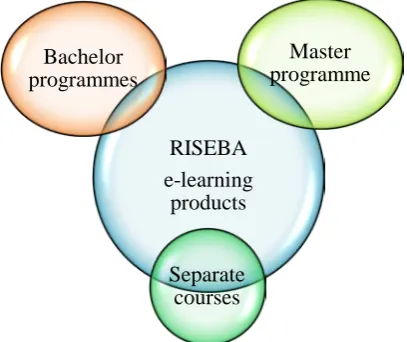
RISEBA University offers 3 e-learning Bachelor study programmes: Business studies, E-Business and Business psychology, and one e-learning program at Master level – Master in Business management. In e-learning form the university offers full degree programmes in two languages – Latvian and Russian.
Moreover, from the 2014/2015 academic year RISEBA University offers one more opportunity, connected with e-learning education: the „open courses”. The student can select a specific course (for example, accounting or project management), study it, get credit points, as well as a certificate and a reference, which proves that the student has studied a particular course (duration 2-4 months). After the course is finished, the student can continue with another one.
Therefore, RISEBA University offers a set of e-learning products. E-learning products are separate courses or full programmes offered to the students with the aim to satisfy their needs:
- to get the knowledge and a certificate (separate courses) - to get knowledge and Bachelor or Master degree (Figure 1.).
Figure 1. RISEBA e-learning products
E-learning at RISEBA mainly uses electronic technologies – Internet, Skype, audio and video content. The study process is implemented via IT-platform Moodle, called e.riseba, where the study materials prepared by academic staff, are available for students. Nevertheless, students residing in Latvia can also benefit from face-to-face classes. Every student has his unique login and password for entering e.riseba. Here published all the specially prepared electronic educational materials – text documents, video lectures, practical exercises, self-evaluation test, suggested reading. Academic and administrative staff of RISEBA Centre for E-Learning always support the students to solve various issues. At the moment at the RISEBA e-learning centre are engaged about 50 academic and administrative personnel: the Head of E-learning Centre, the Administrator, the directors of the study programmes, IT-staff, Academic personnel.
RISEBA e-learning products
Separate courses
Master programme Bachelor
programmes
2. E-LEARNING POTENTIAL IN REMIGRATION OF LATVIAN CITIZENS
The second chapter aims to describe the research object and situation, define the research strategy and describe the methodology used. Also the data gathered, performing a thorough analysis and interpreting the findings are presented in this chapter. The chapter provides the answers to the four key research questions:
- Is there a potential in remigration of Latvian citizens by providing them e-learning products from Latvia?
- Who is the target audience of RISEBA e-learning products in the market of Ireland (gender, social class, age, language)?
- Which RISEBA e-learning products could be demanded in the market of Ireland by emigrants? - What are the most important reasons (arguments) and barriers for choosing e-learning products by emigrants?
2.1. A short description of the object and situation
The statistics show that significant number of citizens of Latvia are immigrating to Ireland for work. At the moment, there are more than 20 000 citizens of Latvia and non-citizens, but people who were living in Latvia, registered in Ireland. Moreover, there are about 80 000 Russian-speaking emigrants from different countries (Central Statistics Office, 2011). It is very important to proovide the support for emigrants offering them the opportunity to get the e-learning education in their mother-tongue (Latvian or Russian). With the help of e-learning emigrants can be integrated again in Latvian Higher education system. The research results show that the University e-learning has remarkable potential in remigration of Latvian citizens.
2.2. Research strategy and methods for gaining the data
During the research process both quantitative and qualitative strategies were used to answer to the research questions. In the paper, special attention is paid to the survey with potential students. Survey with the potential students (representatives of the market of Ireland, emigrants aged from 15 to 60, which mother-tongue is Latvian or Russian, women, men) is done to evaluate the potential of e-learning in remigration plan of Latvia. Nevertheless, the following methods for gaining data were used as well:
-Desk research
-Interview with 12 experts (one of the experts was Ambassador of the Republic of Latvia in Ireland)
-Focus-group interview.
2.3. Results of the research
During the research two main target groups were defined.
Russian-speaking and Latvian-speaking emigrants were surveyed separately: during the interviewing process with the experts, author of the paper got the information that the research results of Russian-speakers can differ from the results of Latvian-Russian-speakers (Tab. 1)
Table 1.The respondents of the research, divided into two groups
Mother-tongue
Gender Age Education level
Total M W
15-19 20-25
26-46
47 and older
Basic Sec. Col Bac. Mg.
Russian 22 78 1 10 79 10 2 15 29 37 17 100
Latvian 41 144 3 29 127 26 12 70 44 40 19 185
In both groups representatives of women gender were more active in participating in research.
The majority of Russian-speaking emigrants taking part in the research has the Bachelor degree, the majority of Latvian-speakers, in turn, have the Secondary education.
The majority of respondents of both groups knows or rather knows what e-learning means. Nevertheless the men from speaking group are more informed about e-learning than Russian-speaking women.
The attitude of majority of Russian-speaking emigrants to e-learning as a way of getting higher education is neutral, in turn the attitude of Latvian-speakers largely is positive or rather positive. There is not observed a significant difference between women and men (representatives of Russian-speakers), so it is possible to conclude, that gender does not influence the attitude to the e-learning as a study form in this group. Nevertheless, Latvian-speaking men are more sceptic about e-learning than women from the same group. That leads to a conclusion that gender may somehow influence the attitude towards e-learning, nevertheless, the difference observed between the two groups of Latvian-speakers is not significant.
It is revealed, that in both language groups the gender does not influence the readiness for studying, nevertheless, it became clear that the men from Latvian-speaking group are more confident in decision-making than women from the same group. The most popular answers between men were “yes’ and “no”, but the most popular answers between women were “rather yes” and “rather no”. This observation leads to a conclusion that the women are not very confident in making decisions, they doubt. It means, that they could be more influenced, so it is possible to try to change their attitude to e-learning, as well as the level of their readiness to choose for studying one of RISEBA e-learning study products, during promotional activities.
Russian-speakers in age group of 47 years and older are more interested in choosing for studying one of the RISEBA e-learning study products, in turn the group of emigrants 26-46 years old are least interested in this opportunity. However, the Latvian-speakers from group 20-25 years old are interested in choosing RISEBA the most. It means that exactly they can become the potential students of RISEBA University. People in the age of 47 years and older are the least interested in choosing one of the e-learning study products. It means, that there is correlation between the level of readiness to study and age of emigrants; moreover, it is interesting, that in every language-group the age of potential students would not be the same. The potential “average” student, whose mother-tongue is Russian, is 47 years old or even older person, in turn the potential “average” student, whose mother-tongue is Latvian, is 20 years old or older person.
It became clear, that the level of education influences the level of readiness to choose e-learning as a study form. Russian-speakers with the college degree are the most interested in this opportunity, in turn the least interested are the people with secondary education. The respondents with Master degree are not very interested this opportunity as well. In turn, Latvian-speakers with Basic education degree are the most interested in RISEBA offered e-learning products, nevertheless, at the moment RISEBA University is not ready to offer them a study programme, because all RISEBA programmes could be offered to the people with secondary, college, Bachelor or Master degree. Nevertheless the opportunities to study an “open” course or several “open” courses still exist and can be offered to them. So it is possible to conclude, that people with secondary education can become the potential clients of RISEBA University. According to the analysed study result, the potential student of RISEBA University, whose mother-tongue is Russian is a man or woman in age group 47 years and older, with college degree, emigrant, in turn the potential student of RISEBA University, whose mother-tongue is Latvian, is a man or woman, 20-25 years old with Secondary education, emigrant.
It became clear, that there are three main reasons for not choosing RISEBA e-learning products, mentioned by Russian-speaking and Latvian-speaking emigrants.
The first reason: People don’t believe that e-learning is appropriate quality study form
The second reason: People already have the higher education, so they are not interested to have one more degree.
The third reason: People are not sure that Latvian diploma is recognized in Ireland, so it does not make sense for them to study.
It became clear, that the potential student of RISEBA e-learning, whose mother-tongue is Russian would be the most interested in the offer to study one or some specific courses. The representatives of this language group are the least interested in continuing the study process in RISEBA, in the case they have already begun study process in another University or the process was interrupted by some reasons. In turn, the potential student of RISEBA, whose mother-tongue is Latvian, would be the most interested in full higher education programme (Bachelor or Master).
Russian-speakers would like to choose for studies mainly the professional Bachelor programme „Business Studies”. Latvian-speakers are mainly interested in the Master programme „Business Management”, nevertheless, Professional Bachelor programme „Business studies” and Academic programme „Business Psychology” also are popular and raise interest between the Latvian-speakers.
The majority of the respondents would like to study in mother tongue: Russian-speakers have chosen for studies Russian language and Latvian-speakers have chosen Latvian language. Such result can be explained with the fact that for them it would be easier to study in these languages or, that means that they do not know English language at appropriate for studies level.
It became clear that the respondents from both language-groups, who can become the real students of RISEBA, are ready to pay for studies not more than 1410 euro per one academic year.
According to the research results the three main arguments, which could motivate Russian-speakers to choose one of the RISEBA e- learning study products are presented in Figure 2. (Figure 2.)
Figure 2. Three main arguments, which could motivate Russian-speakers to choose e- learning study products
According to the research results three main arguments, which could motivate Latvian-speakers to choose one e-learning study products are presented in Figure 3. (Figure 3.)
Reasons for choosing e-learning by
Russian-speakers 1.Opportunity to
combine study process and work
2.Opportunity to combine study process and care for the
small child
3.Opportunity to study in mother-tongue
Figure 3. Three main arguments, which could motivate Latvian-speakers to choose e-learning study products
2.4. The main conclusions of the research
During the research, the answers to all four research questions were found:
- Is there a potential in remigration of Latvian citizens by providing them e-learning products from Latvia?
There is a potential in remigration of Latvian citizens by providing them e-learning products in the market of Ireland. Emigrants from Latvia are interested to get education in mother-tongue, offered by the University, based in Latvia. All e-learning study products, offered by RISEBA University are demanded in the market of Ireland, nevertheless the more attention should be paid to the promotion of separate courses as the e-learning study product.
- Who is the target audience of RISEBA e-learning products in the market of Ireland (gender, social class, age, language)?
Four major target groups are defined:
1. Adults (47 years and older), whose mother language is Russian, and whose appropriate Russian level for studies. Men with College degree. English level is not appropriate for studies. Middle class. Emigrants.
2. Adults (47 years and older), whose mother language is Russian, and whose appropriate Russian level for studies. Women with College degree. English level is not appropriate for studies. Middle class. Emigrants.
3. Youth (20-25 years), whose mother language is Latvian, and whose appropriate Latvian level for studies. Men with Secondary education. English level is not appropriate for studies. Middle class. Emigrants.
4. Youth (20-25 years), whose mother language is Latvian, and whose appropriate Latvian level for studies. Women with Secondary education. English level is not appropriate for studies. Middle class. Emigrants.
According to the unexpected research results, these target groups are interested the most in choosing one e-learning study products. Nevertheless, e- learning study products have to be offered to all the interested emigrants of the market of Ireland.
- Which RISEBA e-learning products could be demanded in the market of Ireland by emigrants? Reasons for
choosing e-learning by
Latvian-speakers 1.Opportunity
to combine study process
and work
2.Opportunit y to study in
mother-tongue
3.Tuition fee
All e-learning products, offered by RISEBA University can be demanded in the market of Ireland. Nevertheless, products raise interest, depending on the affiliation to a particular group:
- Emigrants from both language groups are interested in separate e-learning courses
- Russian-speaking emigrants are interested the most in the professional Bachelor programme “Business studies”
- Latvian-speaking target audience is interested the most in the professional Master programme “Business management” as well as Professional Bachelor programme „Business studies” and academic programme „Business psychology”.
- The potential e-learning student, whose mother-tongue is Russian, would be interested the most in separate e-learning courses.
- The potential student of e-learning, whose mother-tongue is Russian, is least interested in continuing the study process in RISEBA university, in case they already begun study process in another University or the process was interrupted by some reasons.
- The potential student of e-learning, whose mother-tongue is Latvian would be interested the most in full higher education programme (Bachelor or Master).
- What are the most important reasons (arguments) and barriers for choosing e-learning products by emigrants?
Three main most important reasons (arguments) for choosing e-learning products by the Russian-speaking emigrants are following:
• Opportunity to combine study process and work
• Opportunity to combine study process and care for the baby
• Opportunity to study in mother-tongue
Three main most important reasons (arguments) for choosing e-learning products by the Latvian-speaking emigrants are following:
• Opportunity to combine study process and work
• Opportunity to study in mother-tongue
• Tuition fee
The three main barriers for choosing e-learning products are following:
• Emigrants don’t believe that e-learning is appropriate quality study form
• People already have the higher education, so they are not interested to have one more degree.
• People are not sure that Latvian diploma is recognized in Ireland, so it does not make sense for them to study
The research results show that the University e-learning has remarkable potential in remigration of Latvian citizens. The results prove that e-learning is a suitable education for emigrants, who differ from the citizens of the country of their residence, because of the language, nationality, and religion of emigrant. Moreover for Latvia as a country, the idea of integration of Latvian emigrants to the education system again reflects the economic importance, because it can be used as one of the best practice to support the Remigration plan of Latvia offered by the Ministry of Economics of Latvia.
REFERENCES
1. Ajady, T., Adeoye, F., Salawy, I., 2008. E-learning and Distance Education in Nigeria. TOJET: The Turkish Online Journal of Educational Technology, [e-journal] Nr. 7(4) Available through: ERIC database (ED503472) [Accessed 15 October 2014]
2. Badere, A., 2012. RISEBA tālmācības projekta idejas fiziskās realizācijas iespēju nalīze.Maģistra darbs. Rīgas Starptautiskā ekonomikas un biznesa administrācijas augstskola (RISEBA).
3. Banas Edward, J, Frances Emory, W., 1998. History and issues of distance learning. Public Administration Quarterly, Vol. 22, No. 3, [e-journal] Available through: JSTOR <http://www.jstor.org/stable/40862326> [Accessed 31 October 2014]
4. Barreau, D., 2000. Distance Learning: Beyond Content. Journal of Education for Library and Information Science, Vol. 41, No. 2 (Spring, 200) [e-journal] Available through: http://www.jstor.org/stable/40324057 [Accessed 31 October 2014]
5. Bell, Bradford, Federman, Jessica, E., 2013. E-Learning Works Exactly How Well Depends on Its Unique Features and Barriers: CAHRS ResearchLink No. 1. [pdf] Available through: ERIC database (ED541918) [Accessed 15 October 2014]
6. Benta, D., Bologa, G., Dzitac, I., 2014. E-learning Platforms in Higher Education. Case Study. 2nd International Conference on Information Technology and Quantitative Management, ITQM 2014. Published by Elsevier B.V.
7. Central Statistics Office/ Statistics/ Quick Tables/ Persons usually resident and present in the state on census night, classified by nationality and age group, 2011. Available through: <http://www.cso.ie/multiquicktables/quickTables.aspx?id=cdd26> [Accessed 11 January 2015]
8. Criu, R., Ceobanu, C., 2013. E-learning Implications For Adult Learning. TOJET: The Turkish Online Journal of Educational Technology Volume 14, No. 2, [e-journal] Available through: ERIC database (EJ1013743) [Accessed 15 October 2014]
9. Gubernick, Lisa, Ebeling, A., 1997. I Got My Degree Through E-mail. FORBES [e-journal] Available through: http://www.forbes.com/forbes/1997/0616/5912084a.html [Accessed 16 November 2014]
10. Guri-Rosenblit, S., 2005. Distance Education and E-Learning: Not the Same Thing. Higher Education, Vol.49, No. 4 [e-journal] Available through: <http://www.jstor.org./stable/25068081> [Accessed 26 October 2014]
11. Kotch, J., 2005. Does distance learning works? A large sample, control group study of srtudent success in distance learning. E-journal of Instructional Science and Technology. [online]. Available at <http://www.ascilite.org.au/ajet/e-jist/docs/vol8_no1/fullpapers/distancelearning.html> [Accessed 2 November 2014]
12. Latvijas Republikas Ekonomikas ministrijas Reemigrācijas atbalsta pasākumu plāns plāns, 2013.
[pdf] Available at:
<https://www.em.gov.lv/files/nozares_politika/rp/EM_prezentacija_reemigr_plans_05122013.pdf > [Accessed 11 January 2015]
13. Quality and Qualifications in Ireland. National Framework of Qualifications, 2014 [online] Available through: < http://www.qqi.ie/Pages/National-Framework-of-Qualifications-%28NFQ%29.aspx> [Accessed 10 January 2015]
14. Songhao, H. et al., 2011. Evolution from Collaborative learning to Symiotic E-learning; creation of New E-learning Environment for Knowledge Society. US-China Education Review, [non journal] Nr. 8(1) Available through: ERIC database (ED519417) [Accessed 10 October 2014]
15. Valsamidis, S. et al., 2014. E-learning Activity Analysis. Procedia Economics and Finance. [online]. Available at: http://www.sciencedirect.com/science/article/pii/S2212567114000525 [Accessesd 1 O 2014ctober]
16. Vasiljeva, T., Kremer, L., 2013. E-learning system MOODLE at Higher school – implementation results. The 2nd Electronic International Interdisciplinary Conference. Chezk Republic, September, 2-6, 2013.