Nonlin. Processes Geophys., 20, 207–211, 2013 www.nonlin-processes-geophys.net/20/207/2013/ doi:10.5194/npg-20-207-2013
© Author(s) 2013. CC Attribution 3.0 License.
EGU Journal Logos (RGB)
Advances in
Geosciences
Open Access
Natural Hazards
and Earth System
Sciences
Open AccessAnnales
Geophysicae
Open AccessNonlinear Processes
in Geophysics
Open AccessAtmospheric
Chemistry
and Physics
Open AccessAtmospheric
Chemistry
and Physics
Open Access DiscussionsAtmospheric
Measurement
Techniques
Open AccessAtmospheric
Measurement
Techniques
Open Access DiscussionsBiogeosciences
Open Access Open Access
Biogeosciences
Discussions
Climate
of the Past
Open Access Open Access
Climate
of the Past
Discussions
Earth System
Dynamics
Open Access Open Access
Earth System
Dynamics
DiscussionsGeoscientific
Instrumentation
Methods and
Data Systems
Open Access
Geoscientific
Instrumentation
Methods and
Data Systems
Open Access DiscussionsGeoscientific
Model Development
Open Access Open Access
Geoscientific
Model Development
DiscussionsHydrology and
Earth System
Sciences
Open AccessHydrology and
Earth System
Sciences
Open Access DiscussionsOcean Science
Open Access Open Access
Ocean Science
Discussions
Solid Earth
Open Access Open Access
Solid Earth
DiscussionsOpen Access Open Access
The Cryosphere
Natural Hazards
and Earth System
Sciences
Open Access
Discussions
Efficient selective filtering of seismic data using multiscale
decomposition
F. E. A. Leite, M. V. C. Henriques, V. C. Gurgel, and J. M. S. Filho
Departamento de Ciˆencias Exatas, Tecnol´ogicas e Humanas, Universidade Federal Rural do Semi- ´Arido, Campus Angicos, 59515–000, Angicos, RN, Brazil
Correspondence to: F. E. A. Leite ([email protected])
Received: 17 August 2012 – Revised: 1 February 2013 – Accepted: 25 February 2013 – Published: 13 March 2013
Abstract. Seismic signal processing is an important task in geophysics sounding and represents a permanent challenge in petroleum exploration. Although seismograms could in principle give us a picture of a geological structure, they are very contaminated by spurious signals and the ground roll noise is a strongly undesired signal present in the seismo-grams – it does not carry physical information about the deep geological structures. This fact demands a big effort in devel-oping new filtering methodologies. Using discrete wavelet transform, an efficient filtering for suppression of the ground roll is presented. In this method, seismic data is decomposed in multiple scales. We can remove the noise as a surgical op-eration in each scale, just from the regions where they are present or strong, allowing us to preserve the maximum of relevant information.
1 Introduction
Discrete wavelet transform is an invertible integral transfor-mation that is implemented by measuring the correlation be-tween the signal and one mother wavelet function. Differ-ent from the short-time fourier transform, the wavelet trans-form does not use a constant window to localize the events in frequency and space but uses a frequency-adaptive scale function (Daubechies, 1990). Its translations along the signal determine the location, and its stretches and squeezes deter-mine the scale information. These properties are essential for the analysis of nonstationary signals. The scale localization corresponds to the frequency localization, due to the inverse relationship.
In geophysics the application of the discrete wavelet trans-form was motivated by exploration of nonstationary
pro-cesses’ real data which contain multiscale features by nature (Grossmann et al., 1984). The seismic data is a time series with time-varying frequencies that can be found in real pro-cesses. The study of such processes aims at transforming and representing the data so that the frequency content can be obtained locally in time. Therefore, the discrete wavelet is a convenient tool for various seismic-data-processing tasks, such as noise attenuation, because data are represented in time and frequency simultaneously (Deighan, 1997).
As a discrete transform, the discrete wavelet transform has been formulated as a unifying approach to several usages of filter banks. Daubechies, Mallat, and others demonstrated the relation between wavelet coefficient calculations, defined as integral convolutions and the filter banks (Strang te al., 1984; Mallat, 1989a,b). This joint selectivity is useful when there are regions in the signal or image whose frequency content is to be preserved or minimally affected (Corso et al., 2003; Mallat, 1992). The combination of discrete multiscale de-compositions with attenuation procedures on the calculated wavelet coefficients yields filters with joint selectivity in both the time and frequency domains (Daubechies, 1990).
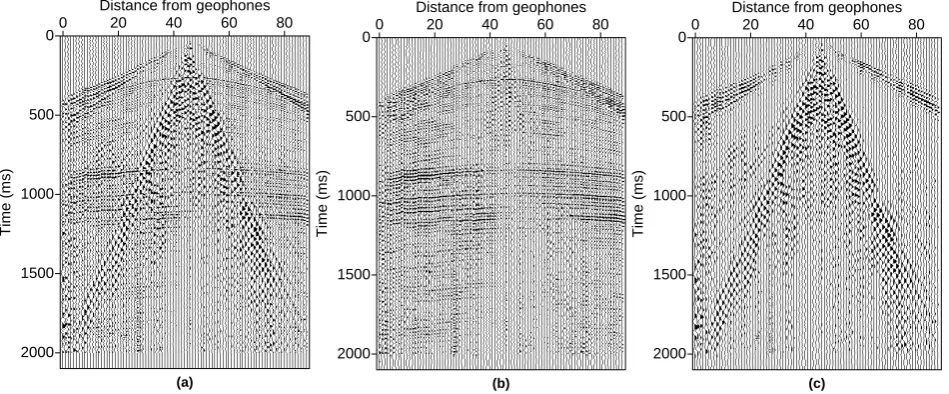
Figure 1a shows the graphical representation for the orig-inal seismic data analyzed. It is a set of signals (traces) ac-quired at several geophones (acoustic sensors) arranged at the ground level. We observe signal noise (ground roll noise in cone form) contaminating the seismic reflections (hyper-boles). The ground roll is a slowly decaying, low-frequency component in seismic records, related to Rayleigh surface waves, thus appearing as a component with low constant apparent velocity (Yilmaz, 1987). As a surface component, these waves do not interact with subsurface structures asso-ciated with oil reservoirs. This means that they do not carry physical information about the deep geological structures
and therefore they become undesirable signals. However, be-cause of the slow decay, the ground roll appears as a strong component during a long period of time. It masks the reflec-tive component that contains information about the deep ge-ological structures. Because of this it is difficult to identify the reflections of interest in the regions of the seismogram where superposition of these two components occurs. Since multiscale decomposition of seismic data aims to character-ize the time-dependent frequency of subsurface, the wavelet transform is well suited for such problems and has power-ful application potential in seismic data processing (Deighan, 1997).
Our paper is organized as follows. In the next section we present a short mathematical background about the discrete wavelet theory of the article and fix the mathematical nota-tion. In Sect. 3, we present in detail our method for ground roll attenuation and the results. Finally, in Sect. 4 we make some final remarks.
2 The wavelet transform
In this section we present the necessary information and re-lations concerning the continuous and discrete wavelet trans-forms. This mathematical framework is the basis for the de-composition of the seismic data, and it establishes the no-tation we use in this work. A detailed formalism of wavelet transform can be found in, among others, Daubechies (1992); Mallat (1998).
As Fourier analysis distributes a signal among a series of sines and cosines, wavelet analysis does the same with a wavelet as the decomposition basis. While the Fourier trans-form does not provide any spatial localization in the quency domain, the wavelet transform is localized in fre-quency as well as in space. The wavelet transform doesn’t use a constant window to localize the events in frequency and space as does a windowed Fourier transform but uses a frequency-adaptive scale function.
2.1 The continuous wavelet transform
The continuous wavelet transform d(s, u) of a function f (t )∈L2(R)in the scalesand timeuis defined as
d(s, u)= hf, ψs,ui = +∞ Z
−∞
f (t )ψs,u? dt, (1)
where ψs,u(t )=
1 √
|s|ψ
t−u s
(2) represents a basis of functions called wavelets. Hereψ? is the complex conjugate ofψs,u(t ), and the parameterssandu are real numbers (s6=0) that represent dilatations and trans-lations of one fixed function, the mother waveletψ (t ).
The continuous wavelet transform is an invertible integral transformation that is implemented by measuring the corre-lation between the signal and one mother wavelet. Its transla-tions along the signal determine the location, and its stretches and squeezes determine the scale information. The scale lo-calization corresponds to the frequency lolo-calization, because scale is effectively the inverse of frequency. In continuous wavelet transform the location and scale are given by a con-tinuous parameter.
2.2 Discrete and orthonormal wavelet transforms
In real situations, seismic data are discretized in time. How-ever, in order to implement the wavelet transform on sampled signals, we need to discretize the scale and location param-eters. Wavelet transforms implemented on discrete values of scale and location are called discrete wavelet transforms. A basis of orthonormal discrete wavelets can be constructed by choosing s=2j andu=n2j with j and n integers. Each value of 2j is known as scale andj is the scale index. The parametern is the translation index, which determines the position of the wavelet in time. The conditions for choos-ings=2j andu=n2jare discussed by Daubechies (1992). This basis is called family Daubechies wavelets.
The corresponding discrete waveletψj,nis defined as
ψj,n(t )=√1 2jψ
t−n2j 2j
, (3)
wherej andn, respectively, are integers associated with di-latations and translations parameters.
Letf (t )be any signal inL2(R). There are bases {ψj,n} such thatf (t )can be expanded, up to arbitrary high preci-sion, by a linear combination of the wavelets as
f (t )=X j
X
n
dj,nψj,n(t ), (4)
where the functions ψj,n are called discrete wavelets, are square integrable with zero mean, and may have some van-ishing moments. The criterion of zero mean is related to the fact that one wants to have the possibility of reconstructing the original function from its wavelet decomposition. The re-sulting set of wavelets{ψj,n}for all j andnintegers form an orthogonal basis. The remarkable property of this basis is that the functions are orthogonal to their translates and their dilates (Mallat, 1989a,c; Daubechies, 1992).
The wavelet coefficientsdj,nof the functionf (t )∈L2(R) are computed by taking the inner product off (t )with the different waveletsψj,n:
dj,n= hf, ψj,ni. (5)
0
500
1000
1500
2000
Time (ms)
0 20 40 60 80
Distance from geophones
(a)
0
500
1000
1500
2000
Time (ms)
0 20 40 60 80
Distance from geophones
(b)
0
500
1000
1500
2000
Time (ms)
0 20 40 60 80
Distance from geophones
(c)
Fig. 1. (a) The original seismic data where the ground roll is present. It corresponds to record 25 as describe in Yilmaz’s book. (b) This is the result after suppression of the ground roll. (c) The suppressed portion of the original seismic data.
respectively. The coefficientsdj,ngive information on the be-havior of the functionf (t )at scale 2j and time 2jn. There-fore representation is said to be at resolutionjor at scale 2j. The difference between two successive approximations is the detail at resolutionj.
3 Methodology and results
We present here the analysis of seismic data which was ob-tained from the Center for Wave Phenomena of the Colorado School of Mines. It has 90 traces, corresponding to equally spaced geophones from the source, and 2048 samples per trace (Fig. 1a). The samples correspond to the time, both in arbitrary scale, which imply eleven scales for decomposition in the wavelet basis considered.
Our proposed method for suppressing ground roll in seis-mic data is based in the multiscale (multiresolution) decom-position scheme (Mallat, 1989a,c) using the orthogonal dis-crete wavelets. The advantages of being orthogonal are that any error in the input signal will not grow under transforma-tion and that stable numerical computatransforma-tions are possible. We optimize procedure by choosing the family of Daubechies wavelets, since these wavelets are perfectly compact in time and have minimum support for a given order of approxima-tion (Daubechies, 1988, 1992). The compactness allows a fil-tering process that affects strictly the events in scales and a delimited region of the seismic data. These procedures can be done in a surgical way, filtering the noise only in the space– time region and scales in which it is present, and keeping the other regions and scales unfiltered.
In a previous filter (Corso et al., 2003), using the contin-uous wavelet transform, the coherent noise region was iden-tified globally in the space–time region and the filtering was
applied in a scale band below a chosen scale threshold. Con-sidering that region of the seismic data corresponding to a bunch of low-frequency components should not be exclu-sively ground roll noise, an attenuation factorAf is intro-duced. When Af =0 there is no filtering; at the opposite limit, whenAf =1 the signal is completely removed. How-ever, we use an attenuation factor adapted for each scale. The signal reconstruction (using the inverse discrete wavelet transform) allows the partition of their components in indi-vidual scales.
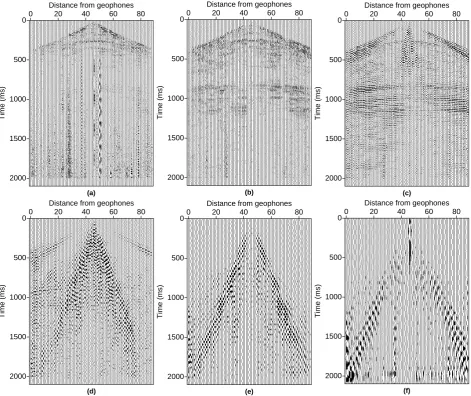
The multiscale decomposition of the seismic data takes into account the timescale localization properties of the wavelet transform. The adaptative filter works in the follow-ing way. The decomposition represents the seismic data in several scales. So, for a given scale, the ground roll becomes more localized in the timescale domain and therefore can be more easily subjected to a surgical removal. In scales where the ground roll and reflections are all included, we used the attenuation factor. Thus, the filter works by reducing the co-efficients, for a factorAf, in at scale. The scales where there is just ground roll are disposed of. The attenuation factor is not used in the scales where the ground roll is not visible. Since the scale is 2j, different values ofj represent different scales. In this example, the indexj ranges from 1 to 11. The scale indexj =1 has the finest resolution and indexj=11 has the coarsest resolution with the lowest frequency content. Finally we reconstruct the cleaned seismic data by scale.
0
500
1000
1500
2000
Time (ms)
0 20 40 60 80
Distance from geophones
(a)
0
500
1000
1500
2000
Time (ms)
0 20 40 60 80
Distance from geophones
(b)
0
500
1000
1500
2000
Time (ms)
0 20 40 60 80
Distance from geophones
(c)
0
500
1000
1500
2000
Time (ms)
0 20 40 60 80
Distance from geophones
(d)
0
500
1000
1500
2000
Time (ms)
0 20 40 60 80
Distance from geophones
(e)
0
500
1000
1500
2000
Time (ms)
0 20 40 60 80
Distance from geophones
(f)
Fig. 2. Multiscale decomposition of the original seismic data (Fig. 1a), using the discrete wavelet transform. (a) is the decomposition in scalesj=1,2 that corresponds to the largest frequency content. (b) and (c), respectively, represent decomposition in scalesj=3 andj=4, which correspond to intermediate frequency. (d), (e) and (f), respectively, represent decomposition in scalesj=5,j=6 andj=7−11, which correspond to the lowest frequency content.
not apply any attenuation process in these scales. In Fig. 2c we have intermediate scale indexj =4 and we see that the ground roll is localized in a small region (in the top central region). So, we apply the filter just in this localized region of the seismic data to attenuate the ground roll. Figure 2d corresponds to intermediate scale indexj =5. In this scale the ground roll starts to appear and becomes dominant. The reflection events are almost invisible. However, a signal of physical relevance is also present. Then, we used the discrete wavelet transform following the methodology developed by Corso et al. (2003) for attenuating the ground roll in this scale. Figures 2e and f correspond to the scale indexesj =6 andj=7−11, respectively. We can notice that the seismic data just corresponds to the ground roll and no physical rele-vant information.
4 Conclusions
We have constructed a filter based on the discrete wavelet transform for processing seismic data. The main goal of this paper is to show an alternative method of removing the ground roll that contaminates the seismic data and disturbs their interpretation. To improve the filtering, seismic data were submitted to a multiscale decomposition. With multi-scale decomposition, we have been able to localize and iden-tify characteristics of the data in a certain scale, verifying if the ground roll is present in that scale. Then we have just attenuated it in that scale. These procedures can be done in a surgical way, filtering the noise only in the space–time re-gion and scales in which it is present, and keeping the other regions and scales unfiltered. This operation preserves the maximum of information contained in the faint, scattered waves coming from the deep layers.
The method of multiscale decomposition has been shown to be valuable in the preservation of information we are in-terested in. This is particularly relevant to situations in which the characteristics of the ground roll can be well discrimi-nated. This method shows improvements over the previous ones, especially for the high degree of adaptability to the sig-nals, as well as for the improvement of the localization prop-erties of the filter. In this method the filtering is much more selective and surgically precise because it is performed scale by scale. That is the reason why it is more efficient.
Acknowledgements. Financial support from the Brazilian agencies
CNPq, FAPERN, FACEPE, FINEP and CTPETRO is acknowl-edged.
Edited by: A. Lanorte
Reviewed by: G. Corso and one anonymous referee
References
Corso, G., Kuhn, P., Lucena, L. S., and Thom´e, Z.: Seismic ground roll time–frequency filtering using the gaussian wavelet trans-form, Physica A, 318, 551–561, 2003.
Daubechies, I.: Orthonormal bases of compactly supported wavelets, Commun. Pur Appl. Math., 41, 909–996, 1988. Daubechies, I.: The wavelet transform, time-frequency localization
and signal analysis, IEEE T. Informat. Theory, 36, 961–1005, 1990.
Daubechies, I.: Ten Lectures on wavelets, SIAM, Philadelphia, PA., 1992.
Deighan, A. J., and Watts, D. R.: Ground roll supression using the wavelet transform, Geophys., 62, 1896–1903, 1997.
Grosmann, A. and Morlet, J.: Decomposition of hardy function into square integrable wavelets of constant shape, SIAM J. Math. Anal., 15, 723–736, 1984.
Mallat, S.: A Theory for multiresolution signal decomposition: the wavelet representatio, IEEE T. Pattern Anal. Machine Intelli-gence, 11, 674–693, 1989.
Mallat, S.: Multifrequency channel decomposition of images and wavelet models, IEEE T. Speech and Signal Process., 37, 2091– 2110, 1989.
Mallat, S.: Multiresolution approximations and wavelet orthonor-mal bases ofL2(R), T. Am. Math. Soc., 315, 69–87, 1989. Mallat, S.: Characterization of signals from multiscale edges, IEEE
T. Pattern Anal. Machine Intell., 14, 710–732, 1992.
Mallat, S.: A wavelet tour of signal processing, Academic Press, 2nd ed., New York, 1998.
Strang, G. and Nguyen, T.: Wavelets and filter banks, Wellesley-Cambridge Press, Wellesley, USA, 1984.