https://doi.org/10.5194/se-10-2001-2019
© Author(s) 2019. This work is distributed under the Creative Commons Attribution 4.0 License.
A multi-phasic approach for estimating the Biot
coefficient for Grimsel granite
Patrick Selvadurai1, Paul A. Selvadurai2, and Morteza Nejati3
1Department of Civil Engineering and Applied Mechanics, McGill University, Montréal, QC, H3A 0C3, Canada 2Swiss Seismological Service (SED) at ETH Zurich, Zurich, Switzerland
3Department of Earth Sciences, ETH Zurich, Zurich, Switzerland Correspondence:Patrick Selvadurai ([email protected]) Received: 30 April 2019 – Discussion started: 27 May 2019
Revised: 6 September 2019 – Accepted: 13 September 2019 – Published: 15 November 2019
Abstract.This paper presents an alternative approach for es-timating the Biot coefficient for the Grimsel granite, which appeals to the multi-phasic mineralogical composition of the rock. The modelling considers the transversely isotropic na-ture of the rock that is evident from both the visual appear-ance of the rock and determined from mechanical testing. Conventionally, estimation of the compressibility of the solid material is performed by fluid saturation of the pore space and pressurization. The drawback of this approach in terms of complicated experimentation and influences of the unsat-urated pore space is alleviated by adopting the methods for estimating the solid material compressibility using develop-ments in theories of multi-phase materials. The results of the proposed approach are compared with estimates available in the literature.
1 Introduction
The classical theory of poroelasticity proposed by Biot (1941) is a major contribution to the disciplines of geo-sciences and geomechanics with applications that include porous earth materials saturated by fluids. The studies in this area are numerous and no attempt will be made to pro-vide a comprehensive survey of past and recent develop-ments. Advances in the area of poroelasticity and its appli-cations to problems in geomechanics in particular are given by Yue and Selvadurai (1995), Selvadurai (1996), Selvadu-rai (2007), Wang (2000), Verruijt (2015), Cheng (2015), Sel-vadurai et al. (2015), SelSel-vadurai and Suvorov (2016), and others. The basic development of the classical theory of
classi-cal theory of poroelasticity is accepted, values of αcannot be greater than unity. Such a value would imply that either
KD<0 or KS<0, which would violate the positive defi-niteness arguments for the strain energy of an elastic porous skeleton (Davis and Selvadurai, 1996; Selvadurai, 2000) with no locked-in self equilibrating stresses (i.e. the skeleton ex-pands under compressive isotropic stresses). A range of val-ues for α is given by Detournay and Cheng (1993), Wang (2000), and Cheng (2015).
The experimental procedure for determining the Biot coef-ficientαinvolves estimating the bulk modulus of the porous skeleton (KD), which, in the case of an isotropic skeletal fab-ric, can be obtained by subjecting a dry or moisture free and jacketed specimen of the rock to isotropic compres-sion and measuring the resulting volumetric strain. This is a straightforward experimental technique and the results can also be verified by conducting uniaxial compression tests on the isotropic rock and measuring both the Young’s modu-lus and Poisson’s ratio. The measurement of the compress-ibility of the solid material composing the skeletal fabric can be either straightforward or complicated depending on the permeability characteristics of the porous material. For rocks with relatively high permeability (e.g. Indiana lime-stone 10−13∼10−15m2 – Selvadurai and Glowacki, 2008 and Selvadurai and Selvadurai, 2010, 2014; Vosges sand-stone∼10−13m2– Moulu et al., 1997), the pore space of the rock can be saturated by initiating a combination of steady flow and vacuum saturation. To determine the compress-ibility of the solid material, the confining isotropic stresses are allowed to nearly equilibrate with the pore fluid pres-sure and the volume changes meapres-sured can be used to esti-mate the compressibility of the solid esti-material composing the porous fabric. With very low-permeability materials (e.g. the Cobourg limestone ∼10−23 to 10−19m2, Selvadurai et al., 2011), the process of saturation of the pore space can take an inordinately long time with no assurance that the entire pore space is fully saturated or that there are no residual pore fluid pressure artefacts (Selvadurai, 2009). Furthermore, even if the pore space is saturated, attaining equalization of the ex-ternally applied pressure with the internal pore fluid pressure can take substantial time (for 150 mm diameter cylindrical Cobourg limestone samples, more than 100 d are required for saturation). For this reason, Selvadurai (2019) proposed an alternative approach where the compressibility of the solid material phase(s) can be estimated by considering the multi-phasic theories developed for estimating the effective prop-erties of composite elastic materials. The composite mate-rial theories associated with the Voigt–Reuss–Hill estimates (Voigt, 1928; Reuss, 1929; Hill, 1952, 1965) and the upper and lower bound estimates proposed by Hashin and Shtrik-man (1963) can be used to estimate the bulk modulus of the solid material (see also Walpole, 1966, and Francfort and Murat, 1986). In this paper, we apply these basic concepts to determine the Biot coefficient for the Grimsel granite. This granite is encountered in the Underground Research
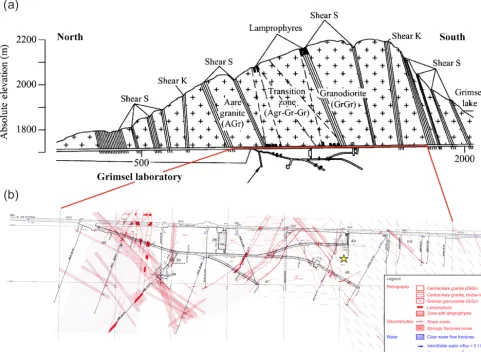
Labora-tory constructed in Grimsel, Switzerland, in order to perform heater experiments to simulate the thermo-hydro-mechanical (THM) loading associated with heat-emitting containers in the event that the site is chosen as a repository for the deep geologic disposal of high-level nuclear fuel waste (i.e. the Full-scale Engineered Barriers EXperiment (FEBEX)). A typical section along the Grimsel Laboratory associated with the FEBEX heater experiment location is shown in Fig. 1.
The Aar granitic rock (also referred to as Aare granitic rock) setting at Grimsel has been associated with initiatives related to the use of granitic rock formations as potential hosts for the creation of deep geologic repositories for the disposal of heat-emitting nuclear fuel waste. Detailed de-scriptions of the geological settings of the Aar Massif of the Central Alps are given by several authors including Stalder (1964), Wüthrich (1965), Steck and Burri (1971), Schal-tegger (1990a), SchalSchal-tegger (1990b), and SchalSchal-tegger and Corfu (1992), and references to further studies are given by Goncalves et al. (2012). Geoscientific studies of the Aar granite have been conducted by a number of agencies includ-ing NAGRA (Nationale Genossenschaft für die Lagerung radioaktiver Abfälle) and ENRESA (Empresa Nacional de Residuos Radiactivos, S.A.), and these initiatives are docu-mented in several reports and articles by Amiguet (1985), Pahl et al. (1989), Keusen et al. (1989), Möri et al. (2003), Alonso and Alcoverro (2005), Alonso et al. (2005), Rabung et al. (2012), Bouffier (2015), Garralón et al. (2017), and Kri-etsch et al. (2019). In relation to the FEBEX research ex-periments, the geological setting of the Grimsel Laboratory contains alternate layers of the Aar granite, transition zones, and Granodiorite, separated by Lamprophyres and zones that are subjected to intense shearing. A typical view of the geo-logical setting is shown in Fig. 1. During the FEBEX exper-iments, the Grimsel Laboratory was used to conduct heater experiments, where the heaters were encapsulated in ben-tonitic clay. An extensive programme of research was con-ducted by a series of research groups to validate the THM response of both the bentonitic buffer and the rock mass and the results of the research efforts are documented by Alonso and Alcoverro (2005) and Alonso et al. (2005). The Grimsel granite used in this research investigation was obtained from boreholes PRP16.001 and INJ16.001 located in the south-ern part of the laboratory, drilled from a cavsouth-ern located at a depth of approximately 450 m. These boreholes were drilled as a part of the Grimsel In situ Stimulation and Circulation (ISC) project (see the location in Fig. 1) that investigated the seismo-hydro-mechanical response of the rock mass to hy-draulic stimulation (Amann et al., 2018; Gischig et al., 2018; Doetsch et al., 2018; Jalali et al., 2018).
com-Figure 1. (a)The Grimsel Laboratory and the FEBEX Drift (after Alonso et al., 2005);(b) detailed map view of the FEBEX drift for reference only (After Keusen et al., 1989 and from NAGRA Technical Report NTB87-14E).
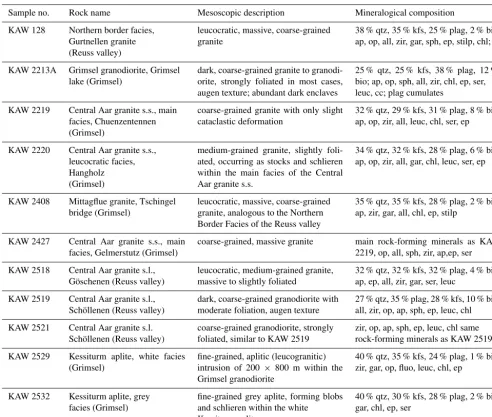
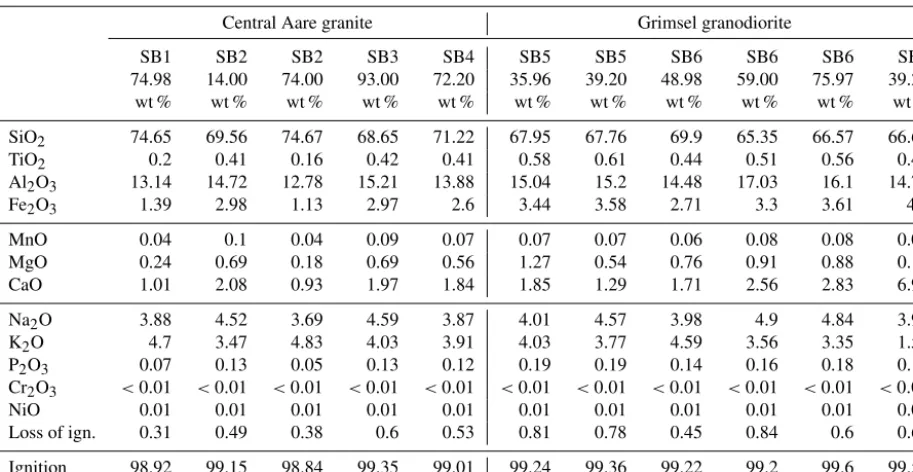
pressibility of the Grimsel granite and for distinguishing the sample locations. For example, the work of Jokelainen et al. (2013) provides information on the mineralogical compo-sition of the Grimsel granodiorite, and the study by Mis-sana and Garcia-Gutiérrez (2012) provides the mineralogical composition of the FEBEX granite. The results reported in these investigations are summarized in Tables 1–4 for com-pleteness.
Figure 2 shows cores of the Grimsel granite and, from a visual perspective, the rock has the appearance of stratifica-tions that would point to the likely presence of transverse isotropy, in terms of its elasticity properties, fluid flow, and fracture and failure characteristics.
The microstructure includes larger crystals of quartz (with dimensions of up to 8 mm), and this requires that a suit-able representative volume element is considered, both in the mechanical testing and mineralogical property evalua-tions. Extensive geomechanical characterization studies have been performed on the Grimsel granite, and these are given in the references cited previously. Permeability studies are
also reported by Schild et al. (2001). A comprehensive inter-laboratory study of permeability of the Grimsel granodiorite is also given in David et al. (2018a, b).
The objective of this study is to employ the existing data on the mechanical characterization of the transversely isotropic granite to estimate the skeletal compressibility of the granite and to use XRD (X-ray diffraction) studies of the mineralogical composition of the Grimsel granite to estimate the compressibility of the solid phase composing the porous fabric.
2 Skeletal bulk modulus of the Grimsel granite
Table 1.Short petrographical descriptions of the rock samples analysed by Schaltegger and Krähenbühl (1990). Compositions are estimated from thin section; all – allanite; ap – apatite; bio – biotite; cc – calcite; chl – chlorite; ep – epidote; fluo – fluorite; gar – garnet; kfs – K-feldspar; leuc – leucoxene; op – opaques; plag – plagioclase; ser – sericite; sph – sphene; stilp – stilpnomelane; qtz – quartz; zir – zircon. The Central Aar granite s.s refers to granitic rocks sampled within the Aar valley, whereas the Central Aar s.l. refers to samples from the same geological unit but that were sampled in the Reuss valley, which is the valley to the east of the Aar valley.
Sample no. Rock name Mesoscopic description Mineralogical composition
KAW 128 Northern border facies, Gurtnellen granite (Reuss valley)
leucocratic, massive, coarse-grained granite
38 % qtz, 35 % kfs, 25 % plag, 2 % bio; ap, op, all, zir, gar, sph, ep, stilp, chl;
KAW 2213A Grimsel granodiorite, Grimsel lake (Grimsel)
dark, coarse-grained granite to granodi-orite, strongly foliated in most cases, augen texture; abundant dark enclaves
25 % qtz, 25 % kfs, 38 % plag, 12 %; bio; ap, op, sph, all, zir, chl, ep, ser, leuc, cc; plag cumulates
KAW 2219 Central Aar granite s.s., main facies, Chuenzentennen (Grimsel)
coarse-grained granite with only slight cataclastic deformation
32 % qtz, 29 % kfs, 31 % plag, 8 % bio; ap, op, zir, all, leuc, chl, ser, ep
KAW 2220 Central Aar granite s.s., leucocratic facies, Hangholz (Grimsel)
medium-grained granite, slightly foli-ated, occurring as stocks and schlieren within the main facies of the Central Aar granite s.s.
34 % qtz, 32 % kfs, 28 % plag, 6 % bio; ap, op, zir, all, gar, chl, leuc, ser, ep
KAW 2408 Mittagflue granite, Tschingel bridge (Grimsel)
leucocratic, massive, coarse-grained granite, analogous to the Northern Border Facies of the Reuss valley
35 % qtz, 35 % kfs, 28 % plag, 2 % bio; ap, zir, gar, all, chl, ep, stilp
KAW 2427 Central Aar granite s.s., main facies, Gelmerstutz (Grimsel)
coarse-grained, massive granite main rock-forming minerals as KAW 2219, op, all, sph, zir, ap,ep, ser
KAW 2518 Central Aar granite s.l., Göschenen (Reuss valley)
leucocratic, medium-grained granite, massive to slightly foliated
32 % qtz, 32 % kfs, 32 % plag, 4 % bio; ap, ep, all, zir, gar, ser, leuc
KAW 2519 Central Aar granite s.l., Schöllenen (Reuss valley)
dark, coarse-grained granodiorite with moderate foliation, augen texture
27 % qtz, 35 % plag, 28 % kfs, 10 % bio; all, zir, op, ap, sph, ep, leuc, chl
KAW 2521 Central Aar granite s.l. Schöllenen (Reuss valley)
coarse-grained granodiorite, strongly foliated, similar to KAW 2519
zir, op, ap, sph, ep, leuc, chl same rock-forming minerals as KAW 2519
KAW 2529 Kessiturm aplite, white facies (Grimsel)
fine-grained, aplitic (leucogranitic) intrusion of 200 ×800 m within the Grimsel granodiorite
40 % qtz, 35 % kfs, 24 % plag, 1 % bio; zir, gar, op, fluo, leuc, chl, ep
KAW 2532 Kessiturm aplite, grey facies (Grimsel)
fine-grained grey aplite, forming blobs and schlieren within the white
Kessiturm aplite
40 % qtz, 30 % kfs, 28 % plag, 2 % bio; gar, chl, ep, ser
isotropic elastic material is normal to thezaxis. The equa-tions of elasticity governing the normal strains can be written in the forms
xx= σxx
Ex
−νyxσyy
Ey
−νzxσzz
Ez ,
yy= − νxyσxx
Ex
+σyy
Ey
−νzyσzz
Ez ,
zz= − νxzσxx
Ex
−νyzσyy
Ey
+σzz
Ez
. (1)
We point out that the Poisson’s ratio is generally defined as νij= −j/i for a stress in thei direction. From Betti’s
reciprocal theorem
νxy Ex
=νyx
Ey ,νxz
Ex
=νzx
Ez ,νyz
Ey
=νzy
Ez
. (2)
Due to the isotropic behaviour in thexy plane,Ex=Ey, andνzy=νzx. These relations reduce the independent ma-terial constants needed to define the principal strains to four:
Ex,Ez,νxy, andνzx. Consider the situation where an element of the transversely isotropic elastic medium is subjected to an isotropic compressive stress state:σxx=σyy=σzz=p. The infinitesimal volumetric strain
v=xx+yy+zz=p
2
Ex
1−νxy
+ 1
Ez
(1−4νzx)
Table 2.Geochemical descriptions of the rock samples across the Grimsel test site given by Keusen et al. (1989).
Central Aare granite Grimsel granodiorite
SB1 SB2 SB2 SB3 SB4 SB5 SB5 SB6 SB6 SB6 SB5 74.98 14.00 74.00 93.00 72.20 35.96 39.20 48.98 59.00 75.97 39.20 wt % wt % wt % wt % wt % wt % wt % wt % wt % wt % wt %
SiO2 74.65 69.56 74.67 68.65 71.22 67.95 67.76 69.9 65.35 66.57 66.66 TiO2 0.2 0.41 0.16 0.42 0.41 0.58 0.61 0.44 0.51 0.56 0.47 Al2O3 13.14 14.72 12.78 15.21 13.88 15.04 15.2 14.48 17.03 16.1 14.73 Fe2O3 1.39 2.98 1.13 2.97 2.6 3.44 3.58 2.71 3.3 3.61 4.1 MnO 0.04 0.1 0.04 0.09 0.07 0.07 0.07 0.06 0.08 0.08 0.09 MgO 0.24 0.69 0.18 0.69 0.56 1.27 0.54 0.76 0.91 0.88 0.12 CaO 1.01 2.08 0.93 1.97 1.84 1.85 1.29 1.71 2.56 2.83 6.99
Na2O 3.88 4.52 3.69 4.59 3.87 4.01 4.57 3.98 4.9 4.84 3.95 K2O 4.7 3.47 4.83 4.03 3.91 4.03 3.77 4.59 3.56 3.35 1.57 P2O3 0.07 0.13 0.05 0.13 0.12 0.19 0.19 0.14 0.16 0.18 0.15 Cr2O3 <0.01 <0.01 <0.01 <0.01 <0.01 <0.01 <0.01 <0.01 <0.01 <0.01 <0.01 NiO 0.01 0.01 0.01 0.01 0.01 0.01 0.01 0.01 0.01 0.01 0.01 Loss of ign. 0.31 0.49 0.38 0.6 0.53 0.81 0.78 0.45 0.84 0.6 0.69
Ignition 98.92 99.15 98.84 99.35 99.01 99.24 99.36 99.22 99.2 99.6 99.52
Figure 2.The Grimsel granite sample taken from the PRP1 bore-hole, with a diameter of 110 mm and a length of 240 mm. The nom-inal planes of stratification are inclined at about 50◦to the axis of the sample.
The skeletal bulk modulus for the transversely isotropic elastic material can be expressed in the form
KDT I = p v
= ExEz
2Ez 1−νxy+Ex(1−4νzx)
. (4)
In terms of the elasticity parameters that are applicable to the direction normal to the planes of stratification (N) and
directions along the planes of foliation or stratification (T), Eq. (4) can be written as
KDT I= ETEN
2EN(1−νT T)+ET(1−4νN T)
. (5)
In the limit of material isotropy,EN=ET =EandνT T = νN T =νand Eq. (5) reduces to the classical result
KDI = E
3(1−2ν). (6)
represen-Table 3. Mineralogical composition of the Grimsel granodiorite (Gr-Gr) (After Jokelainen et al., 2013).
Mineral Sample 1 Sample 2 (Vol %) (Vol %)
Plagioclase 39.0 34.0 Quartz 28.4 37.2 K-feldspar 21.6 12.8 Biotite 5.0 7.8 Muscovite+sericite 2.6 1.6 Epidote 1.2 1.0 Amphibole 1.8 4.6 Chlorite 0.2 0.4 Titanate – 0.6 Opaque minerals 0.2 –
Table 4.Mineralogical composition of the FEBEX granite (after Missana and Garcia-Gutiérrez, 2012).
Mineral Volume (%)
Quartz 30–36 Plagioclase/albite 19–23 K-feldspar 31–37 Biotite chlorite 6–8 Muscovite 1–2
tative values of the elasticity characteristics of Grimsel gran-ite with due consideration for the species of grangran-ite. The ear-liest record used in this study relates to the work of Amiguet (1985) and Alonso and Alcoverro (2005), which indicate the elasticity properties asE≈60 GPa,ν≈0.25.
Pahl et al. (1989) used borehole dilatometer and overcor-ing to estimate the in situ stress state and the overall deforma-bility characteristics of the granite: E≈40 GPa,ν≈0.25. The work of Keusen et al. (1989) gives a range of elastic-ity values applicable to the granodiorite (max[E≈63 GPa,
ν≈0.48]; min[E≈32 GPa,ν≈0.18]) and the Aar granite (max[E≈64 GPa,ν≈0.49]; min[E≈42 GPa,ν≈0.25]). Ziegler and Amann (2012) also report the results of an ex-tensive series of tests conducted on both wet and dry and coarse-grained and fine-grained samples of Grimsel granite. The results are presented as maximum and minimum values as follows: coarse-grained granite: max[E≈59 GPa, ν≈
0.37], min[E≈53 GPa,ν≈0.25]; medium-grained granite: max[E≈63 GPa, ν≈0.41], min[E≈52 GPa, ν≈0.17]. The recent work of Bouffier (2015) uses laboratory overcor-ing techniques to estimate the deformability characteristics of the Grimsel granite, and there is a wide range of results for both the elastic modulus and Poisson’s ratio; average repre-sentative results are indicated byE≈25 GPa,ν≈0.33. The work of Kant et al. (2017) is primarily focused on the estima-tion of the thermal properties of the Aar granite. The results they cite for the modulus of elasticity and Poisson’s ratio are
directly obtained from the work of Alonso et al. (2005) or in-directly from Keusen et al. (1989). Wenning et al. (2018) re-port studies of permeability and seismic velocity anisotropy across a ductile to brittle transition zone in the Grimsel gran-ite.
The skeletal compressibility is also an important pa-rameter in the interpretation of transient hydraulic pulse tests for estimating the fluid transport properties of low-permeability materials including granite and argillaceous limestones (Brace et al., 1968; Selvadurai and Carnaffan, 1997; Selvadurai and Selvadurai, 2014; Selvadurai and Na-jari, 2015). The elasticity properties were determined via dy-namic measurements and the maximum and minimum val-ues are as follows: max[E≈95 GPa, ν≈0.18], min[E≈
65 GPa,ν≈0.15]. Considering the nature of the ductile to brittle transmission zone under investigation and the dynamic nature of the tests, these estimates are far in excess of those for the intact material that is tested statically. Furthermore, the bulk modulus estimated from the maximum values ofE
andνis in the range of 50 GPa, which is lower than the bulk modulus of mono-mineralic albite but exceeds that of quartz. The study by Krietsch et al. (2019) deals with the characteri-zation of the in situ stress state at the Grimsel test site, using a range of experiments including overcoring and hydraulic fracturing. The investigations were extended to include trans-verse isotropy of the rock mass.
The elasticity parameters were inferred through a compu-tational back analysis of the overcoring technique; these au-thors also provide a comparison with the results obtained by Bouffier (2015). An averaging procedure gives maximum es-timates of the isotropic elasticity parameters asE≈26 GPa,
the papers dealing with the FEBEX exercise are excluded from consideration.
The majority of the studies focusing on the evaluation of the deformability characteristics of the Grimsel granite deal with isotropic elastic modelling. The possible influences of either elastic anisotropy or elastic transverse isotropy were addressed in the earlier study by Pahl et al. (1989) in connec-tion with the estimaconnec-tion of in situ stress states. In this particu-lar study, there is no clear statement of the applicable value of the elasticity constants governing transverse isotropy of the Grimsel granite (the degree of anisotropy (ET/EN) does not exceed 1.25), and the study culminates in the adoption of the isotropic elasticity properties that were indicated previously. The research by Nejati (2018) and Nejati et al. (2019) deals with the estimation of the deformability characteristics of the Grimsel granite based on the transversely isotropic elastic model with principal directions aligned in the stratification planes and normal to the planes (Fig. 2). These studies indi-cate that the Grimsel granite tested also exhibited significant anisotropy and nonlinearity. In addition, due to nonlinear ef-fects, the secant, tangent, and average values of the Young’s modulus can depend on the stress level at which the value is estimated.
If a range of elastic behaviour can be clearly defined and if the elastic constants governing transverse isotropy can be determined, then, as shown by Eq. (5), the bulk modulus ap-plicable to the transversely isotropic material can be evalu-ated objectively. The studies conducted by Nejati (2018) and Nejati et al. (2019) provide the following estimates for the elastic constants governing the transversely isotropic elas-ticity model for the Grimsel granite: EN≈30; ET ≈47, νT T ≈0.20,νN T ≈0.10 GPa, Finally, Krietsch et al. (2019) conducted a series of experiments on the ISC core plugs, us-ing overcorus-ing and external pressurization of the hollow sam-ples. These authors also give results of uniaxial tests con-ducted on core plugs extracted either normal or parallel to the foliations (Fig. 18 of their paper). These results can be used to estimate theENandET. From the results presented by Krietsch et al. (2019), the relevant elastic moduli can be summarized as follows:EN≈13;ET ≈35 GPa. These in-vestigations, however, cannot be used to estimate the values of νT T andνN T. Dambly et al. (2019) presented the results of a research programme geared to estimate the transversely isotropic elasticity parameters from results of ultrasonic dy-namic tests and static tests. Nejati et al. (2019) compared the static and dynamic values of the elastic constants at zero con-finement and concluded that the dynamic moduli are signifi-cantly greater than the static ones. In this study we have not considered experimental results derived from dynamic test-ing; therefore, for consistency, any results derived from dy-namic testing of the Grimsel granite have been excluded from further consideration. Considering the experimental evalua-tions available in the literature, the elasticity parameters ap-plicable to the Grimsel granite are summarized in Table 5.
T able 5. Elasticity properties for the Grimsel granite with the corresponding K I D or K T I D v alues: K I D = E / 3 ( 1 − 2 ν ), K T I D = ET EN / [ 2 EN ( 1 − νT T ) + ET ( 1 − 4 νN T ) ] ; N signifies the direction normal to the planes of stratification and T signifies the directions along the planes of stratification. Reference Elasticity type Elastic constants K I D or K T I D Amiguet (1985 ) 1 Isotropic E = 60 GP a, ν = 0 . 25 K I D ≈ 40 GP a P ahl et al. (1989 ) Isotropic E = 40 GP a, ν = 0 . 25 K I D ≈ 27 GP a K eusen et al. (1989 ) (Granodiorite) Isotropic Mean E ≈ 47 GP a, ν ≈ 0 . 33 (K
I)D
mean ≈ 46 GP a K eusen et al. (1989 ) (Aar granite) Isotropic Mean E ≈ 53 GP a, ν ≈ 0 . 37 (K
I)D
mean ≈ 68 GP a Zie gler and Amann (2012 ) T ype 1 – coarse grained Isotropic Mean E ≈ 38 GP a, ν ≈ 0 . 36 (K
I)D
mean ≈ 45 GP a Zie gler and Amann (2012 ) T ype 2 – medium grained Isotropic Mean E ≈ 43 GP a, ν ≈ 0 . 37 (K
I)D
Table 6.Mineralogical fractions of the Grimsel granite (data ob-tained by Wenning et al., 2018, Institute of Geology, ETH, Zurich).
Mineral Specific % KS(GPa) GS(GPa) gravity
Biotite & 2.72 10 77 42 phlogopite
Muscovite 2.70 5 61 41 Epidote 2.75 6 107 60 Albite 3.19 40 76 26 Feldspar 2.60 16 76 26 Quartz 2.72 23 38 45
6100
3 Compressibility of the solid material composing the Grimsel granite fabric
The skeletal material of the Grimsel granite consists of a va-riety of mineral phases including quartz, biotite, anorthite, augite, microcline, and traces of pyrite and magnetite. The composition of these minerals was determined both at the XRD facilities at University of Montréal, QC, Canada and at the Department of Earth Sciences, Institute of Geology, ETH, Zurich (Wenning et al., 2018). The estimated volume fractions and the values for the bulk moduli and shear mod-uli are shown in Tables 6 and 7, respectively. The average volume fractions and the mineralogical compositions tend to vary and the estimated values are, in general, considered to be approximate. The results of the XRD evaluations do not pro-vide sufficient accuracy to group the tested rocks into either the Grimsel granodiorite or the FEBEX Grimsel categories. A very cursory comparison with the data provided in Tables 1 to 3 would suggest that the mineralogical compositions pro-vided by Wenning et al. (2018) and indicated in Table 6 cor-respond to the Grimsel granodiorite, and the results shown in Table 7 correspond to the FEBEX granite. For this rea-son, the XRD data derived from both laboratory evaluations (ETH and McGill) are retained in the estimations of the solid material compressibilityKS. Also, the void fraction (1 %) is neglected in the calculations. The values for the bulk mod-uli and shear modmod-uli for the various minerals were obtained from published literature (Alexandrov et al., 1964; Anderson and Nafe, 1965; Carmichael, 1990; Sisodia and Verma, 1990; Moos et al., 1997; Redfern and Angel, 1999; Schilling et al., 2003; Zhu et al., 2007; Mavko et al., 2009; Lin, 2013).
In the multi-phasic approach, the objective is to determine the overall bulk modulus for the solid mineralogical phase by considering the bulk moduli for the separate mineral con-stituents and their volume fractions. Ideally this needs to be approached using a generalized theory of multi-phasic com-posites that can accommodate a mixture of any number of phases. Such a generalized theory is yet to be developed. The most widely used relationships are those by Voigt (1928) and
Table 7.Mineralogical fractions of the Grimsel granite (data ob-tained by the Earth Sciences Laboratory, University of Montréal).
Mineral Specific % KS(GPa) GS(GPa) gravity
Quartz 2.72 46 38 45 Biotite 2.70 5 77 42 Anorthite 2.75 37 68 38 Augite 3.19 5 95 59 Microcline 2.60 7 52 36
6100
Reuss (1929). The Voigt (V) and the Reuss (R) estimates are
(KS)VI = n X
i
Vi(KS)i, (KS)RI =
n
X
i Vi (KS)i
−1 ,
(GS)VI = n X
i
Vi(GS)i, (GS)RI =
n
X
i Vi (GS)i
−1
, (7)
wherei is quartz, biotite, anorthite, augite, microcline, and voids and subscriptsI=1, 2 refer to the data derived from Table 6 and Table 7, respectively. .
The results given in Hill (1952, 1965) are the mean of the Voigt and Reuss estimates. This basic approach can be ap-plied to estimate the effective bulk and shear moduli for the Grimsel granite: i.e.
(KS)I= 1 2
(KS)VI +(KS)RI
,
(GS)I= 1 2
(GS)VI +(GS)RI
, (8)
where subscriptsI=1, 2 refer to the data derived from Ta-bles 6 and 7 respectively.
Using the mineralogical compositions obtained from XRD analyses given in Table 1, we have
(KS)1=65 GPa, (GS)1=33 GPa, (9) and using the mineralogical compositions obtained from XRD analyses given in Table 2, we have
(KS)2=52 GPa, (GS)2=42 GPa. (10) We consider the upper and lower bounds for a multi-phasic composite consisting of n phases developed by Walpole (1966). The effective bulk modulusKfor the multi-phasic material can be written as
" n X
i=1
V
i
Kl∗+Ki
#−1
−Kl∗≤K≤
" n X
i=1
Vi K∗
g+Ki
!#−1
where
Kl∗=4
3Gl; K ∗ g=
4
3Gg. (12)
In Eq. (12),GlandGgare, respectively, the lowest and great-est values of the shear modulus of the nphases. For com-pleteness, we also record here the bounds for the effective shear modulus (G) of the n phasic mixture, which can be written as
" n X
i=1
V
i G∗l +Gi
#−1
−G∗l ≤G≤
" n X
i=1
Vi G∗
g+Gi
!#−1
−G∗g, (13)
where
G∗l =3
2
1
Gl
+ 10
9Kl+8Gl
−1
;
G∗g=3
2
1
Gg
+ 10
9Kg+8Gg
−1
, (14)
andKlandKgare, respectively, the lowest and greatest val-ues of the bulk modulus of thenphases.
Considering the multi-phasic data set given in Tables 6 and 7, respectively,
(KS)1(64.7,66.0)GPa; (KS)2(52.1,52.7)GPa. (15) Considering the range of solid material compressibilities obtained from the two laboratory investigations, we can con-clude that the lower (L) and upper (U) estimates forKS are approximately
KSL'52 GPa, KSU'66 GPa. (16)
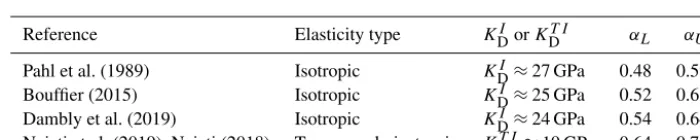
The results for the skeletal compressibilities given in Ta-ble 5 can be combined with the range of solid material com-pressibilities to estimate the upper andlower limits of the Biot coefficient applicable to each estimate ofKDI andKDT I. The relevant results are shown in Table 8.
4 Discussion
In theories developed for estimating the elasticity of multi-phasic materials, the most extensive studies relate to two-component elastic materials. Theories, however, have also been developed by several researchers to include a distri-bution of three elastic phases in the composite material. An early study in this area is by Cohen and Ishai (1967) that con-sidered the presence of a large-void content in the two-phase system. Several other developments have been proposed in the literature; references to such studies are given by Ju and Chen (1994a, b) and the references cited in the Introduction.
The extension to three elastic phases was also presented in the studies by Talbot et al. (1995) and, more recently, by Lin and Ju (2009). Even with these developments, the number of separate components included in the composite material models are insufficient to accommodate all the components of the solid phases listed in Tables 1 to 3 and 5 and 6.
A plausible alternate approach is to essentially reduce the components in Tables 1 and 2 to three phases by combining (using the Voigt–Reuss–Hill approach) the material phases that correlate closely in terms of their bulk and shear mod-uli values. Whether, in view of the approximate nature of the XRD evaluations of the volume fractions of the separate phases, such refinements are altogether warranted is debat-able. The results of the evaluations presented in the paper suggest that the multi-phasic approach in conjunction with XRD data provides a useful alternative to validating the con-ventional experimental approach for estimating the solid ma-terial composing low-permeability porous media. The skele-tal bulk moduli for the Grimsel granite shows a wide varia-tion, indicative of variable lithology of the igneous rock for-mation. In this sense it is prudent to assume a set of limits for the choice of the Biot coefficient rather than to assign a specific value. Certain data obtained in this study give rise to non-realistic values of the Biot coefficient, clearly arising from the estimation of the skeletal compressibility.
Table 8.Upper and lower limits for the Biot coefficient for the Grimsel granite;αU=1−(KDI orKDT I)/KSU,αL=1−(K I
DorKDT I)/KSL, KSL≈52 GPa,KSU≈66 GPa.
Reference Elasticity type KDI orKDT I αL αU Amiguet (1985) Isotropic KDI ≈40 GPa 0.23 0.40 Pahl et al. (1989) Isotropic KDI ≈27 GPa 0.48 0.59 Keusen et al. (1989) (Granodiorite) Isotropic (KDI)mean≈46 GPa 0.12 0.30 Keusen et al. (1989) (Aar granite) Isotropic (KDI)mean≈68 GPa −0.30 −0.03 Ziegler and Amann (2012) Type 1–coarse grained Isotropic (KDI)mean≈45 GPa 0.13 0.32 Ziegler and Amann (2012) Type 2–medium grained Isotropic (KDI)mean≈55 GPa −0.06 0.17 Bouffier (2015) Isotropic KDI ≈25 GPa 0.52 0.64 Dambly et al. (2019) Isotropic KDI ≈24 GPa 0.54 0.64 Krietsch et al. (2019) Transversely isotropic KDT I≈13 GPa 0.75 0.80 Nejati et al. (2019), Nejati (2018) Transversely isotropic KDT I≈19 GPa 0.64 0.71
Table 9.Reduced data set for the upper and lower limits for the Biot coefficient for the Grimsel granite.
Reference Elasticity type KDI orKDT I αL αU Pahl et al. (1989) Isotropic KDI ≈27 GPa 0.48 0.59 Bouffier (2015) Isotropic KDI ≈25 GPa 0.52 0.62 Dambly et al. (2019) Isotropic KDI ≈24 GPa 0.54 0.64 Nejati et al. (2019), Nejati (2018) Transversely isotropic KDT I≈19 GPa 0.64 0.71
5 Conclusions
The accurate estimation of the skeletal deformability char-acteristics of a porous rock is an essential prerequisite for estimating the Biot coefficient for a fluid-saturated poroelas-tic material. While the procedures for conducting either uni-axial or triuni-axial tests to estimate the skeletal deformability characteristics are well known, the exact procedure for esti-mating the elastic moduli, Poisson’s ratio, etc., needs to be better documented so that the interpretations of experimental data can be consistent. The conventional procedure for the pressurization of a saturated sample of the rock and the mea-surement of the resulting sample strains when the externally applied cell pressure matches the pore fluid pressure is per-haps the best procedure for estimating the compressibility of the solid phases of the porous medium. This, however, is not a routine procedure for low-permeability materials, and sub-stantial pressures need to be applied to ensure that volumetric strains of an accurately measurable value can be recorded.
Also, in such cases the strains could involve irreversible grain boundary frictional slip, and this needs to be excluded from the estimation of the solid material compressibility. Here, we advocate the use of a multi-phasic approach where the theories of composite materials can be used to esti-mate the compressibility of the solid esti-material composing the porous skeleton. This is a relatively easy approach since XRD evaluations of the mineralogical phase composition are usually carried out to characterize the rock. In relation to the Grimsel granite, the analysis points to a Biot coefficient that
has bounds rather than a specific value: i.e. 0.48< α <0.71. Values for the Biot coefficient for other types of rocks include the following: westerly granite –α≈0.47; Lac du Bonnet granite in Manitoba, Canada – α=0.73 (Lau and Chan-dler, 2004); Ruhr sandstone – α≈0.65; Berea sandstone – α≈0.79; Weber sandstone – α≈0.64; Ohio sandstone – α≈0.65; Pecos sandstone – α≈0.83; Boise sandstone –α≈0.85 (further estimates are provided by Zimmerman, 1991); Cobourg limestone –α≈0.66 (see also Table 1 in Detournay and Cheng, 1993). With soft rocks such as chalk, the Biot coefficient is invariably in the range of 0.80 to 1.0 (Alam et al., 2010; Nermoen et al., 2013). For the Callovo-Oxfordian claystone the Biot coefficient is estimated to be in the range of 0.84 (Belmokhtar et al., 2018). Other estimates for a variety of rocks encountered in a coal mining setting are also given by Chen et al. (2019).
Data availability. The data related to the research are all
docu-mented in the article. Additional information can be obtained from the lead author.
Author contributions. The concepts leading to the multi-phasic
and their verifications were performed by PAS and APSS. The pa-per was written by APSS, PAS, and MN and formatted to LaTeX by MN.
Competing interests. The authors declare that they have no conflict
of interest.
Acknowledgements. The work described in the paper was
sup-ported by a Discovery Research Grant awarded by the Natural Sci-ences and Engineering Research Council of Canada. This study is part of the In situ Stimulation and Circulation (ISC) project es-tablished by the Swiss Competence Center for Energy Research-Supply of Electricity (SCCER-SoE) with the support of Innosu-isse. The third author would like to thank the financial support pro-vided by the Swiss Innovation Agency Innosuisse, which is part of SCCER-SoE. The authors are also grateful to Eduardo Alonso (UPC, Spain), Lyesse Laloui (EPFL, Switzerland), Florian Am-man (RWTH, GerAm-many), Martin Mazurek (University of Bern, Switzerland), Stratis Vomvoris (NAGRA, Switzerland), Chris-tian David (Université Cergy-Pontoise, France), Jonny Rutqvist (LBNL, USA), Farid Laouafa (INERIS, France), Son Nguyen (CNSC, Canada), Raphael Schneeberger (NAGRA, Switzerland) and Robert W. Zimmerman (Imperial College, UK) for drawing attention to the literature used in this study and for helpful com-ments. The authors gratefully acknowledge the comments made by Joseph Doetsch, Institute of Geophysics, Department of Earth Sci-ences ETH Zurich, which led to improvements in the presentation. The authors, however, are entirely responsible for the statements and conclusions presented in the paper.
Financial support. This research has been supported by the
Natu-ral Sciences and Engineering Research Council of Canada (grant no. RGPIN-2016-04676).
Review statement. This paper was edited by David Healy and
re-viewed by two anonymous referees.
References
Alam, M. M., Borre, M. K., Fabricius, I. L., Hedegaard, K., Rø-gen, B., Hossain, Z., and Krogsbøll, A. S.: Biot’s coefficient as an indicator of strength and porosity reduction: Calcareous sedi-ments from Kerguelen Plateau, J. Petrol. Sci. Eng., 70, 282–297, https://doi.org/10.1016/j.petrol.2009.11.021, 2010.
Alexandrov, K. S., Rhyzova, T. V., and Beliko, B. P.: The elas-tic properties of pyroxenes, Sov. Phys. Crystallogr., 8, 589–591, 1964.
Alonso, E. E. and Alcoverro, J.: DECOVALEX III PROJECT. Mod-elling of FEBEX In-Situ Test, Task 1 Final Report, Tech. Rep., SKI Report 2005, 202 pp., 2005.
Alonso, E. E., Alcoverro, J., Coste, F., Malinsky, L., Merrien-Soukatchoff, V., Kadiri, I., Nowak, T., Shao, H., Nguyen, T. S., Selvadurai, A. P. S., Armand, G., Sobolik, S. R., Itamura, M.,
Stone, C. M., Webb, S. W., Rejeb, A., Tijani, M., Maouche, Z., Kobayashi, A., Kurikami, H., Ito, A., Sugita, Y., Chijimatsu, M., Börgesson, L., Hernelind, J., Rutqvist, J., Tsang, C. F., and Jus-sila, P.: The FEBEX benchmark test: Case definition and com-parison of modelling approaches, Int. J. Rock Mech. Min., 42, 611–638, 2005.
Amann, F., Gischig, V., Evans, K., Doetsch, J., Jalali, R., Val-ley, B., Krietsch, H., Dutler, N., Villiger, L., Brixel, B., Klepikova, M., Kittilä, A., Madonna, C., Wiemer, S., Saar, M. O., Loew, S., Driesner, T., Maurer, H., and Giardini, D.: The seismo-hydromechanical behavior during deep geothermal reservoir stimulations: open questions tackled in a decameter-scale in situ stimulation experiment, Solid Earth, 9, 115–137, https://doi.org/10.5194/se-9-115-2018, 2018.
Amiguet, J.-L.: Grimsel Test Site, Felskennwerte von intaktem Granit, Zusammenstellung felsmechanischer Laborresultate di-verser granitischer Gesteine, Tech. Rep., NAGRA, NIB 85-08, 1985.
Anderson, O. L. and Nafe, J. E.: The bulk modulus-volume relationship for oxide compounds and related geophysical problems, J. Geophys. Res., 70, 3951–3963, https://doi.org/10.1029/sp026p0153, 1965.
Belmokhtar, M., Delage, P., Ghabezloo, S., and Conil, N.: Drained Triaxial Tests in Low-Permeability Shales: Application to the Callovo-Oxfordian Claystone, Rock Mech. Rock Eng., 51, 1979–1993, https://doi.org/10.1007/s00603-018-1442-0, 2018. Biot, M. A.: General theory of three-dimensional consolidation,
J. Appl. Phys., 12, 155–164, https://doi.org/10.1063/1.1712886, 1941.
Bouffier, C.: Stress measurements by overcoring at the Grim-sel site. Results from the campaign of August-September 2015 Study Report, Tech. Rep., ETH Zurich, 119 pp., https://doi.org/10.3929/ethz-b-000256660, 2015.
Brace, W., Walsh, J., and Frangos, W.: Permeability of Granite un-der High Pressure, J. Geophys. Res., 73, 2225–2236, 1968. Carmichael, R. S. (Ed.): Practical Handbook of Physical Properties
of Rocks and Minerals, CRC Press, Boca Raton, FL, 756 pp., 1990.
Chen, Y., Selvadurai, A. P. S., and Liang, W.: Computational Mod-elling of Groundwater Inflow During a Longwall Coal Mining Advance: A Case Study from the Shanxi Province, China, Rock Mech. Rock Eng., 52, 917–934, 2019.
Cheng, A. H. D.: Poroelasticity, Springer-Verlag, Berlin, 877 pp., 2015.
Cohen, L. and Ishai, O.: The elastic properties of three-phase com-posites, J. Compos. Mater., 1, 390–403, 1967.
Dambly, M., Nejati, M., Vogler, D., and Saar, M. O.: On the direct measurement of the shear moduli in transversely isotropic rocks using the uniaxial compression test, Int. J. Rock Mech. Min., 113, 220–240, 2019.
permeabil-ity of the Grimsel granodiorite – Part 2: Modelling, microstruc-tures and complementary data, Geophys. J. Int., 215, 825–843, https://doi.org/10.1093/GJI/GGY305, 2018a.
David, C., Wassermann, J., Amann, F., Lockner, D. A., Rutter, E. H., Vanorio, T., Hildenbrand, A. A., Billiotte, J., Reuschlé, T., Lasseux, D., Fortin, J., Lenormand, R., Selvadurai, A. P. S., Meredith, P. G., Browning, J., Mitchell, T. M., Loggia, D., Nono, F., Sarout, J., Esteban, L., Davy, C., Louis, L., Boitnott, G., Madonna, C., Jahns, E., Fleury, M., Berthe, G., Delage, P., Braun, P., Grégoire, D., Perrier, L., Polito, P., Jannot, Y., Sommier, A., Krooss, B., Fink, R., Hu, Q., Klaver, J., and Clark, A.: KG2B, a collaborative benchmarking exercise for estimating the per-meability of the Grimsel granodiorite – Part 1: Measurements, pressure dependence and pore-fluid effects, Geophys. J. Int., 215, 799–824, https://doi.org/10.1093/GJI/GGY304, 2018b. Davis, R. O. and Selvadurai, A. P. S.: Elasticity and Geomechanics,
Cambridge University Press, Cambridge, 198 pp., 1996. Detournay, E. and Cheng, A. H. D.: Comprehensive rock
engineer-ing: Principles, practice and projects, in: Hudson JA, ed., Funda-mentals of Poroelasticity, Vol. 1., Pergamon Press, Oxford, 113– 171, 1993.
Doetsch, J., Gischig, V., Villiger, L., Krietsch, H., Nejati, M., Amann, F., Jalali, M., Madonna, C., Maurer, H., Wiemer, S., Driesner, T., and Giardini, D.: Subsurface fluid pressure and rock deformation monitoring using seismic velocity observations, Geophys. Res. Lett., 45, https://doi.org/10.1029/2018GL079009, 2018.
Dupray, F., François, B., and Laloui, L.: Analysis of the FEBEX multi-barrier system including thermoplasticity of unsaturated bentonite, Int. J. Numer. Anal. Meth. Geomech., 37, 399–422, 2013.
Dutler, N., Nejati, M., Valley, B., Amann, F., and Molinari, G.: On the link between fracture toughness, tensile strength, and fracture process zone in anisotropic rocks, Eng. Fract. Mech., 201, 56–79, 2018.
Francfort, G. A. and Murat, F.: Homogenization and optimal bounds in linear elasticity, Arch. Ration. Mech. An., 94, 307–334, https://doi.org/10.1007/BF00280908, 1986.
Garralón, A., Gómez, P., Turrero, M. J., Torres, E., Buil, B., and Peña, J.: Hydrogeochemical characterization of the groundwa-ter in the FEBEX gallery, National Cooperative for the Disposal of Radioactive Waste, Tech. Rep., NAGRA Arbeitsbericht, NAB 16-14, Wettingen, Switzerland, 125 pp., 2017.
Gens, A., Garcia-Molina, A. J., Olivella, S., Alonso, E. E., and Huertas, F.: Analysis of a full scale in situ testing simulating repository conditions, Int. J. Numer. Anal. Met., 22, 515–548, https://doi.org/10.1002/(SICI)1096-9853(199807)22:7<515::AID-NAG926>3.0.CO;2-8, 1998. Gischig, V. S., Doetsch, J., Maurer, H., Krietsch, H., Amann,
F., Evans, K. F., Nejati, M., Jalali, M., Valley, B., Ober-mann, A. C., Wiemer, S., and Giardini, D.: On the link be-tween stress field and small-scale hydraulic fracture growth in anisotropic rock derived from microseismicity, Solid Earth, 9, 39–61, https://doi.org/10.5194/se-9-39-2018, 2018.
Goncalves, P., Oliot, E., Marquer, D., and Connolly, J. A.: Role of chemical processes on shear zone formation: An example from the grimsel metagranodiorite (Aar massif, Central Alps), J. Metamorph. Geol., 30, 703–722, https://doi.org/10.1111/j.1525-1314.2012.00991.x, 2012.
Hashin, Z. and Shtrikman, S.: A variational approach to the theory of the elastic behaviour of multiphase materials, J. Mech. Phys. Solids, 11, 127–140, 1963.
Hearmon, R. F. S.: An Introduction to Applied Anisotropic Elastic-ity, Clarendon Press, Oxford, 136 pp., 1961.
Hill, R.: The elastic behaviour of a crystalline aggregate, Proceed-ings of the Physical Society A, 65, 349–354, 1952.
Hill, R.: A self-consistent mechanics of composite materials, J. Mech. Phys. Solids, 13, 213–222, 1965.
Jalali, M., Gischig, V., Doetsch, J., Naf, R., Krietsch, H., Klepikova, M., Amann, F., and Giardini, D.: Transmissivity changes and mi-croseismicity induced by small-scale hydraulic fracturing tests in crystalline rock, Geophys. Res. Lett., 45, 2265–2273, 2018. Jokelainen, L., Meski, T., Lindberg, A., Soler, J. M.,
Siitari-Kauppi, M., Martin, A., and Eikenberg, J.: The determination of 134Cs and 22Na diffusion profiles in granodiorite using gamma spectroscopy, J. Radioan. Nucl. Ch. Ar., 295, 2153–2161, https://doi.org/10.1007/s10967-012-2268-y, 2013.
Ju, J. W. and Chen, T. M.: Effective elastic moduli of two-phase composites containing randomly dispersed spherical inhomogeneities, Acta Mech., 103, 123–144, https://doi.org/10.1007/BF01180222, 1994a.
Ju, J. W. and Chen, T. M.: Micromechanics and effec-tive moduli of elastic composites containing randomly dis-persed ellipsoidal inhomogeneities, Acta Mech., 103, 103–121, https://doi.org/10.1007/BF01180221, 1994b.
Kant, M. A., Ammann, J., Rossi, E., Madonna, C., Höser, D., and Rudolf von Rohr, P.: Thermal properties of Central Aare granite for temperatures up to 500◦C: Irreversible changes due to thermal crack formation, Geophys. Res. Lett., 44, 771–776, https://doi.org/10.1002/2016GL070990, 2017.
Keusen, H., Ganguin, J., Schuler, P., and Buletti, M.: Technical re-port 87-14 E: Grimsel test site geology, Tech. Rep., GEOTEST: Zollikofen/Bern, 169 pp., 1989.
Krietsch, H., Gischig, V., Evans, K., Doetsch, J., Dutler, N. O., Val-ley, B., and Amann, F.: Stress Measurements for an In Situ Stim-ulation Experiment in Crystalline Rock: Integration of Induced Seismicity, Stress Relief and Hydraulic Methods, Rock Mech. Rock Eng., 52, 517–542, 2019.
Lau, J. S. O. and Chandler, N. A.: Innovative laboratory testing, Int. J. Rock Mech. Min., 41, 1427–1445, 2004.
Lekhnitskii, S. G.: Theory of Elasticity of an Anisotropic Elastic Body, Holden-Day, San Francisco, 404 pp., 1963.
Lin, C. C.: Elasticity of calcite: Thermal evolution, Phys. Chem. Miner., 40, 157–166, https://doi.org/10.1007/s00269-012-0555-3, 2013.
Lin, P. J. and Ju, J. W.: Effective elastic moduli of three-phase composites with randomly located and interacting spher-ical particles of distinct properties, Acta Mech., 208, 11–26, https://doi.org/10.1007/s00707-008-0114-7, 2009.
Mavko, G. M., Dvorkin, J., and Mukerji, T.: The Rock Physics Handbook, Tools for seismic analysis of porous media, Cam-bridge University Press, CamCam-bridge, 571 pp., 2009.
Moos, D., Dvorkin, J., and Hooks, A. J.: Application of theoreti-cally derived rock physics relationships, Los Angeles “Critical porosity”, Geophys. Res. Lett., 24, 329–332, 1997.
Möri, A., Mazurek, M., Adler, M., Schild, M., Siegesmund, S., Voll-brecht, A., Ota, K., Ando, T., Alexander, R., Smith, P. A., Haag, P., and Buehler, Ch.: The Nagra-JNC in situ study of safety rel-evanr radionuclide retardation in fractured crystalline rock, IV: The in situ study of matrix porosity in the vicinity of a water conducting fracture, Tech. Rep., NAGRA Technical Report, 00-08, Baden, Switzerland, 115 pp., 2003.
Moulu, J. C., Kalaydjian, F., Tsakiroglou, C. D., Burganos, V. N., Payatakes, A. C., Yao, J., Thovert, J.-F., and Adler, P.-M.: Char-acterization, reconstruction and transport properties of the Vos-ges sandstone, Revue de L’Institut Francais du Petrole, 52, 3–21, 1997.
Nejati, M.: On the anisotropy of mechanical proper-ties in Grimsel granodiorite, Tech. Rep., ETH Zurich, https://doi.org/10.3929/ethz-b-000289969, 2018.
Nejati, M., Dambly, M., and Saar, M. O.: A methodology to de-termine the elastic properties of anisotropic rocks from a sin-gle uniaxial compression test, J. Rock Mech. Geotech. Eng., https://doi.org/10.1016/j.jrmge.2019.04.004, 2019.
Nermoen, A., Korsnes, R., Christensen, H. F., Trads, N., Hiorth, A., and Madland, M. V.: Measuring the Biot stress coefficient and its implications on the effective stress estimate, Proc. 47th US Rock Mech./Geomech. Symposium, San Francisco, CA, USA, ARMA, p. 282, 2013.
Nguyen, T. S., Selvadurai, A. P. S., and Armand, G.: Mod-elling the FEBEX THM experiment using a state sur-face approach, Int. J. Rock Mech. Min., 42, 639–651, https://doi.org/10.1016/j.ijrmms.2005.03.005, 2005.
Pahl, A., Heusermann, S., Bräuer, V., and Glöggler, W.: Grimsel Test Site. Rock Stress Investigations, Tech. Rep., NAGRA Tech-nical Report, 88-39E, Baden, Switzerland, 151 pp., 1989. Rabung, T., Molinero, J., Garcia, D., and Montoya, V.: 1st
Work-shop Proceedings of the Collaborative Project “Crystalline Rock Retention Processses”, (7th EC FP CP CROCK), KIT Scientific Publishing, Barcelona, Spain, 206 pp., 2012.
Redfern, S. A. and Angel, R. J.: High-pressure behaviour and equa-tion of state of calcite, CaCO3, Contrib. Mineral. Petr., 134, 102– 106, https://doi.org/10.1007/s004100050471, 1999.
Reuss, A.: Berechnung der Fließgrenze von Mischkristallen auf Grund der Plastizitätsbedingung für Einkristalle, J. Appl. Math. Mech., 9, 49–58, 1929.
Rutqvist, J., Rejeb, A., M., T., and Tsang, C.-F.: Analyses of coupled hydrological-mechanical effects during drilling of the FEBEX tunnel at Grimsel, in: Proceedings of GeoProc 2003, edited by: Stephansson, O., Hudson, J. A., and Jing, L., Stock-holm, 196, 13–15 October 2003, 44, 114–119, 2003.
Schaltegger, U.: The Central Aar Granite: highly differentiated calc-alkaline magmatism in the Aar Massif (Central Alps, Switzer-land), Eur. J. Mineral., 2, 254–259, 1990a.
Schaltegger, U.: Post-magmatic resetting of Rb-Sr whole rock ages – a study in the Central Aar Granite (Central Alps, Switzerland), Geol. Rundsch., 79, 709–724, 1990b.
Schaltegger, U. and Corfu, F.: The age and source of late Hercynian magmatization in the central Alps: evidence from precise U-Pb ages and initial Hf isotopes, Contrib. Mineral. Petr., 111, 329– 344, 1992.
Schaltegger, U. and Krähenbühl, U.: Heavy rare earth element en-richment in granites of the Aar Massif (Central Alps, Switzer-land), Chem. Geol., 89, 49–63, 1990.
Schild, M., Siegesmund, S., Vollbrecht, A., and Mazurek, M.: Char-acterization of granite matrix porosity and pore-space geometry by in situ and laboratory methods, Geophys. J. Int., 146, 111– 125, 2001.
Schilling, F. R., Sinogeikin, S. V., Hauser, M., and Bass, J. D.: Elastic properties of model basaltic melt compositions at high temperatures, J. Geophys. Res.-Solid Ea., 108, 2304, https://doi.org/10.1029/2001jb000517, 2003.
Selvadurai, A. P. S.: Mechanics of Poroelastic Media, Kluwer Aca-demic Publishers, the Netherlands, 394 pp., 1996.
Selvadurai, A. P. S.: Partial Differential Equations in Mechanics, Vol. 2, The Bi-harmonic Equation, Poisson’s equation, Springer-Verlag, Berlin, 698 pp., 2000.
Selvadurai, A. P. S.: Stationary damage modelling of poroe-lastic contact, Int. J. Solids Struct., 41, 2043–2064, https://doi.org/10.1016/j.ijsolstr.2003.08.023, 2004.
Selvadurai, A. P. S.: The Analytical Method in Ge-omechanics, Appl. Mechan. Rev., 60, 87–106, https://doi.org/10.1115/1.2730845, 2007.
Selvadurai, A. P. S.: Influence of residual hydraulic gradients on decay curves for one-dimensional hydraulic pulse tests, Geo-phys. J. Int., 177, 1357–1365, https://doi.org/10.1111/j.1365-246X.2008.04047.x, 2009.
Selvadurai, A. P. S.: The Biot coefficient for a low permeability het-erogeneous limestone, Continuum Mech. Therm., 31, 939–953, https://doi.org/10.1007/s00161-018-0653-7, 2019.
Selvadurai, A. P. S. and Carnaffan, P.: A transient pressure pulse method for the mesurement of permeability of a cement grout, Can. J. Civil Eng., 24, 489–502, https://doi.org/10.1139/l96-132, 1997.
Selvadurai, A. P. S. and Glowacki, A.: Evolution of permeability hysteresis of Indiana Limestone during isotropic compression, Ground Water, 46, 113–119, 2008.
Selvadurai, A. P. S. and Głowacki, A.: Stress-Induced Permeabil-ity Alterations in an Argillaceous Limestone, Rock Mech. Rock Eng., 50, 1079–1096, https://doi.org/10.1007/s00603-016-1153-3, 2017.
Selvadurai, A. P. S. and Głowacki, A.: Estimates for the local per-meability of the Cobourg limestone, J. Rock Mech. Geotech. Eng., 10, 1009–1019, 2018.
Selvadurai, A. P. S. and Najari, M.: Laboratory-scale hy-draulic pulse testing: influence of air fraction in cavity on estimation of permeability, Géotechnique, 65, 126–134, https://doi.org/10.1680/geot.14.p.174, 2015.
Selvadurai, A. P. S. and Selvadurai, P. A.: Surface per-meability tests: Experiments and modelling for estimating effective permeability, P. Roy. Soc. A, 466, 2819–2846, https://doi.org/10.1098/rspa.2009.0475, 2010.
Selvadurai, P. A. and Selvadurai, A. P. S.: On the effective perme-ability of a heterogeneous porous medium: The role of the geo-metric mean, Philos. Mag., 94, 2318–2338, 2014.
Selvadurai, A. P. S. and Shirazi, A.: An elliptical disc anchor in a damage-susceptible poroelastic medium, Int. J. Num. Meth. Eng., 63, 2017–2039, https://doi.org/10.1002/nme.1354, 2005. Selvadurai, A. P. S. and Suvorov, A. P.: Boundary heating of
poro-elastic and poro-elasto-plastic spheres, P. Roy. Soc. A, 468, 2779–2806, 2012.
Selvadurai, A. P. S. and Suvorov, A. P.: Thermo-poromechanics of afluid-filledcavityina fluid-saturated geomaterial, P. Roy. Soc. A, 470, 20130634, https://doi.org/10.1098/rspa.2013.0634, 2014. Selvadurai, A. P. S. and Suvorov, A. P.: Thermo-poroelasticity and
Geomechanics, Cambridge University Press, Cambridge, 250 pp., 2016.
Selvadurai, A. P. S., Letendre, A., and Hekimi, B.: Axial flow hy-draulic pulse testing of an argillaceous limestone, Environ. Earth Sci., 64, 2047–2058, https://doi.org/10.1007/s12665-011-1027-7, 2011.
Selvadurai, A. P. S., Suvorov, A. P., and Selvadurai, P. A.: Thermo-hydro-mechanical processes in fractured rock formations dur-ing a glacial advance, Geosci. Model Dev., 8, 2167–2185, https://doi.org/10.5194/gmd-8-2167-2015, 2015.
Sisodia, P. and Verma, M. P.: Polycrystalline elastic moduli of some hexagonal and tetragonal materials, Phys. Status Solidi, 122, 525–534, 1990.
Stalder, H. A.: Petrographische und mineralogiche Untersuchungen im Grimselgebeit, Schweiz. Miner. Petrog., 44, 187–398, 1964. Steck, A. and Burri, G.: Chemismus und paragenesen von granaten
aud granitgneisen der Grünschiefer – und amphibolitfazies der Zentralapen, Schweiz. Miner. Petrog., 51, 534–538, 1971. Talbot, D. R., Willis, J. R., and Nesi, V.: On improving the
hashin-shtrikman bounds for the effective properties of three-phase composite media, IMA J. Appl. Math., 54, 97–107, https://doi.org/10.1093/imamat/54.1.97, 1995.
Terzaghi, K.: Die Berechnung der Durchlassigkeitsziffer des Tones aus Dem Verlauf der Hydrodynamischen Spannungserscheinun-gen, Akad. Wissensch., Wien Sitzungsber Mathnaturwissensch Klasse IIa, 142, 125–138, 1923.
Ting, T. C. T.: Anisotropic Elasticity: Theory and Applications, Ox-ford University Press, OxOx-ford, 570 pp., 1996.
Verruijt, A.: Theory and Problems of Poroelasticity, Delft Univer-sity of Technology, the Netherlands, 266 pp., 2015.
Voigt, W.: Lehrbuch der Kristallphysik, edited by: Teubner, B. G., Leipzig, 35, 1928.
Walpole, L.: On bounds for the overall elastic moduli of inhomoge-neous systems – I, J. Mech. Phys. Solids, 14, 151–162, 1966. Wang, H. F.: Theory of Linear Poroelasticity with Applications to
Geomechanics and Hydrogeology, Princeton University Press, Princeton, 287 pp., 2000.
Wenning, Q. C., Madonna, C., de Haller, A., and Burg, J.-P.: Permeability and seismic velocity anisotropy across a ductile-brittle fault zone in crystalline rock, Solid Earth, 9, 683–698, https://doi.org/10.5194/se-9-683-2018, 2018.
Wüthrich, H.: Rb-Sr-Altcrsbestimmungen am alpin überprägten Aarmassiv, Schweiz. Miner. Petrogr., 45, 876–971, 1965. Yue, Z. Q. and Selvadurai, A. P. S.: On the mechanics of a rigid disc
inclusion embedded in a fluid saturated poroelastic medium, Int. J. Eng. Sci., 33, 1633–1662, 1995.
Zhu, W., Hughes, J. J., Bicanic, N., and Pearce, C. J.: Nanoindenta-tion mapping of mechanical properties of cement paste and nat-ural rocks, Mater. Charact., 58, 1189–1198, 2007.
Ziegler, M. and Amann, F.: Laboratory test results obtained from core samples from the Grimsel III borehole at Kessiturm, Tech. Rep., Internal Report, Ingenieurgeologie, ETH Zurich, 10 pp., 2012.