oN ThE IDENTIfICATIoN of ThE EGGShELL
ELASTIC PROPERTIES UNDER QUASISTATIC
CoMpRESSIoN
J. Simeonovová, J. Buchar
Received: September 15, 2004
Abstract
SIMEONOVOVÁ, J., BUCHAR, J.: On the identification of the eggshell elastic properties under quasistatic compression. Acta univ. agric. et silvic. Mendel. Brun., 2004, LII, No. 5, pp. 73-82
The problem of the identification of the elastic properties of eggshell, i.e. the evaluation of the Young`s modulus and Poisson`s ratio is solved. The eggshell is considered as a rotational shell. The experiments on the egg compression under quasistatic loading have been conducted. During these experiments a strain on the eggshell surface has been recorded. By the mutual comparison between experimental and theoretical values of strains the influence of the elastic constants has been demonstrated.
eggshell, elastic shell theory, strain, elastic constants, compression
Ročník LII 7 Číslo 5, 2004
73
The investigation of eggs behaviour under com
-pressive loading is a subject of the increasing inter
-est because this loading corresponds to the loading of eggs during their packing. In order to minimize the eggs laid. In order to find all factors which affect the strength of eggshell, it is necessary to determine the strength of the eggshell. In quasistatic compres
-sion test, eggs are compressed between two parallel plates by a steadily increasing load until failure re
-sults. This procedure enables to determine the force and the shortening of the egg at the moment of failure. These quantities may be affected ba the egg shape, by the thickness of the eggshell and by many other fac
-tors which are summarized by Bain (1997). The exact evaluation should lead to the values of stress and strain at the failure. These parameters may be easily obtained from test mentioned above if we use flat testing speci
-mens. The egg have a complicated shape. The egg may be considered as a shell of revolution. The stress and strain mentioned above can be determined only by the indirect way. There are some papers dealing with this problem – see e.g. Rehgugler (1963), Maneau and Henderson (1970), Tung et al. (1969).
In the given paper we have focused on the solution of this problem using of an advanced elastic shell
theo-ry developed by Gong (1995). This theotheo-ry enables to obtain values of strain and stress even for the layered shell and for static as well as for impact loading (Shim et al. 1996). At the same time the experiments on the hen`s eggs have been performed. The comparison of the results of these experiments with the conclusions of the shell theory led to the possibility of the elastic constants evaluation.
ThEoRETICAL BACKGRoUND
Figure 1 shows a laminated shell of the axial sym
-metry. The model enables to describe the orthotropic elasticity of the single shell layer. The meridional and circumferential radii of curvature are denoted by R and r, respectively, while the distance from the axis of rotation to the centre of a meridional arc is denoted by e. The shape of the egg has been determined by Bartoň and Křivánek (2001) as:
x = a cos(φ), y = a sin(φ),
where
1 + k2 cos(φ)
74 J. Simeonovová, J. Buchar
The used values of constants are: k1 = 21.079 mm, k2 = 0.172, k3 = 0.505.
For an shell subjected to a distributed transverse load qn, the equation of motion can be expressed as (Gong, 1995)
∂N1 ∂N6 Q1 N1 – N2
—— + —— + —– – ——— sinψ = I1ü + I2β¨1 R∂ψ r∂θ R r
∂N6 ∂N2 Q2 2N6
—— + —— + —– cosψ– —— sinψ = I1v¨ + I2β¨2 R∂ψ r∂θ r r
∂Q1 ∂Q2 N1 N2 Q1
—— + —— – —– – —– cosψ – —– cosψ = ρhẅ–qn
R∂ψ r∂θ R r r
∂M1 ∂M6 M1 – M2
—— + —— – Q1 – ———– sinψ = I2
R∂ψ r∂θ r
∂M6 ∂M2 2M6
—— + —— – Q2 – —— sinψ = I2v¨ + I3β¨, R∂ψ r∂θ r
where u,v and w are the displacements along the me
-ridional ψ – axis, circumferential θ – axis and radial ζ – axis; β1 and β2 are bending slopes in the ψ−ζ and θ−ζ planes; Ii are inertia factors defined by Gong (1995) as:
Lk zk
(I1, I2, I3) = ∑ ∫ ρ(k)(1, z, z(2))dz,
k=1 zk–1
where Lk is the number of single layers in the shell.
Ni, Mi, Q1 and Q2 are stress resultants given by:
Lk ξk
(Ni, Mi) = ∑ ∫ σi(k)dξ (i = 1, 2, 6)
k=1 ξk–1
Lk ςk
(Q1, Q2) = ∑ ∫ (σ(3)σ(4))dς.
k=1 ςk–1
The relationship between the stress resultants and the strains induced are described by the following equations:
Ni = Aijεj0 + B
ijkj0
Mi = Bijεj0 + D
ijkj0 (i, j = 1, 2, 6)
Q1 = A5jεj0
Q2 = A4jεj0,
where
Lk ςk
(Aij, Bij, Dij) = ∑ ∫ Dijk(1, ς, ς2)dς.
k=1 ςk–1
Strains associated with the deflections and rotations can also be expressed as function of ψ and θ:
ε1 = ε10 + ζk
10 ε2 = ε20 + ζk20
ε3 = 0 ε4 = ε40
ε5 = ε50 ε
6 = ε60 + ζk60,
where
1 ∂u w ε10 = — —– + —
R ∂ψ R
1 ∂v w u ε20 = — —– + — cosψ – — sinψ
r ∂θ r r
1 ∂w v
ε40 = — —– + β
2 – — cosψ
r ∂θ r
1 ∂v 1 ∂u v
ε50 = — —– + — —– + — sinψ
R ∂ψ r ∂θ r
1 ∂β1
k10 = — —–
R ∂ψ
1 ∂β2 β1
k20 = — —– – — sinψ
r ∂θ r
1 ∂β2 1 ∂β1 β2
k30 = — —– + — —– + — sinψ.
R ∂ψ r ∂θ r
By substituting of single equations we obtain a final form of motion of a shell in terms of deflections and rotations:
Lij
[u, v, w, β1, β2] = {0, 0, ρhẅ–qn,0 0}, where [ ] and { } represents matrices and vectors, reEXPERIMENTAL RESULTS
For the experiments hen`s eggs have been used. These eggs has been compressed using of the test
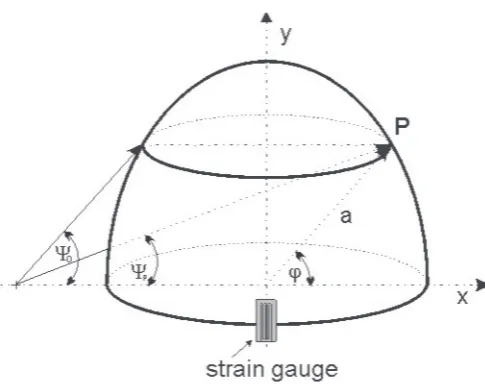
-ing machine TIRATEST at the velocity 20 mm per minute. On the surface of the egg a strain gauge has been glued see Fig. 2. The egg has been loaded by the following way:
- Loading up to 10 N and subsequent unloading - The previous step is repeated for the forces 15, 20,
25, 30 N
- The egg has been loaded up to failure.
In Fig. 3 the record of time dependence of the force
at the top of egg is displayed. The fig. 4. shows the record of the force in the case of the egg failure. The force at the failure is about 49 N. The failure has a form of a thin crack propagation. The record of the strain is displayed in Fig. 5. The record in Fig. 3 cor
-responds to the loading to about 12 N. The egg de
-forms only elastically. The time record of strain in the case of the egg failure is shown in Fig. 6. One may see the release of the strain energy during the failure. In table I the values of maximum strains at the maximum load force F are given. At the same time the values of the egg shortening are also reported. The strain is increasing function of the maximum loading force as shown in Fig. 7. The dependence is linear.
1: Schematic of the eggshell and the used geometry
76 J. Simeonovová, J. Buchar
The shortening of the egg depends on the loading
force linearly as it is documented in Fig. 8. The lineari- ty of this dependence should be verified for another points on the surface of the egg. I: Experimental values of the loading force, strain and egg shortening
FORCE F (N) 12.03 15.26 20.61 25.83 30.91 49.54
STRAIN (x 0.001) 4.32 4.68 5.76 6.96 7.68 9.60
SHORTENING (mm) 0.100 0.127 0.133 0.187 0.222 0.347
3: The experimental record loading force on the time. No damage of the egg occurred.
5: The experimental record of the strain
78 J. Simeonovová, J. Buchar
ThEoRETICAL SoLUTIoN
In the next step we have used the model of the shell loading described in the Chapter 2. The following val
-ues of parameters describing the shape of the egg has been used:
k1= 21.079 mm, k2 = 0.172, k3 = 0.505.
The eggshell has been taken as homogeneous and isotropic. The thickness of the eggshell is 0.35 mm. The elastic properties of the shell are described by the Young`s modulus E and by the Poisson`s ratio ν. The values of these parameters are given e.g. in review paper (Bain,1997). According to the different sourc
In Fig. 9 the dependence of the computed value of
strain on the applied force is plotted. The Young`s modulus is E = 15 000 MPa. It is obvious that the strain increases with the value of the Poisson`s ratio. II: Computed values of strains
FORCE (N) E (Mpa) ν (1) STRAIN (x 0.001)
F = 12.03 N
15 000
0.30 4.28
0.35 4.62
0.40 4.82
25 000
0.30 3.96
0.35 4.15
0.40 4.26
35 000
0.30 3.27
0.35 3.56
0.40 3.98
f = 15.26 N
15 000
0.30 4.35
0.35 4.75
0.40 4.97
25 000
0.30 4.18
0.35 4.42
0.40 4.75
35 000
0.30 4.03
0.35 4.27
0.40 4.51
F = 20.61 N
15 000
0.30 4.82
0.35 5.11
0.40 5.43
25 000
0.30 4.61
0.35 4.93
0.40 5.20
35 000
0.30 4.43
0.35 4.78
0.40 5.07
es the values of E and ν vary in a broad interval. We have performed a serie of computations of the strain values for the given values of the loading force and
80 J. Simeonovová, J. Buchar
9: The dependence of the strain on the applied force . nu denotes the Poisson`s ratio. Young`s modulus E= 15 000 Mpa
In the given figure the experimental values of the strain are also plotted. Very similar results have been obtained for the remaining values of E. The results indicate that the agreement between the used shell theory and experiments is rather poor. The source of the disagreement may consists in the neglecting of the liquid in the eggs and in some possible error of the strain gauges. The used shell theory also neglects some radial distribution of the stress.
CoNCLUSIoNS
In the given paper we have focused on the identi
-fication of the elastic properties of the eggshell. The proposed procedure uses both theory and experi
-ments. The shell theory which has been verified for layered orthotropic shells under static as well as dy
-namic loading is not too convenient for the descrip
-tion of the egg behaviour under static compression. The more detail description of the egg deformation is probably needed. This description should involve a liquid behaviour. This situation cannot be considered in framework of the analytical considerations. Some numerical code should be employed. This research will be content of our forthcoming papers.
SoUhRN
O identifikaci elastických vlastností vaječných skořápek při kvazi statickém stlačování
Práce obsahuje úvodní studii zaměřenou na hodnocení elastických konstant vaječné skořápky při stla
-čování vejce mezi dvěma rovinnými deskami. Postup vychází z výpočtu deformace na povrchu stlačo
-vané vaječné skořápky a následného srovnání vypočtených hodnot s experimentálními. V dané práci jsme provedli měření těchto deformací v jednom bodě při různých úrovních zátěžné síly. Z experimen
-tálních dat vyplývá, že jak deformace, tak velikost stlačení závisí na zatěžující síle lineárně, a to až do okamžiku porušení skořápky. Pro výpočet byla použita relativně spolehlivá teorie skořepiny, které byla ověřena jak pro statické, tak zejména pro dynamické zatěžování. Tato teorie umožňuje získat analytické řešení, a to i pro případ vrstevnaté skořepiny s ortotropními elastickými vlastnostmi. Porovnání expe
vlastností. Hodnoty Youngova modulu a Poissonovy konstanty mohou být určeny jen přibližně s tím, že pro jiné hodnoty zátěžné síly může dojít ke zkreslení velikosti napětí. Přesto bude nutné tuto teorii ově
-řit s tím, že budou provedena měření v dalších bodech a též v dalším směru. Obecně se však ukazuje, že pro detailnější řešení bude vyžadovat numerickou simulaci.
vaječná skořápka, elastické vlastnosti, teorie skořepin, tlakové zatěžování, deformace, lom
The authors would like to express hearty thanks for the financial support under contract MSM: 432100001.
REfERENCES
BAIN, M.: A reinterpretation of eggshell strength. In: “Eggs quality (S. E. Solomon, Ed.), Manson Publishing /The Veterinary Press/ Iowa State University Press, 1997, pp. 131–142.
MANCEAU, J. R. and HENDERSON, J. M.: Physical properties of eggshells. Transactions of the American Society Agriculture Engineering 13: 436, 1970.
REHKUGLER, G. E.: Modulus of elasticity and ultimate strength of the hen`s eggshell. Journal of Agriculture Engineering Research 8: 352–354, 1963.
TUMG, M. A., STALEY, L. M. and HUNT, J.
R.: Estimation of the Young`s modulus and faailure stresses in the hen`s eggshells. Canadian Agricultural Engineering 11: 3–5, 1969.
BARToŇ, S. and KŘIVÁNEK, I.: Determination of
parameters of egg`s perimeterby analysis of digital photography in Maple. Proc. Of the Symposium on the Quality food evaluation, 2001, March 8, Brno. GONG, S. W., TOH, S. L. and SHIM, V. P. W.: The
elastic response of orthotropic laminated cylindrical shells to low velocity impact. Ccomposites Engng 5: 257–275, 1995.
SHIM, V. P. W., TOH, S. L. and GONG, S. W.: The elastic impact response of glass/epoxy laminated ogival shells. Int. J . Impact Engng 18: 633–656, 1996.
Address
Doc. Ing. Jana Simeonovová, CSc. Ústav technologie potravin, Prof. Ing. Jaroslav Buchar, DrSc., Ústav zá