2963
To Study The Effect Of Rice Husk Ash And Iron
Slag On Rigid Pavement
Rabiya Sarwar, Punit Verma, Sandeep Singla, Shakshi Chalotra
Abstract: The present experimental study was taken up in order to enhance the properties of concrete used in rigid pavement and preparing the design mix (control mix as well as replacement mix) of grade M35. The partially replacement of cement with Iron Slag is done at fixed proportion and Rice Husk Ash at varying proportion. As the demand of cement has been increased drastically with the increasing development, the levels of carbon emission has also increases which possess environment threats. Therefore, this research work attempts to replace the cement with Iron Slag and RHA. Various tests like compaction factor test, compressive strength test and flexural strength test was performed. From the obtained results, it can be concluded that from all the replacement mixes, design mix M2 (Iron Slag 30% and RHA 7.5%) was found to be the most optimum proportion at which th e maximum strength parameters were obtained.
Index Terms: Rigid Pavement, Compaction Factor, Compressive Strength, Flexural Strength.
—————————— ◆ ——————————
1.
INTRODUCTION
Concrete is an innovative material which contains fine and coarse aggregate mixed with the cement paste which hardens as the time lapses. Cement is very crucial ingredients as it creates the bond between the various ingredients of concrete. Fine aggregates are used to fill the small voids so that concrete can achieve solid strength whereas, coarse aggregates are used in the concrete mix to attain solid mass and give bulk to concrete. When both the aggregates are mixed with dry cement (ordinary cement or any other cement) and portable water, the mixture forms a slurry concrete. This slurry can be easily transported and poured into the desired mould or shuttering. Then, the slurry concrete tends to set and hardens with the passage of time after reacting chemically. The end result is stone like solid material that has enormous uses in the construction industry. These were the basic ingredients which are being used for normal concrete (M15, M20, M25). Often, for design mix concrete, admixtures and super plasticizers were added in the concrete in order to achieve the target strength and enhance the physical and chemical properties of concrete. These admixtures may increase or decrease the setting time, gives the resistance to particular side-effects of environments etc. In structural members, steel reinforcement bars are often encased in the concrete mass ass the concrete is weak in tension therefore; steel bars impart tensile strength to concrete. Slag is a glass-like by-product which is left behind after the particular metal has been separated (i.e., smelted) from its raw ore. Slag is available in a mixture of silicon dioxide and metal oxides. But, slags may also contain metal sulfides and elemental metals. Apart from being used in the removal of waste in metal smelting, slag can be used differently in many ways like controlling the temperature of the smelting process, controlling the re-oxidation of the fin product obtained just before the molten metal is separated from the furnace. It is a waste-by-product which is obtained by the burning of rice husk. Rice husk is extremely common in regions of Asia because they are the producers of rice and they produce rice on a very large scale. The perfect condition of the cultivation of rice is rich land and tropical climate and it is available in these regions of Asia. The husk of rice is obtained by removing it with farming process before it is being sold in the market. The obtained husk is burnt in the kiln for various beneficial things and then the rice husk ash is used in the concrete industry as a
replacement material. The usage of this material is eco-friendly and efficient in many ways and can be used effectively in concrete with numerous advantages.
2.
OBJECTIVES
The main objectives of this study are listed below:
● To study the combined effect of Iron Slag and Rice-Husk Ash on concrete.
● To partially replace the cement content with Iron Slag (at fixed proportion) and Rice-Husk Ash (at varying proportions).
● To determine the Compressive strength, flexural strength of mix at 7 and 28 days and compaction factor of the concrete obtained with replacement.
● To compare the obtained results and optimum percentage of the various replacement materials.
RESEARCH
METHODOLOGY
After reviewing the literature for the present study topic, a method of systematic approach was developed in order to carry out the objectives of the study. Various steps which were included in the study are as follows:
• The raw material such as cement, Coarse Aggregates, Fine Aggregates etc were collected and their properties were determined with the help of various tests.
• The normal design mix concrete of grade M-35 was designed for the reference point of view as per IS: 10262-1982 without replacing cement and the respective samples were casted and prepared for testing.
• New design mixes were prepared when the cement is replaced with Iron slag (with fixed proportion of 30%) and Rice Husk ash at varying proportions (5%, 7.5%, 10% and 12.5%). Once the required design mix is prepared, then the moulds of various samples were casted and prepared for testing.
• The workable concrete was used to perform the Compaction Factor test and it helps in determining the workability of various concrete mixes.
• The prepared samples were cured at different curing ages i.e. curing at 7 days and curing at 28 days. After curing, the obtained samples were tested for strength parameter (compressive strength and flexural strength).
2964 IJSTR©2019
www.ijstr.org • Then by comparing the results obtained, final outcome of the present experimental study was concluded by suggesting the optimum proportion of various replacement materials.
RESULTS
In present study, the proportion of Iron Slag was kept constant at 30% whereas, the rice husk ash was taken at varying proportion of 5%, 7.5%, 10% and 12.5%. In the end, total 5 mixes were prepared, one control mix and 4 replacement mix.
Table 1. Different Proportions of Iron Slag and RHA.
Design Mix Iron Slag (%) Rice Husk Ash (%)
Control Mix - -
M1 30 5
M2 30 7.5
M3 30 10
M4 30 12.5
COMPACTION FACTOR TEST RESULTS
Compaction factor test is generally performed at laboratory but it can also be performed at the site as well. This test is more sensitive and accurate compared to slump test which is normally used for the concrete which may have low workability or for the concrete which is to be compacted with the help of various vibrators.
Following are the apparatuses which were required in order to perform the test:
• Weighing machine.
• Compaction Factor Test Apparatus (top hopper, bottom hopper, cylinder), trowel, scoop (150mm long), Tamper (dia- 16 mm and length- 600 mm), Ruler etc.
Table: 2. Results of Compaction Factor Test.
Design Mix Compaction Factor
Control Mix 0.91
M1 0.89
M2 0.88
M3 0.85
M4 0.84
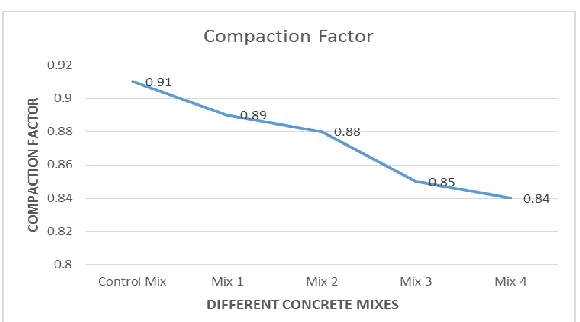
From the results of compaction factor given in the table above, it was observed that Control mix has compaction factor of 0.91
and the value of compaction factor decreases with the addition of replacement material to the concrete mix.
Figure 1. Results of Compaction Factor Test
COMPRESSIVE STRENGTH TEST RESULTS
The samples of size 150×150×150 mm of concrete mix and replacement concrete mix were prepared in the laboratory and tested under Compression Testing Machine (CTM) for their compressive strength. The test samples were prepared as per
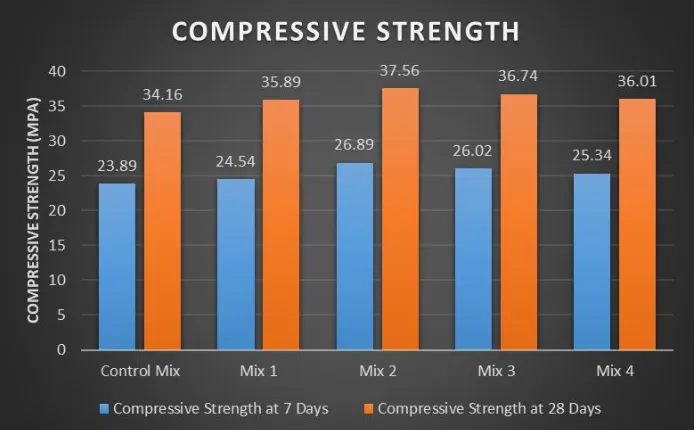
the Indian Standard and after casting, they were left for curing for 7 days and 28 days. Therefore, the results of compressive strength at 7 days and 28 days curing age are represented in the table and graph below.
Table: 3. Compressive Strength Test Results.
Design Mix Compressive Strength (7days) Compressive Strength (28days)
Control Mix 23.89 34.16
M1 24.54 35.89
M2 26.89 37.56
M3 26.02 36.74
2965 Form the table above, it is concluded that with the addition of
waste by-product such as iron slag and rice husk ash, the compressive strength tends to increase till mix M2 and then a
declination in compressive strength can be seen. Therefore, the maximum compressive strength was achieved for the design mix M2.
Figure 2. Compressive Strength Test Results.
FLEXURAL STRENGTH TEST RESULTS
The sample beam size of 100×100×500 mm was moulded and casted of various mixes in order to carry out the flexural strength testing the curing age of 7 days and 28 days. Flexural strength test is a measure of tensile strength of concrete beam
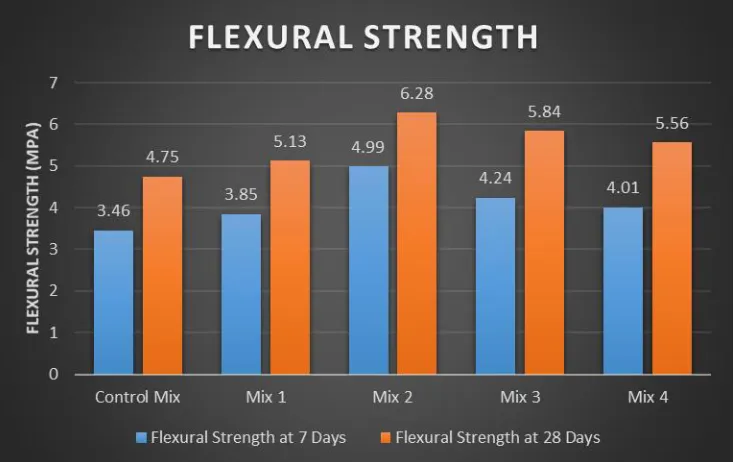
against the failure in bending. It is also called Three-Point flexural test. The results of flexural strength test for various design mixes were recorded and were represented in table and graph below.
Table: 4. Flexural Strength Results.
Design Mix Flexural Strength (7days) Flexural Strength (28days)
Control Mix 3.46 4.75
M1 3.85 5.13
M2 4.99 6.28
M3 4.24 5.84
M4 4.01 5.56
Form the table above, it can be concluded that with the addition of waste by-product such as iron slag and rice husk ash, the flexural strength shows an increase till mix M2 and
after that, it starts falling. Therefore, the maximum flexural strength was obtained for M2 design mix
2966 IJSTR©2019
www.ijstr.org
Figure 3. Flexure Strength Test Results
CONCLUSIONS
The present experimental study was taken up in order to enhance the properties of concrete used in rigid pavement and preparing the design mix (control mix as well as replacement mix) of grade M35. The partially replacement of cement with Iron Slag is done at fixed proportion and Rice Husk Ash at varying proportion. After recording and scrutinizing the results of present study, the following are the final inferences drawn:
● From the results of compaction factor test, it was observed that Control mix has compaction factor of 0.91 and then, the value of compaction factor decreases with the addition of replacement material to the concrete mix.
● Form the results of compressive strength test, it is concluded that with the addition of waste by-product such as iron slag and rice husk ash, the compressive strength tends to increase till mix M2 and then a declination in compressive strength can be seen. Therefore, the maximum compressive strength was achieved for the design mix M2 i.e. 37.56 MPa at 28 days curing Period. Therefore, 3% to 13% increase in compressive strength was seen after replacement. ● Form the results of flexural strength test, it can be
concluded that with the addition of waste by-product such as iron slag and rice husk ash, the flexural strength shows an increase till mix M2 and after that, it starts falling. Therefore, the maximum flexural strength was obtained for M2 design mix i.e. 6.28 MPa at 28 days. Therefore, 10% to 40% increase in compressive strength was seen after replacement. Therefore, from all the replacement mix at different proportions, design mix M2 (Iron Slag 30% and RHA 7.5%) was found to be the most optimum proportion at which the maximum strength parameters were obtained.
REFERENCE
[1] Graciela Giaccio, Gemma Rodrı´guez de Sensale, Rau´l Zerbino (2007). ―Failure mechanism of normal and high-strength concrete with rice-husk ash‖, Cement & Concrete Composites Elsevier Ltd, pp. 566–574.
[2] Mary Vancura, Lev Khazanovich, and Derek Tompkins (2009). ―Reappraisal of Recycled Concrete Aggregate as Coarse Aggregate in Concretes for Rigid Pavements‖ Journal of the Transportation Research Board, pp 149-155.
[3] Chetan Khajuria (2014). ―Use of Iron Slag as Partial Replacement of Sand to Concrete‖, International Journal of Science, Engineering and Technology Research (IJSETR), Volume 3, Issue 6, pp. 1877–1880.
[4] Rohit Kumar, Dr. R.R Singh (2016). ―Study Behaviour Of Concrete After Rice Husk Ash Addition And Its Significance In Road Construction‖, International Research Journal of Engineering and Technology (IRJET), Volume: 03 Issue: 07, pp. 2351–2355.
[5] Gurpreet Singh, Rafat Siddique (2013). ―Strength properties and micro-structural analysis of self-compacting concrete made with iron slag as partial replacement of fine aggregates‖, Elsevier, pp. 144–152. [6] Cherdsak Suksiripattanapong, Teck-Ang Kua, et. Al
(2017). ―Strength and microstructure properties of spent coffee grounds stabilized with rice husk ash and slag geopolymers‖, ELSEVIER, pp. 312–320.
[7] M. Abdullahi, G. O. Ojelade, and S. M. Auta (2017). ―Modified Water-Cement Ratio Law For Compressive Strength Of Rice Husk Ash Concrete‖, Nigerian Journal of
Technology (NIJOTECH
[8] Ujjwal uppal, Er. Preeti Kuhar (2017). ―Effect of Iron Slag Powder On Mechanical Properties of Concrete‖, International Journal of Latest Research In Engineering
and Computing (IJLREC), Volume 5, Issue 3, Page No. 1-4.
2967 Pavements‖, International Journal of Innovative Research
in Science Engineering and Technology. Vol. 7, Issue 2, pp. 1357–1366.
[10] Ankur Mehta (2018). ―Sustainable Geopolymer Concrete using Ground Granulated Blast Furnace Slag and Rice Husk Ash: Strength and Permeability Properties‖, Journal of Cleaner Production, pp. 1–25.
[11] Yamini J. Patel, Niraj Shah (2018). ―Enhancement of the properties of Ground Granulated Blast Furnace Slag based Self Compacting Geopolymer Concrete by incorporating Rice Husk Ash‖, ELSEVIER, pp. 654–662.
[12] Kawade et al., ―Effect of use of Bagasse Ash on Strength of Concrete‖ ISSN: 2319-8753 Vol. 2, Issue 7, July 2013. [13] Kou, Shi-Cong, Chi-Sun Poon, and Miren Etxeberria. "Influence of recycled aggregates on long term mechanical properties and pore size distribution of concrete." Cement and Concrete Composites 33.2 (2011): 286-291.
[14] Kubissa, Wojciech, et al. "Properties of concretes with natural aggregate improved by RCA addition." Procedia Engineering108 (2015): 30-38.
[15] Marcos oliveira de paula.―Sugarcane bagasse ash as a partial Portland cement replacement material,‖ Medellin, September, 2010. ISSN 00127353.
[16] Rajasekar, A., et al. "Durability characteristics of Ultra High Strength Concrete with treated sugarcane bagasse ash." Construction and Building Materials 171 (2018): 350-356.
[17] IS:650-1966; specification for standard sand for testing of cement.
[18] IS:4031(part1 and 2); methods of physical test for hydraulic cement (first edition).
[19] IS:3535-1986; methods of sampling hydraulic cement (first edition).
[20] C.Marthong (2012) ―Effect of rice husk ash as partial replacement of cement on concrete properties. ‖ISSN:2278-0181.
[21] Mehta, P. K. And Pirtz, D. (2000).‖ Use of rice husk ash to reduce temperature in high strength mass concrete‖. ACI journal. S: 10262:2009- Concrete Mix Proportioning – Guidelines.
[22] IS: 456:2000- Plain and Reinforced Concrete – Code of Practice.
[24] P.Padma Rao, A.Pradhan Kumar,B.Bhaskar
Singh,(2014).‖a study on use of rice husk ash in concrete‖.IJEAR