287
Assessment of The Usability of Mobile
Commerce Prototype From The Users
Perspective
Saleh Alqatan, Mohammad H. Alshira'h
Abstract: Despite the M-commerce advantages for Small, Medium, and Micro-Sized Enterprises (SMMEs), especially in the tourism industry, these enterprises have limited access to information on technology adoption. This prevents them from understanding the implications of technology adoption, effective ways of managing competition, determining business and customer needs, and the ability to make strategic and sustainable decisions. This study aimed to develop a tentative design of Tourism M-commerce prototype (TMCP) based on the task-technology fit, perceived usefulness, perceived ease of use, task characteristics and technology characteristics, and to employ SUS and expert review in evaluating the TMCP for determining the factors influencing Mobile commerce. the questionnaire was distributed to the target sample and the obtained data from questionnaires was analyzed through the SPSS statistical software. On the basis of the prototype evaluation results, the proposed model is validated. In this case, the results of the evaluation provided insight into the effect that user acceptance factors have on the level of acceptance of M-commerce among Jordanian SMTEs. The validation also confirmed the relationship between acceptance factors and the acceptance of the M-commerce application among SMTEs. This study opens up opportunities for further studies to use user acceptance theories for system designs in other application domains.
Index Terms: Evaluation, Mobile commerce prototype, Perceived ease of use, Perceived usefulness, Small and Medium-sized Tourism Enterprises, Task characteristics, Technology characteristics , The task-technology fit
———————————————————
1
I
NTRODUCTIONIn the previous decade, development in the tourism and hospitality sectors in light of Information and Communication Technology (ICT) usage has been hailed as one of the significant progresses that occurred. The services that are offered in the tourism sector heavily depend on tourists acquiring information and booking while being geographically distant from their place of visit [1]. It is a widely known fact that ICT offers great benefits for firms to enhance their operations in order to be more effective, efficient, and competitive [2]. Nevertheless, there were not many studies conducted on the ICT practices in the small and medium-sized enterprise (SME) sector, unlike the vast number of researches conducted on large firms [2, 3].Although there are initiatives to employing ICT in developing countries (DC), a large number of businesses in those countries have very limited or no access to technological tools [4, 5]. In the context of developing nations, small and medium-sized tourism enterprises (SMTEs) lack the required skills and resources for the development and maintenance of company websites, although they have increasingly progressive online presence [6]. Through the use of ICTs, tourists and enterprises can communicate effectively, and the enterprises‘ resources and reservations can be managed better. Apart from that, leveraging on emerging technologies, like mobile commerce (M-commerce), may lead to the introduction of online commercial transactions as an option for SMTEs. This allows for customers to interact with the companies in advance of their trip, while decreasing the SMTEs‘ risks [6, 7].Smartphone and mobile apps enable users to scan product codes, confirm and compare prices and buy products online [8]. M-commerce originated from the evolution of the mobile devices usage (e.g., smartphones) [9, 10]. Following ICT, M-commerce has already begun to expand its reach in different sectors [11].
The strength of M-commerce lies in its mobility, where business transactions can be made using mobile devices [10, 12-15]. Mobile applications offer flexibility to users. For example, through mobile technology is now possible to transfer money or pay bills through a mobile device. In addition, similar services can consolidate their transactions into a single application, such as mobile banking and mobile ticketing. Many mobile applications are currently available, including mobile banking, mobile entertainment, mobile information services, mobile marketing, mobile shopping, telematics services, and mobile ticketing [16]. Each of these types is explain as follow: Mobile Banking: There are several options available to consumers for the transfer of money, such as for the purchase of goods or services. Transactions can be made through credit cards, direct mobile billing, and SMS payments.Mobile Entertainment: Mobile entertainment applications allow users to access entertainment, such as music and videos on their mobile devices, and also allows for social interactions with other users, such as chat rooms and online dating.Mobile Information Services: This includes applications that provide up to date information to users, including news, e-mails, travel information, etc.Mobile Marketing: This includes applications that allow companies to interact with customers to increase sales, improve service, conduct market research, or increase customer loyalty. The use of mobile marketing allows companies to market their products or services, while still being inexpensive.Mobile Shopping: Mobile shopping applications allow customers to purchase good through their mobile device. The products that are available for sale are mostly standardised products that are chosen from a mobile catalogue. Products do not have to be digital in nature.MobileTicketing: This application allows tickets that were purchased to be sent directly to the customer‘s mobile device. Often this type of application is integrated to a company‘s promotional or marketing side of the business. Telematics Services: This type of application allows a linkage between information technologies and telecommunication technologies, and is often used in transportation as the Intelligent Transport System (ITS).
____________________________ Saleh Alqatan, Al-Mafraq, Jordan
Mohammad H. Alshira'h, Department of Information Systems, Prince Hussein bin Abdullah Faculty of Information Technology, Al al-bayt University, Al-Mafraq, Jordan
288 This application can offer navigation services and diagnosis,
and access to other types of mobile applications.M-commerce development and proliferation to various fields has been highlighted in studies [17] and it was brought about by the development in mobile applications. Moreover, M-commerce is more appropriate for developing nations with immobile and pricey desktops, and fixed-line infrastructure that is lacking in robustness [18]. In a related study, M-commerce development in the developing nations was evidenced as slow [19] and this urges authors to conduct studies in order to determine the reasons behind such slow development. Particularly, the Arab region is left behind when it comes to M-commerce adoption owing to several reasons [20, 21]. Users surf the net and listen to music through mobile devices and majority of them do not use them to purchase goods/services [22, 23]. Further studies are needed to understand reasons behind low adoption of E-commerce. In this regard, the present study attempts to research on barriers of M-commerce and minimize the gap in literature.
2
T
ECHNOLOGYA
CCEPTANCET
HEORIES/
M
ODELS User acceptance is one of the significant factors of M-commerce development and success in SMTEs. Technology acceptance generally refers to the way people accept and adopt new technology [24]. IS theories and models are developed abundantly [25], as such models provide better insights on the factors influencing consumers‘ adoption of technology. This makes the identification of factors that prevent or drive the adoption and acceptance of new technology a main objective of several studies that have examined user acceptance [26, 27].Therefore, this study adopts a substantive theory to explain the behavioural intention of users in SMTEs in developing countries, with the main variables being intention to use and actual use [25, 28]. The theoretical model of user‘s acceptance of IS is presented inFigure 1.
Fig. 1. Theoretical model on user acceptance of information
technology
The IT use in predicting appropriate behavior may be invaluable in predicting actual use and ultimately, adoption of technology. Many models have been brought forward in order to determine the intentions and behavioral intentions towards use of technology. Under this section, the technology acceptance theories and models are presented and discussed, in particular the following theories:
I. Technology Acceptance Model (TAM). II. Task-Technology Fit (TTF) Model.
These models and theories are developed in different contexts with the aim of providing a deeper understanding of user‘s acceptance, adoption and use of new technologies. The following subsections provide a discussion of some of the models.
2.1 Technology Acceptance Model (TAM)
TAM refers to a model whose primary purpose is to predict the intention of the user to use specific technology [13]. In addition to this, TAM is the most extensively employed model for studying technology and E-commerce adoption in prior studies that focused on consumer‘s behaviour in online shopping [29]. TAM has been acknowledged in terms of its validity and reliability to shed light on technology acceptance and use, and examined in different situations and samples.TAM is highly dependent on other factors in determining behavioural intention (i.e., perceived ease of use and perceived usefulness) (refer to Table 1).
TABLE 1 DEFINITIONS OF THE CONSTRUCTS IN TAM [30]
Variable Describe
Perceived usefulness
The level to which an individual is convinced that a specific system use would contribute to enhanced job performance.
Perceived ease of use
The level to which an individual is convinced that a specific system use would be effortless or effort-free. Attitude toward
using the system
The level of evaluative impact that an individual relates with the use of a specific system in his job tasks.
Studies in literature [31, 32], contended that additional factors or IT acceptance models should be integrated with TAM to enhance its function. Several studies have extended and modified TAM to explain acceptance of new technology. TAM is extensively used in studies because of its parsimonious, IT-centered design that clearly explains the prediction of various user populations‘ acceptance of different IT tools in organizational contexts [33, 34]. SMMEs have to adopt M-commerce for their reconstruction. Therefore, TAM can identify potential factors to influence the reconstruction. Continues usage of the technology would enhance efficiency of SMMEs in the long-term [35]. It is important to determine relevant variables of TAM that are acknowledged by suppliers. This will highlight if the models fall short of providing M-commerce perspectives [36]
2.2 Task-Technology Fit (TTF) Model
289 Fig. 2. Task-technology fit (TTF) model[38]
The model applicability to a specific technology can be determined by examining the potential user‘s tasks and conducting an analysis of the support of technology towards the tasks, following which a match between technology, tasks and the fit outcome (use) can be gauged [38]. The TTF model constructs along with their definitions are tabulated in Table 2.
TABLE 2 CONSTRUCTS OF THE TTF MODEL [38]
Variable Describe
Task characteristics
Tasks are described as the individual‘s actions involved in the transformation of inputs into outputs and they are characterized by factors that may motivate a user to be dependent on certain IT aspects.
Technology characteristics
Technologies are described as the level to which a technology assists in the performance of the individual‘s task.
Task-Technology fit
Fit between task and technology refers to the level to which technology assists in the performance of the task.
Utilization Utilization refers to the behavior of technology use in task performance.
Performance impact
Performance impact is linked to achieving the task portfolio of the individual.
More importantly, the validity of the TTF has been, time and again, evidenced by several authors [40, 43]. Studies integrated and tested TTF and process virtualization theory [44] , in light of learning management systems evaluation [45], or by examining its role in boosting user‘s ongoing use of the system [46]. It is important for mobile technologies to provide users with information whenever and wherever they require it [47]. In this regard, technologies are considered as tools employed to carry out tasks. [48] stated that in IS research, technology is described as mobile systems (hardware, software, and data) and user support services including training and helplines assist users to conduct their tasks. Tasks refer to the actions conducted by individuals in transforming inputs into outputs. [48] added that task characteristics should enable user to depend more on IS. Although the TTF model is not particularly designed for IS acceptance like E-commerce or M-commerce, it is still successful in its derivation of a new range of variables that could contribute to the understanding of the IS acceptance among consumers. The TTF model and its variables of task and
technology characteristics have produced clear information on factors driving IS acceptance or the gaps in IS acceptance throughout countries [49]. Along a similar line of study, the factors that moderate the relationship of other factors have been considered in the Unified Theory of Acceptance and Use of Technology (UTAUT) [25] as well as in the model‘s later version (UTAUT2) [50], when examining the IS acceptance were inconclusive and failed to differentiate consumers‘ IS acceptance in E-commerce in different countries [49]. According to Kim, et al. [51], the task-technology fit has a positive relationship with perceived ease of use and perceived usefulness in the hotel IS case. The use of task-technology fit theory in mobile IS requires the consideration of the mobility of user [43]. Successful technology usage depends on the fit with the task that it is applied on and on a wireless environment, as this requires information concerning the location (Junglas et al., 2008). In this regard, the mobile devices‘ geo-location abilities enable mobile shoppers to look for offers in their areas and save not only time but also effort indicating the match between technology and task [52].User acceptance models should not only analyse factors influencing user acceptance, but should also provide guidance on how to design a specific application. Researchers are interested in explaining why a system is acceptable or unacceptable to a set of users, and also understanding how to design applications using user acceptance factors. Based on the literature review, many previous researches identified the role of M-commerce acceptance factors, but not how these factors can improve M-commerce applications. The use of acceptance models to guide system design and development has not been substantially explored [53, 54]. Several researchers [25, 50] pointed out that despite their predictive capability, user acceptance models provide support to guide design application and implementation, such as mobile banking applications [55] and electronic government systems [56]. Further studies are needed to examine the literature gap and mitigate it and thus, in the present study, the issue is addressed by determining the way user acceptance factors predict the design and development of M-commerce applications, specifically for SMTEs. Such a feat can make sure that M-commerce acceptance is accepted among SMTEs in the developing nation‘s case. The study also attempts to conduct an evaluation of the tourism M-Commerce model effectiveness by examining a prototype developed for the same purpose.
3
R
ESERCHM
ODEL290
Fig.3. The Tourism M-Commerce model
4
P
ROTOTYPINGM
ETHODOLOGYGenerally speaking, prototyping involves four major processes namely, designing, implementing, testing and operating. In the first phase, the prototype is drawn and given with a preliminary shape, size, color as well as other features and in the second phase, the prototype is developed from the materials that the design require. This is followed by the third phase, which involves testing the prototype to ensure its readiness and
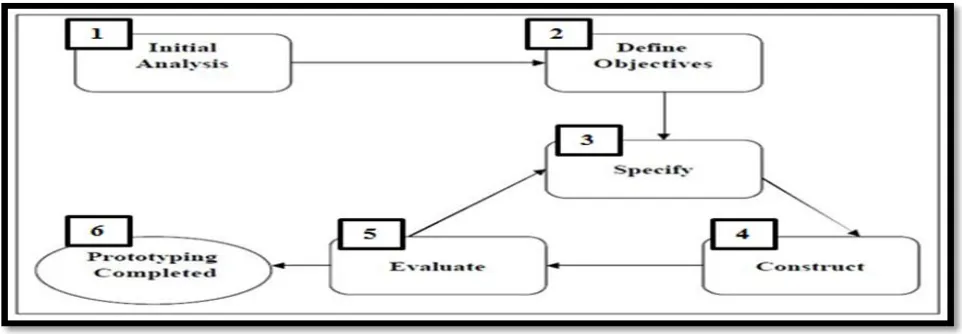
effectiveness for use. The final phase involves the operation of the prototype to test its operation effectiveness. In relation to the above, Bennett, et al. [58] brought forward a conceptual framework known as the system of lifecycle prototyping, wherein which the cycle has six phases (refer to Figure 4).
Fig. 4. A Prototyping Life Cycle
4.1 Initial Analysis
This step determines the prototype development requirements and the focus of the designers is laid on the objective of the prototype. The requirement for more research prompted this study to make use of explorative method for the determination of the drivers of successful prototype application creation on M-commerce for SMTEs and they include, perceived ease of use, perceived usefulness, task characteristics, technology characteristics and the task-technology fit.
4.2 Defining Prototype Objectives
The second phase involves the software development phase, also known as the requirement analysis phase, which is an activity characterized by the consumption of resources. In this phase, the user‘s needs and requirements are determined. This is because prototype development based on ambiguous objectives will lead to misevaluation of processes, as a result
of which difficulties will arise [58]. This study presents a prototype with the aim of highlighting the elements of the proposed tourism M-commerce model in its initial design in order to guide the development of an integrated system of M-commerce tourism that is applicable among SMTEs.
4.3 Specifying Prototype
Despite that fact that a prototype is only for temporary use, it is important to include the entire features in order to freely gauge required modifications later after the final product development. After the objective and the specifications of the prototype are established, it is further evaluated for the required modifications.
4.4 Constructing Prototype
291 the users [59]. Prototypes are of two primary types namely,
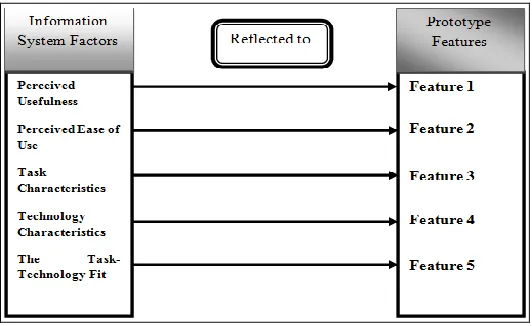
low-fidelity and high-fidelity prototypes. The low fidelity prototype is selected in this study owing to its low and reasonable cost and the capability of evaluating other alternatives to it. The prototype design was created based on the proposed tourism M-commerce model, indicating the significant effect of factors on the acceptance of tourism M-commerce applications. The prototype included all the factors to be evaluated and validated for user acceptance.Prior literature evidenced a significant relationship between user‘s acceptance factors and the features of the prototype and they validated the key role of the features as predictors of the perceptions and acceptance of users in various scenarios, situations and locations [53, 55, 56, 60, 61]. This stage calls for the user‘s requirements as factors transformed into prototype features and developed according to Figure 5.
Fig. 5. User Acceptance Factors Reflected on Features in the
Application Design
The reflection process has its basis on thenotion that optimal function of the user‘s acceptance tests analyzes factors affecting user acceptance and in guiding design and development of a specific application. In fact, technology acceptance models/theories primarily aim to provide an insight into the acceptance of the user ensured through the design application aside from determining and confirming user acceptance factors as determinants of user behavior and use intention [25]. This study found that user acceptance factors namely, perceived ease of use, perceived usefulness, task characteristics, technology characteristics and the task-technology fit have positive and significant effect on behavioral intention towards M-commerce usage among SMTEs. The factors were integrated into the prototype as explained in Table 3 but because the prototype is incomplete as a system, only some IS factors features were presented.
Table 3 KEY INDICATORS FOR THE USER ACCEPTANCE IN THE DEVELOPMENT OF PRELIMINARY PROTOTYPE OF TOURISM M-COMMERCE
Author(s) & Year IS Factor Measurement Item
Bauerfeind, 2003; Baierova
et al., 2003 Perceived Usefulness (PU)
-
Content Quality-
Content Presentation-
LayoutHasan, 2014 Perceived Ease of Use (PEOU)
-
Quick Downloading of Web Pages-
Easy Interaction with a WebsiteWells et al., 2003; Shen and Chuang, 2010; Palmer, 2002; Zhang, 2001
Perceived Task-Technology Fit (PTTF)
-
Content-
Interactivity Fang et al., 2003; Adya andLusk, 2012; Andreou et al., 2005; Chou, 2006
Task Characteristics (Tas_C)
-
Simple Task-
Playfulness Adya and Lusk, 2012; Fanget al., 2003
Technology Characteristics (Tac_C)
-
Integrated Product Or Service Information-
AvatarsThis phase comprises of two sub-phases; first, designing architecture and second, rapid development. The initial application development calls for the use of rapid development tools, which are:Program Design – the initial system involves internet-based prototyping solutions that are built on the Word Wide Web browsers, employing PHP and Android software. Proposed User Interface – a combined version of Macromedia Dreamweaver MX, Adobe Photoshop, Genymotion, Flash,
292 4.5 Evaluate prototype and recommended changes
The empirical evaluation of prototypes can be conducted [62] and the testing uses actual users in order to assess the system‘s usability and acceptability [63].Therefore, it is a must to test the actual user‘s use of the system so that their acceptance and adoption of the new application can be assessed. This stage reviews on the initial M-commerce tourism application based on the users in SMTEs. The prototype‘s primary aim is to examine the proposed system aspects and therefore, it has to be evaluated based on the objectives of the system. Failure to meet the objectives would need modifications and the final three phases are repeated over and over until the meeting of the objectives.
5
P
ROTOTYPINGM
ETHODOLOGYT
OURISMM
OBILEC
OMMERCEP
ROTOTYPED
ESIGNThe process of prototype design entails a conceptual design and physical design [64], and one of the top critical phases of design is the development of new ideas that satisfies the specifications enumerated.
5.1 Conceptual design
The conceptual design is the initial step in prototype building and within this stage, a conceptual model is generated which describes the product, its performance and its appearance [55]. An effective conceptual model is one that is clear to and is suitable for the user [65]. The Use-Case Diagram can be generated in the conceptual design stage to demonstrate and explain the developed software [66]. Based on the user‘s perspective, the Use Case Diagrams indicate the application functions that can be made use of [67]. Use case refers to the set of user-system interactions to carry out a specific purpose, with the user specifying the role of each. Initially, use case was employed in developing object-oriented software, after which it was used to create innovative product designs by concentrating on the user experience design [68]. This study made use of use case diagram to demonstrate the employees‘ interactions with the system and the tourists as users. The use case diagram of the prototype for SMTEs employees is depicted in Figure 6, while that for tourists is depicted in Figure 7.
293
Fig.6. Use Case Diagram of the Prototype for Tourist
5.2 Physical design
The physical design differs from the conceptual design as the former encapsulates certain product features in-depth [65]. Features in the physical design are; appearance and colors, auditory characteristics, images, icons, and menu design [64]. This phase of development ensures that the system and design of the interface provides certain information that is needed for the creation of an effective system [66]. This study indicates that factors significantly influencing user behavioural to use M-commerce prototype. The following features are included in the proposed prototype:Perceived usefulness is the first IS factor in the prototype. Davis [69] referred to perceived usefulness as ―the degree to which a person believes that using a particular system would enhance his or her job performance‖. The features of usefulness stemmed from the literature and it was revealed that in order to satisfy the needs of users, an application has to be useful in content quality and presentation
294
Fig. 7. Perceived usefulness in the tourism M-commerce prototype
Perceived ease of use was reflected as the second important IS factor in the prototype. This feature describes the amount of effort required by the user to user a website, as well as the presence of information that makes communication between customers and the company simple and effective [72]. Ease of use comprises of two subcategories, including quick downloading of web pages and easy interaction with a website [72]. Interaction with the tourism M-commerce prototype is easy for different groups of users (employees in SMTEs and tourists). This prototype consists of interrelated parts in the design of the proposed prototype, namely a part for the SMTE enterprises‘ (Part I), and another part for tourists (part II). All the elements that form the interface are developed to bring about the customer-application interaction. Furthermore, our application is able to provide service and information by SMTEs in a timely manner for customers. Moreover, the download time of the pages is suitable in the tourism M-commerce prototype.The third IS factor reflected in the prototype is task-technology fit
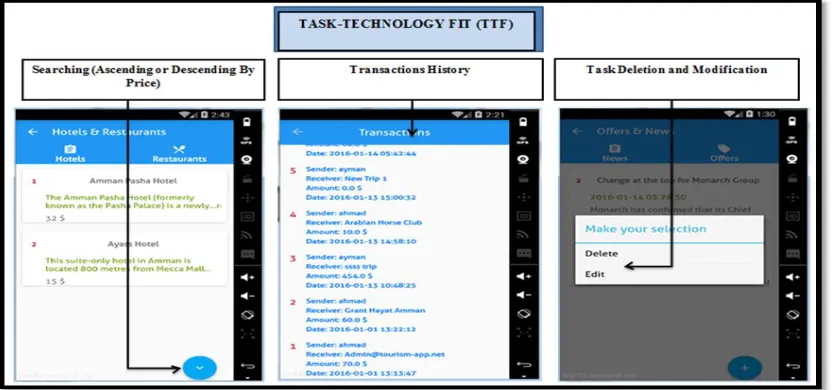
(TTF). TTF is an established theoretical framework in information system research that enables the investigation of issues based on the fit of technology to tasks as well as performance. According to Wells, et al. [73], content and interactivity dimensions reflect TTF within websites or applications.Several content features stand out when seeing the content from within the information system design context, such as relevant information and complete information. Moreover, for the latter, Palmer [74] and Zhang [75] contended that it is necessary to support the ability of the customer to search for information and to receive effective support after purchasing the tourism M-commerce prototype. In relation to this, Shen and Chuang [76] described machine interactivity as the level that users can take part in tweaking the form and content of a mediated environment in real time using the tourism M-commerce prototype, where SMTE employees can perform their task (add, delete, view and edit) by using their mobile at anytime and anyplace, as shown in Figure 8.
295 The fourth and fifth IS factors that were reflected in the
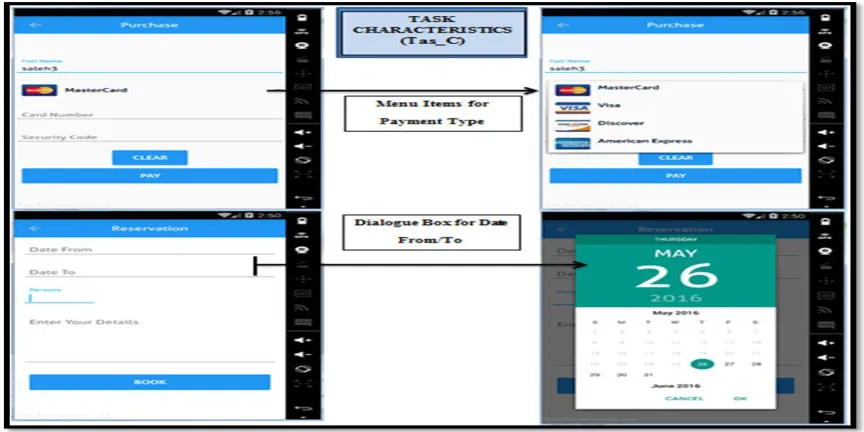
prototype are task characteristics and technology characteristics. From the TTF point of view, tasks refer to actions carried out by individuals in transforming inputs into outputs in an attempt to meet information requirements [38]. In regards to this, task characteristics refer to those that a user may perform through the use of IT. Tasks are gauged through different dimensions, such as playfulness and simplicity of tasks within websites or applications [77, 78]. In the proposed prototype, task characteristics are represented by simple tasks and playfulness as crucial characteristics that encourage the acceptance of the tourism M-commerce application. Magazine [79] revealed that the interface components are effective ways
to lessen perceived complexity, as users will easily get used to the application and won‘t have extra expectations. In this context, features can improve a product only if the users are in need of them. In most instances, the dissemination of features can represent complexity with additional icons, such as menu items, toolbars, and dialogue boxes, as these features may prevent the prototype‘s efficient and productive performance. In the tourism M-commerce application, the task of payment or making reservations for trips, hotels and restaurants are simple and not very complex, and can be completed by providing icons, menu items, toolbars, and dialogue boxes (refer to Figure 9).
Fig. 9. Task characteristics in the tourism M-commerce prototype
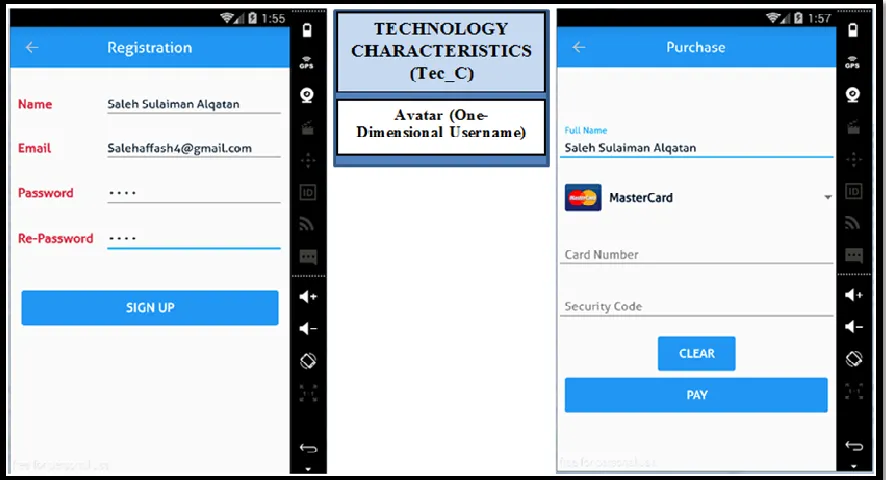
Playfulness is considered to be a feature that needs examination to determine whether or not an the application needs it and to what level. It is notable that playfulness is a critical success feature for particular mobile applications [80]. According to Chou [81], in the context of the mobile information system, playfulness is an important feature to motivate customers to accept and use a system or application, as it plays a role when customers are in the process of searching for information within website or application (refer to Figure 8). The TTF model takes into consideration the significance of aligning functionality and attributes of technology employed to the needs of individuals. The constructed technology attributes are those that users deem as important for portable reading device usability. Technology characteristics are often measured in terms of integrated information and avatars within websites or applications [82].Finally, technology characteristics refer to the level that tourism information that is provided by the application is well-integrated. As such, integrated information plays a part
296
Fig. 10. Technology characteristics in the tourism M-commerce prototype
6
P
RROTOTYPEE
VALUATIONThere are three primary reasons mentioned by Preece, et al. [85] as to the necessity of the evaluation phase for usability testing, the first being to understand the way users use technology. The second reason lies in the knowledge of differences and similarities between on prototype to the next and the third reason is to guarantee that the prototype meets a standard level. Steps are taken to verify and validate the prototype during the development phase. For verification, the prototype built is tested for its accuracy, coherence, preciseness and its meeting of specifications. For validation, the prototype is tested for its applicability and its capability of satisfying the desires and aspirations of the user. The latter is generally carried out following the development process to make sure specific desires and requirements of the prototype are met [86]. The verification and the validation (V&V) process is carried out by a system tester rather than the developer, and it calls for a sequence of technical and managerial tasks assisting to make improvements to the system quality and reliability [87]. V&V also ensures the satisfaction of the user requirements and needs and without verifying the system, critical errors may arise in the case representations. Also, without validating the system, the system‘s decision making may not match that of the needs of the user [86]. Therefore, validation was conducted in this study by inspecting if the functionalities required by the SMTEs are present in the tourism M-commerce prototype and verification was conducted to examine the conformity of the prototype to the requirements enumerated in the earlier phase.
6.1 Verification
During software development the documents and files have to be manually checked to verify the design code [86]. Verification refers to a set of procedures carried out to make sure that the software in any development stage meets the needs enumerated in the earlier stage [88]. A general verification method is the software review, where the product specifications are compared to the requirements of the product and it highlights the presence of any gap. Verification mainly identifies
and resolves any errors, preventing failure in the later stages [88]. Also, the expert review is a general and reliable method used to verify new research and development initiatives [89, 90] and it involves professionals with specific expertise to review the interface design. The primary objective is to review and test the system and pinpoint potential problems [91]. The panel of experts‘ discussion also assists in mitigating any potential issues between the major stakeholders and in recognizing potential issues that the user may face [92]. Therefore, a minimum of three experts is recommended for the review, all of which are experts in similar fields [93].In this study, an expert review was conducted to verify the prototype in light of its meeting of requirements that were listed in the initial phase. There were two experts involved from the Department of Software Engineering, Kuala Lumpur Infrastructure University College (KLIUC), and from Al Al-Bayt University, Jordan.
6.2 Validation
297 projects using SUS with coefficient alpha of 0.91, which shows
that SUS has a high reliability when used with any user interface software.In a study of the same caliber, Tullis and Stetson [97] conducted a comparison among five questionnaires assessing the usability of the website, and the questionnaires included, System Usability Scale (SUS), Questionnaire for User Interface Satisfaction (QUIS), and Computer System Usability Questionnaire (CSUQ). The last mentioned questionnaire is a variant of the Microsoft product Reaction Cards, which the company has been using in their usability lab for several years. The study found that SUS (consisting of 10 rating scales), generated one of the top dependable and accurate outcomes throughout a range of samples. SUS is also the only questionnaire whose questions focused on the different users‘ reactions to the whole website. The authors reached to the conclusion that sample sizes from 12-14 participants called for accurate outcomes [55, 98]. More importantly, the SUS is characterized by an easy to use scale that provides extensive picture of the objective of the usability assessments and it has been called as a cheap and effective tool used to assess prototype/system usability [97]. The SUS usage can enable respondents to reply to the questions easily, collection of data that can be quickly analyzed and calculated and evaluation of many IS types. It also matches the Likert scale as it depends on close-ended items, where statements vary from agreement to disagreement, measured on a 5-point Likert scale [99, 100]. The sample individuals should answer each SUS statements by agreeing or disagreeing to them. This section presents several SUS samples. It is notable that that the selected statements encapsulate an extensive range of system usability aspects such as, necessity for support, training and complexity. The scales have high face validity levels to gauge the usability of the system [99]. Table 4 presents the initial SUS part.
TABLE 4 THE SYSTEM USABILITY SCALE (SUS) [101]
SUS Questions
Strongly Agree > strongly Disagree 1 2 3 4 5
1 I think that I would like to use this
prototype frequently.
2 I found the prototype unnecessarily
complex.
3 I thought the prototype was easy to
use.
4
I think that I would need the support of a technical person to enable me to use this prototype.
5 I found the various functions in this
prototype to be well integrated.
6 I thought there was too much
inconsistency in this prototype.
7
I would imagine that most people would learn to use this prototype very quickly.
8 I found the prototype very
cumbersome to use.
9 I felt very confident using the
prototype.
10 I needed to learn a lot of things before
I could get going with this prototype
SUS measures the usefulness, ease of use and the attitude of the client but the researcher selected to add 12-item scale to measure the TAM and TTF factors in the proposed prototype.
The items were developed and adapted from the main questionnaire that was used to measure the factors impact on the user‘s behavioural in using M-commerce prototype. This approach is supported by ayyash [56] and Alafeef [55]. Table 5 contains the second part of the questionnaire.
TABLE 5 THE SECOND PART OF EVALUATION QUESTIONNAIRE
Construct Items
Perceived Task-Technology Fit (PTTF)
PTTF1 This prototype supports me in finishing my tasks in a timely manner.
PTTF2 This prototype supports me in sharing task information with other tourism workers.
Task Characteristics (Tas_C)
Tas_C1 This prototype is very important for me to take required urgent action in a timely manner.
Tas_C2 This prototype allows me to share task information with co-workers when I need.
Technology Characteristics (Tec_C)
Tec_C1 This prototype provides timely notification of urgent interventions that are required.
Tec_C2 This prototype effectively enables the easy sharing of data with other tourism workers.
Perceived Usefulness (PU)
PU1 This prototype is useful for my job performance. PU2 This prototype supports me in attaining my overall
performance goals.
Perceived Ease of Use (PEOU)
PEOU1 I think that learning to use this prototype would be easy. PEOU2 I expect to become or I am already skilled at using this
prototype.
Behavioural Intention (BI)
BI1 I will use this prototype on regular basis in the future. BI2 I will strongly recommend others to use this prototype.
7.
P
ROTOTYPEE
VALUATIONR
ESULTSUnder this section, the results obtained from evaluating the tourism M-commerce prototype are presented and discussed. There are two parts to this evaluation results; first verification results and second, validation results.
7.1 Analysis of Verification Results
298 TABLE 6 VERIFICATION RESULTS
Factors Features
Expert 1 Expert 2 Expert 3 Answer Answer Answer No Ye
s No Yes No Yes
Perceived Usefulness
Content Quality √ √ √
Presentation Quality √ √ √
Perceived Ease Of Use
Simple Communication With
Website √ √ √
Contact Us Information √ √ √
Perceived
Task-Technology Fit
Content (The Ability Of Users
To Search the Information) √ √ √
Interactivity (The Ability Of Users To Edit The Information Within The Application)
√ √ √
Task Characteristics
Simple Task √ √ √
Playfulness √ √ √
Technology Characteristics
Integrated Information √ √ √
Avatars √ √ √
Table 6 shows the results of the verification test for the tourism M-commerce model, in terms of system usefulness, ease of use, task-technology fit, task characteristic, and technology characteristics. The evaluators noted that the prototype provided useful content quality and presentation quality, and was relatively easy to use, as it provided users with the ability to communicate with the company through the website. The prototype also met the requirements of M-commerce technology and SMTEs tasks through content (the ability of users to search the information), interactivity (the ability of users to edit the information within the application), simple tasks, playfulness, integrated information, and the use of avatars.However, expert recommendations after the testing called for future improvements in the tourism M-commerce prototype application, with the following comments: " avatars were not clear on the tourism M-commerce prototype as a feature for technology characteristics".
7.2 Analysis of Validation Results
For validation, questionnaires were distributed to 22 employees in the SMTEs for their feedback and the sample units were selected from the main sample used for the actual survey. The evaluation helped in the examination of the users‘ attitude towards the tourism M-commerce prototype.
7.2.1 Demographic Profile
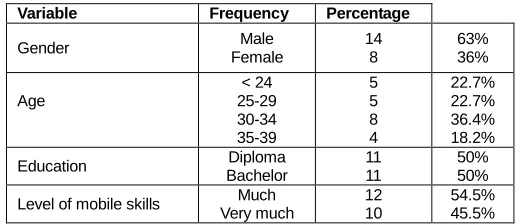
The SMTEs employees requested to evaluate the tourism M-commerce prototype, as respondents, had different ages, gender, education backgrounds and mobile skills levels. Table 7 tabulates the demographic profile of the respondents.
TABLE 7 DEMOGRAPHIC PROFILE
Variable Frequency Percentage
Gender Male
Female
14 8
63% 36% Age
< 24 25-29 30-34 35-39
5 5 8 4
22.7% 22.7% 36.4% 18.2%
Education Diploma
Bachelor
11 11
50% 50% Level of mobile skills Much
Very much
12 10
54.5% 45.5% Table 7 shows that majority of the respondents (63%) were male respondents, while the rest (36%) were female respondents. In addition, with regards to their education level, the respondents were split into two equally, 50% were bachelor students and 50% were diploma students. Majority of them had high mobile skills levels (54.5%), while the rest had medium skills (45.5%). The questionnaire had six parts, within which items are listed that were adapted from different sources for data collection regarding SUS, PU, PEOU, PTTF, Tes_C, Tec_C and BI. Each variable was run through descriptive statistics and the results are discussed in this section.
7.2.2 System Usability Scale (SUS)
299 TABLE 8 MEAN FOR SUSQUESTIONS
Item Mean Standard
Deviation I think that I would like to use this prototype
frequently. 1.8182 .795
I found the prototype unnecessarily complex. 3.4091 1.259 I thought the prototype was easy to use. 1.5000 .511 I think that I would need the support of a
technical person to enable me to use this prototype.
1.5455 .670 I found the various functions in this prototype
were well integrated. 1.4545 .509
I thought there was too much
inconsistency in this prototype. 3.7273 1.120 I would imagine that most people would learn
to use this prototype very quickly. 1.4091 .590 I found the prototype very cumbersome to
use. 3.7273 1.241
I felt very confident using the prototype. 1.5455 .509 I needed to learn a lot of things before I could
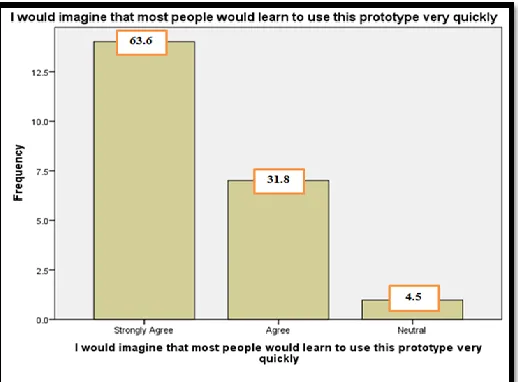
go with this prototype. 3.8182 1.139 Table 8 indicates that the mean ranges are from 1.4091 to 3.7273, with standard deviation values ranging from 0.509 to 1.259. The findings show that the respondents‘ considerations are useful. The highest mean was obtained by the statement, ―I would imagine that most people would learn to use this prototype very quickly‖, while the lowest mean was obtained by the statement, ―I found the prototype very cumbersome to use‖ (refer to Figure 11 and 12). It can thus be concluded that users used and tested the prototype and found it to be devoid of complexity, particularly the feedback portion, which ensures quick learning.
Fig. 11. Statistics Bar Chart of SUS7
Fig. 12. Statistics Bar Chart of SUS8
I. Task-Technology Fit (TTF)
TTF concerns the reaction of user on using the system. Table 9 presents the TTF results. We can notice that mean ranges from 1.5909 to 1.9091 and standard deviation ranges from .426 to .734 from Table 9. Based on these findings, we can conclude that users are satisfied with the prototype.
TABLE 9 MEAN FOR TTF QUESTIONS
Item Mean Standard
Deviation
This prototype supports me in finishing my
tasks in a timely manner. .5909 .734 This prototype supports me in sharing task
information with other tourism workers 1.9091 .426 The question ―This prototype supports me in finishing my tasks in a timely manner‖ has the highest mean of 1.5909 (refer to Figure 13).
300 II. Task Characteristics (Tes_C)
Table 10 presents Tes_C results on the concern of user‘s reaction on the system. From Table 10, we can notice that mean ranges from 1.6364 to 1.4545 and standard deviation ranges from .509 to .902. Based on these findings, we can conclude that users are satisfied with the prototype.
TABLE 10 MEAN FOR TES_C QUESTIONS
Item Mean Standard
Deviation
This prototype is very important for me to take
required urgent action in a timely manner. 1.6364 .902 This prototype allows me to share task
information with co-workers when I need. 1.4545 .509 The question ―This prototype allows me to share task information with co-workers when I need‖ has the highest mean of 1.4545 (refer to Figure 14).
Fig. 14. Statistics bar chart of Tes_C2
III.Technology Characteristics (Tec_C)
Table 11 presents Tec_C results on the concern of user‘s reaction on the system. From Table 11, we can notice that mean ranges from 1.6818 to 1.5000 and standard deviation ranges from .567 to .801. Based on these findings, we can conclude that users are satisfied with the prototype.
TABLE 11MEAN FOR TEC_C QUESTIONS
Items Mean Standard
Deviation
This prototype provides timely notification of
urgent interventions that are required. 1.6818 .567 This prototype effectively enables the easy
sharing of data with other tourism workers. 1.5000 .801 The question ―This prototype effectively enables the easy sharing of data with other tourism workers‖ has the highest mean of 1.5000 (refer to Figure 15).
Fig. 15. Statistics bar chart of Tec_C2
IV.Perceived Usefulness (PU)
PU concerns on how system can be advantageous to users, as well as how the system assists users in obtaining required information. Table 12 presents the usefulness results. From Table 12, we can notice that mean ranges from 1.7727 to 1.8182 and standard deviation ranges from .664 to .751. Based on these findings, we can conclude that users considered the prototype to be useful.
TABLE 12 MEAN OF PU QUESTIONS
Item Mean Standard
Deviation
This prototype is useful for my job
performance. 1.7727 .751
This prototype supports me in attaining my
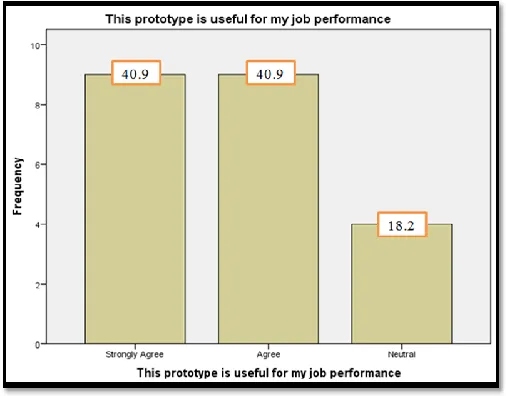
overall performance goals. 1.8182 .664 The question ―This prototype is useful for my job performance‖ has the highest mean of 1.7727 (refer to Figure 16).
Fig. 16. Statistics bar chart of PU1
V. Perceived ease of use (PEOU)
301 as how the system can be understandable and clear in terms of
interaction. Table 13 presents the PEOU results. From Table 13, we can notice that mean ranges from 1.5455 to 1.5909 and standard deviation ranges from .670 to .796. Based on these findings, we can conclude that user considered the usage of ease of use prototype.
TABLE 13 MEAN OF PEOU QUESTIONS
Item Mean Standard
Deviation
I think that learning to use this prototype would be easy.
1.545
5 .670
I expect to become or I am already skilled at using this prototype.
1.590
9 .796
The question ―I think that learning to use this prototype would be easy‖ has the highest mean of 1.5455 (refer to Figure 17).
Fig. 17. Statistics bar chart of PEOU1.
VI.Behavioural intention (BI)
BI concerns the behavioural intention to use the system in future as well as how the system can be recommended and intended in terms of behaviour. Table 14 presents the BI results. From Table 14, we can notice that mean ranges from 1.7727 to 1.3636 and standard deviation ranges from .726 to .869. Based on these findings, we can conclude that user intends to use this prototype.
TABLE 14 MEAN OF BI QUESTIONS
Item Mean Standard Deviation
I will use this prototype on regular basis
in the future. 1.7727 .869
I will strongly recommend others to use
this prototype. 1.3636 .726
The question ―I will strongly recommend others to use this prototype‖ has the highest mean of 1.3636 (refer to Figure 18).
Fig. 18. Statistics bar chart of BI2.
8
C
ONCLUSION302 better comparison of results. This study also suggests that
future studies evaluate the TMCP with other methods aside from SUS questionnaire (e.g., interview) for thorough evaluation.
9
R
EFERENCES[1] N. Scott, S. Burgess, A. Monday, P. O‘Brien, R. Baggio, C. Sellitto, and D. Bank, "Helping tourism SMEs plan and implement information and communication technology," 2010.
[2] H. A. Ashari, M. Heidari, and S. Parvaresh, "Improving SMTEs‘ business performance through strategic use of information communication technology: ICT and tourism challenges and opportunities," International Journal of Academic Research in Accounting, Finance and Management Sciences, vol. 4, pp. 1-20, 2014. [3] K. Nuamah-Gyambrah, F. Agyeiwaa, and M. O. Offei.
(2016, Role of ct in the survival of small and medium scale enterprises in ghana evidence from selected small and medium scale enterprises in new juaben municipality koforidua. 21. Available: https://arxiv.org/ftp/arxiv/papers/1603/1603.02900.pdf [4] . Mpiti, "The potential use of ICT to enhance
agritourism in Lesotho," presented at the Information and Communication Technologies in Tourism 2014, Dublin, Ireland, 2014.
[5] R. Tembo, "Information and communication technology usage trends and factors in commercial agriculture in the wine industry," Msc, The Faculty of Business, Cape Peninsula University of Technology, South Africa, 2008.
[6] v. Hooft, "Towards an ICT framework for sustainable tourism," MSc, Information Science, Radboud University, Netherlands, 2010.
[7] J. Donner and C. A. Tellez, "Mobile banking and economic development: Linking adoption, impact, and use," Asian journal of communication, vol. 18, pp. 318-332, 2008.
[8] P. Stryszowski, T. Reynolds, and A. D. Panizza, " Directorate For Science,Technology and Industry Committee For Information, Computer and Communications Policy," Organisation for Economic Co-operation and Development (OECD)2013.
[9] L. Lazzeretti and C. S. Petrillo, Tourism local systems and networking. USA: Routledge, 2006.
[10]A. A. Layade, "Mobile commerce (M-commerce): a future driver of business growth in Nigeria," Economics, University Of Ibadan, Nigeria, 2012. [11]J. Sreenivasan and M. N. M. Noor, "A conceptual
framework on mobile commerce acceptance and usage among Malaysian consumers: the influence of location, privacy, trust and purchasing power," WSEAS Transactions on Information Science and Applications, vol. 7, pp. 661-670, 2010.
[12]A. A. Chew, "The adoption of M-Commerce in the United States," Honors Thesis, California State University, Long Beach, CA, 2006.
[13]Leong and W. Liong, "Exploring determinants of Adoption of Mobile Commerce Services," MSc, Faculty of Business and Accountancy, University of Malaya, Malaysia, 2008.
[14]K. Stanoevska-Slabeva, "Towards a reference model for m-commerce applications," European Council of
International Schools (ECIS), pp. 1-13, 2003.
[15]E. W. T. Ngai and A. Gunasekaran, "A review for mobile commerce research and applications," Decision Support Systems, vol. 43, pp. 3-15, 2007. [16]R. Tiwari and S. Buse, "The mobile commerce
prospects: A strategic analysis of opportunities in the banking sector," University of Hamburg, Germany2007.
[17]M. Niranjanamurthy and N. Kavyashree, "Analysis of E-Commerce and M-Commerce: Advantages, Limitations and Security issues," International Journal of Advanced Research in Computer and Communication Engineering, vol. 2, pp. 2360-2370, 2013.
[18]Euromonitor. (2011). Special Report: Global M-Commerce Set for Strong Growth Potential. Available: https://blog.euromonitor.com/special-report-global-m-commerce-set-for-strong-growth-potential/
[19]Chetan. (2013). 2013 Mobile Industry Predictions
Survey Available:
http://www.chetansharma.com/blog/2013/01/02/2013-mobile-industry-predictions-survey/
[20]K. Ahmad, "The adoption of management accounting practices in malaysian small and medium-sized enterprises," Asian Social Science, vol. 10, p. 236, 2014.K. M. Faqih and M.-I. R. M. Jaradat, "Assessing the moderating effect of gender differences and individualism-collectivism at individual-level on the adoption of mobile commerce technology: TAM3 perspective," Journal of Retailing and Consumer Services, vol. 22, pp. 37-52, 2015.
[21]N. Trakulmaykee, Y. Trakulmaykee, and K. Hnuchek, "Statistical Analysis: Improvement of Technology Acceptance Model in Mobile Tourist Guide Context," Journal of Advanced Management Science (JOAMS), vol. 4, pp. 161-166, 2015.
[22]K. Ashfaq, S. Younas, M. Usman, and Z. Hanif, "Traditional Vs. Contemporary Management Accounting Practices and its Role and Usage across Business Life Cycle Stages: Evidence from Pakistani Financial Sector," International Journal of Academic Research in Accounting, Finance and Management Sciences, vol. 4, pp. 104-125, 2014.
[23]R. Louho, M. Kallioja, and P. Oittinen, "Factors affecting the use of Hybrid media applications," Graphic arts in Finland, vol. 35, pp. 11-21, 2006. [24]V. Venkatesh, M. G. Morris, G. B. Davis, and F. D.
Davis, "User acceptance of information technology: Toward a unified view," MIS Quarterly, pp. 425-478, 2003.
[25]N. Kripanont, "Examining a technology acceptance model of internet usage by academics within Thai Business Schools," Victoria University, 2007.
[26]E. AbuShanab, J. M. Pearson, and A. J. Setterstrom, "Internet Banking and Customers‘ Acceptance in Jordan: The Unified Model‘s Perspective," Communications of the Association for Information Systems, vol. 26, pp. 493-524, April 2010.
303 learning adoption," Computers & Education, vol. 50,
pp. 1423-1438, 2008.
[29]D. M. Strong, Y. W. Lee, and R. Y. Wang, "Data quality in context," Communications of the ACM, vol. 40, pp. 103-110, 1997.
[30]S. S. Abed, Y. K. Dwivedi, and M. D. Williams, "SMEs' adoption of e-commerce using social media in a Saudi Arabian context: a systematic literature review," International Journal of Business Information Systems, vol. 19, pp. 159-179, 2015.
[31]M. K. Alrousan and E. Jones, "A conceptual model of factors affecting e-commerce adoption by SME owner/managers in Jordan," International Journal of Business Information Systems, vol. 21, pp. 269-308, 2016.
[32]F. Saljoughi, "Adoption of M-commerce," Information and Communication Technology, The University of Agder, Norway, 2002.
[33]Z. Williams, "Adoption and sustained use of M-Commerce to improve efficacy of construction SMMEs," MSc, University of Fort Hare, South Africa, 2011.
[34]Z. Williams, "Adoption and sustained use of M-Commerce to improve efficacy of construction SMMEs," University of Fort Hare, 2011.
[35]B. L. Catalán and P. D. Luque, "M-commerce adoption: TAM vs technology provider perspective through cognitive maps," in Estableciendo puentes en una economía global, 2008, p. 56.
[36]A. R. Hamdan, J. H. Yahaya, A. Deraman, andJusoh, "The success factors and barriers of information technology implementation in small and medium enterprises: an empirical study in Malaysia," International Journal of Business Information Systems, vol. 21, pp. 477-494, 2016.
[37]D. L. Goodhue and R. L. Thompson, "Task-technology fit and individual performance," MIS quarterly, pp. 213-236, 1995.
[38]C.-C. Lee, K.-W. Su, C.-T. Lu, and X.-X. Yu, "Task-Technology Fit and Adoption Behaviors of Mobile Business Systems," presented at the International DSI/Asia and Pacific DSI 2007, Bangkok, Thailand, 2007.
[39]M. T. Dishaw and D. M. Strong, "Extending the technology acceptance model with task–technology fit constructs," Information & Management, vol. 36, pp. 9-21, 1999.
[40]D. L. Goodhue, "Understanding user evaluations of information systems," Management Science, vol. 41, pp. 1827-1844, 1995.
[41]D. M. Strong, M. T. Dishaw, and D. B. Bandy, "Extending task technology fit with computer self-efficacy," ACM SIGMIS Database, vol. 37, pp. 96-107, 2006.
[42][43] J. Gebauer and Y. Tang, "Applying the theory of task-technology fit to mobile technology: the role of user mobility," International Journal of Mobile Communications, vol. 6, pp. 321-344, 2008.
[43]E. M. Overby and B. Konsynski, "Task-technology fit and process virtualization theory: An integrated model and empirical test," Emory Public Law Research Paper, pp. 10-96, 2010.
[44]T. J. McGill and J. E. Klobas, "A task–technology fit
view of learning management system impact," Computers & Education, vol. 52, pp. 496-508, 2009. [45]M. A. Al-Dalahmeh, "The application of information
systems in marketing: a study of empowerment in electronic commerce," Phd, School of Economic & Information Systems, University of Wollongong, Australia 2008.
[46]I. Junglas, C. Abraham, and R. T. Watson, "Task-technology fit for mobile locatable information systems," Decision Support Systems, vol. 45, pp. 1046-1057, 2008.
[47]A. Juhava, "Obstacles of XML-based electronic accounting reference," Information Systems Science, Department of Information and Service Economy, The Aalto University Library, 2012.
[48]E. Lacka, "The effect of the acculturation process on consumers‘ acceptance of e-commerce platforms," University of East Anglia Norwich, 2014.
[49]V. Venkatesh, J. Thong, and X. Xu, "Consumer acceptance and use of information technology: extending the unified theory of acceptance and use of technology," MIS Quarterly, vol. 36, pp. 157-178, 2012.
[50]T. T. Kim, Y. K. Suh, G. Lee, and B. G. Choi, "Modelling roles of task‐technology fit and self‐efficacy in hotel employees' usage behaviours of hotel information systems," International Journal of Tourism Research, vol. 12, pp. 709-725, 2010.
[51]M. J. Kim, N. Chung, C. K. Lee, and M. W. Preis, "Motivations and Use Context in Mobile Tourism Shopping: Applying Contingency and Task– Technology Fit Theories," International Journal of Tourism Research, vol. 17, pp. 13-24, 2015.
[52]Y. Fan, "User Acceptance Model Driven Design," Ph.d, Faculty of Information Technology, Monash University Australia, 2008.
[53]R.-M. Santti, "Technology acceptance factors in e-commerce environment-Case DHL Express," MSc, Department of Information and Service Economy, Aalto University, Finland, 2011.
[54]M. Alafeef, "a demographical interface design model for the adoption of mobile banking applications in developing countries: case study in jordan," PH.D, faculty of information science and technology, universiti kebangsaan malaysia, bangi, 2013.
[55]m. m. ayyash, "an information system model for trust in e-government initiative adoption in Palestinian public sector," PH.D, faculty of information science and technology, Universiti Kebangsaan Malaysia, Bangi, 2013.
[56]S. Alqatan, N. M. M. Noor, M. Man, and R. Mohemad, "A theoretical discussion of factors affecting the acceptance of m-commerce among SMTEs by integrating TTF with TAM," International Journal of Business Information Systems, vol. 26, pp. 66-111, 2017.
[57]S. Bennett, S. McRobb, R. Farmer, and K. Mosman, Object-oriented systems analysis and design using UML. ed: London, England: McGraw Hill, 2006. [58]H. Sharp, Y. Rogers, and J. Preece. (2007).
Interaction Design: Beyond Human-Computer Interaction (2 edition ed.).
304 of user satisfaction and technology acceptance,"
Information Systems Research, vol. 16, pp. 85-102, 2005.
[60]K. A. Pituch and Y.-k. Lee, "The influence of system characteristics on e-learning use," Computers & Education, vol. 47, pp. 222-244, 2006.
[61]W. M. Newman and M. Lamming, Interactive system design: Addison-Wesley Reading, 1995.
[62]J. Nielsen, Usability engineering. Cambridge, Massachusetts, USA: AP Professional, 1993.
[63]J. Preece, Y. Rogers, and H. Sharp. (2002). Interaction Design: Beyond Human-Computer Interaction.
[64]C. Olander, "Design and implementation of a portal application for mobile handsets," MSc, Department of Computing Science, Ume˚a University, Sweden, 2010.
[65]H. B. Rashid, "Collaborative Timesheet Management System," MSc, Information Technology, Universiti Teknologi Malaysia, Malaysia, 2006.
[66]A. R. M. Alkhazali, "Application of Mobile Tourism for Kedah," MSc, Information Technology, Universiti Utara Malaysia, Malaysia, 2012.
[67]R. Gong, S. Luo, and J. He, "Use case based innovative design of E-commerce website," in 10th International Conference on Computer-Aided Industrial Design & Conceptual Design, Wenzhou, China, 2009, pp. 2021-2025.
[68]F. D. Davis, "Perceived usefulness, perceived ease of use, and user acceptance of information technology," MIS quarterly, pp. 319-340, 1989.
[69]P. Baierova, M. Tate, and B. G. Hope, "The Impact of Purpose for Web Use on User Preferences for Web Design Features," presented at the 7th Pacific Asia Conference on Information Systems, Adelaide, South Australia 2003.U. Bauerfeind, "The evaluation of a recommendation system for tourist destination decision making," in the ESADE conference 2003, Barcelona, Spain, 2003.
[70]L. Hasan, "Evaluating the usability of educational websites based on students' preferences of design characteristics," International Arab Journal of e-Technology, vol. 3, pp. 179-193, 2014.
[71]J. D. Wells, S. Sarker, A. Urbaczewski, and S. Sarker, "Studying customer evaluations of electronic commerce applications: a review and adaptation of the task-technology fit perspective," presented at the Proceedings of the 36th Annual Hawaii International Conference on System Sciences, 2003, Hawaii, USA, 2003.
[72]J. W. Palmer, "Web site usability, design, and performance metrics," Information Systems Research, vol. 13, pp. 151-167, 2002.
[73]P. Zhang, "Business information visualization: guidance for research and practice," Encyclopedia of Microcomputers, vol. 27, pp. 61-77, 2001.
[74]C. Shen and H. Chuang, "Exploring users‘ attitudes and intentions toward the interactive whiteboard technology environment," International Review on Computers and Software, vol. 5, pp. 200-208, 2010. [75]X. Fang, S. Chan, J. Brzezinski, and S. Xu, "A study
of task characteristics and user intention to use handheld devices for mobile commerce," presented at
the SIGHCI 2003 Proceedings, Seattle, WA, 2003. [76]M. Adya and E. J. Lusk, "Designing effective
forecasting Decision Support Systems: Aligning task complexity and technology support," in Decision Support Systems, ed: InTech, 2012, p. 24.
[77]S. Magazine, Designing Usable Websites: Smashing Magazine, 2012.
[78]A. S. Andreou, C. Leonidou, C. Chrysostomou, A. Pitsillides, G. Samaras, and C. Schizas, "Key issues for the design and development of mobile commerce services and applications," International Journal of Mobile Communications, vol. 3, pp. 303-323, 2005. [79]J. P. C. Chou, "Understanding user's perceived
playfulness toward mobile information and entertainment services in New Zealand," Master, computer and information sciences, Auckland University of Technology, New Zealand, 2006.
[80]H. R. Yen, E. Li, and C. Y. J. Cheng, "Understanding the Gap between Website Value and Consumer Shopping Orientation: An Application of Task-Technology Fit Theory to Online Shopping Values," in In proceedings of the 8th International Conference of Electronic commerce Big Island, Hawaii, 2008. [81]R. Mendoza-González, M. V. Martin, and L. C.
Rodríguez-Martínez, "Identifying the Essential Design Requirements for Usable E-Health Communities in Mobile Devices," in User-Driven Healthcare: Concepts, Methodologies, Tools, and Applications, ed: IGI Global, 2013, pp. 533-552.
[82]A. Alowayr and R. McCrindle, "User interfaces for mobile learning in higher education in Saudi Arabia," in International Conference on Information Society (i-Society 2016), Dublin, Ireland 2016, pp. 178-179. [83]J. Preece, Y. Rogers, H. Sharp, D. Benyon, S.
Holland, and T. Carey. (1994, 30 April ). Human-Computer Interaction (1 edition ed.).
[84]P. Kubde and D. sable, "The roles of Verification and Validation in System Development Life Cycle," International Journal of Research in Advent Technology, vol. 2, p. 3, 2014.
[85]A. Al-Neaimi, S. Qatawneh, and N. A. Saiyd, "Conducting verification and validation of multi-agent systems," International Journal of Software Engineering & Applications (IJSEA), vol. 3, pp. 115-124, 2012.
[86]O. Deshmukh and M. Kaushik, "A overview of software verification & validation and selection process," International Journal of Computer Trends and Technology, vol. 4, pp. 176-182, 2013.
[87]OECD, "Enhancing Research Performance through Evaluation, Impact Assessment and Priority Setting," The Organisation for Economic Co-operation and Development, Paris, France2015.
[88]A. Scott, "Peer review and the relevance of science," Futures, vol. 39, pp. 827-845, 2007.
[89]P. S. Herrnson, B. B. Bederson, C. D. Hadley, R. G. Niemi, and M. J. Hanmer, "A Study Of Vote Verification Technology Conducted For The Maryland State Board Of Elections Part II: Usability Study," University of Maryland, Maryland2006.
305 Computer Science, Aarhus University, 2013.
[91]L. Williams, "A (Partial) Introduction to Software Engineering Practices and Methods," North Carolina State University, North Carolina2008.
[92]E. Kaivosoja, "The Role of Usability in Software Validation-Case: Medical Device Manufacturing," B.A, Computer Science and Engineering, Aalto University, Finland, 2015.
[93]A. Seffah, J. Gulliksen, and M. C. Desmarais, Human-Centered Software Engineering-Integrating Usability in the Software Development Lifecycle vol. 8: Springer Science & Business Media, 2005.
[94]C. Bratati, S. Roy, and P. Pattnaik, "User satisfaction metrics for cloud computing environment," Eur. J. Acad. Essays, vol. 1, pp. 63-69, 2014.
[95]A. Bangor, P. Kortum, and J. Miller, "Determining what individual SUS scores mean: Adding an adjective rating scale," Journal of usability studies, vol. 4, pp. 114-123, 2009.
[96]T. S. Tullis and J. N. Stetson, "A comparison of questionnaires for assessing website usability," in Usability professional association conference, 2004. [97]J. Brooke, "SUS-A quick and dirty usability scale,"
Usability evaluation in industry, vol. 189, pp. 4-7, 1996.
![Figure 1. the models fall short of providing M-commerce perspectives [36] 2.2 Task-Technology Fit (TTF) Model](https://thumb-us.123doks.com/thumbv2/123dok_us/8630386.1420094/2.612.41.297.474.550/figure-models-short-providing-commerce-perspectives-technology-model.webp)
![Fig. 2. Task-technology fit (TTF) model[38]](https://thumb-us.123doks.com/thumbv2/123dok_us/8630386.1420094/3.612.39.297.59.179/fig-task-technology-fit-ttf-model.webp)