Study Of M-Commerce Trends And Big Data
Analytics Pros & Cons In M-Commerce
Dr. Archana Sharma, Ms. Shweta Singh
Abstract: Big Data refers to tools and methodologies that aim to ce have been expended in retail, telecommunication, information services and finance, services. This research explores the relevance of big data analytics in current trends of M-Commerce and various technologies that make analytics of consumer possible. This research further extends with the case study of Amazon, Flipcart, walmart to provide the insight that how these firms apply big data analytics in their business strategies for better use of M Commerce applications. Further this paper highlights to access, maintain and technical challenges and privacy issues of Big Data in M-Commerce.
Index Terms: Big Data, M-Commerce, Data Analytics, Amazon, Flipkart, E-Commerce, chatbota, augmented reality
————————————————————
1.
INTRODUCTION
The E-Commerce, under which transactions of sale and purchase of products and services have been done through wireless handheld devices such as mobile phones is called M-Commerce.. Using mobile phones, mobile applications and internet, various on-line transactions are carried out . E-Commerce introduced Anytime online transactions and M-Commerce established Anytime Anywhere online transactions. The mobility, ubiquity, flexibility reachability, and features of M-Commerce have augmented the mobile users and mobile internet subscribers in India[3].
Figure 1: Statistica 2019
The major motivation for driving this expansion is consumer preference for smartphones, emergence of low cost and local vendors easily availability. M-Commerce is benefiting from an evolution in consumer behavior and advancement in technology. Apart from traditional system of retail, numerous online business are at the developing stage up such as taxi booking, real estate, healthcare, grocery etc.. Diversified E -Commerce companies have already released their mobile platform such as amazon, flipkart, jabong, snapdeal and paytm [1]
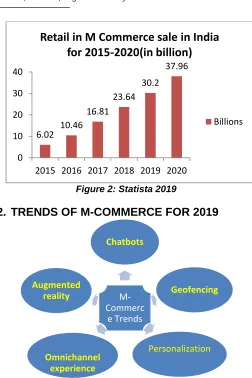
Figure 2: Statista 2019
2.
TRENDS OF M-COMMERCE FOR 2019
Figure 3: M Commerce Trends in 2019
In M-Commerce trends of 2019, it may create a spirited and attractive app for mobile users[2].
2.1 Chatbots
A chatbot as conversational interface is an artificial intelligence which conducts a conversation via auditory or textual methods. Chatbots provide customers with round-the-clock service and able to offer personalized experience according to customers’ preferences and improve interaction over a time. In Data analytics, consumer behaviors and track purchasing patterns has been observed with the help of chatbots by monitoring user data.
524.9 581.1
638.4 684.1 730.7 775.5 813.2
0 200 400 600 800 1000
2013 2014 2015 2016 2017 2018 2019
Mobile subsciption in India
Millions
6.02 10.46 16.81
23.64 30.2
37.96
0 10 20 30 40
2015 2016 2017 2018 2019 2020
Retail in M Commerce sale in India
for 2015-2020(in billion)
Billions
M-Commerc
e Trends Chatbots
Geofencing
Personalization Omnichannel
experience Augmented
reality
_________________________
Dr. Archana Sharma, Associate Professor, IMS Noida, [email protected]
2.2 Augmented reality
Augmented reality associate the data from the physical world to the one that was created with digital tools. With the incorporation of Augmented Reality in the purchasing process, the visualization and animation of the product is possible at home via their mobile devices to the mobile consumer and may spend a more significant amount of time interacting with the product during this process.
2.3 Geofencing
Geofencing as a location based service, allows retailers, service providers etc to offer mobile users the products and services that are more popular in their precise region with the help of GPS. Special RFIDs software have been used to
provide a high-quality service to mobile users. It ensures personalization of messages to the targeted mobile customers and provide the relevant offers time to time.
2.4 Omnichannel experience
Omnichannel is absolutely integrated channel of all channels including online and offline business. With integrating of various communication channels, it focus on the customers perspectives and interest to optimize the consistency of the E commerce marketing messages. omnichannel experience is highly recommended for E-Commerce owners to attract more customers and retain existing ones.
2.5 Personalization
Personalization, means the E- Commerce website personal interaction with the visitor of and predict the website to provide the special offers and product recommendation according to their previous purchase history data geographic location. Due to most of E-Commerce organization app availability on mobile phone, mobile user very frequently access these websites, social networking sites etc. This huge
big data about the mobile user have been collected by
E-Commerce business organizations and with the help of data analytics mechanism like artificial intelligence and machine learning, analyze and predict that what a mobile user will prefer buying next and makes it possible to send personalized offers to a customer.
3.
BIG DATA
Big Data refers to tools and methodologies that aim to transform massive quantities of raw data into ―data about the data‖-for analytical purposes. The term big data analytics may be new to us, but data warehousing, data mining, and database technologies have existed in various forms for years. Google was the first company to effectively use Big Data. Google collected and analyzed massive collections of web pages and relationships between them and created the first truly universal search engine, capable of querying and indexing billions of web pages without human intervention. The infrastructure for big data has unique requirement for conducting deep analytics by integrating the component of big data platform with the enterprise data, combining the traditional data set with the big data only will provide the company a clear view of the analysis. Stock exchange, online banking, online purchasing increased the dataflow through computerized system. This big data has been stored to analyze the customer behavior, inventory monitoring, market behavior by the finance and banking sector. Companies with solution to big data analytics have been pursuing more
progressive ideas, aiming to use big data to improve their understanding of the world and, with it, better the lives. The online E-Commerce businesses and retailers, to give a better service, attracts the customers by online advertisements in this competitive and fast environment. The data is retrieved from Social Media such as Facebook; twitter ,Stock Exchange data which deals with data about the decisions made on buying and selling a share of different companies by the customers. This research explores that Data Analytics could be used to assist M Commerce organizations to improve their performance and give out the best services for the customer in a reliably way. Personalization of the products with respect to the customer’s interest and their interest toward the lower price has also been provided by Data Analytics. Besides improved sales opportunities for companies, Data Analytics also provides valuable insights regarding process improvement across the seller and buyer networks. Finally, it highlights where improvements need to be done in terms of sales performance improvement[4].The commercial technologies that support Business Intelligence and Analytics are RDBMS, OLAP , data warehousing and BPM [5] . To handle the large data (Big Data in petabytes), it is advisable to focus on small data sets based on which the large data sets can be estimated and predicted with the support of a priori algorithms, probabilistic approaches and multivariate techniques are utilized (regression, clustering, association analysis[6]. Big data analytics may be broadly categorized into three categories, which are defined as follows:
3.1 Social media analytics
Refers to analysis of large volume of data generated from social media applications/sites [9].
3.2 Predictive analytics
Refers to use of data to forecast on consumer behaviour and trends [10].
3.3 Mobile Analytics
Mobile analytics refers to the analysis of large volume of data generated from mobile phones, tablets and mobile gadgets [11]. The M-commerce (Mobile commerce) platforms has been complementing and competing with e-commerce platforms. Apart from the similarity in functionality in M Commerce and E commerce, the analyzing methods and technical requirements are totally different in interaction styles and value chain[12]. The rapid mobile development platforms such as Android and iOS have contributed to various mobile persistent applications. Due to the feature of mobile devices and apps are location-aware and being activity-sensitive, mobile analytics research has become more eye-catching.
3.4 Big Data Market and Vendors
extraction, parsing, processing, indexing, and analytics for DBs. Oracle, IBM, and Microsoft. Hadoop including the open source Apache Spark30. Amazon, Flipkart and Google are some of the E Commerce vendors like supply their customers with inbuilt Big Data Capabilities like product catalog, , analytics, integration of data with other sources at ease, historical pricing etc.
4.
DATA ANALYTICS SOFTWARE
In the era of Big Data analytics, ecommerce companies now a days rely on analytics as ―tools of the trade‖. According to a survey by Deloitte 60% of consumers are going more often to look for and purchase products and services. Website’s tools, performance, and content are the instrumental for purchase decisions. To influence the wealth of data from visitor journey and online traffic to product purchase, the effective ecommerce analytics software systems are required. Four analytics software are highlighted below, which are commonly used for data analytics.
4.1 Heap
It provides analytics solution for proficiently tracking the customer data.
Automatically captures each user interaction from cloud services.
Specialized in behavioral analytics
It enables to view all action before a conversion. It can also combine user activity with user attributes
such as contract value and vertical for building complex personas during analysis.
4.2 Mixpanel
Helps in better understanding of each user’s journey by optimizing actionable user analytics in how acquire , engage and retain customers. Specialized in user analytics.
It uses machine learning in performing complex behavior analysis and provides automatic insights to optimizes the flagging of anomalies and spotting upselling opportunities and trends, among others.. It provides actionable data, which can be used in
empowering online purchase with a flawless
experience, building customer loyalty and complementing in-store and digital shopping experience.
4.3 GOOGLE Analytics
It visualizes data from complex reports to apply more complex analytics that are crucial for ecommerce website.
Specialized in behavioral insight and provides the information on bounce rates of each page, traffic sources and session among others.
It provides deep insight into the products, transactions and time to purchase, which provides better understanding of sales to the ecommerce websites to improve the workflow process.
4.4 Web Trends
The key features of web trends includes data export, calculated metrics, customized analytics report..
E commerce website may create unlimited custom dashboards with connected reports , social and geo maps.
It has been specially designed for SharePoint environment and offers unlimited custom reporting for SharePoint-specific reports.
4.5 Brightpearl
It has a complete cloud support for both merchant and wholesalers of e-business organizations to manage their stock, customers and sales transactions in a centralized locations.
It helps to assist e-commerce business operations in check with the help of real-time dashboards and retail KPI reports,
It is reliable for building customizable reports for making performance driven business decisions. Specialized in behavioral insight of customers by
learning who among them are active.
5.
CASE STUDY OF BIG DATA ANALYTICS
ON AMAZON AND FLIPKART
Data analytics helps ecommerce players like Amazon and flip kart to identify both loyal and new customers by using data extraction and segmentation to indentify the browsing habits and patterns of investment. With the support of technology, e-commerce companies customize their offering and promotions by analyzing every user’s click and touch in every session to construct something called the journey of the each customer. For example, when a customer searches through the catalogues of a product range, the search pattern are recorded and a persona is created for the customer so that when he returns to the websites, the search time is quite reduced and highlights the most relevant product according to customer’s interest of purchase the product, the mobile case or screen protector is an example of content based filtering. With the one profile of customer a unique session has been created every time and returns to the site. All sessions are further connected to enrich the user profile and for further analyzing the session, build the user’s journey. Now a day’s online advertisement of a product pop up after a mobile user search for e-commerce websites, which is the outcome of targeted advertising with the help of high end data analytics and machine learning.. The e-commerce sites like Amazon, Flip kart keep track of every clock a mobile user to make on his/her portal and predict the most likely product to but from them. In comparative study of Amazon and flip kart , Amazon’s app and website are more popular then flip kart offering. According to data available Amazon is consistency ahead from flip kart on desktop visits, mobile browser visits; app downloads and average daily active app users.
5.1 Technology used by Amazon and its services
5.2 Major metrics of Amazon’s Recommender System’s are:
1. The selected items have been stored in virtual shopping carts
2. Maintains the previous history of customer’s purchases
3. Items purchases compared to similar purchases by other competitors
4. customers have rated and liked the items
5.3 Technology used by Amazon and its services
Flipkart is more focused in updation of its computing infrastructure. To get fast result, Flipkart get enable the merchant to implement the Computerized Maintenance Management Software (CMMS). Due to tremendous progress of searching patterns, Flipkart has also upgraded and focused towards the artificial intelligence to get improved and coarse understanding of the customer.
5.4 Flipkart Big Data Analytics Services:
BDA supports to predict location based demand, thus inventory in stock may be
With automation of persuaded capabilities in data warehouses, the faster dispatches and accuracy would be possible.
To harness the more reasonable potential of customers ,certain algorithms have been created to precisely red date of delivery
more semantic-based searches .
5 BIG DATA CHALLENGE
In this current scenario of technology, the mobile customer look forward for the product and purchase the same subsequent to the analysis of price comparison at the other E-Commerce websites, rating and reviews of other customers from various resources. Mostly online customers leave their remarks about the product and their preferences about the specific products. These preferences and reviews may be accessed and analyzed by E-Commerce companies. To enhance the more customer oriented E-commerce, the various sites need to accumulate the structured and unstructured data and analyze them by applying the intensive strategies. The major problem with E-Commerce sites is that how to transform the filtered information about the customer and preeminent decision according to the customer preferences. The big data mining in the field of E-Commerce have various challenges like data sampling, demographic preferences of customer, various data analytic tools and various privacy issues.
6 Challenges of Big Data in M-Commerce:
6.1 Volume : The major challenge of Big Data in M-Commerce website is volume of Big Data. The data generated by E-Commerce site is huge in volume, which includes structured data like customer detail,product details and unstructured like reviews, preferences, rating. For the quality of data, the data complexity should be reduced with proper data integration of this structured and unstructured data Its really a challenging task to store, process and cost consideration while processing this distributed data of mobile customer.6.2 Velocity: In general, the frequency of data generation speed and frequency of data delivery speed on average E-commerce site is around 1 petabyte/ second. This frequent flow of data creates the hurdle in frequent decision accordingly. The analysis of the customer sentiments, preferences through social media analytics need real time observation in environment. There is big challenge to synchronize the E-Commerce organization’s data analysis speed happen, when large number of transactions take place at the same moment by the millions of mobile customers? Due to velocity problem, the transaction may remain incomplete.
6.3 Variety: As the Big data has been generated from various resources like Facebook, Twitter, Videos, click stream, Web access, customer profiles, product details etc. in the form of structured, semi –structured and unstructured data. This variety of data creates a challenge to maintain the various form of data structure. Different type of analysis is required for each individual type of data. The predictive analysis in general used to analyze the customer preferences, reviews, and geographic locations of customers, unstructured data from social media etc. Business Intelligence has been applied on structured data. It is a challenge due to this variety of data to produce the desired insights for the online retailers organization.
6.4 High Speed Network : Due to limited bandwidth on mobile network and frequent internet disconnection, the mobile data accessing and transaction is really cost effective and challenging for the online retailers organizations for the efficient use of various resources and Big Data Management. The for location based services for geographically distributed mobile user, data transfers, transaction of sale for E Commerce retails is undoubtedly a big challenge due to network problem.
6.5 Security and privacy: AS the lot of information about the mobile customer has been stored at E –Commerce site in the form of customer profile, customers are generally worried about perceived trust, and how this data may accessed and used by the organization , The privacy of mobile user’s data is really a big issue, as this data gets monitored quite often during run time. E Commerce organizations need to make sure that the mobile users data/information, transactions details etc. are secure.
7 CONCLUSION
Data Analytics on M-Commerce with exploration of category of Big Data Analytics and the best suited data analytics software for M -Commerce websites. A case study of Big Data Analytics on Amazon and Flipkart was done in this research to highlight the technology used to identify both loyal and new customers by using data extraction and segmentation for tracking browsing habits and spending patterns.. Despite of various pros, there are some cons has been discussed in this paper as the Big Data challenges in M-Commerce, which highlights the many technical challenges that must be resolved before it can be utilized fully. More technology enhancements are required to extort the benefits of Big Data in Ecommerce.
REFERENCES
[1]. https://www.pwc.in/en_IN/in/assets/pdfs/publications/ 2015/eco mmerce-in-india-accelerating-growth.pdf/ retrieved on 02 April, 2015.
[2]. ―M-Commerce In India Will Grow Manifold By2019‖, http://www.cxotoday.com/story/why-M-Commerce-growth-inindia-will-be-unstoppable/―M-
[3]. ―MCommerce‖,http://searchmobilecomputing.techtar get.com/defin ition / M-Commerce
[4]. Ahmad Ghandour-"Big Data Driven E-Commerce Architecture",International Journal of Economics, Commerce and Management,ISSN 2348 0386 Vol. III, Issue 5, pp:940-947,May 2015.
[5]. Chaudhuri S, Dayal U, Narasayya V. An Overview of Business Intelligence Technology. Communications of the ACM. 2011; 54(8):88–98.
[6]. Wu X, Kumar V, Quinlan JR, Ghosh J, Yang Q, Motoda H, McLachlan GJ, Ng A, Liu B, Yu PS, Zhou ZH, Steinbach M, Hand DJ, Steinberg D. Top 10 Algorithms in Data Mining. Knowledge and Information Systems. 2007; 14(1):1–37.
[7]. Joseph, R. C., & Johnson, N. A. (2013). Big data and transformational government. IT Professional, 15(6), 43–48.
[8]. Bihani, P., & Patil, S. T. (2014). A comparative study of data analysis techniques. International Journal of Emerging Trends & Technology in Computer Science, 3(2), 95–101.
[9]. http://www01.ibm.com/software/in/analytics/solutions /customer-analytics/social-media-analytics/.
[10]. http://www.webopedia.com/TERM/P/predictive_anal ytics.html.
[11]. Mobile analytics at
http://www.netbiscuits.com/mobile- analytics/. [12]. Hunter DR, Handcock MS, Butts CT, Goodreau SM,
Morris MM. ergm: A Package to Fit, Simulate and Diagnose Exponential-Family Models for Network. Journal of Statistical Software. 2008; 24(3):1–29. [13]. Patterson DA. Technical Perspective: The Data