National Conference on Advances in Engineering and Applied Science (NCAEAS) 16th February 2017
In association with
I
nternational
Journal of
Scientific
Research in
Science and
Technology
Fruit Detection Using Image Processing Technique
Ketki Tarale, Prof. Anil Bavaskar
Department of VLSI Engineering JIT College of Engineering Nagpur, RTMNU University, India
ABSTRACT
Agriculture is mother of all culture, due to the increase demand in agriculture industries the need to effectively grow a plant an increase its yeild is very important. In this study, a method is proposed to detect fruits on tree using image processing technique. For counting the fruits, the main problem is variable lighting conditions for the environment in outdoor. The additional problem is the occlusion of fruits by leaves, branches, and the other fruits. In the proposed method these problems are also examined. External appearance is one of the most significant attributes for fruits when consumers decide to choose or reject them, thus packinghouses need to adopt appropriate systems that are capable of detecting the skin defects for fruits before packing them into batches and reaching the end consumers. In this paper we also differentiate the healthy fruits and fruits which are infected by diseases.
Keywords : Fruit Detection; Image Processing; Skin Defects; End Consumers
I.
INTRODUCTION
Traditionally, quality inspection techniques of fruits have been manual, but these have been highly inconsistence in accuracy, time consuming, tedious and relatively expensive. Thus, the application of new techniques in fruit quality assessment is necessary in order to minimize wastage because most of these fruits are readily perishable. Furthermore, fruit quality grading is becoming a mandatory condition in recent time, although quality of fresh fruits could be defined differ-ently depending on consumer’s preference and final utility, but a standardization to identify the degree of quality in a commodity is necessary for marketing fresh and safe products. Common varieties of tropical fruits sold and consumed widely include oranges, The most time consuming manual process in fruit harvesting is the analysis of fruit state and yield analysis of different fruits like mango, apple, orange, banana and pomegranate this is object. Locating fruits in trees made it easier for analysis and efficient fruit harvesting. An intelligent segmentation and automatic yield calculation of fruits using image processing approach the tree are acquired from real time and simulation using matlab with rail time using digital camera under different
fitting the nearest circular shape. The number of circles fitted to the input image n regarding the L*a*b color space can be.
China is one of the largest fruit producing countries in the world. Since the quality of fresh food varies greatly, efficient technologies are needed for assessment of fruits quality in order to cope with the increasing market expansion and segmentation. Since consumers use fruits appearance to make first evaluation of the quality of fresh food, the presence of skin defects seems to be one of the most influential factors in the quality and price of fresh food. this reason, packinghouses demand appropriate systems that are capable of detecting fruit skin defects.so in this paper we can count the number of fruits and we can distinguish between healthy fruits and fruits infected by disease.
II.
METHODS AND MATERIAL
A. Related Work
(1)“Intelligent segmentation & yield analysis of
mango fruit using bio-inspired mhs approach” [15] Siva Kumar et al In this paper the system can further be
improved for identifying very dense fruits in the tree and images under bad lighting conditions. Images used in the proposed system are two dimensional images. In future, this can be replaced by three dimensional images. 3D images can give clear and overall representation of tree which avoids the problem of using different sectional images of same tree.
(2). “Fruit sorting and grading using fuzzy logic “[16] author suggest the technique begins with capturing the
fruits image using regular digital camera. The features are efficiently extracted from the query image. The color of the fruit determines its class and fruit‟s grade is determined by its size. The fuzzy logic technique is used for both classification and grading of fruits, as it also involves decision making by humans. The proposed technique accurately classifies and grades the fruits. The results are good for the five chosen fruits of same color and sizes. This kind of chosen fruits of same color and sizes. This kind of system can be employed in Agriculture Produce Marketing Corporation, etc.
(3). “Detection and classification of plant diseases by image processing” [4]
Niket Amoda, Bharat Jadhav, Smeeta Naikwadi , Automatically detection In this research, plant diseased is detected and is also classified. The histogram matching is based on the color feature and the edge
Colored histogram diagram of orange fruits
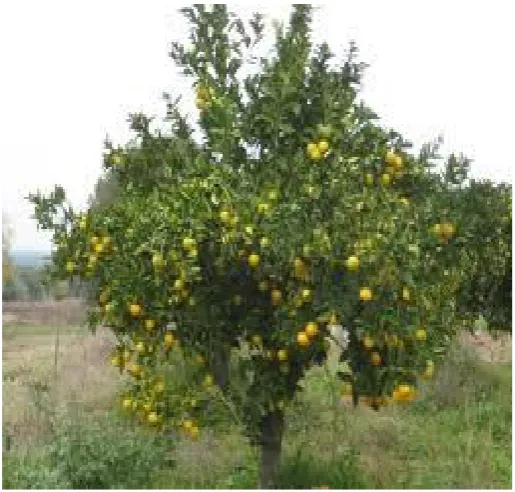
Figure 2. Real Image Captured Using Camera
B. Methodology
Here some image processing technique are carried out to detect the number of fruits on trees,and to recognize whether it is good or infected by disease by its external appearance.with the help of block diagram we can understand it more properly
1. Image Acquisition
This is the first step to collect sample images of fruit which are going to be decided the number of fruits present on the tree. All this images are stored as .JPG standard format and resize into 429x322 pixels. The main application of this task is in production system. So for that the environment remain same including white background.
2. Image Preprocessing
The aim of pre-processing is an improvement of the image data that suppresses unwanted distortions or enhances some image features important for further processing. Here there are two approaches used for Image Pre-processing.
a) Image Enhancement b) Noise Remove
a) Image Enhancement
Enhancement of the image is necessary to improve the visibility of the image subjectively to remove unwanted flickering, to improve contrast and to find more details. In general there are two major approaches [10]. They are spatial domain, where statistics of grey values of the image are manipulated and the second is frequency domain approach; where spatial frequency contents of the image are manipulated. Although Spatial Domain methods are developed for gray valued images. And it can be applied directly on pixels. Whereas in Frequency Domain methods, operations applied on Fourier transform of an image. Here we used Discrete Cosine Transform method to transform an image from RGB scale to Gray Scale.
b) Noise Remove
To remove Noise, in this phase Masking is used. A mask is a filter. Concept of masking is also known as filtering. The general process of filtering and applying mask is consists of moving the filter mask from point to point in an image. At each point (x,y) of the original image, the response of a filter is calculated by a pre-defined relationship [13]. All the filter values are pre defined and standards. proposed technique accurately classifies and grades the fruits. The results are good for the five chosen fruits of same color and sizes. This kind of system can be employed in Agriculture Produce Marketing Corporation, etc.
3. Image Segmentation
In this step for Segmentation Partition method is used. Partition clustering algorithm splits the data points into k partition, where each partition represents a cluster [8]. The partition is done based on certain objective function. One such criterion functions is minimizing square error criterion which is computed as,
E = Σ Σ || p – mi || 2
main drawback of this algorithm is whenever a point is close to the center of another cluster, it gives poor result due to overlapping.
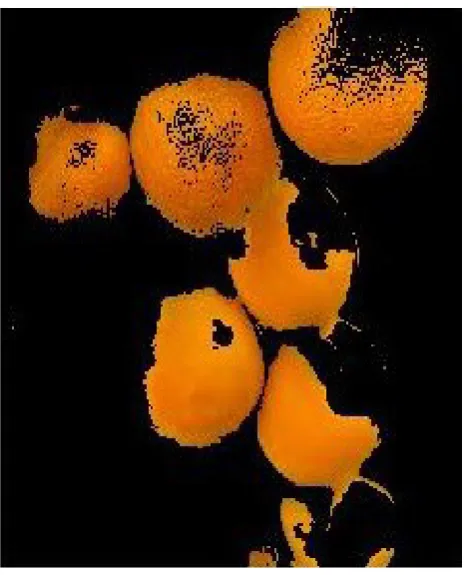
Figure 2. Image Before Segmentation
Figure 2. Image After Segmentation
D. Feature Extraction
In this phase, There are two methods are used namely Texture Feature and Color Feature. For Color Feature
color space conversion method is used. For Texture Feature Canny edge detection and Dilation methods are used probe an image with a small shape or template called a structuring element [12]. The structuring element position is positioned at all possible locations in the image and it is compared.
Dilation:
The Dilation of an input image f y a structuring element s produces a new binary image g= fuss with once in all locations (x, y) of a structuring element s hits the input image f, for example g(x, y) = 1 if s hits f and 0 otherwise, repeating for all pixel co-ordinates (x, y). Dilation has the opposite effect of Erosion. It adds a layer of pixels to both the inner and outer boundaries of regions [12].
Color Feature
It is the main features that are easily recognized by humans in various images. In content based image retrieval color feature is widely used. Most of the images are in the red, green, blue (RGB) color space. There are various color feature based techniques such as color spaces, color histogram, color moment etc. used for retrieval process
Texture Feature
1) Canny Edge Detection
When sudden changes of discontinuities in an image are called as edges. Significant transitions in an image are called Edges. Canny Edge Detection is a popular edge detection algorithm. It was developed by John F. Canny in 1986. It is a multi-stage algorithm. Since edge detection is susceptible to noise in the image [14]. So first step is to remove the noise in the image with a 5x5 Gaussian filter. In Gaussian blur also known as Gaussian smoothing is the result of blurring an image by a Gaussian function. It is a widely used to reduce image noise. And after that Canny Edge Detection will be applied.
2) Morphology (Dilation)
features in an image [12]. Morphological operations relay only on the relative ordering of pixel values, not on their numerical values, not on their numerical values, and therefore are specially suited to the processing of binary images. Morphological operations can also be applied to gray scale images such that their light transfer functions are unknown and therefore their absolute pixel values are of no or minor interest. A morphological operation on a binary image creates a new binary image in which the pixel has a nonzero value only if the test is successful at that location in the input image. Morphological techniques
III. RESULTS AND DISCUSSION
Image processing based on Mat lab is effectively used to determine count of different objects. Traditionally object counting is done manually or may involve costly electronic systems. This can be replaced by proposed algorithm. The developed method is quick and low cost as there are no costly equipment and software. Good accuracy has been achieved in experimental results. It has been observed that for bigger objects the counting accuracy is more. Threshold value is given different for different size of object. Size of disk structuring element has more effect on accuracy. Smaller the object is, less the size of disk structuring element should be. Accuracy can be increased by separating conglutination among the objects
IV. CONCLUSION
Traditionally, quality inspection techniques of fruits have been manual, but these have been highly inconsistence in accuracy, time consuming, tedious and relatively expensive.Here in this algorithm ,automatic counting of fruits using image processing is done and we can differentiate between good fruits and infected fruits. Packinghouses can adopt this system to distinguish damaged fruits from good ones before packing them into batched, therefore the quality of the products can be guaranteed in this stage.
V.
REFERENCES
[1]. The Sixth International Conference on Business Intell1. Zalak R. Barot, Narendrasinh Limbad, "An Approach for Detection and Classification of Fruit Disease: A Survey", International Journal of
Science and Research, ISSN: 2319-7064, pp 838-842, 2015
[2]. M. Wenhua, J. Baoping, Z. Jicheng, Z. Xiaochao, H. Xiaoan, "Apple location method for the apple harvesting robot", 2nd International congress on Image and Signal Processing, CISP’09 , pp.1-5, 2009.
[3]. H. N. Patel, R. K. Jain, M. V. Joshi, "Automatic segmentation and yield measurement of fruit using shape analysis", International Journal of Computer Applications, 45 (7), pp. 19-24, 2012 .
[4]. C. Akın, M. Kırcı, E. O. Güneş, Y. Çakır, "Detection of the Pomegranate Fruits On Tree Using Image Processing", The first International Conference on Agro-Geoinformatics, China, 2012. [5]. S. Cubero, N. Aleixos, E. Moltó, J. G. Sanchis, J.Blasco, "Advances in Machine Vision Applications for Automatic Inspection and Quality Evaluation of Fruits and Vegetables,"Food Bioprocess Technology, vol. 4, pp.487–504, 2011. [6]. L. Wang, X. Tian, A. Li, H. Li, "Machine Vision Applications in Agricultural Food Logistics", igence and Financial Engineering (BIFE2013), Hangzhou, China, Nov. 14-16, 2013.
[7]. "Adaptive algorithm for object tracking and counting", international Journal of Engineering
and Innovative
Technology(IJEIT)Volume2,Issue4,October 2012. [8]. Niket Amoda, Bharat Jadhav, Smeeta Naikwadi "Detection and classification of plant diseases by image processing", IJISET – International Journal of Innovative Science, Engineering & Technology, Vol. 1 Issue 2, April 2014.
[9]. Arivazhagan S., NewlinShebiah R.,
NidhyanandhanSelva S., Ganesan L., "Fruit Recognition using Color and Texture Features", Journal of Emerging Trends in Computing and Information Sciences, vol. 1, no. 2, Pages: 90-94, Oct 2010.
[10]. Nisha Syal "A survey of computer vision methods for counting and yeild prediction" International Journal of Computer Science Engineering (IJCSE),2013.
Computer Engineering & Technology (IJARCET) Volume 1, Issue 6, August 2012.
[13]. Zalak R. Barot, Narendrasinh Limbad, "An Approach for Detection and Classification of Fruit Disease: A Survey", International Journal of Science and Research, ISSN: 2319-7064, pp 838-842, 2015 .
[14]. Kamil S Juber, Hurria H.Al-Juboory and Saba B. Al- Juboory, " FUSARIUM WILT DISEASE OF
STRAWBRRY CAUSED BY Fusarium