87
The influence of ECAP on the Microstructural
and Tribological Properties of AA6061
V Shanmukha Prasad, Dr. J Suresh Kumar, Dr. Thella Babu RaoAbstract— A commercial aluminum alloy AA 6061 was processed through equal channel angular pressing (ECAP) at 500 0 C. The influence of ECAP on tribological properties and microstructure of the alloy was investigated. Experimental results showed that the grain size has reduced due to increase in dislocation density and the fraction of formed grains (sub-grains) after ECAP. Wear resistance of the alloy after ECAP was significantly improved. The loss of mass was reduced noticeably after single pass of ECAP process and increased with increase in load applied.
Index Terms— Equal Channel Angular Pressing, Al 6061, Microstructure, Wear characteristics.
————————————————————
1
I
NTRODUCTIONEqual channel angular pressing (ECAP) is a prominent “Severe plastic deformation” (SPD) technique developed by V M Segal [1] for improving the mechanical properties and super plastic behavior with respect to the grain size reduction [2]. The process of ECAP leads to obtain ultrafine grained (UFG) and even nano structured metals and alloys by imposing intense plastic strain. As a principle, these ultra-fine grained and nano crystalline materials have extraordinary mechanical properties such as yield strength, hardness, toughness and ductility. Further, super plasticity deformation of ultrafine grained materials is improved irrespective of strain rate being higher or lower.
Light in weight, excellent strength along with good corrosion resistance and formability make aluminum alloys the preferred material for structural applications. However, issues might arise in those applications that need high wear resistance. Owing to the significant applications of 6000 series aluminum alloys in structural industries viz., automobile [3] and aerospace [4], the attention of the researchers is more. Therefore, this paper aims to review the SPD techniques and analyze the microstructure and wear properties of AA 6061 alloy processed through ECAP.
2
L
ITERATURE REVIEWIn all SPD techniques, the mechanical behavior of alloys as well as base metals is affected by the grain size, thus making it a critical parameter. This led to the increased [5–9] focus of quite a large number of research groups and individual researchers on SPD technology. Their research focus is to obtain ultra-fine micro structural alloys and thus high strength. Among these materials, again those display novel and high performance properties [10–14] by virtue of their nano and sub-micron sized grains, are attracting more
attention of the research community. Post second world-war, fabrication of materials through severe plastic deformation where in fine grain structures are developed from coarse grained metals has gained significance. This enhanced the mechanical and some physical properties because of UFG structures, which resulted because of SPD in materials like Al, Cu, Ti etc [15–19]. Some of the SPD techniques that gained prominence are “equal-channel angular pressing” (ECAP) [20, 21], “high-pressure torsion” (HPT) [22, 23], “accumulative roll-bonding” (ARB) [24], “Twist Channel Angular Pressing” (TCAP) [25] and “multidirectional forging” (MDF) [26] etc. have been developed and analyzed. All these techniques introduce large plastic strain in bulk crystalline solids and are able to refine grain structure appreciably to nano-scale.
Simple shear takes place in a thin layer at the intersection plane of two equal channels of the die during ECAP process. For this, ECAP process uses low force leading to low pressure requirement (small press can be used). Hence ECAP technique is used extensively than other SPD processes as the tools required are reasonable and easily processes with the existing facilities of the laboratory. Further, many researchers have demonstrated a number of theoretical and experimental analysis on ECAP process [27, 28] to study the effect of process parameters on material behaviour. Grain refinement in ECAP is depends on processing routes, die’s curvature and channel angles, pressing speed and super plastic nature. The effect of design parameters of die and the corresponding uniformity in the optimum strain distribution in the ECAPed materials is reported by Djavanroodi et al [10]. This study reported about 800% reduction in the grain size, 400% increase in UTS, 200% increase in YS of Al where the material has undergone 8 passes through route A, when channel and outer corner angles of the ECAP die are 900 and 150 respectively.
SPD is one of the techniques for intense refining of microstructure in polycrystalline materials [29]. UFG materials with grain size of the order of 1μm to 100 nm and even lower than 100 nm can be obtained by choosing appropriate material and technique. The experimental study of Niels Hansen [30] demonstrated that severely refined grain structure is always accompanied by high angled grain boundaries which is the prime reason for enhanced mechanical properties as well as high ductility of the materials undergoing ECAP, as stated by
————————————————
V Shanmukha Prasad, Research Scholar, Department of Mechanical
Engineering, College of Engineering, JNTU, Kukatpally, Hyderabad, Telangana-INDIA, PH-9492050117. E-mail: [email protected] *Assistant Professor, Koneru Lakshmaiah Education Foundation (Deemed to be Uiversity, Green Fields, VaddeswaramGuntur-522502, Andhra radesh J Suresh Kumar, Professor, Department of Mechanical Engineering, College
of Engineering, JNTUH, Kukatpally, Hyderabad, Telangana. India. Thella Babu Rao, Assistant Professor, Department of Mechanical
88
Hall-Petch correlation. This technique is the most widely known as well as analyzed among the SPD methods and leads the attainment of intensely refined [31] microstructure.
The investigations of I. Saribov et al. [32][32] had been shown the substantial grain refinement and the mechanical behavior of AA 6061 were found during equal channel angular pressing with parallel channels (ECAP-PC). The investigations of C S Chung et al. [33] had been shown the appreciable improvement in high-cycle fatigue life of ECAPed AA 6061. The results of P.K Chaudhury et al. [34] indicated the extensive reduction in forging temperature and stock size during hot forgeability of AA 6061 material with UFG processed through ECAP. The results of J. K Kim et al. [35] studied the effect of post-ECAP aging treatment and found the remarkable improvement in strength even after a single pressing. The study indicated that the accumulation rate of dislocations is high during ECAP and high density of very fine particles were formed in matrix during post-ECAP aging treatment. The investigations of Z. Horita et al. [36] demonstrated the improvement in the mechanical properties of six commercial Al alloys, 1100, 2024, 3004, 5083, 6061 and 7075 after the ECAP had been applied successfully. Further, the study of literature also revealed that the UTS was increased and percent reduction in area was decreased with increasing strain rate [37].
The foremost benefit of ECAP is that the materials can be deformed to elevated strain without change in cross-sectional area. In the recent years, significant progress has been made in the development of ECAP, suggesting that there are excellent prospects for the successful amalgamation of ECAP process into commercial manufacturing operations.
3
MATERIALS AND METHODS3.1 Equal channel angular pressing setup
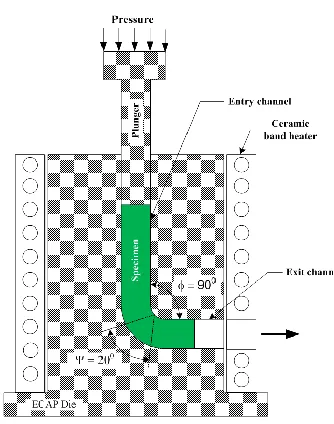
Figure 1: Schematics of equal channel angular pressing
Error! Reference source not found. demonstrates an experimental setup of ECAP process that includes hydraulic press (Universal Testing Machine), ECAP die and plunger, ceramic band heater and temperature control unit. The die has two intersecting channels of identical cross-section with
channel angle of Φ=90° and the outer corner angle of Ψ=20°.
Error! Reference source not found.In this experiment, 12 mm x 100 mm rods of commercial 6061 aluminum alloy were used. The alloy mean chemical composition (in wt.%) are given in Table 1.
TABLE 1
THE CHEMICAL COMPOSITION OF AL-6061 ALLOY
Component Weight. %
Al 95.8-98.6
Mg 0.8-1.2
Si 0.4-0.8
Cr 0.04-0.35
Mn Max 0.15
Zn Max 0.25
Cu 0.15-0.14
Ti Max 0.15
A well lubricated specimen with the same cross-section as that of die channel is placed in one of the channels. The specimen was then heated to 500 0C and pressed it into the second channel by applying pressure on punch using hydraulic press. Ideally, the deformation occurs by shear at the intersecting plane.
Figure 2: AA 6061 Specimen after ECAP
During the ECAP process, substantial modifications in mat erial microstructure occur such as intense grain and particle re fining in the second stage, structure formation characterized b y equi-axed grains and higher angle grain boundaries. Single ECAP pass results in a directed shear texture with visible sub-grain boundaries. In successive passes, the material composition becomes homogenized and low angle grain boundaries have been changed to higher angle grain boundaries. In addition, there is a concurrent decrease in grain size and accumulation of extra dislocations results in breakup of elongated sub-grain and formation of equiaxed structure.
89 Figure 3: Arrangement of Pin-on-Disk Apparatus
The cylindrical specimens for wear testing were prepared to a size of 12 mm x 30 mm length as per the ASTM standard (G99-95a). Sliding faces of the specimens were polished with an emery paper of grit size 600 and 1000 respectively. The dry sliding wear was conducted on pin-on-disc test apparatus (DUCOM TR-20M-106) as shown in Error! Reference source not found.. The surface of the disc (made of EN31 steel with hardness 60 HRC) and sliding end of the pin were cleaned properly with acetone prior to the test. The diameter of the sliding track on the disk surface was set as 100 mm. The wear tests were performed at varying Time and Load parameters in dry sliding conditions. The wear test was carried out for the samples of undeformed and deformed condition.
4
RESULTS
AND
DISCUSSIONS
4.1 Microstructure
Sliced samples of size 10 x 10 x 10 mm were polished first with emery paper of 400 grit size and then with Al2O3 suspension on velvet cloth. The samples were then polished to 1 µm using diamond paste and lubricant oil on disc polishing machine. Finally, the polished samples were cleaned using pure ethanol. An Electronic Microscope was used to examine the microstructure of the 6061 aluminum alloy samples.
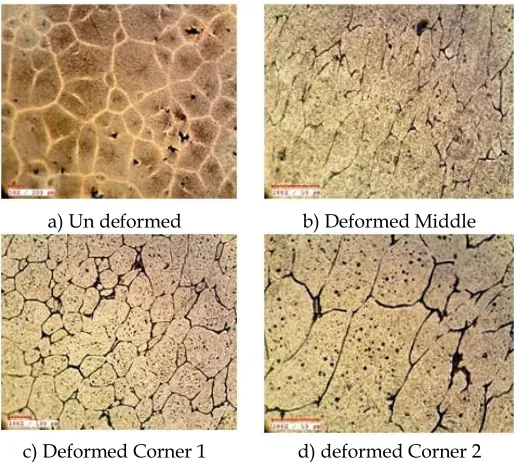
a) Un deformed b) Deformed Middle
c) Deformed Corner 1 d) deformed Corner 2
Figure 4: Microstructure of the specimen at different sections
Error! Reference source not found. shows optical images of the different sections of specimen as shown in Error! Reference source not found. subjected to a single pass of ECAP process. The microstructure of undeformed material consists of grains with an average size of the order 200 μm as shown in Error! Reference source not found.(a). These large grains of undeformed material were refined to an average size of less than 50 m can after single pass of ECAP and is evident from the optical images of the specimens as shown in Error! Reference source not found. [(b),(c),(d)]. The microstructure
after ECAP shows that the grains were found to be equiaxed and homogeneous approximately.
4.2 Wear properties
The influence of applied load and ECAP process on the loss of mass during wear test at a sliding distance of 100 mm was noted in Error! Reference source not found.. The results shows that the loss of mass was decreased considerably after single pass of ECAP process and increased with increase in load applied during wear test. The decrease in the loss of mass due to wear test conducted after the ECAP process can be attributed to the grain refinement and improved strength according to the Hall–Petch relationship.
The wear tests of AA 6061 specimen were carried out with varying time and load parameters. The deformed and un-deformed samples undergone series of tests with load parameter as constant and varying time:
i. Time Vs Frictional values ii. Load Vs Wear rate
a) For Undeformed Specimen
TABLE 2
FRICTION VALUES FOR UN-DEFORMED SPECIMEN
Time
(Min) 5 N Load 10 N 15 N
5 0.020 0.048 0.054
10 0.010 0.054 0.062
15 0.019 0.061 0.072
20 0.010 0.054 0.056
25 0.018 0.057 0.060
30 0.009 0.061 0.068
TABLE 3
WEAR RATE OF UN-DEFORMED SPECIMEN
Load 5 N 10 N 15 N
Initial weight of the specimen 10.57 10.22 10.17
Final weight of the specimen 10.22 10.17 10.12
Wear rate (gm/min) 0.01162 0.00167 0.00066
Figure 5: Friction vs Time – Un-deformed specimen
From the graph of Time Vs Frictional force for the undeformed specimen as shown in the Error! Reference source not found., it is observed that there was an increase in frictional force with increase in load at a specific time. There is an irregular change in frictional force with change in time at specific loads. The values for the Error! Reference source not found. are taken from the Error! Reference source not found..
90
load are noted and the wear rate of the specimen is calculated and tabulated in Error! Reference source not found..
b) For Deformed specimen
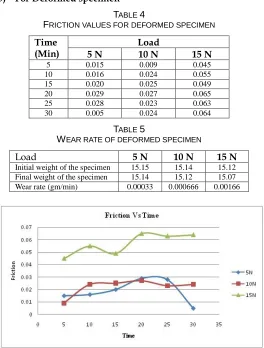
TABLE 4
FRICTION VALUES FOR DEFORMED SPECIMEN
Time
(Min) 5 N Load 10 N 15 N
5 0.015 0.009 0.045
10 0.016 0.024 0.055
15 0.020 0.025 0.049
20 0.029 0.027 0.065
25 0.028 0.023 0.063
30 0.005 0.024 0.064
TABLE 5
WEAR RATE OF DEFORMED SPECIMEN
Load 5 N 10 N 15 N
Initial weight of the specimen 15.15 15.14 15.12
Final weight of the specimen 15.14 15.12 15.07
Wear rate (gm/min) 0.00033 0.000666 0.00166
Figure 6: Friction vs Time – Deformed specimen
From the graph of Time Vs Frictional force for the deformed specimen as shown in Error! Reference source not found., it is observed that there was an increase in frictional force with increase in load at a specific time. Initially for the load 5 N and 10 N the change in frictional force is minimum as compared with the change in frictional force for 15 N Load. The values for the Error! Reference source not found. are taken from the Error! Reference source not found..
The initial and final weights of the specimen for each load are noted and the wear rate of the specimen was calculated and tabulated in Error! Reference source not found..
c) Comparison between deformed and un-deformed
specimens
TABLE 6
COMPARISON OF WEAR RATE
Load 5 N 10 N 15 N
Wear rate undeformed (gm /min) 0.01162 0.00167 0.00166
Wear rate deformed(gm/min) 0.00033 0.000666 0.00166
It is observed that the wear rate of the Deformed specimen
after a single pass is significantly decreased compared with the Un Deformed specimen. The wear rate of the specimens are caluculated individualy and tabulated in Error! Reference source not found.. The values obtained are compared in the
Error! Reference source not found. graphically.
Figure 7: Comparison of Load Vs Wear rate for un-dformed and deformed specimens
It is observed in the graph that, due to decrease in surface roughness of the specimen there is decrease in wear rate up to a minimum value.As it is a dry sliding test temperature of the disc and specimen increases which effects the wear rate.
5 C
ONCLUSIONAA6061 alloy rods of 12 mm diameter and 90 mm length were successfully processed using ECAP with a single pass. The Microstructure of the specimen using electronic microscope revealed that the grains are elongated after angularly pressed. The significant change in the micro structure observed after ECAP is that the voids and blow holes are reduced in the specimen. The specimen is tested and found the wear rate has been decreased considerably after ECAP process than the wear rate of unpressed pieces of AA6061.
R
EFERENCES[1] V. M. Segal, “Equal channel angular extrusion : from macromechanics to structure formation,” Mater. Sci. Eng. A, vol. 271, pp. 322–333, 1999.
[2] R. Z. Valiev and T. G. Langdon, “Principles of equal-channel angular pressing as a processing tool for grain refinement,” Prog. Mater. Sci., vol. 51, no. 7, pp. 881–981, 2006.
[3] A. Macke and B. F. Schultz, “Metal Matrix Composites Offer the Automotive Industry and Opportunity to Reduce Vehicle Weight, Improve Performance,” Adv. Mater. Process., no. March, pp. 19–23, 2012.
[4] P. V. C. Kale, “Aluminium Based Metal Matrix Composites for Aerospace Application : A Literature Review,” vol. 12, no. 6, pp. 31–36, 2015.
91
“Tribological properties of ultrafine-grained materials processed by severe plastic deformation,” J Mater Sci, vol. 47, pp. 4779–4797, 2012.
[7] Y. Zhu, R. Z. Valiev, T. G. Langdon, N. Tsuji, and K. Lu, “Processing of nanostructured metals and alloys via plastic deformation,” MRS Bull., vol. 35, no. December, pp. 977–982, 2010.
[8] N. Gao, C. T. Wang, R. J. K. Wood, and T. G. Langdon, “Wear Resistance of SPD-Processed Alloys,” Mater. Sci. Forum, vol. 667–669, pp. 1095–1100, 2011.
[9] R. Z. Valiev, R. K. Islamgaliev, and I. V Alexandrov, Bulk nanostructured materials from severe plastic deformation, vol. 45. 2000.
[10] F. Djavanroodi, B. Omranpour, M. Ebrahimi, and M. Sedighi, “Designing of ECAP parameters based on strain distribution uniformity,” Prog. Nat. Sci. Mater. Int., vol. 22, no. 5, pp. 452–460, 2012.
[11] M. Karo?, A. Kopy??, M. Adamiak, and J. Konieczny, “Microstructure and mechanical properties of the annealed 6060 aluminium alloy processed by ECAP method,” Arch. Mater. Sci. Eng., vol. 80, no. 1, pp. 31–36, 2016.
[12] C. Reyes-Ruiz, I. A. Figueroa, C. Braham, J. M. Cabrera, I. Alfonso, and G. Gonzalez, “Texture and Lattice Distortion Study of an Al-6061-T6 Alloy Produced by ECAP,” Mater. Trans., vol. 56, no. 11, pp. 1781–1786, 2015.
[13] E. Avcu, “The influences of ECAP on the dry sliding wear behaviour of AA7075 aluminium alloy,” Tribol. Int., vol. 110, pp. 173–184, 2017.
[14] J. K. Kim, H. K. Kim, J. W. Park, and W. J. Kim, “Large enhancement in mechanical properties of the 6061 Al alloys after a single pressing by ECAP,” Scr. Mater., vol. 53, pp. 1207–1211, 2005.
[15] C. Gode, S. Attarilar, B. Eghbali, and M. Ebrahimi, “Electrochemical behavior of equal channel angular pressed titanium for biomedical application,” AIP Conf. Proc., vol. 1653, no. 1, p. 20041, 2015.
[16] E. Mostaed et al., “Influence of ECAP process on mechanical and corrosion properties of pure Mg and ZK60 magnesium alloy for biodegradable stent applications Influence of ECAP process on mechanical and corrosion properties of pure Mg and ZK60 magnesium alloy for biodegradabl,” Landes Biscience, vol. 2535, pp. 1–11, 2014.
[17] Y. Estrin, H. E. Kim, R. Lapovok, H. P. Ng, and J. H. Jo, “Mechanical strength and biocompatibility of ultrafine-grained commercial purity titanium,” Biomed Res. Int., vol. 2013, 2013.
[18] L. Kommel, E. Kimmari, M. Saarna, and M. Viljus, “Processing and properties of bulk ultrafine-grained pure niobium,” J. Mater. Sci., vol. 48, no. 13, pp. 4723–4729, 2013. [19] K. Venkateswarlu, V. Rajinikanth, A. K. Ray, C. Xu, and T.
G. Langdon, “Effect of a scandium addition on an AI-2% Si alloy processed by ECAP,” Rev. Adv. Mater. Sci., vol. 25, no. 2, pp. 99–106, 2010.
[20] N. Van Thuong, H. Zuhailawati, A. A. Seman, T. D. Huy, and B. K. Dhindaw, “Microstructural evolution and wear characteristics of equal channel angular pressing processed semi-solid-cast hypoeutectic aluminum alloys,” Mater. Des., vol. 67, pp. 448–456, 2015.
[21] C. Ting, W. Nong, G. Robert, and T. G. Langdon, “Wear
behavior of an aluminum alloy processed by equal-channel angular pressing,” J. Mater. Sci., vol. 46, pp. 123–130, 2011. [22] A. Loucif, R. B. Figueiredo, T. Baudin, F. Brisset, and T. G.
Langdon, “Microstructural evolution in an Al-6061 alloy processed by high-pressure torsion,” Mater. Sci. Eng. A, vol. 527, no. 18–19, pp. 4864–4869, 2010.
[23] M. I. A. El Aal and H. S. Kim, “Wear properties of high pressure torsion processed ultrafine grained Al-7%Si alloy,” Mater. Des., vol. 53, pp. 373–382, 2014.
[24] Y. Saito, N. Tsuji, H. Utsunomiya, T. Sakai, and R. G. Hong, “ULTRA-FINE GRAINED BULK ALUMINUM PRODUCED BY ACCUMULATIVE ROLL-BONDING ( ARB ) PROCESS,” Scr. Mater., vol. 39, no. 9, pp. 1221–1227, 1998.
[25] R. Kocich, M. Greger, M. Kursa, I. Szurman, and A. Macháˇ, “Twist channel angular pressing ( TCAP ) as a method for increasing the efficiency of SPD,” Mater. Sci. Eng. A, vol. 527, pp. 6386–6392, 2010.
[26] P. N. Rao, D. Singh, and R. Jayaganthan, “Mechanical properties and microstructural evolution of Al 6061 alloy processed by multidirectional forging at liquid nitrogen temperature,” Mater. Des., vol. 56, pp. 97–104, 2014.
[27] C. Xu, S. Schroeder, P. B. Berbon, and T. G. Langdon, “Principles of ECAP-Conform as a continuous process for achieving grain refinement: Application to an aluminum alloy,” Acta Mater., vol. 58, no. 4, pp. 1379–1386, 2010. [28] A. B. Naizabekov, V. A. Andreyachshenko, and R. Kocich,
“Study of deformation behavior, structure and mechanical properties of the AlSiMnFe alloy during ECAP-PBP.,” Micron, vol. 44, pp. 210–217, 2013.
[29] B. Hadzima, R. J. Org, and Y. Estrin, “THE INFLUENCE OF MICROSTRUCTURE ON THE CORROSION PROPERTIES,” pp. 258–271, 2005.
[30] N. Hansen, “Hall – Petch relation and boundary strengthening,” Scr. Mater., vol. 51, pp. 801–806, 2004. [31] Y. Estrin and A. Vinogradov, “Extreme grain refinement by
severe plastic deformation: A wealth of challenging science,” Acta Mater., vol. 61, no. 3, pp. 782–817, 2013.
[32] I. Sabirov, V. U. Kazykhanov, E. V Bobruk, A. A. Dubravina, and R. Z. Valiev, “Enhanced mechanical properties and electrical conductivity in ultrafine-grained Al alloy processed via ECAP-PC,” J Mater Sci, vol. 48, pp. 4501–4509, 2013.
[33] C. S. Chung, J. K. Kim, H. K. Kim, and W. J. Kim, “Impro v ement of high-cycle fatigue life in a 6061 Al alloy produced by equal channel angular pressing,” Mater. Sci. Eng. A, vol. 337, pp. 39–44, 2002.
[34] P. K. Chaudhury, B. Cherukuri, and R. Srinivasan, “Scaling up of equal-channel angular pressing and its effect on mechanical properties , microstructure , and hot workability of AA 6061,” Mater. Sci. Eng. A, vol. 411, pp. 316–318, 2005. [35] W. J. Kim et al., “Enhancement of Strength and
Superplasticity in a 6061 Al Alloy Processed by Equal-Channel-Angular-Pressing,” Metall. Mater. Trans. A Phys. Metall. Mater. Sci., vol. 33, no. October, pp. 3155–3164, 2002. [36] Z. Horita, T. Fujinami, M. Nemoto, and T. G. Langdon,
92