INFLUENCE OF BACKREST
INCLINATION ON THE READING
PERFORMANCE UNDER RANDOM
WHOLE BODY VIBRATION
Vikas Kumara, V.H. Saranb
Mechanical and Industrial Engineering Department, Indian Institute of Technology, Roorkee, India
a. [email protected] b. [email protected]
Tel.: +91 1332 285682; fax: +91 1332 285665. ABSTRACT:
Reading newspaper while traveling in rail cars can occasionally become a demanding task. This sedentary activity is not only influenced by the font size and type but also to a large extent by factors like vibration magnitude, direction, and backrest support. The present experimental study explores the influence of backrest inclination of the seated subjects while reading a newspaper in vibration environment. Thirty healthy male subjects in age group of 20-30 years participated in the study in which they were subjected to random vibrations of 1-20 Hz frequency range at three levels (0.5, 1.0 and 1.5 m/s2) of vibration magnitudes in the three independent axes (x, y and z). Perceived difficulty and percentage reduction in reading performance have been found to increase with the increase in vibration magnitude of whole-body vibration. The measured responses have been observed to be increased with the increase in backrest inclination during the exposure in vertical direction. The obtained results indicate that maximum difficulty was percieved for vibration in the fore-&-aft direction with vertical backrest support. The minimum perceived difficulty and percentage reduction in reading performance was found under the latral vibration exposure in the postures: with vertical backrest support and with backrest support inclined 30º with vertical.
Keywords: Whole body vibration, posture, reading performance
1. Introduction
The train passengers often prefer to perform some sedentary activities like reading, writing, typing etc. while travelling. Various factors such as vibrations, seat design, posture, backrest, temperature etc. affect the performance of sedentary activities. Adverse effects of whole body vibration (WBV) on the performance of various sedentary activities have been observed in the previous studies (Corbridge and Griffin: 1986, Corbridge and Griffin: 1991, Sundström and Khan: 2008, Bhiwapurkar et al., 2010). The field studies (Bhiwapurkar et al., 2010b and Khan and Sundström: 2004) on the Swedish and Indian trains have found that a large number of the passengers prefer reading (newspapers, magazines or books) over other activities. Passenger’s responses to questionnaire in these field studies have shown that on board vibration affects their reading performance. Vibration magnitude and vibration frequency have a strong effect on reading and writing activities (Griffin and Hayward: 1994, Bhiwapurkar et al., 2011, Khan and Sundström: 2006 & 2008).The performance of reading and writing has been observed to be typically decreased in the frequency between 1 and 8 Hz and with an increase in vibration magnitude & duration of vibration (Corbridge and Griffin, 1991; Griffin, 2003; Westberg, 2000). Recent laboratory studies (Bhiwapurkar et al., 2010, Bhiwapurkar et al., 2011, Bhiwapurkar et al., 2012) on reading a word chain in English , a Hindi newspaper and an English e-paper in vibration environment by measuring the subjective as well as objective responses, have shown a strong influence of the WBV on the reading activity. Variables like vibration magnitude, frequency, direction of vibration and subject posture affect the reading performance of the subjects which were evident from the subjective as well as objective measures.
attempt has been made to study the effect of vibration magnitude, vibration direction and backrest inclination on the reading activity in a controlled laboratory environment.
2. METHODOLOGY
2.1. Experimental Setup
The experiment was conducted on the vibration simulator installed in the Vehicle Dynamics Laboratory, Mechanical and Industrial Engineering Department, IIT Roorkee, India. This vibration simulator was developed as a mock-up of a railway coach and used in many previous studies (e.g., Bhiwapurkar et al., 2010-2012; Kumar & Saran, 2014). The vibration simulator consists of a platform made of stainless steel sheets (size 2m x 2m,) which can be excited with the help of three Electro-Dynamic Vibration shakers, in three directions: vertical (Z-axis), lateral (Y-axis) and fore-&-aft (X-axis). The Gaussian random vibrations can be generated by the closed- loop computer controlled vibration exciters, each having a force capacity of 1000 N and maximum stroke length (peak-peak) of 25 mm. A table and two chairs have been rigidly fixed on the platform of the vibration simulator (Figure 1). The cushion-less chairs have rigid and flat backrests with adjustable inclination. All parts of the platform has been found to have no resonance in the frequency range 1 to 20 Hz (considered in this study) for all the three axes of vibration.
The vibration data was acquired through a tri-axial accelerometer (PCB PIEZOTRONICS-356A32) along with a data acquisition device (NI cDAQ-9174) withthe Labview software .
The simulator provides a controlled and comfortable environment with a working illumination well above 250 Lux. The illumination from all the direct and indirect light sources is well-distributed over all the seats and table. The test subjects were seated on the rigidly mounted chairs on the platform of the Vibration Simulator.
2.2. Vibration Parameters
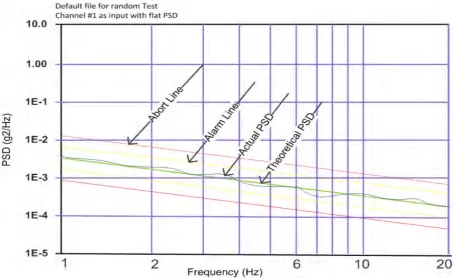
The vibration simulator was excited with a continuous Gaussian random vibration in each axis of vibration (x, y and z), with the help of computerized control system. The three levels of vibration magnitude: 0.5, 1 and 1.5 m/s2 rms (unweighted) were excited in each axis independently. The frequency of random vibrations ranged from 1 to 20 Hz, which is considered a critical range for the human beings. Power Spectral Density (PSD) of vibrations generated by one of the vibration exciters over the required frequency range at 1 m/s2 rms vibration magnitude is shown in Fig. 2.
3. Volunteer Subjects
A total of 30 healthy male subjects voluntarily participated in the experimental study, whose Anthropometric data are shown in Table-1. The test subjects were all students (graduate/postgraduate or research scholar) of the Institute having reading fluency in English and with normal eyesight (normal visual acuity 6/6 vision). The subjects had the freedom to withdraw themselves from experimentation without any reason and at any point of time. An approval from the Institute Human Ethical Committee was obtained for carrying out the present study.
Table 1: Anthropometric data of subjects participated in the experiment
Age (Years)
Height (cm)
Seated Height (cm)
Weight (Kg)
Seated weight (Kg)
Arm length (cm)
Lower leg length (cm)
Mean 26.4 171.7 133.9 70.8 53.3 58.0 50.8
Standard deviation
Figure 1: Schematic diagram of computerized controlled Vibration Simulator
3.1.Subject Postures
The experimental task was performed by the subjects in four postures (Fig. 3). The subject was seated on a chair in an erect posture holding the reading material in the hands in following postures (P):
(i) Without backrest (P1)
(ii) With vertical backrest support (P2)
(iii) With backrest support inclined 30º with vertical (P3)
(iv) With backrest support inclined 45º with vertical (P4)
The normal viewing distance 40 ±2 cm between the subject forehead and reading material [Legge et al., 1985a and 1985b] was maintained throughout the experiments. In order to maintain consistent conditions throughout the experimental process, the inner angle between the upper arm and lower arm of each subject was maintained 95 ±2 degrees.
Figure 3: Four seated postures assumed by the subjects while performing the experiment task
3.2. Experimental Task
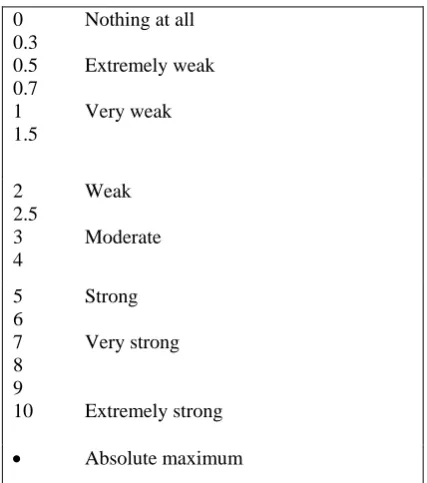
The experimental task consisted of reading aloud, paragraphs of 300 words length, from leading Indian English national newspapers, selected randomly in order to avoid learning effect. Nimrod MT font of size 8 was selected for the reading task as it was one of the most commonly used font type by Indian English Newspapers with varying font sizes (7 to 10) depending upon the news content. The reading performance was objectively evaluated by the experimenter based on the time duration of the reading task. The subjective evaluation was performed by assessment of the perceived difficulty in reading task on the Borg’s CR-10 scale (Borg: 2007), which consists of nine labeled and eight unlabeled points (Table-2). The value ranges from minimum’0’ to maximum ‘10’ for this scale, but greater values can be chosen depending upon their perceived difficulty.
Table 2: Borg’s CR-10 scale (Borg, 2007)
0 Nothing at all 0.3
0.5 Extremely weak 0.7
1 Very weak
1.5
2 Weak 2.5
3 Moderate 4
5 Strong 6
7 Very strong 8
9
10 Extremely strong
3.3.Experimental Procedure
Written voluntary informed consent of the subjects was obtained before experimentation. The test subjects also filled up a health screening questionnaire related to their personal background, level of education, fitness and musculoskeletal disorders (Kuorinka et al., 1987). All the subjects were free from any musculoskeletal disorders and were suitable for the experimental task.
For the convenience of each participant, the whole experiment was split into three sessions (one direction each). Every participant was exposed to total 36 test conditions: three directions of vibration × three levels of vibration magnitude × four backrest postures, with one minute break between the consecutive conditions. All the conditions were randomized in order to minimize the order effects. The experimenter started the digital stop watch at the commencement of the Reading task and stopped it on hearing the word "stop" from the subject at the end of task.
Response Data Analysis
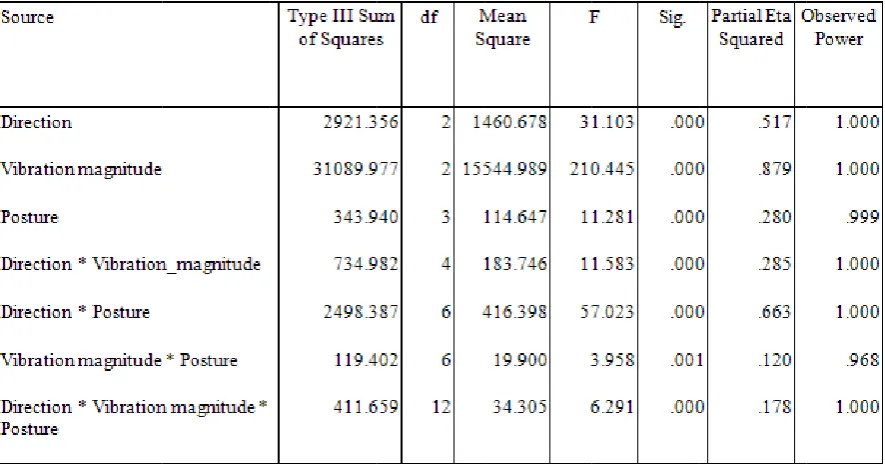
A factorial analysis of variance (ANOVA) was performed with the help of software Statistical Package for Social Sciences (SPSS Inc., Chicago, USA, version 16) to evaluate the collective responses of participants., The results at levels of p<0.05 and p<0.01 were considered as ‘significant’ and ‘highly significant’ respectively. The repeated measure module was selected to evaluate the responses, since the experimental procedures involved repetitive collection of responses from the test subjects for each test condition. In ANOVA, within-subjects module was applied for all the independent variables: Vibration direction, magnitude, and seated postures.
The analysis of variance was also interpreted in terms of two other statistical parameter ‘partial eta square’ and ‘observed power’ which provide the capacity to avoid masking effect of the powerful variables and raise the assurance to right detection of a variable effect, respectively.
4. RESULTS
The reading performance in vibration condition was evaluated by determining the reduction in performance with respect to the reading performance without vibration exposure.
4.1. Subjective Evaluation of Perceived Difficulty in Reading
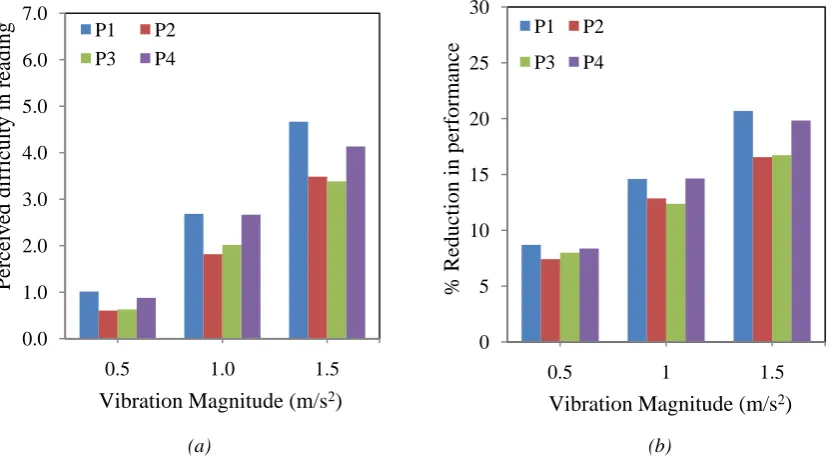
Perceived difficulty in reading under WBV exposure is affected by many parameters e.g. vibration direction, vibration magnitude, backrest inclination etc. and is one of the key factors in reduction of reading performance. For the subjects seated in different postures under the X-, Y- and Z- axes vibrations for all magnitudes, the mean values of perceived difficulty in reading and percentage reduction in reading performance are illustrated in Figures (4a, 5a and 6a) and Figures (4b, 5b and 6b) respectively. In general, both the perceived difficulty and percentage reduction in reading performance increased with an increase in random vibration stimulus, in all the axes and for all postures.
Highly significant differences were observed in perceived difficulty for all the considered vibration magnitudes in all the postures for each axis of WBVs (p < 0.01). The differences between levels of perceived difficulty were also observed to be highly significant for the considered postures in each axis of WBV (p<0.01).
(a) (b)
Figure 4: Effect of vibration magnitude and postures on the (a) perceived difficulty in reading (b) percentage reduction in performance under the WBV exposure in Z-axis.
(a) (b)
Figure 5: Effect of vibration magnitude and postures on the (a) perceived difficulty in reading (b) percentage reduction in performance under the WBV exposure in Y-axis.
0.0 1.0 2.0 3.0 4.0 5.0 6.0 7.0
0.5 1.0 1.5
P1 P2 P3 P4
Vibration Magnitude (m/s2)
Perceived difficulty
in
reading
0 5 10 15 20 25 30
0.5 1 1.5
P1 P2
P3 P4
Vibration Magnitude (m/s2)
%
Reduction in perform
ance
0.0 1.0 2.0 3.0 4.0 5.0 6.0 7.0
0.5 1.0 1.5
P1 P2
P3 P4
Perceived difficulty
in
reading
Vibration Magnitude (m/s2)
0 5 10 15 20 25 30
0.5 1 1.5
P1 P2
P3 P4
Vibration Magnitude (m/s2)
%
Reduction in perform
(a) (b)
Figure 6: Effect of vibration magnitude and postures on the (a) perceived difficulty in reading (b) percentage reduction in performance under the WBV exposure in X-axis.
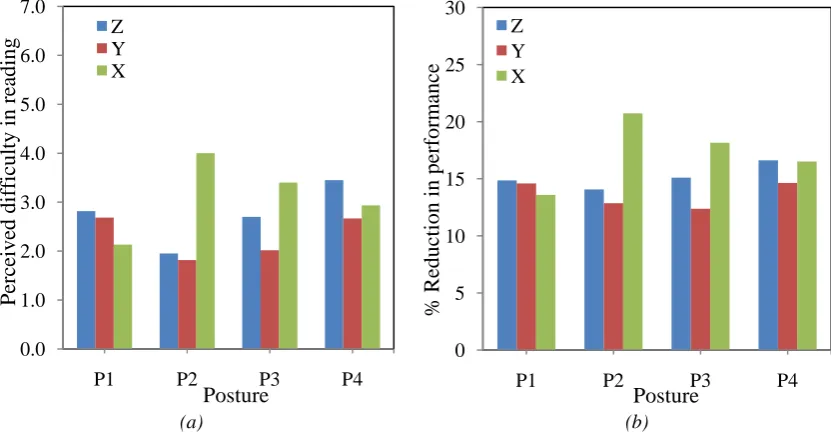
Effects of vibration directions and postures on the perceived difficulty under the WBV exposure at 1 m/s2 vibration magnitude are shown in Figure 7(a). Higher level of perceived difficulty has been observed in the P2 and P3 postures as compared to the other postures (p<0.01) during the exposure to X-axis vibrations. While the level of perceived difficulty is lower in the postures P2 and P3 under the exposure to lateral vibrations.
(a) (b)
Figure 7: Effect of vibration direction and postures on the (a) perceived difficulty in reading (b) percentage reduction in performance under the WBV exposure at 1 m/s2 rms vibration magnitude
4.2. PERCENTAGE REDUCTION IN READING PERFORMANCE
The mean values of percentage reduction in performance of test subjects for the vertical, lateral and fore-&-aft vibrations have been displayed in Figures 4 (b), 5(b) and 6(b). These figures also describe the effects of three levels of vibration magnitude and four postures.
Effect of vibration magnitude on the percentage reduction in reading performance in three independent axis of WBV is illustrated in Figures 4 (b), 5(b) and 6(b). It has been observed that the percentage reduction in
0.0 1.0 2.0 3.0 4.0 5.0 6.0 7.0
0.5 1.0 1.5
P1 P2
P3 P4
Perceived difficulty
in
reading
Vibration Magnitude (m/s2)
0 5 10 15 20 25 30
0.5 1 1.5
P1 P2
P3 P4
Vibration Magnitude (m/s2)
%
Reduction in perform
ance
0.0 1.0 2.0 3.0 4.0 5.0 6.0 7.0
P1 P2 P3 P4
Z Y X
Perceived difficulty
in
reading
Posture
0 5 10 15 20 25 30
P1 P2 P3 P4
Z Y X
%
Reduction in perform
ance
performa considere Highly S of WBV percentag performa vibration posture h
In the for has been decline in reduction vibration the three been obs direction P3 follow 4.3. Ov The perceived overall e effects of reduction independ for the m difficulty magnitud followed observed interactio Ta ance increases ed postures (p Significant eff (p<0.01). The ge reduction ance increases n, the percenta has been found
re-&-aft vibra n found to be n percentage r n in performa n. The percent independent erved for the n of vibration wed by posture
verall Data A
within-subjec d difficulty in effects of all t f independent n in reading pe dent variable a measured resp y to read and p de. The vibra d by the direc d power endor ons on measur
able 3: Tests of W
s with the ri p<0.01). fects on percen
e percentage r in other po s with the inc age reduction d to be greater
ation, the perc significantly reduction with ance with the tage reduction directions hav P2 and P2 po (p<0.01). The e P2 under the Analysis
ct design for n reading an the experimen t variables and erformance ha and their inter ponses. All th percentage re ation magnitu ction as evide
rse the results red responses.
Within-Subject Eff
se in vibratio
ntage reductio reduction in pe stures in the rease in back in performanc r than the perc
centage reduct higher than th h the increase increase in v n in the perfor
ve been show osture in the fo
e lowest reduc e exposure in
r the repeated nd the percen ntal variables d their interac ave been prese raction specify he variables an
duction in rea ude contribute ent from the s of the overa .
fects of experime
on magnitude
on have been erformance fo e vertical dir krest inclinatio
ce at a high le centage reduct
tion in perform he percentage e in backrest i vibration mag rmance for the wn in Figure 7
ore-&-aft dire ction in the re latral vibratio
d measures h ntage reductio s i.e. vibration ction, on the p ented in Table y that the vari
nd their inter ading perform es most to th Partial Eta s all data analys
ental variables in r
e in each ind
found for all or P4 posture h rection (p<0.0 on for vertical evel of vibrati tion in other p
mance at each e reduction in inclination in gnitude has b e random WB 7(b). Significa ection of vibra eading perform on.
has been appl on in reading n magnitude, perceived diff e 3 & 4. The s ables & their action have a mance except i he perceived quared value sis and confir
repeated-measure
dependent axi
the prescribe has been foun 001). The pe l direction of ion magnitude postures (p<0
h vibration ma n other posture the X-axis. E been observed BVs at 1 m/s2
ant reduction i ation compare mance has bee
lied on subje performance direction and ficulty in read significance v interactions a a significant e interaction of difficulty and in table 3 a rm the effects
e test (perceived d
s of WBV fo
ed postures in nd to be greate ercentage red vibration. Fo e (1 and 1.5 m 0.05).
agnitude for P es (p<0.01). T Escalation in p
d for each dir vibration mag in the perform ed to other pos
en found in th
ctive respons e for the estim d postures. Th ding and the p value (p<0.05) are strongly re effect on the direction and d percentage and 4. High v s of variables
difficulty in readi
for all the
each axis er than the duction in
or lateral m/s2) in P1 P2 posture There is a percentage rection of gnitude in mance has stures and he posture
Table 5. DISS An a direction the readi reduction statistical percentag axis of v 2007, Bh from the fast acros level of v during th experime under the for vertic in perfor difficulty increase been face be attribu is a less direction the subje posture. lateral dir performa subject re fore-&-af perceived 2010 & 2 the readin the direct
4: Tests of Withi
SCUSSION
attempt has be n on reading a
ing activity in n in reading p l analysis of t ge reduction i vibration. This hiwapurkar et measured res ss the retina w vibration mag
he exposure entation. Postu e WBV expos cal, lateral and Prescribed po rmance. As th y to read and in responses m ed by the test
In the lateral uted to the sw voluntary con n. The head an ect. This out of
The same pat rection of vib ance have bee epetitively int This repetitiv ft vibration ex d difficulty an 2011, Wollstr ng task when tion of vibrati
in-Subjects Effect
een made to s activity in this n the WBV e performance i
the results (T in reading per s observation
al. 2011,]. Th ponses of alm which is due t gnitude, there
to WBV. T ures adopted sure. It has be d fore-&-aft vi
ostures adopte he backrest in d percentage may be attribu subjects in the WBV, test su winging of the ntrol of the up nd reading mat
f the phase co ttern has been ration. In the en found by th
teract with eac ve interaction o
xposure. At lo nd performanc rom, M., 2000 exposed to W ion along with
ts of experimenta
study the effec s experimenta
exposure. Th is due to the Table 3 & 4). rformance incr is consistent his difficulty most all the tes to the unstabl is overlapping This overlapp
by the test s en observed th ibrations. ed by the parti nclination inc reduction in uted to the rep e P4 posture in ubjects faced m upper body w pper body of terial could no ondition offers
n observed fo fore-&-aft W he test subject ch other when of backrest an ow level of vi ce of a task; th 0]. Movement WBV. The mo h the posture a
al variables in rep
ct of various p ation. Significa e strongest e
vibration mag The results o rease with the with various to perform at st subjects. Th le image on th g of lines and
ing also redu subjects have hat measured icipants affect creases, there reading perf petitive interac
n vertical WB more perceive without the su the test subje ot move in pha s more difficu or the percent
BV, maximum ts for the P2 p n exposed to fo
nd head in P2 ibration magn his is also con
s of head, eye otion of the he
adopted by the
peated-measure te
parameters lik ant effects of ffect on the p gnitude of W of experiment e increase in v past studies t a higher lev he legibility de
he retina [Mo letters due to uces the leg been observe responses are
t the perceived is an increas formance, for ction of the he BV.
ed difficulty to upport of back ects without t
ase due to the lty to perform tage reduction m perceived d
postures. In P ore-&-aft vibr posture cause nitude, directio nsistent with m es and positio ead, eyes and h
e subjects. In t
est (percentage re
ke vibration m f these variabl
perceived dif WBV which is shows that p vibration magn
[Lewis and G vel of vibration
ecreases as the osley and Grif o the moveme gibility of tes
ed to affect th e affected by t
d difficulty an se in both th r the vertical ead and backr
o read for the krest in this pa the support of e lack of suppo m tasks in this p
n in the readi difficulty and p P2 posture, ba ration.
es more disco on of WBV h many past stud n of hands pl hands of the s the vertical vi
eduction in perfor
magnitude, pos les have been fficulty and p also support perceived diffi nitude of WB Griffin, 1980, n magnitude e image on ret ffin, 1986]. A
nt of the subj st subjects d he measured the backrest in
nd percentage e responses: WBV expos est. More diff
P1 posture w articular postu f backrest in t ort to the uppe particular dire ing performan percentage red ackrest and he
mfort to the s has a little effe dies [Bhiwapu
ay an importa subjects are af ibration and P
rmance)
stures and found on percentage ted by the iculty and BV in each Hancock, is evident tina move At the high ect’s eyes during the responses nclination reduction perceived sure. This ficulty has which may ure. There the lateral er body of ection and nce in the duction in ead of test
head moves almost in the vertical direction but in P1 posture, the head moves in mid-sagittal plane, that means subjects face more problem to perform the task in the P1 posture compared to P2 posture in vertical direction [Bhiwapurkar et al. 2010 , Griffin, 2003, Mansfield, 2005]. Maximum perceived difficulty to read and percentage reduction in reading performance has been found in the fore-&-aft direction in the P2 posture assumed by the subjects.
This study has been done to quantify the effect of various parameters e.g. vibration magnitude, direction and postures with backrest inclination. The result presented may be useful for the train manufacturers to consider the parameters while designing the train compartment and seat components to provide activity comfort to the passengers so that they can utilize their time effectively and efficiently.
6. CONCLUSION
The results of current experimental study may be useful while designing the seat system and backrest for the railway passengers. Various parameters : vibration magnitude, direction and postures have been investigated in view of the reading activity performance. The perceived difficulty to read and percentage reduction in reading performance have been found to be affected by vibration magnitude in three independent directions of vibration. Both the responses have been found to increase with the increase in vibration magnitude of each axis of whole-body vibration. Backrest inclination has also been found to affect the reading activity, but varies according to the direction of vibration. The lower perceived difficulty to read and percentage reduction in reading performance has been observed in P2 Posture for the test subjects under the exposure of vertical and lateral vibration independently. Maximum levels of perceived difficulty and large percentage reduction in performance have been observed in the fore-&-aft direction of vibration in the P2 posture. The minimum perceived difficulty and percentage reduction in reading performance have been found under the latral vibration exposure in the P2 and P3 postures.
REFERENCES
[1] Bhiwapurkar M.K., Saran V.H., Harsha S.P., Goel V.K., Berg M., 2010a. Effect of magnitudes and directions (mono-axis and multi-axis) of whole body vibration exposures and subjects postures on the sketching performance. Proceedings of the Institution of Mechanical Engineers, Part F: Journal of Rail and Rapid Transit 225, 71-83.
[2] Bhiwapurkar M.K., Singh P.P., Yadav J., Saran, V.H., Harsha, S.P., 2010b. Influence of vibration on passenger comfort: A survey on Indian train. International Conference on Advances in Industrial Engineering Applications (ICAIEA 2010). Anna University Chennai, India.
[3] Bhiwapurkar M.K., V.H. Saran S.P. Harsha, V.K.Goel and Mats Berg, 2010c, Influence of Mono-axis Random Vibration on Reading Activity, Industrial Health, 48, pp. 675 -681.
[4] Bhiwapurkar M.K., V.H. Saran, S.P. Harsha,2011, Objective and subjective responses of seated subjects while reading Hindi newspaper under multi axis whole-body vibration, Int. Jnl. of Industrial Ergonomics, Vol 141, pp. 625- 633
[5] Bhiwapurkar M.K., V.H. Saran S.P. Harsha, 2012, Interference in Reading an E-Paper under Whole Body Vibration Exposure with Subject Posture, International Journal of Acoustics and Vibration, Vol. 17, pp. 100-107
[6] Borg, E., 2007, On Perceived Exertion and its Measurement, Doctoral Theses Department of Psychology, Stockholm University [7] Corbridge C., Griffin M.J., 1986. Vibration and comfort: vertical and lateral motion in the range 0.5 to 5.0 Hz. Ergonomics 29,
249-272.
[8] Corbridge C., Griffin M.J., 1991. Effects of vertical vibration on passenger activities: writing and drinking. Ergonomics 34, 1313-1332.
[9] ENV 12299, 1999. Railway Applications- Ride Comfort for Passengers: Measurements and Evaluation. [10] Faye EE. Clinical Low Vision, 2nd ed. Boston, MA: Little, Brown & Co., 1984.
[11] Griffin M.J., Hayward R.A., 1994. Effects of horizontal whole-body vibration on reading. Applied Ergonomics, 25, 165-169. [12] Griffin M.J., 2003. Handbook of Human Vibration, second Ed. Academic Press Limited, London.
[13] Hancock R. 2007. The influence of magnitude, posture and language on subjective workload while reading and writing during tri-axial random vibration, M.Sc. Project Report, Loughborough University, Loughborough, U.K.
[14] Henrietta V.C.H., 2004. A comparison of standardized methods of evaluating rail vehicle vibration with respect to passenger discomfort. 39th United Kingdom Conference on Human Response to Vibration. 395-408.
[15] ISO 2631-4. Mechanical vibrations and shock 2001—Evaluation of human exposure to whole body vibrations – P art 4: Guidelines for the evaluation of the effects of vibration and rotational motion on passenger and crew comfort in fixed guideway transport systems. [16] Khan S. and Sundström J., 2004.Vibration comfort in Swedish inter-city trains – a survey on passenger posture and activities. In
Proceedings of the 17th International Conference on Acoustics (ICA), Kyoto, Japan, pp. 3733–3736.
[17] Kitazaki S., and Griffin M.J., 1997. Resonance behaviour of the seated human body and effects of posture. Journal of Biomechanics 31, 143-149.
[18] Kumar, V., and Saran, V. H., 2014. Influence of reading format on reading activity under uniaxial whole body vibration. International Journal of Industrial Ergonomics 44, 520-527.
[19] Kuorinka I., Jonsson B., Kilbom A., Vinterberg H., Biering-Sørensen, F., Andersson G., Jørgensen K., 1987. Standardised nordic questionnaires for the analysis of musculoskeletal symptoms. Applied Ergonomics 18, 233-237.
[20] Legge GE, Pelli DG, Rubin GS, Schleske MM., 1985a. Psychophysics of Reading–I. Normal Vision. Vis Res; 25:239–52. [21] Legge GE, Rubin GS, Pelli DG, Schleske MM., 1985b. Psychophysics of Reading–II. Low Vision. Vis Res; 25:253–66.
[22] Lewis C.H., and Griffin M.J., 1978. A review of the effects of vibration on visual acuity and continuous manual control. II: continuous manual control. Journal of Sound and Vibration 56, 415-457.
[23] Lewis C.H., and Griffin M.J., 1980. Predicting the effects of vertical vibration frequency, combinations of frequencies and viewing distance on the reading of numeric displays. Journal of Sound and Vibration 70, 355-377.
[25] Mansfield N.J., Maeda S., 2005. Comparison of subjective ratings of whole-body vibration for single and multi-axis vibration. In: Proc. of 40th United Kingdom Conference on Human Response to Vibration Liverpool, England.
[26] Moseley M.J and Griffin M.J., 1986. Effects of display vibration and whole body vibration on visual performance. Ergonomics 29, 977-983.
[27] Muzammil M. and Hasan F., Handedness and safety: Vibration effects on cognitive task performance in a rural road automobile driving environment, Journal of Noise and Vibration Worldwide, 385, 11–19, (2007).
[28] Paddan G.S., Griffin M.J., 1988. The transmission of translational seat vibration to the head-II. Horizontal seat vibration. Journal of Biomechanics 21, 199-206.
[29] Sundström J., Khan S., 2008. Influence of stationary lateral vibrations on train passengers’ ability to read and write. Applied Ergonomics 39, 710-718.
[30] Sundström J. and Khan S., 2006. Train passengers’ ability to read & write during lateral vibration transients. In Proceedings of the 13th International Congress on Sound and vibration, Vienna, Austria
[31] Westberg J., 2000. Interference of lateral vibration on train passenger activities: an experiment on human ability to perform reading, writing and drinking. Masters Thesis, TRITA-FKT Report 2000:62, KTH, Stockholm.