PARALLEL IMPLEMENTATION OF
THE COUPLED HARMONIC
OSCILLATOR
Al-Oraiqat Anas M.
Taibah University, Department of Computer Sciences & Information Kingdom of Saudi Arabia, P.O. Box 2898
Email: [email protected]
Abstract: This article presents the parallel implementation of the coupled harmonic oscillator. From the analytical solution of the coupled harmonic oscillator, the design parameters are obtained. After that, a numerical integration of the system with MATLAB, which is used as a tool of benchmark evaluation, is performed. Next, parallel implementation is performed using a well-known approach like OpenMP and WinAPI. Taking into account the errors of basic parameters of the simulated process, the generated oscillations of the proposed parallel realization are almost identical to the actual solution of the harmonic oscillator model. Test ways to optimize the parallel architecture of computing processes for software implementations of the considered application is carried out. The developed model is used to study a fixed priority scheduling algorithm for real-time parallel threads execution. The proposed parallel implementation of the considered dynamic system has an independent value and can be considered as a test for determining the characteristics of multi-core systems for time-critical simulation problems. Keywords: Harmonic oscillator; model; SMP; parallel programming; OpenMP;
1. Introduction
Study of dynamics objects, which consist of large number of inter-related elements, is an important task of design and maintenance of control systems. The real dynamic system contains multiple interconnected physical processes which change in time [1]. Analysis of the dynamics of real objects and control systems is carried out with the construction of mathematical models and their subsequent numerical analysis. The main requirement of similarity of the object and the model is the corresponding rate of change of the model and physical objects [2]. Components with dynamics, described by differential equations of harmonic oscillators with a predetermined frequency, are often used into models. Currently, the use of digital computers for control and monitoring of industrial processes has increased significantly, which makes the development of a digital model for harmonic oscillator an active research area.
As an object for research, consider the Van der Pol system [3], which now is the standard model of oscillations theory and nonlinear dynamics. The model containing two mathematical pendulums is actively used in technical, biological and social systems. In general, the problem of multi-dimensional oscillators is reduced to solving the following system of differential equations:
∑ ′′ 0 (1)
where s is the number of degrees of freedom, i and j = 1, 2, ..., s and denote the generalized coordinates. Parameters and characterize the specific oscillator.
The choice of this object as a test to study the properties of numerical methods is justified by the fact that modelling of generators represents the greatest difficulties in modern design of devices. At the same time, the model of harmonic oscillators can be used as a test to study both digital delays for hardware-in-the-loop (HIL) as well as for software-in-the-loop (SIL) simulation systems and also as a test for information exchange performance in multi-core computing systems.
There are various technologies of parallel programming [4-5] with different architectural approaches to the construction and implementation of digital models. Hereby, experiments are based on the use of symmetric multiprocessing parallel (SMP) systems with shared memory. Most effective, when creating parallel applications for the study of models of varying complexity, is to use the resources of Message Passing Interface (MPI) for distributed memory, Open Multi-Processing (OpenMP [4]) for shared memory, or their hybrid variants. However, for SMP systems, it is preferable to use OpenMP.
2. Mathematical model of the coupled harmonic oscillator Consider the model of free vibrations of masses connected by springs as shown in Figure 1.
Figure 1: Model of masses free vibrations connected by springs [6].
The system of equations of the model is as follows:
0
0 (2)
where x1, x2, C1 and C2 are the displacement of masses m1 and m2, and the spring rates, respectively.
If and then (2) becomes:
2 0
0 (3)
The Wronskian determinant for this system is:
2С 0
0 (4)
Such that:
; (5)
The determinant (4) allows us to construct the characteristic equation:
3 0 (6)
With those numerical values 2g, 20,25 м, a corresponding particular solution gives the roots of this characteristic equation as follows:
, 51,47
, 19,66
Accordingly, we can write a fundamental system of solutions for (2) as the linear combination:
cos sin
cos sin (7)
Oscillation of the values x1 and x2 are called the normal modes. Values and can be found by substituting into (2) or via the MATLAB solvers of computer modelling system [6]:
[x1,x2]= dsolve('equation1',' equation2',’initial value’).
The values of the amplitudes and phase shifts are determined by the initial conditions. It is important, that the simulated system has its own circular frequencies ( , ), which depend on the parameters of the physical system. This type of task prohibits conducting an analytical study in the presence of factors affecting the dynamics of coupled oscillators.
3. Model Development using MATLAB
A complete description of the process of constructing a mathematical model of harmonic signals involves devices having non-linear elements with wide variation of parameters. An important characteristic is the stiffness of the system of differential equations [7]. In such complex problems, numerical integration using computer modelling systems gives the solution. MATLAB has been widely used to investigate the pendulum model [8]. Especially, MATLAB contains solvers for stiff and non-stiff problems.
Before the integration of Runge-Kutta methods, it's necessary to convert the system of equations (2) to the first order form.
Let ′ , ′. So, ′ ′′, ′ ′′.
Accordingly, ′ 2 , ′ .
The obtained results are used later for verification of this proposed implementation model. The corresponding MATLAB code is as follows:
D(1)=x(3);
D(2)=x(4);
D
3 are s
Numerica 32 KB \ L
W for a high Parallel E which is (SMP-sy code), thr
W processor loss in so
Runge-K threads c members main thr allow to of code computin currently the curren Support” model, u experime Figure 2. “CPU U approxim
D(4)=(1/m
The results o shown in Figu
All subsequen al experiment L2 256 KB \ m
With the dev h-level framew Extensions an
served for p ystems). It use reads are simu With the spec r schedule wo olution leading The program Kutta method f
consisting of i s of the new g ead continues set the parame executed by ng units (proc y performing a nt group threa The project i ”.The model r use the valu ents, performe . The basis for sage” is given mately 200 ms
m)*c*(x(1)
of simulation ure 2:
nt software mo ts were perform main memory
elopment of m work using. S nd others [9]. rogramming m es a parallel e
ultaneously st cial Visual Stu orks as require g to latency is
model of the finds the state
itself and oth group execute
s execution o eters for the O
only one thr cessors/cores); a parallel task ads.
is a multi-thr runs on multip ue “OMP_NU
ed on a perso r the assessme n in Figure 3 w
. Then workin
Displaceme n t -x(2)); the displace
Figure 2- The si
odels are crea med on a hard
6 GB running 4. Develo multi-core sy Such technolog
For model d multithreaded execution mod tarted. Finishi
udio “Profilin ed, parts of th s encountered. e oscillator st ement “pragm
er streams, an a code inside f the user co OpenMP appli ead at a give ; “omp_in_p k; “omp_get
readed applic ple threads, as UM_THREADS
onal computer ent of the per where the cyc ng threads con
ment (y axis
imulation result f
ated using C + dware platform g under Wind opment of Par
stems, many gies include O evelopment, t d applications
del “fork-join ing of parallel ng” program m he parallel pro
Therefore, th tarts as a sing maompparal nd calculates e the parallel c
de. Runtime ication enviro en time; “om parallel”
_num_thre
cation compile s specified in S = n” op r with four c rformance of t cle of simulati nsume all proc
) of masses
for , .
++ under IDE V m Intel Core i5
ows 10 Pro. rallel Model factors are re OpenMP, Inte the most popu
on multiproc n”. At the beg l sections requ
mode, it is no ogram switch he following im
gle thread of llelnum_th the correspon construct. Aft functions, wh nment: “omp mp_get_num - allows a th ads” - return
ed in Visual the computer ption “Envir
ores (n = 4), the established ion begins afte cessor resourc
x
m1 and m2 fo
Visual Studio 5-2400, 3.1 G
ecommended l Thread Buil ular technolog cessor system
ginning of th uires the comp oted, as given to different co mplementation f execution. W hreads”, it nding phase v ter the paralle hich are used pbarrier” -m_procs” - hread to find o ns the number
Studio with r processors b ronment”in yield to iden d model in Vi er the short pr ces and all fou
t. sec
x1-Red and x2-Blu
for 0 2,
2013 (ultima GHz, 4 Cores,
to model prog lding Blocks,
gies - OpenM ms with shared e parallel sec pletion of all t later, that alth ores. Hence, t n is proposed When the thre
creates a new variable system
l construction in the parall - determines th
returns the n out whether it r of threads in
the option “ by default. To n Visual Stu ntical results isual Studio in reparatory per ur cores. ue , 0 ate). L1 Cache grammers Microsoft MP is used d memory ction (area hreads. hough the temporary .
ead of the w group of m (2). All n, only the lel model, he section number of t has been ncluded in
“OpenMP o scale the udio. The
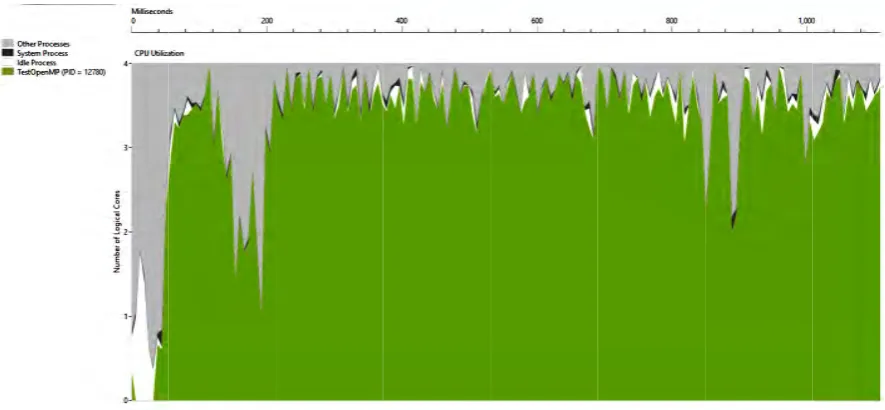
utilizatio consume cycle of t process c program the cycle model so This is d specified processor the threa gcc). original s appropria the mode provides approach Windows implemen
The result of n of cores is w d by sleep fu the numerical consuming lis
threads betwe e of the nume olution.
due to the fac d core. Becaus r for this clas ads with the c
Research of o sequential mo ate to use low elling platform
a programm h, the most fam
s threads, with ntation on the
Figu
model thread well balanced unctions that a
integration an st and on wo een cores. If t erical integrat
ct that Visual se of the need s of problems ore processor
oscillators has odel to a parall w-level program
m and reduce ming interface
mous APIs ar h OpenMP sta e basis of Op
ure 3- Estimation
ds profiling (th d. 85% of the p are used for s
nd may be no orker threads the threads are tion of the sy
Studio suppo d to switch th s is observed. r [13], but it i
Figure 4- T
confirmed th lel model is re mming in the e the overhea e (API) for d re the Window andard as the penMP and W
of CPU utilizatio
he diagram in program exec synchronizatio t considered. timeline diag e migrated (th ystem (2), then
orts OpenMP he thread cont At the same t is necessary to
The result of mod
hat using Open equired. For d cycle of simu ad of the ope developing pa ws Thread AP
high level, ar WinAPI, one
on for OpenMP m
n the lower pa cution time is on, I/O operat Moreover the grams that pr he upper part o
n it leads to d
2.0. and has ext, significan time, the Ope o use other co
del profiling.
nMP minimal developing mo ulation, to acc erating system arallel program
PI and PThrea re used. More can set the g
model.
art of the Figu used efficient tion don’t affe ere are a lot of
robably show of the Figure 4 downtime and
s no way to f nt benefit from enMP 4.0 vers
ompilers supp
changes to th odels of real-t count for the a m. Hence, the ms is require ad API [10]. eover, when c general proper
ure 4) indicate tly for calcula fect program d
f preemptions s the migrati 4) between th d variable del
fixate the thre m the use of sion allows to porting it (suc
he transformat time systems, architectural f e use of a lib ed. To imple
In this case, t omparing the rties for multi
es that the ating, 18% during the in overall on of the he cores in
lay of the
ead at the quad-core o associate ch as Intel
programming techniques. At this point, it is worth to mention that one of the main problems of multi-threaded applications, for multi-core systems with shared memory is “data race” where more than one thread has access to the same variable [10].
Multi-core models threads are created in the application in a suspended state by the function “CreateThread (NULL, 0, Thread1, NULL, CREATE_SUSPENDED, & dwThreadID1)”. They are executed by the function ResumeThread (hThread [i]). To execute a destination thread by a specific core the API function “SetThreadAffinityMask (hThread [i],0x00000001)” is used. In the model, each oscillator differential equation is allocated for executing a separate thread on a single core.
Because there are data relationships between the threads of the system (2), there are possible read/write and write/write conflicts with simultaneous access to shared (global) variables for all threads GX1, GX2, GX3, and GX4. This is the most common difficult error to detect. To eliminate “data race”, there are two ways [10]:
Use of variables that are local to each thread (to identify and describe the common variables in the thread function), and allocate memory on the stack thread (allocate on thread's stack);
Control and synchronize the shared access to critical areas (lock, critical section, event, semaphore, mutex, etc).
When using the first method, a shared resource at the start of treatment (e.g., global variables GX1 and GX2) is copied (X1 = GX1; X2 = GX2) in the fourth thread. Then it is released and the thread of work is free with his copy. It should be noted that the copy operation is atomic.
The “WaitFor” function is used to solve the problem of synchronization. “HANDLE” parameters can be carefully considered based on types of objects. These objects can be in two states: “signalled” and “non-signalled”. The “WaitFor” function expects the objects that are in ““non-signalled”. The thread uses the API function “WaitForMultipleObjects(4,pThread,TRUE,INFINITE)” and develops a common additional thread-function of application. Processing results of the error function calls are as follows:
voidThreadWaiter()
{
DWORD dwWaitResult;
if (InterlockedDecrement(&Awaiter) == 0)
{
InterlockedExchange(&Awaiter, MAXTHREADS);
SetEvent(hAwaitEvent);
}
else
{
dwWaitResult =WaitForSingleObject(hAwaitEvent, 1000);
}
ResetEvent(hAwaitEvent);
}
This user function of our program provides safe change of the variables contents, if they are related to several threads. The function“InterlockedExchange” performs atomic CPU inc/add instructions with a prefix blocking the CPU bus into our ThreadWaiter() function. CPU core cannot change/read memory until the end of the bus lock while the command is executed.
At the preparatory phase of the program, before the start of the cycle of modelling, the time of the execution threads model is determined using the following functions. To evaluate the performance of single-time threads, Windows system functions: “RDTSC” (instruction CPU), “GetSystemTime(), timeGetTime(), GetTickCount” can be used. The resolution is limited by the resolution of the system timer, which is typically has range of 10 milliseconds to 16 milliseconds [12]. But the following functions are used with high-resolution performance counters: “QueryPerformanceCounter” [13], which retrieves the current value and “QueryPerformanceFrequency”, which retrieves the frequency of the high-resolution performance counter. The results of the measurement of time carried out by a standard scheme:
Determination of frequency by“QueryPerformanceFrequency(&timerFrequency)”; Start the cycle of the integration step; measurement of
Computation step of integration in the thread; re-measurement of time“QueryPerformanceCounter(&timerStop)”;
Calculation“timerStop.QuadPart-timerStart.QuadPart ) / timerFrequency.QuadPart”;
The average value for D(1), D(2), which are corresponded to MATLB model is “4.12e-7 seconds” and for D(3), D(4) is “5.24e-7 seconds” for instrumental computer. To reduce the influence of the operating system overhead, the priority of application threads was increased by API function:
“SetThreadPriority(hThread[0],THREAD_PRIORITY_ABOVE_NORMAL)”.
Since the model program is created in accordance with the principles of parallel programming, the size of a single-threaded code is small and cores are evenly loaded, as illustrated in Figure 5 of profiling by using Microsoft Visual Studio Concurrency Visualizer [14]. The results obtained by extending the “Visual Studio - Concurrency Visualizer” are shown in Figure 5. More precisely, column 4 indicates that threads not migrating between cores as for OpenMP model.
Figure 5- Evaluation of switching CPU cores.
An additional mechanism is adopted to reduce the time delay of the phase variables of (2) through reducing the time spent on exchanging information between threads. Furthermore, it optimizes applications on the Intel platforms [15]. In this case, it is necessary to analyse the performance of the application at the architectural level, considering the features of the cache work and the throughput of the data bus [16]. Such features are characteristic for a specific processor model. The processor communicates data to/from the memory with the length of the cache line. The cache line of modern Intel/AMD processors has 64 bytes and is the smallest unit of data that can be transferred to or read from the memory [17]. The MESI protocol, which supports write-back cache, is used to ensure coherence of the processors’ L1, L2, and L3 data cache [18].
Two basic principles of the cache are used in the proposed model. The first principle is “spatial locality”. Accordingly, the data (variables GX1, GX2, GX3, and GX4) in the model need to be combined into blocks with the size of the cache line. Also, the data must be aligned according to the rules that apply to the cache lines. In this case, the main problem is ensuring that the different memory addresses accessed by various cores are located into different cache lines. This problem is solved by using alignment (padding). Whereas the second principle used by the model is “temporal locality”. According to this principle blocks of data (variables) were grouped where reference to code is executed repeatedly with a high probability. Applying this principle reduces the threads time spent for accessing the shared data in the cache.
5. Conclusion
Enhancing performance models of dynamic systems can be achieved by increasing the efficiency of real-time computing processes schedules by minimizing CPU time [19]. In this case, requests for all parallel threads of models having hard deadlines are periodic with a constant interval between requests [20].
In this research, an optimized parallel model of the coupled harmonic oscillator is introduced. The developed model is used to study a fixed priority scheduling algorithm for real-time parallel threads execution. Taking into account the errors of basic parameters of the simulated process, the generated oscillations of the proposed parallel realization are almost identical to the actual solution of the harmonic oscillator model. Moreover, based on the obtained results, the introduced model can be used as a simple benchmark for determining delay in multi-core systems.
6. Acknowledgment
The author would like to thank Taibah University for supporting this research. References
[1] Popovici K. and Mosterman P., “Real-Time Simulation Technologies: Principles, Methodologies, and Applications,” Series: Computational Analysis, Synthesis, and Design of Dynamic Systems, Aug. 17, 2012.
[2] Pimentel J. and Hoang L., “Hardware Emulation for Real-Time Power System Simulation,” Industrial Electronics, IEEE International Symposium vol. 2, pp. 1560 – 1565, 9-13 July 2006.
[4] Asanovic K. and et. al, “The Landscape of Parallel Computing Research: A View from Berkeley,” University of California at Berkeley, pp. 56, 2006.
[5] Demers S., Gopalakrishnan P. and Kant L., “A Generic Solution to Software-in-the-Loop,” Military Communications Conference, Orlando: MILCOM, pp. 1-6, 2007.
[6] Edwards C. and Penny D., “Differential equation and boundary value problems,” Computing and modelling, published by Prentice Hall, Inc., Copyright c 2004, pp.350-392.
[7] Hairer Е. and Wanner G., “Solving Ordinary Differential Equations II,” ISBN: 3-540-60452-9, Copyright © Springer-Ver1ag 1991, 1996.
[8] http://www.mathworks.com/access/helpdesk/help/techdoc/MATLAB.shtm.
[9] B. Wilkinson and M. Allen. “Parallel Programming Techniques & Applications Using Networked Workstations & Parallel Computers,” 2nd ed. Toronto, Canada: Pearson, 2004.
[10] Williams A., “C++ Concurrency in Action. Practical Multithreading,” 2012, by Manning Publications Co. [11] http://openmp.org/wp/openmp-specifications/.
[12] https://msdn.microsoft.com/en-us/library/windows/desktop/dd743609 (v=vs.85).aspx. [13] https://msdn.microsoft.com/en-us/library/ms644904(v=vs.85).aspx
[14] https://msdn.microsoft.com/en-us/library/dd537632.aspx
[15] Gerber R., “Software Optimization Cookbook: High-Performance Recipes for the Intel Architecture,” Paperback, pp. 250, March 20, 2002.
[16] Intel report, “Intel 64 and IA-32 Architectures Software Developer’s Manual,” vol. 1: Basic Architecture, Order number 253665-021, 2006.
[17] Drepper U., “What Every Programmer Should Know About Memory,” Red Hat Inc. November 21, 2007.
[18] Busquets-Mataix J and et. al, “Using harmonic task-sets to increase the schedulable utilization of cache-based preemptive real-time systems,” Proceedings of the third International Workshop in Real-Time Computing Systems and Applications, 1996, pp.195-202, 30 Oct. 1 Nov. 1996.
[19] Liu C. and Layland J., “Scheduling algorithms for multiprogramming in a Hard-Real-Time Environment,” Journal of the Association for Computing Machinery, vol. 20, No. 1, pp. 46-61, January 1973