Journal of Agriculture, Food Systems,
and Community Development
Volume 3, Issue 4
Summer 2013
Published online at www.AgDevJournal.com
New Leaf Associates, Inc.
ISSN 2152-0801 (online only)
Ardyth Harris Gillespie, Nutritional Sciences, Cornell Univ. (USA) (cochair)
Heidi Mouillesseaux-Kunzman, Development Sociology, Cornell Univ. (USA) (cochair)*
Pierre Clavel, City and Regional Planning (Emeritus), Cornell Univ. (USA)
Cheryl Danley, Center for Regional Food Systems, Michigan State Univ. (USA)
Mary Jo Dudley, Development Sociology and Cornell Farmworker Program, Cornell Univ. (USA) Gilbert W. Gillespie, Cornell Univ. (Retired) (USA)* Joanna Green, Groundswell Center for Local Food &
Farming, Ithaca, NY (USA)
Richard Kiely, Center for Community Engaged Learning and Research, Cornell Univ. (USA)
Scott Peters, Imagining America, Syracuse Univ. (USA) Ricardo Salvador, Union of Concerned Scientists (USA) Jennifer Wilkins, Nutritional Sciences, Cornell Univ.
(USA)
JAFSCD Advisors
Laura Brown, Univ. of Wisconsin Cooperative Extension (USA)*
Kate Clancy, Minnesota Institute for Sustainable Agriculture (USA) †
Nevin Cohen, The New School (USA)* David Conner, Univ. of Vermont (USA)* Cornelia Butler Flora, Iowa State Univ. (USA) Julia Freedgood, American Farmland Trust (USA)* R. Bruce Gregory, Farmer, Mitchell Bay Farm & Nursery
(USA)*
Shermain Hardesty, Univ. of California (USA)* John Ikerd, Univ. of Missouri, Columbia (Emeritus)
(USA)†
Anupama Joshi, National Farm to School Network/Occidental College (USA)* Larry Lev, Oregon State Univ. (USA)
Joseph McIntyre, Ag Innovations Network (USA)* †
Ken Meter, Crossroads Resource Center (USA)* †
Rich Pirog, Iowa State Univ. (USA) Ken Robinson, Clemson Univ. (USA) John Smithers, Univ. of Guelph (Canada)
G. W. (Steve) Stevenson, Univ. of Wisconsin-Madison (USA)
Dawn Thilmany McFadden, Colorado State Univ. (USA) Mark Winne, Community Food Security Coalition (USA) Larry Yee, Fairhaven Strategy Group (USA)
Rami Zurayk, American Univ. of Beirut (Lebanon)*† * Also serves on editorial committee
† Also writes a regular column
JAFSCD Reviewers
Paivi Abernethy, Univ. of Waterloo (Canada) Mahbubul Alam, Ehime Univ. (Japan) Colin Anderson, Univ. of Manitoda (Canada) Hossein Azadi, Ghent Univ. (Belgium) Sandip Banerjee, Hawassa Univ. (India) Herb Barbolet, Simon Fraser Univ. (Canada) Mary Margaret Barth, Responsible Source, UIUC (USA) Ricky Martin Bates, Penn State Univ. (USA) Dani E. Battle, Patriot RC&D (USA) Mark Bauermeister, Iowa State Univ. (USA) Molly K. Bean, The Ohio State Univ. (USA) Mihaela Begea, Institute of Food Research (Romania) Ghose Bishwajit, Tong Ji Medical College (China) Eliav Bitan, National Wildlife Federation (USA) Colleen Boodleman, Univ. of Arizona (USA) Rachelle Bostwick, Farmer, Earthkeeper Farm (USA) Mladen Brnčić, Univ. of Zagreb (Croatia) Megan Carney, U.C.–Santa Barbara (USA) Marcia Caton Campbell, Center for Resilient Cities
(USA)
Renee Ciulla, Instituto Ricerche Economico Sociale (USA)
Sean Connelly, Alberta Social Economy Research Alliance Centre for Sustainable Community Development (Canada)
Christine Costello, Cornell Univ. (USA)
Sasha Cuerda, Univ. of Illinois at Urbana-Champaign (USA)
Carolyn Dimitri, New York Univ. (USA) Michael L. Dougherty, Illinois State Univ. (USA) Leslie Duram, Southern Illinois Univ. (USA) Ayman Ekram Fahim, Suez Canal Univ. (Egypt) Hamid El Bilali, Mediterranean Agronomic Institute of
Bari (CIHEAM-MAIB) (Italy)
Patti Taranto Erickson, Salisbury Univ. (USA) Mark Estep, Montana Mobile Processing Co. (USA) James R. Farmer, Earlham College (USA) Melissa Fernandez Arrigoitia, London School of
Economics (UK)
Ian Finch, Univ. of Montana (USA) Rok Fink, Univerza v Ljubljani (Slovenia) Danielle Nicholas Fisher, Eagle Ridge Ranch (USA) Jill Ann Fitzsimmons, Univ. of Massachusetts–Amherst
(USA)
Katherine Flynn, SAFE Consortium (France) Nancy Franz, Iowa State Univ. (USA) Lynn Fredericks, FamilyCook Productions (USA) Jasenka Gajdoš Kljusurić, Univ. of Zagreb (Croatia) Hanna Garth, Univ. of California–Los Angeles (USA) Angela Gordon Glore, AmeriCorps/VISTA (USA) Carol Goland, Ohio Ecological Food and Farm
Association (USA)
Sheila L. Gray, Washington State Univ.–Lewis County Extension (USA)
Arthur Green, Okanagan College (Canada) John Guszkowski, CME Associates, Inc. (USA) Ella Haley, Athabasca Univ. (Canada) Edmund Harris, Clark Univ. (USA) Neva Hassanein, Univ. of Montana (USA) Amber A. Heckelman, Washington State Univ. (USA) Leslie Hossfeld, Univ. of North Carolina–Wilmington
(USA)
Susanne Howard, Missouri State Univ. (USA) Guiping Hu, Iowa State Univ. (USA)
Lauren Hunter, Coop. Extension, Univ. of Idaho-Blaine County (USA)
Lucilla Iacumin, Univ. of Udine (Italy) Valerie Imbruce, Bennington College (USA) Martin Kabaluapa, World Food Programme (Kenya) Sanjay Kharod, New Orleans Food and Farm Network
(USA)
Joel Kimmons, Centers for Disease Control and Prevention (USA)
Franz Klingender, Canada Agriculture Museum (Canada) David A. Knauft, Univ. of Georgia (USA)
Fiona Knight, Private food system consulting practice (Canada)
Uma Koirala, Tribhuvan Univ. (Nepal) Jane Kolodinsky, Univ. of Vermont (USA) Laura Lavid, Florida Organic Growers (USA) John D. Lee, Farmer, Allandale Farm, Inc. (USA) Dale Levering, LCC International Univ. (Lithuania) Matt Lobley, Univ. of Exeter (UK)
Bohdan Lojka, Czech Univ. of Life Sciences (Czech Republic)
Samya Lutz, Whatcom County (USA) Uford A. Madden, Florida A&M Univ. (USA) William Armand Mala, Univ. of Yaounde I (Cameroon) Christian Man, Vanderbilt Univesity (USA) Lisa Markowitz, Univ. of Louisville (USA) Sarah Martin, Univ. of Waterloo (Canada)
Florentina Matei, Universitatea de Stiinte Agronomice si Medicina Veterinara – Bucuresti (Romania) Allen Matthews, Chatham Univ. (USA) Nathan McClintock, Portland State Univ. (USA) Mike McDonald, Florida Gulf Coast Univ. (USA) Jesse C. McEntee, Food Systems Research Institute, LLC
(USA)
Devan McGranahan, Sewanee: The Univ. of the South (USA)
Kim McMann, Berkshire Community Action Council (USA)
Mahbubur R. Meenar, Temple Univ. (USA) Bethann G. Merkle, Independent consultant (USA) Farhad Mirzaei, Animal Sciences Research Institute of
Iran (Iran)
Bernadette Montanari, Univ. of Kent, Canterbury (UK) Alfonso Morales, Univ. of Wisconsin–Madison (USA) Sunshine Morrison, Univ. of Latvia and Wageningen
Univ. (Latvia and the Netherlands) Vicki Morrone, Michigan State Univ. (USA) Phil Mount, Univ. of Guelph (Canada)
Joe Nasr, Centre for Studies in Food Security, Ryerson Univ. (Canada)
Scot Nelson, Univ. of Hawaii at Manoa (USA) Kim L. Niewolny, Virginia Tech (USA) Kimberly Norris, Univ. of Maryland (USA) Lydia Oberholtzer, Penn State Univ. (USA) Fernando Ona, Indiana Univ. (USA) Aleck Ostry, Univ. of Victoria (Canada) Isidro Ovando-Medina, Univ. of Chiapas (Mexico) Tapan B. Pathak, Univ. of Nebraska (USA) Mary Peabody, Northeast Regional Center for Rural
Development (USA)
François Pelatan, AMAP Dordogne (France) Robert Perry, Univ. of Kentucky (USA) Greg Pillar, Queens Univ. of Charlotte (USA) Michael Pinto, Osborn Architects (USA)
William A. Powers, Nebraska Sustainable Agriculture Society (USA)
Madeleine Pullman, Portland State Univ. (USA) Masud Parves Rana, Rajshahi Univ. (Bangladesh) Shivaugn M. Rayl, Carolina Farm Stewardship
Association (USA)
Taylor Reid, Michigan State Univ. (USA)
Kristin A. Reynolds, The New School, New York (USA) David Richey, Lane Council of Governments (USA) Suzana Rimac Brnčić, Univ. of Zagreb (Croatia) Antonio Roman-Alcalá, Alemany Farm (USA) Natalie R. Sampson, Univ. of Michigan (USA) Valerie M. Scopaz, VMS Planning Services (USA) Syed Suhail Mumtaz Shah, The Agronomy Institute
(Scotland)
Uma i Shankari, Rashtriya Raithu Seva Samithi, a farmers’ organization (India)
Christopher Sneed, The Univ. of Tennessee Extension– Blount County (USA)
Garry Stephenson, Oregon State Univ. (USA) Bill Swanson, Valentine Hill Farm (USA) Nicole Elizabeth Tichenor, Tufts Univ. (USA) Diana Vergis Vinh, Public Health Department, Seattle
(USA)
Gerald W. Warmann, South Dakota State Univ. (USA) Amy Webb Girard, Emory Univ. (USA)
E. Christian Wells, Univ. of South Florida (USA) Robert Wengronowitz, Univ. of Chicago (USA) Niki C. Whitley, North Carolina A&T State Univ. (USA) Mollie Woods, Michigan State Univ. (USA)
Jen Wrye, Carleton Univ. (USA)
Steve Young-Burns, PastureLand Cooperative and freelance food writer (USA)
Lorna Zach, Univ. of Wisconsin (USA)
The Journal of Agriculture, Food Systems, and Community Development is published quarterly (Summer, Fall, Winter, Spring) by New Leaf Associates, Inc., ISSN 2152-0801 (online only). Corporate office: 295 Hook Place, Ithaca, NY 14850 USA. Online subscriptions: Farmer/Student/Sole Proprietor/Retiree: US$39; Agency/Nonprofit Staffperson: US$49; Faculty/Consultant/Corporate Employee: US$69; Institutional Library: US$227–US$658 (based on FTE students).
Journal of Agriculture, Food Systems, and Community Development ISSN: 2152-0801 online
www.AgDevJournal.com
Contents /
Volume 3, Issue 4 / Summer 2013
On the cover: Detail of one of the diagram outputs of the action research methodologies session held at the Food Futures Conference in Villa Vigoni, Italy, in April 2013. See the paper A Vision for Transdisciplinarity in Future Earth: Perspectives from Young Researchers for more detail.
Photo courtesy of Marta G. Rivera-Ferre
In This Issue
Food Systems Research Priorities: Blueprints for the Next 5 Years / Duncan Hilchey 1
Columns
Digging Deeper: High-priority Research Approaches for Transforming U.S. Food Systems / Kate Clancy 5
The Economic Pamphleteer: Rethinking Science: The Highest Research Priority for the Next 5 Years/
John Ikerd 9
Open Call
Commercial Bakers’ View on the Meaning of “Local” Wheat and Flour in Western Washington State /
Karen M. Hills, Jessica R. Goldberger, and Stephen S. Jones 13
Book Review
Warhol’s Apiary: A Review of Farming the City/ Christian Man 33
Food Systems Research Commentaries
1. Economic Impacts of Local Food Systems: Future Research Priorities / Jeffrey K. O'Hara and
Rich Pirog 35
2. The Role of Food Hubs in Food Supply Chains / James Matson and Jeremiah Thayer 43
3. Alternative Food Systems and the Citizen-consumer / Matthias Lehner 49
4. The New Environmental Security: Linking Food, Water, and Energy for Integrative and Diagnostic
Social-ecological Research / Philip A. Loring, S. Craig Gerlach, and Henry P. Huntington 55
5. Crop Diversification: A Potential Strategy To Mitigate Food Insecurity by Smallholders in
Sub-Saharan Africa / Ezekiel Mugendi Njeru 63
6. Including the Voices of Communities in Food Insecurity Research: An Empowerment-based Agenda
7. Feeding Cities: Charting a Research and Practice Agenda Toward Food Security /
Catherine Brinkley, Eugenie Birch, and Alexander Keating 81
8. Going “Beyond Food”: Confronting Structures of Injustice in Food Systems Research and Praxis /
Catarina Passidomo 89
9. Food Webs and Food Sovereignty: Research Agenda for Sustainability / Charles Francis,
Michelle Miller, Molly Anderson, Nancy Creamer, Michelle Wander, Jacob Park,
Thomas Green, and Brent McCown 95
10. Participation and Investment in Local Agriculture: What’s in a Community? / David V. Fazzino II,
Philip A. Loring, and Azara Mohammadi 103
11. White Spaces in Black and Latino Places: Urban Agriculture and Food Sovereignty /
Brandon Hoover 109
12. Food Sovereignty and Agricultural Land Use Planning: The Need To Integrate Public Priorities
Across Jurisdictions / David J. Connell, Christopher R. Bryant, Wayne J. Caldwell,
Arthur Churchyard, Greg Cameron, Tom Johnston, Matias E. Margulis, Doug Ramsey,
and Claude Marois 117
13. Research Priorities for Advancing Adoption of Cover Crops in Agriculture-intensive Regions /
Sarah Carlson and Ryan Stockwell 125
14. Researching Market and Supply-Chain Opportunities for Local Foods Systems: Setting Priorities and
Identifying Linkages / Dawn Thilmany, David Conner, Kynda Curtis, Kathleen Liang,
Kranti Mulik, Jeffrey O’Hara, Martha Sullins, and Tim Woods 131
15. Rethinking Research: Creating a Practice-Based Agenda for Sustainable Small-Scale Healthy Food
Retail / Allison Karpyn and Hannah Burton-Laurison 139
16. A Regional Economics–Based Research Agenda for Local Food Systems / Kathryn A. Boys and
David W. Hughes 145
17. Toward Alternative Food Systems Development: Exploring Limitations and Research Opportunities /
Cayla Albrecht, Rylea Johnson, Steffi Hamann, Lauren Sneyd, Lisa Ohberg, and
MichaelCoDyre 151
18. Critical Research Needs for Successful Food Systems Adaptation to Climate Change / Michelle
Miller, Molly Anderson, Charles A. Francis, Chad Kruger, Carol Barford, Jacob Park,
and Brent McCown 161
19. Future Research Approaches To Encourage Small-scale Fisheries in the Local Food Movement /
Connie H. Nelson, Kristen Lowitt, Mike Nagy, and Dean Bavington 177
20. Methodologies for Identifying Food System Research Priorities: Dispatch from Alaska /
Journal of Agriculture, Food Systems, and Community Development ISSN: 2152-0801 online
www.AgDevJournal.com
21. Advancing Rural Food Access Policy Research Priorities: Process and Potential of a Transdisciplinary
Working Group / Sheila Fleischhacker, Donna Johnson, Emilee Quinn, Stephanie B.
Jilcott Pitts, Carmen Byker, and Joseph R. Sharkey 201
22. A Research Agenda for Food System Transformation Through Autonomous Community-based Food
Projects / Branden Born 213
23. Closing the Knowledge Gap: How the USDA Could Tap the Potential of Biologically Diversified
Farming Systems / Liz Carlisle and Albie Miles 219
24. Future Food System Research Priorities: A Sustainable Food Systems Perspective from Ontario,
Canada / Alison D. Blay-Palmer, Irena Knezevic, Peter Andree, Patricia Ballamingie,
Karen E. Landman, Phil A. Mount, Connie H. Nelson, Erin Nelson, Lori M. Stahlbrand,
Mirella L. Stroink, and Kelly Skinner 227
25. The Next Food Systems Agenda: A Western Grassroots Perspective / V. Philip Rasmussen,
Stacie Clary, Al Kurki, and Ron Daines 235
26. A Vision for Transdisciplinarity in Future Earth: Perspectives from Young Researchers /
Marta Rivera-Ferre, Laura Pereira, Timothy Karpouzoglou, Kimberly Nicholas,
Sheila Onzere, Wilma Waterlander, Fawzi Mahomoodally, Anton Vrieling, Fola Babalola,
Journal of Agriculture, Food Systems, and Community Development ISSN: 2152-0801 online
www.AgDevJournal.com
I
NT
HISI
SSUEDUNCAN HILCHEY
Food systems research priorities:
Blueprints for the next 5 years
Published online September 30, 2013
Citation: Hilchey, D. L. (2013). Food systems research priorities: Blueprints for the next 5 years [Editorial]. Journal of Agriculture, Food Systems, and Community Development, 3(4), 1–3. http://dx.doi.org/10.5304/jafscd.2013.034.028
Copyright © 2013 by New Leaf Associates, Inc.
n this issue we offer 26 commentaries from around the world on food systems research priorities. The cover of this issue was created from one of the group outputs of a team of 28 young scholars who convened from five continents to take a transdisciplinary look at future food systems research (see Rivera-Ferre et al.).
In our call for papers, we encouraged commentaries from farm and consumer organizations, research groups, agencies, and any other stakeholders on what they felt are the key applied research priorities for the community development aspects of food systems. We framed the call in terms of filling the gaps in
research and the literature with the hope that this collection of commentaries will encourage new thinking and approaches to food systems over the next few years.
Indeed, the commentaries that arrived reflected the views of researchers and practitioners from dozens of countries and covered a remarkable range of topics. Some are written by individuals while a good number are written by both formal and ad hoc research groups. We were especially pleased to see several commentaries that came out of collaborative discussions of researchers and practitioners.
The commentaries themselves cover a very broad swath of food systems subjects with local, regional, national, and global scopes. Most reflect on the existing literature and propose key questions that they hope to work on or encourage others to work on. In an attempt to organize the commentaries thematically, I created a very simple typology (see below) using three broad food systems domains for the rows (Production, Distribution, Consumption, plus a fourth trans-system category I simply call “Systems Perspective”), and three general sustainability domains for the columns (Social, Economic, and Environmental, plus a fourth trans-sustainability category called “Holistic Perspective”). The resulting typology consists of 16 cells into which the papers loosely fit. Of course a number of papers could have fallen into several cells; I’ve categorized them by the predominance of their topical narrative.
had one or two commentaries. A few possible holes (cells labeled “None”) relate to the economics of production (cell 1/B), which is not a focal area of JAFSCD, and environmental aspects of distribution (cell 2/C). The lack of commentaries in 2/C is surprising since, for example, life-cycle analysis or carbon
footprinting are critical topics in understating the sustainability of regional food distribution systems. Dare I provocatively suggest it is not a priority because we are not likely to find a flattering result? Chances are it is simply the luck of the draw, but feel free to comment constructively on this issue using the comment feature.
In any case, this was my crack at categorizing the commentaries; I welcome thoughtful, constructive feedback on my approach and my interpretation of the results.
Please note that all the commentaries in this issue are open access — you do not need to be a subscriber to download the full-content PDFs, and we encourage discourse about the commentaries through the commenting feature on the website. (This can be found just below the PDF on each commentary’s page.) Consider not only commenting but also downloading these commentaries and sharing them with your colleagues, your organization’s or agency’s partners, as well as in the classroom. They would be especially valuable in graduate seminars to stimulate creative thinking about the food systems issues we face and the research that is needed to help crack these challenges and opportunities.
Complementing these 26 commentaries, JAFSCD columnists Kate Clancy and John Ikerd offer their own takes on food systems research priorities. Kate explores and expands on four recommendations contained in the National Research Council (NRC) publication, Toward Sustainable Agricultural Systems in the 21st Century, and John challenges us to rethink and redesign our basic approach to research altogether!
In addition to our commentaries and columns, we also offer one open-call paper, Commercial Bakers’ View on the Meaning of “Local” Wheat and Flour in Western Washington State. Authors Karen M. Hills, Jessica R. Goldberger, and Stephen S. Jones surveyed bakers to identify opportunities and challenges in creating new regional value chains.
Finishing off this colossal issue is Christian Man’s review of Farming the City: Food as a Tool for Today’s Urbanisation, edited by Francesca Miazzo and Mark Minkjan of CITIES.
Finally, I want to express my deepest appreciation to managing editor Amy Christian for her extra effort in preparing this issue, which includes twice the normal number of manuscripts. While the commentaries were not peer-reviewed, they did require considerable time to proof-read and format (including many evening hours). The JAFSCD community is lucky indeed to have such a talented and dedicated editor at the core of this publication.
Journal of Agriculture, Food Systems, and Community Development ISSN: 2152-0801 online
www.AgDevJournal.com
Typology of the Food Systems Research Commentaries in This Issue(Each title is hyperlinked to the online version)
Sustainability Domains
A. Social B. Economic C. Environmental D. Holistic Perspective
Food S ystems Do mains 1. Production
•White Spaces in Black and Latino Places: Urban Agriculture and Food Sovereignty (Hoover)
None
•Critical Research Needs for Successful Food Sys-tems Adaptation to Cli-mate Change (Miller et al.)
•Research Priorities for Advancing Adoption of Cover Crops in Agriculture-intensive Regions (Carlson & Stockwell)
•Closing the Knowledge Gap: How the USDA Could Tap the Potential of Biologically Diversified Farming Systems (Carlisle & Miles)
•Crop Diversification: A Potential Strategy To Mitigate Food Insecurity by Smallholders in Sub-Saharan Africa (Njeru)
•Future Research Approaches To Encourage Small-scale Fisheries in the Local Food Movement (Nelson et al.)
2. Distribution
•Advancing Rural Food Access Policy Research Priorities: Process and Potential of a Transdis-ciplinary Working Group
(Fleischhacker et al.)
•The Role of Food Hubs in Food Supply Chains
(Matson & Thayer) None
•Researching Market and Supply-Chain Opportuni-ties for Local Foods Systems: Setting Priorities and Identifying Linkages
(Thilmany et al.)
3. Consumption
•Including the Voices of Communities in Food Insecurity Research: An Empowerment-based Agenda for Food Schol-arship (Pine & de Souza)
•Rethinking Research: Creating a Practice-Based Agenda for Sustainable Small-Scale Healthy Food Retail (Karpyn & Burton-Laurison)
•Food Sovereignty and Agricultural Land Use Planning: The Need To Integrate Public Priorities Across Jurisdictions
(Connell et al.)
•Alternative Food Systems and the Citizen-consumer
(Lehner)
4. Systems Perspective
•Participation and Invest-ment in Local Agriculture: What’s in a Community?
(Fazzino et al.)
•Going “Beyond Food”: Confronting Structures of Injustice in Food Systems Research and Praxis
(Passidomo)
•A Regional Economics– Based Research Agenda for Local Food Systems
(Boys & Hughes)
•Economic Impacts of Local Food Systems: Future Research Priorities
(O’Hara & Pirog)
•The New Environmental Security: Linking Food, Water, and Energy for Integrative and Diagnostic Social-ecological Research (Loring et al.)
•A Research Agenda for Food System Transfor-mation Through Autono-mous Community-based Food Projects (Born)
•Toward Alternative Food Systems Development: Exploring Limitations and Research Opportunities
(Albrecht et al.)
•Food Webs and Food Sovereignty: Research Agenda for Sustainability
(Francis et al.)
•Feeding Cities: Charting a Research and Practice Agenda Toward Food Security (Brinkley et al.)
•Methodologies for Iden-tifying Food System Research Priorities: Dispatch from Alaska
(Snyder & Donovan)
•Future Food System Re-search Priorities: A Sus-tainable Food Systems Perspective from Ontario, Canada (Blay-Palmer et al.)
•The Next Food Systems Agenda: A Western Grassroots Perspective
(Rasmussen et al.)
Journal of Agriculture, Food Systems, and Community Development ISSN: 2152-0801 online
www.AgDevJournal.com
D
IGGINGD
EEPERBringing a systems approach to food systems
KATE CLANCY
High-priority research approaches for
transforming U.S. food systems
Published online September 11, 2013
Citation: Clancy, K. (2013). High priority research approaches for transforming U.S. food systems. Journal of Agriculture, Food Systems, and Community Development, 3(4), 5–7. http://dx.doi.org/10.5304/jafscd.2013.034.021
Copyright © 2013 by New Leaf Associates, Inc.
he number of agriculture and food research agendas published over the last 25 years would fill multiple shelves — and that’s not count-ing the long lists within each of those agendas. There are so many research needs in every possible area of the food system that the catalog of topics begins to look random. A long-term overall decline in funding, coupled with funders’ often narrow preferences and with the academic culture of
freedom to choose one’s own research interests, have made food and agricultural research feel chaotic. Priorities and strategies may guide research project choices within some categories, but don’t seem to in most. In this context I want to highlight four different approaches and several projects that I believe are very high priority and are necessary to pursue if there is to be a chance of building a sustainable and resilient agrifood system for the future.
Most of these suggestions come from the National Research Council (NRC) publication, Toward Sustainable Agricultural Systems in the 21st Century, published in 2010. (If you haven’t read at least some of the report I beseech you to do so.) The report, a follow-up to the NRC report Alternative Agriculture published in 1989, “assesses the scientific evidence for the strengths and weaknesses of different production, marketing, and policy approaches for improving agricultural sustainability and reducing the costs and unin-tended consequences of agricultural production” (p. vii). The study committee included 15 members
T
with expertise in food production and agribusiness; crop, soil, and horticultural sciences; water -use and water- quality science; farming systems and agro-ecology; agricultural economics and social science; and federal farm, trade, international development, environmental, and regulatory policies. Two of the committee members were farmers (p. vii).
First, the committee urges the research com-munity to find a way to structure inquiries and approaches so that while
incremental research continues, the strongest emphasis is placed on transformative research. These are projects that show the way to systemic changes that are quite different from the present and dominant system. Examples include organic and managed intensive grazing production systems; values-based whole supply chain development; and sustainable retail structures and supply chains that lower the vulnerability toward food insecurity in low-income areas.
Second, the committee argues, researchers need to identify and examine systems
characteristics that will increase adaptability and resilience. The latter is defined by the committee as “the capacity of the system to absorb shocks or perturbations and still retain and further develop the same fundamental structure functioning and feedbacks” (Chapin et al., 2009, in NRC report, p. 26). It strikes me that at this time we don’t have a good idea what resilient food and agricultural sectors look like. Research describing options that would make a system or sector resilient across the supply chain would be a major contribution to our understanding of where the U.S. food system is most vulnerable to shocks such as drought, eco-nomic downturns, or loss of biodiversity, and in the types of restructuring that can bring greater resiliency. It is systems research that is called for — not piecemeal efforts. Projects need to explore the interdependencies between the biophysical and socio-economic aspects of food and farming systems. The proper scale needs to be addressed
and people need to look carefully at how different scales — local, regional, national, and global — must interact.
Third, the NRC committee is a strong advo-cate for programs that take a landscape approach to the design of agricultural ecosystems, which “maximize synergies, enhance resilience, and inform what policies would be useful in influencing collective action” (NRC report, p. 11). This is
research that takes into account large landscapes such as watersheds and multistate regions, not individual farms or farmers. I would add that the need for a broader view applies as well to the rest of the supply-chain members, such as processors and retailers and their networks.
To me one of the benefits of a landscape approach is bringing more attention to farmland preservation. I don’t think that food system researchers are devoting enough effort to this issue. How can the U.S. possibly meet food demands, even accounting for food produced in cities in the future, if it doesn’t retain its remaining farmland and figure out how to provide access to it by young and beginning farmers? The political, social, and behavioral aspects of this task are daunting. What kind of incentives, regulations, and institutions could encourage locales to be more vigilant and creative in partnership with planners and decision-makers at higher scales — multicounty, state, multistate — in order to guarantee future food security for the country? We need models, best practices, and guidance to accomplish this. These will require multidisciplinary research involving planners, political scientists, and food systems experts working with farmers, developers, and politicians.
A fourth priority research area is investigating new steps that can be taken to support more effec-tive policy-making and “assess the full impacts of current and proposed policy frameworks” (NRC Research describing options that
would make a system or sector resilient across the supply chain
would be a major contribution to our understanding of where the U.S. food system is most vulnerable to shocks, and in the
Journal of Agriculture, Food Systems, and Community Development ISSN: 2152-0801 online
www.AgDevJournal.com
report, p. 13) — with regard to much larger and appropriate levels of funding for agrifood research as well as a wide range of needed agriculture and food program changes. Given how extensive this problem is, it is discouraging that there is still so little funding for research on policy options and outcomes. The unwillingness by governments and many foundations to fund policy research has always seemed counterproductive and shortsighted to me and this is indeed proving to be the case.
An obvious final priority (mine, not the committee’s) is to ask who is going to carry out this transformative, multidisciplinary, landscape-level policy research in the near and far future. Most likely it is students who are learning about systems science and systems research and are participating in extensive transdisciplinary food systems research projects. At this point the ranks of those students are much too small across the country. Advocates need to call on funders, deans, and advisors to overhaul curricula and research training to meet these new needs.
I join the Committee in expressing a sense of urgency toward the entire agrifood research pro-ject. In its words, “agricultural production will have
to substantially accelerate progress towards sustaina-bility goals” (emphasis added; NRC report, p. 5). And I would state again that not just the produc-tion sector but all parts of supply chains need to hurry on up. Given the paucity of research funds and the serious big picture needs and implications described here, I believe a realistic and important argument can be made for funders and researchers to expend more effort in prioritizing their research choices, in pursuing transdisciplinary projects, and in focusing on resilience.
* * *
I want to thank Kathy Ruhf of Land for Good for her contributions — especially to the section on farmland retention and access. Look for her paper, “Access to Farmland: A Systems Change Perspec-tive,” being published in the fall issue of JAFSCD.
References
Committee on Twenty-First Century Systems Agricul-ture & National Research Council. (2010). Toward Sustainable Agricultural Systems in the 21st Century.
Journal of Agriculture, Food Systems, and Community Development ISSN: 2152-0801 online
www.AgDevJournal.com
T
HEE
CONOMICP
AMPHLETEERJOHN
IKERD
Rethinking science: The highest research
priority for the next 5 years
Published online July 8, 2013
Citation: Ikerd, J. (2013). Rethinking science: The highest research priority for the next 5 years. Journal of Agriculture, Food Systems, and Community Development, 3(4), 9–11. http://dx.doi.org/10.5304/jafscd.2013.034.001
Copyright © 2013 by New Leaf Associates, Inc.
t the risk being labeled an uneducated Luddite or a right-wing political conservative, I believe the highest research priority for the next five years should be to rethink science, in concept and in practice. Nowhere is this priority more urgent or important than in research related to food systems, including agriculture. Recent research seems to
indicate that overall public confidence in science has remained relatively strong and stable since the 1970s, at least among most Americans (Gauchat, 2012). However, the research indicates that public trust has declined significantly among those who think science should mesh with common sense, who question industrialization, and who are
A
Why did I name my column “The Economic Pamphleteer”? Pamphlets historically were short, thoughtfully written opinion pieces and were at the center of every revolution in western history. Current ways of economic thinking aren’t working and aren’t going to work in the future. Nowhere are the negative
consequences more apparent than in foods, farms, and communities. I know where today’s economists are coming from; I have been there. I spent the first half of my 30-year academic career as a very conventional free-market, bottom-line agricultural economist. I eventually became convinced that the economics I had been taught and was teaching wasn’t good for farmers, wasn’t good for rural communities, and didn’t even produce food that was good for people. I have spent the 25 years since learning and teaching the principles of a new economics of sustainability. Hopefully my “pamphlets” will help spark a revolution in economic thinking.
John Ikerd is professor emeritus of agricultural economics, University of Missouri, Columbia. He was raised on a small dairy farm in southwest Missouri and received his BS, MS, and Ph.D. degrees in agricultural economics from the University of Missouri. He worked in private industry for a time and spent 30 years in various professorial positions at North Carolina State University, Oklahoma State University, University of Georgia, and the University of Missouri before retiring in 2000. Since retiring, he spends most of his time writing and speaking on issues related to sustainability with an emphasis on economics and agriculture. Ikerd is author of Sustainable Capitalism; A Return to Common Sense; Small Farms Are Real Farms; Crisis and Opportunity:Sustainability in American Agriculture; A Revolution of the Middle; and the just-released The Essentials of Economic Sustainability.
skeptical of the “intellectual establishment.” I am an unabashed advocate of common sense, an open opponent of the industrial para-digm, and a frequent critic of an increasingly arrogant intellectual establishment. I have not lost confidence in science, at least not science defined as a systemic means of acquiring knowledge. I have lost confidence in scientists who insist that “good science” includes only those propositions that have been proven using the “scientific method.”
The scientific method is a specific process of formulating hypothesis and testing their validity through various
structured and systematic means of observation and replication. The scientific method assumes a world of absolute reality, of a unique or singular truth. The purpose of science then is to discover absolute truth. The scientific method also assumes that complex systems can be reduced or separated into their component parts to isolate specific causes of specific effects. Once discovered, the scientific method says that true
cause and effect relationships can be verified through replication, since absolute truth for one condition or situation is true of all conditions or situations. Although the truth of a hypothesis can never be proven absolutely, it can be validated or repudiated thorough replication.
The scientific method has proven very effec-tive in acquiring knowledge of the nonliving or mechanistic world. Few would deny the impor-tance of knowledge gained through the scientific method in physics, chemistry, electronics, engineer-ing, or architecture. However, it has been far less effective in providing knowledge of the living or organismic world. In plant science, animal science, and entomology, for example, unanticipated con-sequences invariably emerge from actions guided by so-called good science. In the thinking, feeling world of the social sciences, the scientific method has provided little if any advantage over systematic observation and logical synthesis of subjective data
guided by common sense. Unfortunately, the most urgent and compelling questions confronting humanity today, including the integrity of the global food system, relate to the living, thinking, and feeling worlds of ecology, economics, and
sociology. The ecological, social, and economic problems
of today are critical and urgent. Thus, the highest priority for food systems research is to rethink and redesign the fundamental concept and practice of
science. Nothing less than the future of humanity is at risk. Scientists can no longer afford the luxury of trying to warp and twist the reality of the living, thinking, feeling world to make it conform to the scientific method rather than redesign their methods of sci-entific inquiry to conform to ecological, social, and economic reality.
The living world is holistic, not reductionist. The first prin-ciple of ecology is that every-thing is interconnected; you can’t isolate specific causes or effects from other causes and effects. Plants, animals, and people, economies, and societies are all living, interconnected systems. Unintended consequences must be an integral aspect of the science of living systems. Most sci-entists understand the limitations of reductionist approaches to research, but they haven’t found an effective alternative to the scientific method in claiming credibility for their work.
Rethinking science must begin with rethinking reality. Perhaps living reality is not unique or singu-lar, but exists as potentials, as in the subatomic world of quantum reality. Two scientists who draw dif-ferent conclusions may simply have observed two different potentials of the same reality. If so, the question is not who discovered absolute truth but how knowledge of each potential or dimension of truth contributes to a better understanding of the whole truth. This does not suggest that truth is relative, as was suggested by earlier philosophers, but instead that truth is multidimensional in that it
The most urgent and
compelling questions
confronting humanity today,
including the integrity of the
global food system, relate to
Journal of Agriculture, Food Systems, and Community Development ISSN: 2152-0801 online
www.AgDevJournal.com
has multiple potentials. Truth cannot be whatever one might want it to be, but only what it has the potential to be. For example, a dog has the poten-tial to be seen as large or small and threatening or friendly, depending on the particular observer. It has multiple potentials. But, it cannot be seen as a cat or snake by any rational observer.
In the living, thinking, and feeling worlds, reality can be seen as the potential “to become” and well as the potential “to be.” Thus, scientists who draw different conclusions about the future based on a common understanding of the past and present may simply be seeing different future potentials. The question is not which is right or wrong, but instead which of those future sets of potentials would be best for the future of society and humanity. In a world of potentials, we could choose from a variety of alternative possibilities for our future, rather than accept the prospect of the mechanistic, absolute, predetermined reality of contemporary scientific thinking.
In a holistic world of potentials we could be guided by general principles rather than specific causes and effects. The purpose of science would
be to discover underlying principles that character-ize the potentials of the world that we want to experience and the world we want to avoid. Some of these principles are self-evident, such as the ecological principles of holism, diversity, and mutuality and the social principles of trust, com-passion, and courage. Some of the principles essential for sustainability obviously are yet to be discovered, including the principles necessary to motivate people to positive action. A sustainable food system is essential for the sustainability of humanity. The highest research priority over the next five years for food systems research, and for research in general, should be to rethink and redesign science to meet the ecological, social, and economic challenges of sustaining humanity. Reference
Gauchat, G. (2012). Politicization of science in the pub-lic sphere: A study of pubpub-lic trust in the United States, 1974 to 2010. American Sociological Review, 77(2) 167–187.
Journal of Agriculture, Food Systems, and Community Development ISSN: 2152-0801 online
www.AgDevJournal.com
Commercial bakers’ views on the meaning of
“
local
”
wheat and flour
in western Washington State
Karen M. Hills,a Jessica R. Goldberger,b *and Stephen S. Jones a
Washington State University
Submitted February 22, 2013 / Revised April 23, 2013 / Accepted May 13, 2013 / Published online September 17, 2013
Citation: Hills, K. M., Goldberger, J. R., & Jones, S. J. (2013). Commercial bakers’ views on the meaning of “local” wheat and flour in western Washington State. Journal of Agriculture, Food Systems, and Community Development, 3(4), 13–32.
http://dx.doi.org/10.5304/jafscd.2013.034.022
Copyright © 2013 by New Leaf Associates, Inc.
Abstract
Most existing efforts toward revitalizing local food production have focused on fresh produce and ani-mal products, largely neglecting staple crops such as grains. Nevertheless, there has been increasing interest in many parts of the United States in relocalizing grain production. Wheat is the most commonly consumed grain in the United States. Commercial bakers could be important supply-chain intermediaries for locally grown wheat, but little is known about their attitudes toward local wheat and how they define local. We surveyed commercial bakers in western Washington State and interviewed experts involved with local wheat movements in other regions. Thirty-four percent of survey respondents defined local as within the state
of Washington, 25 percent provided a multistate definition, and 14 percent provided a flexible (or reflexive) definition that referred to two or more geographic regions. Perceived barriers to purchas-ing local wheat included supply-chain, price, quali-ty, and scale factors. We conclude with discussion of the opportunities and challenges for the relocal-ization of wheat flour supply chains.
Keywords
commercial bakers, local food, relocalization, short supply chains, Washington State, wheat
Introduction and Literature Review
In recent years, local food systems have received renewed attention in the academic literature (Bloom & Hinrichs, 2010; Ostrom, 2006; Peters, Bills, Lembo, Wilkins, & Fick, 2009), the popular press (Kingsolver, Hopp, & Kingsolver, 2007; Pollan, 2006), and government initiatives such as the U.S. Department of Agriculture’s “Know Your Farmer, Know Your Food” program (USDA, n.d.). The local food movement was born out of the environmental movement with concerns about
a Northwestern Washington Research and Extension Center,
Washington State University, Mount Vernon, Washington 98273 USA.
b Department of Crop and Soil Sciences, Washington State
University, Pullman, Washington 99164 USA.
* Corresponding author: Jessica Goldberger; +1-509-335-8540;
“food miles” and the long-distance transport of food (Pirog & Rasmussen, 2008); the community food security movement with concerns about access to healthy, affordable food (Feenstra, 1997); and as a response to the conventionalization of organic agriculture (Fonte, 2008). The local food movement emphasizes supporting local farmers and encouraging consumers to understand the origin of their food (Ilbery & Maye, 2005). The benefits attributed to local food fall into several categories: economic (e.g., jobs in production, processing, and distribution), environmental (e.g., decreased food miles), and social (e.g., increased accountability of agricultural enterprises to local communities).
While various authors have sought to define local foods (Dunne, Chambers, Giombolini, & Schlegel, 2010; Giovannucci, Barham, & Pirog, 2010; Ostrom, 2006; Pirog & Rasmussen, 2008; Selfa & Qazi, 2005), there is a shortage of literature on how “local” is defined in the context of staple crops such as wheat. This study aims to better understand the definition of local wheat from the perspective of commercial bakers, who are impor-tant supply-chain intermediaries. Through a mail survey of commercial bakers in western Washing-ton, our goal was to learn how commercial bakers define local in the context of purchasing wheat and flour for their bakeries, and to understand what they perceive as barriers to the purchase of local wheat. In addition, we conducted telephone interviews with three knowledgeable individuals involved in wheat relocalization in other parts of the U.S. to add perspectives from other regions. While our survey results may not be generalizable to other areas, they can inform grain relocalization efforts by revealing the inherent challenges and opportunities in connecting staple crop (e.g., wheat) producers, supply-chain intermediaries (e.g., processors and bakers), and consumers. In addi-tion, our study contributes to the nascent litera-tures on the relocalization of staple crops and the perspectives of supply-chain intermediaries.
Definition of Local
Local is one of many attributes that can be attached to a food product to communicate value to consumers. For these attributes to be trusted by
consumers, it is helpful to have agreed-upon definitions. The concept of local food has been criticized for its lack of a firm definition (DeLind, 2011; Ostrom, 2006; Schnell, 2013; Tregear, 2011). Third-party certifiers do not set the definition nor regulate the use of the term “local” on U.S. food product labels. Some popular definitions that have been proposed include those based on political boundaries (e.g., within a particular state), distance (e.g., 100 miles [161 km]), or bioregion (Martinez et al., 2010). Pirog and Rasmussen (2008) found that most consumers in the West (13-state region) considered local to be within a 100-mile (161-km) radius. In the 2008 Food, Conservation, and Energy Act, the U.S. Congress defined the total distance that a product can be transported and still be considered a locally or regionally produced agricultural food product as “less than 400 miles [644 km] from its origin, or within the state in which it is produced.” In a study of food retailers’ definition of local, Dunne et al. (2010) found that definitions of local varied widely and were neither strict nor tightly regulated. Further discussion of the definition of local can be found in Giovannucci et al. (2010) and Martinez et al. (2010).
Complicating Factors in the Definition of Local
Local food has inherent complexities that make it difficult to define the term. In the case of plant-based foods, definitions of “local” may depend on whether the crop is grown in one’s region, and on the existence of infrastructure and supply chains to make the identity-preserved local crop available. What qualifies as local for one type of food crop may not be the same for another type of food crop. For example, a consumer in Washington may con-sider California avocados to be local, but expect that apples advertised as local come from within the state or even within the county.Journal of Agriculture, Food Systems, and Community Development ISSN: 2152-0801 online
www.AgDevJournal.com
County, compared with 20 percent of producers in sparsely populated Grant County, defined their local market to be their own or surrounding counties.
Flexible localism implies that the emphasis on local food provisioning is a means to an end, rather than an end in itself. Ilbery and Maye (2006) note that flexible localism reflects the inherent complex-ities of food systems and acknowledge that the distinction between local/alternative and global/ conventional may obscure the hybrid nature of many food supply chains that involve both local and global food products. Embeddedness — the goal of local — has more to do with community, economy, and social relations resulting from the food system than with a set definition based on factors such as political boundaries or distance.
When local foods are expanded beyond whole foods and into processed and multi-ingredient products, the idea of local is further complicated. What percentage of the ingredients must be local for the product to be considered local? Is local based on where products are grown (or raised) or where they are processed? Even more questions arise when considering the involvement of multi-national corporations in marketing of local food. Frito-Lay advertised the use of local ingredients in the states where the company sources potatoes for Lay’s potato chips (Severson, 2009). Walmart is reaching out to local farm suppliers to satisfy customer demand for local produce (Cantrell & Lewis, 2010). To the most dedicated believers, supporting locally grown food is “part of a broad philosophical viewpoint that eschews large farming operations, the heavy use of chemicals and raising animals in confined areas” (Severson, 2009, p. D1). Often part of this viewpoint includes keeping dollars in the local economy by supporting locally owned stores rather than multinational
corporations.
Grains as Local Food
Much of the attention in local food systems has been focused on produce and animal products, with very little attention paid to staple crops such as grains. Staple crops are those crops that provide a majority of calories in human diets and are also critical as livestock feed. Wheat is one of the most
important staple crops, providing 19 percent of human calories worldwide (Mitchell & Mielke, 2005). Wheat is the world’s largest crop by pro-duction area and second largest crop by quantity produced (USDA–Foreign Agricultural Service, 2011). In 2009, U.S. annual per capita consumption of wheat flour products was 134 lb (61 kg), or 69 percent of total flour and cereal products (USDA– Economic Research Service, 2009), making wheat the most important staple crop in the United States.
Wheat is considered a “commodity crop,” meaning that it is essentially interchangeable on the market. The price paid to the grower is determined by a board of exchange, which represents “one of the largest, most impersonal of systems shaping our relationship to food. Although it is almost com-pletely divorced from real grain, its influence is seen well beyond the trading floor — on the farm and in the grocery store, and all over the world” (Kavage, n.d., “The Details: The Point,” para. 1). Movements aimed at food system reform have problematized food’s treatment as a simple com-modity and have called for “decommodifying food” (McClintock, 2010).
Commodity agriculture, which involves the production of staple crops such as wheat, corn, and soybeans, is often viewed as antithetical to sustain-able agriculture by sustainsustain-able agriculture advocates (Lyson, 2004). The system of commodity agricul-ture is often blamed for the abundance of cheap processed food in the U.S. and the epidemics of obesity and diabetes (Carolan, 2011). Food deserts are defined, in part, by a shortage of fresh fruits and vegetables (Ver Ploeg et al., 2009) rather than by a shortage of wheat-based carbohydrates (though it could be argued that most food deserts have a shortage of whole-grain options). Despite these issues, staple crops such as wheat still play an important role in food systems in general and sustainable agricultural systems as food, feed, and malt.
genera-tions, consolidation within the grain industry has resulted in a dismantling of grain production and processing infrastructure in many communities that once produced much of their own grain
(Hefferman, Hendrickson, & Gronski, 1999; Hergescheimer & Wittman, 2012; Hills, Corbin, & Jones, 2011). With concern about food security and the vulnerabilities inherent in our modern food system (Hanus, 2010), staple crops such as wheat may play an increasingly important role in relocal-ization efforts, as communities attempt to reestab-lish the infrastructure necessary for local food systems. The relocalization movement attempts to extend sustainability to the entire supply chain, including processing, packaging, and transport (Fonte, 2008).
The perspectives of producers and consumers have been a popular subject of study in research on local food systems, but the importance of supply-chain intermediaries is a topic that has been less frequently explored in the literature on local food systems. A better understanding of the perspectives of supply-chain intermediaries has the potential to reveal the barriers and opportunities for connecting consumers with local food resources (Dunne et al., 2010; Feenstra, 1997). A USDA study that analyzed 2008 Agricultural Research Marketing Service data found that most sales of local food occur through intermediated marketing channels such as regional distributors and grocery stores, restaurants, and other local retailers (Low & Vogel, 2011). In 2008, at least 60 percent of the value of local foods reached consumers through intermediated channels (distributor, grocery, restaurant) (Low & Vogel, 2011).
Existing literature on the perspectives of supply-chain intermediaries includes several studies of direct sales to restaurants, schools, and other institutions. In a USDA rural development report, Painter (2008) reviews existing farm-to-school programs and farmer-chef collaboratives as methods for marketing differentiated farm products. Starr, Card, Bnepe, Auld, Lamm, Smith, and Wilken (2003) examine the connections between local (produce) farmers and restaurants and institutions in Colorado. Inwood, Sharp, Moore, and Stinner (2009) look at the charac-teristics of early adopters, motivations for using
local foods, and barriers to adoption of local food use by Ohio chefs. Vogt and Kaiser (2008) found in their review of 19 studies of farm-to-institution and farm-to-school linkages that institutional sup-port was needed to transition to this method of purchasing. This literature points to lack of infra-structure and financial support for processing and central distribution as the most important barriers in the creation of local food connections. As with most literature on local food, these papers do not mention local grain.
Despite the lack of literature in relation to local food systems, supply-chain intermediaries are especially important with a food such as wheat, which typically involves more processing, blending, and other intermediary activities than many other foods. A key difference in local grain systems (as opposed to commodity markets) is that generally the identity of the grain is preserved through processing and distribution, so that information about who grew the grain and where it was grown is available to the consumer. While wheat is an ingredient in many different products, much of the anecdotal interest on the purchasing side of local wheat has involved small-scale, artisan bakers (Hills et al., 2011).
Bakers as Potentially Important Intermediaries
in Local Wheat Value Chains
Since the 1970s there has been growing interest in a return to “artisan” bread made without stabi-lizers, dough conditioners, and preservatives (Suas, 2009). Artisan baking has come to stand for a “commitment to production methods that employ traditional skills distinct from the highly controlled and automated production systems of the factory bakery” (Bassetti & Galton, 1998, p. 20). Rather than sharing a shape, ingredients, or style, artisan breads’ common element is that they were “touched by the hand, assessed by the eye and subject to the baker’s judgment at every step” (Bassetti & Galton, 1998, p. 20). John Yamin, CEO of La Brea Bakery (a bakery chain based in
Journal of Agriculture, Food Systems, and Community Development ISSN: 2152-0801 online
www.AgDevJournal.com
Commercial and artisanal bakers are the focus of our project because they have the potential to get locally grown wheat to the consumer while preserving the “story” of the wheat. Commercial bakers have a unique perspective on the possibili-ties of using local wheat because of their position in the supply chain between processors and con-sumers. They are also closer than their customers to the wheat and, consequently, may have a greater interest in the wheat’s origin. A bakery consultant at Great Harvest Franchising, Inc. (Dillon, Montana), said consumers are increasingly looking for locally produced baked products made from sustainable products (Thilmany, 2010).
While extensive literature exists on the defini-tion of local food (see, e.g., Dunne et al., 2010; Givoanucci et al., 2010; Pirog & Rasmussen, 2008), there is a lack of available research on what local means with respect to staple crops such as wheat and how it is defined by commercial bakers, who are important supply-chain intermediaries in the case of wheat and flour. One exception to this is a study of social relations among organic cereal and bread producers, processors, and marketers in Austria, in which Milestad, Bartel-Kratochvil, Leitner, and Axmann (2010) described a pragmatic definition of local based on the availability of pro-ducts locally and the location of potential consu-mers. It was not clear whether these results would be relevant for western Washington or other regions of the U.S. and across organic and conven-tional supply chains. We aim to address this gap in the literature with the research outlined below, which focuses on the definition of local by com-mercial bakers in western Washington State.
Western Washington
In 2008, Washington produced US$745 million worth of wheat (Brady and Taylor, 2011), 85 percent of which is exported internationally (Washington Grain Alliance, 2010). The Cascade Mountains divide the state into two distinct bio-regions, with the majority of the wheat produced in the eastern part of the state and the majority of the population residing in the western part. Eastern Washington has some of the greatest production of commodity wheat in the nation, produced for an export-driven market and moved through a
well-established network facilitating the transport of commodity wheat. While western Washington is more commonly known for the production of horticultural crops such as berries, tulips, and vegetables, wheat is an important rotation crop grown to improve soil quality and break disease cycles. Its value as a rotation crop makes wheat worth growing, even if growers do not profit from the wheat. This wheat is usually sold on the com-modity market and offers growers very little return; usually the grower is trying to “lose less money” on the wheat crop. This lack of profit is due to the smaller scale of the farms and the higher land values in western compared to eastern Washington, as well as the lack of support programs (e.g., subsidies), which are more available to their larger counterparts in eastern Washington. Because vege-table processors have largely left the area, western Washington growers are left with fewer options for their crop rotation, making it more important for each part of the rotation, including wheat, to generate profit. These growers have used vertical integration and identity preservation to maintain their economic competitiveness in other markets (e.g., potatoes, bulbs, berries). Thus, selling their wheat to nearby metropolitan areas where consu-mers are concerned with local food and farmland preservation is of great interest to growers (Patzek, 2012). Developing a market for local wheat would benefit growers and make the wheat component of the rotation more profitable.
Low and Vogel (2011) found that proximity to a metropolitan area, access to farmers’ markets and farmland, and location in the coastal regions of the U.S. are drivers of direct-to-consumer sales. This suggests that local food sales have the greatest potential for economic development in specific places and regions of the country. Skagit County in northwestern Washington had over US$2.5 million in direct-to-consumer sales of farm products in 2007 and is part of a trend of local food produc-tion in the Pacific Northwest concentrated in the areas of higher population density, west of the Cascade Mountains. Western Washington has a higher population density than eastern Washing-ton, and has over 424,000 acres (171,586 hectares)
rotation with other crops on some western Washington farmland. The density of farmers’ markets, which could be used as a proxy for interest in local foods, is quite high west of the Cascade Mountains (see figure 1).
Western Washington is one of many areas of the country where movements are underway aimed at bringing back the local production of grains for local consumption in areas where they were historically grown and processed (Hills & Jones, 2012). Bakers in Victoria, British Columbia; Mount Vernon, Washington; Athens, Ohio; and Asheville, North Carolina, are connecting with growers to reform parts of the supply chain lost over time to consolidation and industrialization of the wheat-milling sector. The goal is often to shorten the supply chain so growers can receive more of the final product’s market share (Appalachian Staple Food Cooperative, n.d.; Hanus, 2010;
Hergescheimer & Wittman, 2012; Wolfe, 2011).
Because western Washington is not far from a large area of commodity wheat production and has some of its own production, there are both chal-lenges and opportunities for relocalization of wheat. Some bakers in western Washington are buying Washington-grown wheat from a company called Shepherd’s Grain, a group of no-till wheat farmers in eastern Washington who market their wheat, which is milled by Archer Daniels Midland (ADM), as part of a value chain that includes iden-tity preservation on each bag of flour (Stevenson, 2009). This brings up the question of what is “local enough” for bakers and their customers and, in the case of baked goods, for commercial bakers. Consumers and food-chain intermediaries such as chefs might consider a 100-mile radius as necessary for fruits and vegetables to be considered local; however, it is not clear how perceptions change when considering wheat flour used in a multi-ingredient product. Food-chain intermediaries
1 J. Sage, personal communication, 2012. 2 Compendium of Washington Agriculture, 2011.
Figure 1 is from “Commercial Bakers and the Relocalization of Wheat in Western Washington State,” by K. M. Hills, J. R. Goldberger, and S. S. Jones, 2013, Agriculture and Human Values, 30(3), 365–378. Copyright 2013 by Springer Science+Business Media B.V. Reprinted with permission.
Journal of Agriculture, Food Systems, and Community Development ISSN: 2152-0801 online
www.AgDevJournal.com
represent “control points” of a local food system as decisions they make influence the system (Dunne et al., 2010). Commercial bakers are the intermediary with the most ability to buy local wheat flour in large quantities. Understanding commercial bakers’ views of local when it comes to flour purchases will provide new insight into local foods in general and local staple crops in particular.
The overall goal of this project was to better understand the important complexities associated with the relocalization of a wheat/flour system by examining the practices and perspectives of commercial bakers. The primary questions addressed are:
• How do commercial bakers define “local” in relation to purchasing wheat/flour for their bakeries?
• How do commercial bakers’ opinions of local wheat/flour compare to their perceptions of their customers’ opinions of local wheat/flour?
• What are commercial bakers’ perceptions of their customers’ willingness to pay a premium for products made with Washington-grown versus western-Washington-grown wheat?
• What do commercial bakers see as barriers to the development of a local wheat system?
To address these questions, we surveyed com-mercial bakers in western Washington. In addition, we conducted interviews with intermediaries (millers or bakers) involved in newly formed wheat relocalization movements to explore grain relocal-ization efforts in other parts of the country. While the results of this study may not be generalizable to other regions in the U.S. or worldwide, they can inform wheat relocalization efforts by revealing the complexities as well as the inherent challenges and opportunities in relocalizing staple crops.
Methods
Survey
Using a modified Tailored Design Method (Dillman, Smyth, & Christian, 2009), we sent
three counties (Cowlitz, Jefferson, and King). We did not detect a clear geographic pattern based on county response rate. In addition, we did not discern significant differences between respondents and nonrespondents in terms of business type (based on bakery name). A more in-depth analysis of nonresponse bias would have helped our interpretation of the survey results.
Interviews
To supplement the information from the survey, we conducted semi-structured interviews with three individuals who have been active in wheat relocalization efforts in the southeastern and northeastern U.S. The interviews took place in June 2012 and were conducted by phone. Inter-viewee 1 has 39 years of experience in the baking industry. Currently a consultant for a well-known, independently owned mill, he works with commer-cial bakers and offers technical support and advice to local grain enthusiasts. Interviewee 2 is a com-mercial baker who operates a bakery with 40 full-time employees and sources 20 percent of his flour from wheat grown within his state (which is not known for its wheat production). He is familiar with the challenges and benefits of using local wheat in his bakery. Interviewee 3 was a profes-sional baker for 14 years and is now a central figure in her region’s effort to revitalize small grain processing and has led a project to open a small mill that provides locally grown wheat to bakers in her area.
Results
Characteristics of Survey Respondents
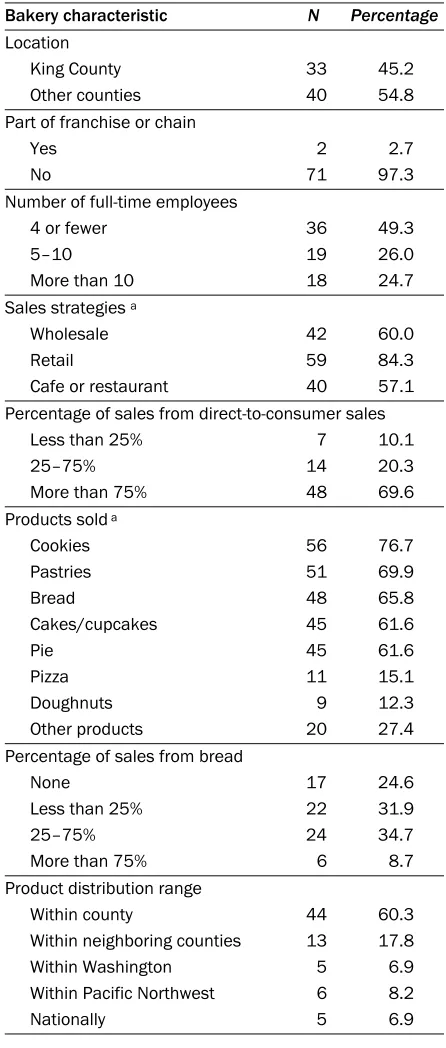
Table 1 presents descriptive statistics for the surveyed bakeries. Of the 73 survey respondents, 45 percent were located within heavily populated King County, which includes Seattle. Eighty-nine percent were bakery owners, 88 percent had only one location, 49 percent employed four or fewer people, 60 percent distributed their products only within their own counties, and 90 percent made at least one-quarter of their sales from direct-to-consumer sales. For 57 percent of respondents, bread sales made up less than 25 percent of their total sales. Annual flour use ranged from 120 lb (54
Table 1. Descriptive Statistics for Surveyed Bakeries
Bakery characteristic N Percentage Location
King County 33 45.2
Other counties 40 54.8
Part of franchise or chain
Yes 2 2.7
No 71 97.3
Number of full-time employees
4 or fewer 36 49.3
5–10 19 26.0
More than 10 18 24.7
Sales strategies a
Wholesale 42 60.0
Retail 59 84.3
Cafe or restaurant 40 57.1
Percentage of sales from direct-to-consumer sales
Less than 25% 7 10.1
25–75% 14 20.3
More than 75% 48 69.6
Products solda
Cookies 56 76.7
Pastries 51 69.9
Bread 48 65.8
Cakes/cupcakes 45 61.6
Pie 45 61.6
Pizza 11 15.1
Doughnuts 9 12.3
Other products 20 27.4
Percentage of sales from bread
None 17 24.6
Less than 25% 22 31.9
25–75% 24 34.7
More than 75% 6 8.7
Product distribution range
Within county 44 60.3
Within neighboring counties 13 17.8
Within Washington 5 6.9
Within Pacific Northwest 6 8.2
Nationally 5 6.9
a Respondents could check more than one answer.
Journal of Agriculture, Food Systems, and Community Development ISSN: 2152-0801 online
www.AgDevJournal.com
kg) for a bakery and deli in a rural area to over 1.5 million lb (over 700,000 kg) for a pita bread bakery with national distribution. Only 7 percent of the bakers milled some of their own flour. This flour accounted for only 11,278 lb (5,116 kg) annually, or 12 percent of total wheat flour used by those bakers owning mills and 0.15 percent of wheat flour used by all respondents.
How Do Commercial Bakers Define “Local”?
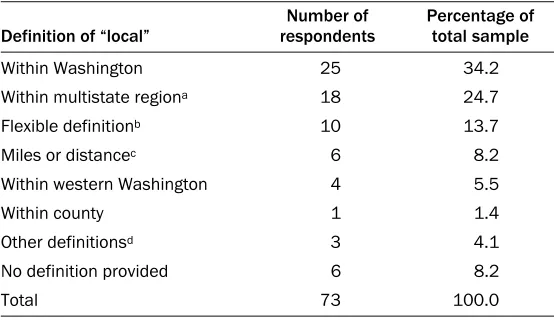
Survey respondents were asked to define local in relation to purchasing flour/wheat for their bakery. Most respondents provided answers based on geopolitical boundaries (state or multistate region) rather than bioregion (e.g., coastal Northwest) or distance (e.g., 100 miles) (table 2). Approximately one-third (34 percent) of respondents defined local as within Washington. Twenty-five percent defined local in terms of a multistate region. Somerespondents referenced the “Pacific Northwest” or “western region” without listing specific states,
while other respondents listed two or more specific states or provinces (mentions included Washing-ton, Oregon, Idaho, Montana, Wyoming, Califor-nia, and British Columbia). Only seven percent of respondents defined local in terms of a county or multicounty region (i.e., western Washington). Eight percent of respondents provided a distance-based definition of local (e.g., 100 miles or 10-hour drive). Twelve percent of respondents either did not answer the question or provided a definition that did not fit the geopolitical boundary or distance categories.
Fourteen percent of respondents provided a flexible (or reflexive) definition of local (table 2). These respondents mentioned two or more defi-nitions of local, such as: “In-state or in-county,” “Vashon Island or WA State,” “Surrounding counties or states,” and “Western Washington — Washington State — Northwest region of U.S.” Several respondents who provided flexible defi-nitions indicated a preference for a smaller rather
than larger geographic range: “Within Washington State but mostly within county limits,” “Pacific Northwest as a general rul