indian J. Plant Physio/ .• Vol. XXVIII No.4. pp. 376-384 (December 1985)
EFFECT OF INORGANIC NITROGEN SUPPLY ON NUCLEIC
ACIDS IN MAIZE LEAVES
S.N. MISHRA AND H.S. SRIVASTAVA
Department of Biosciences. M.D. University. Rohtak-124 001
SUMMARY
Supply of inorganic nitrogen in the from of NOs-. NH,+ and NH, NO. to the maize seedlings increased total RNA and DNA contents of the primary leaves during 8-16 days. Supply of inorganic nitrogen to excised leaf segments from 8-d old dark grown seedlings also, caused some increase in nucleic acid content and this increase was not prevented by the inclusion of tungstate and also to some extent by methionine sulfoximine in the nutrient solution. Decline in RNA and DNA contents in mature (12-16 d) seedlings was prevented to some extent by the supply of nitrogen to intact seedlings and this prevention was not checked by tungstate or methionine sulfoximine. It is suggested that supply of inogranic nitrogen prevents degradation of nucleic acids . in mature leaves.
INTRODUCTION
Increase in organic nitrogenous compounds such as proteins and nucleic
acids during inorganic nitrogen supply to the plants is often interpreted as the
increased synthesis due to assimilation of inorganic nitrogen. However. in a
few instances. increase in protein and chlorophyll contents appear to be partly
due to the prevention of degradation of these molecules (Srivastava 1976,
Mishra and Srivastava 1983, 1985). Nitrogen has been shown to delay sene
scence (Woolhouse and Hardwick 1966, Thomas et ai., 1978) and in those
instances it may prevent the degradation of non-nitrogenous macro-molecules
as well. In the presents investigation, the effect of inorganic nitrorgen on nucleic
acid content of maize leaves, has been studied to evaluate their role in the
synthesis and degradation of nucleic acids.
MATERIALS AND METHODS
377
NUCLEIC ACIDS IN MAIZE LEA YES
dark at 25±2 Co. Seedlings were supplied with
I
strength Hoagland's solution
containing either no nitrogen (control) or
10mM nitrogen in the form of KNO
I •NH4CI or NH4NOa> For some experiments. primary leaves from the seed
lings grown with nutrient solution containing no nitrogen were excised into
pieces and incubated in
!
stregth Hoagland's solution containing either no
nitrogen or nitrogen source as desired. L-methionine sulfoximine (purchased
from Sigma Chemical Co. St. Louis) and sodium tungstate were included in
the incubation medium as desired. The pH of the nutrient solution and of
incubation medium was 6.0.
Extraction and estimation of RNA and DNA were performed by the
method of Ogur and Rosen
(1950)with slight modifications.
RESULTS
Effect of inorganic nitrogen supply on nucleic acid during seedling growth:
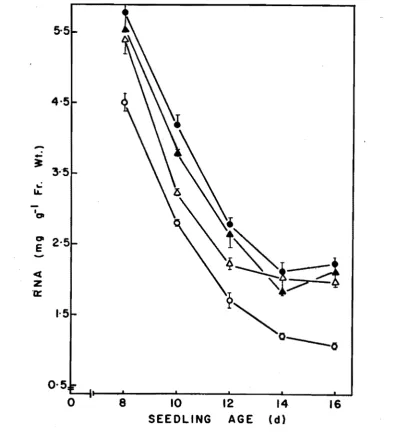
Ribonucleic acid content of the leaves was maximum at 8-d and then declined
upto 14-d in the presence as well as absence of nitrogenous salts (Fig.
1).
A
slight decline in RNA content was observed between 14-and 16-d also, in control
leaves. In the leaves of seedlings supplied with either nitrate or ammonium.
the level of RNA did not change between 14-and 16-d. Although the pattern
of decline between 8-and 14-d with nitrogenous salts was same as in control.
the total RNA content was always higher during nitrogen supply.
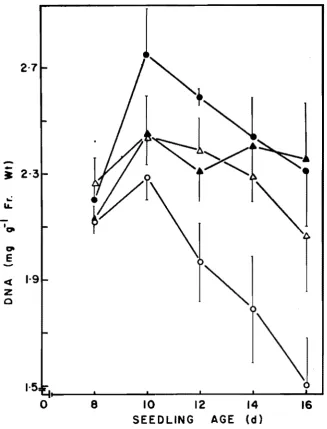
DNA content of leaves from control seedlings increased slightly betwccn
8-and IO-d and then the level declined rapidly upto 16-d at least (Fig.2). The
pattern ,of change in DNA content of KNO
Iand NH4NO. supplied seedlings
f
was also similar to control but the level was always higher with either of the
nitrogenous salts. When seedlings were supplied with NH4CI, the decline in DNA
content after 100d (as observed in control) was not observed.
r
"
Effect of inorganic nitrogen and inhibitor supply on nucleic acid content of
leaf segments from dark grown seedlings:
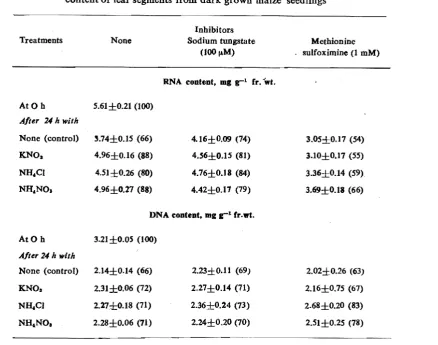
when leaf segments from dark grown
,
378
S.N. MISHRAAND H.S. SRIVASTAVA-
i
2·3
'c:Jt
c:Jt
E
<l
I·g
z
o
1·5
~.----~~----~~----~---~---~--o
8
10
12
14
16
SEEDLING
AGE (d)
Fig. 1. Effect of inorganic nitrogen supply on RNA content of tbe primarY leaves during seedling growtb.
Seedlings were raised in ligbt witb
l
streagtb Hoagland's solution containing desired nitrogen source for different days. In the figure, 0-0 no nitrogen (control). 6.-6. KNO" . - . NH.CI, . - . NH.NO,.NUCLEIC ACIDS IN MAIZE LEAVES 379
observed in the presence of nitrogenous salts also. Tungstate had little effect on
this decline, in the absence as well as presence of nitrogenous salts. Methionine
sulfoximine enhanced the decline slightly in the absence of nitrogenous salts
and in the presence of KN03. However, it increased DNA content slightly in
the presence of NH4CI and NH4NOl.
5-5
4-5
-
-
~3-5
..:
LL.
101
01
2·5
E
-<l
Z It:
1·5
0-5
~;~--8~---~----~----~~
0
10
12
14
16
SEEDLING
AGE
(d)
Fig. 2. Effect of i norganlc nitrogen supply on DNA content of the primary leaves during seedling growth.
380 S.N. MISHRA AND H.S. SRIVASTAVA
Table I: Effect of inhibitors and inorganic nitrogen supply on nucleic acid
content of leaf segments from dark grown maize seedlings
-~.~.-~
Inhibitors
Treatments None Sodium tungstate Methionine
(lOOf,lM) sulfoximine (1 mM)
RNA content, ma
.-1
frowt.
AtOh 5.61±O.21 (100)After 24 h with
None (control) 3.74±O.15 (66) 4.16±D.09 (74) 3.05±O.17 (54) KNOs 4.96±O.16 (88) 4.S6±0.IS (81) 3.10±O.17 (55) NH,CI 4.51 ±O.26 (80) 4.76±O.l8 (84) 3.36±O.14 (59) NH,NO. 4.96±O.27 (88) 4.42±0.11 (79) 3.69±O.18 (66)
DNA content, mg.-1 fr.m.
AtOh 3.21±O.OS (100)
After 24 h with
None (control) 2.14±0.14 (66) 2.23±0.11 (69) 2.02±0.26 (63) KNO. 2.31±O.06 (72) 2.27±0.14 (71) 2.16±0.75 (67) NH,CI 2.27±O.18 (71) 2.36±0.24 (73) 2.68±0.20 (83) NH&NOa 2.28±O.06 (71) 2.24±0.20 (70) 2.51±0.25 (78)
... -.~--~---.
Primary leaves from 8...(1 dark grown seedlings raised without nitrogen, Were excised and floated on
i
strength Hoagland's solution containing desired nitrogenous salts and the inhibitor, in light for 24 h. Relative values to 0 h (8-d old leaves) values are given in parentheses.Effeet of inhibitors :_on stability of nucleic acid content in mature leaves:
..t\I
NUCLEIC AClDS·IN MAIZE LEAVES
381
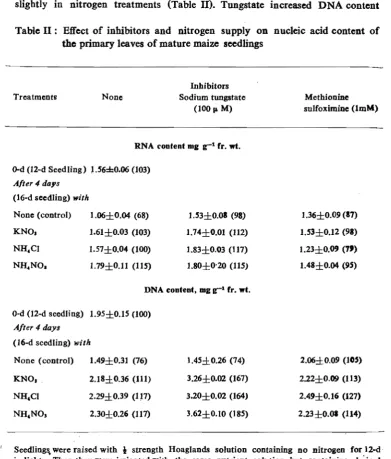
sulfoximine inhibited the decline in RNA content in the presence of KNO. and
NH4N03 and also to some extent in NH4CI and control.
DNA content of the primary leaves decreased in control and increased
slightly in nitrogen treatments (Table
II). Tungstate increased DNA content
Table II: Effect of inhibitors and nitrogen supply on nucleic acid content of
the primary leaves of mature maize seedlings
Inhibitors
Treatments None Sodium tungstate Methionine
(100 Il M) sulfoximine (lmM)
RNA ('ontent mg g-1 fl'. 1ft.
o-d (12-d Seedling) }.S6::%:0.06 (103)
Alter 4 days
(16-d seedling) with
None (control) 1.06±O.04 (68) l.S3±0.01 (98) KNO, 1.61±0.03 (103) 1.74±O.01 (112) NH.Cl 1.57±0.04 (100) 1.83±0.03 (117) NH.NO. 1.79±0.1l (115) 1.80±0·20 (115) DNA ('ontent, mg g-l fro wt. O-d (12-d seedling) 1.95±0.ls (100)
Alter 4 days (16-d seedling) with
None (control) 1.49±0.31 (76) 1.4s±0.26 (74)
KNO, . 2.18±O.36 (111) 3.26±0.02 (167) NH,CI 2.29±0.39 (117) 3.20±0.02 (164, NH,NO, 2.30±0.26 (117) 3.62±O.10 (185)
l.36±0.09 (17) 1.S3±0.12 (98) 1.23±0.09 (7P)
1.48±0.04 (95)
2.06±0.09 (10') 2.22±0.09 (113) 2.49±0.16 (127) 2.23±0.01 (1l4)
382
S.N. MISHRA AND H.S. SRIVASTAVAfurther in the presence of nitro genous salts. The level in the presence of meth io·
nine sulfoximine was also slightly higher than in its absence in each case except
with NH"N03.
DISCUSSION
Total RNA and DNA contents of maize leaves were affected by the
supply of inorganic nitrogen. During a growth period of 8 to 16 days, there
was a gradual decline in total RNA content of the leaves from control as well
as from nitrogen trea ted seedlings (Fig.
1).Decrease in either total RN A or
in m-RNA content with ageing has been demonstrated in soybean (Abdul-baki
and Chandra 1977, Naito et ai., 1978), Festuca (Pearson et al.• 1978) and
tobacco (Wollgiehn et al., 1976) leaves, which is either because of decreased
RNA polymerase or increased nuclease activity (Galston et ai., 1978), Supply
of inorganic nitrogen has no effect on the decline although it maintains
comparatively higher level of RNA.
Changes in DNA content during early seedling growth shows two phascs :
(i)increase between 8-and 10·d and
(ii)a steep decline bctween lO-and 16·d
(Fig. 2). Inorganic nitrogen supply increases DNA possible
byincreasing its
synthesis during the first phase and by protecting its degradation during the
.Iecond phase. The protection of degradation is almost complete
with
ammonium salts. Decline in nucleic acid content including that of DNA with
increasing age of plants has been observed in potato (Singh et ai., 1978), bean
(Naito et al., 1978), pea (Bryant et ai., 1676) and oats (Tester, 1977). Effect of
nitrogenous salts on nucleic acid metabolism varies to some extent according
to the system. Thus, while supply of KNO
shas no effect on nucleic acid
content in lettuce ssedlings (Knypl and Chylinska 1973), it increases the same
in Cuscuta seedlings (Chwhan and Srivastava 1979).
The present experiments clearly demonstrate that the supply of inorganic
nitrogen protects decline in DNA and to some extent in RNA content also
during senescent phase. Since the increase in DNA content is not inhibited
by the inhibitors of inorganic nitrogen assimilation (tungstate and methionine
sulfoximine), it can be inferred that the increase is not due to assimilation of
inorganic nitrogen into precursors of nucleic acids. Consistent with this
assumption, the activity of aspartate transcarbamylase, the key enzyme in the
biosynthesis of nuc1eotides, is quite low in mature and senescent leaves (Johnson
r:')S)A
NUCLEIC ACIDS IN MAIZE LEAVES
383
One of the possible ways of protecting DNA degradation by inorganic
nitrogen may be through cytokinin level whose biosynthesis is reported to be
increased in Vinca rosea cells with ammonium supply and in Acer pseudoplantanus
and Betula pendula with nitrate (Peterson and Miller 1976, Darral and wareing
1981). Further, delay in breakdown may also be affected through decreased
activity of specific nucleases.
REFERENCES
Abdul·baki. A.A. and Chandra, G.R. (1977). Effect of rapid ageing on nucleic acid and protein synthesis by soybean embryonic axes during germination. Seed Sci.
Technol.• 5 : 689-698.
Bryant, J.A .• Greenway. S.C. and West. A.G. (1976). Development of nuclease activity in cotyledons of Pisum sativum L. Planta. 130: 137-140.
Chauhan. J.S. and Srivastava. H.S. (1979). Free and protein amino acids and nucleic acid content in Cuscuta seedlings cultured on different nitrogen sources. Plant
Biochem. J., 6 : 7-15.
Darral, N.M. and Wareing, P.F, (1981). The effect of nitrogen nutrition on cytokinin activity and free amino acids in Betula pendula Roth. and Aeer pseudoplantanus L. J. Expt. Bot.• 32: 369-379.
Galston. A.W .• Altman. A. and Sawhney. R.I{. (1978). Polyamines, ribonuclease and the improvement of oat leaf protoplasts. Plant Sci. Lett•• 11 : 69-80.
Johnson. L.B., Niblett. C.L. and Lee. R.F. (1976). Effects of inhibitors of RNA and protein synthesis on aspartate transcarbamylase activity in etiolated plant tissue. Plant
Physiol.• 58 : 232-236.
Knypl. J.S. and Chylinska, K.M. (1973). Stimulation of protein and nucleic acid synthesis by,KNO. and benzylamino purine in lettuce cotyledons. Z. Pjianzenphysiol.,
70 : 414-419.
Misbra. S.N. and Srivastava, H.S. (1983). Role of inorganic nitrogen in the synthesis and degradation of chlorophyll and carotenoids in maize leaves. Bioi. Plant., 25:
21-27.
Mishra, S.N., and Srivastava. H.S. (1985). Role of inorganic nitrogen in synthesis and degrada· tion of protein in maize leaves. Indian J. Plant Physiol, 18 : 43-52.
Naito, K., Tsuji, H. and Hatakeyama, I. (1978). Effect of jbenzyladenine on DNA, RNA. protein and chlorophyll contents in intact bean leaves: Differential responses to benzyleadening according to leaf age. Plrysiol. Plant., "3: 367-371.
Ogur, M. and Rosen. G. (1950). The nucleic acids of plant tissue: The extraction and estimation of deoxypentose nucleic acid and pentose nucleic acid. Arelr.
Bioclrem., 2S: 262·276.
Pearson, I.A.• Thomas.I{. and Thomas, H. (1978). Nucleic acids from leaves ofa yellow· ing and a non-yellowing variety of Festuca protensis Huds. Planta, 1 .. 4: 85-87.
Peterson, J.B. and Miller,
e.o.
(1976). Cytokinins in Vinca rosea crown gall tumor tiSSUCIas influenced by compounds containing reduced nitrogen. Plant Physiol., 57 :
384
S.N. MISHRA AND H.S. SRIVASTAVA8ingh, 8.S., Singh, M. and Sanwal. 0.0. (1978). Nucleases and nucleic acids durin,g matura tion and following dormancy of potato tubers. Z. Pjlanzenphysiol., 88 : 377-381. Srivastava, H.S. (1976). Some aspects of nitrate assimilation in the seedlings of normal
and opaque-2 mutant of maize. J. Expt. Bot., 27: 12JS-t222.
Tester, C.P. (1977). Nucleic acid metabolism in the developing primary leaf and senes cing coleoptile of germinating oats. Physiol. Plant. 41 : 3OS-3ll.
Thomas. S.M., Thome. O.N. and Pearman. T. (1978). Effect of nitrogen on growth, yield and photorespiratoryactivity in spring wheat. Ann. Bot., 42: 827-837.
Wollgiehn, R .• Lerbs. S. and Munsche. D. (1976) Synthesis of RNA in chloroplast from tobacco leaves of different ages. Biochem. Physiol. Pjlanzen., 170: 381-387. Woolhouse, H.W. and Hardwick, K. (1966). The growth of tomato seedlings in relation