Knowledge management in biomedical libraries:
A semantic web approach
Damaris Fuentes-Lorenzo&Jorge Morato& Juan Miguel Gómez
Published online: 12 February 2009
#Springer Science + Business Media, LLC 2009
Abstract In recent years, technological advances in high-throughput techniques and efficient data gathering methods, coupled with a world-wide effort in computational biology, have resulted in an enormous amount of life science data available in repositories devoted to biomedical literature. These repositories lack the ability to attain an effective and accurate search. Using semantic technologies as the key for interoperation enables searching and processing of biomed-ical literature in a more efficient way. However, emerging semantic applications take for granted specific knowledge that biomedical researchers may not have. This paper presents design principles for easy-to-use biomedical semantic applications by means of ontology-based annota-tions and faceted search. The proposed approach is backed with a usable prototype that shows the breakthroughs of adding these principles to a biomedical digital library where identifying and searching information are critical aspects for non-semantic Web experts.
Keywords Semantic web . Annotation . Faceted browsing . Digital libraries . Biomedical data . Usability
1 Introduction
As discussed in Cohen (2004), it is undeniable that biology
and medicine played a key role in the twentieth century. Over the last 15 years, a dramatic transformation in the practice of life sciences research has been witnessed. One of the central factors promoting the importance of biology is its relationship with medicine. Fundamental progress in medicine depends on elucidating some of the mysteries that occur in the biological sciences. However, biomedical research is now information intensive; the volume and diversity of new data, as shown in Jurisica and Glasgow
(2006), challenge traditional database technologies.
The Semantic Web has emerged as an attempt to provide machine-processable metadata to the ever increasing infor-mation resources on the Web. As its creator Tim
Berners-Lee said (Berners-Berners-Lee et al. 2001), the Semantic Web“is
not a separate Web, but an extension of the current one, in which information is given well-defined meaning, better enabling computers and people to work in cooperation”.
Therefore, the breakthrough of adding semantic metadata to biomedical applications is providing a new level of data and process integration that can be leveraged to develop novel high-performance data and process management systems. The two-pronged use of ontologies allows humans to grasp the meaning of any element and, secondly, allows machines to have formal semantics to support reasoning.
The remainder of the paper is organized as follows.
Section 2 describes the motivation statement for the
research. Section 3 identifies the problems which arise
when semantics or Semantic Web techniques are applied to
traditional applications. Section 4 mentions and compares
different related works that try to overcome those problems.
In Section 5, the solution is presented, implemented in
BioSem, a prototype for semantic social-oriented manage-D. Fuentes-Lorenzo (*)
IMDEA Networks,
Av. del Mar Mediterráneo 22, 28918 Madrid, Spain
e-mail: [email protected]
J. Morato
:
J. M. Gómez Carlos III University, Av. de la Universidad 30, 28911 Madrid, SpainJ. Morato
e-mail: [email protected]
J. M. Gómez
ment of biomedical literature. Conclusions are discussed in
Section6and finally, future work is presented in Section7.
2 Motivation
When the Web appeared into the arena, it made biomedical
literature available across applications (such as Medline1or
PubMed2), departments and entities in general. However, throughout these developments, a particular underlying problem has remained unsolved: articles are stored in a weak structure (or not structured at all), a disadvantage that sometimes makes this information unusable. At best, when the resources (i.e. articles or papers) are categorised, metadata used reside in thousands of incompatible formats and cannot be systematically managed, integrated, unified or cleaned. To make matters worse, this incompatibility is not limited to the use of different data technologies or to the multiple different “flavours” of each technology (e.g. different relational databases in existence), but also extends to an incompatibility in terms of semantics.
For example, one database or metadata source could
have a term called “Tylenol”, intending to model a
particular drug and classifying its function, categorizing it and relating it with some other similar drugs. Another
source could simply refer to the same concept as “DCI”,
“acetaminophen”or“NO2 BE01”. These concepts (despite
being the same) will never be related or correlated as synonyms, except when specified by a user. If a particular researcher wants to know all the information published
about “Tylenol”, he will not be able to obtain a detailed
overview of the information, since the concepts used to categorize the resources are absolutely unrelated. In a larger context, this problem may be multiplied by thousands of data structures located in hundreds of incompatible sources
and formats. In fact, in (Hoffmann and Valencia2005) it is
stated that there are 19 synonyms on average for every gene (with a total of 3.2 millions of synonyms) in the Gene Synonym Dictionary.
Therefore, as the information-retrieval tools currently available to researchers in biomedicine lie far behind the possibilities that a suitable management tool should offer, the need for an online service that provides a way for efficiently accessing millions of linked scientific literature documents, becomes obvious.
3 Problems
The increasing volume of textual information being stored without a clear structure makes applications in the worst cases useless. Actually, applications such as digital libraries can not be used as fully-fledged tools to create and search knowledge in an efficient way, because the information collected within these systems lies unused by computers, mainly due to the human language in which the resources are written and classified. As further processing is needed, new formal approaches are needed to make computers “understand”and interpret the Web content.
In the following list, the problems which emerge when constructing a semantically-enhanced biomedical literature environment are described, including technical and social factors:
& Metadata representation format. Metadata support for the actual information in any biomedical application must be explicitly declared. Some of the current social
tools such as the Web 2.0 applications like Flickr
(http://www.flickr.com) ordel.icio.us(http://del.icio.us/)
apply so-called“folksonomies”to add meta-information
by means of tags chosen by the user (O’Reilly2005). In
this case, even though usability may be high, tags are different among different users; since tags are chosen freely, they cannot be fully exploited in a community in terms of knowledge discovery, as presented by
statisti-cal reports in (Chi and Mytkowicz2007).
& Navigation. Hypermedia authoring applications base the relation between resources in explicit hyperlinks. These links relate one page to another basically according to user considerations (if the user authoring considers they are related). According to a study by (Désilets et al.
2005), the lack of adequate support for link creation and
management is a key usability problem amongst authoring applications. If the relation between pages or pieces of data were represented by means of semantics, the application would be able to provide mechanisms to semantically navigate between related resources with real meaning.
& Search. Given a set of resources, the basic type of querying in current digital libraries is the keyword-based search. Structured requests for more advanced informa-tion retrieval are needed in order to convert a biomedical library to a useful knowledge repository. In addition to simple full-text searches, users must be able to search biomedical literature by querying the semantic knowl-edge, avoiding syntactic-related problems such as articles with related synonymous words, which are related but not returned when a search query is performed.
& Integration. Biomedical applications may need the integration and analysis of diverse types of data that 1
Medline:http://www.nlm.nih.gov/medlineplus/spanish/encyclopedia. html
2
can be distributed across many heterogeneous data-bases. Nevertheless, their structural schemas and their contents are not exposed in a standardized machine-processable way to allow seamless integration.
& Usability. Communities need both a critical mass of users and their participation. Without this mass, users will abandon the systems underlying these communities
(Ignacimuthu 2004). For that purpose, applications
enhanced with semantic functionalities have to be designed with maximum usability and minimum cog-nitive load for every user, independently of their exper-tise level.
The Semantic Web paradigm is based on the traditional Web, enhanced with formal knowledge placed below the current information. This is possible thanks to the extensi-bility of the Web with semantic metadata and semantic metadata processing, which allows computational reasoning
and intelligent capabilities (Berners-Lee et al. 2001). The
fundamental aim of the Semantic Web is to provide a response to the ever-growing need for knowledge integra-tion on the Web. One of the main benefits of adding semantics is bridging nomenclature and terminological inconsistencies to comprehend the underlying meaning in a unified manner.
The next section describes some previous approaches which have applied Semantic Web techniques in order to develop semantically interoperable environments.
4 Related work
Applying Semantic Web techniques to digital libraries and content management applications is an advancing field which has already been the subject of extensive research.
Concerning digital libraries, JeromeDL (http://www.
jeromedl.org/) intends to apply semantic knowledge to traditional digital libraries. However, semantic data makes assumptions about the articles in general, not focusing on semantic information within their contents. Apart from that, the inclusion of semantic information still has to be carried out programmatically; that is, authoring functionalities are not available.
Approaches for authoring semantic desktop applications have already been initiated, such as the ones in Decker et al.
(2006).iAnnotate Tabis an OWL-basedProtégéplug-in for manually annotating text or Web documents with ontolog-ical concepts. A user can select a fragment of text and create instances for a given concept. Besides the drawback
of having to install Protégéand the plug-in itself, there are
no navigability or search functionalities and so the text annotations remain useless.
Apart from these desktop applications, Web approaches have also been implemented. Personal semantic wikis, such as SemperWiki (Oren et al. 2006) are created for personal use, where users can embed RDF statements within their normal text. Even though included in the text, these statements refer to information which relates to the whole
page and not particular fragments in the content. Makna
and MultiMakna (Nixon and Paslaru2006) are also wiki-based applications extended with principles from multime-dia and semantics research. However, the annotations are not particularly intuitive for a user without any specific knowledge the about Semantic Web. An example of the
annotation view is presented in Fig.1, where the user must
understand what a subject is in an RDF triple statement. Furthermore, the annotation view appears separately from the content-edition view.
Semantic MediaWiki (SMW, http://ontoworld.org/wiki/)
is an extension of MediaWiki—the wiki-system powering
Wikipedia—with semantic technology (Krötzsch et al.
2006). However, this application is focused on the
Semantic Web community, and still lacks user-friendliness
for a user with no semantic knowledge.IkeWikialso allows
users to annotate pages and links between pages with
semantic annotations (Schaffert 2006). All annotations in
both Semantic MediaWiki and IkeWiki are always with respect to the current document (annotations are merely properties about a document). These applications, along withMakna, seem to be rather more advanced thanBioSem; however, the intended users in these applications must also have an advanced level. Moreover, the annotation view is separated from the normal editing environment (you have to use a separate annotation mode).
Regarding design principles, some of the preconditions
in Möller and Decker (2005) have been taken into account
for the design of the current system, as will be shown in the next sections. Besides, multi-ontologies and knowledge-layered frameworks such as ours have been provided in
Xiao and Cruz (2006), however, with a different focus.
Fig. 1 An example of the
In what follows, it is explained how to solve the short-comings existing in the above and other Semantic Web applications, both in theory and in practice, in order to achieve the development of an efficient biomedical digital library.
5 Reaching semantics in biomedical systems: BioSem
Given the aforementioned problems characteristic of those faced by traditional semantic applications, the proposed approach is explained here, based on several design principles to solve these drawbacks, and built as a socially-oriented
environment for literature management,BioSem.
5.1 Semantic representation
Design Bearing in mind that metadata processing requires a controlled and well-defined vocabulary, the Semantic Web developed ontologies as the best mechanism to represent, share, reuse and integrate the knowledge hidden within text. One of the most well-known definitions of ontology is the one stated by Borst (extending Gruber’s one (Gruber
1993)), who defines it as “a formal specification of a
shared conceptualization” (Borst 1997). Progress has
already been made to organize biological or medical knowledge in a conceptual way by developing ontologies
and domain-specific vocabularies, such as GALEN (http://
www.opengalen.org/), UMLS (http://www.nlm.nih.gov/re search/umls/) or ON9 (http://saussure.irmkant.rm.cnr.it / ON9/index.html). However, we have found that ontologies designed from medical terminology are not well modeled as
ontologies. Most of these‘translations’model every term as
classes, when this is not exactly correct (e.g. a specific vitamin, such as vitamin B9, is not a subclass of vitamin, but an individual of vitamin class), giving as a result another taxonomy, but not a real ontology. Therefore, in BioSemontologies have been selected as the representation mechanism rather than folksonomies.
Implementation BioSem ontologies can be represented using the various standards proposed by the World Wide
Web Consortium (W3C), such as theResource Description
Framework (RDF) (World Wide Web Consortium 2006a)
or theRDF Schema(World Wide Web Consortium 2004).
Web Ontology Languagemay also be suitable (World Wide
Web Consortium 2006b), since it also provides inference
mechanisms to allow reasoning. Other research is being carried out in this area, where some of the more standardized medical ontologies are being developed using
OWL, such as SNOMED (Wroe 2006). Also, some other
research is developing database schemas definitions to
conform to W3C standards, allowingBioSem to use them
as domain ontologies (Lam et al.2006,2007).
5.2 Semantic scope
Design As every piece of content in BioSemis a resource, they must be first described as such. Once identified, the resources must be described with regard to their content.
Implementation Dublin Core initiative (DC, http://dublin core.org/) is appropriate as the main ontology for describing
the minimal piece of data in BioSem; every paper is
semantically enhanced with DC metadata. Then, one or more biomedical ontologies are used for formalizing the real domain of the content. The basic domain ontology used for the first version of the prototype is an OWL ontology
for biological pathways called BioPax(http://www.biopax.
org). It should be noted that more than one different domain
ontology could be used, and that these potentially different domains could be integrated with ontological engineering processes such as merging or alignment. In this application stage, we have opted for this ontology because is more general and rather reduced, and it is more suitable for the interaction of the users who will participate in the future evaluation study.
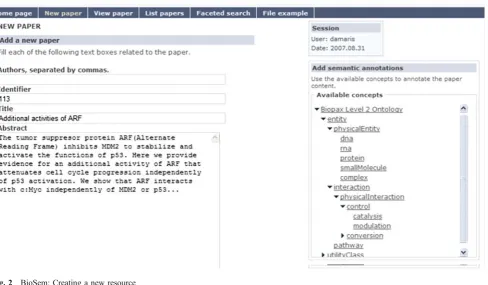
In Fig.2an example of how the ontology is presented to
the user inBioSem is illustrated.
Users write the title and authors of a paper, separate from
the content3. These metadata properties are stored asDublin
Core terms of this new resource. The only requirement
requested from the user is to fill in the text boxes in a form; it is not necessary to hold knowledge about DC vocabulary. This is in contrast to what is expected of users in other
semantic authoring applications such as SemperWiki(Oren
et al. 2006), where users themselves have to type DC
properties and their intended values.
5.3 Creating semantics
Design Authoring the resources in a semantic-based bio-medical application must be made just as easy as authoring them for a traditional one. For this purpose, editing the resources must be done at the same time and in the same view panel as editing the semantic content. The way the user adds the DC metadata to the global paper has been
presented in Fig. 2. To add semantic information to the
content itself, BioSem makes use of the semantic
annota-tions to fill the gap, where annotating a document means
adding semantic data to it (McEnery and Wilson2001).
3
Implementation As Fig.3illustrates, users are provided with tree-like structured semantic information to add; therefore, while editing a paper, they can annotate a word or a set of words with semantic data, just as easy as marking the selected words on the text and associating them with a vocabulary concept from the ontology domain. The text changes automatically to include the related concept within brackets.
InBioSem, there are two ways of adding semantic data to the information:
& Relating the content with an existing instance. In this case, the tree does not display only the concept, but also the concrete individual. To illustrate this by means of an
example, suppose the concept “Gene”, and one of its
associated instances handling below,“Apoe E4”. This is
usual with ontologies in thesaurus form such as the NCI
thesaurus, available at the OBO Foundry (http://obo
foundry.org/cgi-bin/detail.cgi?ncithesaurus), also in OWL format.
& Relating a resource with a new instance. In this case, the concept is modelled in the ontology, but there are
not yet any individuals related to the concept. The annotation has both to create the instance, and to relate
it to the paper content, as Fig. 3shows.
5.4 Navigation
Design The user interface must enable navigation between
semantically-related items (Teevan et al.2004) and ordinary
hyperlinks are not sufficient to display this kind of
information. For this reason, semantic links, or semalinks
are proposed, which are ordinary hyperlinks in appearance but built upon the semantic information. This semantic link, which consists of both the ontological concept to which a certain part of the content is referring and its value (that is, the instance created while authoring), leads the user to resources with a semantically similar content, as this semalinkinformation indicates.
Implementation Figure 4 shows the visual information a semalink can provide. As depicted in Fig. 3, the word “ARF”was annotated as“protein”.
Fig. 2 BioSem: Creating a new resource
Fig. 3 BioSem:
When this paper is provided to the user,BioSemtransforms
this annotation into asemalink. If the user places the mouse
over this link, graphical nodes appear upon the text (see
Fig.4). These graphical nodes make reference to:
& Resources that were annotated with both the concept
and value the semalink indicates. In the example, the
user can navigate to papers annotated with a “protein”
called“ARF”. Notice that if a paper was annotated with
a“virus”concept called also“ARF”, this paper would
not appear in thesemalink references. This is because
“ARF”-virus annotation has the same value as “ARF”-protein annotation syntactically, but not semantically. & Resources that were annotated with any pair of
semantic concept and value that fits with any of the
values of any of the properties of thesemalinkinstance.
Imagine the “protein” class has a property called “is
involved”, and the range of this property is an“illness”.
Suppose then that “ARF” instance “is involved” in
“cancer” (e.g., another instance). Then, the semalink will show graphical nodes making reference to other
papers that were annotated with“cancer”as“illness”.
The information related could have been presented to the
user keeping a metaphorical RDF network, such asWikSar
(http://wiki.navigable.info/) or the Fenfire project (http://
fenfire.org/) does. However, as this is not scalable for large
data sets, BioSem shows the directly related information
(that is, the one related with the direct properties of a concept).
5.5 Faceted search
Design Since keyword-based searches or other different syntactical queries are not an efficient retrieval mechanism, and provided that semantic information is the basis of the current system, a more advanced search is required. A facet-based search is the solution. With faceted metadata
(Ranganathan 1962), the information space is partitioned
using orthogonal conceptual dimensions of the data. These
dimensions are called facets, and represent the
character-istics of the information elements. These facets are then used to select or filter the relevant elements in a certain information space, leading users to the exact information required.
Implementation InBioSem, the information elements are the papers of the library; a facet is a pair formed by a concept and its value; that is, a facet is a semantic annotation.
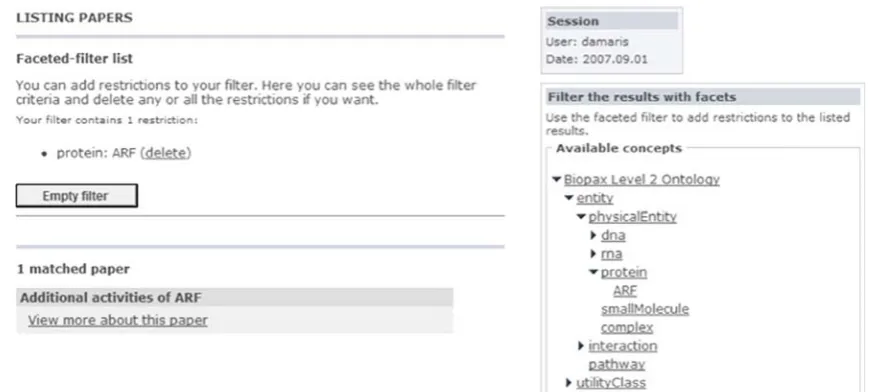
If the user wants to search a certain resource, a faceted filter
is provided (see Fig. 5). For this example, the tree view
shows the possible instances in the repository, originating from their parent classes. As can be seen, a new individual
appears under“protein”concept,“ARF”. When the instance
is selected, a new restriction is added to the faceted filter.
Figure5shows also the results of applying the filter with the
“protein” concept and the “ARF” value as one of its restriction facets; the information space is reduced to the exact resource the user is interested in.
Fig. 4 BioSem: Rendered paper with graphical nodes
5.6 Architectural and programming features
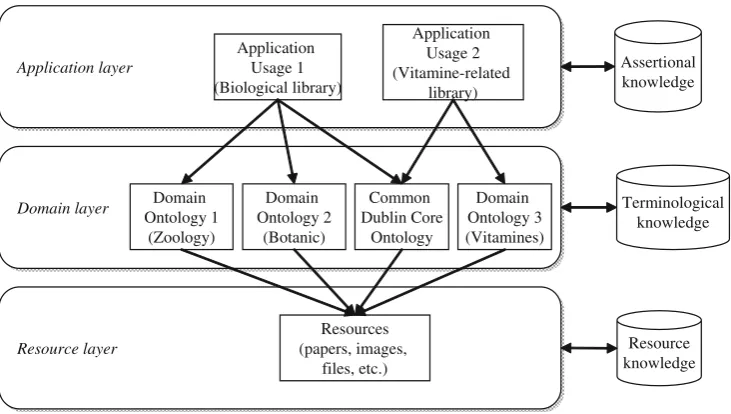
Architecture Taking into account the different levels of knowledge (ontologies, resources, etc.), these levels are divided into three layers:
& Resource layer. This layer manages the textual resour-ces of the biomedical application; that is, the papers. & Domain layer. This layer deals with the ontologies used
to formalize the semantic information for both the resources (DC vocabulary) and their content.
& Application layer. This layer, supported on top of the previous one, is built with the domain ontologies the application requires and it is applied to the resources in the first layer.
Keeping these knowledge layers conceptually separated, the BioSem implementation guarantees the flexibility and reusability of the biomedical application for every kind of bioinformatics domain.
Figure6 shows the framework of this approach, along
with named examples for better understanding. The Domain layer holds the different domain ontologies that
can be used. The Application layer uses one or more
domain ontologies depending on the type of topics the application is going to deal with, and creates the possible semantic instances (assertional data). The Dublin Core Ontology is used to represent the basic metadata concepts of every resource, such as title, authors, etc.
Programming BioSem is implemented by means of Ruby on Rails(RoR,http://www.rubyonrails.org) (Thomas et al.
2005), a Model View Controller-based framework which
eases the task of building this architectural pattern, built
upon the scripting languageRuby. The researchers
consid-ered that this framework provides two basic characteristics which facilitates the development of Semantic Web applications:
& Rails eases the maintainability of the
Model-View-Controller pattern (Reenskaug 1979) while developing
the application.
& A dynamic scripting language,Ruby, as opposed to static languages, to build the semantic digital library. As stated
in Oren et al. (2007a, b), there may be mismatches
among RDF and compiled (static) object-oriented lan-guages. One of them is the inheritance; in common OO type systems, classes can only inherit from at most one superclass, while RDF(S) classes can inherit from multiple superclasses. The other important issue is the flexibility. OO compiled systems usually do not allow class definitions to evolve during runtime. However, RDF is designed for integration of heterogeneous data with varying structure, from varying sources, and this is especially critical in biomedical domain.
Pages are presented to the user in XHTML 1.0 syntax, combined with Cascade Style Sheets (CSS) and visual graphics for navigation, made with JavaScript libraries such as CoolTip(http://www.acooltip.com). Emerging
technolo-gies such as AJAX (Garrett 2005) have been used to
implement the ontology tree, which can load data asyn-chronously as the user needs it. Desktop applications are characterized by rich and responsive features which are frequently unavailable on the Web. This leads to better usability, in the sense of providing a quick response to user requests. With the classic Web applications, the user is obliged to wait when some process is being executed on the server side, and this is especially crucial when it is required to display large sets of data, such as those characteristic of
Resource layer Resource layer Domain layer Domain layer
Application layer Application layer
Application Usage 1 (Biological library)
Application Usage 2 (Vitamine-related
library)
Common Dublin Core
Ontology Domain
Ontology 1 (Zoology)
Domain Ontology 2
(Botanic)
Domain Ontology 3 (Vitamines)
Resources (papers, images,
files, etc.)
Resource knowledge Assertional knowledge
Terminological knowledge
Fig. 6 BioSem knowledge
some biomedical domains. With the technologies involved in AJAX, just the appropriate fragment of a web page is updated on the server side, so the client does not have to wait any longer.
Persistence repositories areMySQL server for resources
information and SQLite- based RDFLite, for semantic
information. Finally, BioSem usesActiveRDF (Oren et al.
2007a,b), a library for abstracting the queries forRDFLite
within the implementation inRoR.
6 Comparison
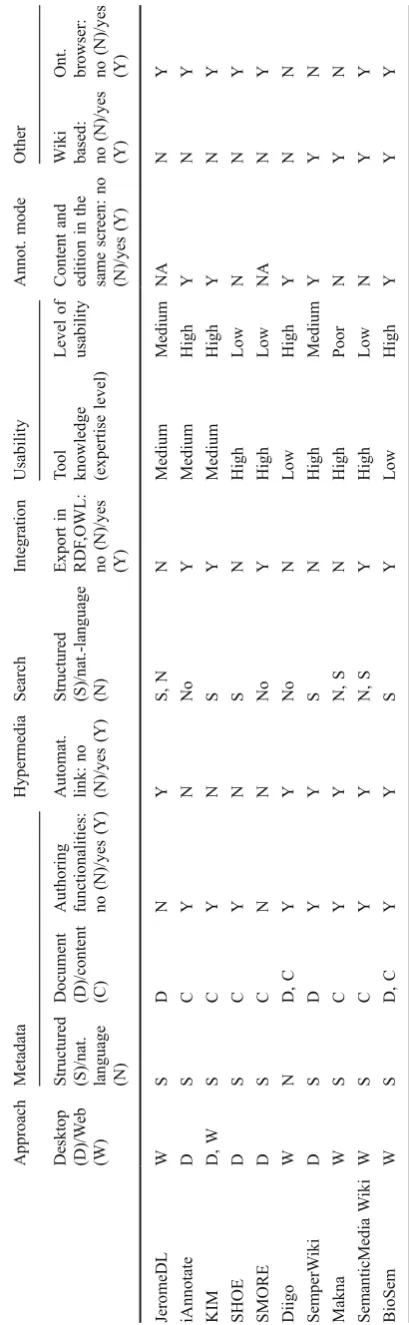
The following table shows a brief comparison ofBioSem
functionality against the functionality in similar digital
library applications or annotation tools (Table1).
Notice that even though most of the applications keep the metadata models in a structured way, some of them
have lightweight vocabularies such as JeromeDL4.
As far as the approach is concerned, notice that most of the web-based applications need a prior installation of the wiki software to get running, a time-consuming task that is
not needed withBioSem5.
7 Conclusions
This paper has presented a new vision for a semantically-enhanced digital library in the biomedical domain, where authoring and adding semantic data are easily performed thanks to guided semantic annotations. Faceted searches and graphical visualizations help the user to find more accurate information and semantically-related data when needed. Components in the architecture are loosely coupled in order to provide flexibility in the implementation phase and to provide extensibility for applying the architecture in any domain of bioinformatics.
In spite of the fact that most of the features presented have been developed separately in other related work, the work presented here gathers all the state-of-art advantages stated there, avoiding the pitfalls of their current
imple-mentations (see Section 4 to see the most characteristic
shortcomings). BioSem development is based on design
principles which take into account the two most important ends of the line of biomedical science and the Semantic Web paradigm: research and knowledge.
T able 1 Comparison among applications Approach Metadata Hypermedia Search Integration Usability Annot. mode Other Desktop (D)/W eb (W)
Structured (S)/nat. language (N) Document (D)/content (C) Authoring functionalities: no
(N)/yes (Y) Automat. link: no (N)/yes (Y)
Structured (S)/nat.-language (N)
Export in RDF ,OWL: no (N)/yes (Y) T
ool knowledge (expertise
level) Level of usability Content and edition in the same screen: no (N)/yes (Y) W iki based: no (N)/yes (Y)
Ont. browser: no
(N)/yes (Y) JeromeDL W S D N Y S , N N Medium Medium NA N Y iAnnotate D S C Y N N o Y Medium High Y N Y KIM D, W S C Y N S Y Medium High Y N Y SHOE D S C Y N S N High Low N N Y SMORE D S C N N N o Y High Low NA N Y Diigo W N D, C Y Y N o N Low High Y N N SemperW iki D S D Y Y S N High Medium Y Y N Makna W S C Y Y N , S N High Poor N Y N SemanticMedia W iki W S C Y Y N , S Y High Low N Y Y BioSem W S D, C Y Y S Y Low High Y Y Y 4 www.jeromedl.org 5
8 Future work
The kernel of this application looks promising to be the focus of multiple approaches in E-Science. Some of them are stated below:
& Navigating through health data records. The BioSem digital library could focus on health-records annotation. This would serve as a base for better health care in medicine, with the possibility for health researchers to find similarities in illnesses and improve the current diagnoses. & Application to manage biomedical ontologies. In this
paper, the reader has seenBioSem can create the
asser-tional knowledge, that is, the individuals (instances) of the
biomedical concepts (e.g. “ARF”protein). In the future,
BioSemcould also be applied to manage the terminolog-ical knowledge: the concepts themselves (e.g. protein). & An application to manage special groups of studies,
such as gene and proteomics analysis. Similar work has
been developed in Bresell et al. (2006) or Camon et al.
(2004) to study gene lists.
& Automatic tagging. The annotation process could be studied to be automatic or semiautomatic, to facilitate the biomedical knowledge generation and transmission.
All these future enhancements toBioSemwould influence
the progress of information retrieval biomedical research.
References
Berners-Lee, T., Hendler, J., & Lassila, O. (2001). The semantic web. Scientific American,284, 34–44.
Borst, W. N. (1997). Construction of engineering ontologies for knowledge sharing and reuse. Enschede: Twente University Press. Bresell, A., Servenius, B., & Persson, B. (2006). Ontology annotation treebrowser: an interactive tool where the complementarity of medical subject headings and gene ontology improves the interpretation of gene lists.Applied Bioinformatics,5(4), 225–236. Camon, E., Magrane, M., Barrell, D., Lee, V., Dimmer, E., Maslen, J., et al. (2004). The gene ontology annotation (GOA) database: sharing knowledge in uniprot with gene ontology.Nucleic Acids Research,32(Database issue), D262–266, England.
Chi, E. H., & Mytkowicz, T. (2007). Understanding navigability of social tagging systems.Proceedings of the SIGCHI Conference on Human Factors in Computing Systems (CHI’07), San Jose, USA. Cohen, J. (2004). Bioinformatics—an introduction for computer
scientists.ACM Computing Surveys,36(2), 122–158.
Decker, S., Park, J., Sauermann, L., Auer, S., & Handschuh, S. (Eds.). (2006).Proceedings of the semantic desktop and social semantic collaboration workshop (SemDesk 2006) located at the 5th international semantic web conference ISWC 2006. Athens, GA, USA.
Désilets, A., Paquet, S., & Vinson, N. G. (2005). Are wikis usable? WikiSym‘05: Proceedings of the 2005 International Symposium on Wikis, San Diego, California. 3–15.
Garrett, J. J. (2005). Ajax: a new approach to web applications. Adaptive Path.
Gruber, T. R. (1993). A translation approach to portable ontology specifications.Knowledge Acquisition,5(2), 199–220.
Hoffmann, R., & Valencia, A. (2005). Implementing the iHOP concept for navigation of biomedical literature.Bioinformatics, 21(2), 252–258.
Ignacimuthu, S. (2004).Basic bioinformatics. Alpha Science International. Jurisica, I., & Glasgow, J. (Eds.). (2006). Knowledge Discovery in High-Throughput Biological Domains. Information systems frontier, 8(1). Hingham: Kluwer.
Krötzsch, M., Vrandecic, D., & Völkel, M. (2006). Semantic MediaWiki.Proceedings of the 5th International Semantic Web Conference (ISWC06), Athens, GA, USA.
Lam, H. Y., Marenco, L., Shepherd, G. M., Miller, P. L., & Cheung, K. H. (2006). Using web ontology language to integrate heterogeneous databases in the neurosciences.AMIA Annual Symposium Proceed-ings, 464–468.
Lam, H. Y., Marenco, L., Clark, T., Gao, Y., Kinoshita, J., Shepherd, G., et al. (2007). AlzPharm: integration of neurodegeneration data using RDF.BMC Bioinformatics,8(Suppl 3), S4 England. McEnery, T., & Wilson, A. (2001). Corpus linguistics (2nd ed.).
Edinburgh: Edinburgh University Press.
Möller, K., & Decker, S. (2005). Harvesting desktop data for semantic blogging. Proceedings of the 1st Workshop on the Semantic Desktop at the ISWC 2005 Conference.
Nixon, L. J. B., & Paslaru, E. (2006). Makna and MultiMakna: Towards semantic and multimedia capability in wikis for the emerging web.Proceedings of the Semantics 2006: From Visions to Applications, Austria.
O’Reilly, T. (2005). What is web 2.0? O’Reilly NetWork, retrieved
from http://www.oreillynet.com/pub/a/oreilly/tim/news/2005/09/
30/what-is-web-20.html
Oren, E., Volkel, M., Breslin, J. G., & Decker, S. (2006). Semantic wikis for personal knowledge management.Database and Expert Systems Applications,4080, 509–518.
Oren, E., Delbru, R., Gerke, S., Haller, A., & Decker, S. (2007a). ActiveRDF: Object-oriented semantic web programming.WWW ‘07: Proceedings of the 16th International Conference on World Wide Web, Banff, Alberta, Canada.
Oren, E., Mesnage, C., Heitmann, B., Haller, A., Hauswirth, M., & Decker, S. (2007b). A flexible integration framework for semantic web 2.0 applications.IEEE Software,24(5).
Ranganathan, S. R. (1962).Elements of library classification: based on lectures delivered at the University of Bombay in December 1944 and in the schools of librarianship in Great Britain in December 1956(3rd ed.). Bombay: Asia Publishing House. Reenskaug, T. (1979).The original MVC reports. Oslo: T. Reenskaug. Schaffert, S. (2006). IkeWiki: a semantic wiki for collaborative knowledge management.Proceedings of the 15th IEEE Interna-tional Workshops on Enabling Technologies: Infrastructures for Collaborative Enterprises (WETICE 2006), Manchester, United Kingdom.
Teevan, J., Alvarado, C., Ackerman, M. S., & Karger, D. R. (2004). The perfect search engine is not enough: a study of orienteering behavior in directed search.CHI ‘04: Proceedings of the SIGCHI Confer-ence on Human Factors in Computing Systems, Vienna, Austria. Thomas, D., Heinemeier Hansson, D., & Breedt, L. (2005).Agile web
development with rails: a pragmatic guide. Raleigh: The Pragmatic Bookshelf.
World Wide Web Consortium. (2004).RDF vocabulary description language 1.0: RDF schema. Retrieved March 30, 2007, from
http://www.w3.org/TR/rdf-schema/.
World Wide Web Consortium. (2006a).Resource description framework (RDF). Retrieved March 30, 2007, fromhttp://www.w3.org/RDF/
World Wide Web Consortium. (2006b). Web ontology language (OWL). Retrieved March, 30, 2007, from http://www.w3.org/
Wroe, C. (2006). Is semantic web technology ready for healthcare? Paper presented at the3rd European Semantic Web Conference (ESWC’06), Budva, Montenegro.
Xiao, H., & Cruz, I. (2006). Application design and interoperability for managing personal information in the semantic desktop. Proceed-ings of the Semantic Desktop and Social Semantic Collaboration Workshop (SemDesk 2006), at the 5th International Semantic Web Conference (ISWC 2006), Athens, Georgia, USA.
Damaris Fuentes Lorenzoholds a B.S in Technical Engineering in
Computer Managements from the Universidad Carlos III, Madrid (Spain) and a M.Sc in Computer Engineering, Development of the Enterprise Information System Specialization. She also holds a M.Sc in Computer Science and Technology, specialized in Software Engineer-ing. She has took up several scholarships in both the Departments of Telematics and Computer Science of the Universidad Carlos III, involved in the latter as a research technician. Currently, she is working as a research assistant at IMDEA Networks, while doing her Ph.D. in Telematics as a member of WebTLab group in the same university.
Jorge MoratoHe is currently a professor of Information Science in the
Department of Computer Science at the Carlos III University of Madrid
(Spain). He obtained his PhD in Library Science from the Carlos III University in 1999 on the subject of Knowledge Information Systems and its relationships with linguistics. Professor Morato has taught courses on Information Retrieval, Search Engine Optimization, Soft-ware Engineering, and Knowledge Modelling Techniques and Man-agement Systems. From 1991–1999, he had grants or contracts from the Spanish National Research Council. His current research activity is focused on text mining, information extraction and pattern recognition, NLP, information retrieval, Web positioning, and Knowledge Organi-zation Systems. He has published mainly on semi-automatic construc-tion of thesauri and ontologies, topic maps, and conceptual and contextualized retrieval of semantic documents.
Juan Miguel Gomez is an Associate Professor at the Computer