The University of San Francisco
USF Scholarship: a digital repository @ Gleeson Library |
Geschke Center
Doctoral Dissertations Theses, Dissertations, Capstones and Projects
2011
Social networking texts among college students :
identity and imagination online
Paul J. Raccanello
Follow this and additional works at:https://repository.usfca.edu/diss Part of theEducation Commons
This Dissertation is brought to you for free and open access by the Theses, Dissertations, Capstones and Projects at USF Scholarship: a digital repository @ Gleeson Library | Geschke Center. It has been accepted for inclusion in Doctoral Dissertations by an authorized administrator of USF Scholarship: a digital repository @ Gleeson Library | Geschke Center. For more information, please [email protected].
Recommended Citation
Raccanello, Paul J., "Social networking texts among college students : identity and imagination online" (2011).Doctoral Dissertations. 216.
The University of San Francisco
SOCIAL NETWORKING TEXTS AMONG COLLEGE STUDENTS: IDENTITY AND IMAGINATION ONLINE
A Dissertation Presented to
The Faculty of the School of Education Department of Leadership Studies Organization and Leadership Program
In Partial Fulfillment
of the Requirements for the Degree Doctor of Education
By
Paul J. Raccanello San Francisco
ii
Copyright 2011 by
Raccanello, Paul James
iii
THE UNIVERSITY OF SAN FRANCISCO
Dissertation Abstract
Social Networking Texts among College Students: Identity and Imagination Online
This research studies the significance of online social networking in the
lifeworld of the millennial student. The focus of this research is to come to a new
understanding of how the created online profiles influence identity formation and
understanding, as well as the capacity to imagine new relationships and different ways
of being with others in the real world. Employing a framework of interpretive
participatory inquiry (Herda 1999), this research analyzes data presented in research
conversations using the critical hermeneutic concepts of text (Gadamer 1975), identity
(Ricoeur 1992), and imagination (Kearney 1998).
The social networking paradigm suggests that the online profile is a
representative text that is a cursory overview of the author. Though often superficial,
these profiles do represent some parts of the identity of the author and also present the
viewer with an opportunity to interpret and appropriate a different understanding of the
author's identity. This research also explores the notion that social networking profiles,
as embellished texts, allow the author to put forth online a manufactured identity
different from their authentic self that can influence a different interpretation and
understanding by the viewer who encounters this fabricated text. Furthermore, social
networking profiles present opportunities for imagining different relationships in the
real world. This research explores the relationship between the massive amounts of
iv
technology to influence the collapse of imagination (Kearney 1988) among members of
the millennial generation.
Findings from this research related to the three research categories of text,
identity, and imagination, and they include the following: 1) online social networking
texts are superficial and embellished but also representative of identity, and they
influence prejudgments of others online; 2) students manufacture an online identity to
connect with others; 3) social networking enhances envisioning real-world encounters
but is also a significant and powerful influence on imagining new and different
relationships. Suggested research as informed by this study include additional
exploration of the manufactured online identity as well as further research on exploiting
v
This dissertation, written under the direction of the candidate‟s dissertation committee
and approved by the members of the committee, has been presented to and accepted by
the Faculty of the School of Education in partial fulfillment of the requirements for the
degree of Doctor of Education. The content and research methodologies presented in
this work represent the work of the candidate alone.
Paul J. Raccanello March 7, 2011
Candidate Date
Dissertation Committee
Dr. Ellen A. Herda March 7, 2011
Chairperson Date
Dr. Caryl Hodges March 7, 2011
Date
Dr. Christopher N. Thomas March 7, 2011
Date
Dr. Kelly Carey March 7, 2011
vi
ACKNOWLEDGEMENTS
This research study is the culmination of a great professional and personal
endeavor, and I wish to extend my sincere thanks and appreciation to all of those
people who guided and supported me in this journey.
Foremost, I extend my great appreciation to the faculty and staff in the School
of Education at the University of San Francisco for their tireless effort and commitment
to their students and to higher education in general. You all are wonderful educators
and I have learned much from this experience. I wish to thank the members of my
dissertation committee, Dr. Ellen Herda, Dr, Caryl Hodges, Dr. Christopher Thomas,
and Dr. Kelly Carey for their support and for allowing me to pursue research of
significant interest to me. I especially wish to acknowledge Dr. Kelly Carey for her
insight into the world of online technologies and for her invaluable help in preparing
me for this research project. I am indebted to Dr. Ellen Herda for opening up the world
of critical hermeneutic inquiry. I thank you for your patience, guidance, and support
over the past few years; I will forever cherish this experience and all that you have
taught me, and I hope for many more conversations filled with new understanding –
and continued laughter.
To the students at Dominican University of California who were the
conversation partners for this research, I thank each of you for sharing with me your
experiences and for showing me the lifeworld of the millennial student. Beyond the
understanding you provided for this research project, your passion for learning inspires
me to challenge myself to do more so that, in turn, I can be more influential in
vii
colleagues in the Office of Student Life at Dominican University for their support, most
especially Dr. John Kennedy, my mentor and friend, for encouraging me to pursue this
doctoral program.
I thank all of my peers at the University of San Francisco for their support and
encouragement. I have enjoyed our time together and I wish you all much happiness
and great success as you continue to do the work that inspires you. I especially wish to
thank Nick Recchia and Nicki Nabasney for sharing in this memorable experience.
Nicki, thank you for all of the laughs and for reminding us, "we are almost there kids."
To my friend Nick, thanks for being the tech-person we could all depend on, and for
sharing your understanding of the hermeneutics of technology with me. (You are
definitely Batman, my friend!) Though I will miss our weekend lunches and support
sessions, I look forward to new experiences and many years of friendship.
To Liz, I thank you for your patience and love, and for always supporting me in
my endeavors. Ricoeur writes of similitude – you exemplify it. Thank you for helping
me to achieve this goal, and for pushing me to the finish.
To my grandmother Evelyn, a beautiful, inspiring, and loving presence in my
life who began this journey with me but was unable to see me finish. Grandma, I did it.
Finally, and most especially, I thank my family – my mother Karen, my father
James, and my sister Amy – for their unwavering support, unfaltering belief in me, and
unconditional love. I am indebted to you for everything you have done for me, and I
am the person I am today because of your commitment to me. You challenge me to
chase my dreams – it is because of all your sacrifices that they have become realities.
viii
"I would wager that no matter how cyber, digital or intergalactic our world becomes,
there will always be human selves to recite and receive stories.
And these narrative selves will always be capable of ethically responsible action."
ix
TABLE OF CONTENTS
ACKNOWLEDGEMENTS ... vi
LIST OF TABLES AND PHOTOGRAPHS ... xii
CHAPTER ONE: STATEMENT OF THE ISSUE ...1
Introduction ...1
Statement of the Issue ...1
Background of the Issue ...3
Online Social Networking ...5
Significance of the Issue ...6
Summary ...6
CHAPTER TWO: REVIEW OF LITERATURE ...8
Introduction ...8
Part One: Anthropological Theory ...8
Franz Boas: The Culture of Social Groups ...9
Bronislaw Malinowski: Human Needs and Social Groups ...11
Ruth Benedict: Influences of Culture on Individuals ...14
Part Two: Students and Technology ...16
Millennial Students: The Online Generation ...17
Millennial Students and Internet Use: The Pew Research Data ...19
Online on Campus ...20
The Online Influence on Social Community ...22
Part Three: Relationship Building and Identity Formation ...23
Self and Other in Online Relationships ...24
Online Identity Formation and Interpretation...27
Online and Face-to-Face Relationships ...29
Summary ...31
CHAPTER THREE: RESEARCH THEORY AND PROTOCOL ...33
Introduction ...33
Conceptual Background and Protocol ...34
Research Categories ...34
Research Category One: Text ...35
Text: Offered and Interpreted Meanings ...36
Text: Multiple Meanings ...37
Research Category Two: Identity ...38
Narrative Identity: Between Same and Self ...39
Identity in Story ...40
Research Category Three: Imagination ...41
Imagination through Narrative and Story ...42
Imagination Influenced by Technology ...43
Research Guidelines ...44
x
Entrée to the Research Site ...45
Selecting Participants ...46
Research Conversation Participants...46
Phillipa Armes ...48
Gerard Cabarse ...48
Rafael Garcia ...49
Alexa Holm...49
Tasha Kahn ...50
Farah Mohsen ...50
Darryl Morris ...51
Johan Norden ...51
Jill Rizo ...52
Clayton Schuster ...52
Data Collection and Text Creation ...53
Research Journal ...53
Timeline ...54
Data Analysis...54
Research Questions ...55
The Research Pilot Project ...56
Research Participant ...56
Research Conversation Data Presentation ...58
Research Conversation Data Analysis ...63
Social Networking Sites as Text ...64
Identities Online ...64
Imagination and Technology ...65
Reflections on the Pilot Project ...66
Background of Researcher ...67
Summary ...68
CHAPTER FOUR: DATA PRESENTATION ...70
Introduction ...70
A Generation Engaged Online ...71
Communication in Virtual Spaces ...72
Differences in Virtual and Real Communication ...74
The Social Networking Profile as Text ...76
A Cursory Overview of the Other ...77
A Representative and Superficial Text ...80
Virtual Reality and a Real Identity ...82
Who Are You Online? ...82
Online Identity: Embellished and Authentic ...84
Interpretation of Others Online ...86
Willingness to Prejudge ...89
Online Interpretation Influences Real-World Interaction ...91
The Significance of Face-to-Face Encounters ...94
Imagining Others and Different Ways of Being...97
xi
Social Networking Influencing Imagination ...100
Summary ...104
CHAPTER FIVE: DATA ANALYSIS ...105
Introduction ...105
Profiles as Text ...105
A Text Open to Interpretation and Prejudgments ...107
Ambiguity of Identity in the Online Text ...109
Identity Online ...111
Idem and Ipse Identities in the Real and Virtual Worlds ...114
A Manufactured Identity ...117
Imagination Online ...122
The Influence of Social Networking on Imagination ...124
The Collapse of Imagination in the Online Generation ...127
Conclusion ...131
CHAPTER SIX: SUMMARY, FINDINGS, IMPLICATIONS ...132
Introduction ...132
Summary ...132
Findings, Implications, and Proposed Actions ...136
Text ...136
Finding One ...137
Finding Two ...137
Implications ...138
Proposed Action ...138
Identity ...139
Finding One ...140
Finding Two ...140
Implications ...141
Proposed Action ...141
Imagination ...142
Finding One ...143
Finding Two ...143
Implications ...144
Proposed Action ...144
Suggestions for Future Research ...146
Personal Statement ...148
BIBLIOGRAPHY ...151
APPENDICES ...159
Appendix A: Letter of Invitation ...159
Appendix B: Thank You Letter ...161
Appendix C: Pilot Project Transcription ...162
xii
LIST OF TABLES AND PHOTOGRAPHS
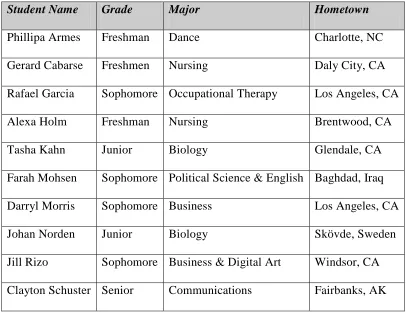
Table 1: Chart of Research Conversation Participants ...47
Photograph of Phillipa Armes ...48
Photograph of Gerard Cabarse ...48
Photograph of Rafael Garcia ...49
Photograph of Alexa Holm ...49
Photograph of Tasha Kahn ...50
Photograph of Farah Mohsen ...50
Photograph of Darryl Morris ...51
Photograph of Johan Norden ...51
Photograph of Jill Rizo ...52
1
CHAPTER ONE: STATEMENT OF THE ISSUE
Introduction
In the past twenty years, the Internet has evolved from a repository of research
data and basic text-based communications to a virtual world teeming with information
and designed for entertainment presented through various multimedia platforms.
Beyond information and entertainment, the Internet provides unprecedented
opportunities for communication and interaction with others in virtual spaces. The
functionality and capabilities of online engagement that exist today will likely lead to
more significant developments in the future, which in turn will influence the everyday
lives of those who participate with this ubiquitous medium. The expansion, evolution,
and future potential of the Internet coincide with the maturation of a generation that has
grown and developed with this technology. Commonly referred to as the millennial
generation (Howe and Strauss 2000), these are the young people currently attending
colleges and universities “whose entire life experiences are being shaped by their
ubiquitous interactions with technology" (Speer 2007:50). These students are proficient
in online communication and comfortable using it in their daily lives (Jones 2002;
Buckingham and Willett 2006; Lenhart et al. 2007).
Statement of the Issue
The growing research investigating the relationship between online participation
and millennial students suggests that the Internet pervades their daily lives. In additi on
to utilizing this technology as a tool and medium for academic and scholarly research,
millennials socially engage with others through various online technologies such as
2
networking sites. In recent years, these social networking sites have become a notable
form of communication for students; the multimedia capabilities allow individuals
around the world with Internet access to be instantly part of these virtual interacti ve
communities. Bargh and McKenna (2004:575) suggest that people, especially
millennial students, “use the Internet is to communicate with other people … [and] to
maintain interpersonal relationships.” Colleges and university campuses, widely
considered to be ideal venues for young adults to establish their identities as they
engage academically and socially with others on campus, have become environments
where communal gatherings and physically present discourse are eschewed in favor of
socialization and communication through online interaction (Jones and Fox 2009,
Porter 2006, Bargh 2002).
The influence of online engagement on millennial student identity development
and peer relationship formation is a phenomenon that warrants additional exploration.
Using critical hermeneutic participatory inquiry for this research (Herda 1999), I provide
some understanding about, and a critical analysis of, the influence of online social
networking on the student culture by means of students' relationship and identity
formation. Current literature (Madge et al. 2009, Gleusing 2008, Buckingham and
Willets 2006) suggests that online participation has the potential to influence peer
relationships and identity formation for those millennial students engaged with this
technology. Using the critical hermeneutic concepts of 1) text, 2) identity, and 3)
imagination, this research explores how millennial students establish identity online and
considers new ways of interpreting students' imagination for seeing themselves in relation
3
Background of the Issue
The college and university campus provides a physically present community
whereby young adults learn and develop by socializing with peers and through
involvement with events and happenings on campus. Institutions of higher education
promote student engagement by developing their academic curricula, supporting
co-curricular programming, and by encouraging participation in various student activities,
clubs, and organizations. The notion of student engagement can imply various
interpretations. In respect to this proposed study, I define student engagement as
physically present interaction in student clubs, organizations, or peer-based social
activities. This type of involvement is critical both to the success of the student and to
the capacity of the institution to develop the learning environment (Tinto 2006;
Pascarella and Terenzini 2005; Astin 1997). Pascarella and Terenzini (2005:602)
suggest that “the impact of college is largely determined by individual effort and
involvement in the academic, interpersonal, and extracurricular offerings" that are in
place for students on a campus.
In my role as the Associate Dean of Students at Dominican University of
California, I strive to help students become part of both the larger campus community
and the myriad of smaller networks and peer groups that exist. The reason for
promoting community and social engagement, in addition to being instrumental in the
social and personal development of the student, pertains to the pragmatic necessity of
retention. Retention is an issue of significant concern for many universities, most
especially smaller institutions dependent on tuition as the main source of operating
4
that involvement and engagement are essential to student satisfaction and persistence.
Students who are socially engaged and become a part of the campus community are
more likely to stay at the university and persist to graduation.
Student peer engagement and involvement are critical components of a robust
university experience. However, the arrival of the millennial generation students –
those who have the access to, and affinity for, online interaction – presents a unique
challenge for institutions because of the potential for social networking to influence
student culture. In my experience at Dominican, I have seen students arrive focused on
connecting their personal computers and gadgetry before trying to integrate with their
peers and the campus community. The millennial generation students bring with them
particular habits and traits toward technology that invite feelings of trepidation for
faculty, staff, and administration (McGlynn 2008; Nworie and Haughton 2008; Speer
2007), who recognize that the students‟ interaction with online social networking is a
phenomenon influencing the student culture; specifically, the development of peer
relationships and identity formation. The students' familiarity and comfort with online
engagement may be incongruent with the personal experiences and professional
expectations of student development personnel who encourage more active
participation with campus activities and organizations so as to promote peer relational
development. Furthermore, participation in online social networking, though valuable
in helping students to establish some social connections, is not considered by experts to
be an adequate replacement to the physically present social interactions that are
significant in students' personal development (Madge et al. 2009). The time spent with
5
others in the real world (Kraut et al. 2002). This disconnect from the campus-based
peer network may be in direct contrast to the notion of the learning and development
that occurs in social and academic communities, which are held in high esteem and
promoted as core values at many institutions or higher education.
Online Social Networking
Developments in the speed and capabilities of the Internet have spurred online
communications to progress beyond textual emails to advanced multimedia presentation
systems that include pictures and music, instant messages, and live video connectivity.
The social networking platforms popular with millennial generation students allow for
users to capitalize on this new technology. Beyond the web-based profile pages that
users create and share with others (Boyd and Ellison 2007), those who interact through
social networking are able to virtually connect and communicate by means of online
media. The people with whom students connect and communicate are labeled friends
on many social networking sites; in actuality, these connections in the online world
may be either actual peers of the students or individuals about whom the student knows
little to nothing about outside of the user profile. Still, students share information with
either category of online contact regardless (Acquisti and Gross 2006). Although there
are numerous online social networking sites that exist for a variety of users, Facebook
is the preferred site for university students and, as such, it is the primary site explored
in this study. The statistical information illustrates the significant influence of this
particular site; there are over 500 million Facebook users worldwide with 200 million
having access through mobile devices, more than 30 billion pieces of information are
6
of all users visit the site on a daily basis, and approximately 85% of all college and
university students worldwide have accounts (http://www.facebook.com/press).
Significance of the Issue
I propose to explore the influence of online social networking on student
identity formation and relationship development; more specifically, the pervasiveness
of this technology and its role in transforming the student culture. Prensky (2001a:1)
dubs millennial students “digital natives,” and tells us that current university students
“have spent their entire lives surrounded by and using computers … and all the other
toys and tools of the digital age.” As such, these students present differences in terms
of how they learn and how they connect and engage with one another. Over the past
decade, I have witnessed a trend of student disengagement from the peer community on
my campus as an increasing number of students opt out of activities that require a
physical presence in favor of active engagement with online social networking sites. In
my role as mentor to various students on campus and as the primary individual who
advises many student groups and organizations, I am compelled to understand better
my students so that I can provide guidance in helping them to become engaged and
contributing members of the campus community, in whatever ways the student culture
is emerging.
Summary
Social networking sites have become increasingly popular and pervasive to the
point that they “have a profound effect on the way people work, the opportunities they
have, and the structure of their daily life” (Donath and Boyd 2004:71). Although
7
identities formed by means of social networking profiles may not reflect students'
authentic selves. Furthermore, these online relationships may detract from student
activity on campus as time spent engaged with online social networking may diminish
the quality of time spent involved in community with others on campus (Kraut et al.
2002). In turn, this may contribute to the development of habits, traits, and actions
specific to the student culture.
In the following Chapters, I seek increased understanding about the influence of
online social networking on student culture, student relationships, and student identity
formation in order to consider new ways of appropriating students' ability to imagine
themselves in relation to others in both virtual networks and in the physically present
campus community. Chapter Two presents literature discussing millennial students‟
affinity for online interaction and the pervasiveness of this technology in their everyday
lives. In Chapter Three, I provide detailed information about the research theory and
protocol that guided this study, as well as an introduction to the critical hermeneutic
categories of text, identity, and imagination. Chapters Four and Five present and
analyze, respectively, the data that emerged during conversations with university
students who are also members of the millennial generation. Lastly, in Chapter Six,
following a Summary of this research, I provide Findings related to the data and the
8
CHAPTER TWO: REVIEW OF LITERATURE
Introduction
The pervasiveness of online interaction in the everyday lives of millennial
students is a phenomenon with the potential to influence this generation‟s socialization
and identity development. The literature (Madge et al. 2009; Buckingham and Willett
2006; Prensky 2001a) suggests that the development of norms peculiar to the culture of
the modern university student are not unlike the culture and identity formation of
indigenous people, tribal groups, and societies researched by early anthropologists.
While there is compelling data and literature that discusses the significance of
technology as a cultural phenomenon for the millennial generation, the research specific
to the relationship between this technology, peer relationship formation, and identity
development is only recently being explored. However, the literature addressing the
influence of online engagement on millennial students comes from faculty and
administrators immersed in the university culture and, as such, their insight and
research is intriguing. The Parts of this Review of Literature explore early
anthropological theory as related to a modern cultural group, data and research on
millennial students‟ affinity for online engagement and interaction, and the influence of
online engagement on relationship and identity development.
Part One: Anthropological Theory
Early anthropologists, specifically those referenced below, studied and
documented the traits and behaviors of other cultures in an effort to understand these
groups. Whereas in many instances the cultures were considered to be primitive by
9
specifically Franz Boas, Bronislaw Malinowski, and Ruth Benedict – influenced how
researchers study behaviors and actions in an effort to understand better a particular
culture or group. This study of the influence of technology in the lives of college
students requires an investigation into the relationship between individual actions,
cultural norms, and the behaviors of social groups.
Franz Boas: The Culture of Social Groups
Franz Boas, a scholar of such varying disciplines as physical anthropology,
biology, and archaeology, directed his studies and research toward understanding "what
determines the behavior of human beings” (Boas and Stocking 1989:42). By uniting
the aforementioned disciplines into a unified and holistic approach to investigating
culture, Boas suggests that cultural practices are not solely "explicable only in reference
to broad evolutionary stages," but that they are “understandable only in specific cultural
contexts” (in Moore 2009:33-34). Specifically, he proposes that environmental factors
influence the norms found in a specific culture. Boas (1955:4) writes, "each culture can
be understood only as an historical growth determined by the social and geographical
environment in which each people is placed and by the way in which it develops the
cultural material that comes into its possession from the outside or through its own
creativeness." The desire to understand what shapes human behavior influences Boas'
studies of the relationship between the environment and a culture.
The relationship between people, environment, and materials is applicable to
this particular study in that the university campus is an environment capable of
influencing the traits and behaviors of students. Boas (1986:13) writes, “the individual
10
can be a daunting experience for many young adults and, as it is the nature of students
to want to be part of a peer social group, they may adopt the behaviors and practices
that exist in that environment in an attempt to integrate better with the community.
Effectively, students may adapt or modify their actions in order to fit in with their
surrounding culture. For millennial generation students, the pervasiveness of the
Internet in most aspects of their daily lives suggests that utilization of this particular
technology is part of their everyday practices. Boas (1955) believes the things with
which people regularly interact influence the behavior of individuals and larger groups.
He writes, "the industrial and economic development of modern times has brought
about a differentiation within our population" (Boas 2005:213). Use of the Internet by
today's college students is analogous to Boas' contemporaries utilizing the industrial
developments of their time; for both groups, the interactions with the available
technologies influenced people's behaviors and practices.
Boas expresses astute awareness of the influence of industrial and technological
developments on individuals and groups, as evidenced in his research of native peoples
of the Pacific Northwest and his work as curator of the American Museum of Natural
History. Challenging the evolutionary development theorists, Boas intentionally
displayed the various artifacts collected during his research in such a way as to
exemplify the function and the importance of the item to the environment and historical
development of a particular culture (Moore 2009). His actions were informed by his
research of certain developments in technology and industry not as unique to specific
cultures, but as part of a much larger phenomenon. Boas (1955:5) suggests, "dynamic
11
factors, that may bring forth similar cultural processes in different parts of the world, so
that it is probable that some of the historical happenings may be viewed under more
general dynamic viewpoints." Developments in online technologies, coupled with more
access to mobile computing and wireless devices, are an example of such a
phenomenon. As is discussed in Part Two of this Section, these conditions influence
the culture of young adults to engage with technology as part of their daily practices
and routines.
Lastly, Boas (1982:254) speaks of the “interdependence of cultural
phenomena,” exemplified in the dynamic between millennial students and online
engagement. Students bring with them to campus their penchant for technology as well
as a desire to adapt and to become part of the campus culture. As is explained in Part
Two, once millennial students arrive on campus, they find that an existing practice of
current students is the use of online social networking. Already comfortable with the
technology and influenced by the existing culture of the campus, the new students
assume the praxis of the established social group. Boas (1982:257) addresses the
dynamic of this relationship, noting that “the causal conditions of cultural happenings
lie always in the interaction between individual and society.” This interaction can
create somewhat of a vicious cycle; the environment influences the action, the action
establishes a pattern, the pattern reinforces the culture within the environment, and the
action repeats and continues.
Bronislaw Malinowski: Human Needs and Social Groups
The theory of functionalism, pioneered by anthropologist Bronislaw
12
Malinowski (1936:440) writes, “culture, in fact, is nothing but the organized behavior
of man.” The classification of actions and traits peculiar to a specific group of people
allows those individuals foreign to the group to understand better the different and
unfamiliar behaviors of others in relation to their own. Malinowski (1936:440) asserts
that culture is a term ascribed to the actions and behaviors of others that serves as “a
determinant of human behavior." As functionalist theory suggests, the purpose of
culture is pragmatic; culture encompasses the actions and behaviors that serve to satisfy
"the organic or basic needs of man" (Malinowski 2002:37). These behaviors and traits
within a particular culture serve as systems and mechanisms to ensure human needs are
met appropriately (Young 2004). However, Malinowski (2002:142) suggests certain
behaviors, unless reinforced by habit, “become unlearned” and cease to be part of the
person's activity. He writes, “no crucial system of activities can persist without being
connected, directly or indirectly, with human needs and their satisfaction” (Malinowski
2002:142). Malinowski (2002) believes all behaviors have some sort of relationship, be
it individual or cultural, with the need of the individual or group.
Functionalist theory, when applied to the present phenomenon of online
interaction, suggests that students participating in online socialization do so to support a
human need. Considering that the purpose of social networking is to establish a wide
network of friends, students participate in the online world to reach out and connect
with others. Social networking sites provide an accessible community; one that allows
students to become part of already established groups, and to some extent, perpetuate
existing cultural norms.
13
analysis of cultural determinism – that is, the process of conditioning and molding. At the same time we see that from the very outset and existence of groups – that is, of individuals organized for cooperation and cultural give and take – is made indispensable by culture (Malinowski 1939:947).
Groups represent community for individuals, and the collective membership of the
group may exhibit the established traits and behaviors representative of their specific
culture (Malinowski 1939).
Beyond the conformity that occurs as the group conditions individual actions,
there exists within this collective a type of relationship that strengthens the connections
of the group members. Malinowski (1939:953) writes, “people unite … because daily
contact and cooperation develop the secondary bonds of acquaintance and affection.”
There becomes somewhat of a "mutual dependence" (Malinowski 1939:938) between
the individual and the group. The individual is drawn in to satisfy a need for
connection with others and is subsequently influenced by the established culture – the
behaviors, traits, and norms – particular to the group. Malinowski (1939) observes that
individuals interact within a particular setting and engage with one another to form a
group that encompasses a variety of relationships and dynamics among the members.
In turn, the bonds further adhere individuals to one another and attract others based on
the need for companionship and recognition of particular cultural norms.
Malinowski's studies and research examine the influence of technology and
machines – the forces of industrialization – on human needs and cultural behaviors.
His writings suggest industrialization is a culture unto itself and those who interact with
machinery become conditioned to rely on these technologies in their everyday actions
(Malinowski 2002, 1939, 1936). The machines of man represent cultural influences in
14
apparatus" (Malinowski 1936:440). Additionally, Malinowski (1936) posits that
interactions with machines become a hereditary behavior passed down and reinforced
with each generation. There is a foreboding tone in his writings; a presentiment of
technology being a significant and influential cultural force that must be regarded.
As explained in Section Two: Students and Technology, the pervasiveness of
technology in the lives of students may be the actualized emergence of Malinowski's
apprehensions. Malinowski (1936:449) cautions, “we have allowed the machine to
overpower man. One of the reasons of this is that we have learned to understand, hence
to respect and to handle the mechanism. But we have failed to develop the really
scientific spirit in humanism." In his later writings, Malinowski (2002:116) states,
“certain devices, forms of organization, customs or ideas enlarge the range of human
potentialities on the one hand, and impose certain restrictions on human behavior on the
other.” Whereas students‟ use of social networking sites seems to fulfill the human
need for a sense of belonging as members of a community, in actuality this community
exists in a virtual space different from reality and absent of real human connection. To
a certain extent, social networking may be a half-filled promise to establish connections
with others. As such, online engagement is influencing, if not somewhat restricting,
students‟ actions as they adjust to the social dynamic and environment of the actual
university campus.
Ruth Benedict: Influences of Culture on Individuals
The research conducted by Ruth Benedict regarding the influence of societal
norms on the development and actions of individuals is appropriate to this study.
15
the research to investigate the influence of these cultural norms on individuals.
Benedict maintains that the understanding of individual behavior is predicated on an
analysis of the relationship between said behaviors and environmental influences, social
norms, and personal experiences (Maslow and Honigman 1970). Moore (2009:81)
points to Benedict‟s research as being focused on “the relationship not only between a
set of things and behaviors, but between the underlying ideas, values and mores that
characterize a particular society.” Within a culture, there are norms and actions that
serve to define a particular group; the pervasiveness of technology in the lives of
millennial students exemplifies the research findings. Benedict (2005:254) asserts that
in order to “understand the behavior of the individual … it is necessary to relate his
congenial responses to the behavior that is singled out in the institutions of his culture.”
Consistent with her research, students may express the personality and norms
representative of their culture through their individual actions.
Subscription to Benedict's research findings implies the recognition,
understanding, and acceptance of the distinctions between cultures as identified by
behaviors of the individuals within these groups. Benedict (1943:102) writes, "the
crucial differences which distinguish human societies … are cultural." These
differentiations between cultures are attributed to the concept of "cultural islanding"
(Benedict 1932:4), which she equates to the deliberate action of one particular group to
distinguish itself from another by resisting the inclusion of certain behaviors and
practices specific to the other culture. Benedict (1932:5) writes, “the resistance … is a
cultural resistance, not the result of isolation due to physical facts of the environment."
16
group, may be the result not of a willful refusal to accept the norms of others, but of a
misinterpretation of these actions as being counter-cultural to the understood norm.
The college campus, once considered to be grounds for social and individual
development, has become an environment capable of influencing an entirely different
type of cultural norm by means of the accessibility to online interaction.
Although the developing cultural groups Benedict researched may well be
viewed as the antithesis to the present generation of college and university students, her
studies of tribal cultures show an interesting parallel to the young adults in the
university environment. Benedict (2005:55) notes that her studies of “simpler cultures”
may help in understanding certain phenomena found in more modernized groups. In
addition, she claims it is the “fundamental and distinctive cultural configurations that
pattern existence and condition the thoughts and emotions of the individuals who
participate in those cultures” (Benedict 2005:55). The patterns of action of cultural
groups contribute greatly to individual learning and development within their respective
social environments. Students notice the pervasiveness of online networking on
campus and this recognition influences their acceptance of online social networking as
an established and accepted cultural trait. Benedict (1932:25) writes, "it can always be
unquestioningly assumed that by far the majority of any population will be thoroughly
assimilated to the standards of their culture.” In joining an online social network,
students exemplify Benedict‟s concept of cultural norms influencing individual action.
Part Two: Students and Technology
The students presently enrolled at colleges nationwide are those in the
17
2009; Lenhart et al. 2007; McMillan and Morrison 2006). Bargh and McKenna
(2004:574) suggest that "the Internet is fast becoming a natural, background part of
everyday life.” In many ways, this affinity for online interaction serves as a defining
behavior and action peculiar to this cultural group. Online activity and engagement
have been part of the millennial students' lives since they were children (Buckingham
2006b; Jones 2002; Livingstone 2002).
Millennial Students: The Online Generation
Millennials are considered part of the “digital generation – a generation defined
in and through its experience of digital computer technology” (Buckingham 2006b:1).
Whereas data illustrate the prevalence of the Internet in their lives, the millennial
students are sometimes misrepresented based on “superficial aspects of Internet use”
(Bargh 2002:7). There exists polarity in the understanding of this group; on the one
hand, research suggests online activity may contribute to social isolation and lack of
motivation (McGlynn 2008; Kraut et al. 2002; Nie and Erbring 2002), while on the
other, online engagement may enhance peer relationship building and development
(Pavicic et al. 2008; Boyd 2007; Quan-Haase et al. 2002).
The techno-referential epithet, coupled with an uncertainty of the influence of
significant online interaction, influence the interpretation of the millennials as different
kinds of students.
18
The millennials are those who "have always been surrounded by and are comfortable
with technology" (Carey 2006:3). Furthermore, developments in mobile computing,
most especially the introduction of web-enabled smart phones and ultra-portable
notebook computers, have made it possible for students to be constantly connected
online with one another.
The means of student communication and interaction is evolving, in large part
because "the computer is taking on an increased social role for young adults"
(McMillan and Morrison 2006:89). Prensky (2001b:1) notes that online activities
extensively dominate students' time and attention to the point that there are “over
200,000 emails and instant messages sent and received; over 10,000 hours talking on
digital cell phones; [and] over 20,000 hours watching TV … all before the kids leave
college." The student culture is in transition; the use of instant messaging services and
online social networking sites, coupled with the use of personal communication devices
that have Internet access, is both portrayed by social media and accepted by the
students as normal and appropriate as the primary form of communication (Hargittai
and Hinnant 2008; Buckingham 2006a; McMillan and Morrison 2006). The ubiquitous
nature of the Internet in society, most especially in the lives of young adults (Jones and
Fox 2009; Nie and Erbring 2002; DiMaggio et al. 2001), has spurred developments in
online technology and functionality that, in turn, are becoming part of the everyday
habits of the generation of students now enrolled in college. The Internet is more than a
tool for academic research and information gathering; McMillan and Morrison
19
entertainment, [and] to easily and conveniently stay in touch with friends." For the
millennial generation, the Internet is part of their way of being in the world.
Millennial Students and Internet Use: The Pew Research Data
In recent years, there has been an increase in the literature investigating the
pervasiveness of the Internet in the lives of the millennial generation (Buckingham
2006a; McMillan and Morrison 2006; Leander and McKim 2003), as well as
information related to young adults' use of specific online technologies (Acharya 2007;
Acquisti and Gross 2006; Rice and Haythornthwaite 2006;). Much of the literature
addressing the millennial generation's affinity for the Internet stems from a
comprehensive study started in 2000 by the Pew Internet and American Life Project
(http://www.pewinternet.org). In 2002, Pew released the data on millennial students‟
use of the Internet and the findings provide significant information on the relationship
between the technology and this specific demographic.
The research project sampled over 2000 students attending a variety of public
and private two and four-year institutions (Jones 2002:5) with the intent of learning
more of "the Internet‟s [effect] on college students … and to determine the [effect] of
that use on their academic and social routines" (Jones 2002:5). Jones (2002:2) notes,
"by the time they were 16 to 18 years old all of today‟s current college students had
begun using computers – and the Internet was a commonplace in the world in which
they lived." Ongoing research (Jones and Fox 2009) that is part of the Pew project
estimates that the significant majority of millennial students regularly use the Internet
as part of daily activities. Beyond the information gathered through the surveys,
20
Internet usage were compiled into the Pew report (Jones 2002). Findings from the
research reinforce that college students are "early adopters" (Jones 2002:2) and habitual
users of the Internet and they are "more likely than the general population to be online,
check email, use multiple email addresses, browse for fun, download music files, and
use instant messaging" (McMillan and Morrison 2006:75). Jones (2002:2) maintains
that "Internet use … has greatly changed the way [students] interact with others and
with information as they go about their studies." The data collected as part of the Pew
Project suggests that the Internet is part of the college students' everyday actions and
experiences (Jones 2002:2).
Online on Campus
The dominant presence of the Internet may influence the behaviors and actions
of millennial students' daily lives (Hargittai and Hinnant 2008; Bargh 2002;
Livingstone 2002). Students use the Internet to supplement academic research (Jones
2002), to establish social connections and communicate with peers (Madge et al. 2009),
and to engage in entertaining activities such as online gaming and web surfing (Jones
and Fox 2009). As Jones (2002:2) suggests, "college students are heavy users of the
Internet compared to the general population … the Internet is a part of college students‟
daily routine." Residence halls, student unions, and cafeterias – once active and lively
social venues – have morphed into online access hubs where instant messaging, social
networking, and various other forms of mobile communications have become the new
systems of socialization, whereby peer relationships are built and communication skills
are honed. Jones' (2002:3) research suggests, "students use the Internet nearly as much
21
especially those in the area of student development, seek to encourage students to be
involved and engaged with the physically present campus community (McGlynn 2008;
Porter 2006; Metz 2004), the students‟ affinity for technology presents continual
challenges because of both their affinity for online engagement (Boyd and Ellison
2007; Fortson et al. 2007; Jones 2002) and because they are "undoubtedly one of the
most significant target markets for new media" (Buckingham 2006a:77). As such, new
developments and iterations in online technology will likely be designed and marketed
with the intent of being incorporated into the everyday actions and behaviors of
millennial students, furthering their virtual connectedness.
Social networking is popular with the majority of university students and has
become the newest and preferred means of online communication and socialization for
this population (Madge 2009; Lenhart et al. 2007; Anderson 2001). On these sites,
users create profiles, volunteer personal information, and then virtually connect with
one another based on self-identified commonalities such as schools attended,
geographic proximity, and friends of others within the network. According to Bargh
and McKenna (2004:586), "the Internet has unique, even transformational qualities as a
communication channel, including … the ability to easily link with others who have
similar interests, values, and beliefs." Social networking thus presents participants the
opportunity to communicate with others and to establish relationships based on the
information put forth online. Bargh (2002:7) maintains, “use of Internet
communication modes for purposes of social interaction continues to grow worldwide
22
are drawn together, socialize, and establish interpersonal connections in virtual
communities (Norris 2004; Livingstone 2002; King 2001).
The Online Influence on Social Community
Though heralded by proponents as a means to promote and enhance connections
between individuals, online interaction has been denigrated by others claiming that it
"leads to an erosion of face-to-face community" (Koc and Ferneding 2007:88). The
debate surrounding the significance of the Internet in influencing those who interact
with it is rife with opponents who mockingly denounce it as "a powerful new tool for
the devil … causing users to be addicted to hours each day of 'surfing' … [where] they
are away from their family and friends, resulting in depression and loneliness for the
individual user, and further weakening neighborhood and community ties" (Bargh and
McKenna 2004:573-574). Though intended to elicit an emotive response, these
statements are not completely unsubstantiated as the literature (McGlynn 2008; Kraut et
al. 2002; Nie and Erbring 2002) suggests that online communication and engagement
may well be deprived of the social interaction often found in physically present
discourse.
Computer-mediated communication is not conducted face-to-face but in the absence of non-verbal features of communication such as tone of voice, facial expressions, and potentially influential interpersonal features such as physical attractiveness, skin color, gender, and so on. Much of the extant computer science and communications research has explored how the absence of these features affects the process and outcome of social interactions (Bargh and McKenna 2004:577).
The concern with such an "impoverished and sterile form of social exchange" (Bargh
and McKenna 2004:575) is the potentiality for online interaction to influence – possibly
23
(Ellison et al. 2007; Livingstone 2002; King 2001;). Koc and Ferneding (2007:88)
write, "the proliferation of information and communication technologies has influenced
many aspects of the lives of young people through creating new social and cultural
spaces that have challenged long-established ways of socialization." In addition to
influencing relationships among those young adults who are part of the millennial
generation, there remains the possibility that online interaction may have a significant
influence on the ways members of a social community communicate with one another.
Though there have been significant advances in the capability of technology to
virtually connect people, these connections ultimately happen in a virtual reality that is
mediated by online technologies. Bargh and McKenna (2004:577-578) write that
online communication "limits the 'bandwidth' of social communication, compared to
traditional face-to-face communication settings.” The authors suggest that “Internet
communication assumes further that the reduction of social cues, compared to richer
face-to-face situations, must necessarily have negative effects on social interaction"
(Bargh and McKenna 2004:578). There exist differences in how people communicate
online and in the real world; in essence, interactions that happen in virtual reality, and
the relationships formed by way of these interactions, may be different from those that
take place in actual reality. Part Three of this Review of Literature discusses the
alternative option for online interaction as a means for promoting student engagement
and fostering relationship developments.
Part Three: Relationship Building and Identity Formation
The computer, specifically online social networking, plays a critical role in
24
(Pavicic et al. 2008; Valentine and Holloway 2002; Turkle 1995). Speer (2007:52)
posits, “technology has greatly changed the context of one-to-one interaction." The
ways in which millennial generation students interact and communicate with one
another is in transition from in-person to online (Boyd 2007; Buckingham and Willett
2006; Anderson 2001), and the differences in which this particular generation relates to
others influences both the communication paradigm and the culture on many college
campuses.
The rush to judgment about the social effects of the new communication media has branded them as positive and negative in equal measure. Alienation from “real world” relationships coupled with a lack of social regulation within the medium is balanced by liberation from the influences, inequalities, and
identities to which people are subjected in face-to-face interaction (Spears et al. 2002:91).
Existing literature both supports and criticizes the influence of online communications,
most especially in relation to the millennial generation, which has grown up and is most
comfortable with this particular technology. Whereas online interaction does allow for
a certain degree of privacy that is sometimes misinterpreted as individuals being
isolated from others (Tufekci 2008; Spears et al. 2002; Anderson 2001), this virtual
anonymity may allow for individuals to better "express their 'true' selves (those
self-aspects they felt were important but which they were usually unable to present in
public) to their partner over the Internet than when face-to-face" (Bargh and McKenna
2004:581). Online engagement and interaction, contrary to other interpretations, may
therefore promote more interaction with others in both virtual and real spaces.
Self and Other in Online Relationships
McMillan and Morrison (2006:89), in discussing ways students interact and
25
online.” Millennial generation students communicate, establish connections, and
develop community within these online networks (Lenhart et al. 2007; Livingstone
2002; King 2001). Furthermore, Beer and Burrows (2007:1.3) note that there have
been "significant developments in Internet culture [that] have emerged in the last two
years." Their research explores the capability of online technologies for "reworking
hierarchies, changing social divisions, creating possibilities and opportunities,
informing us, and reconfiguring our relations with objects, spaces and each other" (Beer
and Burrows 2007:1.2). Students‟ persistent engagement with technology
(Buckingham 2006b; Jones 2002; Prensky 2001a) suggests that it is becoming part of
the “mundane realities of everyday life” (Beer and Burrows 2007:1.2). Online
communication systems such as the social networking sites used by the millennial
generation, allow for the sharing of everyday information, which influences learning
about others (Madge et al. 2009; Lenhart et al. 2007; McKenna et al. 2002). McMillan
and Morrison (2006:75) report that "young people‟s online social life mirrors offline
relationships: computer activities provide support for offline friendships; are mainly
devoted to ordinary yet intimate topics (e.g., friends, gossip); and are motivated by a
desire for companionship." According to Anderson (2001:22), “the sense of security
afforded by the anonymity of the Internet may provide some students with less risky
opportunities for developing virtual relationships.”
Whereas online interaction offers individuals a degree of privacy, it may also
inhibit social development in the real world. Research indicates millennial students use
the Internet to communicate with real-world friends, not necessarily to seek out new
26
al. 2002). Use of the Internet is "an individual activity" (Nie and Erbring 2002:280);
online engagement may contribute to the interpretation of participants as being
reclusive or isolated (Fortson et al. 2007) and also reinforce existing similar behavioral
patterns (DiMaggio et al. 2001). In discussing issues of development specific to
college students, Anderson (2001:22) writes, "although some college students flourish
in an atmosphere that provides frequent opportunities for meeting new people and
developing new relationships, others who are less socially inclined may have difficulty
establishing real-life relationships." The security and anonymity (Anderson 2001)
offered online might not exist in real-world situations where individuals must encounter
one another and push themselves into new and different social situations in order to
establish a relationship.
The benefits and criticisms of online interaction and communication as a means
to establish relationships are secondary to the preferences of those individuals who
engage with this technology for the purpose of socializing with existing peers and
encountering new people in online spaces. Bargh (2002:3) writes, “because the quality
or nature of Internet interaction differs in important ways from face-to-face interaction,
some people feel more comfortable in one domain than the other.” Individuals use
social networking as a means to reach out and establish new connections (Madge et al.
2009; Boyd 2007; Jones 2002) and they also utilize the technology to maintain existing
relationships (Boyd 2007; Buckingham 2006; Prensky 2001a). Both relationship
forming and friendship maintenance require participants to spend time actively engaged
online and not with others in physically present community. As noted in Section Two,
27
(2006:91) write, "many respondents reported that they feel in danger of losing
themselves amidst the wealth of information available." This need to create distance
from online engagement is critical in allowing participants to reflect on their
relationships with others and their own identities.
Online Identity Formation and Interpretation
Current literature supports the notion of the millennial generation experimenting
with identity play and formation in online networks (Valkenburg and Peter 2008;
Buckingham and Willett 2006; Wilbur 2000). Bargh and McKenna (2004:583) write,
"membership and participation in Internet groups can have powerful effects on … self
and identity." Implicit in these discussions is the recognition that individuals possess
multiple identities; those associated with the physically present body of people in the
real world (Gleusing 2008; Donath 2005) and virtual personas developed online
(Buckingham and Willett 2006; Livingstone 2002; Turkle 1995). Hodkinson
(2007:628) writes, "online communications have proved to be a significant factor in the
development of fragmented, fluid patterns of individual identity." Online participation
frees the individual from the connection to a physically identifiable body, thereby
allowing individuals to create multiple, and often different, identities online
(Hodkinson 2007). Donath (2005:27) writes, “though the self may be complex and
mutable over time and circumstance, the body provides a stabilizing anchor."
Contrarily, within the virtual world, "information rather than matter" (Donath 2005:27)
is the substantive form of identification.
The nature of social networking sites allows participants to share information by
28
“personal narrative is a primary tool for sensemaking” and that the information shared
online through these stories “can influence … a person‟s identity.” The stories shared
on social networks help individuals to make sense of others (Gleusing 2008). However,
the voluntary actions of online participation suggest an individual can create multiple
identities simply by choosing what information to share, and what to withhold.
Gleusing (2008:72) further states, "people live according to stories … the stories we tell
ourselves can heavily influence how we perceive the world around us, how we give it
meaning, and how we behave in it, particularly in relationships with others." Implicit
in social networking are questions regarding the validity, and appropriateness, of the
information – the stories chosen to be shared – on participants' profiles.
Turkle (1995:178) writes, "when we step through the screen into virtual
communities, we reconstruct our identities on the other side of the looking glass."
There may be some disconcertion regarding the validity of the information shared to
build online identities. On the one hand, the identity of the online person may be an
anonymous or known representation of self (Lewis and West 2009; Tufekci 2008;
Anderson 2001) where individual discloses information reflective of one's true
character. On the other hand, the virtual identity might be a newly imagined persona or
intentionally deceptive identity (Giglietto 2007; Donath 2005; Valentine and Holloway
2002). Donath (2005:28) asserts, "identity plays a key role in virtual communities …
knowing the identity of those with whom you communicate is essential for
understanding and evaluating an interaction." A challenge to the interpretation of
identity online involves the textual nature of information shared. Online interaction
29
heterogeneity" (Norris 2004:33). Valentine and Holloway (2002:304) write, “the
material body is not simply rendered invisible online: it becomes completely
irrelevant.” In the online world, participants can be anyone they imagine themselves to
be. Without the body to serve as reference to the identity, there exists a “possible
discrepancy between 'cyberselves' and real selves'" (Hardey 2002:579). Understanding
the other based on an interpretation of online identity requires recognition of the
ambiguity of the online identity.
Online and Face-to-Face Relationships
Although the literature indicates that millennials use the Internet for
communication with others (Madge et. al 2009; Golder et. al 2006; Jones 2002), Baym
et al. (2004:306) note that among these students, "face-to-face communication clearly
remained their dominant mode of interaction.” Despite the prejudicial understanding
that millennials constantly are connected to others via their online communication
technology (McMillan and Morrison 2006; Jones 2002; Prensky 2001a), these young
adults nonetheless remain open to the opportunity to converse with others through
physically present dialogue and interaction. When compared to their use of online
communication, millennials are “more likely to use face-to-face conversations … in
more intimate relationships” (Baym et al. 2004:314). The prejudgments that online
interaction is a detrimental influence on the millennial generation may thus be
unfounded.
In addition to millennial students' affinity for physically present discourse
(Madge et al. 2009; Baym et al. 2004; Bargh 2002), there is the potential for online
30
boundaries of cyberspace and possibly develop into actual real-world relationships
(Madge et al. 2009; Ellison et al. 2007; Koc and Ferneding 2007). Bargh and McKenna
(2004:582) note that online communication "not only helps to maintain close ties with
one‟s family and friends, but also, if the individual is so inclined, facilitates the
formation of close and meaningful new relationships." Furthermore, Koc and
Ferneding (2007) discuss the notion of the Internet supplementing real-world social
connections in that it offers a means for easy and convenient communication with
others. These aforementioned studies indicate that contrary to the prejudicial notion
that those who engage with the Internet may be reserved or anti-social (McGlynn 2008;
Kraut et al. 2002; Nie and Erbring 2002), millennials enjoy socially interacting with
others, both online and in the real world.
Although online social interaction suggests this technological medium promotes
"online to offline connections [where] online connections resulted in face-to-face
meetings … the assumed online to offline directionality may not apply to today's social
networking sites that are structured both to articulate existing connections and enable
the creation of new ones" (Ellison et al. 2007:1144). Bargh and McKenna (2004:586)
further suggest that beyond promoting real-world interaction, social networking in itself
may be a "fertile territory for the formation of new relationships." The paradigm that
socialization happens in physically present community is shifting given the
pervasiveness of the Internet in the lives of the millennials. Ellison et al. (2007:1146)
write, "online interactions may supplement or replace in-person interactions, mitigating