A Formal Approach to Testing Programs in
Practice
Shaoying Liu1, Wuwei Shen2, and Shin Nakajima3
1 Department of Computer Science, Hosei University, Japan [email protected]
2 Department of Computer Science, Western Michigan University, USA [email protected]
3 NII, Japan [email protected]
Abstract. A program required to be tested in practice often has no avail-able source code for some reason and how to adequately test such a program is still an open problem. In this paper, we describe a formal speci cation-based testing approach to tackle this challenge. The prin-cipal idea is rst to formalize the informal requirements into formal oper-ation speci coper-ations that take the interface scenarios of the program into account, and then utilize the speci cations for test case generation and test result analysis. An example and case study of applying the approach to an IC card system is presented to illustrate its usage and analyze its performance.
Keywords:Speci cation-based testing, Formal speci cation, Black-box testing
1. Introduction
Programs required to be tested in practice often have no source code for some reasons (e.g., con dentiality) but testing such programs is necessary and im-portant for software quality assurance in industry. A traditional approach to deal-ing with this problem is black-box testdeal-ing (or functional testdeal-ing) [1], but how to carry out an adequate black-box testing in this situation still remains a chal-lenge.
In this paper, we describe an approach to using formalization to help the tester understand the desired functionality of the program and build a rm foun-dation for testing the program. Speci cally, our approach suggests that the re-quirements be formalized into a set of formal operation speci cations whose signatures are constructed based on the program interface scenarios. The for-malization will force the tester to draw an accurate, complete, and precise pic-ture about the desired behaviors of the program and to prepare a solid founda-tion for testing. To make our approach work effectively, the formal speci cafounda-tion must be ensured to be internally consistent and valid with respect to the infor-mal requirements. This task can be ful lled by means of forinfor-mal speci cation inspection [2] and/or speci cation animation [3]. Since this issue is beyond the scope of this paper, we omit further discussions. The reader can refer to the re-lated work for details of the inspection and animation techniques. In this paper, we focus on the descriptions of how the interface scenarios of a program are derived, how the formal operation speci cations are constructed based upon the program interface scenarios, and how testing is carried out based upon the formal speci cations.
The remainder of the paper is organized as follows. Section 2 describes the essential ideas of the testing approach and the process of testing. Section 3 discusses how to formalize the informal requirements based upon the program interface scenarios. Section 4 focuses on the test case generation and test result analysis. Section 5 presents an example to illustrate how our approach is applied to test an IC Card software. Section 6 introduces the related work and compares it with our approach. Finally, in Section 7 we conclude the paper and point out future research directions.
2. Essential Ideas
The essential ideas of our approach is rst to formalize the requirements and then to carry out a testing. When formalizing the requirements, we abstract the program under testing into a set of operations, each de ning an independent service, such asW ithdraworDepositin an automated telling machine (ATM)
Functional requirements
Program
Construct formal specifications
Generate test cases
Run the program
Analyze test results Formal
specifications
Test cases
Test report
Execution results
Fig. 1.The testing process using our approach
account. As far as de ning the functionality of the operation is concerned, we use pre- and post-conditions, the most commonly applied notation in the liter-ature [4], to specify it, based on the informal requirements, as shown in an ex-ample later. One may argue that writing such a formal speci cation may not be a routine exercise in practice and therefore our proposed approach depending on formal speci cations may not be practical enough. While this might be true for the current industry where formal methods are rarely used and software cri-sis continues, the future software development would be signi cantly improved when some of the activities, such as testing, are undertaken, with effective tool support, by well trained practitioners or consultants in formal methods.
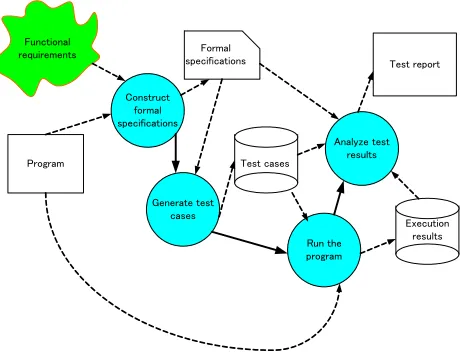
An interface scenario of the program is represented by a sequence of in-puts and the corresponding output of the program. It can be identi ed by exe-cuting the program using sample inputs, but the precise relation between the sequence of inputs and the output is unknown. The goal of testing is to identify whether such a relation is implemented correctly in the program with respect to its de nition in the speci cation. Assume that we have achieved formal spec-i catspec-ions for the program under testspec-ing, what we need to do next spec-is to gener-ate test cases based upon the speci cations to test the program. The whole process of testing using our approach is illustrated in Figure 1.
3. Construction of Formal Speci cations
A software system for a simplified Automated Teller Machine (ATM) needs to provide two services for customers.The services include withdrawing money from the customer s bank account and inquiry for the account balance.To withdraw money, the customer s card and password as well as the requested amount are required. The bank policy does not allow overdraft when the service for withdrawal is used.For an inquiry about the customer s account balance, the system should provide the current balance of the customer s account.
Fig. 2.A description of informal requirements for the simpli ed ATM.
1. Find important functional scenarios described in the informal requirements, where each functional scenario describes an independent, desired function in terms of the input-output relation.
2. Form an operation to de ne all of the identi ed functional scenarios, but the signature of the operation must be formed based on both the requirements and the interface scenarios of the corresponding program.
3. Write the pre and postconditions for the operation using a formal speci -cation language.
Next, we discuss these three issues, respectively.
3.1. Finding functional scenarios
The rst step is to nd the functional scenarios important to the end user from the requirements description. This can be done by reviewing and analyzing the informal requirements speci cation. We de ne each identi ed functional scenario as a single operation.
Let us consider a simpli ed ATM system as an example. Suppose the infor-mal requirements for the system are given in Figure 2 and we want to nd all of the important functional scenarios. We analyze the document to identify the relevant requirements and highlight the related text segments using the bold italic font, as indicated in the gure. Through the analysis, we realize that this functional scenario is concerned with withdrawing money from a bank account. Therefore, we form an operation and name it W ithdraw. Applying the same
principle, all of other functional scenarios can be identi ed and de ned as ap-propriate operations.
3.2. Identifying interface scenarios
I1 I2 In ...
I11 I12 ... I1m I21 I22 ... I2w In1 ... Inq
I111 I112 I121 I122
Fig. 3.Illustration of an interface tree
relevant types randomly. During the execution of the program, we continue to supply test cases if they are required by the program (e.g., via its GUI). Such an activity continues until the nal execution result is provided. Since this technique is not aimed at really testing the program but at nding potential interface sce-narios, the test cases needed should be as merely necessary as possible. This can be interpreted differently in practice when practical constraints are taken into account, but the following speci c criterion can be considered as a prin-ciple for striking a balance between nding interface scenarios and generating test cases at this stage.
Let the rst level (top level) interface of the program under testing, called
Interf ace1, shownexclusive input patterns:I1; I2; :::; In, indicatingndifferent
choices for the input of the program. For each selected pattern Ii (i = 1:::n)
, another lower level interface showing m input patterns I11; I12; :::; I1m will
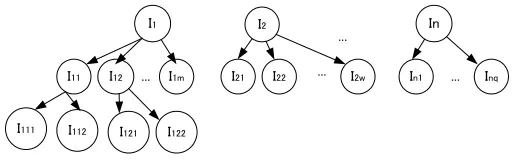
be displayed. Applying this principle to all interface patterns at all levels, an interface tree for the whole program could be built, as illustrated in Figure 3. Then, a set of test cases need to be generated to cover every path from one of the top nodes (denoting one possible input pattern on the top level interface) to one of the bottom nodes (denoting one possible input pattern on the related bottom level interface), such as path1 = I1; I11; I111 and I1; I12; I121. Note that there might be many functional scenarios (behaviors) under each interface scenario (input). Creating test cases to cover all of such functional scenarios would increase the cost while missing identifying any interface scenario would jeopardize the functional coverage in formalizing the speci cation. In this sense, the criterion for test case generation described above provides a good balance. Assume that we have obtained all interface scenarios, the next issue is how to represent them so that they will present a clear guideline for the formalization of the corresponding functional requirements. We adopt the following nite state machine (FSM) notation for this purpose.
De nition 1. A nite-state machine (FSM) is a quintuple( ; S; s0; ; F), where
is a non-empty set of input symbols,S is a nite, non-empty set of states, s02S is an initial state, is the state-transition function, andF Sis the set of nal states.
S0
S1
S3 S4
S5
cp = {card_id, password} S2
-cp r = {return}
w = {withdraw} sb = {s_balance}
am = {amount}
S6
ri = {reinput} am+
Fig. 4.An example of the nite state machine for a simpli ed ATM
program, where a page of GUI is an image with certain layout and contents shown on the display of computer. Each input symbol in denotes a set of input items whose concrete values are necessary for executing the program.s02S
denotes the very top page of the GUI of the program. de nes transitions of pages of the GUI based upon the input items. F represents the set of nal
pages showing the execution result of the program.
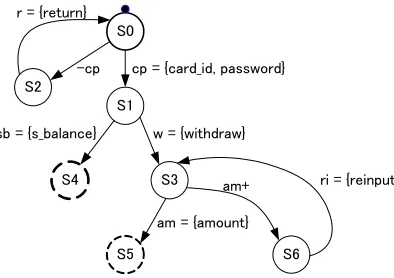
Figure 4 shows a simple example of FSM for a simpli ed Automated Teller Machine (ATM) program. The state s0, marked with a black dot at the top, is
the initial state, representing the top page of the GUI of the ATM system, and the statess4ands5are both nal states which are deliberately drawn in broken
line circles. The FSM describes two interface scenarios. One is the scenario for withdrawing money from the bank account, and another is to show the account balance. The scenario for withdrawing money starts from the initial state s0.
When correct user'scard_idandpasswordare provided, which is denoted by
symbol cp, the state will transfer to s1; otherwise, if any of them is incorrect,
denoted by symbol cp, the state will transfer to states2and will return to state
s0. At states1, if the input symbol isw(denoting thewithdrawcommand), the
state will transfer to states3; otherwise, the state will transfer to the nal state
s4 denoting the nal page of GUI in which the requested account balance is
shown. At states3, if the requested amount smaller than the account balance is
provided, denoted byam, the state will transfer to the nal states5; otherwise,
if the amount is greater than the account balance, the state will transfer to state
s6, and then returns to states3for re-input of appropriate amount.
In the context of the FSM, an interface scenario is in fact de ned as a set of state transition sequences. Each sequence has the form: [s0; s1; s2; :::; sn],
wheres0 must be the initial state of the FSM andsnmust be a nal state. For
example, the scenario for withdrawal discussed above is de ned by the set of state transition sequences:
[s0; s1; s3; s6; s3; s6; s3; s5],:::,
[s0; s1; s3; s6; s3; s6; :::; s3; s5]g.
Obviously, this interface scenario is in nite, but the input values associated with the state transitions can be classi ed into a nite set based on which corre-sponding input variables can be declared in the signature of the correcorre-sponding operation. For example, three input variables for representing inputs card_id,
password, and withdrawal amount can be declared for the signature of the
withdrawoperation. As a result, the operation has the following format:
processW ithdraw(card_id:string; password:nat0; amount:nat0)
cash:natjerror_message:string
end_process
where the output variablescashanderror_messageare created for the need of
writing the formal speci cation.
The operation contains three input variablescard_id,password, andamount.
Thecard_idis a string, and bothpasswordandamountare a natural number
(including zero). The output of the operation has two exclusive possibilities: ei-thercashorerror_message. The pre- and post-conditions of the operation are
empty at the moment, but will be completed in the next step. The operation is written in the SOFL formal speci cation language [5] for the sake of our exper-tise. SOFL is an extension of VDM-SL [6] to have more capability for modelling of practical systems. Note that in spite of using SOFL for discussion, our ap-proach presented in this paper is independent of speci cation languages; it can be applied to any formal notation using pre- and post-conditions.
3.3. Construction of Formal Speci cations
Having understood all of the implemented interface scenarios, the next key is-sue is how to formally de ne the identi ed functional scenarios as operation speci cations. As mentioned in Section 3.1, the potential behavior of each op-eration can be derived from the informal requirements, but the understanding of it may remain limited due to the ambiguities of the informal expressions. Writing a formal speci cation for the operation can force the tester to consider every possible aspect and to establish a rm foundation for testing. The key issue in writing the formal speci cation is how to provide appropriate pre- and post-conditions for the operation.
This can be done by analyzing the corresponding functional scenario. We rst target on the post-condition because it focuses on the function of the oper-ation by de ning the reloper-ation between input and output. During this process, we may nd that some state variables (or external variables as we call in both VDM and SOFL) are necessary for expressing the post-condition. We then try to g-ure out the pre-condition to ensg-ure that the post-condition de nes a valid nal state when the pre-condition is satis ed by an initial state. Consider the oper-ationW ithdrawmentioned previously as an example. Applying this technique,
processW ithdraw(card_id:string; password:nat0; amount:nat0)
cash:natjerror_message:string
ext wraccounts:set of Account
preexists![acc:accounts]j
acc:card_id=card_id and
acc:password=password
postlet acc:accountsj
acc:card_id=card_id and
acc:password=password
in
amount acc:balance and
cash=amount and
accounts=
union(
dif f(~accounts;faccg);
fmodif y(acc; balance!
acc:balance amount)g
)
or
not(amount acc:balance)and
bound(error_message)and
accounts= ~accounts
end_process
where the logical operator “and” is used for^and “or” for_.
In this speci cation, an external variableaccountsis declared. This variable
is used to hold a set of customers' bank accounts, each being a member of the type Account that is declared as a composite type with three elds: card_id, password, and balance. The pre-condition requires the existence of a unique
account in accounts such that its card_id andpasswordare the same as the inputcard_idandpassword, respectively. The post-condition de nes two cases:
one is for a successful withdrawal and the other is a failed withdrawal. When the requested amount is not greater than the balance, the withdrawal will be successful and the requested amount will be delivered, which is denoted by the variable cash. The balance will also be updated in the account to re ect the
reduction of the requested amount. On the other hand, when the withdrawal is failed (i.e., the amount is greater than the account balance), an error message denoted by the variable error_messageis provided. For testing purpose, we
are not interested in the speci c content of the error message implemented by the program, therefore, we use the expressionbound(error_message)in the
post-condition to mean thaterror_messageis made available but its content is
4. Test Case Generation and Result Analysis
The goal of testing is to check whether each speci cation scenario de ned in the speci cation is correctly implemented by the program. Theoretically, for anyspeci cation scenario, there should be animplementation scenario in the program to correctly implement it if the program re nes the speci cation. A natural strategy for test case generation is therefore to let the generated test cases cover all the speci cation scenarios. To effectively apply this strategy, we have worked out a decompositional approach to test set generation from a pre-post style formal speci cation, which will be introduced later in this section. To this end, we rst need to precisely de ne the fundamental concepts known as
functional scenario form(FSF) and functional scenario(FS).
4.1. Functional scenarios
For simplicity, letS(Siv; Sov)[Spre; Spost]denote the speci cation of an operation S, whereSiv is the set of all input variables whose values are not changed by
the operation,Sovis the set of all output variables whose values are produced or
updated by the operation, andSpreandSpostare the pre- and post-conditions of S, respectively. InSpost, we use~xandxto represent the initial value before the
operation and the nal value after the operation of external (or state) variablex,
respectively. Thus,~xserves as an actual input variable of the operation while xis treated as an output variable; that is, ~x 2 Siv andx 2 Sov. Of course, Siv andSov may contain other input parameter variables and output parameter
variables, respectively.
De nition 2. Let Spost (C1^D1)_(C2 ^D2)_ _(Cn ^Dn), where each Ci (i 2 f1; :::; ng)is a predicate called a “guard condition” that contains no output variable in Sov and 8i;j2f1;:::;ng i =6 j ) Ci ^Cj = f alse; Di a “de ning condition” that contains at least one output variable inSovbut no guard condition. Then, a (functional)scenariofsofSis a conjunctionSpre~^Ci^Di, and the expression(Spre~^C1^D1)_(Spre~^C2^D2)_ _(Spre~^Cn^Dn) is called afunctional scenario form(FSF)ofS.
The decorated pre-conditionSpre~ =Spre[~ = ]denotes the predicate resulting
from substituting the initial state~ for the nal state in pre-conditionSpre. We
treat a conjunction Spre~^Ci^Di as a scenario because it de nes an
inde-pendent behavior: whenSpre~^Ciis satis ed by the initial state (or intuitively
by the input variables), the nal state (or the output variables) is de ned by the de ning conditionDi. To facilitate our discussion throughout this paper, we call
the conjunctionSpre~^Cithetest conditionof the scenarioSpre~^Ci^Di.
Note that simply treating a disjunctive clause in the disjunctive normal form of the post-condition as a functional scenario is not necessarily correct in sup-porting our method for checking the re nement relation between the speci ca-tion and the program. For example, letx >0 ^(y =x_y = x)_x 0 ^
to betrue, wherexis the input andythe output. It states that whenx >0,yis
de ned either asxor as x(the speci er does not care which de nition will be
implemented). In this case, the programmer may re ne it into the post-condition
x >0^y=x_x 0^y=x+1and then implement it, which will of course satisfy
the original speci cation. However, if we convert the original speci cation into the disjunctive normal formx >0^y=x_x >0^y= x_x 0^y=x+1, and
treat each of the two disjunctive clausesx >0^y =xandx >0^y= xas
an individual functional scenario, respectively, and generate test cases to cover each of these two scenarios, we may not nd a satisfactory answer in the pro-gram for the scenariox >0^y= xbecause no program paths implementing
this scenario exist in the program. This may lead to a confusion in testing and consequently increase the cost. Another concern is that a disjunctive clause in a DNF may not properly re ect the client's perception of a desired function. For instance, neither of the two expressionsx >0^y =xandx >0^y = xis
appropriate to re ect the client's desire individually, but the functional scenario
x > 0^(y =x_y = x)obtained by their combination does. For the above
reasons, our strategy of generating test cases based on functional scenarios is adopted in this paper.
Any operation speci cation can be transformed to an equivalent FSF and a proved algorithm for such a transformation is made available in our previous publication [7]. Below we use the operationSwap_Increase_M aintainas an
example to explain the concepts of FSF and functional scenario. The example may look a little arti cial but it allows us to illustrate all the relevant aspects of the concepts.
Swap_Increase_M aintain
(f~x;~yg;fx; yg) [x >= 0;
~x <~y^y= ~x^x= ~y^~x <100_ ~x <~y^(y >~x^x >~y)^~x >= 100_ ~x >= ~y^(y= ~y^x= ~x)_
~x >= ~y^(y+ ~x=x+ ~y)],
where Swap_Increase_M aintainiv = f~x;~yg; Swap_Increase_M aintainov
=fx; yg;x >= 0is the pre-condition; the last predicate expression is the
post-condition; and all the variables involved are of the typereal. The operation ex-changes, increases or “sustains” the values ofxandy, depending on certain
conditions satis ed by the input. An FSF of the speci cation is derived as fol-lows:
(1) ~x >= 0^~x <~y^~x <100^y= ~x^x= ~y_
(2) ~x >= 0^~x <~y^~x >= 100^(y >~x^x >~y)_ (3) ~x >= 0^~x >= ~y^(y= ~y^x= ~x_y+ ~x=x+ ~y)
This FSF is derived from the DNF of the post-condition and includes the three functional scenarios marked by(1),(2), and(3)(after removing the last operator
_ in each case), respectively. In(1), ~x >= 0 is the decorated pre-condition; ~x <= ~y^~x <100is the guard condition; andy= ~x^x= ~yis the de ning
Before describing the test strategy, we need to clarify the concepts oftest caseandtest set precisely.
De nition 3. LetSiv =fx1; x2; :::; xrgbe the set of all input variables of oper-ationS andT ype(xi)denotes the type ofxi (i= 1; :::; r). Then, a test case for S, denoted byTc, is a mapping fromSiv to the setV alues:
Tc :Siv!V alues
whereV alues=T ype(x1)[T ype(x2)[ [T ype(xr).
A test case is usually expressed as a set of pairs of input variables and their values, for example,f(x1;5);(x2;10); :::;(xr;20)g. A test set for operationS is
a set of test cases, and is usually expressed as a set of sets of pairs. With the above preparation, we can now de ne precisely the test strategy.
Test Strategy: Let operation S have an FSF(Spre~^C1^D1)_(Spre~^ C2^D2)_ _(Spre~^Cn^Dn)where(n 1). LetT be a test set forS. Then, T must satisfy the condition(8i2f1;:::;ng9t2T Spre~(t)^Ci(t)).
We call this strategyscenario-coverage strategy (SCS). The strategy states that for each functional scenario there exist some test cases in test setT that
satisfy its test condition. IfT meets this condition, it will ensure that every
func-tional scenario de ned in the speci cation is tested (at least once), thus ensur-ing that no speci ed functional behavior is missed in the test.
To ensure that the test strategy is fully applied, a decompositional test set generation approach is proposed, which is described in detail next.
4.2. Decompositional Approach to Test Set Generation
Using the decompositional test set generation approach, the test set generated from an operation speci cation is realized by generating test sets from all of its functional scenarios. The production of test set from a functional scenario is realized by generating them from its test condition, which can be divided further into test set generations from every disjunctive clause of the test condition. To clearly describe the proposed method, we rst need to de ne a function, called
test case generator (TCG), that yields a test set for a given logical expression such that every test case in the set plays an independent role while it satis es the expression (e.g., assuming the expression is a disjunction, each test case in the set makes each disjunctive clause true). We useGto denote the TCG, which is a function from the universal set of logical expressionsLEto the universal set
of test setsTS, formally,
G:LE!TS .
By logical expressions here we mean the rst order logic expressions written in SOFL. Letpbe a logical expression inLE. Then,G(p)represents the test set
generated, which is a member ofTS and satis esp(i.e., every test case in the
test set satis esp). The key issue now is howGis de ned. We will de neGto
ensure that our test strategy discussed previously is supported.
An FSF of operation speci cationS is a disjunction of all its functional
FSF should therefore be the union of all the test sets generated from all of its functional scenarios, as formalized inCriterion 1below.
Criterion 1:G((Spre~^C1^D1)_(Spre~^C2^D2)_ _(Spre~^Cn^Dn)) =
G(Spre~^C1^D1)[ G(Spre~^C2^D2)[ [ G(Spre~^Cn^Dn).
Since the execution of a program only requires input values, test case gen-eration from a functional scenario actually depends only on its test condition. This idea is re ected inCriterion 2.
Criterion 2: Let Spre~^Ci ^Di (i = 1; :::; n) be a functional scenario of
operation speci cationS. Then,G(Spre~^Ci^Di) =G(Spre~^Ci).
In general, pre-conditionSpre~can be in any form of predicate expression.
To de neGto deal with test case generation from the conjunctionSpre~^Ci, a
systematic way is rst to translate the conjunction into an equivalent disjunctive normal form (DNF) and then de neGbased on it, as re ected inCriterion 3.
Criterion 3: LetP1_P2_ _Pmbe a DNF of the test conditionSpre~^Ci.
Then, we de neG(Spre~^Ci) =G(P1_P2_ _Pm) =G(P1)[ G(P2)[ [ G(Pm).
A Pi (i = 1; :::; m) is a conjunction of atomic predicate expressions, say Q1
i ^Q2i ^ ^ Qwi. An atomic predicate expression, in our context, is one
of the three kinds of predicate expressions: (1) a relation (e.g.,x > y), (2) a
negation of a relation, and (3) a strict quanti ed predicate. A strict quanti ed predicate is a quanti ed predicate whose body does not contain any atomic predicate unrelated to its bound variables. For example,8x2X y > xis a strict
quanti ed predicate, while8x2X y > x^q >0is not, because it contains the
atomic predicateq >0that is not related to the bound variablex. This criterion
indicates that generating test cases from a test condition can be achieved based on its DNF. The focus now is on the issue of how to produce test cases from a clause, such asPi Q1i ^Q2i ^ ^Qwi . To discuss the generation criterion,
we rst need to de neG to deal with atomic predicate expressions, which will set up a basis for discussions on test case generation from the conjunction.
Criterion 4: LetSiv =fx1; x2; :::; xrgandQ(x1; x2; :::; xq) (q r)be a
rela-tion involving variablesx1; x2; :::; xq. Then,G(Q(x1; x2; :::; xq)) =fTcj(8x2fx1;x2;:::;xqg
Q(Tc(x1); Tc(x2); :::; Tc(xq)))^(8x2(Sivnfx1;x2;:::;xqg)Tc(x) =anyvalue)g,anyvalue represents any value taken from the type of variablex.
For a relation involving a subset of the input variables of operation speci-cationS, we generate a test case in which each involved variable is given a
speci c value in its type and all the generated values satisfy the predicate ex-pression Q(x1; x2; :::; xq), but the input variables of S that are not involved in Q(x1; x2; :::; xq)are all assignedanyvaluefrom its type. For example, suppose
operation speci cationShas two input variablesxandydenoting two integers,
then it is possible that G(x > 0) = ff(x;2); (y;8)gg (containing a single test
case) where8in the pair(y;8)isanyvalue, but the values of variablesxandy
in the test setG(x < y) =ff(x;2);(y;5)ggare notanyvaluebut the values that
satisfy the relationx < y.
Criterion 5: LetQ1
i^Q2i^ ^Qwi be a conjunction ofwatomic predicates in a
test condition of a functional scenario ofS. Then, we haveG(Q1
i^Q2i^ ^Qwi) =
G(Q1
i)\ G(Q2i)\ \ G(Qwi ).
Let us take the operationW ithdrawas an example to show how the criteria
can be applied. The operation is converted into a disjunction of the following two functional scenarios:
(1) (exists![acc:accounts]j
acc:card_id=card_id and
acc:password=password)and
acc inset accounts and acc:card_id=card_id and
acc:password=password and
amount <=acc:balance)and
(cash=amount and
accounts=union(dif f(~accounts;faccg);
fmodif y(acc; balance > acc:balance amount)g) (2) (exists![acc:accounts]j
acc:card_id=card_id and
acc:password=password)and
acc inset accounts and acc:card_id=card_id and
acc:password=password and
not(amount <=acc:balance))and
(bound(error_message)and
accounts= ~accounts)
where theletexpression is translated into the equivalent conjunction: acc inset accounts and acc:card_id=card_id and
acc:password=password.
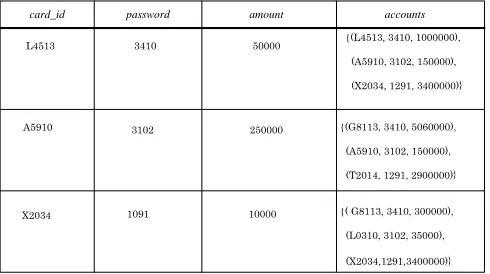
Following the test strategy SCS described above, we generate a test set as shown in Figure 5 that cover the two functional scenarios. Each test case consists of four values for the four input variables (i.e., the three parameters
card_id,password,amount, and one external variableaccounts). The test case
on the rst row allows us to test the situation where both the inputs card_id
andpasswordare correct and the inputamountis smaller than the customer's
account balance. The test case on the second row checks the situation where both the card_idandpassword are correct, but theamount exceeds the
bal-ance. The one on the third row tests the situation where the pre-condition of the operation is not satis ed because of the inconsistency between the input
password and the registered password in the customer's account. Since the
card_id password amount accounts
L4513 3410 50000 {(L4513, 3410, 1000000),
(A5910, 3102, 150000),
(X2034, 1291, 3400000)}
A5910 3102 250000 {(G8113, 3410, 5060000),
(A5910, 3102, 150000),
(T2014, 1291, 2900000)}
X2034 1091 10000 {( G8113, 3410, 300000),
(L0310, 3102, 35000),
(X2034,1291,3400000)}
Fig. 5.A test set for the operationWithdraw.
4.3. Test Result Analysis
One of the major advantages of formal speci cation-based testing is that a pre-cise test oracle can be automatically derived from the speci cation and can be used to determine, both automatically and manually, whether a test has found an error or not.
De nition 4. Letf Spre~^C^Dbe a functional scenario of operation spec-i catspec-ionSandP be a program implementingS. Lettbe a test case generated based onf andrbe the result of executing programP usingt. Then, an error inP is found usingtif the following condition holds:
Spre~(t)^C(t)^ :D(t; r)
This test oracle states that for a test casetsatisfying both the pre-condition
ofS and the guard conditionCof functional scenariof, if the execution result rofP does not satisfy the de ning conditionD(together witht), we can assert
that an error inP is found by test caset.
In fact, this test oracle is derived from the re nement relation betweenSand P, which is formally de ned as follows:
8~ 2 Spre(~ ) =)Spost(~ ; ),
where~ denotes the initial state before operationSand (=P(~ ))denotes
the nal state after operationSthat is produced by executing the corresponding
program P.P is a correct re nement of speci cationS if and only if the nal
state produced by executing programP on the initial state~ satisfying the
pre-condition meets the post-condition. In other words, if there exists any nal state that does not satis es the post-condition after the execution of the program with a satisfactory initial state, the program will not be a correct re nement of the speci cation, implying that a bug exists in the program.
The test for the operationW ithdrawshown in Figure 5 can help to explain
consists of two values: updatedaccountsandcash. We substitute them for the
variablesaccountsandcashin the post-condition, respectively, and evaluate the
following implication:
W ithdrawpre(Tc1))W ithdrawpost(Tc1; R)
If the result is true, it means that no error is found byT1
c; otherwise, it indicates
the presence of some bugs in the program. Similarly, we can also perform the test result analysis for the other two test cases, which we omit here for brevity.
5. An Example
We have applied our approach to test anIC Card software systemdeveloped by a group of senior students at Hosei University. The system is intended to provide three services:operations on ATM,purchase of railway tickets, andpayment for shopping. The operations on ATM includes withdraw, deposit, show balance,
transfer money, change password, and transactions record printing. For pur-chasing railway tickets, the system provides the operations:purchase a ticket,
charge the card with cash,charge the card from the customer's bank account,
show balance of the card (i.e., the amount of money available in the buffer of the card), anduse the card(for entering and existing a station). The payment for shopping is a service that allows one to pay for the goods purchased at shops using the card. It includes the following speci c functions:check card validity,
check amount restrictions (e.g., a card cannot be used for shopping of more than a xed amount in Japanese yen per day at the same shop),authenticate the card user, andpay for shopping.
Since the whole example is too large to be put in a paper gracefully, we choose only the ATM sub-system as an example to show how our testing ap-proach can be applied. As the ATM example in Section 3.3 is a simpli ed ver-sion of the system we use in this section, the contents of this section would be understood easily.
5.1. Application
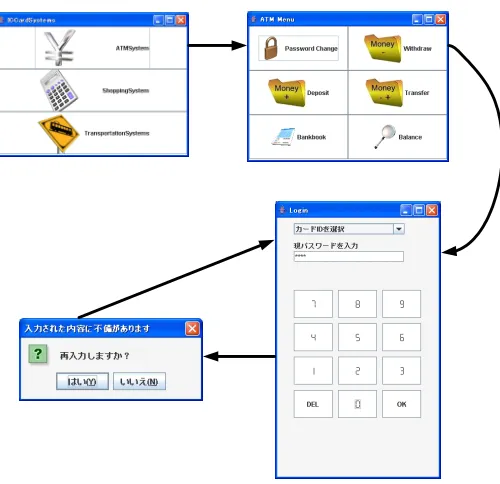
Figure 6 shows a snapshot of the GUI scenario for an unsuccessful withdrawal from a customer's bank account. The rst page of the GUI for the system shows three choices: ATMSystem, ShoppingSystem, and TransportationSys-tems. Clicking on the button namedATMSystem, the system transfers from the rst page to the ATM GUI page given at the upper-right of the gure. Clicking on the button namedWithdraw, the GUI changes to the page requesting acard_id
and apassword, which is given at the bottom-right of the gure. When a wrong password is input, the system moves to the page displaying an error message and requesting the user to re-enter the password. Clicking on the “yes" button (the left one), the system returns to the page requesting for a card_id and a
password.
Fig. 6.A snapshot of using ATM for an unsuccessful withdrawal from the bank account
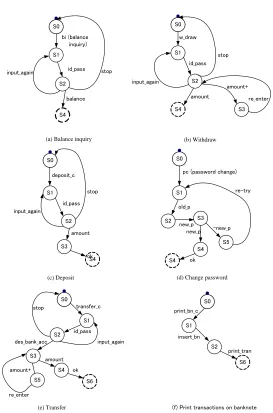
for simplicity and readability, as shown in Figure 7, each describing a single independent interface scenario, as indicated in the gure. Taking the same ap-proach as we explained in Section 3, we construct an operation speci cation in pre- and post-conditions for each functional scenario. For the sake of both space and the similarity to the simpli ed ATM example, we omit the speci ca-tions here. We carried out testing of the program based upon the speci caca-tions to verify whether the desired behaviors are implemented correctly. The details of the testing is illustrated in Table 5.1.
Since this case study was mainly intended to test the usability of our approach (i.e., how interface scenarios can be found, how formal speci cations can be constructed, and how test cases are generated) rather than conduct a rigorous
Features No. of test cases No. of detected defects
withdraw 8 3
deposit 7 5
show balance 6 2
transfer money 8 7
change password 9 6
transactions record printing 7 4
experiment on its effectiveness, we only collected the data of defects found by our test cases rather than measured its effectiveness in terms of defect detec-tion rate or some coverage criterion. There were total 27 defects found as the result, but the main defects that lead to major functional errors with respect to the functional requirements in the speci cations are three, which are illustrated as follows:
– In the speci cation the cash card and password are required to provide be-fore any service (e.g., balance inquiry, withdraw) starts, but the implemen-tation in the program puts the selection of services before the input of card id and password. The purpose of such a requirement is to prevent people without cash card from trying to “play” with the ATM system.
– In theWithdraw service, if the requested amount is over the account bal-ance, the customer should be given two choices: giving up the use of the service or re-entering the amount for withdrawal, but the implementation in the program insists only on re-entering the amount. The same error is also found in theTransfer service: when the amount for transferring is over the account balance, the program insists only on re-entering the amount rather than offering the choices.
– In theDepositservice, the amount for depositing is required not to be over 1,000,000 Japanese yen, but the program does not implement this con-straint, therefore allowing any amount to be deposited in one service.
In the three errors, we found that the rst one was relatively easier to nd, but the second and the third ones took us more efforts to nd out, because the miss-ing functions did not cause fundamental problem in providmiss-ing the services, and therefore did not easily attract the tester's attention. The tester's attention was actually raised by examining the corresponding de ning condition in the post-condition of the operations. This result shows that formal speci cation does bene t testing in our approach.
5.2. Discussion
Our experience in the application has shown the usability and effectiveness of our testing approach for programs with no source code available. In particu-lar, formalization of the informal requirements based upon the interface sce-narios derived from the program has been found effective in helping the tester detect obscure errors and defects. Since all the potential interface scenarios need to be identi ed based upon executions of the program for writing interface-consistent formal speci cations, a general technique calledtesting-and-correction
must be taken. The technique suggests the following activities:
S0
S1
pc (password change)
S2 old_p S3 new_p S4 S5 new_p -new_p re-try S4 ok
(d) Change password S0 S1 deposit_c S2 id_pass input_again S3 stop amount S4 (c) Deposit S0 S1 S2 S4 S3 w_draw id_pass input_again stop amount+ re_enter amount (b) Withdraw S0 S1 S4 bi (balance inquiry) S2 id_pass input_again stop ok (a) Balance inquiry balance S0 S1 transfer_c S2 id_pass input_again stop S3 des_bank_acc S4 amount S5 amount+ re_enter S6 ok (e) Transfer S0 S1 print_bn_c S2 insert_bn S6 print_tran
(f) Print transactions on banknote
No.2 If the program does not terminate normally due to some bugs, the pro-grammer will be asked to eliminate the bugs before the next action in testing is taken.
No.3 Repeat steps 1 and 2 until all interface scenarios are found.
The process of applying thetesting-and-correctiontechnique helps to detect some obvious errors in the program, but it may not be effective in uncovering ob-scure errors, especially those violating the requirements in an ambiguous man-ner. Such obscure errors can be effectively revealed during the formalization of requirements and the testing process based upon the formal speci cations.
To effectively use our testing approach in practice, however, the following challenges may need to be addressed.
– The program must always terminate normally or the programmer must al-ways be available for removing bugs detected.
– The tester has suf cient ability and skill in formalizing the informal require-ments into formal speci cations. For this purpose, the requirerequire-ments must be complete or the client must be available for consultation whenever the details of the requirements are inquired by the tester.
The rst challenge is not exceptional for the application of other testing ap-proaches, but the second one may be a major challenge in practice currently. The reason is that most software testers are not necessarily trained in for-mal methods and may not know how to use the technique, but this situation is changing due to three factors. The rst is that many evidences have demon-strated the power of formal speci cation in enhancing software quality [8] and more and more companies become interested in training their employees in for-mal speci cation techniques (e.g., in Japan). The second factor is that a growing number of practitioners have become using formal speci cation techniques in practice, especially in the domain of dependable systems [4]; this demonstrates the feasibility and effectiveness of formal speci cation techniques in industry. The third is the progress made in supporting formal speci cation construction by software tools based on formal speci cation patterns [9]. With such a tech-nique, one does not need to directly write formal speci cations; instead, one only needs to express one's ideas in a structured English and the supporting tool will gradually automatically produce the formal speci cation. With the above progresses, it is possible for high level testing consultants or company practi-tioners to ef ciently apply our method in practice.
6. Related Work
Our work falls into the category of model-based testing (MBT), but differs from existing approaches in the way of deriving models. In this section, we brie y overview the related work in this area and compared it to our approach.
discussion of MBT, MBT based upon graphical models, MBT based on formal speci cations, and automation in MBT. El-Far and Whittaker give a general in-troduction to model-based testing in [11], discussing its underlying principle, process, and techniques. Apfelbaum and Doyle argue that a nite state ma-chine MBT can reduce cost and time, and can increase software quality, but pointed out that the technique also faces challenges in acceptance [12]. Offutt
et al describe an approach to generating test cases from UML Statecharts for components testing [13]. Hartmann et al extend the approach for integration testing and provide effective tool support for test automation [14]. Bernotet al
set up a theoretical foundation and a tool support for speci cation-based test-ing, explaining how a formal speci cation can serve as a base for test case generation and as an oracle for test result evaluation [15]. Dick and Faivre pro-pose to transform pre-condition into a disjunctive normal form (DNF) and then use it as the basis for test case generation [16]. Stocks and Carrington suggest that test templates be de ned as the base for test case generation and a large test template is divided into smaller templates for generating more detailed test cases [17]. In order to deal with the practical challenges MBT techniques have encountered due to the inconsistency between the component interfaces in the model and in the program, Blackburn et al present an interface-driven MBT approach that combines requirement modeling and component interface analy-sis to support automated test case and test driver generation [18]. In spite of tremendous efforts by many researchers, MBT is still dif cult to be used for large scale systems because of its complexity and the potential inconsisten-cies in both component interface and system architectures. It is also unsuitable for testing programs, such as legacy code, which does not have source code available. To tackle this problem, Bertolinoet al describe an anti-model-based testing approach in [19]. The essential idea of this approach shares with our testing approach presented in this paper; it suggests to use some test cases to execute the program under test and observe the traces of executions, and then try to synthesize and abstract model of the system. Compared to our work in this paper, Bertolinoet al neither advocate the use of formalization for the abstract model, nor discuss in detail about how all the necessary traces are observed and represented and how the traces are synthesized into an abstract model. Our novel contribution in this paper is to present a systematic method for identifying all interface scenarios, formalizing requirements into formal op-eration speci cations whose interfaces are consistent with the corresponding ones of the program, and for testing programs based upon the formal speci ca-tions.
7. Conclusion and Future Work
formal speci cations to test the program. The bene t of our testing approach is to allow the tester to thoroughly understand the desired behaviors of the system and to provide a precise model for testing it. We have also applied our approach to an IC Card system to gain experience and to learn potential challenges in practice.
In the future, we will continue to work along the direction set in this paper to make the testing approach more mature and effective. In particular, we will re-ne and improve the techniques for discovering interface scenarios, formalizing user requirements, and generating test cases. We also plan to conduct a rigor-ous experiment on the effectiveness of our approach in industrial environment. To enhance the ef ciency of the testing activities, we will also work on the tool support.
Acknowledgments.This research is supported in part by NII Collaborative Research Program, 973 program Grant No.2010CB328102, and NSFC under Grant Nos. 61133001, 60910004. We would like to thank all the students involved in this project for their contri-butions to the application of the testing approach and cooperations in data collection.
References
1. B. Beizer,Black-Box Testing, John Wiley and Sons, Inc., 1995.
2. S. Liu, J. A. McDermid, and Y. Chen, “A Rigorous Method for Inspection of Model-Based Formal Speci cations”, IEEE Transactions on Reliability, vol. 59, no. 4, pp. 667–684, December 2010.
3. M. Li and S. Liu, “Automated Functional Scenarios-Based Formal Speci cation Animation”, inProceedings of 19th Asia-Paci c Software Engineering Conference (APSEC 2012). December 4-7 2012, p. to appear, IEEE CS Press.
4. J. Woodcock, P. G. Larsen, J. Bicarregui, and J. Fitzgerald, “Formal Methods: Prac-tice and Experience”,ACM Computing Surveys, vol. 41, no. 4, pp. 1–39, 2009. 5. S. Liu, Formal Engineering for Industrial Software Development Using the SOFL
Method, Springer-Verlag, ISBN 3-540-20602-7, 2004.
6. The VDM-SL Tool Group, Users Manual for the IFAD VDM-SL Tools, The Institute of Applied Computer Science, February 1994.
7. S. Liu et al, “An Automated Approach to Speci cation-Based Program Inspection”, in Proceedings of 7th International Conference on Formal Engineering Methods (ICFEM2005), Manchester, UK, 1-4 Nov. 2005, pp. 421–434, LNCS 3785, Springer-Verlag.
8. D. Craigen, S. Gerhart, and T. Ralston, Industrial Applications of Formal Methods to Model, Design and Analyze Computer Systems: an International Survey, Noyes Data Corporation, USA, 1995.
9. X. Wang, S. Liu, and H. Miao, “A Pattern-Based Approach to Formal Speci ca-tion Construcca-tion”, inProceedings of 2011 International Conference on Advanced Software Engineering and Its Application, Jeju, Korea, December 13-15 2011, CCIS 257, pp. 159–168, Springer-Verlag.
11. I. K. El-Far and J. A. Whittaker,Model-based Software Testing, Wiley, 2001. 12. L. Apfelbaum and J. Doyle, “Model-Based Testing”, inProceedings of Software
Quality Week Conference. May 1997, LNCS, Springer-Verlag.
13. J. Offutt and A. Abdurazik, “Generating Test Cases from UML Speci cations”, in
Proceedings of Second International Conference on UML'99, Robert France and Bernhard Rumpe, Eds., Fort Collins, CO, USA, October 28-30 1999, pp. 416–429, Springer.
14. J. Hartmann, C. Imoberdorf, and M. Meisinger, “UML-Based Integration Testing”, in
Proceedings of 2000 ACM SIGSOFT Symposium on Software Testing and Analysis, Portland, Oregon, USA, 2000, pp. 60–70, ACM Press.
15. Gilles Bernot, Marie Claude Gaudel, and Bruno Marre, “Software testing based on formal speci cations: a theory and a tool”, Software Engineering Journal, pp. 387–405, November 1991.
16. J. Dick and A. Faivre, “Automating the Generation and Sequencing of Test Cases from Model-based Speci cations”, inProceedings of FME '93: Industrial-Strength Formal Methods, Odense, Denmark, 1993, pp. 268–284, LMCS 670, Springer-Verlag.
17. P. Stocks and D. Carrington, “A Framework for Speci cation-Based Testing”, IEEE Transactions on Software Engineering, vol. 22, no. 11, pp. 777–793, November 1996.
18. M. R. Blackburn, R. D. Busser, and A. M. Nauman, “Interface-Driven, Model-Based Test Automation”, in Proceedings of 2005 International Conference on Software Testing, Analysis and Review. Nov. 14-18 2002, pp. 27–30, Software Quality Engi-neering.
19. A. Bertolino, A. Polini, P. Inverardi, and H. Muccini, “Towards Anti-Model-Based Testing”, inProceedings of 38th Annual IEEE/IFIP International Conference on De-pendable Systems and Networks (Extended Abstract), June 28 - July 1 2004, pp. 124–125.
Shaoying LIU is Professor of Software Engineering at Hosei University, Japan. He received the Ph.D degree in Computer Science from the Univer-sity of Manchester, U.K in 1992. His research interests include Formal Meth-ods and Formal Engineering MethMeth-ods for Software Development, Speci ca-tion Veri caca-tion and Validaca-tion, Speci caca-tion-based Program Inspecca-tion, Au-tomatic Speci cation-based Testing, and Intelligent Software Engineering En-vironments. He has published a book titled “Formal Engineering for Indus-trial Software Development Using the SOFL Method” with Springer-Verlag, four edited conference proceedings, and over 120 academic papers in refereed jour-nals and international conferences. He has recently served as General Co-Chair of ICFEM 2012 and PC member for numerous international conferences. He is on the editorial board for the Journal of Software Testing, Veri cation and Reliability (STVR) and ISRN Software Engineering. He is a Fellow of British Computer Society, a Senior Member of IEEE Computer Society, and a member of Japan Society for Software Science and Technology.
model design and analysis, software model consistency checking, model-based software testing, software error detection, and the management of software ar-tifacts.
Shin NAKAJIMA received Ms degree in 1981 and Ph.D degree in 2000 both from The University of Tokyo. He is currently professor at National Institute of Informatics, Tokyo, Japan. His current interests include formal methods, au-tomated veri cation, and software modeling. Dr. Nakajima is a member of ACM, JSSST, and IPSJ.