©2016 New Delhi Publishers. All rights reserved
Identification of Research & Development Prospects in
Small-Scale Food Processing Industries
Vister Joshi
1, Sachin Gondkar
2, A.K. Godara
3and P.S. Shehrawat
4 1Research Associate, ICAR, Pusa, New Delhi, India2Assistant Professor, College of Agriculture Business Management, Loni, Maharashtra, India 3&4Professor, Dept of Extension Education CCSHAU, Hisar, India
Corresponding author: [email protected]
Abstract
The core objective of this research article is to investigate the different areas of R&D anticipated significant by the entrepreneurs associated with small scale food processing units particularly in terms of their prospect and start-ups motivator of small food processing business in Haryana. The added advantage of Haryana is its close vicinity to National Capital region, state applying contineous efforts to explore the benefit of this sector. Ministry of Food processing Industries visioned various policies and acting as driving force to bring R&D’s benefit for food processing sector but, small scale units probing their turn. The study present was conducted on 160 entrepreneurs engaged in food processing industries in Karnal, Sonipat, and Gurugram and Yamunanagar districts of Haryana state to understand their anticipation towards R&D sector and revealed various aspects which could benefit the small sector. Survey was done with the help of interview schedule. Aquaintness to R&D and availability of institute’s anticiapated most prosperous for food processing with weighted mean score of 2.10 and 2.02 respectively. Economic utilization of biomass, waste utilization and quality testing were other areas of prospects. Socio-economic characterstics of entrepreneurs was also studied. Along with, about one third of entrepreneurs felt that self motivation was one of the important reasons for them to enter into food processing business. Keywords:Small scale units, Food processing, R&D, Prospects, Haryana
Food processing industries considered as aurora sector in India. The continuous growing demand of ready to serve food opens the door for the tremendous growth of this sector, particularly in those areas which come in close vicinity to metro cities of the country. Haryana has an added advantage of near to Delhi/NCR and also a productive agrarian state thus; food processing is the most emerging sector in the state. Economy of Haryana is basically an agrarian economy, yet, the management of food basket remains a big issue. Where on the one hand, supply of food shortage due to some obvious reasons; storage of hitherto produced food grains is also a matter of concern. Estimates reveal that a whopping 9.33% of the total production of grains goes into waste at various stages of production (Khosla R, 2012).
should benefit Food Processing Industry in terms of product and process development, improved preservation, packaging, storage and distribution technologies, value addition, standardization of additives, coloring agents, preservatives, pesticide residues, etc. with focus on enhancement of production, quality, consumer safety, public health and trade (MOFPI, 2014). But impulsion towards small scale industries in the dispensation of schemes seems secondary as the performance, policies, problems, and prospects of the small scale industrial sector suffered ill from the problems of the inadequacy of financial assistance, up gradation, quality assurance and conscious efforts of the govt. to bring back to the track (Shehrawat, 2006). The paper presented here intends to find out the prospect of Research and Development to accelerate the growth of food processing and the motivator’s responsible for the entrepreneurs to choose food processing industrial profession.
Methodology
Four industrially developed districts, viz. Yamunanagar, Karnal, Sonipat and Gurgaon in Haryana were selected purposively. Highest area under fruits and vegetable crops and vicinity to National Capital Region (NCR) was the major consideration of selection. Before selecting the entrepreneurs for study, a comprehensive survey was done in respective District Industrial Centres (DIC’s) and Micro Small and Medium Enterprises (MSME)-Karnal to enlist the existing food processing industries. From the list so prepared, 40 entrepreneurs were selected randomly from each district. Totaling, 160 respondents constituted the sample for the study undertaken. Zonal officers of DIC’S, MSME-Karnal & Bhiwani, and 20 entrepreneurs were also interacted to set the tone for deliberation on pre-testing the schedules for sample collection followed by an interpretation of the technical language of schedules for eliciting maximum information from the respondents. The schedule was reinterpreted and redesigned based on the real setting of the research problem. Multi-stage stratified random and purposive sampling technique was used for the purpose of this study. To explore the quantitative and qualitative insight of problems with food processors, triangulation method was adopted. For this semi-structured
interview, schedule was devised to cover all the possible issues in accordance with the objectives of the study. The analysis was done with the help of SPSS. The variables were measured by using a 3-point continuum Likert-type rating scale ranged from very prosperous, prosperous and not prosperous and scores were given 3, 2 and 1, respectively. On the basis of responses from respondents, Weighted Mean Scores (WMS) were computed on the basis of scores obtained from respondents. At last, rank order was given to each item based on their weighted mean score for observing the relevancy of each prospect. For each aspect, the score obtained by respondent was multiplied by their respective choice scores and divided by the maximum possible scores. Finally, a ‘Z’ score was obtained for judging the prospects of each area by using formula as:
Z score = (x-mean)/SD
Results and Discussion
Socio-economic characterstics of entrepreneurs
Selected socio-economic characteristics of entrepreneurs are illustrated in Table 1. The majority of the entrepreneurs belonged to middle age group (54.4 %) followed by young entrepreneurs (27.5 %). Also, about 56% of entrepreneurs had college level (graduation and post graduation) education whereas, 37% of the respondents had attended school up to secondary or senior secondary level and 7.5% of the respondents having qualification less than matriculation.
10 years. Thus, it can be concluded that majority of enterprises were either at adolescent stage or about to mature. The socio-economic status of entrepreneurs further revealed on the basis of their annual profit and value of their assets and results showed that majority of the entrepreneurs i.e. 68.12% had medium socio-economic status, while about one-fifth had high socio-economic status. Only 12.50% of the entrepreneurs belonged to low socio-economic status.
Table 1: Socio-economic characterstics of entrepreneurs (n=160)
Sl.
No. Characteristics Category Frequency
1 Age of
entrepreneurs Young (Below 30 years) (27.5)44
Middle (30 to 45
years) (54.4)87
Old (Above
45years) (18.1)29
2 Education level Below matriculation 12 (7.5)
Matriculation 25
(15.6)
Senior secondary 34 (21.3)
Graduate 67
(41.9)
Post-graduate 22
(13.7)
3 Family
occupational background
Farming 43
(26.9)
Service 27
(16.9)
Business 57
(35.6)
Any other 33
(20.6)
4 Age of
enterprise 0-5 years (51.9)83
5-10 years 54
(33.7)
>10 years 23
(14.4)
Low SES 20
(12.5)
5 Socio- economic status (SES)
Medium SES 109
(68.1)
High SES 31
(19.4)
Figures in Parentheses are percentages; Source; Author’s Investigation
Percieved R&D prospects by the entrepreneurs
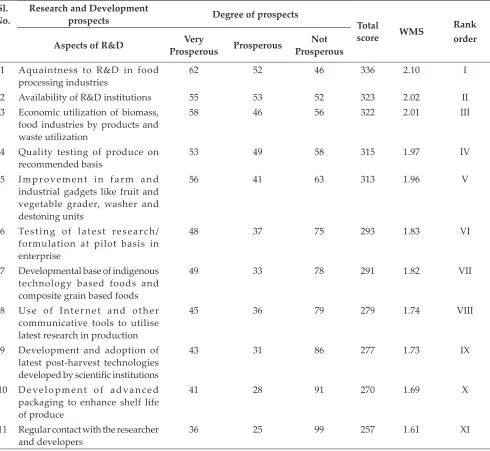
The prospects of Research and Development to encourage food processing industries were studied from entrepreneur’s viewpoint. Results showed that (as in Table 2) the entrepreneurs perceived, that all the sections of the associated system either government agencies, policy makers, or engaged processing units to impart the research-oriented approach in the development process of food processing sector, as varying taste and preferences urging more innovative, research-driven demand for processed food. Thus, the majority of entrepreneurs ranked first to the situation of research upliftment for food processing industries through awareness, campaign and effective extension activities in the state and scored weighted mean of 2.10.
It was common optique of all the selected entrepreneurs that the presence of any R&D institute gave direct benefit to the local shareholders of the state, like in Haryana, the presence of MOFPI’s-National Institute of Food Technology and Entrepreneurship Management (NIFTEM, Sonipat, Haryana), research divisions of State Universities and ICAR-Central Institute of Post Harvest Engineering and Technology (CIPHET, Ludhiana, Punjab) are of worthy importance to the entrepreneurs engaged in food processing. Entrepreneurs realized the presence of R&D institutes creates future prospects for their units to sustain in a massive manner. Thus, this aspect with WMS of 2.02 evaluated as the second important prospect for food processing industries.
R&D commune should open to waste management to the by-product of their unit. This aspect is highly prosperous to the food processing industries as the primary aim of waste management to be the prevention of waste generation, waste conversion to economic utilization of bio-mass i.e. product re-use. Economic utilization of biomass, food industries by-products and waste utilization stands at the third most prospect of R&D with the Weighted Mean Score (WMS) of 2.01. While investigating in large units, it was found that source reduction i. e. decreasing the volume of waste material and by-product generated is the most effective method to reduce
your disposal costs., Animal feeding, composting and landspreading were methods adopted by the industries as an alternative to waste management. The food testing industry works closely with manufacturers to ensure that all products are scientifically tested and proved to be safe for human consumption at a variety of stages, from raw material to production line, to finished product. Food testing can cover many aspects of the food manufacturing process. Most commonly, a common set of scientific techniques is used to analyze, assess and record the safety and viability of a product in terms of microbiological stability and chemical composition.
Table 2: Research and Development prospects perceived by entrepreneurs for food processing units (n=160)
Sl.
No. Research and Development prospects Degree of prospects Total
score WMS
Rank order Aspects of R&D ProsperousVery Prosperous ProsperousNot
1 Aquaintness to R&D in food
processing industries 62 52 46 336 2.10 I
2 Availability of R&D institutions 55 53 52 323 2.02 II
3 Economic utilization of biomass,
food industries by products and waste utilization
58 46 56 322 2.01 III
4 Quality testing of produce on
recommended basis 53 49 58 315 1.97 IV
5 Improvement in farm and
industrial gadgets like fruit and vegetable grader, washer and destoning units
56 41 63 313 1.96 V
6 Testing of latest research/
formulation at pilot basis in enterprise
48 37 75 293 1.83 VI
7 Developmental base of indigenous
technology based foods and
composite grain based foods
49 33 78 291 1.82 VII
8 Use of Internet and other
communicative tools to utilise latest research in production
45 36 79 279 1.74 VIII
9 Development and adoption of
latest post-harvest technologies developed by scientific institutions
43 31 86 277 1.73 IX
10 Development of advanced packaging to enhance shelf life of produce
41 28 91 270 1.69 X
11 Regular contact with the researcher
and developers 36 25 99 257 1.61 XI
But, testing laboratories established to reach large scale industrial units. For marginalized units were devoid of their benefit. The research in quality improvement and portable testing methods can lead micro and small units to improve their quality standards. Entrepreneurs felt that there is the bright scope of research in quality testing areas and in the state of Haryana, it considered a prospect for food processing industries. Thus, WMS score calculated as 1.97 for quality testing on the recommended basis. There must be the provision of mobile testing laboratories in the state and quality standard should legalize to micro and small units. Industrial gadgets place an important role in the efficient running of the unit. The quality and timely delivery of any processed food depend on the efficiency of human labor and machines and gadgets associated with the units.
Research and Development formulate to improvise the efficiency of processing tools to unburden the dependency on labor, generally migrated, and their heavy wages. Entrepreneurs felt the graders, choppers, slicers and other small gadgets used in the fruit and vegetable units should operate through electricity but not manually. They further had a perception for research prospect in this area as either availability of these gadgets was of poor quality or cost-ineffectiveness. The weighted mean score was calculated as 1.96. Another aspect related to R&D came from entrepreneur’s standpoint about the research formulation at pilot basis in their own enterprise. New technologies operations must take place in facilities built on design requirements specific to operations involving in the food processing unit. It is also necessary to train staff to use appropriate personal protective equipment (PPE), and follow established policies as well as appropriate standard operating procedures to protect workers, contractors engaged in the unit. Safety should always be at the forefront of any research and manufacturing operation, Entrepreneurs weighted at a mean score of 1.83 and ranked sixth as an important aspect of R&D prospect in the state of Haryana.
Further investigation to understand the other prospects of R&D to pacify Micro, Small and Medium food processing units from associated entrepreneurs revealed the need for applied research on the developmental base of indigenous technology based foods and composite grain based foods (WMS 1.82).
Local knowledge makes out to nest within existing resources, tools, and techniques. The grain-based food society, particularly in Haryana and nearby states, demanding composite food and impetus to processing units to innovate from indigenous technology base. Entrepreneurs pursued a prospect in organized research on existing knowledge base to boost their profession. Information Communication Technologies (ICT’s) consummates a massive informative revolution in the society and research outcomes are not distant. To link up with the latest research and technology development, ICT considered as a handy tool.
Thus, entrepreneurs persist in the usage of communicative tools to establish an affiliation in gathering research outcomes to adopt innovative technologies for their firm. The development of the food processing industries depends on the adoption of new technologies. In fruit, vegetable, and cereal based units, the research on post-harvesting techniques has an economic impact on cost cutting and reduction of perishable raw material losses in the unit. Also, effective packaging breakthrough the demand of processed food and encourages brand recognition in the market. Development in cost effective, environmental and consumer friendly packaging could advance the food processing scenario, particularly for small units. Respondents weighted advancement in packaging with 1.69 mean scores and presumed as a prospect for the development of food processing industries in Haryana.
Thus, it could be affirm from the results that research and development had higher prospect to encourage food processing in the state but, the basic problem in many of R&D organizations is that they mainly react to the marketing organization’s demands. Thus, R&D organizations have little say in how things should be done for the small scale food processors from varied aspects. Also, state should consider this fact and develop its policy to enhance investments for the growth of this sector.
Conclusion
companies have plenty of ideas about what to do, but unless they clearly set a direction and define a framework for evaluating and selecting R&D projects, the best ideas may not be pursued. The study concluded that there is plethora prospect in strengthening the R&D processes in state which can include improving R&D project planning, identifying the need of entrepreneurs engaged particularly in micro and small units. The innovation in products with their packaging, affordable waste management techniques, mobile quality testing units with the simple and effective procedure, indigenous technical base besides setting higher standards related to carrying out technical work. This paper also suggested to policy makers, government agencies, private shareholders and NGO’s to consider micro and small units while developing any road map. MSME and DIC’s should impart regular training to the entrepreneurs on new research outcomes and extension agencies undergo adoption strategies for advanced technologies. Also, there is a need of providing adequate facilities to the processors. Integrated efforts of both the public and private role players in this field must be brought for the development.
References
ASSOCHAM. 2014. Food Processing and Agribusiness. A report on Processed Food and Agribusiness: Opportunities for investment in India. New Delhi, India.
Bansal, V. 2003. Prospects of Agro-Processing Industries in Haryana, International Conference on Statistics, Combinatorics and Related Areas (Mimeo), October 3-5, 2003, University of Southern Maine. Portland, ME, USA.
Chadha, S.K. 1999. Prospects of Agro Food Processed Industries, Political Economy Journal of India, 8(3&4): 124-131.
Devraja, T.S. 2009. Financial performance of Agro Based Industries. Anmol Publications Pvt. Ltd., New Delhi. FICCI. 2010. Government of India, Ministry of Food
Processing Industries (2010-11), Annual Report. New Delhi, India.
Grover, R.K., Suhag, K.S. and Aneja, D.R. 1996. Retrospects and prospects of agro-processing industries in Haryana.
Indian Journal of Agricultural Marketing,10(2): 10-17. Khosla, R. 2012. Growth and Development of Agro-Processing
Industries in Punjab and Haryana: A Comparative Study;
Arthashastra- Indian Journal of Economics and Research; 1(3). cited from www.indianjournalofeconomicsandresearch. com.
Khosla, R., Sindhu, H.S. and Dhillon, S.S. 2010. Performance and Prospects of Agro-Processing Industries in Haryana. Proceedings of 2nd International Conference on Business Management, ISBN: 978-969-9368-06-6.
Rais, M., Acharaya, S. and Sharma, N. 2013. Food Processing Industry in India: S&T Capability, Skills and Employment,
J. Food Process Technol., 4: 9. cited from http://dx.doi. org/10.4172/2157-7110.1000260.
Rao, P.P., Birthal, P.S. and Joshi, P.K. 2006. Diversification towards high value agriculture - Role of urbanisation and infrastructure, Economic and Political Weekly, pp. 2747 – 2753.
Sharma, K.D., Pathania, M.S. and Lal, H. 2010. Value Chain Analysis and Financial Viability of Agro-Processing Industries in Himachal Pradesh, Agricultural Economics Research Review, 23: 515-522.
Shehrawat, P.S. 2006. Agro Processing Industries---A Challenging Entrepreneurship For Rural Development,